Become a Creator today!Start creating today - Share your story with the world!
Start for free
00:00:00
00:00:01
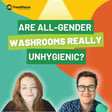
All-Gender Washrooms Aren’t Just for Trans People! image

All-Gender Washrooms Aren’t Just for Trans People!

S1 E2 · Gender in Focus
Avatar
36 Plays3 months ago

Many organizations think of all-gender washrooms as something they do for trans and non-binary people. But in reality... these spaces make life easier for almost everyone. Parents helping kids. Caregivers assisting disabled family members. People with mobility needs, or those who just want more privacy. When done right, all-gender washrooms don’t just include trans people - they include everyone.

In this episode of Gender in Focus, Kai and El explore why these spaces are so often misunderstood, and what truly inclusive design looks like in practice. They discuss how simple features - privacy, safety, accessibility and clear signage - can make shared spaces more comfortable and equitable for all.

They also tackle one of the most common workplace missteps: when organizations try to be inclusive by simply changing the sign on the door, without rethinking how the space actually works. And Kai shares a real-world example from Clayton Community Centre in Surrey, BC, designed with HCMA Architecture and TransFocus, that shows what it looks like when inclusion goes beyond good intentions. You can check out this example of washrooms done right here: https://www.youtube.com/watch?v=x7Hjh7Ao9fA

Keywords: all-gender washrooms, gender inclusive design, trans inclusion, universal washrooms, multi-stall washrooms, inclusive signage, gender inclusive spaces, accessibility design, TransFocus Consulting, HR, DEI


Recommended
Transcript

Introduction to TransFocus Consulting

00:00:04
Speaker
Welcome to the Gender in Focus podcast. I'm El and each week I get to ask Kai Scott, the president of TransFocus Consulting, all the questions you have ever wanted to ask about trans and non-binary people in the workplace and in the wider world.

Safety Concerns of All-Gender Multi-Stall Washrooms

00:00:18
Speaker
People can get stuck thinking that all gender multi-stall washrooms are somehow more unsafe or not as safe as women's and men's spaces. Part of the reason for that misunderstanding is that within all gender multi-stall, they are designed totally differently than men's and women's spaces. like they're like a total yeah You can't just kind of slap on a sign and be like, okay, it's all gender. It's often like, why do we need to do this when it's only helping 1% of the population? And it's actually when you kind of pull together all the people who might benefit from these spaces, they are actually the majority. ah there's
00:00:59
Speaker
Most of us can benefit um from all gender washrooms in in ways that we maybe wouldn't expect.
00:01:10
Speaker
All gender washrooms get talked about a lot, but rarely with nuance.

Privacy and Accessibility in Washroom Design

00:01:15
Speaker
In this episode of Gender in Focus, we're breaking down the difference between single user and multi-stall all gender washrooms, who actually uses them, hint, it's not just trans and non-binary folks, and why privacy, safety, disability access, and family needs all show up in these spaces. We'll also unpack what inclusive signage really means and what it definitely doesn't.
00:01:39
Speaker
Plus, share a standout example of a multi-stall all-gender washroom at Clayton Community Center in Surrey, BC. El you see these questions and the panic play out on social media. so I'm really looking forward to unpacking this with you here today and to actually see what people are are really reacting to when they think of all-gender washrooms.
00:02:02
Speaker
Welcome. Oh, well thank you. Yes, I do see a lot of this play out on social media. um And it's always super fascinating, because often it's either met with like, outright anger, or just complete confusion. And there seems to be that's the binary. That's the either side of the that's the spectrum we're on. And so um Yeah, I guess how I wanted to start this, if it's okay with you, is first of all, just talking about um what kinds of washrooms we are specifically talking about in this episode, because like, I don't want there to be any confusion around like what spaces that but like each space has different needs, whether it's and a sort of multi-stall whether it's single unit. And so before I get into who's using what, can we just outline what it is specifically we're talking about here?
00:02:49
Speaker
Absolutely. that's okay. yeah Yeah, it's so important to clarify. this is There's a few different configurations of washrooms and also change rooms. And so it's it's important to be clear so that people understand what's at play.
00:03:04
Speaker
For today's episode, we are focused on multi-stall all-gender washrooms. But the reason why I wanted to distinguish is that there are also single unit washrooms.

Inclusivity of Single vs. Multi-Stall Washrooms

00:03:15
Speaker
So those are the self-contained washrooms, have their own door, you know, walls around it and a toilet and a sink. And it's yours, private, and is a really popular option. you know It used to be called, you know it's the washroom that people with disabilities use. It has expanded a bit to offer options for other folks, especially for folks who ah don't want to access either the men's nor the women's. And so it has become kind of an all gender space that is single unit.
00:03:52
Speaker
Everybody's excited. Well, not everybody, but many people are excited by this configuration. But the other type of all gender or washroom is a multi-stall one. And that's where people so tend to pump the brakes or some people do at least. And that's why we thought it'd be good to go it into it a little bit more, um recognizing that there's different things at play within those spaces where genders come together in a way that maybe not everybody is used to know knowing that we've had traditionally men's and women's only spaces.
00:04:26
Speaker
Right. When, well, you just mentioned this, but when people hear all gender washrooms, they often assume that it is just for trans and unnumbered people, or or at least that's what it looks like on social media from the comments that

Benefits of All-Gender Washrooms Beyond Trans and Non-Binary Communities

00:04:39
Speaker
I get. um It's often like, why do we need to do this when it's only helping 1% of the population? And it's actually really, or at least my understanding of this is when you kind of pull together all the people who might benefit from these spaces, they are actually the majority. ah there's Most of us can benefit um from all gender washrooms in in ways that we maybe wouldn't expect. And so my my first question then is who who actually uses these spaces and who benefits from it outside of trans and non-binary people? Of course, trans and non-binary people too. Yeah.
00:05:13
Speaker
Yeah, yeah, absolutely. And I think it's important to recognize, like you said, it it is a majority. um And sometimes that's ah overlooked because maybe we're just looking at it from a siloed perspective, right? Of course, it helps trans and non-binary folks. Mainly because there's no gendered expectations for how somebody should look, you know, what their shape of their body is. Everybody is allowed into that space and that clarity and spaciousness is really instrumental to access for trans folks where there can be a disconnect between or a difference between their gender identity and how they look. So that's number one. But um you're right. It's not a a trans specific washroom. There is no such thing. There's not one place where trans people go. That would be a very dangerous thing, in fact, if that were the case, because there's still a lot of stigma against trans folks. And to label a washroom in such a way would basically put a target on somebody's back. Right. And so
00:06:19
Speaker
There is no such thing. it would not be a good idea to do so. And so that's where this, you know, all gender multi-stall washroom is serving so many different types of people. You know, we hear time and time again, we've done patron listening booths at recreational centers or during surveys that we've done at universities.

Family and Disability-Friendly Facilities

00:06:40
Speaker
We find time and time again that families really need spaces where they You know, no matter the gender configurations of the family, they can go in together. There's so much that parents have to navigate. I'm not a parent myself, but I have a lot of compassion.
00:06:58
Speaker
If you're going into a single gender space and you have a kid of another gender, like Then you have to figure out, okay, how old are they? How will the others react to a kid of a different gender? um you know Are they going to involve staff? like This is like a huge calculus versus all gender multi-stall, no thought process. Just go in. There's no expectations or weirdness that might happen. It's just easy.
00:07:25
Speaker
So that's one aspect. Another aspect is for people with disabilities. Typically, all gender multi-stall are set up in a way where there's a handful, one or more accessible stalls. Some of them have adult lifts, which is super, super important ah for people with disabilities to be able to participate in life.
00:07:51
Speaker
Sometimes they have care attendants that are of a different gender as well. And so similar to families, it's not a lot of thought process if there's that all gender multi-stall space.
00:08:03
Speaker
Last one is friends, even like going together. And so you don't have to stop your conversation. you can just continue it, maybe not in the stall. But, you know, it just, it's, it's a, there's a social flow to that. So those are just a handful of folks, types of groups that benefit from it beyond just trans and non-binary folks.
00:08:28
Speaker
What I will say, like from my perspective personally here is that um I've been a care caregiver to my brother who's disabled and yeah there have been quite a few issues where we've come across because some of the kind of arguments we've had is, um well, there are disabled toilets or disabled bathrooms. And so often those spaces are not really treated with the respect that they deserve. Often there'll be like a storage room. You might find that like we've been in swimming centers before I've taken my brother swimming and
00:08:59
Speaker
that's just been the sort of dumping ground. The disabled bathroom was like where everybody puts the like mop and it's just like cluttered and you can't use it. And it's it's incredibly dangerous for somebody who's not very steady on his feet. right um So that's really tricky. It's also often,
00:09:15
Speaker
not designed in a way that puts disabled people at the forefront and it's not super helpful. The space can be pretty dangerous if if it's not designed right. and so um it's And also what tends to happen is there might be like one disabled washroom. And so if you have three disabled people, you're you're stuck, you're you're in a position where you can't use it. And I'm um you know a different gender to my brother. And so i can't just take him to the washroom with me. And I can't really go in with him either. And so it really puts us in a bit of a bind. And when we've been in spaces that have access to um these sort multi-store or gender washrooms, it means that my dad can help me too. Or it means that like, you know, myself and my sister and my brother can go in and, and you know, help them out. So it's it's so helpful. It makes it I'm so passionate about this because it's been so helpful to me in so many ways, not just because I'm non-binary and there are times, there are some days where I really feel discomfort around that. um Not all the time and not very often, but there are times where I do. And then also it's helped me and my brother throughout my life. And and it's so, it really does benefit so many people. Thank you for sharing that. That's so, it illustrates the kind of day-to-day struggle that families can endure because things aren't set up properly, you know, whether it's from the disability lens or from, you know, gender identity. And oftentimes single unit washrooms are tucked away somewhere under lock and key too. That just adds that you know, number of hoops that you have to jump through to, to get there. And like, you really do feel like an afterthought, um, yeah you know, from that perspective where it's like, I got a, you know, you know, stroll or legs, you know, somewhere extra. Um, and then also have to talk to the security guard who may be, you know, er with, you know, suspicion, right. It's just like, yeah, it's not great.
00:11:14
Speaker
So, yeah You know, also a lot of the washrooms, sorry, i'll I'll get out of this, but some of the disabled washrooms, you have like a special key to get in and and you' like you get access to that. So you have these keys, but they it means that they' all will anybody can unlock the door if you have a key. So there have been times where I've been helping my brother out ah like and then somebody unlocks the door and walks in and it's like, he deserves privacy too. And so all gender washrooms,
00:11:41
Speaker
offer that space and it's also you know some of the fear as well is if something happens or an accident happens he hurts himself and or he's quite a lot bigger than me so he maybe he hurts me um which has never happened thankfully but you you don't know um that you're locked away and nobody knows that you're in there until somebody finds you and so we're actually all gender sort of like opens sort of um yeah like hang on wait what am I saying multi-store washrooms provide that like safety as

Enhancing Safety with Design Features

00:12:11
Speaker
well. there There's a lot of safety involved in that. And that's the thing that a lot of people really get stuck on is safety and, and ah how to keep these spaces safe. So I was wondering if if you would mind going into that too, from the perspective of, of course, trans and non-binary people, but also sort of wider too, if that's, if that's okay. Sure. Yeah, yeah. That's a really important point. And one, you're right, where people can get stuck, um thinking that all gender multi-stall washrooms are somehow more unsafe or not as safe as women's and men's spaces. And ah
00:12:50
Speaker
Part of the reason for that misunderstanding is that there are, within all gender multi-stall, they are designed totally differently than men's and women's spaces. You can't just kind of slap on a sign and be like, okay, it's all gender. Right. onto a men's or women's. In fact, some clients have come to us and said, that's what we want to do. And then we say, actually, we'd advise you to renovate these spaces to introduce more safety measures, more privacy measures to make this work, right? You can't kind of carbon copy them. And so men's and women's spaces typically have not that great a privacy. i don't know. your experiences but i don't like those gaps between the door and the frame like not very few people do from what from our research our extensive research surprise shocker um and you know there's gaps at the bottom and then know Maybe the lighting's not so great. you know There's all kinds. And then it's kind of also the door to the entrance is shut. And so again, to your point about if you need help, it's harder to call for it, right? So all these dynamics within men's and women's spaces that actually I want to improve to be a part of designing better ones. Like I still have them, but you know we can make them better. And I think a lot of people would help would like that.
00:14:21
Speaker
But all gender multi-stall spaces are different because they're fully enclosed stalls. They're almost essentially their own room. um Maybe it's a naming thing really than it is about, you know, so that people understand this is your own room. has its own lighting most often. you know There's a color-coded lock so that people can see it's occupied and aren't trying to barge in um There's ah also um open entrances typically to these types of spaces where there's a you know clear sight line from outside into the space. um and Then there's privacy within the the stall itself. right so It's just got this nice blend of things.
00:15:06
Speaker
and typically it's centrally located in a place where there's a lot of traffic so that there's this kind of passive monitoring that is happening whether within the facility by all the people in it or from outside of the facility um some features we've worked with hcma architecture and they do really nice touches of like a bench in front of the washroom so that you know people are sitting there and you know rifling through their bag and so they're paying attention too so it just has way more safety um sometimes there's emergency buttons um it's super well lit like you can see everything um the the sight lines aren't blocked there's not these like kind of corners where you can get tucked away um and so it's just and you've got a common sink area that people are there to help each other out if needed And so it just, there's way more to, to it, but those, it gives you some texture, of just that type of, um, intentional design so that it's safe, uh, private and comfortable.

Importance of Clear Signage for Inclusivity

00:16:15
Speaker
I wanted to ask briefly about inclusive signs because you mentioned that you can't just chuck a sign on and hope for the best. So there's it's not, signage doesn't have to be super complicated, but there is a level of thought that needs to go into it. um And I guess that's my question is, well, okay, we've all seen, I'm sure, those washroom signs that are like,
00:16:39
Speaker
you alien or cowboy we don't care just wash your hands or like whatever it is yeah or just like you know i think often people really want to play and like be playful with their signage when it comes to all gender spaces and so yeah could you go into what does good signage actually communicate what does it look like and maybe what is a bit less helpful Right, right. Well, we could start with a little helpful since you gave such a really great example of what to avoid, what we don't recommend. And like you said, I can understand people wanting to be playful. And there are certain workplace cultures that might lend themselves to, they want to be more playful. And I understand that. But given the seriousness of washrooms, it is important to be a little bit more matter of fact.
00:17:33
Speaker
And it is about conveying information and making sure it's clear enough for facility users to select the washroom that's right for them. So you you can probably redirect the playfulness to another area, but leave the signage out of it. So no whatevers, because for many, it isn't actually whatever. it's They get a lot of flack in washrooms. And so it is kind of sensitive for them. And so that's where that clarity is key.
00:18:01
Speaker
So we, and your point was also well taken, simplicity is super important as well. So when we're signing a all gender multi-stall washroom, so there's other types of washrooms and we can talk about those, but for this purpose here and now we'll talk about all gender multi-stall.
00:18:23
Speaker
It is really important to indicate what a facility has. So we're very much focused on function based signage. So toilet, if there's a shower in there using that kind of signage with a shower head. Right. So if you're going to depict things with icons, it's important to focus on the function. Right.
00:18:46
Speaker
And sometimes if there's a change room, you can have the hanger, right? So there's different ways to depict that. We've seen the full range of different things that people have utilized and um that's really helpful.
00:19:00
Speaker
If you have to use words, then it's about indicating a welcoming message. So everyone welcome is a really powerful way to signal that. And then it's really clear, no guesswork. And it has this like positive a feel to it as well. Oh, okay. Everyone. Excellent. You want to make sure it is for everyone. So some if there's no accessibility within that washroom, then you have to take a different approach, right? Right.
00:19:30
Speaker
You can say all genders welcome as an example or any gender welcome, right? Right. So you just want to be careful about that with accessibility because if there's no accessibility, then unfortunately not everyone is welcome. Right. Right.
00:19:44
Speaker
So that's clarifying. um And then the things not to do along with the alien. It's not to depict gender icons. So steering clear. Sometimes organizations, they think they're signaling everyone by putting the man and woman icon. um But unfortunately, that doesn't include folks who are non-binary. And so we don't want to rely on gender icons. Sometimes people think, oh, we'll just add the infamous half skirt, half man. or i can't remember. Some community members have a really clever way of talking about it.
00:20:25
Speaker
generally not well received by the trans and non-binary community. Some people are perhaps neutral on the matter, but for many that is not a reflection of how they experience their gender, how they view it, how they communicate it. Mm-hmm.
00:20:39
Speaker
There might be an odd exception. Maybe it's not odd. It's just an exception. But yeah, so this is really a key though. For example, I don't consider myself to be half ah female or half woman, half man icon, right? like um yeah There might be some people who are bi-gender, maybe that represents them, but it's not a way to signal trans and non-binary folks as a whole.
00:21:05
Speaker
So that's where it's best just to steer clear, just drop the gender icons entirely and just focus on toilet, shower, hanger icons, whichever ones are relevant. And then the, if you're going to use text using everyone welcome.
00:21:22
Speaker
hu you mentioned about um sort of like family spaces a little bit earlier I think um unless I'm inventing that apologies but there is such a thing as ah family spaces uh sort of how do you how do they how are they phrased how are it's like family rooms or family change rooms yeah So there are a few people who are like, who are who are quite familiar with that already. And so when we're looking at all gender washrooms and all gender change rooms, often families can maybe see that as it being sort of their space, even if that's not what was intended, because I guess we have this background of understanding the idea of a family room. And so, um ah yeah, I wanted to know if you could go into that a bit and sort of how that can be navigated and just like what's going on there. Why we why yeah why is there that protection? Yeah, it's um it has a few things so at play. Some of it is about historical patterns of use of these

Transition to Universal Change Rooms

00:22:24
Speaker
spaces. So historically, they have been primarily spaces that were designated or so signed as family change rooms. But of course, it's not just families that are served or that need these spaces. And so over time, there's been a shift to calling these universal change rooms because they're for everyone or should be for everybody, given that there are distinct needs, whether it's related to disability or in this case, we're talking about gender diversity. um
00:22:55
Speaker
it's It's really important to expand. There could be other things. People who are aging often have mobility issues that are better served within this type of universal change room. So things have been shifting.
00:23:10
Speaker
And to the degree that organizations tell people when they're updating, more often than not we find that they don't unless we're involved and then we say we we share we kind of encourage folks to update and also do appreciate that some people might not be super welcoming at first about this shift right so there is a bit of communication um that is helpful to understand why this is happening and who this helps and
00:23:41
Speaker
Now, the main thing that happens, um and I understand this because um i can only appreciate just how much pressure is on parents and caregivers in general. So what happens within change rooms, especially ones attached to pools, is that there are swim lessons that are happening. And so we have families who, high stress moments of having to get their kids ready and out into the pool, Getting them swimming about and, you know, getting this important knowledge on how to stay alive in the water. you know, so this is important. And they come out and it's a big hub of blue, you know. um
00:24:21
Speaker
So I can appreciate that pressure that they're under and that this is a limited space, especially during high traffic times. where there's just mass chaos, I can only imagine. I've seen it a little bit too here and there. yes And so there can be a defensiveness of this is our space because we have these specific needs at this moment um of high pressure. And so that can often be where that conflict arises between family members who are understandably trying to get through the space quickly onto the next thing, I'm sure. and individual users in that space where often families or parents parents or caregivers will say to individual users, hey, you know, we need this space more than you. You should go to men's and women's spaces. And so um they can, it can even get to conflict where they bring in staff. And so it's just this tension that arises. Yeah.
00:25:22
Speaker
However, we may not know exactly the reasons why somebody has chosen to use the universal. Some of it it is about mobility. So it's older patrons who cannot walk the distance to the men's or the women's, which are usually further away.
00:25:39
Speaker
It can also be about non-binary users or even trans men and women who are not very welcomed in men's and women's spaces. And so it is about letting families know that there's these other needs at play. And really the focus is not on who, but what happens in that space. And the clarity is about using the space as efficiently and as quickly for everyone. Because that's the real crunch.
00:26:07
Speaker
It's not so much of the people. It's really about people taking a little bit too long. And so maybe having time limits during the high traffic times or some other mechanism to help people move along.
00:26:21
Speaker
Right. um On the topic of like all gender change rooms, then I was wondering if you could go into like, well, hang on, I don't remember what I was going to try and say, but that there needs to be a bit of a mentality shift as well in terms of like,
00:26:37
Speaker
who this sort of I'm saying this separately to to families but just more generally that often people see like all gender washrooms all gender change rooms as of the trans washroom as well like that can be used that way and so if there can be a mentality shift that it's all gender and it is for every gender anyone can go in there um it can be I'm speaking for myself here. The reason that I'm sort of stalling on this is because I have a story in which I was really awkward about this.
00:27:09
Speaker
So that I ah went to an all gender change room with my partner at the time, who's a man. And I ah was suddenly very uncomfortable about him being in there with me, despite being my partner. And it was just a practicality reason we went in there because all my stuff was in his bag along with his stuff. And rather than standing outside trying to like dig through his bag to get all our stuff out, we just went into the all gender one. And then we had the space to to get what we needed out. um But there was like a very specific moment where I was like, wow. very uncomfortable about him being in there with me despite him being my partner and of course he was wonderful partner and and ah a great person but and and definitely not an unsafe person to be around but all of a sudden I was feeling uncomfortable because my mentality has been I should be in the women's uh women's costume or women's change room you should be in the man's costume and change room why are we doing this alongside each other I felt like I was breaking some kind of law I felt like it was uncomfortable and it was funny i mean we were laughing about it but I was very uh I was like deeply uncomfortable about it and so I'm I was wondering if you could kind of go into that like

Personal Experiences and Societal Influences in All-Gender Spaces

00:28:29
Speaker
mentality shift. I mean, obviously you can't speak for my experience, but like more generally it's, it's new for a lot of people and I'm also non-binary. And so obviously I am not only am I, of course, an ally to to trans people, but I'm also personally it like benefiting from these spaces. So I want these spaces to exist. And even I found them weird at the beginning to get used to.
00:28:51
Speaker
Yeah. Yeah. It's true. i mean, it's so fascinating to observe oneself, right? Kind of going through the feelings. And even if you're in support of it and benefiting from it, it could still have a moment of discomfort or like this feels off, right? In some way. And I think it's okay to acknowledge those things too, right? I think sometimes people think, oh, this I should just...
00:29:16
Speaker
accept it right away and especially if they want to be like a super duper ally um but really it's just about no i had a moment of pause or i didn't quite know how to handle the situation or i felt uncomfortable because the pattern has been we separate genders and you go here i go there and like you know it's just very kind of separated. It's hard to... And I experienced this when I first came out as trans, going from the women's washroom to the men's, right? I felt I was passing some invisible threshold that was in violation of something. was just like...
00:29:56
Speaker
But it really isn't. It's mostly like something we make up as a society and then we all kind of fall in line and, you know, do the patterns. But um it yeah, it just takes some time to adjust and then it's not such a big deal. And it it is kind of the next thing, right? um And it is something we commonly hear. And i think it's it's okay to give oneself permission to adjust to something that might feel a bit different or is different and whatnot. So yeah, I get it.
00:30:31
Speaker
And ah you know i think part of the reason why perhaps that hasn't come up for me given the kind of mindset shift that you were talking about is I grew up in Germany where it's a different relationship and approach to bodies in general. um You know, it's not like all of Germany is nude at each. is I mean,
00:30:57
Speaker
There's a little bit more nudity, public nudity in Germany in ways that were designated places. Let's call it that. um Where just like a body is a body. It's not right anything extra or different. People appreciate diversity of bodies. in ways that people aren't staring and commenting. It's just like, no, that's a different form of another body, right? So right I like that kind of casual, more matter-of-fact approach to different physiologies. And they also have more all-gender spaces just from the get-go. Right.
00:31:37
Speaker
They do still have men's and women's spaces, but, you know, I went as a kid into all gender change rooms um and saw all kinds of folks and some of that we didn't have change, like private change booths, you know, so it's not everybody of all ages, you know, and it's just matter of fact. And, you know, of course, there's and people using it together and enforcing safety. whether collectively or with support from staff. So, you know, there's, but again, it's just less sexualized too. So there's not these kind of harmful things that, I mean, not saying that it never happens, obviously it does in any country, but it's less of a situation. And so really interesting that I, like for me, it's making sure i ah I appreciate and understand where people do have hesitations because that's not actually my experience. I haven't generally hesitated around all gender spaces, but that's because I grew up with it, right?
00:32:39
Speaker
Right. Yes.

Designing Inclusive Facilities at Clayton Community Center

00:32:40
Speaker
um You mentioned at the beginning of this episode about a sort of a real example that Transfocus has worked with. And so I was wondering if you could go into that and just, yeah, kind of um go over how thoughtful design can benefit so many different people.
00:32:58
Speaker
Absolutely. Yeah, this is a a really good example. And I went in there and took video of it just because it was such a good example.
00:33:08
Speaker
And this is ah Clayton Community Center, which is in Surrey, British Columbia in Canada. And we worked with HCMA Architecture, which I've already mentioned. So we're we're big fans of HCMA and all the great work. They're just so brilliant. And it's always such a joy to work with them because they really listen and try to understand the issues from a variety of different groups, not just trans and non-binary groups. but looking at accessibility needs as well, among others. There's cultural aspects.
00:33:42
Speaker
So they took the time and, you know, with City of Surrey um as passionate about these inclusion measures as well, along with environmental. So a bit of a side note, but... um We created this Clayton Community Center with you know consultation sessions with the community and also where we came Transfocus came in and and provided advice from a gender diversity lens.
00:34:09
Speaker
And this is a facility that's an all gender multi-stall washroom. And then they also have all gender multi-stall change rooms. So it's two separate facilities. And we'll link the in the show notes the video in case you want to take a look. And basically, I was thinking about it or reviewing it from a gender diversity lens. But of course, generally, this is something that benefits so many as we've been talking about.
00:34:37
Speaker
But it's Well lit, uh, the indicators, uh, to whether something is occupied or not is very clear. it's at the top and it's, um, it's lit up. So it's very obvious because it's a white background. So the contrast is amazing. Like, okay, that is available or definitely don't go there. Right. Uh, so that provides assurance and the, it's an open entrance that has two. So there's kind of a pillar in the middle. So it provides some amount of privacy, but then kind of, uh,
00:35:06
Speaker
um entrances on either side of that pillar so it's nice flow through there's really nice fixtures has an adult change table which i just know is such a ah big deal and provides so much dignity it's easy to operate there's no key to get in there you just get in get use it right away for those who need it And then there's also the fully enclosed stall as well. So it's really just your own space. You can't hear other people when you're inside and you know you can't see anybody else either. But there's also a call button in case you do need help inside. right So sometimes there can be a bit of a tension between privacy and safety. And so adding a few other features ah can help. um There's a few other things. There's a vanity area at the back of the facility where people can, you know, a little bit more semi-private, you know, fix their hair, put on makeup or, um you know, whatever else they need. yeah. But that's separate from the common s sink area, which sometimes people in the research that we've done have mentioned that they feel a little self-conscious, ah you know, adjusting themselves in front of other genders. They're not used to that. And so these small little adjustments can help make that space really feel comfortable, safe, and um like ah ah something that you're excited about. And there's like this collective pride in And we've certainly heard that in the feedback that people have provided. So it's very exciting to see that.
00:36:47
Speaker
Amazing. Well, I will link that in the show notes. um Do you have anything else you wanted to add before we go? or are you good? No, that's it. That's all I can think of. I'm sure there's there's more details, but of course, every client or situation is slightly different. And so these are just some of the overarching key takeaways from the work that we've done. Amazing. Thank you so much, Kai. Yeah, thank you too.
00:37:11
Speaker
Bye for now. Bye.