Transcript
Speaker: I've been doing this for 14 years.
Speaker: You don't last this long in this industry if you don't truly have like a love for the work that you're doing and the peace that you're bringing to people during a horrible time.
Speaker: Yeah.
Speaker: Hi everybody and welcome to another episode of the Glam Reaper podcast.
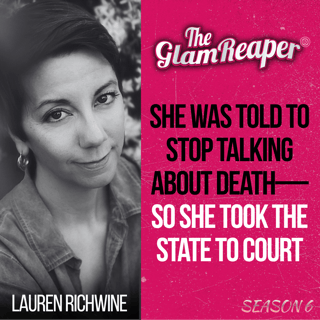
Speaker: I'm your host Jennifer Muldowney aka the Glam Reaper and on today's episode we are doing, we're going down a little childhood route of mine or route as you guys say over here and we're talking to a Little Miss funeral.
Speaker: So I love, we used to love the Little Miss and the Little Mr. Man.
Speaker: So Lauren, welcome to the showy.
Speaker: Thank you so much for having me.
Speaker: It's so nice to be here.
Speaker: I have followed you for a while.
Speaker: So I've been in this business for about 15 years and I'm dying for you to tell everyone your story.
Speaker: So I've kind of followed you from early on.
Speaker: And then I know like sabbatical, we talk, you talk and want to hear all about that.
Speaker: And I know you've kind of
Speaker: You know, you're not as involved in all of the online stuff as you used to, which is so cool.
Speaker: But I want to hear all I want to hear the journey and how you came to be Little Miss Funeral.
Speaker: How did that name come about?
Speaker: Oh, so, yeah, my name is Lauren.
Speaker: Sorry, at the beginning, I guess.
Speaker: I am a licensed funeral director in the state of New York.
Speaker: I have been working actively at a funeral home for the past 14 years.
Speaker: And when I first started, I first started Little Miss Funeral, I think it was 2012.
Speaker: And it kind of started, I was 22 at the time.
Speaker: I'd already been working in a funeral home for two years.
Speaker: And it kind of started out of depression for me, I guess.
Speaker: I'm being very young, working in the funeral home.
Speaker: I'm the kind of person where I talk about my feelings.
Speaker: So if something's bothering me, you know about it.
Speaker: If I'm happy, you know about it.
Speaker: And I think working so much in the death care industry at such a long early age, it really like I just wanted to kind of share what I was doing.
Speaker: And at this other hand, I was kind of sick and tired of friends and family asking me about my job.
Speaker: So I thought, OK, let's just, you know, do tubers with one stone.
Speaker: I will start a blog.
Speaker: I will get some of how I'm feeling off of my chest and kind of down on paper, like an online diary.
Speaker: And then I would have my friends and family read it too.
Speaker: Kind of started with that.
Speaker: I honestly never thought anybody would read anything that I put because it started with a written blog, not a YouTube or anything.
Speaker: And I truly never thought that anybody but my friends and family would read it or truly be interested in it.
Speaker: Like this was kind of at the very beginning of like the internet funeral process.
Speaker: Death Care Dying Arrow.
Speaker: I was kind of one of the first ones, like along with Caleb Wilde.
Speaker: There was Ace Ratcliffe at the time, who was like the mortuary report, you know, and like you had the modern mortician who was coming on the scene.
Speaker: So like there weren't a lot of us that were actively sharing our stories.
Speaker: careers online.
Speaker: And the name Little Miss Funeral kind of started, I am not the biggest of ladies.
Speaker: And growing up, my nickname was always Little Lauren.
Speaker: Like, if there were other Laurens around, it was kind of like, oh, hey, Lauren, what Lauren?
Speaker: Little Lauren.
Speaker: You know, so like, Little Miss just...
Speaker: And then I was like, well, funeral, I do funerals.
Speaker: So Little Miss Funeral was kind of born.
Speaker: Like, I'll never forget.
Speaker: I was actually at my husband's house, but we were just, we were engaged.
Speaker: We were engaged at the time.
Speaker: And I was sitting on his couch.
Speaker: And I'm like, yeah, Little Miss Funeral, that's good enough.
Speaker: Didn't even put any thought into the name, like, truly, which I really like the name now that I hadn't been around.
Speaker: So I'm like, hey, it worked out.
Speaker: Yeah.
Speaker: And the blog really just kind of took off from there.
Speaker: I mean, I just honestly started posting about like my day to day, like things that I experienced, emotions that I was dealing with, how I was dealing with those emotions.
Speaker: I would kind of like make jokes here or there, like kind of posted an article one time about 10 things that I learned while working in the funeral home.
Speaker: And Caleb Wild saw that, Confessions of the Funeral Director.
Speaker: So he asked if he could put that on his blog.
Speaker: And that kind of like jumpstarted everything.
Speaker: Yeah.
Speaker: Like he really kind of jumpstarted everything.
Speaker: And I found that the more I wrote and the more I shared, the better I was able to deal with the emotions that came along with being a funeral director.
Speaker: So I did that for quite a long time.
Speaker: And I liked writing.
Speaker: I personally believe that I am a better writer than I am speaker.
Speaker: I feel like I have all these thoughts in my head.
Speaker: And when I put them down on paper, I can kind of cohesively put them together and I can edit them and really...
Speaker: see what I want to say and then put it out when I think it's perfect.
Speaker: I feel like when I talk, sometimes my ideas and emotions just come out and I'm like, oh, did that make sense?
Speaker: But then, oh gosh, I think it was 2017.
Speaker: My husband kind of encouraged me to start a YouTube channel.
Speaker: He was like, hey, Lauren, you know, blogs are out.
Speaker: YouTube's in.
Speaker: do that.
Speaker: And I was kind of like, I don't know.
Speaker: I don't know if I want to.
Speaker: I don't know if I want to sit on a camera and talk.
Speaker: Yeah, I don't know if it's for me.
Speaker: But he really encouraged me to do it.
Speaker: My husband's really active online, like even to this day, like he has his own like gaming channel.
Speaker: He is just really into social media.
Speaker: And he pushed me to do it.
Speaker: And I did it.
Speaker: And that was pre kids.
Speaker: And I ended up falling in love with it.
Speaker: Like I would come home from work and I would set up my camera and I would record videos again about things that I was doing or emotions that I was feeling.
Speaker: And then it kind of evolved into people asking me questions and I would answer the questions that they asked.
Speaker: And then the YouTube channel, you know, started to take off.
Speaker: I mean, I don't have like anywhere close to like a million subscribers or anything like that.
Speaker: But for like a small town person who, you know, who am I in the grand scheme of funeral directors?
Speaker: Like it was awesome to have a lot of support.
Speaker: And I didn't really leave.
Speaker: Like, I still don't think I left YouTube.
Speaker: I have so many, like, ambitions to come back.
Speaker: It's just that I am on such a different journey in my life right now.
Speaker: I work still at a funeral home about 30, 35 hours a week.
Speaker: Yesterday, I worked 13 hours.
Speaker: And now I have two kids.
Speaker: And we homeschool.
Speaker: So if I'm at the funeral home, I'm basically there now.
Speaker: All day long.
Speaker: And when I'm home, I'm with my children, homeschooling my kids, taking them to co-op.
Speaker: We live on like 11 acres.
Speaker: I got chickens.
Speaker: So I am just like at a different journey.
Speaker: It takes a lot of time to do the videos and the editing and the posting.
Speaker: So I keep saying, oh, when the girl, when they go to bed, then I can record a video.
Speaker: But then I find I'm exhausted at that time.
Speaker: So one day, hopefully soon, I'm going to post another video up there.
Speaker: And that was it.
Speaker: That was sort of the start of it.
Speaker: Because I do remember, I think you were pregnant with your first child was when it sort of, you were like, you know, I think up to the secret.
Speaker: I think I remember...
Speaker: Yeah.
Speaker: I didn't do that on purpose.
Speaker: I feel comfortable talking about it now, but I grew up and my mom had a lot of issues.
Speaker: She lost one baby, had my brother, had a miscarriage, and then had me.
Speaker: So growing up, my mom was always very vocal.
Speaker: I always knew I had a sister in heaven.
Speaker: We always talked about this stuff.
Speaker: So I don't know why.
Speaker: I just had this preconceived notion that
Speaker: Because my mom had issues, I would have issues.
Speaker: So with my firstborn, it was kind of like we ignored that I was pregnant.
Speaker: Like we didn't post like anything like only people who saw me in person knew.
Speaker: And it wasn't that I didn't want to share the news, but it was kind of like I...
Speaker: I was prepared.
Speaker: I was, it's horrible to say, but I was just working in death and dying and seeing things that I've seen.
Speaker: I was just like, I'm pregnant.
Speaker: Hopefully I'll have a baby.
Speaker: It wasn't like I was trying to hide it.
Speaker: You know, it was kind of me dealing with that, being a funeral director.
Speaker: seeing different horrible situations that I see.
Speaker: So yeah, that was kind of a secret, but not, I mean, if you watch my videos, I'm just getting bigger and bigger.
Speaker: So it's like, how could you not know when you're honestly watching, you know, it's like, I am actively changing shape in front of you.
Speaker: And then after she was born, I kind of got back into it a little bit, got into the swing of things.
Speaker: And then same thing, like didn't plan it, but like second pregnancy, then kind of same thing disappeared a little bit because of that.
Speaker: And then
Speaker: posted a video saying we had a second kid and then I think that's the last video I posted.
Speaker: Yeah.
Speaker: And that was two years ago.
Speaker: So, but I mean, it's like, as you said, you're at a different trajectory in life.
Speaker: It's not like you're not in the business anymore, but you go through different.
Speaker: And I think for women as well, because
Speaker: Our bodies go through such changes and there is, I think when you work in death care, you see so much loss.
Speaker: Like it's interesting that you said that because it is fascinating.
Speaker: Like baby showers is fascinating to me.
Speaker: Like they're in Ireland now where I'm from.
Speaker: They weren't a huge thing because...
Speaker: It was very much like you hoped you brought a child.
Speaker: Yes.
Speaker: And it was, you know, wasn't an expectation of this is absolutely guaranteed.
Speaker: It was, you know, I know that's kind of 80s Ireland and stuff like that.
Speaker: But like here, it's like you'd have baby showers.
Speaker: And I used to be a bit like have a bit of an ick about that because I'm like, what if it doesn't?
Speaker: You know, there is so much.
Speaker: So I do.
Speaker: I understand a lot of people keeping it secret.
Speaker: I know you didn't, but just like what you said there about how you hoped.
Speaker: rather than expected to yeah it's incredible and I'm delighted and congratulations that you did you know it's it is something that I think more and more people women need to talk about and address is discarriages and how often people have them and
Speaker: It should not be just an expectation that, you know, everything's going to be perfect.
Speaker: And obviously the older we're getting, which we're doing more now, you know, and all of this sort of stuff.
Speaker: But I do think in death care, we kind of get to see a different side of life.
Speaker: You know, I certainly, I mean, with the death of my two friends that brought me into the space.
Speaker: It was a smack in the face.
Speaker: It was like, wait, what do you mean we can die when we're in our 20s?
Speaker: This is bonkers.
Speaker: I didn't sign up for this.
Speaker: You know, it was always people were old or they had cancer or something.
Speaker: And, you know, I mean, cancer is just so prevalent, but that was the disease that people sort of died of when I was in my 20s at that stage.
Speaker: And so for this idea that people at a child's age or in their teens or 20s would pass away was such a novel thing.
Speaker: But yes, it's so prevalent.
Speaker: It's crazy.
Speaker: Yeah, I think that's one thing that the death care industry did.
Speaker: It really opened my eyes at a young age.
Speaker: I was 21 and 30 working.
Speaker: that it can happen anywhere and anytime.
Speaker: So I just, I'm very aware of mortality.
Speaker: I've always been very aware of mortality.
Speaker: Do you find that, can I ask, do you find that I'm not a mom, so I'm asking you, but do you find that that influences the way you parent?
Speaker: Yes, because I quit my full-time job when my firstborn was born to be a stay-at-home mom.
Speaker: And then that lasted for about six months until a local funeral director kind of came and said, hey, Lauren, do you want to work for me part-time?
Speaker: And I said, oh, dang it.
Speaker: Because I do, I do love what I do.
Speaker: I feel like you don't, I've been doing this for 14 years.
Speaker: You don't last this long in this industry if you don't truly have like a love for the work that you're doing and the peace that you're bringing to people during a horrible time.
Speaker: I just think that it's very difficult to be a devoted funeral director and a present parent at the same time.
Speaker: I think that's why traditionally you see more men in the role because they traditionally were more of the breadwinners and it wasn't that women weren't able to or capable of doing it because women are wonderful in these roles.
Speaker: I just think that tradition is
Speaker: And the man goes out and the woman stays home.
Speaker: And my firstborn, like I said, the minute she was placed into my arms, I was like, oh, God, nothing is more important than this little baby right here.
Speaker: And I loved her so much that I quit my job or didn't stay away for long.
Speaker: But I am not.
Speaker: Willing to put anything above my kids.
Speaker: And that might make me a worse funeral director for it.
Speaker: Because in the past, my families that I served came above everything and anything.
Speaker: Weddings, birthdays, I can't tell you how many family affairs I missed in the past.
Speaker: My husband just always knew.
Speaker: If something came up, I was going to be gone.
Speaker: And he had peace about that.
Speaker: He knew I was dedicated to my job.
Speaker: But the minute I had kids, I was like, you know what, if they need me, they're coming before a family because I see death.
Speaker: I see grief.
Speaker: I see that time is fleeting.
Speaker: And I'm not promised tomorrow.
Speaker: My family's not promised tomorrow.
Speaker: And I when my time on this earth is complete, I don't want to have any regrets that I didn't spend as much time with my kids as I physically could.
Speaker: I love that, Lauren.
Speaker: And, you know, you've touched on so many points that I want to come back to.
Speaker: But just it's interesting what you're saying there, because that is so true.
Speaker: Like your family should come first.
Speaker: But yet, I mean, I don't have kids and a lot of funeral directors I work with don't have kids.
Speaker: And I do feel like families come first.
Speaker: I mean, even for my 40th, God, nearly two years ago now.
Speaker: But I flew I flew to Ireland to celebrate my 40th with my friends and family in Ireland.
Speaker: But I flew back.
Speaker: three days early because I had a big funeral that I had to come back to.
Speaker: And like that, yeah, it just comes first.
Speaker: It's like, no question, your family's first and you have to be there for these families.
Speaker: And even the first time I was coming home to Ireland post COVID, I postponed that trip because the family needed me, even though I needed my family.
Speaker: I think when you do have kids of your own, that just completely changes.
Speaker: And because we see how many regrets I think people have at the end of life that we like, I mean, kind of my fourth book is writing about this where it's like, I genuinely believe if we realize...
Speaker: If we get hit on the head and realize that life is finite, guys, it is for every one of us.
Speaker: Doesn't matter how much money you've got in the bank.
Speaker: It's finite.
Speaker: There's only so much time we have.
Speaker: We will live and love more.
Speaker: And that's it.
Speaker: It's being there like for your family.
Speaker: Like I'll fly home to Ireland in a heartbeat to surprise my parents just because I know time is limited with them.
Speaker: And I feel like so many people don't see that because they're not working in life and death.
Speaker: It's.
Speaker: Mm hmm.
Speaker: Yeah, it's just it's amazing.
Speaker: And I think you're so right.
Speaker: However, that does lead there to be a little bit of an issue in obviously recruitment in the space because we want more women in the space.
Speaker: There are more women coming into the space, but like that, like as they have kids.
Speaker: And I do think even though it's tradition, I do think as much as women and I know most of my friends went back to work.
Speaker: There is still that pull of being at home.
Speaker: Like, what do you think the future holds for the space?
Speaker: Like the business?
Speaker: Do you think it's just I know.
Speaker: I mean, honestly, I truly thought that I had conversations with my husband and I thought I was going to pop out my kid and he was going to be home and I was go back to work because that was just how much I loved my job.
Speaker: So I'm not saying that every woman who's having a kid who is a funeral director is going to feel the way that I feel.
Speaker: And there's nothing wrong if you are your desire to serve other people pulls you away from your kids.
Speaker: I think that everybody has different circumstances and there's different joys that get brought to us in this life.
Speaker: And I I know it's bad to say, but I get joy from being a funeral director.
Speaker: I know people are like, how can't.
Speaker: Can you say that?
Speaker: Because it's such a sad time.
Speaker: But I think that being able to do something for somebody who can't do it for themselves is very fulfilling.
Speaker: And I think that there are options for people to be funeral directors and mothers.
Speaker: I have a colleague who I work with right now.
Speaker: She's also a mom.
Speaker: She has two kids of her own.
Speaker: And she always says that her dream job, she's kind of
Speaker: putting out there is she would love to just do removals at night, like from, you know, six o'clock until, you know, the next morning, go home, get her kids on the bus to go to school, sleep a little bit during the day.
Speaker: And then she's there when they get off the bus from school.
Speaker: able to have dinner with them and kind of get them situated and then do removals again.
Speaker: There are so many different avenues in the funeral industry that I really think it does open a lot of doors for people to choose because you don't have to do it all.
Speaker: In the state of New York, I have a dual license, so I can legally embalm, make arrangements, lead funerals, basically A to Z. Or at the funeral home where I work now, I basically am the arranger.
Speaker: So I
Speaker: I am the one who is walking the family through the process, setting up everything, making sure it's all organized.
Speaker: But then I have colleagues who are doing the actual preparation work.
Speaker: So we kind of work in a team setting.
Speaker: And I just think that if people explore, they would be surprised at how many different avenues they could go down to be in the death and dying field.
Speaker: And it's interesting because I only just had a wonderful woman recently on the podcast, Heather from Before the Coffin.
Speaker: Do you know Heather?
Speaker: You know what?
Speaker: I have been offline for so long.
Speaker: I don't know anybody now.
Speaker: It's also it's OK because I also feel like there's somebody who was in the space and there's a lot of similar names that even I get a little.
Speaker: Heather and me were just chatting about how she went into transplant surgery.
Speaker: removal and transportation of, I just, I was blown away.
Speaker: I was like, I never even knew that that was a part of like what you guys do.
Speaker: So there's so many facets to it, exactly as you said.
Speaker: And while I think, you know, there is this sort of recruitment freeze or I forget what they're, they have a term for it now where everyone's panicking that, you know, they're not gonna be able to recruit enough.
Speaker: I feel like exactly as you kind of just said, that it's more that we need as an industry, and I know they hate that word as a profession, whatever way we want to call it, you know, if we would just stand back and look at it from other industry perspectives, right, and not look at it as the way it's always been.
Speaker: Like I keep saying this, just because it's the way it's always been done doesn't mean it's the way it always has to be in the future.
Speaker: And I went to a funeral home out in Long Island.
Speaker: And there I think was late last summer, late last year.
Speaker: And there were I met these two incredible women who just happened to be there at the same time.
Speaker: But like that, they're job sharing effectively at this funeral home.
Speaker: But they both work part time so they can be with their kids.
Speaker: And that time, but that they have they still have the job that they love.
Speaker: And so it's basically like almost like a relay race, like they hand them like I've taken the family this far.
Speaker: Now you're going to have Mary will call her who takes you the rest of the way through.
Speaker: So like one would do three days a week, one week and the other does four.
Speaker: And then they flip the next week.
Speaker: And I just thought that is brilliant because you also by doing that, you are allowing people to have the freedom of being with their children.
Speaker: Or not.
Speaker: It doesn't have to be for moms.
Speaker: It's all applied to dads or whoever else.
Speaker: And just people in general.
Speaker: But it also gives them, there's also less chance of burnout.
Speaker: Because you've just got, you've got enough time.
Speaker: And I want to come back to it.
Speaker: Because you just hit such a valid point at the start.
Speaker: Is mental health in the space.
Speaker: You know, burnout.
Speaker: I've seen so many funeral directors burn out in this space.
Speaker: And wonderful ones like yourself.
Speaker: Who give so much and care so much.
Speaker: But because they don't get enough downtime or self-care time, because it's a very giving space.
Speaker: I mean, you know, you hit the nail on the head, which I personally believe as well, is that you said, you know, people look at you odd and how can you love being a funeral director or get some joy of it?
Speaker: And I absolutely agree.
Speaker: And people will say to me, but Jen, you know, you suit...
Speaker: Another space.
Speaker: I mean, I'm a memorial planner, not a funeral director, per se, but, you know, they're like, oh, you're so happy and cheerful all the time.
Speaker: You know, you suited party planning better.
Speaker: And I'm like, but I get so much love and joy and fulfillment from what I do.
Speaker: Each family that comes in, I know that without me, this road would have been gone.
Speaker: With me holding their hand, it's a little bit easier.
Speaker: And I can sleep at night knowing I gave that family all that I could in whatever way I could and made that road just that little bit more comfortable for them.
Speaker: It's just we need to start looking at the space from a different point of view.
Speaker: And I think more part-time moms, part-time dads, just, yeah, we need to fill our cups up in whatever way we can.
Speaker: Now, how do you, other than your kids, how, if you do, fill your cup up in terms of looking after yourself?
Speaker: Because it is tough, especially when, and I'm sure as a mom, if you've got like child deaths and, you know, the spousals, it can be tough.
Speaker: It hits home.
Speaker: It definitely is.
Speaker: It definitely is.
Speaker: And it's so funny because the older I get and the more family members that I've lost, I'm able to like identify with a lot of the families that I'm serving so much more.
Speaker: Like when I was 20 years old, everybody that I served realistically was old.
Speaker: You know, if they were 40, that's old.
Speaker: If they're 50, 60, 70, you know, that's old when you're 20.
Speaker: Yeah, no, I remember this year.
Speaker: I'm like, oh, my God, I remember looking at people in their late 30s and thinking they were ancient.
Speaker: It's so true.
Speaker: And I'm 34.
Speaker: And it's like, you know, as I get older, I'll get I'll get somebody who passed away and I'll be like, what's the birthday?
Speaker: Oh, my gosh, that's like me.
Speaker: And it's so funny because I'm like, identify people.
Speaker: the older you get, the more life you live, the more you see and do.
Speaker: I think it makes you a better funeral director because you're you just have so much more under you that you can stand on.
Speaker: And I think that people feel comfortable knowing that they're not in the boat alone.
Speaker: So going through, you know, I've lost
Speaker: Now, my grandmother, who was like one of the most important people in my life, I've lost aunts, uncles.
Speaker: I mean, I've lost so many people within the last 14 years that I have taken care of.
Speaker: So that helps me identify with families more.
Speaker: And when I do identify and when those deaths
Speaker: do hit home more so they're just tough days you know I'm I'm I'm very I feel things very deeply and I tried not to for a long time but it's just it is who I am so on those days I I have a very supportive husband like I have the best husband in the entire world um he knows like if I'm in a mood I'm just gonna leave her alone and she's just gonna be in the mood and it's fine and honey do you need anything okay nope I'm just gonna go over here you know like we
Speaker: We've been together.
Speaker: My husband and I have been together since we were 15.
Speaker: And we're 34 now.
Speaker: And I just really like doing things with my family.
Speaker: I said at the beginning, we live out in the country.
Speaker: We have 11 acres.
Speaker: So I like just being outside.
Speaker: I like hanging with my chickens.
Speaker: Like, it's kind of the simple stuff.
Speaker: You're the best.
Speaker: I'm pro-chicken.
Speaker: I will talk anybody into getting chickens.
Speaker: I will talk chickens.
Speaker: The whole thing would work in an apartment in New York City, though.
Speaker: You'd be surprised.
Speaker: We could make a little coop.
Speaker: They don't need a lot of space.
Speaker: But it's kind of like the little things, you know, like I have found that it's like the everyday mundane that kind of gets me through hard times.
Speaker: I also now because I'm not really writing as much as I used to, and that really was like a journal for me.
Speaker: I talk about it.
Speaker: You know, if I'm having a bad day, I'll be like, OK, honey, sit down because I just got to tell you what I went through.
Speaker: Or I'll be sitting down with a coworker in the other day and be like, I just have to tell you about this family that I dealt with.
Speaker: And I just have to get things off my chest.
Speaker: I'm that kind of a person where I just need to like have that like verbal throw up where I'm just getting everything out.
Speaker: And then I and then I feel better.
Speaker: I heard that from a therapist that that is actually a thing that a lot of sort of feminines, feminine brain want to do or need to do.
Speaker: And it was, you know, it was kind of talking about sort of male versus the female brain.
Speaker: And it was how it was basically how we need to nearly say to set it up, right?
Speaker: Be like, I don't need your advice.
Speaker: I don't need you to say anything.
Speaker: I just need to open you to open a bucket so I can pour this into you.
Speaker: And then we move on.
Speaker: And so clearly.
Speaker: Yeah.
Speaker: And it works for me.
Speaker: So I do that a lot.
Speaker: And I also do.
Speaker: I mean, I'm not active.
Speaker: I always say I do not physical activity, but I do do like an adult ballet class like once every two weeks.
Speaker: And I have like a good group of girlfriends who go to that, too.
Speaker: So like that's one thing that I do for me.
Speaker: You know, it's adult ballet, so it's not it's like glorified stretching, really.
Speaker: Like, you know, we're not really doing.
Speaker: I mean, we're moving, but we're not doing much.
Speaker: We're trying, but we're not.
Speaker: And it's kind of fun because it's like an hour and a half.
Speaker: And I'm just with like a really good group of girlfriends that I've known for like quite some time.
Speaker: And we're doing something physical, physical enough for me, you know.
Speaker: Yeah.
Speaker: So I don't know.
Speaker: I just think that I think having a good partner is important.
Speaker: I'm somebody who I need support.
Speaker: So I definitely married the right person.
Speaker: And that just that gets me through it.
Speaker: And it's so to and to kind of touch on what you were talking about at the start, because like you and I'm so proud of you, if I get to be as a stranger for taking the time, you know, to step away from all the online stuff when you had your your child and
Speaker: Because like Caleb Wilde, who's funeral director, you know, he's done similar and he's gone so far as to pull back.
Speaker: But now is kind of coming back and helping other funeral professionals and coping them on mental health.
Speaker: Yeah, I do that too.
Speaker: Yeah, it's brilliant to see.
Speaker: And I mean, listen, I'm not a therapist by any shape of the imagination.
Speaker: I do feel like everyone in the funeral space is a teeny bit of a therapist because, you know, it's what you kind of have to do.
Speaker: You absorb people's, you're empath, pathetic, you know, you absorb people's emotions and, you know, you help them kind of through things.
Speaker: And I've been asked to speak on mental health a couple of times.
Speaker: And I think it's
Speaker: I mean, and I'm always very clear that I have no license to do this, you know, and I'm not a therapist or anything like that.
Speaker: But I think it's more I like to facilitate conversations and I feel like there's no right or wrong.
Speaker: Everyone can come to the table with whatever, you know, they feel like is appropriate for them to get through whatever it is, you know, and I've been through my own dips and stuff.
Speaker: What I love about Caleb and you honestly talking with us here.
Speaker: is that you're so open and honest about your struggles and what you need to move forward.
Speaker: I feel like maybe because it was quite a male dominated space for so long and more women are coming up in it.
Speaker: But like we're talking about this now, like mental health funeral space.
Speaker: is becoming a huge thing.
Speaker: Myself and Barbara Chemist from Cana had a whole podcast chatting about this as well.
Speaker: Funeral peer support are providing that service to funeral directors if they need it.
Speaker: And now Caleb is coaching it.
Speaker: It's very interesting.
Speaker: I feel like it's only going to get more and more
Speaker: So I think that's like kind of the difference.
Speaker: I don't know.
Speaker: So back when I started everything, there was no like Instagram famous, like influencers, you know, these people like truly it was like kind of the beginning of everything that is happening now.
Speaker: And every once in a while when I log on to my Instagram and I'm kind of scrolling, I'm like, holy cow, there are so many people out there and I never did anything like
Speaker: to become an influencer or a funeral guru or to like become a face of like an industry or anything like I truly look at myself as just like a normal woman who is doing a not so normal job and I am very confident in who I am I have always been very confident in who I was even as a young girl I was never ashamed of me I'm always just like this I am who I am and you like me or you don't like me but you're gonna know what I think um because I'm gonna tell you what I think yeah
Speaker: And take it however you will.
Speaker: Yeah.
Speaker: So that's I think the difference between like today and back then, it's like like I identify with Caleb so much.
Speaker: Like when he was writing, like I came from a small town mom and pop funeral home.
Speaker: He obviously had his family funeral home and with his books and his writing and everything.
Speaker: I met him in person.
Speaker: He's a wonderful man.
Speaker: Everything he's gone through, I'm like, did we work at the same funeral home?
Speaker: Did we go through the same things?
Speaker: Because I think that this industry is kind of like glorified, like, oh, it's the death care industry.
Speaker: It's cool.
Speaker: It's up and coming.
Speaker: There are so many things that you can do, but there's such a dark side to what we do.
Speaker: And that's what you take home with you.
Speaker: And I think that's what people aren't showing on social media.
Speaker: They're showing the look at this casket.
Speaker: Look at this embalming.
Speaker: Look at this, this.
Speaker: And it's so shiny.
Speaker: And what we do is so cool.
Speaker: And we should share it with everybody.
Speaker: Which is great because it's getting people interested in it.
Speaker: And we want the interest and we want the curtain pulled back because what we do shouldn't be a taboo subject.
Speaker: But I think that it's important to be honest with people and to be like, listen, this is a really great profession, but it's also a really heavy profession.
Speaker: That's one of the reasons I've never been afraid to share what I feel or what I'm going through, because it's my truth and it's what I am going through.
Speaker: And I'm not ashamed of that.
Speaker: But also, I think that people need to be aware that this industry gives.
Speaker: Yeah, it's so that's such a good point, because there is there is a little bit of it becoming a bit of an at the fact that we're even talking about influencers in the space is why.
Speaker: So weird.
Speaker: 2024.
Speaker: What is happening?
Speaker: Because it's a tough one, because exactly as you said, we want you want attention to it.
Speaker: You want people to know life is finite and, you know, think about their plans.
Speaker: Maybe, you know, do a bit of pre-planning, do on burial cremation or other things.
Speaker: Do you want, you know, what, what do you want for your end of life?
Speaker: And what does that look like?
Speaker: And then there's all these, you know, new occupations coming up and new technology.
Speaker: Like you've, I don't know how many death doulas, you know, I come across.
Speaker: The celebrant role is obviously becoming huge.
Speaker: And then, you know, technology.
Speaker: I mean, if I get another call, which listen, I'm open for them, but.
Speaker: you know these kids coming out of college wanting advice because they're going to disrupt the death care industry with their new app that's going to gamify pre-planning and I'm like okay it's not really going to you know because they see these death fluencers or whatever they're called whatever way it is
Speaker: And look, I'm I'm so here for opening the conversation.
Speaker: I wouldn't be doing this podcast.
Speaker: And so many people have even said to me, like about why I'm doing podcasts.
Speaker: I do it honestly as a total burden of love or whatever the word is, because I love talking to people like you.
Speaker: Like I love having these fascinating conversations.
Speaker: And sometimes it's offloading where we're like, oh, me too.
Speaker: Me too.
Speaker: Or, you know, sometimes it's finding out about some amazing product or service that I never knew was was around.
Speaker: But exactly as you said, there is such a dark side to the space that we don't show.
Speaker: And, you know, do I think I'm going to start recording those times where I break down crying because I've just done a service that I kind of couldn't hold it.
Speaker: I could hold it together until I was on my own.
Speaker: And am I going to show me sobbing outside of?
Speaker: No, probably not.
Speaker: You know, because I don't know if we need that either, because I do think there's a little bit of acting in that, too.
Speaker: You know, but it's.
Speaker: It is.
Speaker: It's addressing all facets of it, because even like a lot of people, I don't know about you, but for me, a lot of people will say, oh, God, you know, a young person's funeral or suicide, it must be so hard.
Speaker: And I'm like, yeah, it is really hard.
Speaker: But sometimes the older people affect me more because all of a sudden I'm seeing like I obviously live in New York.
Speaker: My parents live at home in Ireland.
Speaker: And so I'm sort of like, oh, my God, you know, I'm resonating with that could be my mom.
Speaker: And even though obviously because I'm in the space, I've thought about it.
Speaker: But all of a sudden it hits me just because you're seeing these wonderful people talking about their mom and how great she was.
Speaker: And then you are just and that's it.
Speaker: That's all that it is.
Speaker: And that can then.
Speaker: take you into a spiral where you're just, you know, you start to overthink everything.
Speaker: And from a funeral director point of view, and when it comes down to, not necessarily even embalming, but preparation of the body, which obviously I'm not licensed to do, but I know from talking to funeral directors, like there are some states that bodies get into that...
Speaker: I have seen quite a few, you know, and in those situations, you almost disassociate the fact like I have been in some really traumatic passing, some really horrible, like painful deaths that the person must have experienced.
Speaker: And I feel bad.
Speaker: bad saying this, but I almost in the situations when I was working on the body or doing cosmetics or doing dressing, casking, whatever it may have been.
Speaker: I don't think of it as a person.
Speaker: I think of it as I need to do this job right now.
Speaker: And this job is me putting this pair of pants here or putting this makeup here and putting the shoe here.
Speaker: Like I'm not thinking to myself, this is somebody's mom.
Speaker: This is somebody's dad.
Speaker: Because if I put that humanity to it, I won't be able to do it.
Speaker: And it's not that I'm trying to be heartless, but it's kind of a coping mechanism of something I need to do to be able to do the job so that I can help a grieving family.
Speaker: Yeah.
Speaker: Yeah.
Speaker: It's such an incredible service.
Speaker: Honestly, you guys do.
Speaker: And my house literally is off.
Speaker: I literally have one here.
Speaker: I can do it.
Speaker: And it.
Speaker: Like during COVID, it broke my heart, even though I'm not a funeral director, but it broke my heart.
Speaker: And again, I am lucky insofar as a lot of normal people, because we're not normal, a lot of normal people follow me and engage with me in conversation and listen to the podcast and stuff.
Speaker: It broke my heart during COVID when funeral directors and everyone in the funeral space got just so blatantly ignored by all of the, you know, the first responders were doing all of this and getting all these freebies and all of this amazing stuff.
Speaker: And absolutely, should they have?
Speaker: Yes.
Speaker: And, you know, they were saving lives.
Speaker: But at the end of the day, I know funeral directors were working 24-7 because bodies, especially in New York, were just piling up.
Speaker: Just craziness.
Speaker: So, yeah, listen, my hat is firmly off to you.
Speaker: And I'm in the Western New York area, so I'm on the opposite end of the state as you are.
Speaker: But I had colleagues of mine who were leaving and going to the city.
Speaker: during COVID because there was just such a demand for licenses and general directors to help.
Speaker: So that was a really difficult time to work.
Speaker: Absolutely.
Speaker: And it was one actually was one of the times where I was kind of upset that I wasn't licensed, that I couldn't help in any way, shape or form.
Speaker: So Lauren, it has been amazing talking to you.
Speaker: We could I could obviously talk to you all night.
Speaker: I feel like we might want to since you're one of the few guests that is in the state, I might have to visit out to you and we just might have to hang out a little bit more because I can talk to you all day and all night.
Speaker: And I just think you've got such a wonderful attitude.
Speaker: You've had such wonderful forethought being so young in like getting this word out.
Speaker: And I know you didn't think it at the time.
Speaker: And I totally everything you said just resonates with me.
Speaker: Like I started with a blog and I hated this on camera business.
Speaker: You know, now I don't mind so much because when I'm talking to people, I forget about myself.
Speaker: So thank you for doing it, though, because you started what now we're seeing as people having conversations that they maybe never would have.
Speaker: And it is thanks to you and Caleb and the like.
Speaker: So and I'm just I'm so happy that you've got such a lovely balance and such beautiful support at home and with your husband and stuff.
Speaker: So thank you for joining us.
Speaker: Oh, thank you so much for having me.
Speaker: you