Transcript
Speaker: Apologetics is a spiritual discipline of loving, humble service that tries to use virtue-orientated rhetoric to lead people to be persuaded that a God-centered way of life through faithfulness to Jesus as Lord is a rational, good and beautiful choice to make.
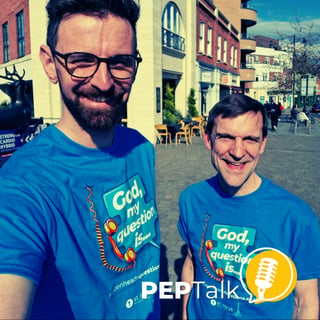
Speaker: Welcome to Pep Talk, the persuasive evangelism podcast from Solas. I'm Simon Wenham, your co-host today, and it's great to be joined by my colleague Steve Osmond. Steve, we we haven't had you on the show for a little while. How things going with you? Yeah, it has been a little while. um Things are good. The sun is starting to come out here in Scotland after a a very dark and wet winter. So yeah,
Speaker: you know Things are looking up. Good to be back there. Great. so It's great to have you back. and yes very we're We're recording this at spring, so we're we're suddenly suddenly seeing a bit of a bit of the sun. so um we're We're talking about philosophy and apologetics today. and Philosophy means loving wisdom, which I know you do, Steve. but um what What about yourself? Do you have any formal philosophical training?
Speaker: Yeah, surprisingly, i do. So I did a ah master's MA in apologetics and theology, but the seminary I did it at, we had a big, big chunk of philosophy. And I i actually think I'm um probably more of a sort of budding philosopher than I am a theologian or apologist, although there is a good good close link, I think, between apologetics and philosophy, which we will definitely be hearing a bit more about today. So I'm excited for this conversation.
Speaker: Brilliant. Thank you. Well, we're we're in very good company because I'm delighted that we're joined by the philosopher, apologist and author Peter S. Williams. He's just written a book called Stepping Stones to Christianity, and he's going to be unpacking this whole topic with us. and Peter, we last had you on apparently six years ago. So sorry it's taken so long to have you back on the show, but welcome back. um I wondered if you could...
Speaker: Start us off by saying a little bit about where you're based and how you got into this form of communication in the first place. Yeah, well, I'm based in Southampton, ah although I'm an adjunct professor for a Christian university college in Norway, ah bizarrely enough. um But i I got into this whole area when I first went off to university and I studied humanities at ah Cardiff University.
Speaker: And they make you do three different subjects in your first year. And I was down to do a degree in English literature and music. and took philosophy as my sort of makeup course for that first year and ended up ah really discovering the philosophy then, the the love of wisdom, as as you say, ah and really being interested as ah as a Christian, ah thinking about the sort of big ideas of life, the universe and everything from a Christian viewpoint, and ended up ah taking the the the study of philosophy through.
Speaker: and working then in the kind of um broader area, as you say, of Christian apologetics. But there's very much a link through to philosophy dealing with some of the the central kind of questions of ah life and God and meaning and all of those big, juicy questions that apologetics also connects to.
Speaker: Yeah, Peter, thanks again so much for joining us. um Now, when people hear the word apologetics or or even philosophy, um I think especially Christians, you know, they they can get a little bit nervous um thinking that, hey, this is really only for the clever people.
Speaker: What would you say to someone who's maybe thinking that way? Okay, well, apologetics is a word that we get from a New Testament Greek phrase in 1 Peter, a letter of 1 Peter, chapter 3. He talks about always be ready to give an answer.
Speaker: to people who ask you a reason for the the hope that you have in Christ. And that the word that we're translating in English there and an answer is the Greek apologia.
Speaker: It was a ah legal term, really. It was like what your lawyer would do for you when they stood up and gave a a speech defending you in court. So it's a word that means ah defense or the the idea idea of just giving ah ah a reasonable reply.
Speaker: ah to some one ah And so Peter is there saying to all Christians ah to be ready to give a reasonable response to people when they ask you, you know, why are you a Christian?
Speaker: why do Why have you done this? and And of course, we all, both of us who are Christians, have our reasons for doing that. We may explain those reasons at various different levels of simplicity or complexity. We may take different angles on on why that is. that we We think it's reasonable for us to to to be followers of Christ, but simply trying to do our best to to give that response to people, well, that is apologetic. so it's something that the New Testament calls all Christians to be involved in. And of course, to be involved in um in the best way that we ourselves can.
Speaker: And for those of us who you know have brains that work that way, then the calling into the more kind of academic end of doing that is entirely appropriate. But ah You know, you don't have to ah be in academia in order to be doing apologetics, particularly with that quote but of mine that you read out earlier. If you think of it in terms of just trying to um help people to to see that Christ is really attractive, that being a follower of Christ is a persuasive life choice to make.
Speaker: Absolutely. And one one thing i I found very striking about your work and really, really loved is that you you have a much broader sense of actually what apologetics means. I think a lot of us associate it just arguments for God. So you quote Paul's teaching in Colossians 4, 5 to 6 as a model for Christian witness. And you talk about our character reflecting the goodness of God on one side. You talk about our emotions and imaginations reflecting the beauty of God on another. And then a third component, which is the logical content, so speaking about the truth of God. And we'll we'll cover those in turn. But I wondered if you could say something a little bit about why our character reflecting the goodness of God is important in evangelism.
Speaker: Yeah, absolutely. So i think, you know, God is a God of truth and goodness and beauty.
Speaker: ah And, God's character, of course, is reflected in Christ in the incarnation, it is the truth, goodness, and beauty of God expressed in Christ, which is attractive, ah which is what we as human beings are made for, made to be satisfied by. And I think we need to express that kind of holistic a set of characteristics ah in our lives as ah disciples of Christ, as followers of Christ, and to be trying to communicate that as best we can, to incarnate that ourselves as best we can with people. And that's what they will find attractive and plausible about becoming a Christian themselves. So anything that we can do to
Speaker: kind of incarnate that, to spread that in the world, to point people to the truth, goodness and beauty of of of God. ah That is, I think, ah central to the the the Christian calling, as it were, to the Christian way of life or spirituality, if you like.
Speaker: Hi there, it's Gavin from Solas here, just very briefly interrupting today's podcast to remind you that Solas' book, Have You Ever Wondered?, is now available. It's an ideal gift to give to people who aren't Christians, but people who are thinking through the big issues of life, beauty, justice, identity, love, stories, nature, hope, things which intrigue us, move us, and prompt us to ask big questions, but ultimately point towards the Christian faith. It's a pre-evanjistic book, and it's proven to be really helpful in developing good conversations with people in our world today about Jesus. if you'd like to find out more, come over to the Solas website, solas-cpc.org, where you can find out more or look online in your usual bookseller or on the high street. And now, back to the program.
Speaker: what What is interesting to me is the the beauty side of things. People, I think, especially when it comes to philosophy or apologetics, beauty isn't one of the things that's you know front and center um of their minds. um And you mentioned using someone's imagination as a way to engage the heart, you know finding the things that they love. And in one of your presentations that you you give, which is online, and we will link to it, um you mentioned Dr. Peter Krief saying that he knew a couple of people who actually came to faith because of St. Matthew's passion, which was composed by Bach.
Speaker: Yeah. yeah yeah Can you give me couple of more thoughts on that? because i think that's really interesting. Yeah, I think, ah again, it's a kind of indirect religious experience, in a sense, that our experience of beauty is ultimately grounded in the beauty of God.
Speaker: just as much as our experience of what is ain't no good ah and the parasitical experience of things being evil, which we must judge against a standard of goodness, ah that standard of goodness is ultimately is the character of God.
Speaker: And I think when we're saying that something is beautiful, What we're saying is that it is, objectively speaking, good that we appreciate it for the qualities that it has.
Speaker: So within the Christian tradition, just as ah Christians think of truth as being something objective, something that we discover rather than you just you know invent We also think of goodness as something that we discover in reality. We're not moral relativists.
Speaker: We think there really is kind of a moral law, if you like, based in the character of God. But that also applies in in the mainstream Christian tradition historically to beauty, that that beauty is something that is discovered.
Speaker: rather than than just subjective and relative. We all have our own different capacities for appreciating beauty. You may be able to appreciate things that I personally don't get.
Speaker: i don't I don't think I'm necessarily like morally obligated to appreciate the beauty of the same things that you appreciate. But I think when we appreciate the beauty of something, we are within our moral rights,
Speaker: to appreciate it because of the qualities that it has and he's actually good that we appreciate it uh and so there's this this this sense of um i love the way that the british philosopher christian philosopher john cottingham puts it he puts it in in terms of worthiness said the the truth is that which is worthy of belief And the good is that which is worthy of choice, worthy of choosing to do.
Speaker: and the beautiful is that which is worthy of appreciation. Yeah. Yeah. That's a lovely way of putting as you say, it but it draws all of those together, doesn't it? As as you say, it for why it's it's worthy to be trusted, etc. yeah i i think Think of Paul in Philippians. He said, whatever is admirable, if anything is excellent or praiseworthy, think about such things.
Speaker: Absolutely. Brilliant. Yes, that's a yeah helpful way of just remembering ah that you had to keep our focus on the right things. So thank you for that. and When it comes to truth, which you you mentioned, um i think what one concern for many Christians is is that there are lots of these very clever philosophers saying that obviously you should be an atheist or perhaps agnostic. and But then of course we hear clever Christians saying, actually, no, it is rational to believe in God. and is Is it simply a case that people can rationally argue either way and philosophers can do that because they're philosophers? Or all is there something that should point us towards
Speaker: ah Christianity or theism as as a philosopher? I know that's a very broad question, but I wondered if you could make a a few simple points in in relation to that, because I think that is a concern for many people when it comes to academia and and philosophical arguments. Yeah, yeah. Well, of course, ah As a philosopher, I'm going to say I think the arguments are ah way in favour of the the Christian viewpoint.
Speaker: But what is the lay person to do? Well, on on the one hand, of course, I would encourage lay people to inform and educate themselves more about philosophy. ah You can do that from from Christian sources. i have ah ah ah ah a book called A Faithful Guide to Philosophy, for example, which is a Christian introduction to philosophy.
Speaker: um But also, i mean, you might just kind of come to the opinion that, look, there there are clearly are you know clever, intelligent people on on both sides.
Speaker: um that That, at the very least, would show that it's not like an an obvious knockdown case one way or the other one might one might think it's not just obvious there clearly is an area where there art there are arguments there are there are points to be made on both sides even if you think ultimately one side has the best of that discussion right but if you're not personally in a position to kind of follow
Speaker: all of that. You don't have to um just suspend judgment and sit on the fence. um Practically speaking, we're all going to live as if there is a God or as if there isn't.
Speaker: We're all practically going to live as followers of Christ or not. right So and there's a tradition of philosophers like the American philosopher william William James, for example, who kind of points to this kind of practical aspect of you actually have to make a practical decision right ah And so kind of that practical rationality of um just because you don't kind of know in a rational sense, can it still nonetheless be reasonable to decide to put your faith in God, to decide to live as a follower of Christ? you're saying I'm just going to assume
Speaker: that this is true. i may not know one way or the other, right? But I can i can make a kind of practical assumption and and and put my faith in Christ, put my faith in God, and that still be a rational and reasonable thing to do in that situation where I'm not actually sure, you know, about the the truth of this.
Speaker: But so long as i I don't believe that Christianity is false, right? I don't believe it's false. And i I do believe that it is reasonable for me to take this step of faith.
Speaker: So Christian faith is never about taking an unreasonable step. leap of faith right um but neither might you might also think neither does it have to be a matter of um you know first of all thinking that you know something and then doing it. So I i think you know saving faith is about trust, allegiance, giving your trusting allegiance to Christ.
Speaker: And that can be a reasonable thing to do, so long as you don't think Christianity is false. ah thinking that Christianity is true is is a great bonus. And within the the the great Christian tradition, you know, Christianity claims to be a knowledge tradition.
Speaker: um It's not just a philosophical idea. It's grounded in these historical events. The disciples are going about saying, you know, um we know this because we saw Christ. We saw him raised from the dead. We're prepared to give our lives for this. We're giving testimony and so on.
Speaker: um And so they think there's good reasons for doing it, and they're using that to kind of persuade people that this is true. But what they're calling people to is an act of personal trusting allegiance in Christ.
Speaker: Mm-hmm. And so I think it's yeah it's useful to kind of map out that territory that way. Faith is is is reasonable, um but it is, you know, faith and ah knowledge are not the same thing.
Speaker: ah Just as much as, you know, even the demons believe and and tremble, having the true belief is not what is saving within the Christian tradition. It's it's trusting faith, trusting allegiance in Christ.
Speaker: um But the Christian tradition does also claim that it is true and that it's got good reasons for believing it's true.
Speaker: yeah I think that starts bridging the gap from or at least showing the difference between, hey, there's this side of things which is very evidential. And I think people often think that, hey, that's all that there is on the sort of the apologetic side is just showing all the facts that you you have and either you believe or not.
Speaker: um But you you quote Blaise Pascal in saying that we should present arguments in a way so that people want things to be true. They want Christianity be true to be true. And then we show them ah that it is. right So that starts moving us in the practical direction a little more. um Could you give us some advice on how do we do that? What does that look like practically, in your opinion?
Speaker: Yeah, there's been interesting research on the way in which um many non-Christians have these kind of assumptions, ah negative assumptions about Christians and Christianity that prevent them from taking an evidential case for the truth of Christianity seriously.
Speaker: And it's when those negative assumptions are kind of punctured that they become willing to seriously consider the evidential ah a case for Christianity. So they have a crisis in life and they find that a Christian friend is the one who is loving and supportive towards them.
Speaker: ah And they you know they may not have expected that because they have negative ah assumptions ah about Christians or they've had a bad experience before or whatever. but you know So that kind of ah loving attention from a Christian can then open them up to seriously considering ah the truth claims and the rational warrant of Christianity. Yeah.
Speaker: um Of course, you know every case is an individual, but you know research has has been done at a sort of higher ah ah abstract level of research from sort of conversion research. I think it's Jana Harmon, someone who's very interesting on this. um she She says, um I've got a quote here from Jana Harmon. She says, the majority of former sceptics in my research first decided Christianity was good or attractive before they became willing to look to see whether it was true.
Speaker: ah And so showing people that Christianity, and particularly, of course, that Christ is ah something if someone who is good, who is beautiful, who is attractive, who is offering an attractive way of life,
Speaker: it it can open the door to then engaging in the questions of, well, Yeah, but is Christ really who Christians think he is? Is Christ really who he said he was?
Speaker: Is there a good reason to believe that? And so it's a kind of both and rather than an either here.
Speaker: yeah I think that that's, um, something we actually see quite a bit culturally at the moment. I think of people like your, uh, the historian Tom Holland, his book dominion, which really does, uh, show how so much of our Western culture is just shaped by Christian values. And we're saying, Hey, this thing is, is good. And it is actually beneficial to society and, and all the things we hold dear and valuable. Um, I think about someone like a Jordan Peterson, even for example, who seems to be um saying something similar in different ways from different perspective. Um,
Speaker: Now, obviously, to me, that they still need to get to the point of saying, oh, and by the way, it's also true. Like, this is part of objective reality that Christ is who he said he is, who he claimed to be. And that's the difference of then that's what moves you to be able to say, okay, and I put my faith and trust in him as Lord and Savior.
Speaker: um So, yeah, we definitely see see that going on. Yeah. But on the practical side, again, with communicating that, I think, as you pointed out, it's it's also so much more about the way that we communicate and and how we do that and showing love. Because so much of the time, people, I think, are put off by Christians often because of the way that we engage with people. um Could you give us a couple of thoughts on on the practicality of the how?
Speaker: Yeah, sure. So to go back to that ah quote from one of my talks that you read out so nicely, um notice is I talk about um apologetics as ah ah an act of loving, humble service.
Speaker: right And I think um that emphasis on following Christ's servant leadership model when we're doing apologetics, when we're doing evangelism.
Speaker: um Some people use that the the the the phrase persuasive evangelism as a good way of expressing what apologetics is. And why would you want to do evangelism in an unpersuasive way? Right.
Speaker: But that includes ah the character of Christ that we reflect in the way that we communicate and try to be persuasive to people.
Speaker: and and And to view this as an act of loving and humble service to people. We're trying to help people to be able to grasp what is inherently persuasive, true, good, and beautiful about Christ and a Christ-centered way of life.
Speaker: Right. ah And so um if we are more concerned with showing how clever we are in arguing, if we're more concerned with winning the argument than with winning the relationship ah and reflecting the love of Christ and the concern. we know We're trying to do this out of loving concern for other people. We think Christ is great and we want other people to have that as well.
Speaker: Right. ah we We think we have this opportunity to ah be in this relationship with the God who created the universe, ah the God of love, of truth, of goodness, of beauty. Right.
Speaker: Of course we want other people to find this in their lives, and we want to find how on an individual basis, when when when we're talking with people and interacting with people, how best to help them to recognize that.
Speaker: And so apologetics, evangelism, is an act of service um where we are Christ's ambassadors, right? right Gregory Kuchel, the American Christian philosopher, has great material on what he calls the ambassador model of apologetics. where you know He talks about having a winsome character as well as an informed ah mind and so on.
Speaker: and And that very much fits with trying to incarnate the truth and goodness and beauty of Christ in how we are communicating and trying to be persuasive towards non-Christians.
Speaker: Yeah, lots lots to think about and and definitely whets the appetite. um But before we start wrapping things up, um if I think someone wants to understand, dig a little bit deeper into philosophy, apologetics, um really as a first step, could you give them maybe one or two quick recommendations of where to look?
Speaker: ah Yeah, let's think. So I've already mentioned my book, A Faithful Guide to Philosophy. That would be a kind of um under undergraduate ah kind of level text or sort of A-level undergraduate kind of level text.
Speaker: There's a nice... um little book I think by J.P. Morland and maybe a co-author called um Philosophy Made it Slightly Less Difficult which is a great great title but Yeah, so sort of some there are some more introductory kind of texts to philosophy from a Christian viewpoint than than there used to be ah back in the the day when I was starting out in philosophy in the in the last millennium.
Speaker: um ah ah And a lot of online material and so on as well, you know, Reading is great and we need to recover reading, particularly particularly in our and our kind of culture.
Speaker: But we do have fantastic resources available online in terms of audio and and video material. um I mean, I've got a website, which I'm sure you can plug, but let me also plug the American Christian philosopher and apologist William Lane Craig has a website called Reasonable Faith, which has a ah ah load of you know free ah video material, the adult Sunday school classes that he teaches called Defenders.
Speaker: um yeah great material in there um you know i'm not going to uh we're not going to agree on everything amongst ourselves and christians don't is it's important to kind of see that and get used to the fact that christians um disagree over you secondary and and and tertiary uh matters and kind of get a feel for the the kind of train out there um But viewing a few websites like that um and although the UCCF, the Christian Colleges University movement, have a website called Be Thinking.
Speaker: ah which has lots of material at kind of different levels of complexity. So so some some some very short introductory material, audio, video articles and so on, through to and sort of much more at deep, longer material. So those are a few kind of sources that I'd point people to.
Speaker: Brilliant. Well, we have ah thoroughly enjoyed chatting. I think we could just keep going for another two hours. I feel like we're just scratching the surface. um But yeah, that's um the the true, the beautiful and the good. I think you've unpacked those. I love the framework that you use for that. And so, um again, really recommend that people come come along and read more your work.
Speaker: But thank you again so much for chatting to myself and Simon today. And we look forward to chatting to you again soon. Thank you. It's been a real pleasure, guys. Ta. Well, that's it for our ah episode of Pep Talk. Thank you again for listening. And as always, we will have another very exciting episode coming out for you again soon. Cheers for now.