Transcript
Speaker: responses, be where you feel comfortable um as as long as you're being an advocate for meaningful change. um But people have been like, Brian, why don't you leave? And I'm like, why?
Speaker: be Like i'm I'm doing the good that I needed to have done for me. When I was a child, I'm trying to be the hero that I needed to be. But more importantly, um I'm trying to be the member of the community that needs to impact for change.
Speaker: um And like we all can make meaningful change where we're at. Welcome to the Diverge podcast, inclusive of autistic and other neurodivergent voices.
Speaker: We exist to bridge the gap between specialized knowledge and everyday parenting. We are on a mission to bring together the most forward thinking experts who are deep in the trenches championing, neuroaffirming, and developmentally based approaches to therapy, to education, and life.
Speaker: Designed for parents, educators, friends, and allies. Conversation by conversation, insight by insight, we are building community and making space for all kinds of minds.
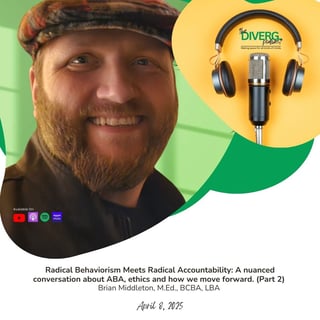
Speaker: Hi everyone. i know I'm always really excited for every episode, but this week's episode is no exception. Today we are talking with Brian Middleton. He is the bearded behaviorist on Instagram.
Speaker: And i found him a few years ago, about a year and a half ago, when I was really looking to see if there was a different way to do applied behavioral analysis. As most of you know, it's the easiest thing to access through insurance and it's the most readily available resource.
Speaker: But if you are kind of on your own and going up against BCBAs at school or in different places, sometimes it's really hard to find someone who is values aligned, but also speaks that language. And what I found when I started following Brian and a couple of others on Instagram is that there are quite a few autistic BCBAs who are really pushing for change in the industry and advocating on behalf of autistic people. And they just have a really amazing point of view that deserves to be heard. So really excited to have Brian today.
Speaker: We're going to talk about a lot of things. um Some of it is just, you know, At its core, what is applied behavioral analysis? What is it not?
Speaker: Where has it been co-opted in the wrong direction? And how does that apply to how it's being used today and how it's being used with our kids? There's just some really great information in here. It's really great practical things as well.
Speaker: And then we're going get into a conversation around medical models of disability, which is a big topic in the online world um around autism and disability in general and how we approach things and where we go from here.
Speaker: What I love about Brian's approach to these conversations is that he really focuses on the fact that he believes the industry should take accountability ah for what's happened in the past and some of what's currently happening. But most importantly, he has a tremendous amount of grace and compassion for parents.
Speaker: And if you've stumbled through, you know, the world of disability parenting, you in any respect, one of the first things that you will see throughout history is that parents often end up holding them back.
Speaker: We are tasked with raising these kids um and dealing with some things that we didn't expect in a world that doesn't necessarily value them in the way that we would like see our kids valued. And with it, we're bringing with us a whole lot of systemic ideas that have been implanted, whether we like it or not.
Speaker: And so there's a lot going on Most of the time, parents are just trying to get through the day. and then when you take a step back, you realize that if anything goes south, the whole world is sort of blaming you.
Speaker: Way back in the day, we were refrigerator moms. And now we get caught in debates about types of therapy get called names online for parenting certain ways.
Speaker: And I think what I love about Brian's approach, as I mentioned, is it's just so compassionate. It's so realistic. It's so rooted and grounded in reality and what we're dealing with.
Speaker: But it also has a very clear sort of way forward. So I think it's a conversation everyone will enjoy. But also, it it's just packed with really valuable information. So excited. So let's get into it.
Speaker: All right. Today we are here with Brian Middleton. He is the bearded behaviorist on Instagram. I have been following him um for a couple of years now and have always been very, very impressed by the advocacy work that he does, but also something that he's a part of called Critical Friends of ABA. So I'm going to let Brian introduce himself and we will get into it.
Speaker: Hi, Brian. Hi. Thank you for having me. I'm excited. Really grateful to be here. Like, thank you much. Amazing. Well, thank you um Tell us a little bit about you who you are, your background, why you do what you do.
Speaker: Well, um okay, so let's start with ah a little bit about me, myself, and I and on a more personal level. um I am autistic ADHD or ADHD.
Speaker: um I was identified it as having dyslexia dysgraphia ah early on um in in my tweens slash teens. um And I heavily suspect that I am also dyspraxic mildly.
Speaker: um because of a few things that when I learned about dyspraxia, um is there a benefit for me getting ah a formal diagnosis? No, because there's ah the work I do right now doesn't really impact that. It's more of a just being aware of.
Speaker: um But I, when I was a tween slash teen, received that the diagnosis of the dyslexia dysgraphia alongside of nonverbal learning disorder,
Speaker: um which is a common misidentification for assigned male at birth, autistics. um And ah it wasn't until I was ah a special ed teacher because I i pursued um a an undergraduate degree in initially history,
Speaker: And then added special education as a dual major and then specialized into special education. And when I was working as a mild model or moderate special ed teacher with autistic kids, I was like, this is my childhood.
Speaker: Yeah. Like this is that like, i like obviously there were differences, but this is my childhood. And so, um I pursued more understanding to try to understand what was happening with myself and with the students I was working with.
Speaker: Um, interestingly, my journey towards getting diagnosis was a lot different from a lot of other people because I had access to resources as the behavior specialist, special ed teacher.
Speaker: yeah and And so, like, I went out and found resources and got a hold of some formal diagnostics that the school district normally threw shreds because they didn't work with adult learners.
Speaker: Right. And and i I filled out all the things, had family fill out all the things, walked into the doctor's office, said, Doc, I think I'm autistic. Here's all the data that I have gathered. Here's the assessments that were scored. This is this, this is this and blah, blah, blah. Oh, here's my old IEP.
Speaker: I was one of the the first recipients of an IEP um wow because ah idea was authorized and yeah. i graduated in two thousand and four from high school so um long Long and short of it, ah I showed all this to the doctor and said, hey, um what do I need to do to get a formal diagnosis? And the doctor said, you did it.
Speaker: So like very much different story than than what most people have to to figure out. um But like this led to me going like, oh, I know what's wrong with me. Yeah.
Speaker: Um, and, uh, that, that led me down a journey of, uh, that it's not what's wrong with me. It's, this is what's, this is the piece of information that was missing.
Speaker: Right. um which I'm sure we're going to go into like the the philosophical piece and yeah and of all the models of disability, but long and short of it, it's it's been a big journey for me. And um it's a journey of self-discovery as well as a journey of advocacy. It's been a journey of realizing the very distinct advantages that I've had due to circumstance, due to birth, due to environment.
Speaker: um And like when I went into behavior analysis, in some ways I came in with my eyes half shut because I didn't quite understand 100% the criticisms that the field had. um And in many respects, I'm grateful that I had that ignorance because I may not have gone further in.
Speaker: Right. and um Because on the other side of that, once I had the, oh, oh no, that's what they mean. Oh crap. Yeah. um Like that, that piece,
Speaker: I'm glad I had it when I had more knowledge because um like, I know some people, many people who've come to me and they're like, I don't know if I want to stay in behaviorism because I don't like all this other stuff, blah, blah, blah, blah. thinking you about changing careers.
Speaker: And I've, I've, and I've talked with them about it and I don't try to convince people to stay. i write yeah try to convince people to have an impact where they're at. And if if them having to leave is where they're they're going to have their impact, then I encourage them to do that. But like my response is be where you feel comfortable um as as long as you're being an advocate for meaningful change.
Speaker: um But people have been like, Brian, why don't you leave? And I'm like, why? Yeah. Like i'm I'm doing the good that I needed to have done for me.
Speaker: When I was a child, I'm trying to be the hero that I needed to be. But more importantly, um I'm trying to be the member of the community that needs to impact for change.
Speaker: right And like we all can make meaningful change where we're at. And so um i I got my master's of education yeah with administrative endorsement when I was a special ed teacher.
Speaker: As I was finishing that program, um I came across a behaviorist who taught me about behavior analysis and helped me to understand what I needed to do because I was a, um, running an under, underfunded, under supported program where basically the kids were struggling and I was spending at least a ah quarter of my paycheck helping and supporting them.
Speaker: um And and that the understanding of radical behaviorism that I was able to bring to the table literally changed things for the better for the kids. And I I see the potential for good and I see not only the potential for not good, but also the literal harm that's happening. And i I believe that the only way that we can truly impact change is to acknowledge the harm that's done, is done, has been done.
Speaker: and correct and and make things better because becoming a BCBA, a board certified behavior analyst for those who are NGWA, that stands for not good with acronyms,
Speaker: like Sorry, i can't I created that when was special ed teacher because special ed is rife with acronyms. acronym So NGWA, please use it. It's it's a joke.
Speaker: But yeah, so so my journey but to become a behavior ah board certified behavior analyst is one of discovery of of simultaneous joy, exploration, excitement, horror,
Speaker: um frustration, anger, ah gratitude, ah just just a whole slew of things. and And I really do think that the only way that we can initiate meaningful change is by being aware of of the problems that we have, um including being aware of tokenism, um which, like, unfortunately, my first big interactions with behavior analysis outside of my grad program
Speaker: um was tokenism, but we can go into that if that needs to come up. it's It's a process.
Speaker: Right. So um one of the questions I love to ask people on the podcast before we jump into things, because I think it helps ground everyone is if you had a magic wand, I could change anything about this field, anything about the way we're talking about neurodivergence right now, what would it be?
Speaker: I mean, magic wands change anything. Yeah.
Speaker: if It would be a cultural shift towards understanding that all behavior is an indication that something's up.
Speaker: Like something's happening in the environment. And that there's nothing wrong with a person if they're expressing distress, frustration, anger, irritation.
Speaker: It's an indication that something's wrong in the environment. Like if across the board, I would, ah I wish we could like culturally make that shift because more than anything else, when I, when I do my advocacy work, I, I am like as a behavior analyst providing caregiver coaching, because that's something that I do as a behavior analyst, providing support for school staff, um,
Speaker: uh, for, for friends, for family. Like, obviously I have limitations on what I can do as a behavior analyst with friends and family, but like, I'm always, I'm always teaching and shaping and showing people, um like that understanding that it's not something wrong with the person.
Speaker: It's an indication that there's something wrong in the environment. And in fact, um, I, I actually quasi loathe the name behavior analysis Because like technically it's inaccurate. it's We're environmental analysts. We identify what's happening in the environment and analyze how the environment impacts learning and impacts behavior.
Speaker: um and And when you make that cognitive shift away from behavior analysis to environmental analysis, it really changes the way we perceive things.
Speaker: Um, so that changes, ah like I can even go back to situations my son and that would change everything. ah Like if everyone around was focused on the environment, purely and totally, we, I told you we had him in a program for three years. Kindergarten was kind of a disaster. ah um and when I pulled him out and started homeschooling, one of the things that we learned very quickly was that a lot of what was being called eloping, which wasn't even eloping, was him removing himself from situations where he felt crowded.
Speaker: Whether it was someone on top of him, because someone you know did this in a desk, yeah or too many people in the room. yeah like it it was all environmental, and no one had ever picked up on it.
Speaker: They were just like, oh, it's refusal, he's eloping, he just can't sit in a chair. It's like, that's not what's happening. Yeah. Yeah. and And like, even if it is refusal, okay. Why is he refusing? Yeah. Like, like refusal is a right.
Speaker: Yeah. ah Vocal protest is a right. oh Yeah. ah People say noncompliance, noncompliance is nonbehavioral. ah do do Do you know, have you heard of the dead man test?
Speaker: No, I have not. Okay, so yeah this is not just behavior analysis that uses this test, but it's it's ah it's a behavior analyst concept. yeah So the dead man test, it sounds a little morbid, but if a dead man can do it, it does not count as behavior.
Speaker: Interesting. Okay, so laying down on the ground. If a dead man can do it, it's not behavior. That's interesting. Falling over.
Speaker: Falling over is not a behavior. Noncompliance. Right. Like if you shouted a dead man to do something and they're not doing anything, that's nonbehavioral. That's so interesting. Sleeping is a behavior.
Speaker: There's actually sleeping there' sleeping specialists, both in medical and behavioral. I have some very good friends who specializes. That's really interesting. Specialists. um mean like Refusal.
Speaker: Refusal is a behavior. Right. Right. So I actually have a joke. Dead man tell no tales because that's verbal behavior. Right.
Speaker: That's funny. So, you know people are like, Pirates of the Caribbean. like, that was around long before Pirates, but okay. yeah That's funny. we're going to have a great comment. There's so many. I was taking great restraint to get through this intro because there's so many of these questions like packed in here.
Speaker: ah and like having fun with this. That's important thing. You kind have to. ah So we kind talked about it before we jumped on, but a lot of our listeners or parents,
Speaker: Or, you know, here in New Jersey, we have a lot of clinicians working in what I call more compliance heavy environments. And you're welcome to challenge me on that language. um Maybe they're doing like child led therapy, but it's like in conjunction with.
Speaker: a kid who's getting a lot of other like more compliance based stuff or the clinic as a whole is compliance thing, whatever that might be. um ABA, particularly when applied to these young autistic children, sparks a lot of intense debate.
Speaker: ah So I would love for you just to share your perspective a little bit on the middle ground that you've found in ABA and what sets the work you and your colleagues are doing apart from the more dominant practices in the field, the ones that spark so much to me.
Speaker: Okay, so i am I'm going to do a little something a little sneaky because I know this is a later this is a question that's going to possibly come up later, but I'm going to relate to it a little bit.
Speaker: So um first, let me let me address a a a common misconception. A common misconception is that Ivar Lovas is the creator slash founder of Applied Behavior Analysis.
Speaker: Yes, it is. Because I didn't know that he wasn't. So um what Ivar Lovas, O Ivar Lovas is his full name. I forget what the O stands for.
Speaker: What he did is he popularized applied behavior analysis through a pathological framework. towards ah ah Towards treating autistic children.
Speaker: um I am going to say something and then and and then I'll try to explain it a little bit if necessary, but hopefully it'll it'll become readily apparent ah just based off what I say.
Speaker: ah Lovas essentially tried to take the the person out of the institution and instead tried to put the institution into the person.
Speaker: so So private previous to Lova's, the medical model of disability, the medical field, the the attitude was if you were autistic, which previous to that it was called childhood schizophrenia, um or if you if you had any other type of disability that made you, quote, ugly, unquote, that's referencing the ugly laws, um you were institutionalized.
Speaker: And so what Lovas did is, and I'm not trying to demonize him. I'm simply stating historical facts. and historical perspectives here. This is important.
Speaker: What Loevas effectively did was take that cultural attitude of we institutionalize a person and instead he tried to use operant behavior, operant conditioning to condition the individual to appear indistinguishable and therefore try to institutionalize them inside their own bodies.
Speaker: And compliance-based approaches with any form of behavioral supports, therapies, treatments, services, whatever.
Speaker: is effectively continuing that work of trying to make a child indistinguishable from their peers. and ah We have neurodiversity language now, so we can say indistinguishable from their neurotypical peers, but I wanna make sure that a part of understanding this is also understanding the the neurodiversity language.
Speaker: um Neurodivergent means diverging from the typically typically accepted norm. It does not mean typically developing. Neurotypical does not mean typically developing. It means typically accepted.
Speaker: Oh, that's interesting. I've never heard anybody break that down. That is super critical. It is. um Because it's it's about. So from a behavior analytic perspective and behavior analysis, therere there are three things that control behavior. Phylogeny.
Speaker: Phylogeny. AKA nature biology. Yeah. Ontogeny, AKA nurture, learning, psychology, whatever you want to call it. There's multiple names for it.
Speaker: Right. and So, so there's your learning and then culture. Yeah. So, so, and radical behaviorism is an evolutionary science It falls underneath the functional contextual umbrella.
Speaker: Right. um Because that's the overarching science. So ah social psychology, positive psychology, ah neurology, endocrinology, um evolutionary psychology, evolutionary biology.
Speaker: um All of these are underneath the functional contextual umbrella. um Polyvagal theory, which there are some There are some criticisms that I have of it, but there are some positives too.
Speaker: That's telling me I want to go so deep into this. Yes. and and And I'll touch on it when we get into the ACT piece because there's there's actually crossovers. so Okay, great. Yeah. um Especially when we get into ACT and PDA and and ODD and all that stuff. Got it. Amazing. but So we'll come back to that.
Speaker: But like radical behaviorism falls underneath that umbrella. And so we're a part of it. And so we there there's some critical assumptions that we have to have as radical behaviorists.
Speaker: it And those assumptions are that behavior is controlled by those three things within an environment. Right. So if you fail to account for the phylogeny or the nature of a person. Right.
Speaker: And you fail to account for their culture. and you're only accounting for ontogeny, aka a learning history, and then you overemphasize ontogeny to the point of compliance, then what you're doing is you're conditioning the individual to be in a prisoner in their own body.
Speaker: And that's what the autism community and the disability community refers to as neurodivergent masking. Yes. and and i And I've actually taught multiple presentations on on how masking can be understood from a behavior science perspective, especially from a behavior analytic perspective, because masking can be conditioned.
Speaker: Now, there's the opposite of compliance is cooperation. Yes. Yes. Okay, so are are there times and places when compliance is necessary?
Speaker: Yes. yeah Yeah. Like it if it's an emergency situation. Yeah. Yeah. I don't want to worry about a child um running into a burning building or ah like running into a street, like ah that sort of thing.
Speaker: Are there times when that's necessary? Yes. But the overemphasis on compliance is because of that pathology paradigm Not my term. That actually comes from dr Nick Walker, ah who is a an elder in the ah neurodiversity community.
Speaker: She is a heavy contributor towards the um neurodiversity paradigm and the work there. Okay. Very cool to know. So, so I highly recommend her work, especially the book, Neuroqueer Heresies. Okay. It's, it's, it's an, it's a heavy read, but thankfully it's a collection of essays.
Speaker: Yes. So it's an easy read and it's available on audio for those audio files. So like audio, this at this stage in life. Yes. Audio is a wonderful thing. Yeah. um But, but the, the pathology paradigm is the is broadly speaking, the paradigm that pathologizes behavior and and reinforces the neurotypical paradigm, the paradigm that if you're not neurotypical, if you're not accepted, there's something wrong with you.
Speaker: So what's interesting about the way you're presenting this is, are you familiar with the work of Dr. ah Alicia Broderick? Autism Industrial Complex? Yes. Yes. Okay. So I just interviewed her maybe like two weeks ago.
Speaker: um She has a great, her book's amazing. it it's ah It's a heavy read because it is heavily cited, but she has a great talk online where she talks a little bit about the rise of autism acceptance, autism awareness.
Speaker: And one of the things she says that's not often present in the conversation specific to ABA is And she's like, there's two things that have happened over the last four years. She goes, yes, ABA has become this dominant, like cure all. And I use that very intentionally, even though I don't believe it um in the, in the, the world of autism and what parents are seeking for their kids. She's like, but honestly, avi just rode way.
Speaker: She was what actually happened was this very like, fear-based point of view around what it means to be autistic and what's going to happen if your kid is autistic. She goes, and ABA was just there.
Speaker: She goes, any of the services that we like currently use could have ended up in that spot. But I've never seen someone break it into those like two pieces before. and what you're talking about, pathologizing sounds like a very similar train of thought.
Speaker: Yep. ah Like, I'm not deeply familiar with um with her work, but I was I was familiar enough that when you said when you said um Dr. Broderick's name, I was like, oh, who is that?
Speaker: So, yeah. And it is
Speaker: Like, I have seen pathology perp paradigm crop up a lot in education. I've ah thankfully SLPs, so speech therapy and occupational therapy are moving away from it. ah Probably a little better at moving away from it right now than radical behaviorism.
Speaker: um And just so everybody knows, when I say radical behaviorism, there's it's because there's a difference between. So the first behaviorism was called. um Oh, methodological behaviorism. Okay. um Methodological behaviorists believe that the only thing that counted as behavior is what you could see.
Speaker: Interesting. Okay. So the reason why radical behaviorism became the dominant behaviorism, and and i so I don't say that methodological behaviorism is gone because there's still people who claim to be radical behaviorists, but are not. Right. But B.S. Skinner...
Speaker: specifically challenged that notion by saying that thoughts, feelings, emotions, internal events count as behavior. Just because we can't observe it does not mean it can't count.
Speaker: Right. So a lot of times people claim that Skinner didn't believe that like thoughts, emotions, feelings were behavior. That's not true. That's, it's completely the opposite of true.
Speaker: Yeah. um It's what he said was and at the time he said, we do not have, the right technology to a sufficiently account for it.
Speaker: sitting um But in his book about behaviorism, the entire second chapter ah titled, I think the world, ah the universe beneath the skin or the world beneath the skin, he said, we have to try to account for it and we need to develop a technology for accounting for it. um lova ah Sorry, not Lovis, Skinner was proven right.
Speaker: through the fMRI, the functional MRI, because we can now observe it. And in fact, if Skinner had been aware of ah early work in neurology, the first human recording of brainwaves was, I think, in the nineteen twenty s Oh, wow.
Speaker: Okay. So, so we, we have we had EEGs and we, and and like, if he had been aware of it, which, you know, he couldn't have been like the, like information in the, where it spreads and who was aware of it. He just wasn't aware of it.
Speaker: But, but his, his hypothesis was proven even before he hypothesized it. So internal events count. And we do have some technology now. It can be improved, but,
Speaker: but we have technology to account for it. And that's where we're going to be going when we go into the act piece. um ah That's, that's a part of that, that conversation. um But I, I want to very briefly because i I think I'm looking for it right now. Cause I always, always don't forget the name of the authors. I, I, I remember but brain. Yeah. um yeah that one there cook Sorry, trying to find it. one more thing to make a ah there's ah There's a title of a um ah paper that was published, and I'd like to point this out because this paper is so very, very critical. it is... yeah said
Speaker: Nope, that's not it.
Speaker: Whoa. Ethical concerns with applied behavior analysis for autism spectrum disorder. Disorders in quotes. yeah um It is by... ah Wilkenfeld and McCarthy.
Speaker: Okay. um know It was published in 2020 and it was published to the Kennedy Institute of Ethics that might get this journal. i have some toys for you So it it's it's a journal that very specific and I'll drop it in the chat so you can. great. Yeah, we'll definitely link that in the, um,
Speaker: was going say, we'll link that in show notes for people. Good. Cause I want to read that. i I want people to be aware of it. Um, and people need to be aware of it because, uh, I'm going to briefly summarize their conclusion. Sorry for the spoilers, but at the same time, not sorry. It's still worth reading.
Speaker: Yeah. Um, Their conclusion was that the current dominant species of behavior analysis, and I use i stole that term. I'm using it. I'm crediting that, so I'm not stealing it. But the current dominant species of behavior analysis is not ethical.
Speaker: Interesting. Because it violates the rights of the individual. And between my reading that article and me reading the the book, Pain and Shock in America, which is a fantastic book that um documents the um horrors of Judge Rotenberg Center.
Speaker: yep um And then my exposure to some really great people. um One of the models of disability that is really critical to the conversation is the model disability called the human rights model of disability.
Speaker: And that it's it's a very simple model. It's disability rights are human rights. And if we're violating the rights of a disabled person, then it's not effective treatment, right? it's it's We're violating human rights.
Speaker: um And the reason why Judge Rotenberg Center and their use of contingent electric skin shock is still around is because when the Massachusetts organization, I forget this name,
Speaker: um The governmental organization challenged Judge Rotenberg Center. They made a very critical mistake. And that critical mistake is they did not start with the constitutional amendment against cruel and unusual punishment.
Speaker: They started with the argument that they had the authority to tell Judge Rotenberg Center to not use contingent electric skin shock. And because they started with that, they opened this very big loophole. Right.
Speaker: because and and And this is a both simultaneously a criticism and also an acknowledgement of the historical flaws that we have to keep in mind. Because like behavior arises for a reason.
Speaker: by But the the the reason why they didn't see that is because the people who were running that organization were operating from the pathology paradigm.
Speaker: And they viewed themselves as saviors.
Speaker: It was white saviorism. ah We're going to have to like do two parts of this. Okay. but You just hit my favorite, favorite topic. Okay.
Speaker: And so like when, when they, when they fail to acknowledge the really important critical piece of the rights of the individual, Like, because, because the conversation of quotes, effective treatment, I don't know if you're doing the video or not. If you want to do a video, great. If you don't, that's fine.
Speaker: ah Okay, cool. ah But like, I'm doing air quotes here. Effective treatment, right? Effective treatment is not effective treatment if it violates the rights of the person, period.
Speaker: Before we even get to the point of whether or not. Yeah.
Speaker: Yeah.
Speaker: So, yeah. Anyways, um so so I hope that ah that I went round a bit down a big ri rabbit hole. so
Speaker: um So I guess going back to that middle ground, there there is no middle ground in behavior analysis. It's is it do you honor the rights of the individual or not? Right. Do you, do you honor the dignity of, of that person to, and and their rights to autonomy, to self-determination?
Speaker: Like, are there, is there complexity in the situation? Is there nuance? Yes. Yes, there is like, but, But when it comes to the middle ground of compliance heavy environments, and I have no correction for you on that. You said, feel free to connect correct me.
Speaker: And my response is no correction. it's If it's compliance heavy, then it's a problem. like is Again, is there times and places where compliance may be necessary? Yes, of course.
Speaker: Like it's, it's not just parenting. It's also just life. There are situations where um emergencies where like, if, if the, if the hurricane is coming in and the house is blowing down, if the the building is on fire, if there is a dangerous animal that's approaching you, like, you you know, that, that, that, that funny little meme of, do you, can I pet the dog? I want to pet the dog. Yeah.
Speaker: right With the little girl who wants to pet the bear. like No, that was a compliance situation. Nope, you do not get to pet the bear. Even if you think it's a dog. Because that bear can unalive you. ah Very quickly.
Speaker: like
Speaker: Because we like that's just the nature of of life. is there if we There are certain things where if we don't follow through with like being aware of safety and things that happen, then, then the natural consequences, you're no longer present on this planet as a living, breathing being.
Speaker: And you don't pass the dead man test. ah But the the flip side to that is, is that we need to build collaboration. Right. Yeah. We're social creatures, even, even people, even humans that have a lower social drive. Right. We're still social creatures. Right.
Speaker: So there's two two kind of trains about it's always really interesting to me right there's the absolutely unexpected like disability right piece of all of this but then there's also this like flip side and maybe it's because i' my personal experience and the profile of my child but like the compliance heavy stuff hasn't traditionally worked Like, he generalizes so much more through collaboration.
Speaker: And I don't know if there's research and work on that, but like that's what blows my mind. And I think nobody wants to talk about it. No, there there there is some research on it. I'm not going to be able to quote it or sign it off the top of my head type thing. But um there' there's emerging research that demonstrates the opposite.
Speaker: um And then there's also research that demonstrates that compliance heavy, specifically punishment heavy,
Speaker: environments do not lead to meaningful learning. um And when I say punishment, I want to very be very clear here. When I say punishment, I'm meaning the behavior analytic definition ah punishment.
Speaker: So ah let me define reinforcement and punishment because when we define them together, they make more sense. So reinforcement is a stimulus that follows a behavior that increases future behavior.
Speaker: Punishment is a stimulus or sorry, it increases or maintains a future behavior. That's in a similar class. ah Punishment is a stimulus that follows a behavior that decreases future punishment.
Speaker: Sorry, sorry, dick decreases future behavior. behavior and future checking So, for example, early on when I when I corrected the spelling of my my name.
Speaker: Yes. um That by definition was a punishment.
Speaker: but by By definition, because everyone listening, I misspelled his name in our show notes. it's It's and it's not I'm not pointing that out for the purpose. I think it's a great, great analogy. It's sort a perfect example. Right. So but I didn't just deliver a punisher in it. And that's it.
Speaker: I also delivered like how I delivered it mattered. Right. And then I also followed it up immediately by reinforcement with reinforcement, because it's actually reinforcement that changes behavior because you're reinforcing an alternative and incompatible or other behavior.
Speaker: Right. um and And so, like, that's that's one important thing to point out is that but when I say punishment, I don't mean aversive, painful thing. Right. That can include that.
Speaker: But punishment is simply some sort of stimulus that reduces future behaviors. Now, I want to clarify something else really important here, too. Punishment does not equal bad.
Speaker: Reinforcement does not equal good.
Speaker: Reinforcement does not equal bad. Punishment does not equal good. yeah it's They are just a way of viewing stimuli. Remember how I said that we're behavior analysis is the wrong name. It's environmental analysis. yes The thing that behavior analysts analyze is stimulus.
Speaker: yeah And how stimulus impacts behavior. The environment is filled with stimulus. I am a part of the environment. You're a part of the environment. The walls around us, this podcast, like that your your device, yeah um everything that you're listening to this on, everything is a part of the environment and all of it is stimulus.
Speaker: Now, here's a fun one for you. And I like to point this out because I like to to bridge the gap and help people to see. And for the clinicians out there, I hope this helps you with seeing this and and increases your willingness to work with your peers.
Speaker: Occupational therapy is the other side of the behavior analysis coin.
Speaker: Occupational therapy deals with sensory processing. Behavior analysis deals with stimulus analysis.
Speaker: Interesting. so So an occupational therapist specializes in how the individual processes stimulus. Right. Behavior analysts identify how the environment and the stimulus within the environment impacts learning.
Speaker: So really what occupational therapists and behavior analysts need to do is work very closely together when we're talking about any sort of processing that is different from the accepted norm or different for or that is presenting in a way that is is unusual from the uh the mean distribution of processing now notice i'm trying not to say normal yeah It's hard to not to say normal, but I get to. But like, it's like we have, we have expectations, right? Because, because the concept of normal came about because of, of stimulus, right?
Speaker: It is, it is quote, non-pathologically. It is normal to hear somebody communicate in vocal, vocal spoken words. Right. But just because it's your expectation is that it's that doesn't mean that there's other forms of communication.
Speaker: AAC is a valid form of communication. and we should be viewing communication as non-hierarchical. Yeah. So like any form of communication, as long as we can understand it, is critical. Right.
Speaker: And and we're when I say non-hierarchical, I mean, we're not supremacists. Right. Yes. Yes. but Like how was thinking of this stuff in here. Yeah, I love it. love it And it's funny, too, because I just finished up a list of questions for Blanc after listening to her work.
Speaker: And ah it was very true. And my son's has been very true of my son's journey. But like she echoes it again and again and again. She's like the second.
Speaker: you start acknowledging all communication, all of it, not demanding things, not just acknowledging. She's like, you are into a whole new world of the potential for this child to develop. And she speaks in very confidently about it.
Speaker: And and that I can, and I can tell you that that is so true because every single time that I i work with any for any individual person, Like I work, I love working with families. Yes, my client is the the primary learner, right? The rights holder.
Speaker: I'm going to add this for clinicians, stakeholder, environmental stakeholder, change it from stakeholder to environmental stakeholder. They hold a stake in the environment. yeah Okay. And then the number one environmental stakeholder is the rights holder.
Speaker: Interesting. Okay. Yeah. I owe that perspective to my very good friend, Imad Zahir, who is actually a, book like at the time of this recording is a board member for the, um, association for positive behavior supports.
Speaker: So, so Dr. Dr. Zahir is a, is a very good friend and we've presented together a couple times. It was fantastic. Um, and And he taught me that concept. So I want to give credit to Dr. Zahir.
Speaker: The rights holder is is this the person who is the recipient of services. So anyways. I tend to like semantics, but those are a really important ones.
Speaker: so So you talked a little bit about the disability rights model. yeah What other models are worth taking over that? And what what does that mean? differentity responds with disabilities So ah a model of disability is how we conceptualize or view disability um So the dominant model now is is actually two models, but the dominant model that affects therapy is the medical model of disability.
Speaker: Please, please, please, let's try to make sure that I know we like to do shorthand. Let's try to remember to say the full name medical model of disability, because the medical model of disability is not the medical industry.
Speaker: correct yeah like There is a fundamental difference. The medical model of disability is how we conceptualize disability. And the medical model of disability views disability as being some sort of pathogen yes that resides within the person that needs to be separated from the person.
Speaker: let's try In behavior analytic terms, we call this a mentalism. It's a circular logic argument. um So... ah Note, I'm going to use this example, but I'm i'm using this example with the utmost respect for um this psychologist because ah one, I respect his work, but also I, too, Skinner always only spoke of this psychologist with respect. So Sigmund Freud...
Speaker: introduced a mentalism of the ego id and superego as being a a so a separate separate entity from the individual. Now, what Freud was to discuss and other ah psychoanalysts are are doing is they're describing something. So if we look at it less as a a physical thing and we look at it more as a metaphor, then it's less of a mentalism.
Speaker: um It's less circular in its logic. But the idea is that it's at a homunculi is the term. If you're familiar with ah um Full Metal Alchemist, the anime, they they talk about homunculi.
Speaker: but But basically a homunculi is like a separate entity from the person. Think of it like a demon on your shoulder or an angel on your shoulder, that sort of thing. um And so the medical model of disability views disability as being a homunculi, a thing that needs to be exercised and removed from the person.
Speaker: um And the reality is more complex than that. um Now, the other dominant model of disability that works synerggenic synergistically with the medical model is the moral model of disability.
Speaker: ah The moral model of disability is talked about not nearly as much. I owe credit to my dear friend, Dr. Lindsay LeBrun, for introducing me to the like the the moral model.
Speaker: um And she is an amazing behavior analyst in her own right. So if you ever want to have somebody come on and talk to, she's great at that. ah But um the moral model of disability frames disability as being a moral failing.
Speaker: It's it's it's either a moral failing in the person or in the family of the person sometimes is framed as being the sins of the parents being visited ah upon the them through their child.
Speaker: Like there's so many different ways that you're framing disability. Yeah. Taking it back to 22 weeks. Exactly. eighty AD? I can't remember them. It's all gone out of my brain. BCE, there you go. yeah Yeah.
Speaker: And the the in schools, the moral model of disability crops up more or a lot alongside the medical model, especially when it's blaming parents.
Speaker: Interesting. i was actually just thinking more in terms of... ah Invisible visibility. um Well, that too. Invisible visibility definitely. Like the the concept of lazy. Oh, they're just lazy.
Speaker: Well, are they? Like, what is lazy? Define it for me. um But if it like there's there's a lot of ways that the moral model crops up. and And we see that a lot. um We see it cropping up a lot in politics, unfortunately.
Speaker: um we We see it a lot in in religion. um And this is not a knock against religion. This is a We need to be aware of this so that way we can counteract it.
Speaker: Because like you can have your faith and be a a human that respects people's so other people's rights. that's It's that simple. Absolutely.
Speaker: And so, yeah. So those that's that's the pathology paradigm models, basically. um The functional contextual models um or the neurodiversity aligned models, if you will.
Speaker: um and And please note that these models of disability are not a guarantee that they're neurodiversity aligned. Right. Correct. Yeah. Not a guarantee that their pathology will not happen, but they're, they're more aligned with it.
Speaker: um And so the, the, the most common talked about model is the social model of disability. um The social model disability conceptualized, this is conceptualizes disability as being a consequence of the interaction between impediment Right.
Speaker: And, and society. Yeah. So, so impediment is, ah is, is where there's something that impacts the person's ability to do something.
Speaker: Right. Right. So ah if, if I were tongue tied, right, that's an impediment. i And, and therefore I would probably need sign language or, or a surgical intervention or a AAC device to be able to communicate.
Speaker: ah with with some sort of verbal vocal-esque type behavior. um I had a learner who was tongue-tied and we we did ah a combination of of sign language and AAC. And ah so surprise, surprise, the concerning behaviors, or as some people call it problem behaviors, magically disappeared yeah because the the individual could communicate. Communication is everything. So important.
Speaker: yeah So, so like that's an impediment and the, through the social model of disability, my modification of the environment by introduction of AAC and sign language and by educating the people around reduced and or eliminated or alleviated the disability. So disability is an interaction.
Speaker: Right. And, and in the, in the, buy ah in the, um, so functional contextual paradigm or the neurodiversity paradigm there, there I use functional contextual paradigm is my thing.
Speaker: I'm trying to, I'm trying to help people understand that neurodiversity falls underneath functional contextualism. Right. So, so it's, so I'm introducing something kind of new, but at the same time, it's not that new. It's actually been around for a very long time. Right. Yeah. Well, and it's also, I think there needs to be some, some protection of,
Speaker: neurodiversity terminology. think it's so easily get sucked. It could so easily get sucked into things that it's not. Like, um, yes. Um, and it does. yeah It's really funny because when I see autism speaks or, uh, autism partnership foundation or the low loss Institute trying to use neurodiversity language, they're consistently twisting it into pathology paradigm.
Speaker: Right. Which is one of the reasons why I like to very, be very clear about correcting the meaning of neurodivergent and neurotypical. Right. Right. And neurodiversity is akin to biodiversity. Right.
Speaker: Right. yeah The diversity of neurological types or neural of which there's a lot to talk about. Yeah. Yeah. And I'd actually like to point out that it's better. for Let's expand our language a little bit.
Speaker: This is another term that I'm pushing um neurobiological types. Neurobiological. Oh, yeah. That makes sense. Because we're not brains in a meat suit. Right. No, not at all. but We're like our our biology is connected. This this concept that somehow your mental health and your physical health are separate.
Speaker: No. No, we're we're not dualists. They're not separate. They're together. That's not even science. but Yeah, it's not even science. We separate out linguistically yeah because we're trying to comprehend it.
Speaker: but right But like just like we separate i out the cardiovascular system from the respiratory system and so that way we can understand them, are they truly separate?
Speaker: Like, does does the heart perceive itself as being different from the lungs? No. Or any less important to the heart functioning or the lungs functioning?
Speaker: It all comes together and collaborates. So um I mentioned the human rights model of disability, which is synergistically collaborates with the the social model. But my favorite model of disability, which I love the social model of disability, but the social model of disability does...
Speaker: have one very common problem. And that is when we only look at it from the social model perspective, there's something called diagonal ableism that occurs. So diagonal ableism is when a social support modification, intervention, change, modify whatever you want to call it, doesn't work.
Speaker: And a person is excluded because of that. then it it very quickly results in the person who is only thinking from the social model accidentally slipping into the medical model of disability or the moral model of disability of, well, they're just crazy. Yeah.
Speaker: i see i I see that a lot too Yes. I would say when parent conversations land in the space of like, but this is really serious and we have to take care of it, which we'll get into more of that later.
Speaker: yeah and it doesn't work. Like it's just to turn off to people who maybe be or use more positive approaches or whatever that might be. sir There's a better way to say that. But yeah. yeah and And so the last model disability I'll talk about, and then we can probably put a pin in it from here. yeah But, but the last model of disability is the biopsychosocial model of disability.
Speaker: okay Okay. ah From a behavioral analytic perspective, remember how was talked about phylogeny, ontogeny, culture? Uh-huh. Biology, phylogeny. Ontogeny, psycho as in psychological or called learning.
Speaker: Culture as in social. Biopsychosocial. Yeah. And so the biopsychosocial model acknowledges that disability can arise through an interaction between impediment and the environment. So we still have that understanding that it's an interaction.
Speaker: So disability is a verb, not a noun. Okay. Okay. Right. So you you don't have a disability because having a disability means it's a noun. Right. But if you are disabled or you are a disabled person, that explains the the action, the interaction that's happening.
Speaker: and so this thing So the impediment can arise through biological behavior. the tongue tie is an example um or, or diabetes or cancer, or um if, if you happen to be born where you, your, your brain is needing additional ah medical support ah or, or, or medication related support, then, you know, medical medication is beneficial and it, that's the impediment and the medication is supporting and addressing the impediment.
Speaker: Psychological, learning behavior, how we learn, how we interact with each other. um Social, the social piece is really important to all of it. Now, are there circumstances where disability may only be biological or may only be ah ah psychological or may only be environmental?
Speaker: Yes, there there are, I'm sure, very rare circumstances where it may only be one of those. But the reality is, is that the biopsychosocial model tries to account for all of those.
Speaker: Yes. And how we're conceptualizing disability and then we're how how we're seeking to modify the environment to address disability. yeah and and request Yeah, that makes total sense because one of the follow-up questions was, so it's only ever been presented to me as medical versus social, but that's because I'm not as deep in that world. but I'm very new to this myself. i'm i'm just I just hyper-focus and go, whoa, well what's this? I understand that.
Speaker: But I think one of the things that typically comes up, like, boots on the ground among parents is like, well, if you take away the medical model, where are my kids supports? And if you, and if you leap into the social model to your point, where does that put my child who is not, it yes, theoretically they are disabled by their environment, but like, there are still very real debilitating issues happening as a result of this, that we could fix the environment all we want. And it's still going to be a quality of life issue.
Speaker: So that, yeah, that model makes a lot more sense because it seems to take all of them into account. Yeah. and And this is an important thing I like to point out, especially for PDA parents and for ah profound autism parents.
Speaker: i I get annoyed by the profound autism because it feels like it's a goalpost move. yeah but But at the same time, it's a goalpost move by certain people, but it's not a goalpost move by all people. So, yeah but the profound autism conversation is because of diagonal ableism.
Speaker: Right. Because, because parents who are struggling and who need that support are, are are being left out of the conversation because of the neurodiversity movements, overemphasis on the social side.
Speaker: Right. and So, so all behavior functions, all behavior arises for a reason. All behavior is indication. Most of it is communication, but all of it is indication. indication I owe that to my friend, Tara Vance, who taught me that. She is the president of um neuroclastic education.
Speaker: ah she She taught me all behaviors, indication, not communication. um So, but ay diagonal ableism creates a problem of it leaves people out and it marginalizes people.
Speaker: Right. And like the, we still need to center the rights holder. Right. But we need to understand that the environmental stakeholders also have rights. Right.
Speaker: That is also fair. Right. yeah and and and And we can advocate for the rights of the individual while also addressing the rights and supporting the rights of the environmental stakeholders.
Speaker: And we can kindly and patiently and very firmly say, no, you do not have a right to dictate to somebody else how to live their life. Right. Right. Right.
Speaker: yeah And so like when when I see autism parents, big air quotes, they're getting defensive and and and centering themselves.
Speaker: The reason why they are doing that is because they are marginalized as 100 percent. Yes. And and that the way that we address the disconnect between all these groups is by bringing it back to the um functional contextualist paradigm you of saying your rights matter too.
Speaker: Yes. Rights are non-hierarchical. Now your child's rights very much are very important. Yeah. And you need to have support. Like,
Speaker: One of the ah functional contextualist science I love is anthropology. One of the anthropologists that I absolutely love to follow, and I always forget her name because I only see in writing. and I don't get here. It's being said, I'm sorry.
Speaker: ah She points out that um during hunter gatherer days, um parenting throughout the process of a 24 hour period, there would, aside from the two parents.
Speaker: Yes. aside from the two parents of the children, there was at least 14 other independent people participating in childcare. Very, yeah.
Speaker: And and and it was a they were it was literally when they say it's it takes a village, it's it literally that. It's um it's it end And another thing to point out is that the anthropological research shows that For approximately 50% of the day, the mother would spend that time in leisure.
Speaker: we'd have a lot more regulated nervous systems. yeah Yep. Yep. Okay. So, so a lot of it is, this is functional contextualism. It's understanding the phylogenic piece, the, the nature of the individual that humans are not machines that we can't just constantly be on.
Speaker: And that leisure is a critical component to addressing fatigue and And and and leading to a well-regulated nervous system. um And and so we we have to have that very critical piece accounted for.
Speaker: so if you consider that from a non-disabled, a parent of a non-disabled child. Yeah. Right. And in hunter gather days slash in hunter gather existing hunter gather cultures, because we can examine those. so Like if that's the level of support that they need now fast forward to or or bring it over shift perspective over to postmodern capitalism and post industrialism. Right.
Speaker: um And the expectations that are placed on a family. yeah Like, of course, the parents are going to be scared that they're going to have their rights violated as well. they And lose that little support. Yeah.
Speaker: Yeah. Like, and so how do we address it? We don't address it by dividing. We address it by coming together and yes, anding. Like, yes, and is so important. It's, it's, it comes from,
Speaker: um ah it comes from improv, right? So it's yes and, like whose line it is anyway and that sort of stuff. it's It's saying, yes, this is what's happening and we need to respect the rights of the rights holder.
Speaker: Yes, you need support and this is a really sucky situation and how can we reduce restrictions and move towards cooperation? Yes, there's a very clear safety concern And we have to address that safety concern.
Speaker: And what can we do to move away from coercion and compliance base and towards making things better?
Speaker: a bit of an abrupt ending, but a really great episode, a part one to what I think is going to be at least two more parts, maybe three. um So as always, we'll link anything we talked about in terms of references in the show notes below.
Speaker: really excited for the remaining episodes. That was super meaty and really great. ah We'd love to hear your feedback on DMs and Instagram or over email. And as always, you can check out what we're doing here in the local area at www.divergeprograms.com. Thanks again, and we will see you Friday of next week.