Transcript
Speaker: I'm JC Stoner, and this is the Swakuho Podcast.
Speaker: Today's episode is extra special because we are recording this bonus episode in Fort Smith, Arkansas at the annual Swakuho Conference.
Speaker: It's been two years since our region has all been together, so I want to send out all the appreciation I can to the staff at University of Arkansas-Fort Smith and Arkansas Tech University.
Speaker: You did real good.
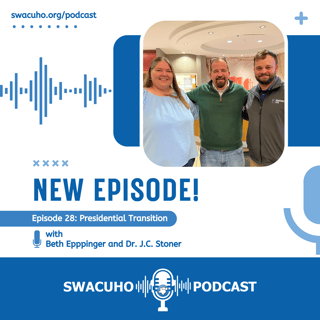
Speaker: And I want to give a personal shout out specifically to Beth Eppinger and Delton Gordon for hosting us with such style here in Fort Smith.
Speaker: It has truly been a pleasure.
Speaker: On the best of years, hosting a conference is challenging, time-consuming, and emotionally exhausting, just to name a few.
Speaker: I can't even begin to imagine those feelings leading into the first conference back in person when considering case count fluctuations, potentially lower participation, cut travel budgets, and all the other things.
Speaker: So for those in the audience, the rest of the conference, if you see someone with a host committee ribbon on their name badge, you better thank them from the bottom of your heart for rising to the occasion.
Speaker: If you're listening to this on your drive home from the conference, reach out to Beth and Delton and thank them.
Speaker: I'm sure it wasn't easy, but they did it.
Speaker: So today I'm slotted in as a program in session block six, the second to last block.
Speaker: My program abstract enticing participants to choose this program was, quote, be a guest of the session and you might find yourself as a guest on the podcast because I'll be doing micro interviews with audience members.
Speaker: We will be talking about what you learned in previous sessions, plans of action post-conference, and maybe even your hopes and dreams.
Speaker: It's hard to tell what's going to transpire in the session because you will be generating the content.
Speaker: If all goes according to plan, our region will have a bonus podcast episode to listen to on the way home from the conference.
Speaker: So let's have some fun.
Speaker: Our first guest is Nikki Neely, an assistant residence life coordinator at UT Dallas.
Speaker: Nikki, you went to picking up the pieces.
Speaker: What is the most impactful thing you've learned in that session?
Speaker: The most impactful thing I learned was John Maxwell's five levels of leadership.
Speaker: It talks about the relationships that you have with others ranging from a five being a pinnacle and one being a position, meaning that you follow someone because you have to because of your title.
Speaker: I think that really showed the different levels of where you are with students and even other professionals and how you both can view a relationship differently and how that impacts the work environment that you have together.
Speaker: So what specifically are you going to do tomorrow with what you learn there?
Speaker: So with that, I actually wanted to do something called a temperature check with my students and actually ask them, like, where do you feel like, what kind of relationship do you want with me?
Speaker: And then rate what I feel like I have with them, and how can we get to where they want to be?
Speaker: If they feel like they're a one and they follow because they have to, what can I do to improve that?
Speaker: Or what are things that I've done that you don't appreciate?
Speaker: But with me, if I feel like we're closer to a three or a four, but they don't feel that way, then what am I getting out of that relationship, and what can I do to impart more wisdom on them?
Speaker: How do you think you'd react if one of your staff told you they were a one and just was here because you were their boss?
Speaker: I feel like you're going to have that anywhere, but I would see that as a learning opportunity to discuss with them.
Speaker: What is that about it that makes it a one?
Speaker: Was it that we had a conversation once or is there an improvement I can make whether you feel like something is disorganized or I'm not timely with something?
Speaker: So I think feedback can be really positive and knowing that you're a one when someone can really help you improve your relationship or make the adjustments you need to make them more comfortable in that one position.
Speaker: Um, Nikkel actually talked about in that session, she was the session presenter for that, um, that work within the bounds of that level.
Speaker: So you don't always need to improve to a five if you're a one, but it's good to know where you stand so that you can make the adjustments to make that person and yourself more comfortable.
Speaker: So tell us about your overall conference experience.
Speaker: Okay.
Speaker: So for me, I think the conference has been very eye-opening.
Speaker: There are a lot of things for me not having a master's degree that I've gotten to learn, hearing about theories, things like the ethic of care.
Speaker: You know, when you're a committee chair or anything and you're caring about people more than just their position, I think that ties back into the five levels of leadership, having the ability to care about someone outside of their role and how they serve you.
Speaker: But also just getting to experience how new professionals feel about their positions and seeing that I have a lot of the same experiences or different experiences that others are having and how we can connect and how I can offer them advice or get advice from them.
Speaker: What's the most challenging part of your job?
Speaker: I would definitely say it's...
Speaker: Understanding the way in which you approach conduct or student follow-up, I think the way in which you approach conversations that may be difficult for students really impacts them in the future.
Speaker: The idea of restorative justice and educating them when something happens, I feel like goes a lot longer than just being punitive with them.
Speaker: I feel like understanding where they come from, maybe it's a background or maybe it's a language barrier, but the way that it influences decisions they make and how you can improve that and help them become part of the community rather than just forcing them out because they did something, quote unquote, that got them in trouble.
Speaker: Our next guest is James Fairchild, the director of housing at University of North Texas.
Speaker: James, welcome to the show.
Speaker: Hi, JC.
Speaker: Thanks.
Speaker: James, how long have you been at UNT?
Speaker: Yeah, I started as a RA in 1997 at UNT and I've been there my entire adult life.
Speaker: Wow, moved up the ranks.
Speaker: Yeah, I managed.
Speaker: Unusual in the field, I guess, probably is a way to put that.
Speaker: But UNT is home and it's where I hang my hat every day.
Speaker: Do you feel like you know every single job because you've had every single job?
Speaker: I can pretty well say I've held most every position in our department and have connections all over campus to have a pretty good understanding of the landscape and what we do and how our university works.
Speaker: You went to the program Odd Jobs, embracing specialties and weird roles in res life.
Speaker: I'm sure you've seen a few odd jobs and weird roles through your time.
Speaker: I have.
Speaker: Yeah, I've held a couple of those jobs, whether it's the other duties as assigned in whatever your regular role is, or we've come up with some things to make it happen that were just necessary to
Speaker: to put a person in a position or put a team together to, uh, to address a specific problem.
Speaker: So yeah, that's, that's familiar territory and what we have to do to get it done.
Speaker: Isn't that the truth?
Speaker: What is the oddest job you've ever had to do?
Speaker: I mean, I, the oddest job probably, and I loved it when I was a student.
Speaker: Um, I did summer conference cleaning crew.
Speaker: It was a complete change of pace.
Speaker: It was hot and sweaty and wet and dirty.
Speaker: And it, we,
Speaker: carried around bags of trash and delivered linens to rooms and did everything.
Speaker: But it gave it it gave an opportunity for myself and that team and and even working with that group since then in professional roles to, you know, help you help students that may have a perspective.
Speaker: about that kind of work to ground them a little bit and give them some foundational understanding.
Speaker: There's a lot of importance on those housekeeping and facility support roles that things don't get done without that.
Speaker: So it really, it was an opportunity early in my pre-professional development, my student employment.
Speaker: And so I really think fondly about that and call on that experience on a pretty regular basis even now in my regular job.
Speaker: Yes, I couldn't agree more with you about how I supervise our housekeeping at UT Dallas, and it is one of the highlights of my job is working with them.
Speaker: And you are absolutely right.
Speaker: Like, it's such a critical role and probably one that is the most underappreciated in terms of, like, contributory value.
Speaker: And I consider our housekeepers like our silver bullet of customer service in terms of just, like, you want someone to fix, like, just do some gesture of good wills and cleaning people's units when you don't need to or
Speaker: aren't responsible for it.
Speaker: And it just helps out so much.
Speaker: It goes a long way towards, towards the experience for our students and, and, and conferences guests too.
Speaker: Yeah.
Speaker: And if you want to know who knows things about residents, your housekeepers, they know because sadly, a lot of people just walk by and pretend they don't exist so that they get to see everything.
Speaker: And if we can encourage anything, and again, housekeeping is very dear and near and dear to my heart, but encourage people to really take advantage and build relationships with the people that are, you know,
Speaker: work in those buildings.
Speaker: Agreed.
Speaker: Yeah.
Speaker: So pandemic's two years old now, give or take.
Speaker: And where do we go from here?
Speaker: Man, that's the $100,000 question, I think, or more, depending on, you know.
Speaker: I don't know.
Speaker: I think, well, I've got some ideas.
Speaker: Yeah.
Speaker: On our campus, you know, we've gotten really comfortable with the idea of, you know, early on, there was a lot of talk about unprecedented times and things like that.
Speaker: Now we have precedent.
Speaker: We've been doing it for two years.
Speaker: And so...
Speaker: it's one of those things that we should draw on that experience and keep finding ways to solve the current problems of the day.
Speaker: But then, you know, think about the opportunity of where we're coming out of it potentially, or we're working our way towards being out of it.
Speaker: And what does that look like to re-implement or re-engage the things that we've done before?
Speaker: And then also, you know, those things that we did before for a long time, if we stop doing them, do they need to come back?
Speaker: And do they
Speaker: have the same value or do they have the same experience that we want to provide to students or have we found some new ways that need to stick around?
Speaker: So, you know, the hybrid version of what we have going forward is something that that
Speaker: There's an opportunity, at least right now, we're kind of at a at a at our transitional period back into into what may or may not feel like normal to some of us.
Speaker: And for our students, especially, you know, undergrad students, they don't know anything different.
Speaker: So are they in a good place with where we've at with what we've been providing for for the last couple of years?
Speaker: Or do we need to find a happy medium or a mix of all that to provide the best experience and the best service that we can?
Speaker: I think that's where we're at on our campus.
Speaker: We are trying really hard to push out of it quicker maybe than others.
Speaker: some other schools and the general public, uh, you know, Texas is, is unique in the viewpoint of, of, of the state as far as that goes.
Speaker: But, uh, but our university trying to be safe and proactive, but also return to a regular college experience in our department being a contributing part of that, um, has really taken us back into the, let's get back out of this as quick as we can.
Speaker: The pandemic, in a lot of ways, served as an accelerant for certain areas like service providing and even outside of higher education.
Speaker: Is there something that the pandemic provided you the opportunity to do something that you'd always wanted to do with your department but weren't able to because it didn't have the legs behind it?
Speaker: That's deep.
Speaker: For context, I had a friend, I was outside the region talking, and they had been trying to do virtual tours with like campus admissions for years.
Speaker: And they're always like, we can't do that.
Speaker: And you can't do that.
Speaker: Well, then the pandemic hit and they got virtual tours done and created in about two weeks.
Speaker: And my friend was like, okay, so it wasn't that you couldn't do it.
Speaker: It's just that you didn't want to.
Speaker: Yeah.
Speaker: Yeah.
Speaker: I think, um, for us, the, the, probably the best example of that has been, uh, how we deliver training and, and, you know, zoom or, or, uh, teams or whatever is a, is a great tool to do a live presentation, but being able to record and curate some content that provides the opportunity for training, not just in those regular seasons of the year, the July, August training time.
Speaker: And maybe you get a couple of days of training in January.
Speaker: doesn't really help people that come on mid-year, mid-semester, new professional staff that come on waiting, having to wait for a six-month cycle for the real training to come back around.
Speaker: We've been able to translate a lot of that into, you know, an actual presentation and not just a slide deck or, you know, here's what your supervisors are going to review with you.
Speaker: So,
Speaker: You know, it's been a tiptoe in that direction, I think, but it forced us because, you know, the training from a year ago for our RA staff and our community director staff was expected to be remote.
Speaker: And so how could we do that, still get what we needed in the hands of those staff members?
Speaker: It gave us that opportunity to explore it when previously it had just been about reserving a
Speaker: a big auditorium classroom and sitting a hundred and some RAs down and telling them what they need to know or having a conference room full of community directors and walking through the content.
Speaker: So we really were able to make a shift in that direction.
Speaker: It's got legs to keep us going in that way for the future.
Speaker: That's great.
Speaker: So in closing, you've been at UNT your entire career.
Speaker: We talked to Kent Sampson on episode one.
Speaker: He was at Oklahoma state his entire career.
Speaker: I'll ask you the same question I asked him.
Speaker: Have you ever thought about leaving?
Speaker: Well, that's a tough one.
Speaker: Um, uh, yeah.
Speaker: Yes.
Speaker: It's absolutely crossed my mind where that's, that's a different question.
Speaker: What opportunity?
Speaker: Um, and you know, uh,
Speaker: it's a weird unknown of being an undergraduate and graduate student at UNT and a professional staff member for as long as I have.
Speaker: It's, it is what I know.
Speaker: I think those are translatable skills and, and, and knowledge that I would be able to take somewhere else, but the, you know, the home component of it and leaving Denton and leaving UNT would be, would be a tough hurdle to clear, but it's definitely not out of the question.
Speaker: You know, I, I don't,
Speaker: I don't have ultimate plans to, well, it sounds dark to die at my desk on campus, but I've got a lot of people, I've got a lot of contacts and friends that are like, all right, so when's retirement coming up?
Speaker: Okay, we'll settle down.
Speaker: Not quite there yet.
Speaker: I'm sure there's a few people around here who have some resources for you when it gets to that point.
Speaker: Yeah, yeah, yeah.
Speaker: We'll be looking for the behavioral intervention team resource pretty soon, yeah.
Speaker: All right, well, thank you, James.
Speaker: Thanks, JC.
Speaker: Our next guest is Trish Snow, an area coordinator at Texas Lutheran University.
Speaker: Trish, welcome to the show.
Speaker: Thank you.
Speaker: And fun fact, Trish is actually the moderator of my session here.
Speaker: So she's done a good job taking care of all the getting people in and doing the eval at the end.
Speaker: So Trish, you went to Cancel Culture.
Speaker: Tell us about that program.
Speaker: It was a wonderful program where I was really interested to see the direction it was going to go towards because cancel culture obviously is a hot topic.
Speaker: And especially given the last four to six years of our political climate in America, it could have gone in a very emotional direction.
Speaker: But it was really focused on how are we having conversations with our students to kind of redirect them, both support them and their very emotional reactions to things that are happening in their real world.
Speaker: and then supporting them through the concept of redemption.
Speaker: Once someone gets canceled, what does it look like for them to come back and how are we having those conversations?
Speaker: Because the big conversation that our presenter was having with their students on their campus at Ole Miss was, okay, you're canceling everyone who supported Trump.
Speaker: What does that mean?
Speaker: What does that look like?
Speaker: And the student, after about two days, was like, I can't eat because there were so many businesses and so many other organizations that they rely on.
Speaker: to eat, to function, to take a shower, and they realized, wow, I don't think this is a hill I can die on.
Speaker: I'm going to have to make some compromises with myself.
Speaker: So how do you have that supportive conversation with those students to give them a space where they can still feel like they're supporting their own values and also still living their lives in this world, in this country, in this state, in wherever you happen to be?
Speaker: Did they use any examples of people in higher education who have been canceled?
Speaker: Well, people adjunct or adjacent.
Speaker: The two women who had their students, their kids paid for to go to college in California, that scandal.
Speaker: I cannot remember their names, but I know one of them was in full house.
Speaker: I'm terrible with names.
Speaker: Aunt Becky.
Speaker: Yeah, Aunt Becky.
Speaker: Exactly.
Speaker: That was one of the examples for higher education that we talked about of what were you willing to sacrifice?
Speaker: Like those parents were willing to sacrifice being canceled and they paid to have their students or their kids.
Speaker: into university, one of which arguably might not have wanted to be there.
Speaker: But that was something that was also a conversation, like what would you be willing to sacrifice to be canceled?
Speaker: Because there are some parents that would be willing to go out on that limb and like be canceled publicly or lose their job so that their child would have that type of opportunity ahead of them.
Speaker: So what's a tangible takeaway for someone listening who's talking to their students?
Speaker: Like walk me through what that conversation looks like.
Speaker: I think tangible for me would be a student comes into my office, something happened online, and I work on a small campus.
Speaker: It's very high school-esque.
Speaker: So someone said something on Twitter, and it's like, we can't talk to them anymore.
Speaker: And it's like,
Speaker: okay, talk, walk me through this interaction.
Speaker: What is going to happen here moving forward?
Speaker: Are you really never going to talk to this person again in classes?
Speaker: Like walk me through the interactions that are coming forward.
Speaker: Walk me through the next three weeks.
Speaker: And then having that follow-up with that student a week later and seeing if they held true to that.
Speaker: And obviously like in housing, if you have that follow-up and the student's like, yeah, no, those students haven't talked to anybody in two weeks.
Speaker: It's like, that might be a student alert.
Speaker: But having that follow-up with them where they can kind of see
Speaker: where their values and having to have that prolonged emotional reaction, that sustained peace, kind of supporting them through that and listening, but not judging when they might fall back on their original plan.
Speaker: So.
Speaker: Yeah.
Speaker: What if you're on a group project with them?
Speaker: You don't have any choice over that, so you can't ignore it in that.
Speaker: Yeah.
Speaker: Tell me about the act of redemption and were there parameters or
Speaker: like anything outlined that's like, okay, this person is, should be considered redeemed.
Speaker: That conversation, it came back to kind of group think and mob mentality of like the mob has to decide that maybe they've done enough, but it wasn't, um, it, it, it definitely was an apology is usually never enough.
Speaker: There has, it, there has to be some piece of restorative justice.
Speaker: If something is going back to the community that was harmed, um,
Speaker: for that to happen or some piece of justice might maybe punitive for like the example of the two Aunt Becky, she technically did time, but was that enough for some people?
Speaker: For some it was and for others, Aunt Becky's still canceled.
Speaker: But I think especially on our campuses, like talking with students about, well, what type of apology?
Speaker: Because there's a difference between saying, I'm sorry, and having change and allowing that time for them to make that change and prove it to you versus just saying, I didn't want an apology.
Speaker: And it's like, okay, okay.
Speaker: So if you don't want an apology, then what do you want?
Speaker: Because I think a lot of students just want to be mad rather than to feel that healing, which valid.
Speaker: And especially on small campuses, we need to have that community piece in mind.
Speaker: And that's something I think is very difficult of supporting and being there for the community and not just oneself.
Speaker: My first six years were at a small private school, so I know exactly what you're talking about.
Speaker: There's so many benefits to organizing the community, except for when they organize themselves in ways that aren't as productive.
Speaker: Exactly.
Speaker: So Trish, let's talk about being at a small school.
Speaker: What is the most challenging part of your job working at a small school?
Speaker: It may be what we just talked about.
Speaker: Maybe.
Speaker: It's definitely the multiple hats and how they kind of pile on at once in two weeks.
Speaker: Um,
Speaker: Sometimes you get two weeks of like, this is good.
Speaker: This is coasting.
Speaker: I'm getting a lot of experience.
Speaker: And then something will happen in your area.
Speaker: And you'll have two conduct cases with 11 students.
Speaker: And you'll have a staff member that's being terminated.
Speaker: And you're just like, why did this happen in one month?
Speaker: Because then it really taxes the resources for the people around you.
Speaker: And it definitely...
Speaker: It's difficult sometimes to have the grace for yourself because at that point you've got timelines you're trying to meet.
Speaker: It's very much a little outside of your control and that area for grace becomes a little bit more difficult to wiggle and negotiate with.
Speaker: However,
Speaker: The people at those small schools, when those do happen, are very willing to step in and say, hey, you literally have a lot on your plate right now.
Speaker: Do you mind me taking anything away from you so that you have the ability to handle what's in front of you right now?
Speaker: So, well, when everything can pile up, I think it's the most difficult because you can never plan for it.
Speaker: It just kind of happens.
Speaker: It definitely gives you a good piece to be, like, appreciative of and to, like, reflect on blessings, I think, especially in a first year of the job.
Speaker: I love reading small school job descriptions for like posted positions because a lot of times there's something so random thrown in there.
Speaker: Like I've seen ones that are like area coordinator and radio show manager or someone who worked for me was also the cheerleading coach.
Speaker: And what's the most random thing that's not housing related that you do?
Speaker: I don't know if it's random, but what was definitely unexpected was being made a deputy Title IX investigator in my first year.
Speaker: I did some of this work, and I do behind the bystander training from a graduate assistantship.
Speaker: So I feel prepared on the prevention and the support side.
Speaker: But to have that handed to me my first year, along with one of my coworkers, I was like, oh, we're doing this now.
Speaker: not random, but very unexpected.
Speaker: So that's something I'm having to navigate now.
Speaker: But it definitely provides my staff a place where when something happens, they're the first ones to know.
Speaker: So now my director at least gets like a weekend off when we happen to be on call because the RAs can come to us instead of having to call him directly to report now because the laws in Texas have changed so significantly over the last four years.
Speaker: They are required to report to an investigator and
Speaker: rather than just to a staff member because of the level of who needs to know.
Speaker: And at this point, we ended up with so many cases because students don't know how to talk to each other.
Speaker: Whether or not they follow through, just the reports that come in have been just substantial compared to the past.
Speaker: So it's been interesting.
Speaker: I wish I had a better random job that was radio host.
Speaker: Yeah, no, I'm just kidding.
Speaker: You never know what those things are going to come up.
Speaker: Like I was a guest on a student's radio.
Speaker: They brought me on to talk about like financial smarts of college students or whatever.
Speaker: And I keep it on my rolling resume because you just never know when some job is going to appear and be like.
Speaker: Well, now I get to put a guest on podcast.
Speaker: Exactly.
Speaker: Everyone update your resumes.
Speaker: If that's enticement to come and be a guest right now, I'll even write the bullet or a four-year resume for you.
Speaker: That's even better.
Speaker: So Trish, let's go back to small schools.
Speaker: Again, I'm having such flashbacks here about small schools.
Speaker: Could you talk about the campus politics of a small school?
Speaker: No, it's interesting.
Speaker: I came back to my institution, Texas Lutheran University.
Speaker: I graduated from there in 2018 with a degree in chemistry, went and got a master's degree at Seattle University in the Pacific Northwest, very different culture.
Speaker: And then I came back here because I wanted to give something back to my university because working there I knew that
Speaker: They were trying to make a lot of changes.
Speaker: You don't get paid a lot, so it's hard to bring in those individuals who have those types of trainings.
Speaker: And while I'm not great, I at least went out and got some education to bring back, it's been interesting navigating
Speaker: South Central Texas having all of these ideas from the Pacific Northwest and how do you meet those cultures in the middle?
Speaker: So the politics, I think the students get split where we have a lot of our conservative rural students that'll come through and we have a lot of students who are from like more of the urban cities and have these mashing expectations.
Speaker: And it's even better when the parents get involved and they're like, oh, I'm so glad my student doesn't have a professor who teaches CRT.
Speaker: And I'm like,
Speaker: what is your student's major again?
Speaker: Kinesiology?
Speaker: Oh yeah, I would be really surprised if in the kinesiology major they were leading a critical theory that most sociology students don't even start getting into until their junior or senior year.
Speaker: So it's very interesting navigating those political conversations as they come through because it's definitely a picking your battle.
Speaker: And it's definitely like they'll see something in the window and it's like, I didn't know that was here.
Speaker: And it's like, it's a college.
Speaker: We have freedom of thought and freedom of ideas and just leaning into allowing that
Speaker: but still trying to provide those safe spaces.
Speaker: We're working on bringing gender-inclusive housing on our campus right now because our DEI office is only about two, three years old, and it's a barrier for students to have to go there to get accommodation, to live somewhere where they feel safe.
Speaker: So we're just slowly building on things that we know need to be there and trying to make those spaces so that it's easy for students to feel included no matter where they line on the political spectrums.
Speaker: That's great.
Speaker: Good to be a part of something like that.
Speaker: It is.
Speaker: It's very rewarding.
Speaker: Even as much as meetings get pushed back, it's nice to know that at least I get to push for them to come back.
Speaker: Trish, thank you very much.
Speaker: Thank you.
Speaker: Our next guest is Laura Glasgow, a residential life coordinator at UT Dallas.
Speaker: Hello.
Speaker: Let's talk about 10-Minute Leadership, a program you went to.
Speaker: Give us a brief rundown.
Speaker: Absolutely.
Speaker: So this presentation or this idea was actually kind of from your brain, or at least the name did.
Speaker: So they talked about using intentional time during staff meetings or meetings.
Speaker: Trainings with your student staff to teach them something.
Speaker: So it's only 10 minutes, but it's giving them a topic or extra training that you feel they might need and using that time to kind of teach them.
Speaker: But in a fun way, I think sometimes our training can get a little.
Speaker: monotonous.
Speaker: But, you know, I think using the idea of 10 minute leadership really helps bring back the fun in the way we train.
Speaker: I really enjoyed it.
Speaker: I'm very excited.
Speaker: I wrote down so many notes.
Speaker: I already have a plan for Monday staff meeting, so my staff better buckle up.
Speaker: But I think that's, I went to that session, because it was something that I've been thinking about.
Speaker: And I could not for the life of me figure out how
Speaker: to create something like that for my staff because they actually asked me for it and I was like, I don't know how to put this together.
Speaker: So that session was probably the most impactful session I've been to in a long time for Sakuho.
Speaker: I'm very excited for it.
Speaker: So thank you for the idea for them.
Speaker: It was great.
Speaker: Loved it.
Speaker: Yeah, I love that.
Speaker: And the whole point is like, they've been asking for it.
Speaker: You're like, I don't even know where to begin.
Speaker: That's the whole point is like, how do we make things so simple and small that all you can do is succeed where so often it's like too big, too fast.
Speaker: And yes, it originally was my idea.
Speaker: The thing I don't think I mentioned, I went to the session also just because I was
Speaker: wanted to be the proud dad of someone presenting.
Speaker: I thought they did an excellent job, but the one thing I didn't mention afterwards was,
Speaker: It was an idea.
Speaker: Like you see things all the time, a video or like an article.
Speaker: And it's like, oh, there's a little nugget in here for staff development, but build it out.
Speaker: So it's like, OK, let's do this.
Speaker: But I wasn't supervising RAs anymore, but I was like, oh, this would be a good professional development.
Speaker: I took this idea to probably a dozen hall directors over the years.
Speaker: And not a single one of them ever, they're like, oh yeah, this is great.
Speaker: That'd be, that'd be cool.
Speaker: That'd be cool.
Speaker: Lexi was the first one to ever do anything about it.
Speaker: And it's just like the benefit she got from doing that is just, I just think fantastic.
Speaker: So.
Speaker: Yeah.
Speaker: And, and I'm excited about the idea of using it for my pro staff.
Speaker: One of them is sitting in the room and using that for our meetings that we have, as well as using them for our bigger staff meetings as well.
Speaker: Cause I think
Speaker: that's a great idea to also bring to your professional staff because why not use that time that you would have been doing highs and lows, which are great, but.
Speaker: But they're not.
Speaker: Right.
Speaker: Yeah.
Speaker: So can we be using that time more intentionally and helping them learn things?
Speaker: Because like we talked about and someone else talked about, you go from six months between training.
Speaker: So why not use that time?
Speaker: So I would love to be able to also recreate it for our pro staff as well.
Speaker: Yeah, and the other point is we –
Speaker: Meetings are often or occasionally like a waste of time.
Speaker: And sometimes it's like, so it's like, like we're canceling a meeting and then the boss is like, no, I need you to bring everyone together and talk about this in person.
Speaker: It's like a 10 minute agenda item, but you got to do it.
Speaker: It's like, how do I bring my staff together for 10 minutes?
Speaker: Oh, okay.
Speaker: By the way, we're going to do this little 10 minute development on top of that.
Speaker: So it doesn't feel like a total waste of our, you know, 10 o'clock evening time slot.
Speaker: So you can just kind of insert it as you, as you need.
Speaker: Yeah.
Speaker: Yeah.
Speaker: Well, and like we talk about, this could have been an email versus a meeting.
Speaker: So why not?
Speaker: If we're using that time, let's use it intentionally.
Speaker: And like I said, my staff asked me for this and I was like, oh, good.
Speaker: Someone created this and now I can use it.
Speaker: So I'm very thankful that I went to that presentation.
Speaker: So what's your idea for Monday then?
Speaker: So I actually talked about it in the session.
Speaker: My staff, not so much, but some of the staffs struggle with communicating with each other and communicating with their staff member effectively or their pro staff.
Speaker: So I talked about doing the build a peanut butter and jelly sandwich activity.
Speaker: So you have a loaf of bread, a jar of peanut butter and a jar of jelly.
Speaker: And they have to explain, walk you through how to make a peanut butter and jelly sandwich.
Speaker: What usually happens is they say, put the peanut butter on the bread.
Speaker: You put the jar of peanut butter on the loaf of bread.
Speaker: They're like, that's not what I said.
Speaker: That is exactly what you said.
Speaker: So I can interpret the things that you say differently.
Speaker: So you have to be very clear with what you want.
Speaker: So it's an exercise showing them that
Speaker: The way that they're communicating with people may work for them, but don't work for the other person that they're trying to communicate with.
Speaker: So that's something it's always a fun activity where they're like, yeah, it's so funny that you're doing this, but they're actually learning something.
Speaker: And that's kind of where I see this 10 minute leadership coming in is it's very easy.
Speaker: Like you talked about our staff meetings are at 10 o'clock on a Monday.
Speaker: It's very easy to just go through your your agenda and call it a day.
Speaker: But I think we need to be more intentional about doing fun things with them, and that's what they want.
Speaker: So that's my plan for Monday.
Speaker: I don't know what I'm doing after that, but I've got time to figure it out.
Speaker: Laura, you are also a chair of a SWACUHO committee.
Speaker: I am one of the co-chairs for the placement committee.
Speaker: My other co-chair is Ty Broussard from Texas A&M.
Speaker: And what is the placement committee's responsibilities?
Speaker: Yeah, so we work with the region to get out postings from various institutions for jobs that they have, as well as typically hosting a placement room at conference.
Speaker: So that's a space for people to use if they're doing mock interviews or if institutions want to interview people within the region.
Speaker: That's a space to do that.
Speaker: We also partner with the newsletter committee to do headshots for our attendees if they're looking for a new headshot.
Speaker: It's completely free, and that is on the schedule for conferences.
Speaker: And then the hope is throughout the year that we can do more webinars or conversations within the region about trends we're seeing within interviewing, placement, those types of things.
Speaker: I would ideally love to see resume review at conferences.
Speaker: So right now we're hoping to gain more committee members and that will be able to bolster more of what we can offer at conferences and throughout the year.
Speaker: So if you're looking for a committee, placement is the place to be.
Speaker: Well, and let's apply what we were just talking about with 10-Minute Leadership.
Speaker: I've got some ideas here on how to launch your committee and get people involved.
Speaker: Small victories, validation.
Speaker: How cool would it be if you had a series of programs related to micro-interviews with hiring managers about what's, for example –
Speaker: What's the most annoying thing you see on resumes?
Speaker: You could have a 30-second video of me ranting about inconsistent dash usage.
Speaker: And we post on social media, and then we have several of those, small scale, easy to do.
Speaker: But then people see it.
Speaker: They're like, oh, I need to go look to see if I have inconsistent dash usage.
Speaker: And now everybody who's done this has improved their resume.
Speaker: You could do several things like that.
Speaker: I love it.
Speaker: Yeah, when you brought that up the other day, I was like, I need to go look at my resume right now because I don't know what he's talking about, but I'm sure I have it.
Speaker: It's so bad.
Speaker: It's all I see.
Speaker: It's all I see.
Speaker: Hyphens, N-dashes, and M-dashes.
Speaker: All right.
Speaker: I'm bringing my resume to you next week so you can look it up right now.
Speaker: I will find one, I promise.
Speaker: But that's the thing that I, when I was on the research committee a couple of years ago or a few years ago now, we did a survey.
Speaker: It's like people coming out of the conference are like amped up to want to participate.
Speaker: And then when committees struggle, it's because there was nothing for them to do.
Speaker: And then they're like, why am I on this and what's going on?
Speaker: And so, you know.
Speaker: I would also love to see more upper leadership progress.
Speaker: joining our committee as well, because they're going to be part of those hiring managers and they have a unique perspective that like I wouldn't necessarily have.
Speaker: Um, so I think that would be fun to have some of those members as well on our committee and to be able to give that perspective as well.
Speaker: Yeah.
Speaker: Nobody's bigger in the game.
Speaker: Anyone can come and hang out on the committee.
Speaker: Yeah.
Speaker: Let's hang out.
Speaker: Get some different perspectives.
Speaker: Yeah, absolutely.
Speaker: You were a presenter, Laura.
Speaker: How did that go?
Speaker: It was good.
Speaker: I make it a point to present every year at conference.
Speaker: The reason for that is we do a lot of good work that we want to help other people do that work as well.
Speaker: And I'm proud of the work that I do at my institution.
Speaker: I'm proud of my institution, so I want to share it with people.
Speaker: This year I presented on UTD's response to COVID-19 during 2020 and 2021-2022.
Speaker: And then I also presented on what to expect during your first year as a new professional.
Speaker: I presented with Nikki Neely as well as Ty Broussard.
Speaker: And we just wanted to talk to new people or new professionals about, you know, what they can possibly expect and get some information from SHOs across the region to be able to talk about what they wish they knew their first year and what wisdom they wanted to pass on to the new generation of professionals.
Speaker: What's the most challenging thing about being a presenter?
Speaker: For me, it's...
Speaker: I can put the presentation together and I hope that it makes sense.
Speaker: But I think engagement is probably the hardest one.
Speaker: I've learned over the years that I have to add some humor to it because just like our students sitting in class for eight hours a day get very tired when they listen to us during staff meeting.
Speaker: It's the same thing, I think, during presentations that it can be a long day and if it's
Speaker: very much Charlie Brown, womp, womp, womp, womp.
Speaker: That can get very, it's easy to get disengaged.
Speaker: So I try to add some element of humor into my presentations just to liven it up a little bit.
Speaker: But I also enjoy presenting, so it's one of my secret favorite things to do.
Speaker: I love presenting, but I actually don't.
Speaker: I actually just love writing the program abstracts.
Speaker: I just think that's such a fun challenge, 100 words.
Speaker: guarantee every program I've ever done at Swakubo is 99 or 100 words.
Speaker: Like maximizing, it's like writing a good resume.
Speaker: It's like, how do you maximize?
Speaker: The unfortunate byproduct of that then is you write good abstract, your program gets selected, and then you have to do the program.
Speaker: But so if anyone ever just wants abstract writing workshop, I'd be happy to polish it up for you.
Speaker: But I actually think I was joking with a PEFA, the programming committee chair, when
Speaker: I have a program this afternoon that I was kind of a last minute ad because there were some people that dropped and I was like, oh, I've got this program that I could do.
Speaker: And I was like, it's only got 98 words in the abstract.
Speaker: And I was like, I've got two more words I could put into there.
Speaker: But that's my favorite part.
Speaker: Yeah, I actually did the same thing.
Speaker: The 2020 presentation for COVID was a last minute ad because they needed more.
Speaker: So I was like, I have it if you want me to do it.
Speaker: Yeah, in the act of presenting, as I've said on the podcast before, it's like, it's just a gesture of goodwill.
Speaker: Like so many people in the intro, we talked about all the people that have put so much time.
Speaker: It's like the least we can do is to get 50 minutes to share something.
Speaker: And it doesn't have to be big.
Speaker: It doesn't have to be huge.
Speaker: It's just like, you know, how are we contributing in that way?
Speaker: And, you know, a lot of people want to
Speaker: someday present budget proposals to a board of trustees and presenting at your RA training is like the foundation block to presenting at a regional conference, which is the foundation for presenting at an international and so forth and so on.
Speaker: There's like building blocks there.
Speaker: And I just think it's such a wonderful thing also.
Speaker: Yeah, and I think it's the same thing with our student staff who come and say, when they interview with us, saying, I want to get more experience interviewing or being able to talk in front of a group.
Speaker: And then we ask them, hey, do you want to present during RA training?
Speaker: And they look of absolute fear.
Speaker: But as they get more comfortable presenting and doing things like that, I think that's really helping them meet that goal.
Speaker: So, I mean, I always encourage people to present if it's something that they're interested in.
Speaker: And we're all doing things that
Speaker: would potentially benefit others, so why not?
Speaker: Take pride in your work.
Speaker: Yeah, absolutely.
Speaker: All right.
Speaker: Well, that's about all the time we have.
Speaker: The business meeting is up next, and I certainly don't want to be the presenter who makes people late for the business meeting and makes the Secretary Bobo pull out her hair trying to reach quorum.
Speaker: When this airs, we will have elected a new president, a new treasurer, and hopefully affirmed several motions to update Swakuho's constitution and bylaws.
Speaker: Those include changing references to chief housing officer to be senior housing officers and
Speaker: and updating pronouns to be more representative throughout the documents.
Speaker: I'm also pleased to announce that three days ago, the SWACUHO Executive Board approved additional funding for the podcast, which is allocated for transcription services.
Speaker: So starting in March, all episodes of the SWACUHO podcast will come with transcripts.
Speaker: All past episodes will have the transcripts added by the end of March.
Speaker: This is just one small piece within SWACUHO's strategic plan to increase access and inclusivity to member services.
Speaker: I hope everyone has safe travels back home and put something into action they learned here at the conference.
Speaker: And with that, I say to you, good day.
![027 - 60th Anniversary Reflections | Leanna Payton [Feature Topic]](https://media.zencastr.com/cdn-cgi/image/width=320,quality=85/image-files/605db9539a00e40074826685/06c5aca9-3cbf-42bc-8be4-a2294e76736c.png)