Transcript
UKRunChat: Welcome to the UK Run Chat podcast. I'm Michelle and joining me today is someone who really embodies the idea that running can be a vehicle for much bigger stories.
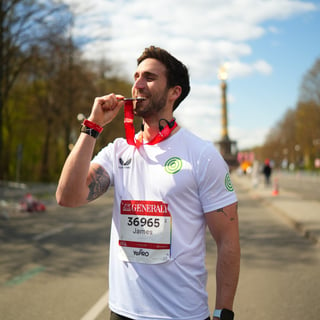
UKRunChat: James Lewis is an endurance runner from the UK who's taken on a series of unconventional challenges, attempting world records and is planning next to dribble a football all the way from Morocco to Birmingham during the World Cup.
UKRunChat: So this is a conversation about curiosity, having a bit fun with running, resilience and also making mistakes. James, welcome to the UK Run Chat podcast. How are you?
James Lewis: Yes, ah actually very good, thank you. You okay?
UKRunChat: yeah Yeah, good, thank you. So just yeah just take us back a bit. So before these endurance challenges were your thing really, who were you and what did running look like for you then?
James Lewis: So, ah interestingly enough, I was quite literally nobody. I was admittedly a big waste space, but I didn't do anything. I um finished sixth form. I kind of just dragged my feet through sixth form, didn't really even go to classes. and I was quite overweight, not in any good shape. I wasn't trained for anything.
James Lewis: and then I thought, you know, going to join the army. So then I started train then, got into running, got decent at running, and and then didn't get in the army. And i was like, what do I do now? Because I failed on the medical.
James Lewis: So if it wasn't for the army, however, I would probably still be fat, and not really achieving anything, not doing anything with my life, dragging my feet, as I say. But then I started to carry on the training, strength training, the running.
James Lewis: Strength training kind of took the lead. But then I had the idea of doing a charity run. So I had only ran maybe 15 miles before and after trained for the army.
James Lewis: And then I saw a video of some guy talking about how he'd managed to run 24 hours straight. I think it was on treadmill. And I just, cause maybe ah I'm a delusion a bit delusional to some degree, but i thought I could do that even though I'd only run 16 miles. So I went for a run right there and then.
James Lewis: um remember running to my usual my usual route and popped by my missus's workplace and went and told her, I reckon I can do this.
James Lewis: So I set up the GoFundMe, got in, no, the JustGiving, and then the charity, St. Giles Hospice, got in touch with me because they got the notification. And then, yeah, I organized a 24-hour run around a single 400-meter track.
James Lewis: And then, yeah, I managed that somehow. i mean, I'll rewind it a bit because to do that was quite interesting because I'd only ran for nine weeks leading up to that.
UKRunChat: Yeah, what but I mean, that that's not a lot of preparation really, is it?
James Lewis: So I don't know why I picked
UKRunChat: What what made you think, oh, I can do this?
James Lewis: As I say, I've always had sort of ah a sense of, i think I think a lot of people have to some delusional degree, um a lot of belief in what they can do, but it's just the the key difference is a lot of people don't actually go through with ah cause ah on i only see but I've done some cool things with running, but I'm only one person. There are millions of people out there who don't actually tap tap into like what they're capable of. And I feel as though some people could outshine some of the things I've done and they're just sat at home not doing anything because they've not even bothered.
James Lewis: bu I'm not an exceptional runner. I've just done, I've just like, you know what I mean? Took took the ah took the dive and yeah. But as I say, many people out there don't realise that they're actually unbelievable unbelievable, but they just haven't,
James Lewis: gone for it. But m so as I say, I was delusional, delusionally confident, but sometimes in life that kind of works because if it wasn't for that ah sense of delusional confidence, I never would have for in and I never would have realised I could do it.
James Lewis: So in the nine weeks leading up to it, I was doing a big run every couple weeks, but my other runs are maybe six to eight miles, but every two weeks and a weekend I'd do a big run and that get incrementally longer. So my first one, think my first one was a half marathon.
James Lewis: And then I went straight to 20 or a marathon, but at this point I didn't have any running shoes. So I was just running my Nike Air Force ones.
UKRunChat: Oh, wow.
James Lewis: Which is interesting.
UKRunChat: How did they feel?
James Lewis: Terrible, terrible. Yeah, they felt horrible. So I'd run my first ever marathon in them, which was quite impressive. And then after that, I stopped going for miles as the 24 hour run wasn't a challenge of miles. It was a challenge of lasting. So I did, think after that was six hours.
James Lewis: and I think I just maybe clocked about 30 in six hours. Then two weeks later it eight hours and two weeks later was 10 hours and that was the final practice run until I inevitably, well until I then eventually did the 24 hour.
James Lewis: Yeah,
UKRunChat: Yeah, so how how were you feeling after that 10-hour run? did Did you think then, yeah, I can do this?
James Lewis: it was quite emotional to be honest.
UKRunChat: Yeah.
James Lewis: It was only a training run but I had some supporters there. It was on a 400 metre track and there's um like a football clubhouse there where a lot of the old-timers like to drink. look some of the blokes that run the club and probably built it as well were just there drinking and they were cheering me on the whole day.
James Lewis: And then, a yeah, and they were donating money to me as well, which is lovely.
UKRunChat: Oh, that was lovely.
James Lewis: I had a couple of friends come down and just very briefly just have a look because all thought i was mad because I've never done anything like this before. They all thought I was mad. um And then at that point, I was maybe half an hour away to an hour away and I was just running around this in the lap, just thinking to myself, like, I actually can do this, so.
UKRunChat: Yeah, that must have been quite emotional, finishing that.
James Lewis: yeah yeah even just for training everyone was a little bit yeah um the real run itself really was and the real run itself i probably cried for maybe two hours of the running because i was only i think maybe 22 at the time but i was just in so much pain i was um
UKRunChat: Yeah.
James Lewis: Yeah, at one point my girlfriend pulled up the Just Given page and showed me all the donations. and I used that as a sort of revitalising tactic to keep me going at the roughest part in the night.
James Lewis: And I just had to run off from her just because like, it was actually like making me like ball. So, because there was some really nice messages that came in the donations. So yeah, it was lovely. there
UKRunChat: Yeah, and I guess a lot of donations came in as you were working your way through 24 hours.
James Lewis: Yeah.
UKRunChat: Yeah.
James Lewis: Yeah, so we ah posted a lot on Facebook and there's a local local Facebook group for our area called Rugeley Rocks and we posted it in that and it kind of blew up and that's when everyone in Rugeley realised what was going on and so a lot of people donated, liked the photos, and came down and supported as well.
UKRunChat: Oh, that's lovely. Did you have a lot of people come and come and help you along in person then?
James Lewis: Yeah, so the Rouge Lee Running Club didn't know until they saw it Facebook. And then one of the ladies came down at 11 p.m. maybe. She'd come down and was running with me. then she'd come back at 4 a.m. in the morning with loads of fruit and and and snack bars. She brought down her Rouge Lee Running Club. They were all running around with me, keeping me company.
James Lewis: Yeah, I'd never met any of these people before in life either.
UKRunChat: Yeah, that's so nice. Running tends to bring out the best of people, especially when you're doing big challenges like that.
James Lewis: Yeah. Yeah.
UKRunChat: That's so nice.
James Lewis: Yeah.
UKRunChat: Yeah. what What did you get out of that 24 hour run then that you perhaps weren't expecting? Talk us through some of the emotions and the feelings.
James Lewis: It's kind of unlocked unlocked me, which might be a bit of a weird way to put it because...
UKRunChat: Okay. Oh, that's interesting.
James Lewis: um since then I've kind of realized that I can do a lot of things I never thought possible and running as I say was the key to unlocking that sort of self-awareness which is which is crazy to think really
UKRunChat: Yeah, but that's that's incredible, actually. You covered 92 miles, didn't you, that day?
James Lewis: yeah 92 yeah
UKRunChat: Yeah. Why do you think you were so strict with yourself on the not stopping? Because it was the kind of, it was the it was the keeping going, wasn't it, over 24 hours? But
James Lewis: yes
UKRunChat: Could you have allowed yourself breaks if you'd have wanted to?
James Lewis: could have, yeah, but I thought I was at that point where I was maybe 18, 16, 18 hours in two thirds of the way done. It's like, this could be so much better if I just didn't have a break.
James Lewis: And that's what I want. I just wanted the better story. I just wanted the the bigger accomplishment, even if no one else cared but me. Just, it was just more impressive. So I thought, again, I'm delusional, I can do this.
James Lewis: And then it it fluked out and nothing.
UKRunChat: Yeah.
James Lewis: nothing terrible happened. I mean, I stopped on one other occasion for an injury. I remember now. It was so long ago, can't remember very well. ah I'd think I'd maybe strain something on the front of my lower shin on the front of my foot.
James Lewis: And from then I had to ah kind of hobble it the whole way. I had my girlfriend one side and a friend the other side holding arms with me, carrying me across the finish line for the last hour. But yeah, that was another break that I had because i to we had to dress the injury.
UKRunChat: Right.
James Lewis: yeah
UKRunChat: Yeah. How did you recover afterwards? What were the kind of the two, three weeks after that challenge like?
James Lewis: interestingly enough four days later i went on holiday yeah so four days late i do it i can't remember what i did i think my recovery just was down i just i like to i liked to read at the time so i was reading a lot and i was just sat around at home just doing absolutely nothing because i had it all off work
UKRunChat: Did you?
UKRunChat: Yeah.
James Lewis: And I was just sat around doing nothing and just relaxing. and And four days later, me and a friend went to, we went and did a couple of music festivals around Albania and Italy and Malta in a spread of three weeks.
James Lewis: So that was my recovery. But I do remember.
UKRunChat: How were you feeling in there? Were you managing to walk around much?
James Lewis: So I was hobbling. I couldn't walk the next day.
UKRunChat: Yeah.
James Lewis: but this is the point I'm getting to. When i was in the airport, my head was still spinning and I still hadn't like re-established myself. and Because not only is it ah taxi such a massive tax on your body, but just mentally as well, especially since I'm sleep deprived,
James Lewis: and and running around in circles the whole time. Yeah, it was tough. So even when i was in the airport four days later, my head was still spinning. I still, I didn't feel on earth still properly.
UKRunChat: Yeah.
James Lewis: Yeah.
UKRunChat: Did you change directions on the track, James, or did you keep going the same way round?
James Lewis: and another
James Lewis: Same way. Yeah.
UKRunChat: Oh, that's too off, isn't it? That's really tough.
James Lewis: Yeah.
UKRunChat: Yeah.
James Lewis: You might think that, oh, it'd be refreshing to get the way, but you kind of have that habit and it feels unnatural to start going other way.
UKRunChat: Yeah, that's really tough. ah so you So you've um you finished the 24-hour event.
James Lewis: yeah
UKRunChat: You've unlocked another level of James. So what what happens then? What did you do next?
James Lewis: so then i realized that this was something i'm massively passionate about so from then on i started planning more charity events and um fundraisers and challenges and trying to level it up and trying to make it harder for myself because i loved that it raised money but also got a lot of local attention and brought a lot of people together and and by doing so we raised a good amount of money for the charity so i then moved on to planning the next year um raised uh four and a half thousand pound that year and thought that this is something that ah really i really love doing it so from then on i've i've created um
James Lewis: It's not an official charity yet, I'm hoping to get it recognised over the next year or so, but a foundation under my dad's name. Because this is the whole reason why sort started, because I was trying to raise money for the hospice that took care of him.
UKRunChat: Yeah.
UKRunChat: Okay.
James Lewis: And so next year we planned for a football tournament that ran on the football pitch inside of the same exact running track, where I then attempted my next running challenge, which was of course another 24 hour running challenge.
UKRunChat: This one was slightly different, was it? Was this...
James Lewis: Yeah, well, slightly different.
UKRunChat: Yeah.
James Lewis: So this, this one was, uh, I announced doing it before I thoroughly looked at the rules.
UKRunChat: Wow.
James Lewis: So this was interesting. So thought that's spiced up a bit. Let's do the same exact sort of setting and idea and run, but kind of switch up a bit.
James Lewis: So I was practicing doing running around the track for long distances, but with a blindfold on.
UKRunChat: wow
James Lewis: Yeah, and my girlfriend was coupled with me, Bolly Arms, um side by side, guiding me around the track. And we'd done that a few times for an hour here, an hour there. And then one day I got a few friends down to volunteer to run with me um and tried eight hours.
James Lewis: So in eight hours, when we was practicing it, we managed to cover 36 miles. and in them 36 miles um at the end my girlfriend and my sister then thought curiously wonder what the world record is for this and it turned out time it was only 72 miles so it was from then i thought that's perfect that's next year's challenge we're gonna go for the world record for it i planned it announced it and then not long before it thought i'm gonna have another look over the rules
UKRunChat: Right. OK. Yeah.
James Lewis: And it was then i realized that you can't actually be touched by anyone. So then we had to kind of create a plan of how I was going to actually run around four-meter track without actually seeing where I'm going.
James Lewis: And then not only that cover 72 miles. So then the the the master the master plan we came up with was that a partner, a volunteer would lead in front and they would wear bells on their laces.
UKRunChat: Right.
James Lewis: And I would follow the ringing of bells. And I had to listen to them for 24 hours.
UKRunChat: a brilliant workaround, I will say. so why did you come up with the idea of doing it blindfolded then? Where did that come from?
James Lewis: Because I wanted to level up the the difficulty in some way. And I thought and that was just some random ah idea that crossed cross mine crossed our minds.
UKRunChat: Yeah.
James Lewis: And then we were lucky enough to realise that the world record was quite achievable. And so that's why we went for it. But honestly, it was just a random random idea. We just wanted to keep the same setting, same sort of challenge.
James Lewis: Because i liked the locality of it. I liked the fact it was on a single track.
UKRunChat: Yeah.
James Lewis: Because then I could have a lot of people witness it rather than me running in from here to there and nobody see it.
UKRunChat: Yeah.
UKRunChat: Yeah, it's easier to manage isn't it when you keep it contained.
James Lewis: Yeah, exactly.
UKRunChat: Yeah. So so you you did beat the world record that day, but it wasn't ratified, was it What happened there?
James Lewis: Yeah.
James Lewis: Yeah.
James Lewis: So we had a couple issues. One of the issues was the fact that the camera, we had ah a runner in front with bells and a runner behind and they would wear a chest strap with GoPro and film it. I think the rules have changed since since that day that you can't have it, you've got to have a stationary camera.
James Lewis: But at the time he wore it on a chest strap and they would run behind me. but it would obviously die quite often. So we'd have to grab a phone and record the battery change and just pause.
James Lewis: But it died a lot more times than we anticipated and we weren't prepared for it. One of the times the the batteries died really unexpectedly because we remember that we'd had it uncharged, but someone had went into the clubhouse, unplugged it because they wanted to charge their vape instead.
UKRunChat: I couldn't make that up, could you?
James Lewis: So there was a stage where I was off camera for like two minutes or so. There was one point where there was a spectator watching the football tournament that we organized um on a deck chair on the running track and I ran into and fell on top of her.
UKRunChat: Oh no.
James Lewis: And my mate pulled me off of her, which is physical assistance, which was against the rules. So these things only made things harder for the run, but were actually against the rules.
UKRunChat: Oh no.
UKRunChat: Yeah.
James Lewis: So and that's why last year, 2025, we reattempted it, but with a stronger, more secure plan for filming and evidence gathering.
UKRunChat: Yeah. And how did that go last year then? Nobody asked what happened.
James Lewis: terribly again.
UKRunChat: There I am.
James Lewis: So it was 30 degrees. We'd run three and a half hours, 13 miles, and we'd realized one of the cameras was dead. because we had a camera on each corner of the 400 meter track.
UKRunChat: Thank you.
James Lewis: So one of them was dead. It wasn't taking charge from the power bank we'd hooked up to it for whatever reason. So from then I was faced with the option of either canceling right there and then, because I'm 13 miles in, haven't clocked and I'm already battered because I'm i'm getting sunlight almost getting sunstroke because it was degree day um and cancel on all the volunteers for the next 21 hours or just restart from zero and secure three hours worth of volunteers as i go and ah went with the latter and it turned out to be a day of 27 and a half hours of running yeah 27 half hours of running 30 degree heat both days and yeah i think that was then the most painful day of my life
UKRunChat: Yeah.
UKRunChat: Yeah, it's tough. Yeah.
UKRunChat: Yeah, so that would have been the longest amount of time you've run for. is that right?
James Lewis: yeah so it was 27 a half hours and ah think in total maybe 92 or 95 miles covered i almost wanted to go to 100 because i've never done 100 before but ah i was not getting out that deck chair
UKRunChat: Yeah.
UKRunChat: So please tell me that attempt was ratified.
James Lewis: No, it wasn't.
UKRunChat: no
James Lewis: Sorry, ah forgot I forgot didn't mention it. So not only did it die and stop filming, when I restarted it, upon review of the footage weeks later, it then turned out that one of them had stopped filming up to 19 hours.
James Lewis: And that's a typical error that happens with GoPros of that model. I think it was GoPro Hero 8, where a lot of the time they only film up to 18 to 19 hours continuously.
James Lewis: I even paid 90 pounds for a data um mining app that you plug the SD card in it and it does a deep scan of the the drive to find the last footage.
UKRunChat: Right.
James Lewis: But I ended up just losing 80, 90 pound again. And yeah, it, yeah It really such a terrible and or quit layup unfortunate series of events, but it doesn't matter because the main goal was to raise money and that we did. so
UKRunChat: I was going to say, you seem very calm and cool about the fact that you've run and not, you've run you've run it, you've broke the record, but you've not had it ratified. I mean, what how did you process that at the time? Were you we just cool with it? Were you all right?
James Lewis: I tend to not get so emotional emotional or annoyed by things that aren't in my control because there's not really much point to getting annoyed by things out of your control.
UKRunChat: Yeah. Yeah.
James Lewis: and And at the end of the day, I've survived and I'm able to run again and do it again. So yeah, you caught you've got two choices really, don't you?
UKRunChat: yeah
James Lewis: You can get annoyed about it, but that gets you nowhere or you can kind of move on with it. I mean, I do intend on going back and doing it again just to get it under my... I get it put on my CV. So, yeah, because it's, it's having a world record is, is no easy feat.
James Lewis: And I feel like it's like within, within grasping distance. So I feel like I'm going to go back and do it just so I can say I've done it. And yeah, but it's nothing to me.
UKRunChat: Yeah. So what are you putting in place for next time then? And when's that happening?
James Lewis: It, it, it does come down to, it is, It's expensive because you've got to get the cameras. So I had to buy a new camera for it. I'm thinking now going to have to get four cameras just to make it just to plate safe. One on each corner, better cameras so they don't die. Because one of them was ah the new camera that filmed fine, but the other one was bit an older version and that stuff that struggled.
James Lewis: So four cameras, then you four power banks so they stay alive the whole time. And you've got have four terabyte SD cards there, about £90 each. You're looking at about £450 maybe per angle. And if you need four angles, yeah.
UKRunChat: Yeah.
James Lewis: it's It's a lot of money, but at the end of the day, it's a lot it's a lot of money.
UKRunChat: It's a big commitment, isn't it? Yeah.
James Lewis: and so Yeah, as you said, big commitment. It's a lot of money as well. But if you think about it people will pay... tens of thousands of pounds for a university degree on their CV.
James Lewis: I'd rather have a Guinness World Record on my belt, although it's the financial investment is a fraction of a university to degree. There is a lot of obvious physical investment because it's painful, and but I feel as though it's still cheaper and it looks, I would rather have that on my CV personally.
UKRunChat: Yeah.
UKRunChat: yeah So what's the what's the actual process of going for a world record then? What do you have to do do? you have to lay your plan out and make an application?
James Lewis: So they have a long list of current records and then you apply for it. It's a long winded process. I will be honest. I can't commend Guinness on any sort of, on any level in terms of my interactions with them because they take weeks, sometimes months to reply, which is useless when you're trying to move fast and get things planned in order.
James Lewis: And then when you finally get a response, it's just very, very vague, very brief. It's not very helpful at at all because they have such such a detailed rule set for every single record. It's a lot to take in. There's a lot of questions. It's not it's not easy to understand. And when you ask them for clarification, they're no use, no help at all. And you've had to wait six to eight weeks. So that so it is hard work.
James Lewis: And then not only is it hard work to understand the rule sets, it's then hard work to gather enough evidence because the level of evidence you need to gather is mental. So had to have every frame of the 24 hours, had to have on camera every every second of 24 hours and I had to be in the camera.
James Lewis: And then not only that, I needed two volunteers for every single hour and to sign as a witness statement. Yeah. and As well as a few other sort of boring bits, but yeah, that that alone is hard enough.
UKRunChat: Yeah. Yeah, that must be pretty hard getting that number of volunteers for an event of that duration.
James Lewis: Yeah.
James Lewis: It's tough. i had a lot of people pull out the day before as well, which was hard work. So I had to, on the day of, gather more volunteers. And then not only that, I then had to run three hours and then restart and then gather more volunteers while I'm running blindfolded.
James Lewis: Yeah, it's not easy.
UKRunChat: Yeah. Wow. i Well, hopefully third time. Lucky for you, James, next time you attempt that.
James Lewis: Yeah.
UKRunChat: Yeah.
James Lewis: Fingers crossed.
UKRunChat: i mean, it's funny because ah I love your attitude there because, I mean, ah a lot of runners struggle when the races don't go to plan. They can kind of beat themselves up about it.
James Lewis: Yeah.
UKRunChat: I mean, what would you say to someone who's dealing with the disappointment after giving it everything like that?
James Lewis: Well, i've I've got two halves to that to that question. you'll like, one you probably won't like, but one one would be that as i've As I've just said, like if it's something out of your control, let's say you've done great in your build up to the run, you've done everything perfect that you're aware of, and then let's say something really unfortunate happens, like an injury, um like there's no point getting upset about it because like it was out of your control. There's no point getting angry for things of your control because it's just going to hinder you moving forward because you can stop right there and then and carry on moving forward.
James Lewis: or you can stay annoyed and stay where you are, or even go backwards and get annoyed to the point where you stop running. So one one approach is more beneficial, one is one's only going to hinder you. So if there's no point getting upset about it if it's not out your control. Now, the other half the answer is if there was something out of your control that you could have done something to to plan for, you you've made a mistake,
James Lewis: Don't shy away from that. You're going to feel terrible because you've made a mistake. Now, if you're going to make a mistake and you don't learn from it, then it was as a pointless investment, really.
James Lewis: It was a pointless mistake to make. So if you're feeling let down by a run, I'm sorry to say it, but you need to, you sort of need to weaponise that negative emotion that's come from that.
James Lewis: Because, the The alternative, again, feeling bad and not learning anything from it and then not developing as a person, not developing as a runner.
UKRunChat: Yeah, yeah we look we learn from experience, don't we? Yeah, that's a good answer.
James Lewis: Yeah.
UKRunChat: Thanks, James.
James Lewis: kind of see the value in that suffering. I mean, it's funny. One of my favorite movies, the villain says one of my favorite quotes and I hate repeating it because it's a villain, but he talks about how, um, there can't be like, he basically just emphasizes the level of value, the level, how much value you you can, you can get from suffering.
James Lewis: I mean, there's the German philosopher Schopenhauer who says, uh, what does he say now? and loss really shows us and the value of things now if you've gone to do ah ah do a marathon and you've you've had to pull out you've lost out on a medal you've lost out on that that personal satisfaction and that shows you how valuable that is that you if if you didn't fail then nothing would be as valuable does that make sense so yeah and everyone's going fail when it comes to running but
UKRunChat: That makes perfect sense. Yeah. Yeah. Yeah, hence why you is that why you set yourself such difficult challenges, do you think? I mean, you don't seem to have a problem with the running itself, though, do you? Does that come naturally to you, that endurance?
James Lewis: um I'm not too sure I feel i feel like an endurance thing is sort of the mental thing um because um like every time I run I get injured and every time I run I get injured it's just a case of is it worth running on the injury or is it better to to stop and recover but I always have a goal in mind that is always more important than the pain you know what I mean
UKRunChat: Right, okay.
UKRunChat: Yeah. Yeah, I mean, because two weeks after that blindfolded challenge, you you ran from Paris back home to the UK, didn't you? is that right?
James Lewis: yeah Yeah.
UKRunChat: Yeah.
James Lewis: so Yeah. 2022, I ran 24 hours without a break. 2023, sorry, no. Year one, I ran 24 hours, no break. Year two, I ran blindfolded.
James Lewis: But then year three, wanted to repeat the blindfold and get the record on my belt. But I didn't want that to be my main challenge because that's just last year.
UKRunChat: Yeah.
James Lewis: That's that's old news now.
UKRunChat: Yeah.
James Lewis: That's not going to drive as much attention or donations to the to the the fundraiser. So I wanted to repeat that, but my main event was i was going to fly to Paris and run home.
James Lewis: And that was in, I think it was July, July, 2025. Yeah. And again, that was painfully, terribly ah terribly painful. But again, like it was so,
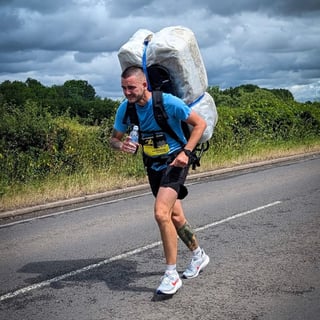
James Lewis: it was so unlocking again. It's, it's made me a better person. It's made better runner. It's made me more aware. But it was some of the most terrible, terrible days of my life because I'd be running day in, day out, injured by myself in a foreign country, no hotels, sleeping on the streets.
James Lewis: But at the end of the day, because I'd gone through so much suffering, I would sit down at the end of the day in my hammock in a forest in France, don't know where I am.
James Lewis: and I'd be sat there with a pack of biscuits in my hammock thinking this is one of the best feelings that I've ever had in my life. And they are still some of the best memories of my life. Just sat there with something as small as a pack of biscuits but I can sit at home with a pack of biscuits in a bed that's a lot comfier a hammock any day I want.
James Lewis: And a lot of people do this every day, but it doesn't mean anything at that point um because it's not actually come from any investment. Like it's not, you've not invested a lot of pain. You're not, not suffered for it.
James Lewis: And people do it all all the time and they're no longer grateful for it. But I would run 10 hours from Paris to a small town north of it, through forests, not knowing where I am in pain, carrying a rucksack with eight, 10 kilos on my back, hurting, sweating, cause it's so sunny, not sure where I'm going to sleep. I'm not speaking to anyone because I'm in France. There's a massive language barrier and yeah, terrible circumstances, but it makes me much more sensitive to the smaller things.
James Lewis: Yeah.
UKRunChat: Yeah.
James Lewis: Much more grateful.
UKRunChat: How did it feel arriving home after that journey then? That's quite an epic journey to go from and a different country.
James Lewis: Yeah, so there's two answers again to that. there's There's one answer, again, that's sort of pleasant, and one that's sort of not pleasant. there There was one where it was like,
James Lewis: because ah Because in France it was holiday season and nowhere was open and if I'd done my daily 30 miles and there was no hotels near me, I had to sleep where I was. So I'd swing my hammock up.
James Lewis: If there was no trees, I'd sleep under a bridge around the by the side of the road. that's what That's what life was like at that point. But that taught me how how beautiful and how amazing it is to have a nice comfy bed.
James Lewis: So ever since then, I've had a massive, massive appreciation for just sleeping in a bed.
UKRunChat: Yeah.
James Lewis: we don't realise how lucky we are, especially in the first world. like How luxurious are we? how how How lucky are we? But we never take a minute to realise it. And that's really told me how fortunate I am. So that was one thing. It's made me much more grateful again for the smaller things. But then...
James Lewis: immediately upon like returning home ah day after my body was confused, my mind was confused and I kind of felt almost, it's a weird word to bored and kind of like directionless. I was like, what do i do today? Like, like I've got nothing to do today.
James Lewis: And I was almost like annoyed by that fact because I'd been running 30 miles every day with a set goal every single day. But at that point I was, I was thinking that what do i do now? i was kind of like a bit lost.
James Lewis: Do
UKRunChat: Yeah, that's funny, isn't it? Are you the kind of person who's constantly on the go, then you have to be doing something?
James Lewis: um do you mean something greater or do you mean something in the moment?
UKRunChat: like i just mean, are you like a generally active person? you have to be constantly like, duke can can you just sit and and be still? Because it it seems to me like you do really enjoy putting yourself through these difficult challenges.
James Lewis: it's its It's actually the opposite. It's the opposite.
UKRunChat: Is it?
James Lewis: No, I do it for the end result.
UKRunChat: Yeah.
UKRunChat: yeah
James Lewis: I do it for the end result of levelling up, developing, but also raising money and kind of building in and building upon every single year. Because year year on year, I've managed to fundraise more.
James Lewis: And that's the goal year by year now, to raise more than the last year. So that's what I'm working towards. not working towards being a better better runner for personal gain. I'm working towards being a better runner for the gains i just mentioned. Now for running, I really don't like it.
UKRunChat: Don't you? That surprises
James Lewis: I'm not really not a fan of it. I'm really not a fan of it. i mean I'll be honest, that's that's maybe dishonest. i do i don't love it nearly as much as people expect me to.
UKRunChat: Right.
James Lewis: A lot of times I'm running and I'm thinking, I'm only running cause I have to. Cause if it wasn't for running, then again, I, where would be? Like my life is so centered on the fundraising and the health and fitness side that if, if it wasn't for running, like, I don't know where I'd be and I wouldn't be doing anything what love. Like I am now.
James Lewis: So I kind of do cause I have to, like, ah know I know need to, but I love about it.
UKRunChat: Yeah.
James Lewis: The motion itself, many, many, many bad memories.
UKRunChat: Well, yeah, but I'm good ones as well.
James Lewis: Yes, of course.
James Lewis: Yeah.
James Lewis: I thought this is perfect, I'm gonna run a marathon in my garden dribbling a football. And then I realized how how possible that was. Like, I didn't realize that was going to be so possible. I thought it was going to be a lot more difficult than it was. and Not to say it was easy, it wasn't, but I thought it was a lot more it was a lot more manageable. Anyway, I then had the idea of maybe one day doing a running challenge with a football.
James Lewis: And it was one night when the St. Giles Hospice, who had been fundraising for all these years, they hosted a winter gala event. a black tie event and invited me down. I'd never been to a place like that before. I felt like an imposter really in my in my suit surrounded by all these people in bow ties. And um they had a really moving evening where they discussed all the funds they'd raised and where the money actually goes and showing your personal stories. And at this point, that running challenge was only an idea.
James Lewis: and And then at that point, I realized that I've got the body, the health and the mindset to go and do crazy things like this this year. I wanted to do it next year.
James Lewis: So I said, you know what, like ah um life moves fast. Let's do it now. going to do it this summer. So right then and then at the end of the evening, I went to the guy ah I liaised with called Sam at St. Giles.
James Lewis: and mentioned it to him and he says, yeah, you know, the World Cup's on. and And so as at that point I was like, you can't not do it. So now the goal is to fly to Morocco with a football, dribble it from Rabat, the capital to Tangier in the north of Morocco, cross for Gibraltar straight, run from south Spain to Calais, Calais to Dover, run it home to Birmingham, but then actually run it home I'm tightening it Africa to Birmingham.
James Lewis: Africa, it just sounds crazy. Birmingham, Birmingham's a lot bigger than my small hometown, it would get more attraction that way. But I'm going to be home from Africa, yeah.
UKRunChat: That was really cool. So like what what kind of scares you about this challenge? it's It's a big one. And what what are you having to put in place to make sure it it works well?
James Lewis: um The run itself, I'm too occupied at the minute to even concern myself with the run itself, which is maybe silly because it's going to be challenging.
James Lewis: It's going to be a logistical nightmare. Um, But I'm more occupied right now with securing the investment for the challenge because it's gonna be expensive. And so I'm hoping that I can find a company who would be willing to sponsor it. So I need a company that's gonna invest in it in return for sponsorship, so I run in their branding.
James Lewis: But if I don't get that, I'm gonna have to pay for it myself. So if you think about paying for that, I've got to pay for, ah I'm going to be out at work for 10 weeks. My partner is going to come with me. She's going out of work for 10 weeks. She's going to drive her support, her car, be the support vehicle and drive with me for the whole way.
James Lewis: But ferrying the car from ours to Morocco, that's free three and a half grand already.
UKRunChat: Yeah.
James Lewis: The camera equipment to get it and at all filmed professionally is going to cost maybe 500 pound. and then I want to hire someone to actually film it day by day. So to employ someone to come along with us, film every single day, edit it, post it on the day of, so I can have a daily post every single day so people can watch online and see the challenge. And that way, hopefully that will go viral, the calls will go viral and will fundraise a lot more money. And now for a challenge is as bold as this one, i feel as though,
James Lewis: it will get a lot of attention. I mean, I hope it does, but I don't i don't see why it wouldn't because it's such a novel novel idea coupled up with the World Cup. A challenge, that everyone has a challenge, so the challenge is to get home in time for the World Cup final and And my my goal is to fundraise as much money as possible for the charity.
James Lewis: And and recently enough, the charity has had to close down nine beds. So my goal is to open them nine beds back up because they're still sat there.
UKRunChat: Yeah.
James Lewis: They're just sat there empty because the the hospice hasn't got the funding to run the staff and just keep them warm. So to a big company, you're getting in return a lot of exposure.
James Lewis: And I feel as though if I was to put my money into it, I'm only local. I can only... if I get a lot of reach on my brand through that, it's not going serve me as well as it would do a big brand, but it sells like, for example, a sports drink or a sports clothing brand or a shoe brand.
James Lewis: It would serve them better than me. And plus they've got some more money than me. So yeah,
UKRunChat: yeah so you're working hard on finding kind of a ah big sponsor at the moment and it's interesting that that that's the most worrying for you aspect for you at the moment than the actual run like yeah that's
James Lewis: Yeah, yeah, because as I say, there's there's a lot, it'd be a good investment for a company to sponsor this because they'd be front and centre of what's going to be a viral challenge. And I expect it to get a lot of media attention. I expect it to even make it onto the television for the BBC, but but the World Cup broadcasting.
James Lewis: Now they can put in a donation that will cover the funding of the event, enable it, but also a surplus so that they still get ah a great return on investment, but then the charity just makes loads of money.
UKRunChat: Yeah, yeah.
James Lewis: So, and that's what it all comes down to really. So,
UKRunChat: Yeah, so you're aiming to get those nine beds back back up and working for the St Giles Hospice. Just tell us a little bit more about the charity then, just to finish, and hopefully people can can have a look online and and support you.
James Lewis: Yes. So it's based in Litchfield and in Staffordshire where I'm from. But as I say, they've had to cut the ward down nine beds because they just don't have the funding.
James Lewis: I didn't realise, I believe it's 10 million that they have to fundraise each year to keep the hospice open. Now for a charity, that is that's difficult.
UKRunChat: Yeah, that's huge.
James Lewis: That's very difficult. Now I'm sure they get caught a quarter of that funded by the NHS, which means they have to make up just under 8 million each year. Now that's hard work. So...
James Lewis: Hopefully if a challenge like this blows up and I can like with the internet, you never know what can happen, but and if anything can. So you could even fundraise enough money with the right with the right brand to sponsor and and and enable the challenge.
James Lewis: You can raise hundreds of thousands of pounds and you could open back them nine beds because it is sad to think that they're just that open. in know in a ward just cold unused because the hospice just can't afford to run them when there's such a long list of people and and families even young children they're on a list to get into a hospice like this and to use those beds but yeah
UKRunChat: Yeah.
UKRunChat: Yeah. oh Well, all the very best of luck with your challenge then, James. So where can people follow you and just follow kind of your training for it and the journey itself?
James Lewis: So you can find my personal Instagram, ex-James Lewis.
UKRunChat: Yeah, brilliant. And we'll pop a link to the charity as well in the show notes so that people can have a look at that as well.
James Lewis: amazing.
James Lewis: Yeah, thank you.
UKRunChat: All right. Well, thanks so much, James, for joining us today. That's been an incredible conversation. and and thanks for being so open and honest about the you know the highs and and the mistakes as well, the reality behind all those challenges.
James Lewis: Thank you.
UKRunChat: So we wish you all the very best. For anyone listening, we'll link to James's account and the upcoming Africa to Birmingham football run and ways that you can follow and support his journey in the show notes.
UKRunChat: If you enjoyed this episode, please share it with a running friend, leave us a review and keep the conversation going. James, best of luck. We'll be watching closely. Thank you for listening to the UK Run Chat podcast.
UKRunChat: We'll see you next time.