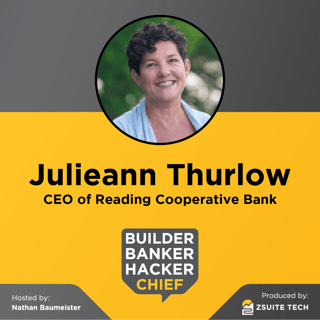
Transcript
Speaker: That got me over the fear until i walked in the door and realized this is an entirely different experience and world. And while my knowledge that I brought, you know, the past 20 plus years of banking experience that I brought with me to the table is great.
Speaker: It was only the tip of the iceberg. And my then crippling fear took over that I wasn't smart enough. I wasn't good enough.
Speaker: Hi, my name is Nathan Baumeister and you're listening to Builder, Banker, Hacker, Chief. A podcast where executives from the world of finance and technology have shared the stories of how they got where they are and the decisions that made them who they are.
Speaker: Along the way, I've been looking for hidden moments of truth and sacrifice, wisdom and folly. And with you, our listeners, I've learned a lot about what it takes to lead teams and companies.
Speaker: Three years ago, when I started hosting this podcast and collaborating with my producer and friend, Zach Garver, I wanted to learn from these journeys so that people could use the insights to grow personally and professionally.
Speaker: This episode, number 25, marks a turning point in my own journey. Earlier this year, I stepped down as CEO of Z Suite and handed the reins to Jill Feiler, my next and final guest on Builder, Banker, Hacker, Chief.
Speaker: Jill has been a close friend and colleague since we first met at a fintech startup in Austin, Texas more than a decade ago. As the eldest daughter of a single mother, Jill learned early how to shoulder responsibility, care for those close to her, and to maintain very high standards.
Speaker: There are not many people who have the wisdom, humility, and self-awareness to take the path to CEO that Jill has taken. After nearly 20 years in bank leadership, she chose to work as an individual contributor, caring for clients and keeping her stress to a minimum.
Speaker: But the investments that Jill's mother made in her were too powerful to keep hidden under a bushel. I could see that Jill's unique combination of tenacity, empathy, and professionalism were exactly what the company needed.
Speaker: She just needed a little nudge from me. And never mind that story she tells about me throwing her off a cliff. And it's those same qualities that make her such an excellent candidate to take the helm at Z-Suite Technologies.
Speaker: As American poet Henry Wadsworth Longfellow once said, great is the art of the beginning, but greater is the art of the ending. The episode you're about to hear is an ending and a beginning for me, for Jill, for Z-Suite, and the entire team that has worked to make this show what it is.
Speaker: So for one final time, join me as we do some cliff diving off the edge of our comfort zones and into the windswept horizon of leadership on episode 25 of Builder, Banker, Hacker, Chief.
Speaker: Well, Jill Feiler, I can't tell you how I'm excited to have you as the last and final guest for Builder, Banker, Hacker Chief. I am so excited to be here, Nathan Baumeister.
Speaker: You know, it's ah it's been such a wonderful journey doing this podcast, and I couldn't think of a better way to end than to interview my successor as the CEO of ZSuite Tech as I step aside.
Speaker: um And just really excited to share all of the wonderful things that I've learned from you and the different stories of your life with everyone who listens to the podcast. Yeah, I'm so excited to be here. And I think this is such a ah fitting way ah to ah end the podcast as to be the last guest. And I'm just so excited to be here and have this conversation with you. Awesome. Well,
Speaker: as a As we think about your leadership journey, and as we think about trying to you know learn the stories of what's helped you to to to become the amazing leader that you are, I always like to start from the beginning.
Speaker: So now with the benefit of 2020 vision, right? okay As you think of your growing up time period, are there certain events or stories or people that really had an outsized influence to help you become who you are today?
Speaker: Yes. And that is such a great question that I think that not many of us think about. in terms of what has shaped us as leaders throughout our journey.
Speaker: Because the inclination and and my inclination, especially as well, is to think about, well, what was my first job? yeah And then how did I you know transform throughout the years and the many different jobs and roles that that we have ah as leaders? And so I love thinking about that and going back ah to think about different points in time ah through your formative years that were very influential in creating the people that we are today.
Speaker: ah And so I think in ah for me, it's definitely my mom. um So I knew were going to say that. I know you did. This is not new news for Nathan. um But just like ah a little bit of background, i you know was the my mom um had me when she was 19. I was the first born.
Speaker: the first daughter, the first niece, the first grandchild um on both sides of of the family. And um i think we all know what that means, right? Like there's many people that talk about that. It's like, ooh, she's in charge.
Speaker: That's the boss. That's the boss of the family. And I can still hear my brothers and sisters, by the way, there's I'm the oldest of six. And I can still hear my brothers and sisters going, mom, Jill's not the boss of me.
Speaker: and And you're like, yes, I am. I did actually. thought but um And so that's really, you know, that really is the beginning of that.
Speaker: But then additionally, ah my mom and my mom and dad were divorced when I was seven years old. um And so at that point in time, my mom was 28 and had five children under the age of seven as a single mom.
Speaker: So, you know, And during that time, and and of course, my mom grew up during um the 60s and seventy s And, you know, being a woman in the 70s, then on your own with that many with that many children um in a woman in that generation, um she became, um you know, such a supporter and advocate of women um and women's rights. And so growing up,
Speaker: What was instilled in me is I always, you know, I'm capable, I'm smart, I can do whatever it is that I want to do um And all kind of wrapped around, you're going to college.
Speaker: that's That's it. There was never a question in my mind growing up that I was going to college. um And so you know, really... thinking about that and understanding always have always with the knowledge in my mind due to my mother that I am a capable of doing whatever it is that that I want to do.
Speaker: Um, so okay I'll give you, can I, can I share a story that I think is telling? So I remember back, um, If my brothers and sisters listen to this, I'm just going to start this by saying um my mother had a way. My mom is is ah four ten I think, 4'10", 4'11", tiny, tiny woman. and And so, you know, trying to wrangle and discipline, um keep five children of that age, you know, in line. Her go to move that we call it was she pointed her face at us.
Speaker: Oh. And i'm telling you, Nathan, there was nothing more terrifying. But then when she pointed at your her face you? She pointed her face. Yeah. Yes, exactly. and so we all like, we all know what that means.
Speaker: And we all, no matter when we were in college, when we were adults, no matter what, if she, put to this day, we're like, oh Yeah. but what have i done What have I done now? um And so i remember when I was in ah fifth grade and grades were extremely important in our family. um We were always you get straight A's. That's it. That's the end of story. You work hard. You're capable. You're smart.
Speaker: This is the way it is. um And I remember being in fifth grade and was in social studies class and we had a project where and and I don't know, you know, Nathan, I know you're you're quite a bit younger than me, but we had to, you know, oftentimes they'd be like, OK, so for your project to understand, you know, this tribe or whatever it was and so and in social studies, you You have to build diorama or you have to build like a house of what they lived in and mud and you have to put it on this plate you know big wood slab and then you have to bring it to school on the bus. in this Absolutely.
Speaker: Yes. Many a project like that. Okay, perfect. So i put it off. I put it off. I procrastinated. I procrastinated. And I did it at the very last minute. And it was amazing.
Speaker: junk. Not your best work. Not my best work. It was fact, it was terrible work. And so all of that led to me bringing a report card home with a C and social studies. And I had A's and everything else, but i had a C in social studies and I knew what was going to happen.
Speaker: And so i had it in my head of my talk track of how, you know, you practice and you're on the bus. You're like okay, this is what I'm going to say. And this is going to work. This is really going to work. And so report card to my mother and my mom,
Speaker: what is happening? And i was like, everything's gonna be okay, mom. Because my teacher told me that a C is average.
Speaker: Being average is okay.
Speaker: So do we think that my mother pointed her face at me? Well, I'm guessing that she did not have an average child. but ah She did not think she had an average child. That is correct. so um i think I think that story really kind of wrap wraps up how...
Speaker: you know, the expectations as a child and just making sure that your understanding of what you're capable of and believing in yourself yeah of the things that you can accomplish and sky's the limit. And just because, you know, you're a woman in the 70s or a child of the 70s doesn't mean that you can't go to school and you can't be anything that you want to be.
Speaker: um And that's always been within me. and so I think, you know, being taught that at an early age, Leadership isn't about anything else from a parent standpoint. And I think parents are leaders as well, which is really right.
Speaker: It's and it's something that you don't really think about until someone asks a question like you just asked me um about that, because parent parenting is about serving. and promoting and investing and advocating for um and learning those lessons early on.
Speaker: really shaped me to be who I am today. Even though my my brothers and sisters still say, you're not the boss of me. You're like, sure, I am. Yes, I am. Well, ah you know my older sister. do. My oldest sister. And she shares many of the similar traits that you just talked about for sure as well.
Speaker: That's why I get along with your sister so well, right? And she's a great leader. You know, she's a great leader because of it. One one question I have for you. um First, I love the example that your mom, it was given that she had high expectations of what you could do. And it wasn't that you, it wasn't that like you had to do it or anything like that. It's like, no, no, it has nothing to do with like compulsory. You have to do this. It's, I know you're capable and you will do it because you are capable.
Speaker: ah ha This idea of high expectations, I think is extraordinarily powerful as a leader. um I have seen you drive that level of quality from the people that you work with as well. And you have those high expectations, but man, sometimes it's heavy.
Speaker: It is So I'd love to hear any thoughts that you have, whether it be from your growing up years as well as um you know later in life, but how do we strike that balance of having high expectations of the people that we lead with?
Speaker: Or sorry, how do we strike that balance between having high expectations for the people that we lead, but not have it so heavy that they buckle under that pressure?
Speaker: Yeah, that's that's a great question. And I think um i think it's a different answer whether you're the one that has hired that person.
Speaker: So you are the hiring manager versus ah leading a person or team that you quote unquote inherited somehow. i think I think there's a different answer because when you're the hiring manager, you can hire two those expectations, and you can have a clear understanding of, you know, what the expectations are and match the capability.
Speaker: Yeah. You know what you're getting yourself into, and I know what I'm getting myself into. That's right. Because, because as you know, and you and I have worked together for over a decade, and I think we practice this very well, is having direct conversations and having transparent conversations is extremely important.
Speaker: and especially when you do hold your team to higher expectations. You have to be very quick with feedback um and making sure that you're getting the results that you need.
Speaker: um Now, we've all, as leaders, been tasked with leading a team that we didn't hire or didn't have a say as as a hiring manager. And ah that that is a different, in my opinion, that that's a different way to lead to those expectations. Because in some cases, you have to under uncover what those capabilities are for that team member, for that role. And then you have to kind of lead to bring those out, to make them the most effective. And you have to be extremely supportive of those individuals and and drive the confidence in them that they are capable of hitting those higher expectations.
Speaker: I couldn't have said this better myself. I'm a firm believer in this principle. Leadership is my passion, and one of my favorite things is helping people discover what they're really capable of.
Speaker: Too many people are afraid that they can't make a difference in the world or reach lofty goals. They live in fear of high standards and subconsciously undermine their own success. as leaders, we need to model that failure isn't final, that growth is possible, and that doing your best is the most anyone give.
Speaker: And knowing that they have the support of the leader, knowing that it's okay to fail along the way. We all fail. I fail every single day. um and And as long as we're learning from those failures and getting better to lead to those high expectations, I think that's the key.
Speaker: Yeah. Yeah. Because when you come home with a c
Speaker: you just have a quick conversation, a direct conversation. Hey, remember, this isn't who we are. Did you do your best work here? And I bet your answer is like, no, I didn't do my best work. No, I didn't. I tried to say it was for a hot minute, you know, and then it goes back to the face pointing and all of that. Exactly. Well, so your your mom had this expectation, you're going to college. So I'm guessing you went to college.
Speaker: I sure did. So what did do you, where where did you go and what'd you study? So I went to UW-Madison in Wisconsin. a Fantastic Big Ten school, by the way. Go Badgers.
Speaker: Badger, Badger, Badger, Badger.
Speaker: um And i went in um with the idea that I was going to study psychology. so Interestingly enough, ah both of my both of my parents, my mom and my stepdad, have PhDs in psychology.
Speaker: And so I find that I find the study of psychology fascinating. I find, um you know, studying emotional intelligence and organizational behavior to be fascinating if we want to take it a level to to the business level.
Speaker: um But then i was like, do I want to go to school for 100 years? ah No, I didn't. No. So naturally, I switched my major to business because when you're 18 years old, that just feels like a natural natural transition. um And so I ended up majoring in finance. However, what I did to kind of bring that psychology factor back into my studies was i double majored in um human resource management as well as finance.
Speaker: Very cool. So, i you know, I think there's there's much more openness in corporate America these days to working with people who have degrees or don't have degrees, right?
Speaker: i think Absolutely. I think there was a very large portion of time where certain jobs, it's like, I'm not even going to interview and unless you have an undergraduate degree. um And, you know, I think that that's been a great change because not everyone has that opportunity and there's a lot of ways to get learning and experience outside of just in the classroom. But you obviously chose the formal education route.
Speaker: I'm curious, like, what what did um getting your formal education through your undergraduate work and, you know, fast forward a little bit, I also know that you went to the... yeah ah you went to banking school as well, right? i did. Yes. Yeah. So, so not only did you go once, you went back again to get, get more education. What role did that play in helping you again, be the leader that you are and kind of have the career that you've had?
Speaker: Um, so I love the setup of the question, first of all, because i I also think that it's really important and like, really like the fact that we don't require college degrees any longer, because I do believe that experience is the most important thing.
Speaker: Um, and the experiences that we bring to the table, um in, in our everyday getting work done life, uh, doesn't necessarily require a degree for everyone.
Speaker: um But however, for for myself personally, i mean, we can question whether I decided or whether I was required to go to college. One in the same? are One in the same, absolutely. um But I think one of the things that going to college helped me was to establish relationships outside of my existing world.
Speaker: And so you can feel like when you're going to high school, that high school is the most important thing. And oh my gosh, and I'm never going to do anything better than when I did in high school. And this is my best friend forever and ever and ever. And all of those things. And, you know, you get into a different world where suddenly not only are you establishing ah more relationships, i would say deeper relationships, um but you're doing it without adult supervision yeah for the first time in your life.
Speaker: And so i think for me, um college wasn't as much what I learned in the classroom. um It was more about ah learning to establish relationships, building your emotional intelligence around that. And that's really where you kind of form your emotional intelligence. um you You know, in in most cases for me, particularly, I had a job throughout college. And so you're balancing relationships.
Speaker: um school and life and work. And really, that's the first time that you've had to do any of those things. And so for me, college was extremely important in establishing myself um as like kind of the groundwork into adulthood and a professional career um and how to begin to establish relationships in the workplace, um which is much different than an establishing them in life.
Speaker: Yeah, absolutely. So it sounds it's it's almost like ah a next step progression without having to go all the way. It's a little bit of a safer space than just going out completely on your own.
Speaker: But there is more freedom and there is more learning than the environment where you're at home and in high school. That's right. absolutely Absolutely. And what I love about it is that this may sound strange, but you don't recognize that you're learning at that age. Yeah. But you're just a sponge, right? But you don't think about it in those terms. It's just you're going about and doing what you've got to do. But when you go back and take a step back and look, oh, my gosh, there's such important formative years um in in some of those things that we talked about. and And for me, it's number one was building emotional intelligence. Yeah, no, that's great. Yeah, 18 to 22-year-olds aren't necessarily super great at self-reflection or introspection quite yet. No, not at all.
Speaker: I wasn't anyway. I wasn't either. There was definitely a lot of learning going on that I didn't realize was learning. Yeah, absolutely. So you had a job you were college. What'd you do? Oh, my gosh.
Speaker: so i So first of all, when I was in high school, I worked in a grocery store. Were you a bagger? No, I was a i was um checkout girl, but my brother was a bagger.
Speaker: um And my other brother worked in produce. And then my sister worked in the meat department. And then my other sister worked in the bakery. This was a whole family thing. like how was Is it the Filer supermarket?
Speaker: Well, Mueller, Mueller. That's right. Mueller. made Yes, yes, yes. It's maiden name Mueller. Um, it was not, but we all, we all did work there. Um, and so, you know, I was in grocery store and then when I went to college, um, I got a job at, uh, the front desk of my dorm.
Speaker: And so this is the, the extrovertness in me that was coming out is like, how many people can I meet and be friends with at once?
Speaker: And that's going to be the front desk of the dorm because, you know, back then we still got mail and we still got packages. And, you know, I sold the laundry tickets and the meal tickets and all of that kind of stuff. So I, you know, got to know everybody. And then when I moved out of the dorm, I worked at Haagen-Dazs ice cream shop on State Street in Madison, Wisconsin.
Speaker: who um that What's your favorite flavor? My favorite flavor is Swiss almond vanilla.
Speaker: I would like some right now, please. Check it out at a grocer near you. um The Mueller grocery store. Yeah, there you go ah so it's interesting, again, looking back on the choices that you make with your part time jobs through you know your college career, because then my senior year in college, I was a teller at a bank.
Speaker: Ooh, here's the foreshadowing. There it is. And so, you know, all of the common themes there ah are really customer service and being in front of people and helping people, which obviously has shaped me into the roles that I've that i've had throughout my career.
Speaker: Yeah. Any type of person, whoever walks in that door, you're going to figure out how to, how to help them, how to create a relationship, how to create a connection. Yeah, that's right. And the ice cream store, fun fact, stayed open until, um, 2 AM on Saturday nights in the summer.
Speaker: Oh, wow. So, so you can imagine who you're getting at 1, 1 AM on a Saturday. Yeah. Yes, exactly. A very fun job.
Speaker: That's awesome. So you did end your college career, though, at a bank. I did. I did. And so was it a natural trend transition? Like when you graduated, did you know you wanted to be a banker because you because you stepped into the teller world? So what what drew you to it? What drew what drew you to banking?
Speaker: So, so when, when I was, when I was at Madison, I took my business focus, obviously you have to take general business credits. And I, from some of my electives, I started taking banking classes.
Speaker: And i really enjoyed ah the the the idea of banking and especially around how important banks are to the communities that they serve and and the role that they play in the communities throughout throughout the United States. And so um one of my best friend's mother worked at a regional bank.
Speaker: um and got her and I both jobs as tellers in a drive-through only bank. They don't have those anymore. um But we it was the best job ever in college. We worked three to six every day.
Speaker: And then we worked every single Saturday, eight to 12. um Best job ever. And so it felt very, since my finance degree was heavily focused on banking, I took this at every banking class that that was given at Madison.
Speaker: ah And then i enjoyed it so much. i enjoyed the customer aspect of it. I enjoyed the bank that I worked for, which isn't around anymore. And ah and they heavily promoted on the development of their employees. Yeah.
Speaker: And so I was able to, while I was in college, i was able to train as a personal banker during that time. And then when I graduated, was able to immediately move into a full-time personal banker role, which was absolutely fantastic. So you graduated and you stayed at that same bank and you went from teller to personal banker. That's right.
Speaker: Fast forwarding a little bit, how long did you end up staying at that organization? So that organization, I stayed for 15 years. um They were very good to me. I was always on the retail side of the the house. I was a branch manager. I was a hub manager, you know, kind of moving up the ranks there.
Speaker: ah The mistake that that regional bank made is um sending me to graduate school of banking, which kind of gets back to your education um conversation is, and so Graduate School of Banking is a three-year program ah for bankers to grow and expand in your banking knowledge, ah you know, new and innovative ideas that are coming, ah human resources, like the whole gamut. It's basically for up-and-coming bank presidents and CEOs.
Speaker: is what the program is for. ah And so a lot of community bankers utilize the the program as for for as an important part of their succession planning, which is really cool.
Speaker: Regular listeners of this show will know that I'm an advocate for education of all types, conventional and not so conventional. Although Jill may have gotten recruited away from the institution that sent her to get her master's, there's an important lesson here.
Speaker: You won't win the hearts of your team if you try to keep people trapped. A leader's job is to help others uncover their passions, talents, and the unique contributions that only they can make.
Speaker: You can cultivate the soil, can plant the seeds, but the growth, it's out of your control.
Speaker: school for the the bank regional banks that I worked at is that i met a whole lot of community bankers and was immediately recruited after year one to a community bank.
Speaker: During my time at Graduate School of Banking, I transitioned from um a large regional bank over to a community bank. Yeah. as we ah Before we move over to the community bank, I just ah would love to hear, are there any particular stories or people during that time period at that regional bank that helped to shape you to be the leader that you are? Obviously, you found success as you got you know promotion from promotion. They ended up you know even sending you to the Graduate School of Banking. But I'm just curious if any so particular stories come to mind.
Speaker: Yeah, that's a great question. And I think one of the biggest um one of the biggest things that I got out of working at that regional bank is the importance of building relationships with your team and what those boundaries kind of look like when you're establishing relationships and friendships Um, because those lines can get really blurry, but you're with these people, the majority of your day. Right. yeah
Speaker: And so you're bound to establish friendships. And i did just that during, during my time there. And, you know, the, the, I can think of of two women in particular that i established meaningful friendships with um that I'm friends with to this day.
Speaker: ah in fact, um one of them, I was the the personal attendant in her wedding. um And really great story is that one of them just hired the other one within the last year to be on her wealth management team for a regional bank.
Speaker: Because I ah would like kind of pulled those together. But it It wasn't so much, it was it was more about what they taught me in that it is okay. Like it it's it's absolutely wonderful wonderful to be be friends with the people that you work with and the employees that you have, but it's also okay to make sure that those expectations are still being set and met.
Speaker: And those two women really taught me that and taught me the importance of not only relationships, but the importance of the fact that I learned so much from those two women along the way to shape me to be who I am.
Speaker: Yeah. No, I love that. And I think, I'm sure you're not the only one that has received this advice, but it's like, if you're going be managing a team, don't be friends with any of them. Right. I mean, that's kind of that's kind of an, I would say older school point of view, but definitely think a lot of people still,
Speaker: subscribe to it. um And I think the reason is, is because man, does it put you in an awkward position when you actually have to let someone go or or or something like that. So would just love to hear because obviously I'm on the camp of Dude, I want to be friends with everybody, right? I just love people. And, um you know, like you said, you and I have worked together forever, and I would consider you, you know one of my best friends that I have.
Speaker: um But we still had tough and hard conversations. But, like, how how how do how do you how do you balance that? Or I guess what would what would you say for advice for people who might be thinking that they can't be friends with any of their ah team members?
Speaker: um, to maybe open up that door a little bit, but to how not to kind of cross the boundaries. Yeah. Um, I think that, I think that's a great question and I think it starts with respect for each other and respect for the roles that we have and the understanding that you know, tough conversations are going to happen and that's okay because if there's not respect for each other, you're not going to enter into a friendship anyway.
Speaker: Um, and so, I think personally, the best relationships that I've had, whether it's me being the leader or like you said, Nathan, you being my leader for so long, I think our friendship absolutely elevated the the work that we did together because of our friendship and because of the respect that we have for each other. I wanted to make you look good because you were my friend.
Speaker: And so, and you did right well, I thank you. um But so that, that would be the, you know, that would be the advice that I would have is that don't be scared of it because having friendships at work enhances the relationship. It enhances the fun that we have and, and, and the goals that, that we're hitting together, the success that we're sharing.
Speaker: And, you know, we, you can't shut, we don't have time to shy away from direct conversations. And not getting to where we want to be. um And so as long as you're honest with each other and transparent and have that respect. It's it's just the best.
Speaker: Yeah. No, I love that. And thank you for sharing it. the the The one other thing that came to mind is also realize that you might actually lose the friend, right? like Yes. Good point. mean, um and it's hard and it's difficult, but I can think of examples in my life, and I'm sure you can with yours, that ah you know someone that you did become friends with in the end, hard decision did have to be made or a hard conversation had to be made and feelings were hurt and the friendship was lost and, um, but I think it's worth it, right? I think it's worth it to put yourself out, out there and accept that as ah as a possible risk. I mean, obviously you want to do what you can to not have that happen, but i think it's inevitable that it will.
Speaker: i agree. And, and the reward is worth the risk because I will tell you the majority of my best friends right now, today, outside of my sister, because if she listens to this, she would kill me, um, is,
Speaker: all from work, all from work relationships, every single one. And so that to me is worth it, is worth the risk. Yeah, absolutely.
Speaker: All right, so they convinced you. They convinced me. A regional bank to a community bank. That's right what's right. Was there something particular that drew you to a community bank specifically, or was it just the people at that community bank that um really drew you there?
Speaker: Yeah, so it was the people, um but it was also the this idea of ah not feeling like a number. And I'm not saying that, you know, the I'm not saying I felt like a number at the regional bank. Sometimes I did.
Speaker: ah but there really is that, you know, culture and bureaucracy that goes along with that, where um i don't know everybody that works at my company. I don't.
Speaker: Um, and so the idea of moving to a community bank that had, you know, just under a hundred employees at the time felt really special to me.
Speaker: And, you know, something that, oh my gosh, is is this a place where I can actually influence change, where I'm going to have a say that I'm not going to be just a number where maybe my ideas matter.
Speaker: And that was, that alone was very appealing to me. yeah Yeah, absolutely. So how how long did you end up being at this community bank? So I was at that community bank for six years, six or seven years.
Speaker: Six or seven years. And um just to kind of fast forward to kind of close out that picture, as you look at your banking career, so you're at the regional bank for about 15 years, the first community bank you stepped into, you're at six years, and then what's kind of the the rest of your journey there from a banker's perspective?
Speaker: Yeah. so um so at the, so basically those were my only two banks that, that I worked, worked with. um And so the community bank, I started as um the, the ah head of retail.
Speaker: So, you know, including all the branch employees and digital banking and, and those types of things. um And then ah as i ended my career there, I ended up as the, as the president of the bank.
Speaker: um And so, when I left the bank, um you know, you're you're kind of at a crossroads. And so it's, it's a matter of I was making the decision to leave because it was in a very small community. i found myself ah ah an empty nester.
Speaker: and I was like, wow what am I gonna do next? What is the next phase? And is it That i want to I want to retire my career or, you know, as a banker um in a very small community. And is this what I want to do for the rest of my life?
Speaker: um and i And I came to the conclusion that it was not. And so I really took some time to figure out within the banking space, what else is there?
Speaker: Where else can I go that I can remain in the in the industry that I know and love, but perhaps serve it in a different way? Yeah. and so Yeah. So what's what's interesting to me, so you had you you were brought up by a very strong-willed ah mother that was like, hey, you can take on the world. And by the way, you're going to take on the world. That's right. And you can do anything, and you will do anything.
Speaker: You pick an industry that, and a lot of them a lot of them did, but definitely banking had a very strong glass ceiling for women. hu ahhah But you won the game, right? You won the game.
Speaker: You became president of the bank. Right? Like, that's awesome. And then you're like, okay, I'm good. I want to move on. This has to have been like a big decision for you. I mean, that type of that type of transition, like just take me through kind of that thought process. Do you remember kind of when you made that decision?
Speaker: i do. And... and yeah and it's It's interesting um because my entire mindset was around... This kind of gets away from the topic of of the podcast here, Nathan, but it gets around me getting out of leadership.
Speaker: um and so And you're part of the story. Well, no yes. not Sorry. So... um so I when I really stopped and think thought about, you know, where um where my I was focusing on where I felt stress um and where ah where I thought that I could make the best impact in my next in my next adventure.
Speaker: yeah and one of the things that i I was thinking about was, hey, what if, um you know, I wasn't, because i've been I've been leading since I was 23 years old. I've been in some sort of supervisor, manager, leader role. And You know, so that is it's hard.
Speaker: 20 people. Yeah. 20 years of very hard. yeah And, um you know, and and when I sat and thought thought about it, all I was thinking about at that point in time was I wasn't focusing on the positive things that we've just discussed here. I wasn't reflecting on that. I would i was just thinking that everywhere I turned, it was.
Speaker: jill jill jill Jill, Jill, Jill, Jill. And everyone looked at me to be making the decisions and me to be doing the things. And I thought, you know, would it be refreshing if I was an individual contributor?
Speaker: It's easy to put executive leaders on a pedestal. But when you're in charge, there's no escaping the problems. They're like dandelions. No matter how many you've dealt with, more are always popping up.
Speaker: And the threat of burnout looms over you constantly, and unless you can embrace that it's impossible to solve all the problems. That's not where the real gains come from anyway.
Speaker: They come from watching your team grow and become leaders in their own right.
Speaker: And the i was responsible for myself and potentially a portfolio of clients, let's say. And how great would that be?
Speaker: And would my stress go away and would I you know not have anxiety and all of those types of things? And so fast forward, um I found a absolutely fantastic ah fintech company ah that was ah were, was excited to hire me a former banker, um, as part of their client success team, um to help manage, uh, the clients and consult to the clients with the software that we were offering them.
Speaker: Um, and that's where I met Nathan Baumeister. Well, so you moved from the light side of, of, of banking to the dark side, the tech side. That's right. I, yes. Clients love when I say I'm a recovered banker. Yeah.
Speaker: Was it scary for you to to to to have that type of switch that far your career? It was so scary. how It was so scary. How did you get past that? like how did you How did you move past the fear?
Speaker: Because I think there's a lot of people that are like, that wanted to make big moves, ah ha but the fear paralyzes them a bit. Yeah, so I think what got me over the fear was a couple of things. Number one,
Speaker: um was I get and understand banking was was something in my head. But then the second thing was I'm only going to be responsible for myself.
Speaker: And i can do that. i I can work as hard as I need to work to make sure that I'm executing on what I need to execute on because I'm only responsible for myself now.
Speaker: And that got me over the fear until I walked in the door and realized this is an entirely different experience and world. and while my knowledge that I brought, you know, the past 20 plus years of banking experience that I brought with me to the table is great.
Speaker: It was only the tip of the iceberg. yeah and my then crippling fear took over. a that I wasn't smart enough, I wasn't good enough.
Speaker: Yeah. Well, how did you get over that then? I had a leader at the time ah that he he's the one that hired me ah and, ah by the way, ah resigned to go to another another role on my fifth day.
Speaker: ah so that didn't help. ah However, ah before he left, he when i shared with him point blank, I don't think I can do this.
Speaker: and And I don't think I'm good enough and smart enough and all of those things. And I think I made a mistake. And so there's the importance of direct communication. Yep. Because if you internalize that. You're super super vulnerable at that point, right? Exactly. That's radical transparency for sure.
Speaker: Yes, exactly. And he started laughing.
Speaker: He just started laughing. That's an appropriate response, I'm sure.
Speaker: and said, what? You have been here, Jill, for three business days.
Speaker: And you're you we hired you for a reason. Your resume speaks for itself. You are so capable of doing this job.
Speaker: And he was so supportive. And heard me out and actually really listened to my fears and what I was nervous and what I was scared about. um And he, ah he matched me with another member of the team that can help me get through um the anxiety and the fear that I was going through, um which by the way, is my best friend to this day.
Speaker: he That in itself, just somebody being there to say, you're wrong. Yeah. And you can absolutely do this, but then taking it a step further to put something into motion, to execute a plan, to make sure that I felt supported and that I would get what I needed to be successful.
Speaker: Yeah. what about what ah What a beautiful story. And I think it just... it it's ah It's a reminder that you you need to put yourself in a place to be with people who care and want to support.
Speaker: and um And sometimes, hopefully, you can find it in the person you report to, right? Right. Yes, absolutely. But sometimes you can't. And so maybe there's, that's where you need to broaden your network. You need to have the right mentors. You need to write have the right support network. You need to have the right friends that might be able to do that and buoy you up in those times of need as well. But what a but what a beautiful story. And I love, just absolutely love that it was Yes, you're capable. Yes, you can do it. But I also hear you.
Speaker: And I see that you could need that. There are things that that I can do to help you with that. Why don't you get together with that person? What a cool story. Yeah, absolutely.
Speaker: So five days in, your hiring manager left. But yeah there was this beautiful story of support. And you're like, OK, it. now i got think Now I have some co-workers that I could work with.
Speaker: um And your dream of being an individual contribut contributor lasted lasted how long, Jill? That lasted for seven months. um and I think seven months was a good run.
Speaker: but but yeah I do too. Now I know this story, but you have to tell it. You have to tell this story. This is a great story. So, um, so yeah, seven months in and, ah the company is, is reorganizing the client success team and trying to figure out a way to focus, put our arms around the customers in a different way.
Speaker: um and, you know, driving satisfaction, driving growth, driving, you know, all of those metrics, low turn retention, all of those things. And the reorganizing and putting into place ah regional managers for the client success team and you know, wanted to look at it potentially in a geographical way, which it which actually worked out really well and was a very smart move.
Speaker: And ah so all of a sudden there were you know, we had. I'm going to say, call it 2020, 25 client success managers. And now we're creating, ah breaking those into four teams and hiring four regional managers to lead those teams.
Speaker: And the postings came out and I was like, oh, that's nice. And went about my day. And then enter one Nathan. who pulled me aside and said, ah hey Jill, so you're going to apply for one of these regional manager roles, right?
Speaker: And I said, Nope. He goes, and Nathan stopped right then, right? That's he just he did but he just looked at me and you're like, really? Nope.
Speaker: And can you tell me why? And I said, and I went through all of the story that I just told about being an individual contributor. And ah this is this is where I feel like I want to live for a little bit longer. And you you let it go that day.
Speaker: but then the next day, i remember having the exact same conversation and you started it the exact same way, which in hindsight just makes me laugh. ah where i like I like parallelism. Yeah.
Speaker: Repetition, Nathan. um And so this went on for a couple of days. and every time we had the conversation, you got a little bit deeper and asked me more probing questions,
Speaker: um talked about the capabilities that I could bring to the table um and the success that I would see with those teams and ah the success that we would see as an organization, um and just emphatically stating that I was the right person um to take on one of these roles.
Speaker: And so you drove confidence in me that I could do it, really drove home ah the my past experience as a leader and what that would mean to the team,
Speaker: ah to to drive success, having that kind of support for the client success team. And so ah we ended up having really good conversations and i ended up applying for the role.
Speaker: And then you didn't get it. Just kidding. Yeah. Well, I don't i don't know if we'd be having this conversation and then, Nathan.
Speaker: No, I remember at that time, ah so the organization that we that we were with was going through a lot of growth. There were a lot of changes going on. And ah quite honestly, know. I knew that we needed Jill in that position.
Speaker: right We needed you ah to be in that position based off of what it was there. like Obviously, we would have I would have, we would have totally respected the decision if you didn't apply, right? Like that right totally would have been fine.
Speaker: um But there was there was a real need and you brought unique experience, unique leadership skills that didn't exist in the company at that time in that department that i was like, man,
Speaker: is there a real, real reason why she doesn't want to do this? Because man, we could definitely use your help. And I'm curious ah that, that, that call to serve, if you will, um how much, how much of that had to play it into the decision where you finally did decide like, yeah, I'm going to, I'll go ahead and do this.
Speaker: I'll throw my hat in the ring. Yeah. I would say, I would say the majority that, that was the majority of the, the reason why I decided to do it. and <unk> I'll tell you that it was one of the best decisions that I've made in my career.
Speaker: and the reason is because um i'm i'm glad I took you know, six months off or whatever it was to be an individual contributor. Because when i got back into a leadership position, it really hit home for me how much I absolutely love it.
Speaker: a yeah And the the feelings that I were feeling ah previously were, were based on something else. It wasn't the people that I was serving.
Speaker: Um, and it wasn't the company that I was serving. it was more turning point in my life, uh, kind of as a whole and, and evaluating where I was. And so, yes, it was the call to serve. Yes.
Speaker: Uh, that, you know, understanding that my impact can yield great things. Um, but the whole recognition of The love of leading by making that decision it was very powerful for me.
Speaker: Yeah. No, I think that's great. You had a wonderful run leading that team at multiple different levels until you were actually over that team completely, um which then foreshadowing, we you and I had is another similar conversation. we did. At the next transition. But I'm curious, as you think about the rest of your experience at Kasasa, are there any other stories that kind of come to mind that helped ah really ah define who you are as a leader?
Speaker: One of the big attributes as a leader that I think is very important is the ability to influence change management. And It's really, really important to understand that it's not just about the team that you're leading.
Speaker: When you're looking at change management, so direction of whether that's directional change, organizational change, um you know product change, just new ideas that we're doing from a delivery perspective,
Speaker: You have to have the ability to influence and motivate and educate not only your team, but your peers, your leaders, stakeholders, um you know whether whether there's a board involved, whether there's shareholders involved.
Speaker: Surprise, surprise. I couldn't agree more with Jill on this one. I've watched leaders of all types struggle to recognize how wide their circle of influence really is.
Speaker: If you don't learn how to guide change management and take full ownership for how stakeholders experience and perceive that change, you're going to deal with constant friction.
Speaker: You can't force people to change, but there's a lot that you can do to help them see it coming and know how it will affect their day-to-day life. Change isn't easy.
Speaker: But there's no universal law that says it always has to be painful.
Speaker: And so my time there ah really helped shape that particular leadership attribute for me that is just critical um for the next phase of of where I am in my career. And so i'm over the moon, thankful that I had that opportunity ah to be able to sharpen that skill in a really positive way.
Speaker: Yeah, no, i i I love that. And um I've definitely seen you throughout the time that just I've worked with you, um that skill level just increasing, increasing, increasing and getting those learnings, which is absolutely critical. i think a lot of people don't spend enough time really thinking about architecting change management and um what that means and really understanding the players that are involved, how hard it's going to be. Right. How much more you have to communicate, you know, all those different types of things.
Speaker: So, but within that, uh, can I just say one more thing there? Yeah, please. Because within that, um, is also the opportunity to receive feedback when you're trying to influence change, which can also shape what you're trying to change. Right. And um in a much more positive way, because the more you have those conversations with your, with your peers and your outside influences and those you're trying ah to influence with whatever it is, you're going to naturally get feedback that helps you get to a better spot collectively. Yeah, yeah. I know if i said that right, but you know what I mean.
Speaker: Oh, I think you said it right. but So fast forwarding, you know ah you end up making the decision to leave Kasasa.
Speaker: did. I find out about it. You did. And I happen to be starting a company that I really needed a cheap client officer. but And you were basically at the top of my list.
Speaker: Almost. So... i was like, dude, we need to get together. And I want you to be your chief client officer, um which kicked off this whole story at Z Suite Tech. And then fast forward even from there, i make the decision that it's time for me to step aside as CEO so I can pursue some some other dreams that I have ah to pursue.
Speaker: i remember making that same similar call. Hey, Jill. ah I think I have another leadership challenge for you. i I only share this like in this succession because evidently and I like inviting you to do hard things.
Speaker: Yeah, you do What's up with that?
Speaker: Thank you for always accepting the call. but Obviously. I'm always going to take the call. You should always take the call. You should always take the call. yeah Yeah.
Speaker: Yeah, absolutely. That was... That was that ah whole story, Nathan, is so um validating for much of this conversation about building friendships and building um work relationships out of respect and knowing that we can do hard things.
Speaker: And, you know, that gets us to that next level. Like, it's just such a beautiful succession story, I believe. Yeah, absolutely.
Speaker: as you As you think about your time at Z Suite, um I'm curious if you have any particular story that you might want to share that has helped you kind of in in in this stage.
Speaker: That's a good question. You know, as we talked about every stage of our life, we're learning and we're growing. And we're experiencing different things to help help shape us as human beings, really. And i think one of the things that has ah has helped me develop into into who I am today, specifically with Z-Suite, even though we're in leadership roles, every employee at the company
Speaker: is important. Every employee um has an opinion and wants to provide feedback about how to make things better. And Nathan, you know this better than anyone as the CEO, you're not the end all be all.
Speaker: In fact, the employees are the most important thing. They know more than you know. They know more than I know. And it's really, really important for those employees to feel heard And for us to listen, really listen to what they have to say. don't know. Somebody said that once, Nathan. Who was it? Oh, yeah, it was you. um But really...
Speaker: Really listen to what they have to say and that's and not be performative about it and and making sure that you're taking that feedback and executing on it. And if you're not going to, going back and telling them why. And it's not just a matter of making them, um you know, having a collaborative environment, which is important.
Speaker: And that's a great, um you know, a great value add with that. But really fundamentally, it's because they know more than I do.
Speaker: They just do. and so it's important to say those things out loud and to understand that and to not let your ego get in the way. um It's just, ah it's it's been an extremely um humbling experience and, you know, just eyes wide open.
Speaker: It's just been fantastic to learn that um and to feel it every single day. Yeah. No, i I love that. And it's it's funny because it's like, yes I always love looking for win-win situations, right?
Speaker: Yes, exactly. they get a win because people feel heard, right? They feel they feel like their opinions matter. But then the company gets a win because you also get better input for everyone to make better decisions. So it's like, right why doesn't everyone do this? like Exactly. Exactly. Why doesn't everyone do it?
Speaker: I mean, if we want to a real story, we could talk about the time that you tried to throw me off a cliff, but you know. Well, look, look, I was helping you climb the cliff, not throw you off the cliff. And just for those of you that are listening, the cliff is in air quotes, by the way. but but but but Hey, I have my side of the story. You have yours.
Speaker: That's true. That's true. And then there's this other piece of the story, which are called facts, but but which we don't care about anymore. we don't we only care about my perception and my perception is you were trying to throw me off the cliff. And it's actually, it's a better, it's a better story. Let's not let facts get in the way of a really good story. Exactly. Team building, team building. Totally worth it.
Speaker: All right. So as we wrap up our time together, have two questions for you. First, i I love getting book recommendations from the people I talk to, but I don't want to get like the typical business book recommendations. So do you have any recommendations for our audience for a non-business book?
Speaker: Nathan, as you know, i am. you can't, you can't give us list of a hundred. Okay, fine. Fine. here's the deal is that am.
Speaker: typically someone asked me this question and I have to go back in my whole years of growing up and take a look at all of my books that I've read. And I'm a huge Stephen King fan. Um, and so love Stephen King. Uh, however, some of the books that I have read lately, and I'm talking about within the last six months have been absolutely unbelievable. Um, and driving different lessons, uh, that,
Speaker: that I am just astounded by. And I don't know if it's just, you know, my maturity. We don't need to talk about my age, um but that I'm reading in a different way, um even if it's for entertainment and fiction purposes. So that is a very long setup to a very simple question.
Speaker: um Not shocking for you, I'm sure. But the the one of the books that I most recently read was is called The Midnight Library by Matt Haig.
Speaker: um And it is an absolutely fantastic, wonderful story. So highly recommend that. um And then another book, I know you said one, but I'm going to get two because I can't help myself. ah The other book that I recently read is Atmosphere by Taylor Jenkins Reid.
Speaker: Okay. I will have to check out both of those. Absolutely fantastic. Yeah. ah we We share very similar tastes in books that we enjoy. So I can't wait to pick those yeah All right. And now our final question that we always like to ask everybody that comes onto the podcast from your perspective is leader born or is a leader made? Oh, good question.
Speaker: Um, I would say both everybody's favorite answer. and I think, I think we're born, i think we're nurtured in different ways. My story,
Speaker: um and into being leaders in whatever way that is, in whatever way you're, you know, you're, you're born with from a skillset perspective. So I think there is an element of that.
Speaker: um However, i think you do have to be a person that is open to learning and growing and developing as a leader and taking everything from your environment to be better and better every single day.
Speaker: whether that's your family, whether that's a book, whether that's your community, whether that's your employees, whether that's your peers. um You're taking every piece of learning. And if you're willing to do that, you can be an excellent leader.
Speaker: Yeah. Well, you get the final word on Builder, Banker, Hacker Chief to the answer to that question. So wow we all know that the last person who answers it, it's the right answer. So A plus on that one.
Speaker: Thank you. um You know, Jill, i I couldn't have come up with a better way for us to finish this experiment that we kicked off several years ago in Builder Banker Hacker Chief than interviewing the new CEO of ZSuite Tech.
Speaker: So thank you so much for joining me. Thank you, Nathan. This has been absolutely wonderful. I enjoyed the conversation so so much. Absolutely. And thank you for being such an awesome part of my life. Thank you as well.
Speaker: The professor J. Carla Nortcutt once said, the goal of many leaders is to get people to think more highly of the leader. The goal of a great leader is to help people to think more highly of themselves.
Speaker: Which is also an excellent answer to the question, is a leader born or made? Leaders are people who see qualities and potential in us that we cannot see ourselves. They call us beyond the confines of comfort and easy answers.
Speaker: They invite us to use whatever power we have to make the world a better place. When I first met Jill Feiler, I could see that she brought so much more than the master's in banking and a career in leadership.
Speaker: Jill was the type of person who could help her team to unlock potential and see their own gifts and talents more clearly. She also wasn't too proud to serve where the need was greatest without needing the spotlight.
Speaker: Today, I'm humbled and honored to watch her lead Z-Suite Forward, and I'll be cheering her on as her friend. This interview is special in so many ways, equal parts ending and beginning.
Speaker: Don't forget to check the show notes for her book recommendations. As we bring builder, banker, hacker chief to a close, I'd like to take a moment to thank you, our listeners.
Speaker: May these 25 episodes continue to light the way for new and upcoming leaders in finance, technology, and beyond. I'd also like to thank the team that has made the show possible in the first place, including Catherine Ring, Zach Garver, Andrew Bales, Shelby Hoffpower, and Nathan Butler at Nimblewit Productions.
Speaker: Also, heartfelt thank you to every one of our guests. You were beyond generous with the one resource none of us can get any more of.
Speaker: Your time.
Speaker: Hi, I'm Zach Garver, the producer, writer, and editor of Builder, Banker, Hacker Chief. When Nathan, Catherine, and I first started batting around the idea of starting a podcast for Z-Suite, I was thrilled and nervous at how much creative freedom they gave me.
Speaker: Over and over again, their trust and feedback allowed me to create work that I am extremely proud of. I count myself blessed to have worked on this show and learned from Nathan and the all-star lineup of guests that he put together.
Speaker: It was like being a fly on the wall of 25 boardrooms. Each time I just hoped that I could do justice to the vulnerability and wisdom on display. Sometimes the hardest thing you can do as an artist is step out of the way and allow light to shine through.
Speaker: Even though this is a goodbye of sorts, if you enjoyed the show, please continue to share it with your friends and colleagues. For the foreseeable future, it will remain available on all major podcast platforms, including Apple Podcasts, YouTube Music, and Spotify.