Transcript
Speaker: Welcome to the I'm Not A Barista podcast. We're here to talk about all things coffee from industry careers, brewing tips, community support and more with some really incredible people who love coffee as much as you do. We hope their stories inspire you because humanity runs on coffee and together we can empower all the people behind every cup.
Speaker: Now let's get ready. Are you ready? Yeah, let's do this. It's been a long time. Let's do this. How are you feeling? All good. Yeah, finally. How are you there? I'm great. Thank you. You were originally born in Philippines. Yeah, I'm from Philippines and I've been here in UAE for five days. Five years of it.
Speaker: Wow. If you've been there for five days and became the champion there, that is something really fast. Yeah, five days. And I was like, okay. Five years. Yeah. And how's life? It's been good. Yeah, it's good. It's just that we stopped for how many months, years because of the pandemic. But hearing you even get back to work so easily. So that's good.
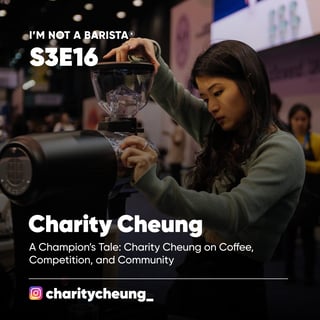
Speaker: Yeah, it's good. It's good to be in you during these days of pandemic and golf. Oh, I see. So I can see behind you, you have some of your paintings. Some of it. Some of it. Of course. We all know that you are a self -taught artist, right? Yeah, I'm a self -taught artist. And you're also a champion. Yeah. 2021. 2021 and 2022 in Britain.
Speaker: Um, let's first talk about your artistic career. I mean, well, your history in a coffee world, but let's talk about the art. All right. So I'm not really so serious before in art. I just do it for fun because my brothers are the real, I can say artists.
Speaker: because their field of studies are more into designs, engineering and all. So back in college, they used to do exhibitions. They have a group. So I have three brothers and I used to go with them. They do exhibitions, they do their works in galleries. So I just love being with those kinds of people. It has their,
Speaker: positive energy, push me more into art. No, I don't do more of it. I just go with them. And then one day I tried, I tried painting and it's cool. I just collect it. I don't sell before.
Speaker: until people can see and appreciate my artworks. I don't sell for public, to be honest. I choose people who will own my art. I sell something like connection.
Speaker: So for the gatherings, I choose only the artworks that I want to let go, or I can let go, because there are artworks that's so attached to me, even not so good by the eyes of others, they're like connection. We know that they are artists, the painters, and some of them are coffee, fanatics, home borrows, and they love latte art, but you're a little bit different.
Speaker: You're not into that naughty art world because you love painting. Why is that? Not that I'm not a fan. I just love that.
Speaker: an art that I can keep, you know, like you do an art in a lot of art and you just finish it. You know, like I want to keep it. I want when I see a like precise lot of art, I was like, can I keep this? No, you cannot. And you have to drink. Yeah. But I love seeing those creative people into art and making art as well. OK.
Speaker: So here's a tricky question. We got clay questions from the community. So I want to ask you, if you have to choose art and coffee, which one?
Speaker: Oh my God, I will not choose any because it's like interconnected. Like it both goes the same way. I fell in love in both ways in a way. Like once you get into the process, you know, there's no way out, like you'll be stuck in there.
Speaker: Once I get into art, it's like I don't want myself to stop doing it. Same thing with coffee. When you discover something in coffee, you end up discovering something more, something like that. Okay. So you cannot choose any of it. I cannot. All right. That's a hot question. I have to say, um, we know that you graduated the food technology at university. Does it help your, your coffee career? Okay.
Speaker: Let's start when I finished my studies with technology when I got a B .C .E., not so old old time.
Speaker: I was able to practice my biggest for two years in Philippines. So I was working in food laboratory. So as I had an experience in Coca Cola, Coca Cola, but then company, Nutri Asia. So basically my work is in a closed room laboratory. You see chemical analysis, microbial analysis, quality control and research.
Speaker: So for two years I've been doing that back when I was 20 years old. So it's like, I'm in a closed room, I'm alone by myself, analysis and all. I was like, I'm too young and I don't want to be stuck doing the same thing.
Speaker: for like it's just two years, I'm 22, I have to go out. I have that dream of typical Asians, like I have to go outside the country. And that time in order for me to go out of the country, the easiest way
Speaker: is to be in food service. And I'm not thinking of the money that I will get or that I will move to another career. But since I don't have any background in food service, I took up another course of food and bell services. So it's just a short course, like a year, and then I moved to UAE.
Speaker: So the first job that I get in UAE, even my family doesn't like it, it's just the barista. So I went there, I see people doing an art, talking to the guests like, wow, they know coffee.
Speaker: And I was able to work in a commercial first. And in a year, I get promoted as in charge. So I handle the operations, though it's commercial. But still, you see already the community being together just because of coffee.
Speaker: And then I fell in love with specialty coffee when I went to a coffee shop. And then the barista is just like full heartedly talking about one cup with a guest. So I was like, what's wrong with him? What he's talking about is science. We didn't do that in commercial shop, right? Yeah, we would. That's it? Okay. Two dollars. And then when they're talking about science, I was like,
Speaker: water I was working with with this loves and all and I can hear the same thing that I was working for. There's a lot of things to to work and to know about a cup and then I started exploring move to specialty coffee learn about anything that I can learn about it and until now I'm still doing that.
Speaker: This is so awesome. You somehow found this connection between your education and your new passion. Talking about coffee, what was the first specialty coffee, the special specialty coffee that changed your life? You think, oh, this is not the regular coffee I drink. This is something else. I need to find out. I'm a scientist.
Speaker: I tried first, that time the heat was experimental across this. So I was like, no, this is not coffee. This can't be coffee. I remember it's Panama.
Speaker: but it's so chocolaty. I didn't even buy it just so you have to try it. And I drink coffee without sugar before. So I really love black coffees. And then when they give me that, it gives like, what is this? So that starts because even in normal coffee shop, right? If I'm behind a bar, I always want to talk with
Speaker: like new guests in coffee, because like the excitement is there. You can talk about a cup. In UAE, there's a lot of guests, they're really into coffee because it's part of their culture. No, because it's an Arab country, it's a Muslim country. So most of the Emirate or all of the Emirate people, they're not allowed to have
Speaker: alcohol. So they're aware of meeting, conversation, gathering with everyone. It's all with coffee. That's why all the coffee shops here, to be honest, are like a act of Emirati people. And they're really embracing the specialty coffee. I had even experienced in my previous company were in
Speaker: The whole shift, you'll be just in the brew bar, brewing 5, V64, and there's more pending. That's how they love filter coffee.
Speaker: Wow. I read his article a few days ago. I think someone tagged me on Instagram said, UAE is one of the top countries among the other elite, especially coffee countries, cities like London, Seattle or somewhere else. And they say Dubai, UAE, they are a huge
Speaker: coffee community there, and especially coffee, it's a huge thing. It's developing so fast. Can you tell us more about it? Like, how much do you know since you've been there for five years? When I started here, it's not a big hit that time. But you see, in the span of five years, you've seen a lot of growth. And it's because of the consumers, not just because of the coffee people.
Speaker: The consumers are embracing it so much to the point that they are patronizing the brand and how and actually it helps in social media and all because all of the the customers that are the market that you're targeting is Emirati people.
Speaker: And they're very excited and new things and new innovations, whatever they can find out there, they are supporting it so much since they are capable of knowing what is specialty coffee. They just explore and it just be getting bigger and bigger each year. And there are even like 500 cafes now here in UAE since because they're capable of spending, right? Yeah, exactly. To be honest, they're capable of.
Speaker: So what is, what is the most favorite drink in UAE? So there's Cobro. I guess we know, but it changes. That's why it's nice. They're following the trend, to be honest. For example, the more last two years back, they're more kind of sweet drink than when I was working before there's like sweet drink, like Spanish latte. They love that.
Speaker: And then after a year after that, it was filter coffee everywhere. They're all V60. They don't even know V60, but they will go to the shop and they give me V60, give me a spina magicia, give me the smallest expensive coffees. Wow. Yeah. That is cool. So whatever you put in, in the trend, they will keep following us.
Speaker: All right, so I remember when you were competing, the Burrows copy used Geisha, right? Yeah. And many competitors use Geisha nowadays. Otherwise, you're not competing at all. I mean, Geisha definitely has more advantages than the other coffee. But when you talk about when you have customers come into your shop and say, I want a Geisha, it's a little bit different from a regular coffee, you know, since in other places, because mostly,
Speaker: They will they will choose some regular coffee like Ethiopia and Kenya or Colombia. But if if customer come in order Geisha directly, which means they are having very good spending power. Exactly.
Speaker: Because like what I said, they're following what is the trend. Yeah. So if, if someone like, for example, some popular or someone's published this one, they will keep patronizing. It's easy for this country to set a trend because they will keep following it. And that's also generally in competition. Like competition has become platform of everything. If you want to launch something, if there's new innovation,
Speaker: It's become a medium. What if you if you encounter a guest and then you you'll just say it's a competition series. It's a competition coffee. They'll be like, OK, give me that and give me this. OK, I don't want normal coffee. So they think that if I have a very good natural Ethiopian coffee here and it didn't go to the stage, I will not buy it. It's cheaper. OK, I will not be.
Speaker: No, I want a more expressive one. What is very interesting? Yeah, but it's part, yeah, it's part of the baristas and the community to educate people, right? And now it's party. It's like switching, like, like what I told you, it's changing. It's the responsibility of like us to educate the guests as well. There are more office to explore and it's a wide range of coffee origin varieties processing and all.
Speaker: So you talk about the coffee community there likes to follow some trends. And in addition to coffee events, fairs, where do you think they'll find other information about the trends, coffee trends on social media, like Instagram, or they follow certain kind of influencers like a blogger, like James Hoffman or Morgan.
Speaker: Exactly. They are really into social media, the market here. So whatever they can see, whatever some, I think it's in general, not even just in UAE. If one influencer will promote one coffee, even not tasting it will assume that it's good. It's like even a brand, even it's not so cool. If someone promoted, for sure we will buy it. We don't care if we will get
Speaker: upset with the result, but for sure, at first time you will buy it. It's the same thing with art. If there's already a name, of course you will pay for it, not just because of the art, but because of the artist. It's great to hear you compare two industries together. Since people are so willing to spend more money on really top quantity coffee, how about the coffee shop owner? Are they willing to pay more for a good barista? It's I think 50 -50.
Speaker: Some are still willing to pay, but in UAE, for sure, everyone is capable of making a coffee shop. Just because they can. Wow. I want to move there. I can see that the baristas here are getting paid more compared to other countries.
Speaker: It's interesting. We understand that, you know, if you're born in a country because you can change the fact that's already happened. So sometimes we see a lot of immigrants, they move to the other countries for a better life. Let's say American dream. People love to go America, you know, to pursue their dreams. They can do anything and maybe become the next barista champion. And the question here is when you, most of
Speaker: The baristas are foreigners and it seems you don't have a lot of local competitors except I think I know Suleiman. Yeah, for sure. He's the first supporter of Anna Barista. He's kind of one of the few locals really get a title, right? Yeah. And also while we have Ibrahim, so he won 2018 if I'm mistaken, there are very few.
Speaker: But the good thing is actually started that they are getting more into it, into the process. There are, but they're not being exposed or they have their own separate life or separate work that the coffee is like a side job for them. They cannot make it like full time. But like by passion as drinking coffee, they really patronize it.
Speaker: What about the normal coffee lovers there? Like they would like to buy more and put that home or they prefer going to the coffee shop and join their coffee? That's a good question because during pandemic,
Speaker: I can say the roastery gained more because coffee is part of everyone. There's no other way to have profit just to buy in roastery, whole bins. They have to learn from themselves or maybe some higher baristas to teach them a tool. It happens. So after pandemic, when all shops open, they're all excited to go shop.
Speaker: is to, you know, to come back with connecting people and shops, but they came back in a more educated way. I like my comfort to be like this. I do at home. Can you teach me how to do this? I have a set at home and it always happens. And it's a good one. We talk about Bora Home, Bora's, and you are the Bora's Cup champion.
Speaker: What is your secret? Or maybe you can tell us some of your competition experience. Maybe this can help other baristas who are considering joining the Boris Cup. First, how can I say it? I didn't plan to compete. Like precise plan. No, I don't have that. I don't even have a five years plan. I'm that kind of person.
Speaker: I know I have a goal that I want to achieve something. So I watch people competing because like what I said, the trend is there. Whatever they put in stage, people will know about it. And it's a good one. It's a good impact of the competition. You're setting something.
Speaker: So as a barista, I just keep watching and by kind of training, I can say it's just, I write everything that I learned, or at least I have to write something that I learned. So that become part of my training for competition. It's like when I decided to compete, I go back to all my notes and I said, it's all there. So the product of that is that what I perform in the stage.
Speaker: So if you want to compete and you're like me before, like two years back, I think just do it and be consistent about it. Like it's not like I want to compete tomorrow and then the next day I'll be so afraid. It's part of it. Being nervous is part of it, but it's how you will do it every day.
Speaker: That's the difficult part of doing everything. If you do it consistently every day, most people cannot. I guess there's a difference why we have champions, we have regular baristas. I mean, but the common thing is we all love coffee. That's the important part. So you are the champion. Also, you are the head barista at Express 11. What is your work right now?
Speaker: So I'm currently working at 7th Fortune Coffee Roaster as Head of Coffee Quality. So after three years of working in a cafe, so I love it. I really love it. I fell in love with coffee community connections because I work in a cafe for three years. So it's like, I'm not working. No, I know it's tiring.
Speaker: But, you know, if I get fired in the bar, I just go out in the door and talk with a guest. Like it's an ice breaker because you cannot stay in the bar for eight hours and just making coffee and coffee. It's so tiring to be honest. So the ice breaker that I get is just connecting with people. So that's why I love working in the bar and then I was able to manage the shop.
Speaker: And from there, when I get exposed into competition, so I see more of inspiration, I said, I always want to get back from where the coffee comes from. I always have the idea in mind that I want even to work in the park.
Speaker: And for me to be able to do that, I want to explore all the stages of this coffee chain. So for me to be able to get that is to be in a roastery, at least me exposed with production, how did it happen, coffee quality and all. So I moved to a roastery, which I'm exploring right now. So the next step, according to your logic, you're supposed to be a trader or a back to a region.
Speaker: I, oh, because I really want to be connected from where it comes from. From the very beginning of my career, when the barista told me about the coffee and all the chain that it's been through or it goes to your cup, it's like, okay, I want to be part of all of those processes. Even that work from there, but at least I want to explore all of it. I want to be part of it.
Speaker: That is great. Talking about these, we have been seeing a lot of videos on the internet about paying more for specialty coffee so it can help farmers. I was really, I'm still very confused about how this works because it sounds a very simple solution, right? You do A and B happens, but I know that real life
Speaker: Coffee is commodity and the price is not controlled by the farmers. There are many people in the supply chain like have a huge influence and most of them are not very transparent. So we're talking about paying more coffee so the farmer can get more money or leave better. It's kind of, I don't know, what do you think about this?
Speaker: Yeah, it goes still back to transparency, though. It's a good quote. Like, it's catchy. Oh, we have to pay more then. But it will not be effective. We will not really know if it's really happening back in the origin. We really don't know. It's not seen. That is the part of the chain that is so blurred from how the
Speaker: entrepreneur by coffee from the farmers. But I hope we get more transparency in that. And I hope that there will be a setting line that we set this price is the lowest that we can get or something like that.
Speaker: Based on your understanding, do you know anyone, a customer like from UAE, they care about this? You know, when you talk about good quantity coffee, of course they can pay more and they are willing to pay more, but do you need to introduce them this idea that you are paying more, not just for us, but for the farmers? And how is the local coffee community? Is this a thing there? People talk about it, pay more to help farmers or we just
Speaker: buy whatever the best out there in the market. So I think there are there are entrepreneurs here who are willing to support and are supporting this kind of projects. And the good thing here is easy to
Speaker: to share those kind of projects because Emirati are willing to understand the situation of the industry. So for example, there are roasteries that are promoting farmers, not just paying a bigger amount, but they're like, they're exposing more of the farmers. So one will expose one farmer and everyone will follow.
Speaker: I think that's more than paying more money because you're giving more business to one farmer that you're producing. Yeah, it makes sense. Thanks. Thanks for helping me understand all this. I'm really confused. I'm looking for my help. Someone please explain, you know, how that works. So I have some questions from the community. Last week we made a story. Say, what kind of question do you want to ask her? I don't want to be laughed.
Speaker: Yeah. Very good questions. And here's one from John in rocks. Ask about your, um, uh, how do you prepare for Boris cup championship as a competitor? I mean, we talked a little bit about that, but like you can say we have top three tips for other competitors. So for new words, what I did, I have a training lab. So I have a calendar as well.
Speaker: For example, one month I make sure that all of those days I said, for example, I do experiment and make a conclusion on two days, for example, just about the water. So my first week, or at least three days of first week, I'll focus on water, not everything else. I'll read about water, I'll watch about water,
Speaker: All about that. On the next three days, and it's in my calendar. Really, I have a big calendar about it. And I'll just make an experiment about maybe agitation, how I pour and all. So training calendar helps very much because as a competitor, you have a lot of things in your head. And you can think of it all at the same time. You even need people.
Speaker: for you to help in small things. That's a competitor. I don't want to think about it. I don't want to think about the size of the table because it happens that for me, for example, the table is too high. So I need to have a stage.
Speaker: personalized stage so that I can reach the table. So those kind of stuff. I have a supportive team back in me. So those kind, I don't have to think, I just have to think about the presentation that I will make. So the second one, aside from Chinese calendar, the second is you should have
Speaker: a good partner or a good team behind you. It's a team effort. You cannot do it alone. Like what I said, it's a lot of things that you have to think of. You just have to organize it.
Speaker: At least you need to have a customized table. Yeah, because not everyone can follow the one that's in the regulation and it happens. You know, there's no perfect organization that can set up a perfect event. And you as a competitor, you have to adjust on those mistakes. For example, I practice also the worst thing that can happen on a stage. For example, I want to cough.
Speaker: my mic is off, I practice those things. I felt, I practicing breaking glass and how can I, how can I get up on the situation? So I don't practice to be perfect. I practice how can I cope up with the situations. That's a very interesting point of view. When you think about it, right? Imagine what could go wrong.
Speaker: How can I handle that? Yeah, because you don't know, you know, you've been preparing for how many months and then it can mess up by just a snap and you have to be prepared for it just not by winning. And also we don't compete by winning, right? Because as a competitor, I felt like I always have a responsibility to
Speaker: to use the 10 minutes or 15 minutes in a very effective way. Because I get inspired by the competitors, by their competition. But what innovation can give to the people, it's not like, okay, I have a guts, I will talk, I will do. That's it. No, because
Speaker: If you really care in the industry, you want to share something that they can take out of what you said. So take that 10 minutes to say all the things that you want to say in the community. Is it going to inspire people? Is it going to give new innovation, new, whatever new?
Speaker: because there are like old and new coffee people that are listening to you. So it's a big responsibility to be on that stage. It's just that to have an experience. It sounds a little bit scary and too heavy for many baristas, which is think about most people think barista are people who serve coffee at a coffee shop. And then on a stage, they have to think something bigger, way bigger than who they are.
Speaker: There's a lot of responsibility there. Yeah. And don't forget to enjoy too. Don't forget to have fun. I can imagine there must be a lot of stress. How do we cope with the stress? A lot of stress. Basically, mentally. So advice that I can give is that
Speaker: Exercise. Don't miss out on the part. Exactly. It helps you to think well because you're in the part that even you're far from the day, you'll find yourself cramming or self -doubting.
Speaker: There's like kind of emotional ups and downs in those preparations. It's not that today I am in lieu of thinking about this. No, I think it will be a little bit better if you're being a little bit organized. It depends on the people. Like, you know, there are competitors who just go and maybe it's natural to them. And so I don't set this for everyone.
Speaker: just that it works for me. There are competitors that were more spontaneous, more fun, but I don't say that it's wrong or I'm right or I'm wrong or either right. It's just
Speaker: You'll find your way. You'll find your way how to hope to things. For example, I have paintings as well. I can think more if I paint and I have coffee. I have a lot of inspiration that I get when I'm painting, maybe because I'm an artist or whatever they do. For example, there are baristas and there are runners and there are athletes. So the athlete that's their way of
Speaker: getting more inspiration. So that just don't are 100 % of your your mind into the process that you're computing. Yeah, I guess most people will figure it out their own way to cope with this. This question is from Winnie Barista. What inspired you in coffee? What inspires me in coffee? It's the people. It's the people that
Speaker: You know, we've been so connected about a single crop of crop. The innovations doesn't stop. People keep learning about it. People keep arguing about it as well, but it's good because in the end of the argument, there is a conclusion.
Speaker: So, and we are so aligned since of the social media happening, every like knowledge is accessible. So there's no way that you'll stuck on like traditional knowledge that you have. It's like technology as well, keep evolving. So there's no dead end of being there. So it's like studying also and learning for me is an art itself. It will not stop. So that inspires me, I guess.
Speaker: and getting to be connected to people just because of the coffee. You'll meet someone and then you can just talk about coffee. Even you just met now. That's how powerful the coffee is. So talking about people, can you name one person who inspires you a lot in your coffee journey? So many. I have a long list. A lot. But OK, talking into
Speaker: Maybe competition. Because when you see people competing, if what really they say and stage reflects to what they do, it inspires more of race to compete or at least to add more something. That's true. For example, what Sasha did at CM and then now it's until
Speaker: Until now, there are some people innovating about it. They have a lot of people. I'm not going to hurt anyone, so I better not name them. I don't want to hurt their feelings. Yeah, but I get inspired for those kinds of people that what they do and stage reflects on what they really do in the community.
Speaker: Yeah, it makes sense. So you don't have to single out one person, but even you, as if you met a barista in a cafe, and you can see he's really connected, the way he prepared coffee, the way he talks to you. He's so connected in what he's doing.
Speaker: You know, I'm so shallow, I can be inspired in many simple ways. So any people making coffee for me, maybe I can be inspired by them. You're a learner, you always got inspiration from others. I think that's the best treat as a learner. Yeah, it's not just for influencers or I'm happy if I inspired people, but you know, you can be inspired by anyone.
Speaker: So we talk about who inspired you. Let me ask you this. If someone needs inspirations and they come to you, how would you would inspire others? You know, now you are the inspirer now. You are inspiring other people. Wow. That's over about me. Well, you know, I just do my
Speaker: thing, to be honest, I just do my thing. And it's a good start for them as well. I do what I love. And I love what I do. And I keep choosing it every day. So I find ways for me to enjoy my thing.
Speaker: So I don't focus on the negative because there's always negative. I don't focus on what people say because people will talk anyway. So I'm pretty sure that whatever I do, it will help in terms of community. It will help other people who can see me or as much as possible. I can help someone who wants to be on where they want to be like competition. I answer.
Speaker: as much as I can. And same way with art, I share my emotions through art. So that's it.
Speaker: All right. I guess you're not really ready to spare more people. Maybe I better prepare a speech when next time someone comes to me, hey, I need your help. Wait a second. Here's my list. All right. So we'll have nice question. Oh, it's a strange one. The question is, are you single? I'm not married.
Speaker: Not married yet. Okay, great. That's a short answer. I have my question for myself. I noticed that you like wearing a bucky head. I see that in your pictures. Yeah. What is so special about why do you like it so much? Oh, to the animals. In my previous work, we have to wear a hat. It's not so different reason. We have to wear a hat because we don't wear
Speaker: What do you call that? Internet. Okay. So you're in food industry. You have to have your hair. So I don't wear like that kind of crap because it hurts my head and I have a migraine. So I cannot wear. So I feel like there's nothing in my head. Yeah, it's comfortable to be honest.
Speaker: So do you also have a collection of baguettes? I have. A lot more. Maybe 30? I don't know. I don't know. I have less gown. Yeah, I have less. I even wait. So tell us more about who you are in real life. Who's the real marrying in real life? So what's so even? I can think of that. I'm a runner.
Speaker: I used to join the wet lawn, marathon, even that, well, in coffee industry and early in art industry. So I think there's still part of me that always want to keep moving. I do penny boards as well. I skate. And cycling. So I'm, I can say I'm,
Speaker: outgoing introvert. So they're part of times that I just want to be alone painting things so I can think more. But there are also times that I want to go out selectively. So that outside golf industry, I mean, because I always go out with coffee people. So yeah, those are my extras.
Speaker: That's important, right? When you do art and you do coffee, it's more like not moving much that you need to combine some activities to mix it up a little bit. That makes sense. All right. So one last question from the community is very, very important since you are the bird's cup champion. What is your favorite go -to recipe for all kinds of coffee? Okay. So there.
Speaker: I don't have one recipe that fits all. So if you have one, it's okay. If someone is having, it's okay.
Speaker: but I approach my coffee in different ways. What I want to do here, what's my coffee, what's the coffee that I'm having so I can, I cannot use this recipe when I'm using the other coffee. So I keep adjusting every day. I have different routes. Every day I have different recipe and I take note of it if it's good and if it's better adjusted. So I don't stick with one.
Speaker: Yeah, that makes sense. Let's put it in this way, in a simple way. If you have a new variety of coffee, you need to pick up one recipe first to test that out, right? So which recipe will be the first one you want to try? Like the base, okay. Yeah. So very basic, you can use always 12 grams first. 12 grams. And yeah, and it was to 15. I don't know longer than two minutes.
Speaker: and then I adjust from there. Oh, that's simple. Very simple. Thank you so much. What last word to our audience today? What do you want to share? What do you want to say to the audience today? Anything you want to inspire our audience, the baristas who are listening to this podcast? So
Speaker: I just wanted to say like maybe in your situation like me five years back who just want to
Speaker: You know, you're just a baby very psyched. You just have to work on it every day. You have to be consistent in learning something. You go on connecting to people, whatever you're reading right now may not be significant the next day. So make sure you don't stop learning.
Speaker: base your knowledge on something that you just read now, because maybe tomorrow it will change. So by practicing it, you learn from it. It's not that something that we read. And believe me, even those old guys in the coffee industry are the legends, they don't stop as well. So I get inspired by those people who keep creating something for the industry.
Speaker: be a lifelong learner, always learn. So yeah. Where can we find you if someone visiting UAE? Oh, so you just passed by at 7th version of your roster. I'm always there, I'm not there. I go out visiting our clients. That's my work. Yeah. Thanks for this episode. I really have a lovely talk and nice to know more about you. Thank you so much, Miki.
Speaker: Thanks for tuning in to this I'm Not A Barista episode. Subscribe to this podcast and follow us on Instagram at I Am Not A Barista for more empowering vibes and true coffee stories that connect you with coffee lovers around the world. You're a part of our global community where we celebrate baristas and their craft in everything that we do.