Transcript
Speaker: race scal end Hey, this is Katie and you're tuned into Risk Alliance, a podcast about the hard, soft and surprising skills that will help us stay afloat if our modern systems don't.
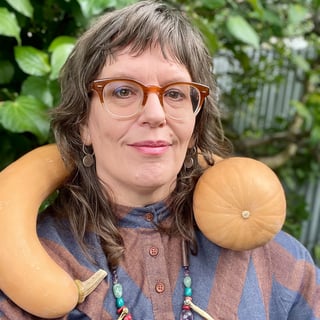
Speaker: I am extra grateful to be recording in Lutruwita, Tasmania, surrounded by calendula and dandelion and raspberries and rambling pumpkins in my mum's backyard.
Speaker: Jord and I are camping down here in the van for a few weeks, intercepting friends and family and hopefully a few dozen oysters. It is a perfect autumn day, and I want to talk to you about Jar Power.
Speaker: I was thinking about Jar Power as we packed the van to the hilt with homegrown and lovingly sourced foods to sustain us on the road, so we don't blow our travel budget on Eggs Benedict and oat milk lattes.
Speaker: So what is Jar Power? Well, it's something many homesteaders and foragers will be familiar with already, and it comes from stocking your pantry and your shelves, or your camper van in our case, with an ever-increasing array of colourful, non-industrial foods in jars. Old peanut butter jars, or tahini jars, or coconut oil jars that will never not smell like suntan lotion.
Speaker: When you buy food in bulk, or grow it at home, it's not packaged of course, so you've got to do that part yourself. In our tiny house we have jars of random plant matter lining the walls, things like dried corn silk and hawthorn blossoms, nettle leaves and calendula flowers, cornflower petals, elderberries, dandelion roots, powdered orange peel and experimental herbal salts tinged with green, dried fruits from our neighbour's orchard, basil pesto and zucchini pickles, and partially fermented goat-derived goop.
Speaker: There are obviously plenty of foods we haven't foraged, also displayed in jars, like rice and grain and oil and spices, and they still deliver jar power, because jar power is that feeling you get when encircled by abundance, abundance made visible thanks to the see-through nature of glass.
Speaker: This signals a deep sense of safety and satisfaction to the human psyche, being surrounded by food. How comforting is that? Jar power emanates from the ephemeral beauty of perishables arranged like works of art on open wooden shelves, forever being eaten, then replenished, shifting with the seasons, and reminding you of that time you went foraging with your friends last summer, or ferreting along the damp flanks of a river harvesting turkey tail mushrooms.
Speaker: Jar power really comes into its own when maybe a friend comes over and they're like, holy hell, what is happening here? Is this Hogwarts? Where are the Weet-Bix? And then they confess that they're a little bit inspired by so much naked, unpackaged food. And maybe they'll forage and bottle a bit more of their own food too.
Speaker: Jar power also comes from the rightness of reusing a material like glass, made from dwindling sources of precious sand and energy, much of which still ends up in landfill. And one more thing.
Speaker: The best way to remove stubborn, sticky labels from glass jars, which can totally cramp your aesthetic, is hot water and eucalyptus oil. Someone with immense jar power is a chap by the name of Robin Greenfield. You've probably heard of him because he has a habit of making the news with his environmental hijinks.
Speaker: Robin is someone I've respected for many years for his edginess and honesty, the way that he calls out the insanity of industrial systems while never sounding preachy. In the past, Robin has given away all of his possessions, taken vows of poverty, stapled pieces of trash to his clothing till he was a walking tip, grown all of his food, and this year is foraging 100% of his food to show us what's possible and to live the kindness and liberation he wants to see in the world.
Speaker: He's not farming or even gardening, he's properly foraging, shopping Earth's wild aisles to fill his belly and stock his pantry. and He has been carrying an assortment of wild foraged foodstuffs around the country to talks and interviews, beautifully displayed in glass jars, to better show off the technicolour abundance we so readily overlook. look Jar-peh.
Speaker: Today, Robin and i get real deep, real fast about farts and also about foraging as resistance, as a reclamation of our critical thinking skills and care for country, and also about things like finding your purpose and niche, non-attachment and joy as a radical act within structures that want us sad.
Speaker: I felt so energized after this conversation and I hope it charges your aquifers too. All of my gratitude to Robin for carving out time for Raskillians in his busy schedule and to you for listening in.
Speaker: I am incredibly thankful to all the folks on Patreon who are helping me do what I love and produce this podcast single-handedly without advertising, funding Raskillians as a community, allowing me to spend many loving hours researching and recording and wrangling my inner critic to bring these conversations to you.
Speaker: Thank you so much Patreon pals, you keep Reskillians afloat, and a very merry welcome to new patrons Laura and Beverly. If you want to join us, we're at patreon.com forward slash Reskillians. And if you can tell me how many times I said jar power in this introduction, I'll draw you a little picture. Alright wannabe foragers, here's Robin Greenfield. Enjoy!
Speaker: Well, Robin, I am so stoked to be sharing this conversation with you. It's the start of my day. So kicking off my morning with a conversation with Robin Greenfield is just like kind of heavenly. And so thanks so much for joining me this morning. I think it's your afternoon, right? Yep. 4.41 here. And I happen to be in Miami, Florida today on a speaking tour.
Speaker: And... Well, I'm happy to be in conversation. I think i think we're gonna go some places over the next hour. I'd love to start by just asking how you're doing, like checking in with you and seeing what's happening like in your body and mind because you know you're on this tour.
Speaker: I imagine i imagine like it gets to the point where maybe some days you're like, man, I just need to nap right now and not be recorded for posterity. like How are you doing, Robin? The reason I was laughing is because I actually have pretty bad gas today. but
Speaker: There's that honesty. Yeah. How I'm doing overall is pretty excellent. So today's day 133 of no grocery stores or restaurants, no gardens, you only eating what I'm foraging for for a year. so I'm four months, four and a half months in now. And you know, when I take a moment to actually think about it, I'm like, I have literally broken free from the global industrial food system. I am sitting here, not surviving, but actually thriving without having even a garden, just harvesting what the earth is freely and abundantly providing. And most days, I don't think about it at all, because it just feels absolutely normal. I don't remember the grocery stores right now. I'm not craving really anything I don't have.
Speaker: And so I have this complete diet. And you know I didn't know that I could do this. It's a real test. But i'mm I'm actually, i would say, thriving overall. And so I'm also tired. I'm on a speaking tour, giving talks most days as well as leading plant walks. And I like my alone time and silence and quiet time. And I'm not getting enough of that and not quite enough sleep.
Speaker: So I'm also struggling, but I'm thriving and struggling at the same time.
Speaker: Thank you for that snapshot and the honesty. um let's just like dig in a little bit deeper to this gaseous state that you find yourself in. Is that because of something you ate or is it like the stress or the, you know, the extra burden in your schedule? Like, what do you put that down to?
Speaker: It's the wild yam diascaria alata. There's no question about it whatsoever. As soon as I started eating wild yam, I started to have gas. Prior to that, I was eating wild rice or manomen, which is the that's the staple calorie that is available in my homeland. And down here, the staple calorie that's available to forage is wild yam. And it's not the best for my digestion, but it's so it's so easy to harvest in such large quantity to you know be my caloric base that I'm continuing to eat it you know anyway. And i just I think what I have to do is ideally start fermenting it. So
Speaker: i I dehydrate it and blend it into a flour. And now if I can i can make sourdough out of it and then make flatbreads and tortillas and pancakes and such, that might be the solution. But I just have been a little too busy to get around to doing that.
Speaker: Oh, sourdough yam sounds delicious. And yeah, this is this is a question I've had for a while, Robin. Like when you eat really locally and really seasonally, sometimes it isn't exactly the stuff that might be best for your digestion or is there this...
Speaker: ah This thing where we've got to maybe demote our perfectionistic stainless steel digestive expectations and understand that sometimes like our health isn't going to be totally like spot on because we've got to eat what nature is providing for us.
Speaker: Yeah, I mean, I'm not into human optimization at all. I spend zero time on human optimization. i I just want to live a good life.
Speaker: I'm not trying to live to be 100 or 120. And I'm not trying to be able to have the highest levels of physical, you know, prowess or anything like that. I just need to be able to ride my bike and you know, get where I walk and and and harvest and garden and do what I need to do. And i don't need absolute prime health to be able to do that. And so, yeah, I mean, i'm not someone who makes, I don't consider myself someone who really makes a lot of sacrifices because I'm all about living a deeply healthy and happy life.
Speaker: But In this area, I would say, yeah, I mean, i' I'd say we do probably need to make some sacrifices and be willing to put up with less ideal conditions than we're used to. Because the reality is is that the conditions in which we have our frame of mind are based on systems of exploitation and destruction where we get our convenience and comfort at the expense of others where we don't see the truth behind our actions.
Speaker: So I expect to bear part of the burden of of life and that means absolutely less convenience and comfort and right now that means of some farty days.
Speaker: Farty days and farty nights could be like a rom-com based on your life. Well, fortunately, there's no romance with humans in my life very intentionally. And the earth does not mind at all if I'm farting.
Speaker: She loves it. Just laps it up. It's like, please come take me some more. This is like contributing to my plants. Yeah, absolutely. And the animals the animals have no problem with the farts either.
Speaker: Oh, well, you know, I'm joking because it's like a defense mechanism as against like the existential things I'm feeling as you speak, which I really like unsurprising given like we're seven minutes into the conversation and I'm already really wanting to go there with these bigger questions and like my curiosity around, okay, like this point that you've touched on around not optimizing your life and kind of accepting the burden.
Speaker: I feel like maybe I'm part of this generation that's a little bit broken because of the choices of my parents and their parents and the things that we've been fed, like those three generations of cats. And they are eventually really unwell because of the biscuits they've been eating. And it's like, that's me So you've you've alluded to this idea of accepting that we we're mortal, that we're fallible, and that there are things that are bigger than us and that we're part of those big things. What has been your process around coming to terms with that, Robin?
Speaker: Yeah, well, I mean, two of my biggest practices are non-attachment and impermanence. And i think one of our greatest threats as a humanity is that we are so latched on to life.
Speaker: so deeply latched on. But the way I look at it is this. Every second, two people die. Two people just died. Two people just died. Two people just died. Two people just died. Two people just died.
Speaker: I know with certainty that I'm not more important than any of those two people, any of those two people, any of those two people. So that's that. It could be me that dies in any of those seconds, and it's no it's it should be no a big deal because i don't even it I don't think about the other people that are dying, and I am no more important than them.
Speaker: So that's a huge relief, actually, to embrace that. And the non-attachment aspect is we live in a time where, you know, we want things to be a certain way. And of course, so do i I. want us to live. I want to help to end the injustice and the exploitation. And I want humanity to live in harmony with this earth for the sake of all life on this earth.
Speaker: But at the same time, I practice non-attachment and just embracing that things are what they are and I can't control them. And having these deep level of attachments isn't actually going to help me be more effective in my you know work to create more health and happiness around me.
Speaker: And this also helps to let things go. I'm a deeply serious person, but at the same time, I only take things so seriously because you also have to remember, it's like, we don't even know what a human being is. You know, what are we, who are we? We don't actually know the answer to those. So how seriously can you take things when you don't even know if we might be zeros and ones on a simulation theory of some sort? So...
Speaker: Those are two of my key practices, non-attachment and impermanence.
Speaker: Yeah. I like to imagine that it's all just like the fleeting daydream of a giant ladybug somewhere in a parallel universe. I like that. And it is it does give me a giggle that like we have all this solemnity and seriousness and science and it's like, but you really don't know. At the end of the day, there's this giant mystery at the heart of everything. And how thrilling is that? Nobody's going to crack it.
Speaker: It really is. You know, I have this interesting feeling lately that that I'd like to share because I'm feeling it right now. And so here I am having this conversation and we're having this conversation because A number of people list know who I am listen to me, and are interested in what I have to say and even put some weight into what I have to say. That's that's objectively you know true.
Speaker: However, I'm sitting here and I'm looking out around me and completely... completely almost disassociated from that, where I don't remember that anybody has any interest in what I have to say, knows who I am, would remember me tomorrow if I wasn't here.
Speaker: And I'm not sure where that's come from because that didn't used to be the case. It only started in the last few years. But it's just this interesting feeling. And if I think about it too much, I almost start to what like think, what what is going on here? like am i real Do I exist? Am I real?
Speaker: And I don't know. I can't put exact words to it. But it's just something that I feel. And in this moment, I wanted to share that. Yeah, I kind of felt my edges dissolving a little bit as you said that as well. It is, yeah you know, there's so many things that are true all at once and even holding um like Indigenous perspective to know that paradox is a law of the universe, not this thing that's aberrant. So, yes, it can be true at once. As you mentioned that, I almost wonder if this is a natural way of feeling
Speaker: for a lot of indigenous people that lived where they didn't have the self like we do, where they were more existing in an interconnected state and they never were born into a society that creates so much separation.
Speaker: And if it's not the if it's not the result of the last years of work of dissolving the self, I still have a self course big time but I've done a lot of work to dissolve the ego and the self and maybe this is part of that when you do dissolve more of the self you start to just kind of exist in a more present outside of yourself way yeah I suppose like yeah bringing it back to foraging and you've already touched on
Speaker: that sense of independence from the industrial food system and many of those structures of oppression and exploitation that we, most of us are still leaning on and living with. And therefore they create so much cognitive dissonance because we don't agree with them, but we depend on them. And then you've alluded to the fact or the felt sense of freedom because you know now that you can exist and thrive outside of that food system which you've spent so many years critiquing
Speaker: and Yeah, I've been thinking more and more about this this freedom piece and that freedom is less, I think it kind of has negative connotations even like politically, right, like with the libertarian kind of approach, but actually freedom as ah as a fundamental state and right of of creatures and every single being who can have their freedom in relationship, you know, to other others' freedom. Yeah, I'd love to dig in a little bit more, Robin, to how you how you've gotten to this place that I think a lot of listeners and I know myself would definitely yearn towards because we know that gaining those skills and then inhabiting that freedom is like very powerful on many levels.
Speaker: Yeah, I am all about freedom. And you're right. There is like this word has been put into situations of polarization and there's some negative connotation around it.
Speaker: But I believe that freedom is a basic human right and a basic human need. And there's a whole, you know, gradient of freedom. Of course, we want to be a part of communities where we depend upon each other, which in a sense takes away some autonomy.
Speaker: And so it's about having that balance of autonomy and freedom while still having systems that and communities in place that require us to do stuff for others, maybe when we don't exactly feel like it in that moment and where we are willing to share resources that maybe we would kind of rather just have to ourselves.
Speaker: And so there's ah there's very much a ah ah gradient of that freedom. But for me, from the beginning and When I woke up in 2011 to the reality of the world that we live in, I realized that I was living in a web of consumerism, that I was wrapped in a web of consumerism and I was attached to it by hundreds of strands so deeply, deeply woven into.
Speaker: and i wasn't free. i wasn't free. I could never be free when I knew that each of these strands was tied to systems of exploitation and oppression that were taking away other people's freedoms.
Speaker: I want freedom, but I'm not willing to have freedom by stealing away from others. I want nourishing, wholesome food, but not at the expense of the people, the plants, and the animals, because I want it to exist in a state of interconnectedness, and true freedom only exists when every element involved has that freedom as well.
Speaker: So I think for me, that's one of the main central focuses of my life is pursuing autonomy and freedom in a way that also provides that autonomy and freedom to others at the same time.
Speaker: Mm-hmm. Yeah, it's co-freedom. And my next question for you is, you started reading books and kind of wising up in 2011, just being like, holy shit, look at this this tangled web of exploitative systems and stuff that I'm tethered to, and that doesn't make me feel good. And so you had that intellectual awareness. And What makes, okay, so a lot of us have that that awareness. so We've seen the documentaries, we've read the books, we've listened to the podcasts. What makes it different for you to then take these steps? And I know you're a fan of taking lots of steps, over time, how did you get to the point that you're at now and maybe others, myself included, were still kind of like just hanging out, thinking about things, cogitating rather than practicing?
Speaker: Yeah, I mean, i i wish I knew the answer to that. i I really have only existed inside of my own mind and body and only really truly know how that works compared to others' And I don't really truly fully know what's going on inside of others. So it's it's hard for me to give conciseness to it. But what comes to mind is one, that I am potentially built and wired in a way that facilitated it much more easily than others.
Speaker: There is the fact that I do have a substantial amount of privilege and What I mean by that is that my basic needs for safety and security and stability were quite met.
Speaker: And so that allowed me to venture more into the unknown and take more risk. Now, of course, there's plenty of people out there who have the same level of privilege as I do who don't go, you know, who don't take the leap. And there's people with way more privilege than me who don't take the late leap. leap So that's just, you know, one element and one possibility. But it does play a role. Being a white man ah in this society allows – it's much more easy to take those – take those some of those risks.
Speaker: um There's also – As I said, just that I've always been someone who is an explorer and who pushes the limits.
Speaker: And I don't know where that comes from, but that dates back to like single digits Robin Greenfield. I was, that's the way I was from a very young age.
Speaker: And then i think I'm also just highly driven by truth. And I'm highly driven by non delusionalism. So I am very, very profoundly against living a life of delusion. And i was in delusion, and I didn't know it.
Speaker: And then I learned it. And then I just said, I can't do that. That's not for me. And I also just, I don't know, maybe I have a stronger zest and quests and yearning for freedom because that's what this is about. It's like like we talked about, this is this is the ultimate freedom that I'm pursuing in having in living a life that's based in close connection with the earth and the people and the plants and animals. So, I mean, those are those are some of the things that come to mind
Speaker: But I really don't know what the truth is because just one asterisk is I don't know if we have free will. I'm open to the idea that we don't have free will. And if we don't have free will, then everything that I've just said only has so much relevancy.
Speaker: Assuming that there are there's relative free will and there are choices we can make. Assuming that because otherwise podcasting is pretty futile, right? Because I'm here to ask you, how you are the way you are, why you do what you do and like help others glean inspiration from that and inspiration begets a change or or an action. So let's just take that for granted. um so finding our niches, like you've obviously identified these qualities in yourself and these proclivities and you're like surfacing those gifts and now channeling them towards something that's really amazing. And it feels really good and satisfying in your bones. And yeah, question that a lot of people have is, okay, how do i how do I surface my gifts? How do I know what to focus on? What do I do if I don't really know who I am or what I want to track towards in the context of, we all want things to be different. Like we all want a more beautiful world. So I wonder if you have any thoughts for, for folks who are really looking to find that ecological niche for themselves based on those, like you said, those really early inklings as children.
Speaker: Yep. Absolutely. Well, definitely I would, I would feel your feelings, you know, tune in with your feelings and see what's bringing aliveness. Like when does joy start to bubble up inside of you? And when do you feel like you're, you know, really onto it and explore that. And then when you instead are feeling like a pit in your stomach or a lot of anxiety in your chest, feel into that. And so definitely,
Speaker: feel your feelings and see what they are telling you. And i generally encourage people to go the direction of what's really making you feel alive. And it might not be what you rationally think you're supposed to be doing or what you've been taught that you're supposed to be doing.
Speaker: And so that, you know, that could be gardening is where you feel, wow, this is for me or or foraging or, you you know working to live a ah very low waste life or homesteading, or it could be you know in a podcast, you know having a podcast and interviewing people to share their message.
Speaker: And then with that, dropping the concern of what people think about you, because I think that probably is one of the most limiting factors in figuring out who you really are, is how many hours are you spending on what are people thinking about me? And if I do this, how will this be perceived by others? And will it result in me being successful and loved?
Speaker: And instead of that, look at life through the lens of, is is this action beneficial to the earth, my community, and myself? Ask that question with everything and see what arises. And then also, you know will this bring me meaning and purpose and joy?
Speaker: That's another aspect of it. And I would say another big part is pursuing just radical honesty and authenticity. That is one of the most powerful things we can do today because that's where you that's where you are able to bring your true gift to the world when you're truly being yourself. We all have gifts to the bring to the world. I have no doubt about that whatsoever.
Speaker: And radical honesty and transparency and you know being who you are is an incredible act of resistance in a society that's trying to make us all just be quote unquote normal and just follow this monotonous path. So just in doing that, you are existing in a state of service to society and helping break that mold.
Speaker: So true. so i want to um I want to ask you about finances because I feel like it relates to that last point in how we be of service. It's ironic and kind of tragic that I think a lot of the time we can't afford to be ourselves or we feel like we can't we can't get free from from our debt or from our financial obligations. So again, every single person's circumstance so individual, but what have you done to free yourself up to be your Robin self without like the financial hangups?
Speaker: Yeah, well, I've made a lifetime commitment to living simply. Mahatma Gandhi said, live simply so others may simply live. And I have brought that into the core of of my being.
Speaker: And So what I've done to break free, i mean, I still exist in the monetary system to some degree, but to a large degree, i have broken free from the monetary system.
Speaker: And the way that I've done that is through building skills and building a life around relationships, relationships with the earth, relationships with, you know, my fellow humanity and relationships with the plants and animals we share this home with.
Speaker: So I have dozens of skills that allow me to accomplish what I need to accomplish that in the past I would have had to spend money on. And i have hundreds of relationships.
Speaker: I mean, just every plant that I forage, I have a relationship with, which means I don't have to make money to instead just buy a food or a medicine that I instead harvest, whether it would be from growing or foraging.
Speaker: But then also there's so much exchanging with people. That's relationships. I have friends who practice acupuncture or massage who don't know how to forage. And they can share acupuncture with me and I can forage food for them or teach them how to forage even more ideally.
Speaker: So building a life around relationships and skills is what largely helped me break free from the monetary system Mark Boyle, he went by the Moneyless Man. he was one of my early inspirations in demonetizing my life.
Speaker: So in 2015, I made a lifetime commitment to earning below the federal poverty threshold, which at the time was $11,000 a year for an individual in the United States.
Speaker: And I've made a lifetime commitment to not paying federal taxes and instead donating 100% of my media income to the people and the organizations that are working at the grassroots, doing the work to serve the people.
Speaker: So I've made a lifetime commitment to paying taxes, but just not through the federal system that is based upon the military industrial complex, police brutality, you know the the subsidization of fossil fuels and so on and so on. And this all feels utterly, utterly normal and in the flow for me.
Speaker: But I know that you know in this society, that's you know that's ah that's that's a very different way of of going about finances. and And then I practice complete transparency with my finances. So if anybody goes to...
Speaker: robingreenfield.org slash financial transparency. I share where my money comes from, how I earn it, and any you know relationship that I have through my nonprofit with you know that's bringing in funds, where that's coming from, and about as deep of a level of financial transparency as as I could fathom is is what I've been doing now for years and getting even more deep with that over the last years.
Speaker: Yeah. and And just for context and contrast, you had a very different goal around money in your 20s, right? Yes. When I was 25, I was running a marketing company. At the peak, we had 20 independent contractors selling advertising.
Speaker: And I had a goal of being a millionaire by the time I was 30 because I saw money as freedom, actually. That was one of the main reasons why. And this is a huge turn of from running a corporation to Yeah, absolutely trying to have money be as least involved with my life. But at the same time, I do use money as a medium or as a vessel for positive change. So I do run a nonprofit and we do bring in funds with the idea of trying to use money as a way to create positive change. And one way I look at it is we use money with the intention of
Speaker: dissolving the monetary system. So we use that money to plant fruit trees so that less people will need money to buy food instead instead have fruit. So that's part of the transition ethics that we talk about in permaculture is not being able to live exactly the way that we would you know prefer because sometimes the most beneficial, powerful thing we can do requires being somewhere in the middle.
Speaker: And i also love that you've pointed us towards this really I feel like it's a very compassionate stance when you when we understand that we're all trying to get our needs met and those needs are really fundamental, freedom, belonging, safety, sustenance, but we just have different ways of going about them and some of them have been kind of co-opted or manipulated by these extractive systems, but we want the same things fundamentally. You wanted freedom, but you just had a different mode of of getting there and, yeah, i do i do think about
Speaker: that how powerful it is to understand with compassion what our drivers are and that there are different ways of meeting those needs that are much more beautiful and beneficial for everyone.
Speaker: Yes, absolutely. I was so fortunate to fall into the practice of nonviolent communication or compassionate communication about four years ago. And it's a language based around understanding our feelings and needs and understanding what other people are feeling and needing and understanding what we ourselves are feeling and needing. And the idea is that every feeling arises based on a need that is met or not met.
Speaker: And at any given moment, every single human being is doing the best that they know how to meet their needs. Even the most dominator, you know, people in in our society,
Speaker: the belief is that they are doing the best they know how to meet their needs. And, you know, you take some of our, dictator, um you know, governments. And it's really that ah deep down they they really, really have a need to be loved or a need to a need for respect, a need for belonging. And that's really where they're operating from. But they choose a strategy that's not the strategy that we would use. It's definitely not the strategy that I would use. And it's a strategy that ah ultimately harms others.
Speaker: But always being able to look at why people are doing things and understanding it's all coming out of out of needs and feelings is ah it's my chosen way to exist in this world. And I'm so grateful for that practice. The book, Nonviolent Communication, I've read it six times. It's one of the most foundational books to my life.
Speaker: Yeah, thanks for bringing that in. And I absolutely share your perspective, even though it ah you can get some pushback on that because we see it's It's quite convenient and simple to see people as purely evil and needing to be purged. And that feels good. It feels good to rail against something or someone. um it It takes a little bit more mental gymnastics to really have compassion for the people we see as as at the top of ah this very, very dysfunctional pyramid.
Speaker: Yeah, I mean, the one of the teachings is that the hardest person to give empathy to are your superiors or you know people that are higher up. And i so you know i experienced that myself. So ah you know i'm I am a dominator. I grew up in a dominator society, and I was taught the dominator ways. And I didn't really know that until I had been in that realm for like multiple decades, you know, a good 30 years or so. And so it takes a lot of work to overcome the dominator inside of oneself.
Speaker: And i have seen where people who, you know, see me as um this person that has more power than them, they can't see the human the in me. And Most of the time when people have experienced me in a way that results in them feeling you know disheartened, disappointed, angry, the reality is is that I'm suffering inside along with them. that i'm feeling Usually when things go wrong, it's because
Speaker: I'm feeling overwhelmed or disheartened or anxious. And then i am not a, and then I end up communicating in a way that is, you know, that stimulates pain for other people. And it's the hardest to empathize with that person. And because I've experienced a lot of that, I know that there's all sorts of leaders out there and people who are in positions of power that it's not what we think. The assumptions that we make are not you know always accurate and that they are they're also suffering inside too.
Speaker: Yeah, thank you for that really epic reminder. So I'd love to get back to the meaty goodness of foraging. And i know that's super alive for you right now. And it's so much more than it appears on the surface, you know, on the surface. Okay, sure, like you're eating from the wild, that's super cool. But I know that There's a layer upon layer of of rationale and resistance and like a real political statement that you're making with your foraging. I'd love to paint a picture for the listeners around what your foraging year looks like. What are the parameters? What kind of things you're eating? You know, like the nuts and bolts. And then if we can dig into some of those finer details, that would be amazing.
Speaker: Sure. So, yeah, you mean I mean, you kind of need to define what is foraging. Because when you look up foraging on the internet, some dictionaries will say it's just the harvesting of one's food. Which, you know, you could be harvesting your food from the grocery store shelves and it would count as foraging according to that definition.
Speaker: So I had to come up with what my definition of foraging is. not because one is needed necessarily, but because one is needed for the sake of this experiment, because I am declaring that I am foraging all my food for a year and I need to create clarity of what that is.
Speaker: So what that means is it's harvesting my food, which includes plants, fungi, and animals, that is not being intentionally cultivated as food by humans.
Speaker: So some of that's really, really easy. You know, there's a wild black walnut tree in the forest that was planted from falling from another, you know, black walnut tree.
Speaker: Clearly foraging. But then you have, like, for example, an apple tree that I find on the edge of a field. There's no house around,
Speaker: but That might have been an apple tree planted 100 years ago by someone who's no longer here. And that apple tree is basically rewilded at this point. it's It was from an old homestead, ah old old farmstead.
Speaker: That, for me, is foraging. Okay, well, then we go, we're in the city, and there's an empty lot. And there's a pear tree on that empty lot.
Speaker: and there's you know that tree is just existing on its own. Yeah, maybe it was probably planted by people, but it's not being maintained. That, for me, is foraging.
Speaker: You've got ah someone's front yard, and there's Suriname cherries or loquats growing in it. and They have that as a landscaping plant, so they actually intentionally planted it, but they didn't even know that it's food.
Speaker: That for me is foraging because it's not food that's being intentionally grown. So one way of looking at it is as lot as it's food that I'm eating that is not taking anybody else's food, and but definitely food that's not being intentionally cultivated.
Speaker: and then But you have more gray areas, so eating the weeds. If I eat the dandelions from you know my mom's front yard, that's foraging for me.
Speaker: But what if you eat the dandelion that's growing around the raised bed? Is that foraging? What if it's growing in the raised bed? ah I don't really harvest that because that's like in a directly cultivated area.
Speaker: But what about your friends who have food forests where the the line between foraging and growing food is totally blurred? What do you do then? I'm not sure what counts as foraging in there. and um So there isn't always a clear answer, but it some of it's very clear. And some of it is like, oh no, I'm not going to harvest that. that's That's not going to count as foraging. And then other ones are like,
Speaker: all right, I'm harvesting this, but this doesn't feel quite exactly what I want to be doing here. And so the answer is I practice transparency with what the it you know what it is and on at robingreenfield.org slash foraging guidelines.
Speaker: That's where i dive deeper into that little you know little walkthrough that I just did of what what counts as foraging and what doesn't for this year. Yeah, that's way more nuanced than I realized.
Speaker: Well, we live in such an interconnected world. Humans have been in relationship with this world for such a long time that when you look at most plants now, there is a relationship of some sort with humans.
Speaker: Yeah. And I feel like it actually brings us around to that assumption that there's humans and then there's wildness and the assumption that meant that colonizers could be like, hey, there's nobody here. This is ours for the taking. Whereas we know it was a vast and beautifully tended garden, like a wild garden of first peoples. And it's like, yeah, I guess that nuance is really important in terms of questioning all of these assumptions that we have about purity and connection and all of those things. so Yeah, we live there. We're so disconnected that it's hard to fathom the level of disconnection
Speaker: And this experiment of foraging all of my food, that's one of the main purposes is to reconnect. And it turns out there's a lot of gray areas and that our words ah don't work all the time because it's a language that was built around disconnection in the first place.
Speaker: And so for me, I've got a great flow, but the hard part is, you know, how do I say what I'm doing most accurately? And that's hard to do, especially because, well, how how many hours do you have you know for me to explain it? And on the news, it's a matter of seconds and minutes. And so that is one of my great challenges in that regard, which I'm grateful to have this conversation and for those who get to listen to this and dive into a little of that.
Speaker: Hmm. So what kind of meals are you eating? Well, um I generally eat about breakfast, lunch and dinner most days. And what I usually do is I make I often make one pot of food that I'll eat for all three meals. Sometimes I'll make a pot of food that lasts for multiple days.
Speaker: My diet when I'm up north in my homeland is wild rice. Right now I'm on a Florida speaking tour and so it's the wild yam instead of the wild rice.
Speaker: I generally will have fish or venison, deer meat with most every meal. Mushrooms, mostly dehydrated mushrooms that I harvested last fall. I eat about six species of mushrooms, primarily bolete, chanterelles, and maitake being the main ones that I'm eating right now.
Speaker: And then greens, ideally fresh greens that I'm harvesting, but I'm often not taking the time to harvest fresh greens. But if not fresh greens, then green powder that I've made, dehydrated stinging nettle is one of my staple foods.
Speaker: And different herbs, bee balm and wild onion are my main flavors, my my main spices. And that kind of is like what's in my pot.
Speaker: And then I eat fruit most days. Up north, it's apples, pears, plums, highbush cranberries, nanny berries, autumn olives or autumn berries, et cetera.
Speaker: Down here, it's a lot of citrus right now in the winter in Florida. And then I also eat a lot of nuts, black walnuts, hazelnuts, hickory nuts, being the main, and pecans, which are a type of hickory nut, are the main nuts that I'm eating right now. And then also I'll mention down here, I'm also eating a lot coconuts right now during this window of time that I'm in Florida in the winter. So I'm eating about 100, think I've harvested about 130 so species and probably
Speaker: 30 to 40 species makes up you know the ab the vast bulk of my diet. And then there are those condiments and additions that we just have them as so foundational to our diet that they're invisible, but like cooking oils and salt and spices and you're foraging for those things as well. Yes, correct. I harvest my salt from the ocean.
Speaker: For cooking oil right now, I'm using deer fat. I harvested a pretty... pretty sizable deer that I got a gallon of fat from. i have not been successful with making hickory nut oil yet from the yellow bud hickory. I did harvest enough to make one gallon, but I haven't rendered it yet.
Speaker: And so yeah, absolutely my cooking fat, all of the spices. So when I say 100%, I literally mean it. There's no exceptions. of there's For an herb, for for and even my medicine for the entire year, I was actually just sick last week. I got a pretty strong cold, and I relied only on the herbal medicines that I had harvested for that as well.
Speaker: So yeah, down to down to everything. And it's ah it's a really, you know, it really forces you to to learn, to grow and to build the the skills and relationships when you have to make complete meals and you have to make you know, make meals that truly nourish oneself. Because if I just had all the spices and the oil, oh my gosh, this would be a whole different scenario and the connection level would be a fraction of what it is by by having to by by choosing to do this.
Speaker: Yeah, I wanted to ask you about the medicine piece because i used to be a naturopath and herbalist and I would feel like the real strength of quote unquote natural medicine is in prevention and bringing vitality to the organism so that you're less likely to fall ill at all. But I'm thinking about acute situations where we really need pain relief or wound healing. Where have you gotten to with with that kind of stuff? Do you have painkiller that you go to from the plant world?
Speaker: Well, i I haven't had too many situations where I've needed that. i'm Partly, my as you said, my holistic practice of preventative health care works well.
Speaker: But I also am, I guess, maybe you could just say fortunate that I haven't had too much of of things to deal with.
Speaker: But I, of course, one of our most important medicines is our mind. Because pain really depends on our mindset. And there's a lot of people that I've learned from, they they can show very clearly the pain that they can experience without actually experiencing it.
Speaker: So I do think that I've managed to do that to some degree where I experience pain and I'm able to say, and so it is, this is pain, I Cut my foot open a month ago on a oyster shell. And it's, you know, I'm looking at it right now, a month later, and it's still it's still there, that wound. I probably put some yarrow on it, but no painkiller. And yeah, i i'm I will say again, I've been pretty fortunate up to this point.
Speaker: that I haven't had too many really major things and that I'm also able to deal with a lot of pain that would generally in our society be people would say, well, pop a pill, feeling some pain, pop a pill. And instead I say, and this too shall pass. And so it is.
Speaker: Well, I have a question that I know that you're asked a lot and I'm sorry to be the broken record, but I just love your response or the responses I've heard you give to this question in the past, but It's around the, but not everyone can forage idea of wouldn't we just rape and pillage the planet if everyone went out tomorrow and decided that they wanted to gain all of their calories from the local ecosystem? Like, what do you say to that?
Speaker: Well, i say, yes, if everybody left their homes today and decided that they were just going to take, take, take from the earth, yeah, we would do some serious damage.
Speaker: But isn't that exactly what we're doing as a society right now through the global industrial food system is take, take, take? And aren't we in the sixth mass extinction right now where 10,000 to 20,000 species are going extinct per year?
Speaker: Thich Nhat Hanh, one of the greatest influences in my life, a very calm person, said in his book, um The Zen of Saving the Planet, that we may only have a hundred years left as a species. So what we're doing right now is obviously not working.
Speaker: Now, if everybody decided they wanted to go out and forage though, that would mean that every human being was critically thinking about the societal structures that we have. It would mean that they had learned the truth of our global industrial food system. It would mean that they were wanting to relate differently with the world. The people who do pillage, the foragers who do pillage are usually, they're people who are harvesting in large quantity to sell it. That's where most of the problems come from. They don't come from people that are going out to harvest their personal foods and medicines and to share directly with their community.
Speaker: And the reason for that is that we foragers want there to be food and medicine to continue for us to harvest and for our community and for the next generations. So at first with a lot of foragers, yes, there is some more of the focus on just what can I get? I want food. i want medicine.
Speaker: But the more that we're out there in connection, the more we start to fall in love. And when we fall in love, we want to be stewards. We want to be protectors of these plants. So the truth is, is that we need more foragers. We absolutely need more foragers because we are the ones who stand strong for these ecosystems and would be willing to put our bodies on the line to save these places. Why? Because these are our homes where these plants grow are our homes as much as the little box that we live in. And often we feel more passionate about these spaces than the little box that we live in.
Speaker: So Sam Thayer is one of the foragers who I've learned from the most, and he passionately talks about how the answer is we need more foragers, and I absolutely wholeheartedly agree with that. Foragers are also critical thinkers, and that's what we really need today is critical thinkers.
Speaker: Mm-hmm. So wonderfully said, Robin. Yeah, yep. And I'm thinking about that that grief that so many of us feel in the precariousness of our collective situation and everything that has brought us to this moment and there is that.
Speaker: But I'd love to know how you hold that and find joy. Like what are your joy and delight moments in the atmosphere of real intense collective grief? Mm-hmm.
Speaker: Yes, we are in a time of collective grief. And I actually do have people who, you know, kind of are unhappy with me because of how, well, joyous that I am in a time where they would like to see me maybe grieving more.
Speaker: And for me it comes down to the strategy that joy is an act of resistance and that grief yeah grief is absolutely important. We all we all must grieve.
Speaker: But to exist in a state of chaos and depression and overwhelm, we're falling for it. we're being're they're getting They're getting us. They're destroying our power.
Speaker: And so joy is one of the most powerful things that we can do is remain in that place of of bounding energy, remaining in a place of love and a place of connection.
Speaker: So what allows me to do that is taking care of myself. It means taking time off the computer and the, I don't have a cell phone, but you know, all of the connected devices. So for me, that means going alone into nature for a week at a time. Every year I do a week at a time. I just came out of two weeks of silence and solitude in the Everglades National Park.
Speaker: It's also the Vipassana meditation. I do 10-day silent meditations, just fasting from the chaos from the world. But you don't have to go to that extreme. It's just shutting off the computer every day and having time where I'm disconnected from that. It's having a balance with the amount of media that I'm consuming and knowing how much can I take in and without it actually decreasing my effectiveness and efficiency at help at being of service to the world.
Speaker: It is living in service. Every day, making sure that I'm living in service gives me joy and meaning. It is eating nourishing food, foods that truly nourish me rather than poison me, getting out and foraging,
Speaker: being in a garden. it is relationships, nourishing relationships with my my family and my friends and my colleagues, caring for one another. um It's growth, you know continuing developed skills, all of these things. And I really could just go i could just go on and on and on. There's so many things that bring me joy, but those would be some of them. And of course, I'll bring a couple more in and that's breathing. wow, when I stop and breathe, does the joy bubble up in me? And looking out onto the horizon or, you know, to the trees that are out there, saying hello to the birds. I love, you know, just just listening to the birds. Wow. I mean, what what's what's a greater gift than songbirds? And they've come to us wherever we are.
Speaker: So many things bring me joy. And I definitely encourage people out there to Take the time to to tap into that and experience that joy. It's not selfish. It's one of the most important things that we can do in the times that we live in.
Speaker: Thank you so much. And I feel so delighted to have been able to spend an hour with you, Robin, and so grateful for the work you do in the world and how you show up doing that.
Speaker: and the gifts that you share so freely. And I'm sure that you've put the wind in the sails of of many people listening today. So I just want to thank you so much with a little bit of tears, just like leaking out the corner of one eye, full disclosure. Well, i very much enjoyed ah i very much enjoyed our conversation. Thanks for bringing out all of these topics. It's ah deeply meaningful and I'll be available anytime you want to do another conversation.
Speaker: Thanks so much, Robin. You're very welcome. Send in love to all of you dear friends.
Speaker: That was Robin Greenfield. You don't need me to tell you where to find him. Just talk about foraging near your phone and the algorithm will direct you to his feed, momentarily, along with ads for contraception, which is what we've been shown lately.
Speaker: Rude. So, I've got a pretty major guest for you next fortnight. He kicked off the collapse conversation back when nobody wanted to hear it. So we're going to be getting heady and hearty and brave and real with a really intelligent human.
Speaker: All the suspense you'll find out Monday week who exactly I mean, have a lovely autumnal fortnight if you're listening in the Southern Hemisphere or Spring Awakening if you're upstairs.
Speaker: Catch you soon.