Transcript
Speaker: Peoples all over the world have gone through terrible things and found some kind of equanimity with the situation, found a way to show up and love, to love their children, to love their communities, to take joy in the small day-to-day moments. That to me seems like the most important thing to cultivate.
Speaker: Hey.
Speaker: hey This is Katie, and you're tuned into Raskillians, gratefully recorded Jarrah country in central Victoria, where the carawongs are calling, the sweet chestnuts are falling, the apples are on, and the garden is going off, because it is that time of year when the penultimate harvest overlaps with winter plantings.
Speaker: And if you're not sowing peas or broccoli seeds, you're simmering a cauldron of passata or blending basil pesto late into the evening, which is exactly what Jordan and i have been doing, patting ourselves on the back for self-sufficiency in condiments, if not actual calories.
Speaker: But there's a new level of urgency I'm noticing amongst homesteading types to grow food, to get goats, to put their survival ducks in a row. And it's no surprise given the sudden yet long-anticipated descent into global chaos, which could just be another blip for the civilizational mothership, or a more dramatic and permanent shriveling of the resources teat. We just don't know what's going to happen tomorrow.
Speaker: So at the top of this ep, I want to acknowledge the current situation in the Middle East. The fathers, mothers, sisters, brothers, more than human kin, and the land caught in the bloody machinations of money and power.
Speaker: Like me, I'm sure many of you are feeling great waves of rage and grief at the war machine. And at the same time, wondering, will these terrible ripples reach our shores?
Speaker: Is this the beginning of the end we've all been waiting for? Am I going to be okay? Are my people going to be okay? What should I stockpile? How much space does a goat actually need? And will they fit on my balcony? And can I feed them fiddle leaf figs and monstera?
Speaker: It is definitely a time when a lot of folks are asking big questions and really grappling with life and death level stuff and perhaps feeling a lot of anxiety and channeling it into prepping.
Speaker: And maybe you're not and that's totally sweet too. Lately I've been thinking about my grandpa, who I wasn't particularly close with but had the privilege of sitting beside as he died.
Speaker: It was a week-long thing, one of those cascading internal failures that can't be fixed and everyone knows it's the end and so you wait.
Speaker: And the dying person waits. And to me, this existential reckoning is one of the more harrowing scenarios I can imagine, seeing the sand in your very own hourglass run out.
Speaker: But to my grandpa, at least from the outside, His imminent expiry offered one final opportunity to flex his crazy sense of humour and showcase a level of grace I'll never forget.
Speaker: He was listening to a lot of music in that hospital room. The Beatles, Leonard Cohen, Nina Simone, Van Morrison, the classics. One day when we were all there, he requested a song in his quiet, raspy voice.
Speaker: You know he said, the one about the woman... who steals your heart and takes your money with the devil red lips and skin the colour mocha. And we were racking our brains trying to think of which song in Grandpa's curated catalogue of tasteful tunes he could possibly mean. and he kept delivering snatches of lyrics as if he were reciting Shakespeare.
Speaker: And we all took it very seriously. The nurses were on board too. Let's grant Grandpa his dying musical wish. And finally, someone said, is this the one? Is this the song?
Speaker: And Ricky Martin's Latino pop masterpiece from the 90s, Livin' La Vida Loca, ricocheted around the room and Grandpa's face cracked into a massive smile and he nodded vigorously. yep yep, this is the song I meant. And he sang along and just radiated glee at the absurdity of this request.
Speaker: so bright, so brash in contrast to the moment, so solemn, so serious. And we all just lost our shit watching grandpa, this powerful diminishing man, mock the funereal atmosphere, having a grand old time bopping along at the 11th hour to the one and only Ricky Martin.
Speaker: And this story isn't to say that we've just got a smile through the nightmare and put on a brave face as terrible things take place, but something else that's a bit harder to articulate and would probably make Grandpa turn in his grave if I try too hard because he always shied away from sentimentality.
Speaker: But it's something around sharing a joke with the cosmos. It's something around fiercely inhabiting the present moment. And it's something to do with grace and mystery and the dissolution of binaries. Is Ricky Martin good or bad? Is death good or bad?
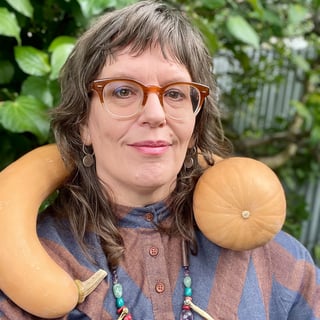
Speaker: What I do know is that today's guest, a woman I've been trailing through the forest to entice onto the podcast, shared the most beautiful sentiments around these deep questions. Her name is Emily Coates, and she's a practitioner of ancestral skills.
Speaker: She can light a fire with her bare hands, build shelters without nails or glue, and has lived in the bush alone for months on end. Emily knows a thing or two about survival.
Speaker: But in this conversation, when I asked Emily for her thoughts on how to best prepare for the rocky times ahead, what kind of skills should we be cultivating to feel more resilient, etc., she said that in her eyes,
Speaker: Spiritual preparedness is where it's at. Doing the inner work, tending the parts which make us whole, and being able to find equanimity, even joy, in those most trying of moments.
Speaker: So I won't give you any more spoilers before we dive into this chat with Emily, but I will set the scene by telling you that Emily is a facilitator, a guide, a dream worker, and a dancer who works closely with Claire Dunn, who you'll remember from episode 11.
Speaker: Emily offers classes in deep nature connection, ancestral skills, and soul-centric threshold crossings. Thank you to those beautiful people who share snippets of their lives and leanings with me via email. Receiving an out of the blue letter from a listener never fails to make my day. Thank you so much to everyone who writes to me. I'm at katie at katie.com.au if you ever want to get in touch.
Speaker: And if you have the means and clean good things from these convos, You can support Riskilliance financially on Patreon. This podcast is entirely community funded because ads or sponsorships would make me nervous and awkward and self-censoring, probably. So instead, you are my sponsors, a group of legends on Patreon who pay me to do this without strings. And I'm so very grateful to every single one of you. Big thanks to new patrons Ivan and Jo. It has been lovely connecting with you. And if you feel moved to become a patron too, find us at patreon.com forward slash riskilliance.
Speaker: Now let's hear from the wise and wonderful Emily Coates.
Speaker: i want to welcome you Emily because I'm just so excited to to share this conversation with you this morning and it's really bloody cold here on Jarrah Country today and I'm imagining that we are sitting around a campfire with toasty toes and that atmosphere um so I'm just conjuring that up for this ah online conversation this morning thanks Katie it's great to be here and I'm huddling up too with my warm cuppa in my hands. excuse
Speaker: Yeah, we we actually met quite a few years ago now and i'm remembering Nature-Based Leadership training and that's where I first encountered you and you were helping facilitate that with Claire. And I have some really strong associations with you and especially this image of you starting a fire by friction with a hand drill by yourself, which if anyone else has tried that is nearly frigging impossible.
Speaker: um And since then you've gone deeper and deeper into living skills and human beingness, like those years between 2022 now. I can only imagine how much you've you've learned and grown, and that's what I'm really excited to hear from you today. But what really surprised me, Emily, when you sent me through some notes about yourself and your backstory was to learn that you studied economics at Oxford and have been a software developer and a policy analyst and even a ballet dancer, like, This this generated so much curiosity in me and I'd love to hear from you about that path that you were on.
Speaker: Thanks, Katie. Yeah, oh I'm also remembering our time together through the Nature-Based Leadership Training, which is Yeah, it was a special time. Yeah, I guess my journey has been fairly winding, but it's all felt like every step has felt like something that I've needed to do. So I did study philosophy, politics and economics at Oxford.
Speaker: And ah I loved the ballet group that I was part of while I was there. And I did then go on and do a master's in environmental policy at Oxford as well. But there was always a part of me that really I just wanted to be an activist and I like i took what I studied but I yeah really channeled my my energy and my passion for the world into direct action and I was part of the climate change movement over there. and did a lot of quirky actions. I did a ballet protest. I did a lot of arts protests and we were trying to, yeah, really raise awareness about climate change, but also the influence of the oil industry and its influence on arts. So was part of a group that
Speaker: was targeting oil companies for sponsoring arts institutions and we would take really creative actions. Like ah one group I was part of was called BP or Not BP and we would go along to performances of the Royal Shakespeare Company and just before they were about to start, we'd just storm the stage and get up and we'd Shakespearean-inspired protests about BP and that kind of thing. So it was a really um beautiful time in my life. And yeah, I also felt like my mind really wanted to be doing something that really engaged it. I've got to quite a love of maths and logic. And so i found myself working in a think tank.
Speaker: called Green Alliance, where I got to crunch numbers and research the secular economy and energy. And I really loved that. I also realized that then there was this whole other part of me, the spiritual side of me and the part that really just wants to be living in a different way.
Speaker: that was still unfulfilled. So it's it's been just a journey of, I guess, always just looking out for what the next thing is that feels like it needs to be met. Yeah, I'm really relating to that, I guess, the subtext of part of what you were saying there about being more in your head and in that intellectual realm and i definitely identify as a brain on stilts and I've got to be really careful to to actually do things rather than simply read about doing things or write about doing things. It it almost is this trickery that I can play on myself where if I've written a little story, it eclipses the need to actually embody that story and I'm wondering as an intellectual gal, how have you learned to
Speaker: drop into your body oh yeah great question i mean it's so funny i was so um enthusiastic to get a job at this one place called the new economics foundation because they wrote policy papers about things like how we all needed to work less and go outside more and we needed to organize things in our local communities more and we needed community currencies and They had all these great ideas and I wanted to go and work for them so I could write about all of these things. And at some point I realised it's not enough for me to just keep thinking about how things need to be different.
Speaker: But I need to start living that. And it's it's actually still an ongoing question for me because ultimately I love doing intellectual things, but what I see the world needing right now is not more intellect.
Speaker: because as a world, we've done a great job of cultivating that way of knowing that facet of our wholeness. And what's more needed, I believe, is connecting to our hearts, to our bodies, to our intuition, our deep imagination.
Speaker: And so when I'm tempted to take on that mindset, work that will be really stimulating for my mind or spend a long time thinking about something and analyzing it from different perspectives. I have to remember, I don't feel like the world needs more of this. And so if I can start to try and put that part of me back into right relationship with the other parts of me, then I am doing my bit for what the world needs.
Speaker: To answer your question about how I drop into my body, firstly, I go outside. Just go outside. Stop relating to everything in my own head as though I'm just like a machine running a lot of instructions through my brain. and I start to look around me and see everything as a being.
Speaker: Even the parts of me that might be all competing for my attention at that point, see the beingness in all of them. And then I just start to relate to everything as though we're in conversation.
Speaker: And somehow I find that doing this
Speaker: It just changes everything, changes the way that I am feeling, changes my perspective. I don't feel alone in my thoughts and worries.
Speaker: I feel usually a lot more hopeful. Life just starts to feel like a collaboration again. Yeah, and that's before I've even then connected to what's going on in nature around me, what I'm feeling in my own body.
Speaker: It's like the world rushes back in when I do these simple things. So there's a few, there's a few. thoughts for you just so beautiful and my toes are curling with that it's kind of like that feeling that you get when you imagine putting your feet into warm sand it's just like that sensuousness of of stepping outside and feeling things against your body and I'm wondering Emily you harboring this these animist tendencies back when you were engaging in Shakespearean inspired direct action or yeah how has your activism evolved, couched in this beautiful conversant way of being with the world?
Speaker: I don't know that I would have known what the term animism meant back then, but I certainly have always felt the world as very alive. And as a child and teenager, I was very curious about things that couldn't be explained rationally, which was interesting because I had such a strong mind, but I didn't feel like things that didn't come through the mind were any lesser.
Speaker: So there's yeah there's always been a thread for me in being open to to that which is not quite so easily visible, at least not to the untrained eye.
Speaker: But I feel my journey with activism, it was tempered a little bit, I think, by just, as is common with many of us, the the feeling of exhaustion that I was fighting all these fights and never really getting anywhere.
Speaker: And i I think leaving the UK where I was doing a lot of my activism and coming back to Australia when I was 30 sort of caused me to have a bit of ah a blank slate and a clean start and to feel more into how do I feel that I want to be in service to the world now.
Speaker: And so activism doesn't anymore to me look like going out on the front lines but feeling that my my life is lived in service to creating the kind of world that I want to live in and that I want to leave to future generations.
Speaker: And that can be a combination of just moment-to-moment living. So taking the time in the morning to acknowledge the birds in my garden, to sing back to the Currawong or to the Eastern Spinebill, growing food,
Speaker: in a veggie garden, taking care with how I speak to other people, how I speak to people on the internet, just those choices that I can make moment to moment.
Speaker: And I've also come to see that the work that I'm doing at the moment, which is including taking people out into nature to connect more deeply to nature, but also to themselves and to each other.
Speaker: I'm seeing how this is also activism. And I think I went through a period of doubting that it was But it just felt too fun to be useful.
Speaker: And I did wonder, like, am I just doing this because I enjoy it and it's giving me personal satisfaction? Working with people as well, there's always a part of me that has wondered, is this is this a big enough way of contributing to the world? Because where I came from, I was much more looking for kind of top-down impact by...
Speaker: wanting to work in an influential think tank that would influence the government or wanting to fight a really big campaign that would have a huge effect environmentally if we were successful.
Speaker: And so part of the humility of just maturing, I suppose, has been to see that the small moments and the individual people that may benefit from this work is still a really important contribution. But then another thing that I'm realizing more and more is that it's not just the individual people that come to the programs that benefit from this.
Speaker: This is a way of creating the kinds of people that will create the world that we need to live in. It feels to me like on some level I've accepted that I don't need to have a big global impact.
Speaker: I can just work with what's here in front of me. And on another level, working with what's here in front of me is having a big global impact. um On some level, i I'm always going to identify with with the ideal of being an activist. And on another level, I kind of don't think that's a helpful lens at all because I just want to live in a beautiful, harmonious world where I'm contributing as much as I can with everything I do, like our ancestors did for thousands and thousands of years.
Speaker: A really wonderful summary that you've offered there. And I think a lot of people will relate to those feelings of wondering if they're doing enough and then coming home. to that fundamental knowingness of it has to it has to start with that. And those ripples are indeed really profound. Sometimes we don't have the wide boundary thinking to understand where those ripples are going and how big those those waves of change can be.
Speaker: And if we are creating these little ripples that will ripple out and get bigger, then having real precision in how we should show up seems even more important because that will get amplified and and ripple through the world.
Speaker: I just heard the ballet dancer in you with an exacting elegance come through there.
Speaker: So Emily, just so that the vision is clear for people listening, what exactly are you getting up to in the bush with people? Like are these are these secretive behaviours something extraordinary or are you really doing quite ordinary things with folks out there on the land? Like what are some of the nature connection practices that you're engaging with and and supporting people to be involved with? And then, yeah, what are the effects that you're seeing of those on the participants?
Speaker: Well, at the moment I'm running a course called Earth Time, the Lost Art of Being Human. And we meet once a week in the parklands in inner Melbourne.
Speaker: And it's an exploration of how we might form connections with nature and with each other. and with ourselves through practices that our ancestors have done for thousands of years, but which also offer an alternative to picking up our phone and using an app.
Speaker: It's so easy just to pick up the phone and snap a picture of something that we want to remember. or that tickles us in some way and I have nothing against photography. I mean my dad was a cinematographer and I yeah I think it's an incredible art form and great way of documenting our lives but I've just come to notice that for me personally and for a lot of people that I meet something is lost if we can just so instantly use technology can just make us miss so much.
Speaker: So like I gave the example a couple of weeks ago of when I was at tracker school with Tom Brown Jr. in the United States a few years ago.
Speaker: And we were out there every day in this class of advanced tracking and awareness. lying on our bellies, looking in gravel, rocky terrain,
Speaker: at almost imperceptible marks. Like these weren't tracks in mud or sand that you could see. These were just the evidence that some animal had been there through whether the rocks were a little bit more shiny or dull, or whether there was a pine needle that had cracked just where their foot might have stepped on it or...
Speaker: whether there was a place where a stone had been dislodged. So we're looking at these tiny details and studying the ground essentially and learning to just see a whole layer of of existence that most people would miss.
Speaker: And just after spending hours doing that, just the world would open up to me in this way that just brought me so alive. And feels like it really is part of who I am is to want to see more.
Speaker: there's There's a part of me that just loves this feeling of hidden things being revealed and coming to life. So an experience like being in that place and then when I was living in the bush last year, i was often just staring at the same sets of trees and plants, the same scene and heading out to a new place and just feeling everything just popping out at me. There was just so much information coming into my being and not just in a like sensory overload kind of way, but
Speaker: I just felt so excited by by everything that I could see and smell and hear and even going into the public toilets. I would just see like the patterns on the walls and the mold on the ceiling and the cracks in the tiles. And it was just like, there's so much to experience and so much just available to us if we make ourselves available.
Speaker: And then I was at a workshop around the same time last year where we were going on a plant walk and we were being given whole lot of information about all these different native and introduced plants, edible, medicinal properties and so on.
Speaker: And I was doing little sketches and I'd have to look at the plants and look back at my notebook and then try and remember, oh, where exactly were the leaves and look back at the plant and feeling myself connecting, building these strings of connections John Young would say to these new plants that I was meeting.
Speaker: And I looked around and others would be just pulling out the phone and snapping a picture and then moving on to the next one. and And they're missing so much because I I was so enjoying really having to get to know this plant just in that few seconds I had where I was trying to draw it.
Speaker: What I was noticing about it was so much greater than I had just been snapping a picture of it. So that's the kind of thing that we do in this class. it's also navigation what is it to navigate by looking around and really paying attention to landmarks rather than just always putting on google maps and i'm very much prone to overalign google maps but i just feel sad i just feel like i'm missing out on adventures and on really experiencing
Speaker: what the world around me wants to show me. So we do things like that in this class where we we take things that you could do really easily on a phone and we look for what would be the ancient way to do it instead.
Speaker: Yeah, it reminds me of that Martin Shaw sentiment, either living a life that's two miles wide and two inches deep versus two miles deep and two inches wide. And I think often that I could spend my entire life plumbing the depths of my backyard and turning over every single leaf and learning the nuances of of every every wren feather tail. like um It is really magic and that revealing what is hidden is deeply resonant with me and the the enchantment that bubbles to the surface that I think, as you said, since childhood, you've had this this inkling and this inclination to understand that there are these hidden currents perhaps just waiting for us to to take a look and I really relate to that. And as you speak about these practices, these ancient evocations, do you anticipate a future in which your tracking skills or your botany or your bird language might actually serve you in a survival sense?
Speaker: ah it's a Yeah, it's a good question. It's not something I think about often. I think I tend more to think about survival skills that are going to be useful in the future are spiritual ones that I'm cultivating, spiritual and emotional and relational.
Speaker: That's at least been the approach that I've taken so far in terms of prioritising that inner journey more so than the acquisition of land and developing a really great resilient veggie garden and I would like to do those things also. ah Yeah, as as we approach this ever-changing future, i do wonder which of these skills are going to be useful. i I feel like bird language has been something that's kept our ancestors alive
Speaker: before houses and cars and all these things that can protect us from predators back in the origins of humans living out in on the savannah and out in nature with predatory creatures, bird language really was something that we needed to know so that we could hear if like a lion was coming in this, you know, we hear John Young speak about this with his time spent in the Kalahari with the Bushmen there, they still make sure that all their children know bird language because it really does keep them alive.
Speaker: Well, what a great response and something that has really got my ears pricked is the spiritual side and that inner belief system and resilience. And hearing you say that, Emily, i have to know more. Like I have to know why you see that as something that kind of gazumps growing food at this point.
Speaker: Well, around the time that COVID happened, I was in a relationship with my ex-partner who I'd been with for 10 years or so.
Speaker: And he had really got the permaculture bug and wanted to buy land and grow food. And that was before COVID. And then COVID happened. and I was in this big underworld journey. I read Soulcraft by Bill Plotkin. I was just, everything was unraveling, shedding lots of old skins and just really awakening to the beauty and the mystery of life.
Speaker: i I could really see now that we were faced with this global crisis, that was affecting all of us. I could really see the importance of physical preparedness in all these ways.
Speaker: But I also just had this strong sense that peoples all over the world have gone through terrible things. And the stories that we hear the ones where people have found some kind of equanimity with the situation, found a way to show up and love, to love their children, to love their communities, to take joy in the small day-to-day moments of sharing food together, of enjoying the feeling of the wind on their face or the sun and and just how my experience of whatever kind of crisis we were going through
Speaker: was so dependent on my ability to have that kind of larger sense of myself and of the world that wasn't that wasn't dependent on how things were going in my life or in how the state of the world was. That to be able to still tap into the feeling of love and the feeling of gratitude and care, still taking care in those small,
Speaker: moment to moment interactions. That to me seems like the most important thing to cultivate. And I remember when I was, it was actually, it was literally like the week before lockdown, i was on a Soulcraft program, an Animus Valley Institute program.
Speaker: It almost got cancelled because the guides weren't sure that they wanted to still be out in Australia with everything shutting down with international travel and so on. Just around that time, I think the news had started reporting on the number of deaths from COVID and this was the top number headline figure every day.
Speaker: And there was a man on the program, one of the participants, and think he was from Cuba. And he was speaking about the history of his people in Cuba and how having experienced the collapse of society and having to rebuild it from the ground up, what they really needed in those moments was friendship, was generosity, was humour.
Speaker: And he said something that I've always remembered, that this obsession just with with only wanting to measure the number of deaths and not how people are dying, are they surrounded by loved ones when they're dying and how are people living? And he said, ultimately, it's not about whether we live or whether we die, but how we live and how we die. And I was like, wow.
Speaker: yeah, like I want to live well and I want to die well and I want to not be afraid of death and I'm not, I don't think. This obsession with death is the problem so we just need to stop it from happening ah rather than How can we enjoy being alive and how can we enjoy death as an ending in an inevitable part of of life?
Speaker: So I think it was around that time that I just started to think this is, it's more important for me at the moment to be cultivating my wholeness. And i use that term from Bill Plotkin, so the the facets of wholeness being the east part of us, the the sage who's also the innocent,
Speaker: who's also the sacred fool and the trickster, but this one who's so present-centred and light and joyful while also being completely accepting of death.
Speaker: Then there's the north of us, the wild indigenous one who is fully in their body and in their emotional world and welcomes emotions of all kinds, just because it's part of being a human to experience this full spectrum of emotion and they're wild they they're sovereign they are just deeply enmeshed in the natural world and they know their belonging is to this whole earth and they're west of us which is the dark muse beloved the creative one the romantic the one who is allured by
Speaker: b dream world and the mysterious the one who's comfortable with shedding and decomposition and then the south of us who is the leader the one who can nurture new life and can take action bring vision to action So cultivating our full human wholeness feels to me like a pretty important survival skill, whatever future we face.
Speaker: I hope you don't mind if I just keep asking you questions till midnight tonight because I could just listen to you all day. It's so wonderful hearing your weaving of stories and this wisdom that you've been harvesting and assimilating. And, yeah, I've thought so much about life and death. I mean, i say that as if everyone else doesn't. I don't know what other people think in their in their thinking minds, but I know ever since I was a child I've been obsessed with death in a way that I think signifies
Speaker: how shrouded in taboo it is and that obsession comes from the lack of conversation I think we have around it and this seeming this mismatch between what I saw the preciousness and ephemeralness of life and therefore the consequence of that and how much is at stake every single day and then this sleepwalking that I saw most people doing.
Speaker: I want to ask you, Emily, what gives you the determination to live with such devotion and depth? I know that you've had experiences in your life that have... opened your eyes and perhaps you're unable to really to close them in the way that others could who haven't seen as much like what is it that fuels this devotion and and discipline that I'm I'm getting from you in in cultivating all these directions and leaning into her this wildlife that of course involves the risk that we could die and will die hmm
Speaker: Yeah, just feeling my heart because it was just a few days ago that I marked the 10-year anniversary since my dad died and I really feel that his death was the catalyst for me with a lot of these ways of being.
Speaker: just it was just before I turned 28 that he passed and I'd been wanting to live in devotion to the world before that, but just that the circumstances of his death was such that it was a real wake up call for me.
Speaker: So I'd been living in the UK and my parents were in Australia hands dad had developed cancer, but we had been given the impression that it had been cleared and that he was going to be fine. And couple of years on from that, I had just been having this inkling that we just never know really what's going to happen. But my life was quite confusing. i was enjoying my work and my relationship in the UK, and i didn't really want to move back to Australia, but I also wasn't sure where I did want to live. i ended up
Speaker: leaving London and moving to a little village in North Wales where there was incredible rock climbing. My life just felt very hazy and uncertain and everything that I could imagine doing in the future, none of it felt like it was clearly the way forward.
Speaker: So I had a lot of questions. Did I want to have kids? Did I want to stay in the line of work that I was in. And hearing my confusion, my best friend said to me one day, is there anything that you know for certain that you definitely want to do before you die, that you don't want to look back on your life having they not done?
Speaker: And I said, well, with my dad having been a little bit sick, I do have the sense that the one thing that I know that I want to before I die is to spend more time with my parents who live on the other side of the world, to spend more time with them while they're still relatively young and healthy.
Speaker: to not just go back to tend them on their deathbed. That felt really clear to me. That felt like the one thing that I knew that I wanted to do. And so then few months later, i was at home one night and I received a call.
Speaker: Well, I received a call from my mum actually saying, Dad, Dad's cancer's come back. It's really bad. we're We're just looking into the options. We don't know what's going to happen. And I said, oh, okay, like, you know, keep me updated.
Speaker: A few hours later, I get a call from a doctor saying, get on the first plane you can and you may or may not make it in time to say goodbye. And I went into a bit of a panic trying to look up flights and I didn't know what I needed to pack and whether I was packing for a funeral. And I was just really, really, really trying to make sure that I i booked a taxi and I set an alarm and I set a backup alarm. I just, I really didn't want to miss the flight in case I missed saying goodbye to my dad. And I eventually just calmed myself down and I thought, look, I don't know whether I'm going to make it in time to say goodbye.
Speaker: but that's not really the issue the issue is that my dad's dying and this was the one thing that i didn't want to happen and i was really angry for about 15 minutes And then I just felt this opening and it was like something came and filled that space. And it was like, I will take this as a lesson.
Speaker: I will take this as a gift. I will never make this mistake again. I felt like I'd been procrastinating and if it was important, I needed to take action and I didn't want this pattern to ever happen again.
Speaker: With that, I managed to get a couple of hours sleep and I woke up and I was just waiting for the taxi to the airport when I got a call to say that my dad had died. so I just, yeah, for the flight home, I just felt very sad and also very joyful. I just, I cried the whole way on the plane and i just I just felt so much love and so much gratitude and thought of all the people that have terrible relationships with their dad and I just felt like so grateful that I'd had a really good relationship with my dad and he was an inspiration to me and he had died,
Speaker: fairly quickly without a long drawn out illness. And I felt like I'd received this gift also that from now on, it was like i had permission to follow things if they felt important and to not do them later, to not try and live a life that's palatable to other people and repress what I actually really want to do.
Speaker: And I've seen this serve me because the vision that I wanted to go and live in the bush for a year. And I felt like this this longing kept showing up in me and it just wouldn't go away. And I knew that I couldn't i couldn't just put it off indefinitely because I didn't want to have to live that mistake again.
Speaker: So I spent three years searching for land that I could go and and live on and have this kind of experience. And eventually was able to do this last year at the beginning of last year. I went out and and had my go at a year in the bush, which in the end was seven and a half months before I decided I had done enough and I was really aching to be back in the world and back in service and back offering my passion to others.
Speaker: I just don't think that I would have had that kind of drive if it wasn't for this experience with my dad. And also, I guess the other part of it is realizing that death, while it's really, really painful and it's really sad, and I was really sad that my dad died when he did, but death is also not the end of the world.
Speaker: And That has been helpful for me too when I might get stuck in my head about, oh, i don't want to make the wrong choice about what I do next month or, you know, should I go to this course or not? And you're getting stuck in these decisions or, oh, I said the wrong thing or, you know, whatever. But then like we're all going to die from that perspective. If I can be okay with that, then I can probably be okay with accepting that whatever outcome happens in this situation it's going to be fine.
Speaker: Thanks for sharing that story about your dad and, yeah, so much gratitude for that gift and the gift of that landing on the eardrums of people listening and feeling that emotion and the truth of that.
Speaker: Yeah. Yeah. So what was your intention beyond feeling intensely compelled? What did you take out into the bush as your intention and and reason for wanting to be there?
Speaker: had many. One of them was to deepen my connection to one piece of land. So wanting to learn the bird language and learn about the animals that live there and get to know the the plants and what was useful for fibres and for fire and all of that, just to really feel like the place felt like family.
Speaker: That was one. And to just have so much time, so much time without distraction, without all of the other responsibilities of modern life. I also wanted to be tested in a way, not in a macho way, but just to to really know the elements, to really know the earth without these layers of of comfort and protection that I had become accustomed to in the city and just being able to go inside when it rains or put on the heater when it's cold. I really wanted to feel what it's like to have to be in a kind of negotiation with the world.
Speaker: if I needed something to have to to find a way to make it happen within what was possible in the space. Even just, I was reflecting that it was one year ago today that i started building my shelter.
Speaker: but was using black wattle, which was abundant because there'd been fires through that area. And so there was just regrowth everywhere. But to harvest a tree for my shelter, I really had, I felt that I had to to talk to it and say, hey, I would like to use you in my shelter would you be open to that and if I got a no then I wouldn't cut it down but like having to really negotiate my needs with the land and not just be able to take whatever I wanted like I can do when I have all those layers of separation between me and the beings that I'm using to be alive I also wanted to further understand my own soul and my own vision in the world which I did definitely I had a lot of time to really
Speaker: deepen into some of the nuances of what I feel like I'm here to do. i mean, I think I just, I wanted to be kind of surprised. I wanted to see what would happen if I didn't have the stimulation of of screens. I wondered if my mind would slow down and get to a place of, I don't know, like a peacefulness or or just a ah clarity without so much distraction.
Speaker: And as you mentioned, you built your shelter from scratch. So this isn't you going into the bush and bush meaning eco lodge where you've got an assault and an outdoor bathtub and a bottle of rose and you're just having some Emily time.
Speaker: What did you arrive to? What was there? Who was around you, if anyone, and what kind of tools were you or weren't you able to take? i I loaded my car up with stuff. So I had lots of tools, but all hand tools. I didn't have any electricity. i had like a handsaw and a small axe and a magic and a spade. And I basically went out with a small patch of ground that I was going to be using on a larger property, 900 acres.
Speaker: There was a veggie garden and a house a couple of kilometres away from where I was going to be with three lovely people that lived there, plus some woffers that came by. i yeah had water that I could drink, but it was about seven-minute walk down a steep hill to get to the river.
Speaker: so I was always going down and bringing water back up and... I had hoped that I'd thatched the shelter entirely with with grasses or other materials I found on the land. But in the end, I think my shelter was a bit ambitious, really, realising now it was quite big. And I'd calculated roughly that I was going to need a thousand bundles of grass.
Speaker: but I think I got managed to get about 250 bundles in and decided that I didn't want to spend the whole time just building a shelter and thatching. So i ended up leaving a tarp over the top of it for the rest of my time.
Speaker: But yeah, it was all lashed together with ah string and natural bottle cordage as well for some of it. So yeah, no nails, no drills, no metal, just string and trees and grass.
Speaker: and a tarp. But yeah, the tarp. If I'd persevered, I would have been able to get rid of the tarp. I mean, definitely like there was a trade-off that I was constantly experiencing between how much I wanted to be with like as little as possible versus how much having some of these extras items around me just made life a bit more comfortable. So it's this constant battle between like my chair, my table,
Speaker: my cushion, my picnic rug, all these things, I would put them in the car and decided didn't need them and I would just sit on my grass mat that I'd woven and then my bum would get sore and my back would get sore and I'd go to the car and I'd pull out the chair and the cushion and the the table and um trying to both live in this way where I just looked around me and saw nature and also trying to live in a way where I had some enough comfort that I didn't just get distracted by how much pain I was in because that wasn't the goal it wasn't just to try and endure pain that was the last thing I wanted um I didn't just want it to be an endurance challenge I wanted it to be connective
Speaker: And how much interaction did you have with other humans? I usually went up and spoke with the landowners about once a week but I had no phone signal where I was so if I wanted to speak to anyone outside that I would have to go to their house as well and use their wi-fi. Then I would go into town about once a month and that was a two-hour drive so yeah I couldn't just nip to the shop if I wanted some chocolate or something it was Which was actually great because it meant that I did have, like I would have one block of chocolate and if I wanted a piece of chocolate, I'd have to go up to the chocolate and say, hey, chocolate, um I'd really like a piece of you because I'm feeling sad or I'd really like a piece of you because I need some energy so that I can dig a new toilet or something. And just, yeah, just like the conversation, having conversations with everything around me.
Speaker: rather than the way that I might eat chocolate at home of kind of just mindlessly shoveling it in. It just, it was just a completely different way of interacting with the world. And I didn't feel lonely when I was in conversation.
Speaker: And I would speak, like I would speak to fire before I made fire when I was, I didn't do friction fires every day, but I did for a good stint in the middle, make um make a lot of friction fires. And before making a fire, I would,
Speaker: gather the materials, the kit, and I put my hands on them. And I just feel like such gratitude to this lineage and to the ancestors that have passed down this skill and to the spirit of fire itself. Like the fact that we can create fire, this is so incredible.
Speaker: And I would feel that gratitude. And then I would say, i would love a fire because I want to warm my shelter and I want to cook my food tonight. Please may I have a fire and I will be patient.
Speaker: And sometimes I'd feel a little tingling through my hands coming from the, from the kit. And, and then I would start the process of making a fire by friction and usually bow drill at that point.
Speaker: And it was like, I'd made a promise that I would be patient. It always delivered me a fire when I said that prayer. And I would really look forward to those moments, even if I couldn't be bothered to make a fire, just, I would look forward to getting to have that conversation with fire because it just felt so ancient and it enabled me to drop into a space of deep listening and even if the whole rest of the day I was in my head and I was like doing this and doing that, like just for those few seconds, I was in this place of deep listening and reverence.
Speaker: And I just feel so healthy, so healthy to not always be the centre of my own story and to, yeah, to just to be curious about another and to be grateful and to be feeling like the the deep time element, like this is something that goes back so far.
Speaker: So those little moments, those little moments I really look back on and think like, oh, I need more of them in my life here back in the city. Yeah, it's awesome having those benchmark experiences, those precedents that you've previously set for yourself and you know you can return to because there's this imprint on your psyche and that feels really helpful with any of these more challenging, daunting tasks that And what what were you hunting or foraging or simply eating out there?
Speaker: hello Veggies from the landowner's garden and then dry foods that I would buy from the shop. supplementing Supplementing with some things that I foraged, which...
Speaker: It was not a huge amount. There was some some mushrooms, field mushrooms and blackberry nightshade I remember getting and some little other greens that I would snack on.
Speaker: I had a roadkill possum that was actually gifted to me one of the first days that I was there. Yeah, I cooked it up into a delicious stew. And then there was another possum that would come and visit my kitchen every night.
Speaker: And I started to nickname him Stew as well because I thought that I would set a trap and turn him into a stew, but I didn't. I didn't do that but every night where I would just hear like the tiniest little almost imperceptible sound and I just it was like I built this connection with Stu that I just knew so well the tiniest little sounds that he would make and I would just often it would be it would come at a point where I was lying awake thinking oh I really need to pee I really need to pee and just can't be bothered and then I would hear these sounds and I'd be like
Speaker: ah it's stew and I'd like leap out of bed and like chew stew out of the kitchen and then usually I'd be like oh thank you stew thanks for getting me up and I sometimes wouldn't even know if I was hearing it but i would just be like I just have a feeling that that's stew in the kitchen and then it would be yeah you have shared about spirit tracking and I remember watching a video of John Young intuitively tracking in Africa and seeing the tracks of this animal in his mind's eye and understanding on some cosmic level or where it was and where he should go and that is fascinating to me as the head-based individual I've outed myself to be and what has your experience with this more intuitive knowing
Speaker: been and how can a head in a jar like me get there yeah well i mean i think one thing that helps me and this was something that that i heard john young explain as well was that it comes through the physical so it comes through developing physical capacities for tracking in the case of spirit tracking or when it comes to developing connections with particular species or beings the beyond the physical, it comes from having a really strong physical connection. So for me, there were um particular plants that I relied on a lot. So bladygrass was the one that I used to thatch my shelter and wild tobacco, which is a tree about three or four metres high. That was one that I would use for my fire kit, my bow drill, baseboard and spindle.
Speaker: So... Those two, I really felt like i had a relationship with and wild tobacco going back some years now, but Bladygrass, I just started connecting to it while I was there.
Speaker: You know i spent hours with my hands in the Bladygrass and noticing just exactly what it looks like at the base and how it looks different to the Lomandra and the Garnier and and how it feels to pull it out and how it feels depending on how old it is or what time of year I'm trying to pull it out or just attuning to all these details and I don't know how it works and I don't think we need to know how it works but I would then find myself wandering when I wasn't particularly thinking about bloody grass but just following my body what John Young calls a body radar and going down
Speaker: little path and off to the left and through some trees and then just coming upon a whole field of lady grass and that that's for me spirit tracking and that is not just one skill that that anyone could develop with any plant without having built that connection it's like it comes through that connection and and through that time that i spent getting to know the lady grass that means that now I have a connection with that plant. And yeah, as John says, like it goes both ways. So I can i can feel it and it can feel me or call me to it. Or I mean, yeah, it was just all trying to put language on it, which maybe doesn't help. But I think what what I've heard him say when he refers to the Bushmen ah training their youth in tracking is that he says, sure, we could just teach them spirit tracking.
Speaker: But that would make them lazy and crazy. So we always teach them everything physical first. And then when they've got a really strong physical grounding and they they can read all the tracks immaculately,
Speaker: Then we also teach them that they can use spirit tracking because some days it might be really dark. You might be really far away. There might be an animal coming after you and you don't have enough information available to use the physical skills. And at that point, maybe you get a flash of intuition and you know where you need to go.
Speaker: And I liked that approach because it takes some of the pressure off trying to be intuitive or trying to do it the spiritual way and to just allow that it's kind of an extension of the physical. um But it happens when we're able to then put the physical kind of aside and just tune in, tune into an image or a And there are techniques, I mean, to develop this. and And there's some great exercises from Tom Brown in practicing spirit tracking things that you lose around the house.
Speaker: And I take a lot of joy in this, actually, if I ever lose. Like I lost my watch the other day and it'd been missing for a week or two and I decided that I was going to spirit track my watch.
Speaker: So i like i i just got really, like so his technique is you start by really feeling how much you are longing for the thing and really feel why you want it, why you want to find it.
Speaker: And then let go of any expectation that it's gonna happen and just just enjoy, just enjoy wandering without any expectation, any connection to your own self-worth if you do or don't find it, just let go of all that.
Speaker: And then just follow the body, follow any impulse to go in one direction or another direction. If any images pop up in your mind, maybe just kind of playfully experiment to moving towards whatever that might be. and And I had this image pop into my mind of the glove box of my car.
Speaker: So I headed out to the car and I looked in the glove box and again, thinking, it doesn't matter if it's not there. It's, you know, this is just fun. I'm just going on a little adventure. and i've opened the glove box.
Speaker: It wasn't there. And then I just had the impulse to check the driver's side and underneath the driver's seat, I found my watch. And I was just just so delighted. Just, you know, cause I,
Speaker: It wasn't a stressful experience. It was just quite fun. And if I hadn't found it, it wouldn't have mattered. I would have maybe found it another time. But it means now when I lose things, i actually get quite excited by the opportunity to practice spirit tracking. So, yeah, I think for me it's like it's just an opportunity to practice being in a different part of my being, a different way of being than just thinking.
Speaker: And ah feel like it's important for me to keep developing these other ways of knowing because ultimately to, be a fully functioning human.
Speaker: So, I mean, you started to ask about my work before and I also, the other part of what I do is more in like the realm of vision quest and guiding people in their inner world.
Speaker: And It's absolutely important that I have access to my intuition and ah felt sense of what to say next or where to go or how to guide someone. So something like practising looking for my watch through spirit tracking feels like an exercise that is healthy for me to do.
Speaker: This is probably why Jordan and I are ah so good at tracking down the last gluten-free lemon custard tart in any time that we're in we just have a feeling of which cafe to look in and they there it is. There's the lemon jar.
Speaker: Really? Yeah, it was, we were just in Tassie and Jord had been talking about, like, he's really... obsessed with these it's very specific it has to be gluten-free because we're both gluten-free and I don't know if there's one company that makes these generic like cookie cutter lemon tarts and then ships them around Australia but he tends to intercept them in the most unlikely of places and Yeah, this little town in Tassie, we were just talking about it and then we we were walking past this little window kind of hole in the wall cafe and there on a plinth bathed in holy light was this lemon tart. And I said to the girl, would that happen to be the last one that you have? And she was like, it actually is. So we took that as a strong universal cue to keep going um in the direction of our hearts.
Speaker: so That's it exactly, yeah. hopes of connection yeah I'd love to circle back to one of the intentions that you shared for your bush time, which was what's my brain going to be like without the addlement of my screen and devices? And i often hold that question of is it dementia or is it my devices? And what can you tell us about the clarity of mind you
Speaker: you experienced or maybe not um off the back of that extended time in a deeper more quieter space well it's it's interesting because i don't think it was as dramatic as i was thinking it might be what i did enjoy was that it became a tool because i did i i bought a dumb phone but it ended up not being useful really because there was no phone signal anywhere. So to use the wifi in the house of the landowners, I needed a smartphone or a laptop.
Speaker: So I still had a smartphone. But it it just felt like a tool that I would use when I needed to do something specific and it didn't have this grip on me like it can when I'm in the city or in kind of my normal life now.
Speaker: ah there was a lot more interested in everything going on around me, noticing new bird language patterns and doing the crafts that I might be doing. And I think it just felt simple and obvious.
Speaker: But I think actually one other the thing that I did experience was just the lack of reliance on Google for things. Cause I used to think I was good at figuring things out, but I was just really good at Googling them. So noticing, for example, there was one night that I was driving back from,
Speaker: The camping trip I'd been on I'd been at the Warren Bungles and I was driving back and I reached this, basically it seemed like a river going over the road. I don't have a lot of experience in four wheel driving or, and I don't have a four wheel drive either. I've got a station wagon, very low ground clearance. And just my immediate response was, oh, just Google what's the safe amount of water to drive through for this car.
Speaker: That was about 9.30 at night. I was in the middle of nowhere and had no phone signal and I just, that just wasn't an option. And i I had to really just look at this situation and look at the car without much knowledge.
Speaker: And I'd had a lot of car trouble previously on that trip and I really didn't want more car trouble. And I realized that to drive around the river would add another two hours of driving. And I was already still two hours from home. I think I was meant to get home at 1130 or something. So it can take me half the night or I could go through.
Speaker: And I decided to drive around and it just felt like the right thing to do. And it just felt empowering to just to not have any guilt and think, oh, you know, I'm not brave enough or I'm not, you know, there was no negative self-talk. It just was clear to me that that was what I was going to do.
Speaker: And I ended up finding a beautiful little campsite to stop at so I didn't have to drive all night. It felt like a a growth opportunity, which it wouldn't have done if I just Googled it. It would have just been a case of following instructions and, you it would have been interesting and I would have learned something, but it wouldn't have given me that sense of trust in my experience inner knowing and trust in myself that I can make difficult decisions. And I think I found that really valuable because I think with phones all the time, there's fewer opportunities to actually have to grow in that way. And that was something that I found really valuable.
Speaker: I love that story. It subverts that hero's arc of conquering something. You actually respectfully bowed to the river and went around at your own inconvenience, but really could see the wisdom of that and the opportunity in that. And it's unexpected that a story should have a conclusion like, and so I didn't do it.
Speaker: I love that the way that that lands and what it reveals about our expectations of adversity and what it means to to overcome. um Emily, one final question that I have is related to the permaculture principle, designing from patterns to details. And I've got that sense of the patterns of your life, of of purpose and intention and connection and my experience incessantly practical mind wants to know what the details of that life are. How do you fill your days to create this broader pattern of connection?
Speaker: Well, this morning I started the day by going down to the river and just marvelling over how high it is after all the rain and looking around and noticing all the things that had been blown in from the wind.
Speaker: during the night and then I came up and had a shower in the outside shower. The water was getting blown so far sideways at points that I wasn't really getting any water on me and then my towel and my dressing gown were both quite wet because the water had blown all the way over to where they were.
Speaker: But I really cherish living somewhere where I can shower outside. And in the same way that while I was in the bush last year, I just would love sitting by the river and washing my undies or just being outside.
Speaker: And in those moments of not doing much, just kind of sitting and contemplating while doing some kind of task like that. to be paying attention to what birds are around, what sounds am I hearing? While we were just, while we were talking before I thought that there was a some interesting bird had flown in. I think all birds are interesting, but I think there was a hawk or something flew in. So it's just having some of my awareness on what else is going on outside particularly can bring just a lot more of that connection in those moments throughout the day.
Speaker: I, yeah, try to do things with other people that enable me to still be connected, whether it's going on a walk with someone or going and foraging berries or,
Speaker: rather than always just meeting up inside or doing something that yeah it takes me away from the world, particularly if it's someone who will be interested and also curious so that we might be mid-conversation and we can stop and be like, oh, what was that? And one friend in particular who whenever I'm out, we both always have our binoculars and we'll just always be stopping and marvelling over whatever is happening and that is at least as interesting to us as whatever we might have been talking about.
Speaker: that friend and another ah is in a little group. We share stories once a fortnight or so of what's been happening at our sit spots. Yeah, I mean, then beyond that, like I'm teaching classes in Darebin Parklands. I have been, yeah, I've just come back from Vision Quest where I was supporting and I'm just releasing the details for an upcoming shorter Vision Quest two-day program that will be on in December.
Speaker: So, I'm just really wanting to deepen more and more into the work of beyond nature connection as a way of bringing us into relationship with the place around us. How is it also a mirror to own psyche and our own soul?
Speaker: And how does being in relationship with the wild help us cultivate the facets wholeness that I spoke about and also help give us glimpses of our soul and our work in the world? So i yeah, I'm really,
Speaker: leaning in more into that world and dream work is another passion of mine so i was enjoying doing that over breakfast at Vision Quest sitting with people and having some really deep and beautiful explorations of of the dream world which is another mirror that is so valuable to offer pieces of of our world from that poetic symbolic perspective that we would never get to by just thinking about them with our minds so i really really value dream work and yeah available also for mentoring dream work and working with nature particularly and with the body to reveal more of one's innate human wholeness and wisdom
Speaker: I've just felt really bathed in your eloquence and speaking eloquently in itself is such a gift and such ah such a skill that I assume and I i really feel that you've consciously cultivated too. And as someone who loves words, I know that it can be quite challenging to put them in an order that will land that will landd with clarity for another human. so just love your work and, yeah, I'm really excited to to share this with the world.
Speaker: Thanks, Katie. I've really enjoyed our conversation. Thank you so much for reaching out and instigating it.
Speaker: Welcome to the outro. What is it for? Nobody's sure, but if you want some more podcast info, I can tell you that I'm ambitiously striving to release another episode next Monday to make up for last week's deficit where I was sick and just about to head off on retreat. And it was a big thing and I gave myself the week off and it felt really amazing. But I also try not to do that.
Speaker: too often. So I'm going to see you in seven days and counting back here on your favorite podcast platform. And until then, you can take a look at Emily's Linky Poo's in the show notes or go out foraging mushrooms because it is the season and they are popping the word for the force that pushes mushrooms up out of the ground. You know how they just explode up out of the soil with this incredible energy. So there's a word for that and it's called papowie.
Speaker: And I learned that from Robin Wall Kimura. Papowie! You have to throw your arms up to the sky when you say it. Maybe go outside and practice and we can reconvene on that. Lots of love. Thanks for listening.