Transcript
Speaker: And the ultimate intimacy for me is that body-to-body connection to place, body-to-body connection to the animal in the killing, um the opening of the animal's body. It's a ritual. That, for me, is nothing new.
Speaker: for humans as a species. In fact, it's it's it's very old and we have been doing it as a species much longer than we haven't. And it is an act of making sacred. For me, it's an act of honoring and making sacred this animal, this animal's home and this body and life that is going to feed my life and my body. Race aliens!
Speaker: Hey, this is Katie, a fly just flew into my nostril, and you're tuned into Riskiliance. Episode 67, which means there are 66 other juicy episodes in the archive awaiting your ears if you are new here, or if you just want to enjoy them again.
Speaker: And so many more in the queue, because i don't know about you, but I still have questions! I am gratefully recording in Jarrah Country, Central Victoria, which has produced a pastiche of beautiful and sorrowful happenings over the past couple of weeks. The roadside elder trees dripping with bunches of berries.
Speaker: Hundreds of pink and purple parcels of medicinal potential against a hot blue sky. The waxing crescent moon hanging just above the western horizon late at night, strangely oversized and orange.
Speaker: Suddenly dark, suddenly damp mornings. A snake slithering over scolding pavers towards my foot. Two snakes making a scaly love pretzel by the side of our house.
Speaker: Lime green unripe acorns, softening nectarines, fattening pumpkins, three black kites chasing a raven with a plum in its beak, three cockatoos hanging upside down from a power line playing.
Speaker: Sparrows taking turns to drink from the smallest dribble of fluid from a barely leaking tap. A sparrow in my hands. Blood blooming from a hole in its neck where the cat's fang had gone in. And after too many minutes of holding the little bundle of feathers, wishing and waiting for a quick and peaceful passing, I finally dealt the killing curse.
Speaker: And it squeaked. And I cried. The beating sun. The drumming rain, a sparkling lake, lying on the grass looking up into the spiralling leaves of an ash tree, the intense stare of a wallaby who spotted me first, so many seasonal things.
Speaker: I want to say thank you to those premium humans who've left Reskillians a glowing review on Apple and Spotify, which is a huge vote of confidence. It really helps give the show some cred. And all of my gratitude to the Patreon community who single-handedly, well, many-handedly, fund this work, offering a joyful and connective alternative to those high decibel ads that batter your ears just when you're entering a peaceful reverie in the middle of your favourite podcast.
Speaker: We'll be having none of that. And a special shout out to new patron of the show, Harry. Thanks, Harry. And also Irma, all the way from Denmark, who made an independent donation as a gesture of reciprocity. i really appreciate it, Irma. You can be part of the Riskilliance Patreon Village at patreon.com forward slash riskilliance.
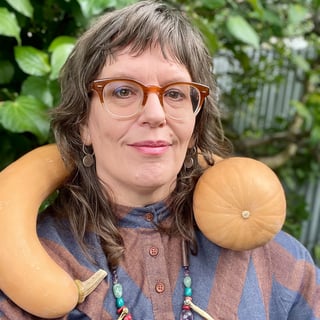
Speaker: Things happen there and they are good. So today we have an incredible woman by the name of Christy Green joining us on the airwaves. I recently gobbled up Christy's book Moonlight Elk, licking my fingertips as I turned each page because it is just so sumptuous. And it's the story of Christy's own life and her journey to become a solo female hunter in New Mexico. ritually tracking elk through snow and forest and dreamscape, a fierce and fluid unfolding of motherhood, womanhood, stewardship, intuition and deep connection with the land.
Speaker: It's not a book that tells you what to think about food systems or eating meat or the poly crisis. It is a moonlit wonder through one woman's relationship with herself and her place.
Speaker: So what an honour to have the chance to speak with Christy, who as well as being an author is also a landscape architect, artist, textile designer and bringer togetherer of so many facets and fascinations.
Speaker: It was also extremely affirming to love a book so much, then find the woman who penned it just as gracious and clever as the pages promised. Thank you so much for being here, folks, and please welcome Christy Green.
Speaker: Well, Christy Green, welcome to Riskillians. I am absolutely thrilled to be chatting with you this morning and in your afternoon. Where are you beaming in from? Oh, i'm I'm thrilled to be here with you, Katie. I'm i'm beaming in from Santa Fe, New Mexico.
Speaker: o Yeah, i I actually had to look on a map to locate New Mexico. This shows my ignorance with a lot of geographical type things. But yeah, what is what is the landscape like there and what's happening in the season? Oh, yeah, yeah you're not ignorant. I mean, it's it's interesting, even in the United States, when I travel and other places here, a lot of people don't know where New Mexico is and they actually do think we're part of Mexico. So it's funny because we have the oldest capital in the country from the 16th century, but nobody knows that. And nobody realizes what our history is here and the cultural diversity and and also the ecological diversity. We have eight different eco regions here. And I'm in Santa Fe, which is at about 7,000 feet.
Speaker: And so we're sub-alpine, high steppe, high mountain desert. We get what we used to get, like, on average, 14 inches of precip a year. And now it's more like maybe 10 if we're lucky. And right now it's obviously it's February. So here it should be winter.
Speaker: And this year has been an unseasonably warm and dry season, like hardly any snow up at the ski basin. There's only like 32 inches, whereas usually or what we like to have is over 100. And we've had daytime temperatures in the fifty s which is easily 20 to 30 degrees warmer than than usual. so And I know that that none of that is, you all, I'm sorry, I should be speaking in meters and Celsius, but we are lagging in so many ways in the United States, and including joining in in something that everybody else agreed to a long time ago as systems of measurement. And I apologize on behalf of my country for a number of things, current and past, right?
Speaker: ah well christy i feel like you would definitely be someone who is part of the harmonizing of the world and so ah that's a really beautiful preface but um of course you are yeah so deeply connected to the more beautiful world that i believe is is possible that we feel in our hearts and that um is yeah one of the many reasons i was so moved to speak with you after your publisher, you know, solicited me ah with a cold email, which I have to say doesn't happen very often. um And it isn't something that i would normally really respond to because this podcast is is relational. I love to have a reason to speak with someone, a preexisting connection, something that that makes sense, that doesn't feel like I'm just extracting content in a story. But, you know, I heard this little voice saying, hey, this sounds really fucking interesting.
Speaker: Read the book. you know, I fell headlong into this incredible world and this incredible story. So i wonder, Christy, at the risk of, I don't want to alienate the listener who may or may not have read Moonlight Elk, I wonder if you can give us a little um dust jacket summary of your book, which will be forming the basis of our conversation or maybe a springboard to talk about lots of other things that are are alive for us. Oh, sure. Yeah, I'm happy to say it's funny because ah Moonlight Elk, the book evolved over about a decade and it was mostly kind of ah I think ah i thought of myself as like a fawn on ice skates when I started writing the stories. Their reflections, they're more like internal reflections of my experiences hunting and being on the land in New Mexico and other places.
Speaker: And some people might want to simplify or distill the themes into, you know, hunting only. But actually, for me, the questions I ask and the things I were i was feeling and places I was um going and exploring were more about my relationship to place, my relationship to food, my relationship to my own body, to myself, relationship to men. and also how women are viewed and perceived, experienced by others. So there are a lot of questions that have to do with, for me, the most important thing, which is relationship. They happen to be through the lens of hunting, but um not not in a one dimensional way about going out and getting an animal, you know per se. So that's i don't I don't know if that's enough of a description.
Speaker: Yeah, so beautiful and a really amazing primer for the questions that I have for you, which may be quite convoluted in a way because ah it's almost like, and this is a reflection of how your work arrived to me, it's it's like images and and felt senses rather than these formed commentary on on anything really. it really it It struck me when I was reading, I was i was kind of waiting for you to proselytise about you know the ethics of the ethics of eating and the ah justifications of taking a life and get on your environmental soapbox. And obviously those themes are there between the lines, but I experienced the book in my body and it was a real direct like kind of torrent of of images and scenes, as you say, rather than a kind of intellectual exploration. um it was far more poetic and I wonder if I'm near the mark with how you approached creating those words, which really must struggle to capture what it is actually like to to be with the land. Yeah, it it it is. It's difficult to put into words, but it's one of my favourite forms of expression is through language. And i would say um what I'm...
Speaker: I think, not that i started out this way or that I would articulate it, but trying to, I want people to feel something emotionally, viscerally, sensually. I'm a sensualist and to the to the extreme. And i think,
Speaker: I didn't have a preconceived idea of what I was doing with these stories or why. I had no idea I was going to write a book. I didn't know. it was The writing was my processing of experience and my my way of trying to get out of my head and articulate these huge questions that I've been living with for a long time as a mother,
Speaker: as a woman and I'm also a landscape architect and I specialize in like edible landscapes, native plant landscapes, soil building, water harvesting. So I work, I've been working as a professional with land, um you know, for 26 years here and I come from Alaska. And I come from a farming background, so the earth has literally been at my fingertips my whole life. So I've always related with my body to the earth. And I find what has been challenging, like in my landscape architectural practice, is um the position of being expert.
Speaker: I don't want to be an expert. I don't want to point my finger at anybody. i don't i actually am more interested in listening and listening to what the other than human world has to teach and show and demonstrate and through writing and through hunting i've come the closest ever to being able to listen deeply and slow down and actually consider an other than human perspective and that has been i don't know probably the greatest gift of of my hunting practice have you felt like kind day centering
Speaker: humans or the human gaze and being able to inhabit a more than human perspective, or at least like invite that perspective in. Was that something that you were playing with way back when you started learning to hunt or has that emerged from the process?
Speaker: I was trying to do it in my work a lot because I primarily in my work, I'm more interested in um designing for, like I was saying, soil, water, animal, you know, plant, pollinators, habitat, you name it, and less for ornamentation or pleasing people.
Speaker: I mean, of course, I'm i'm a professional and i most people do hire me because they want something to look and function a certain way. But the longer I was working as a landscape architect, the the more dissatisfied I became because I didn't feel like the questions people were asking were what I was necessarily interested in. I wanted to know how could we do something for the earth, not what do we expect or what are we entitled to. just... So the more I was doing that work, the less interested I was in the human hand, so to speak. And that sort of dovetailed with starting to hunt because I didn't start to hunt till I was 40. I'm 55
Speaker: And ah so as a you know mature adult onset hunter, I was, um i don't know, craving the hunting in a different way that I didn't even know. i thought I was going, you know, as the title suggests, you know, around food, that I was going for food because I grow a lot of my own food in my garden here at home. I like to grow food for other people. My my work is centered on food. I host parties around food, dinner, you know. And so I thought, well, why wouldn't I go try to harvest my own meat? So that was the initial impetus to ask to learn to hunt.
Speaker: But actually what happened, I could have never foreseen. um i did i couldn't imagine it because it affected me so deeply. It was this major like cathartic experience of um changing how I felt about my own body, changing how I felt about the animals, about food, my connection to place for sure. Having that kind of um deep awareness and time and presence in place is beyond anything I've ever experienced because it is so intimate and it's immediate and it's urgent. Sometimes you can't, it's not casual, you know, and it literally is life and death and there's no way to kind of replicate that in my experience. So yeah, it was, it was a huge, um huge watershed shift in my life.
Speaker: I don't want to lose the, the trail on the landscape architect thing too soon. And I have so much, So many questions around your hunting journey and that intimacy as you described, but on the ah relating with clients and you've mentioned that feeling of dissatisfaction as someone who is obviously hired to bring a vision, a very human centric vision to life for someone. i am really keen to know if and how you've gone about deftly or maybe covertly weaving in, you know, the more than human benefits into your landscape designs, like justifying that to people. Do you just not say anything and create something that is is great for everyone? Like, Where are you at with that these days, Christy? Do you even try or you kind of moving in a different direction now? I think you're right. I think in anything we do, we can bring forward
Speaker: what we value and who we are and to stay in alignment with those values. And mostly in my experience, I think people do want to do what's ecologically beneficial. I think they do want to do something that that helps um the other than human world.
Speaker: A lot of times people don't necessarily know what that is. um It's a lot about education, especially if people are moving here from somewhere else. um I have had people who flat out you know really don't care about it and take offense if I say anything about, like for example, harvesting or recycling water. There are some people who see that as an affront to their freedom and their, quote, their resource, but that's very rare. Mostly people want to do something that is good. I don't know that they want to do it above what they want um yet.
Speaker: um There are a few clients I've had that are that committed. I had one client I worked with for about 10 years. And for the whole first year, all we did was build soils, actually two clients.
Speaker: So we worked on building soil and that's very rare. um And then some clients are totally committed to, yeah, attracting pollinators, hummingbirds, creating wildlife corridors, harvesting water. So especially here in New Mexico, where, you know, i imagine where you are too, when it's a really tough and extreme place. People know they can't get by with consuming in ways maybe they have in other places that are more temperate. So they have to kind of do it or they're going to suffer. So people, I think, are open to being educated about what what other choices are possible. Some of my favorite projects are working with Indigenous communities here.
Speaker: And those have been rewarding because there is definitely, you know, a centuries old, multiple centuries old place based relationship with animals, plants, water as relatives. And that for me is speaking a similar language.
Speaker: and represents a value system that I feel more aligned with. So I love working with indigenous and local kind of organizations. And I try to try to say yes to those and and attract more of those projects. So that that helps me. And I ah honestly have been leaning more into writing and trying to do, i feel like storytelling is is where I want to be.
Speaker: putting my energy more like through art exhibits, um through the books, um through clothing that I've been producing that has to do with the animals and their habitats. So I have been leading and and stepping into other other new ventures as well.
Speaker: Where do you draw the line with new technologies as an artist? Again, like I know as a writer, there's ah increasing incentives, I suppose, to keep up with the AI Joneses and incorporate those tools into one's practice or business with your kind of lens on the world and your grounded approach to things.
Speaker: How are you engaging with the tools of our time? i am so analog. I even have a T-shirt from Birchbark Books, Louise Erdrich's bookstore in Minneapolis that says the future is analog. That's my position.
Speaker: I have a handwritten calendar. i have 28 years worth of handwritten calendars in my cabinet. I'm a very on the ground, tactile. i i don't um I don't know. i don't I'm not a technology person I do use different kinds of programs of course like AutoCAD for my design drawing I do things like that um I write by hand every morning for an hour or two i draw by hand I'm resisting progress in that way I don't know also part of that is I just don't know enough about it so I don't have trust yet you mentioned your your morning writing practice Christy I'd love to know what else features rhythmically in your life
Speaker: Oh, that's that's a beautiful question. For sure, the writing every morning, is that's the practice of the dream. So I'm very interested and i feel like my place is in the liminal space, the in-between spaces. Between night and day, those are my sort of juiciest times. So I do that writing dream practice every morning. And then I do hot yoga every day, a really extreme kind of intense hot yoga. That's the body-mind practice, which helps you know mentally and physically for hunting, but also just to be in the world. i have you know my garden here at home is seasonal.
Speaker: Every year, you know i work, I plant, harvest you know from spring till usually November or so. So that's very much about seasons and cycles. And of course, hunting practice,
Speaker: I just got back from hunting quail last weekend. And, you know, so trying to be involved with hunting here and other places, anywhere from like, say, August to February, or at least October to February off and on. It's not every day, but just depending on location and and species. Those are all practices I'm absolutely committed to, and they sort of shape my days and weeks and years.
Speaker: It's mostly around seasons and and place. And do you exclusively hunt by yourself these days? I prefer to i I was just with my friend al We were hunting together for quail a couple hours south of here. And i said, you know, I may just go off on my own. And he said, yeah, okay. And we just sort of felt it out.
Speaker: and And we hunted more together this time than we have lately. But i do I do prefer it. i I think I'm an other-centered person. Maybe that's because I'm a woman. Maybe it's because I'm a mother. I don't know. Maybe it's just me.
Speaker: So I'm used to tuning in to how other people are doing and wanting to make sure that they're comfortable, their needs are met, and and so on. and I don't want to do that when I'm hunting because I just want to be as fully, you know, my animal self as possible. So the best way for me to do that is to not have another human around. And that's not not an easy thing. That's probably not the smartest thing because some hunts... would definitely be better with another person for a lot of reasons, safety reasons, you know, packing out a large animal is easier with another person, it's another set of eyes and ears, you name it, backup support, moral support.
Speaker: um So I don't know that it's the smartest choice, I have to say, but it's just my preference. And has that been there with you from the beginning of your hunting journey, that desire to really be in the fullness and aloneness and intimacy of that solo experience? Or has that come later? Because I suppose a really easy face value reading for someone like me would be, fuck, that sounds really scary. Like go with your mate, even though i totally hear what you're saying. But yeah, has that has that come as you've deepened your experience and capabilities? Yes, for sure. I mean, i learned, to i asked Al, he was my partner at the time. He's hunted his whole life. So I asked if he would take me and he said, sure, which was really generous. And my first hunt was for an elk in Northern New Mexico. And so I did hunt with al He taught me, i learned from him for
Speaker: I don't remember how many years, you know, the first years and, you know, not just elk, but deer and turkey. was, he, he hunts a lot of different animals in different places. And so he was totally open. Like I said, generous with teaching me and taking me. And i don't know that I felt like I was okay. Now I'm good enough to go do this myself. I just wanted to know, well, if the men,
Speaker: do it themselves. And if they're able, and there's this sort of assumption that that they could do it themselves, well well, can I? I wanted to know if I could do it myself, um if I was able in the the capacity way and all the different ways of being able to to hunt. But also, i i did want to shed... The responsibility kind of, so to speak, for someone else or the even the awareness. I did take my, I would take my daughter hunting. She came turkey hunting with me a few times when she was little. She doesn't want to hunt. She doesn't eat meat. now, but she's one person I don't mind going with because ah she just has a way about her that we just are ah a ah really good duo. There's almost like a, we don't have to even speak. So she doesn't go with me now, but, but yes, it did evolve over time and it has deepened. And the more I go by myself, the more I want to go by myself.
Speaker: I don't know. I will see how long that lasts. i and And I will say the more I go by myself, Probably what's also true is I i choose to shoot less.
Speaker: i take I take fewer shots. And that's practically speaking, but also i'm not i don't have any external pressure to take a shot, you know, to do what someone else thinks I should do.
Speaker: So that that's interesting too. I could, you know, there were two years in a row that I had elk hunts that I didn't. didn't take a shot, you know, and that's, that's good and bad. I guess I'm not coming home with any meat, but I also chose to do what felt was right for me. You know, I wonder if you can paint a bit of a picture for us, Christie, about what it's like.
Speaker: It's what it's like when you go out on an elk hunt, maybe, maybe if you want to describe like one time recently, or maybe your first time, that would be really beautiful. One of the last hunts, not last year, but I think it was the year before that, it was one of the most beautiful hunts. I was by myself on a public land hunt here.
Speaker: And on opening morning, i usually go scout a day or two before, and I knew exactly where I wanted to go. And that year, too, there was little snow. So this one area I had wanted to go that was pretty high up, like at 10,000 feet, was more accessible because there wasn't, you know, like thigh-high snow And so i started following my desire and going the way I wanted to go. And there had been just a fresh dusting of snow and i could hear the elk calling the cows and the calves calling. So I slowed down and I was topping out on this hill, just getting ready thinking, well, there might be some elk right there based on the sounds I was hearing. And sure enough,
Speaker: I looked up and there were these three cows and they were crossing this open meadow. And it was the most beautiful sight because to me, I can still see them in my mind's eye.
Speaker: Two of them kind of ran because the wind was swirling. So I think they knew something was up. I think maybe they they could smell me, but they couldn't tell where I was. And so they kind of bolted and the one in the back, she stopped and it was almost like she was doing this pirouette. on her back feet with her nose in the air, trying to figure out where the scent was coming from.
Speaker: and And really in that moment, she was probably at 100, 150 yards. She was within range. I probably could have taken a shot, but I i just didn't. I just thought this is this this most spectacular moment of intimacy where I get to see her and, you know, her kin in their world moving through time and space. And I just didn't want to penetrate that in any way. I mean, that's what I, the sense I make of it now, articulate looking back after a couple of years in the moment, it just didn't feel like the right thing to do, I guess, you know? And then later on that, I had lots of encounters on with elk on that hunt, more another small herd of cows, one very large bull. I got to stand and walk for at least half an hour and
Speaker: I didn't take a shot at all on that hunt. I was out for, you know, five days. So yeah, that was a great hunt and I didn't get milk. i don I don't know. I don't know if that makes sense to anybody, but it's the way it is for me so far.
Speaker: listen Yeah, such such vivid itd descriptions. And even though i can and can kind I can picture what an elk looks like-ish, I mean, an oversized, extra cute deer. I don't know, like, what what does an elk look like?
Speaker: Oh, they're, think they're, like, if you know, like, say, a red deer, European red deer, maybe a little more like that. So they're, I think of deer as being dainty on a smaller scale and their movements are different. Like the elk has that long neck and they have, they're just a lot bulkier, bigger, they're a darker color. Their movements are different. Their behavior is totally different. And yeah, they are, um don't know, they just, to me, they're Well, deer are too. I feel like they're both mythic, like in different ways, you know, deer sort of prance and elk drift.
Speaker: I don't know. They're just so, I just, I don't know. I have such a, I just love them so much. um All of them. I've spent more time with elk than with deer. So I'm less familiar with deer, but.
Speaker: Yeah, if you'll excuse the really kind of ah blunt and reductionist question, and this is something that maybe other people may ask and maybe I've i've definitely asked, what is that paradoxical thing that is at once just marvelling at the beauty and the magnificence of these beings and, you know, that those long soft lashes and those limpid eyes and those fuzzy little butts, like, They're just exquisite in every way. And then i can i can kind of hear that prevailing question of like, why would you kill such a thing? Like what a horrific thing to do. Like what is what is this post-simplified
Speaker: position or relationship that that you have with a creature that is at once mythic and magical and then also something that you're going to dismember? Mm-hmm.
Speaker: it's It's just extreme paradox. And for me, i feel that, excuse me, I don't have an answer as to you know how to make sense of the paradox. In fact, I don't really want to make sense of it. There is this, what I call communion. For me, it's communion in the most deep, not religious sense of the word. And that is communion to me is the ultimate intimacy.
Speaker: And the ultimate intimacy for me is that body-to-body connection to place, body-to-body connection to the animal in the killing, um the opening of the animal's body, um slicing, skinning, packing, processing, all of that. And it's a ritual.
Speaker: And I don't think that for me is nothing new. for humans as a species. In fact, it's it's it's very old and we have been doing it as a species much longer than we haven't. And it is an act of making sacred. For me, it's an act of um honoring and making sacred this animal, this animal's home and this body and life that is going to feed my life and my body. And there you know through my hunting practice, you know at first I would...
Speaker: It was very simple. I used to work at hunting lodge in Alaska, and we would process a lot of animals for other hunters. They weren't processing their own own animals. And I was in college, and I remember thinking, well what is this? It felt so dissociative. You know, there wasn't a relationship with the animal or the place. There was a desire for a trophy. And that just felt very strange to me. And so what I've loved through my hunting practice is experimenting and exploring the bodies. And then also like, for example, the quail we brought home the other day, was Valentine's Day here and we were, well, Al mostly was processing the quail and I reached in the bag where the feathers and the bones were and
Speaker: opened up the sternum and there are the hearts. And all I could do was I pulled every heart out of 31 quail and arranged them on a plate in this pattern, took all of the tails and arranged them, all of the feet.
Speaker: And we had the birds themselves, the feathers, the skins on the table. And we made four different types of entrees with sauces and different kinds of things that went with them with a quail. And to me, that was celebrating this animal and the exquisite beauty and glory and genius that she is.
Speaker: And some people would maybe see that as just a bunch of dead animals. I don't know. And I don't know. I'm not saying, like just like in Moonlight Elk, I don't feel like I'm saying I'm right. I'm just saying, for me, this is the experience. This is the way i can honor, best honor, be most intimate, and also offer something to people to come and share and, in a way, take holy communion with place and with the body of these animals, you know water, soil, and the plants that they have transformed into their bodies that then are feeding us. so
Speaker: And then I make different art. Like right now, I'm looking out at a whole skeleton of an elk that I harvested two years ago. He's hanging on the porch. I have other bones hanging everywhere. Their bodies are all over the house. They're my, I don't know, I feel like they're my relatives. They're not trophies. It's the story and the individual that I feel that everlasting connection with. Yeah. it's it's paradox and it's mystery and it's beautiful and it's painful and I don't want to explain it and I don't want to be black and white about it yeah yeah you you mentioned in your book uh and I think this is something that you'd heard a borrowed thing but the types of hunters, people had categorized them into threes and one of those threes, the trios of types of hunters was the utilitarian hunters, the domination or sport hunters and the nature hunters. Do you identify with one of those or are you in a are you kind of category-less?
Speaker: <unk>t I hope I'm category-less. I've always, always tried to defy boundaries and boxes. Even as a landscape architect, I just don't want to be a prescription or one description or one category. I can't. I don't think, I honestly think not many of us are. It might be easier to try to maintains some understandable category. It might be easier to reside in that. It might be easier to understand each other as that.
Speaker: But i I don't know. I can't. It doesn't work for me. I don't know. I don't know what category I am I don't know. I'm just learning. How about that?
Speaker: Yeah. yeah i Yeah. And I suppose, yeah I always find it funny ah as as a podcaster, or as someone who asks other people these questions that sometimes and oftentimes I know that the question is,
Speaker: it might be kind of completely missing the mark or this really brittle thing that is just going to kind of turn to dust when when i when I ask it to this complex and indescribable human who's in my computer right now. And I see them as a starting point and a bit of clay on the wheel. And that's my little ah preamble to asking you another kind of clunky question, which is about are there more or less kind of noble ways to take an animal's life? And I'm thinking of the time in your book where you you go to that private property where they're essentially, you know, just feeding the deer and the deer come and then you just take your pick. And there is a deep question for you around what it means to have this non or less relational kind of experience with that creature and just kind of bag one. What are your thoughts on on more or less noble ways of of hunting?
Speaker: oh I don't know about Noble, but I will say i i really enjoy hunting. I love the hunt. And that is as much a part of the experience and the practice for me as actually, you know, getting an animal. So that hunt was on my cousin's, their ranch in Texas. And it's interesting. If you actually want to...
Speaker: go into that question, which is a beautiful question, complex question with a lot of emotional and varied responses. Erica Hauser, she's a friend and also an author in her book, The Age of Deer that came out a couple of years ago, and we've done some readings together and become close. But she talks about that quite a bit in her book and interviews quite a quite a few different people about what is an ethical kill? What are the ways we hunt? What are the ways we show and share what we've harvested and so on. But for me, on that hunt that that ranch land, in their minds, they needed to clear out, not just their minds, ecologically speaking, needed to clear out some of the deer because the the ah land couldn't support that population.
Speaker: And so they were happy for me to come and harvest deer on the land. And I had not harvested an elk during my elk season here in New Mexico. So I drove, so I saw it as an opportunity to be with my beautiful family and spend time with them and learn a little bit about their lives and this land. And it it was really strange to show up like my cousin's husband said, you know, you could wear anything because you're going to be in a blind. the corn feeder will go off, the deer will come, you will you'll take a shot.
Speaker: So it was very, it was um kind of a gimme if there is such a thing, which I did have conflicting feelings about. And I did ask those kind of explicitly in that story. It's the five deer story in the late elk.
Speaker: You know, is this is this better than going to the grocery store? Is it worse? is it Is it better in some ways? Because if it's an easier hunt, is it a better chance at making a clean kill and not not wounding an animal in a more like so-called wild setting? I i don't know. i mean, I was very grateful to have those animals, that that meat, I have all the hides, the skulls, the jaws, the hooves are on my living room table.
Speaker: You know, i'm I'm grateful for them. And i I honestly don't know if it was... the best thing to do it was for me, I guess, in the time, you know, that was a choice I made.
Speaker: i don't, I don't really like to go to the grocery store to buy meat. I'm not saying that I'm not saying people are wrong who do that. I don't think everybody should go hunt. It's certainly not for everybody, but so it was a choice that I was lucky to have. And I said, yes. And speaking of the food system,
Speaker: and your comment there, I don't think everyone should go and hunt. Have you imagined into the world where people do try and hunt? Every single person has a go at this thing. Is that something that you would see as as a positive, maybe illumination of all of the dark, murky things we live within our lives, these unknowns um that then allow us, I guess, to have these very exploitative systems that we're completely disconnected from? Do you think that the land could support more or maybe all humans reclaiming some degree of yeah of hunting like is that something that you've talked about before or have an opinion on that's a great question i don't know if anybody's asked me that i have definitely talked about it with friends and thought about it and for me that kind of hunting i would love it if humans were more directly connected to home and to their sources of food. And hunting is a really, in my experience, ah excellent, deep, beautiful way to be connected and also to have a different appreciation for place and sustenance.
Speaker: I see that kind of hunting if we were going to do ah hunting on a more broad level, like more people doing it. It would be like you know grasshoppers, pigeons, rabbits, squirrels, rodents. What's at hand? It's small game every day or however much. And it would be more communal, I think.
Speaker: you know So it might be the person who lives by the river would catch the fish. i live in the mountain. i go for the elk. Someone who's closer to town might get the squirrels and we share. you know It's like sharing from the garden who has the mozucchini or who has the tomatoes, like that kind of relational hunting and and place-based hunting that is on a smaller daily scale. I'm i'm really curious about how that would work.
Speaker: I do think like ah like ah sometimes a few years ago, I would walk around my neighborhood. I live along the Santa Fe River, which is mostly dry, but I have two acres here and I would be practicing with my bow a lot and I would walk the river.
Speaker: And ah not actually hunting, but drawing the bow in practice, aiming at rabbits and squirrels and things just to be practiced walking the landscape drawing instead of just drawing at a target, shooting at a target. And a lot of my neighbors were really upset about that. They saw it as dangerous. They don't want hunting here. and you know I understand that because there are kids or other people, it can be dangerous, but it's also a reflection of where we are these days that there's a preference for going to the store or going elsewhere to find food. And I don't i don't know. That's one of my reasons for hunting is is connection to what is making home. you know, and making home. And i I believe in deepening connection and relationship. And how I do that is partly how I do that is through hunting. So I would love to to imagine people being more connected to each other and into place through hunting, you know, and also that requires
Speaker: And careful observation and participation in the whole system, like knowing when, you know what, this year there aren't enough squirrels, we're not going to go hunt them. Or this year there's a drought, there's not enough grass to sustain the animals. So we we can only, let's harvest all the grasshoppers that have come because of the drought. Do you know? So it's it's paying attention. It's not just going out and getting what we want when we want it.
Speaker: You know, that's a skill. That's a real skill. I wonder what other skills there are in that package of hunting and that practice. What are the the human skills that have kind of bubbled to the surface for you and that that other people could start to think about or cultivate if they wanted to be more directly connected in these ways? Gosh, even something... even something as simple as a very small pot of herbs outside the kitchen door.
Speaker: you know, it's, it's not, I think it's about being realistic about what our lifestyles are and what our desires are. You know, like a lot of times when I'm working with clients, they'll say, okay, I want a huge garden. I want to grow everything I'm going to eat. And almost almost always say, well, let's start small and make it something that you trip over, you know, from the car to the front door, like those kinds of things. And just beginning to remember our bodies, listening to the body, remember the seasons, the sun orientation, the slope, you know, just paying attention so much and not and in in a way also um thinking about the garden or even, you know, the animals as an experiment to learn about ourselves. So instead of it having to be performative or perfection based, you know, I'm going to do it right. or not at all. Actually, we make a lot of mistakes and and to have a little lighter hand around how to learn in the process because so many people, you know, the the world is more urban than it is not. And so many people don't have those skills passed down, you know, and
Speaker: So it's not a given that anyone's going to know when to water a plant, you know, or when to harvest a tomato. I've planted tons of edible gardens for people and they were afraid to touch the plants because they thought they were going to kill them. And I said, just, you know, or one person, I said, you know, pick some peas for supper. And he went out and pulled up the whole plant. He didn't know to just pick the pods.
Speaker: And it's okay. You know, we're we're it's like a urban, a different generation of of having to learn again. So some of the skills I just think are so basic. Chop wood. You know, all water. And so remember, I think a lot of it has to do with the body. I mean, I really do. It's this body embodied learning. It's not ah a removal from the source or a theoretical idea of something. It's actually applied basics, you know, get a shovel, dig a hole or mound up the the soil on the downhill side of ah of a tree so that the water that's running will accumulate and collect and go to the roots. You know, think it's just very basic. And it is in some ways, it feels like a foreign language because so many people are are removed from that. And you know I'm not like an expert. like when People will ask me to teach them to hunt or to garden, and so much of it is lived. I don't know if that's your experience or your partner as he's learning to hunt too. like
Speaker: So much of it is is is lived, observation, and and then also embedding, imprinting in the body, that that knowing, you know that kind of learning that is and and more animal and more plant way. I mean, they're they're adapting all the time to their surroundings, and they show us their adaptations. They show us their physiological, their migratory adaptations. And there's something to that. It's not not like you learn something and hit autopilot, you know, like drive and go. It's it's just not, I don't think. I'm the first person to admit conflating information with experience. You know, I've listened to a podcast and felt like I've done the thing and no, actually it's it's a very different thing when you, ah like you said, take a shovel and
Speaker: um crack open the earth and see what's there and see what the texture of the soil is like and really understand like if you plant something straight into that dry and and cracked and cloddy soil like it's probably not going to enjoy that experience um but then Christy what about these more these higher stakes situations so when you're going out into the forest and there's a very real imperative that you not get lost because you could die. What are those skills that you've you've learned, that you've you've taught yourself or been mentored in around, you know, natural navigation, locating yourself in in space and and with enough time to get back to your camp? And, you know, there's there's things that will literally kind of like kick your ass if you aren't up to speed.
Speaker: Yeah, no, I get my ass kicked every time I go out. And part of that's my own fault because I have this great desire to, you know, see what's over that hill or what's around that corner. Like I'll, I think I mentioned this in one of the stories in Moonlight Elk, like I have usually a general plan or a general idea where I want to go based on where I think the animals would be based on the topography, watering holes, whether, know, species and so on. And I usually take ah a couple of different printed maps and then I have a, you know, a GPS unit. So I have electronic maps. And I also, just to say, i am the only parent of my daughter and that I'm very aware of that. So I probably don't take as many risks as some people, maybe because of that, also maybe just because of who I am, but I'm pretty careful and I've also... really gone hard and fast in a lot of directions and have i have gotten lost I have gotten myself in precarious situations at like a top of ah a slope not knowing how to get down i've been out way past dark way before you know sun up all of that it's you know it's it's risky and I pace has something to do with it and always kind of checking in to see where I am
Speaker: um and and again i think it's learning a place um you know not setting out i try not i try not to be arrogant when i'm somewhere like assuming that i'm going to be okay because i don't feel like i will always be okay the weather changes you know injury can have injuries can happen all of that i remember one story the story called little bull and moonlight elk for whatever reason that morning i had a ah you know more fear about going on the day's hunt. And there was kind of a blizzard coming in that there wasn't much sun. The sky was, the clouds were low.
Speaker: And i asked myself, you know, what are you afraid of? Cause I had a sense of where I needed to go was, which was the really steep, dark, dense wooded area. I felt like that's where the elk are going to be moving through. So I just told myself, well,
Speaker: Act like you're talking to Olivia, you know, you're a little girl or you're a little girl self and and walk where you can see you've walked. And I was lucky to have the snow so I could see my my my tracks.
Speaker: And um I did that for the first few steps and then I felt fine. And I just am usually tracking myself, um looking behind me to see landmarks, orienting myself to the sun, sound, you know, if I can, if that's relevant, almost, you know, always trying to keep track of where I am literally to know where I'm going and then how to get back or which way I want to go back.
Speaker: And certainly when I'm somewhere new that I've never been, i try to scout or go out a day or two before just to learn a little bit, but it is, it's tough. Like here, public land hunts are five days. So that's a big ask, especially for an elk. So, you know, stakes are high, like you say, And I'm aware of not wanting to get lost and also not wanting to go so deep in and to to really tough terrain to try to pack an animal out by myself is, you know, that's not easy. So I try to be realistic around that too. But a lot of it has to do with observation and pace. And then if I'm out hunting turkeys, I'm the worst because I follow them. And i a lot of times i they're going so fast or I'm going according to where they're calling. And I don't
Speaker: pay attention to where I am. So sometimes I might have to look at a map or at the GPS unit more to see where I am in that case, because I've just totally forgotten whatever the plan was. I'm not following any sensible rule.
Speaker: Every hunt is different. I try to be careful though. One of the most liberating experiences that I've had was when I did a retreat on this private property that adjoined a state forest. But we we knew that this property, as much as one can guarantee such a thing, would have no other people hanging out in it, like no members of the public. And the sense that I had just walking off into that that bushland, I was just flush with the felt sense of freedom from the potential fuckwits who I fear. Like i fear running into other humans in those spaces. It's not and maybe this is completely naive as well, I don't have as many fears around just being, you know, surrounded by trees or on my own. It's more like what kind of characters might I meet out there and then what? Then what would I do? And um so this this time, ironically, I did get totally lost because I was kind of overcome with the the joy at just being set loose on this place. But have you run into any kind of sinister characters on your hunts?
Speaker: It's a good question. Yeah. And I do talk about that in some of the stories in Moonlight Elk. It's definitely like you. I mean, I hate to say it, but it's true. you know, being a woman out there by myself, I've never seen another woman solo hunting. I've seen women with men hunting, but I almost always to hide.
Speaker: i and I don't want to say that. And I'm sorry. i just, I, you know, you don't know. And, and, and so far, I've had really positive experiences with anybody and everybody I meet. Mostly the people I've met and talked with have been ah really encouraging and open and not sketchy or or competitive necessarily. And mostly it's men. Mostly I'm talking with men out there.
Speaker: and And so far, you know, I've been lucky and I, but I do, like I said, if I have an opportunity to hide, I do. Does it feel different carrying a gun?
Speaker: It does, but, you know, they're carrying guns too. you know one So, and that also talk about, you know, turning up the flame, you know, anything that does happen, it just gets exacerbated with a firearm. I'm sorry. It's, it's good and bad.
Speaker: you know It might also be a false sense of protection. I don't know. you know i don't I don't ever want to find that out. But but also spending time you know more time in Alaska. I've been up there quite a bit lately, and you know there's a very real feeling of the presence of brown bears. you know They're everywhere. And so that feeling of walking in fear, i don't like having the feeling of walking in fear, whether it's from a human or from a predator, but it's real.
Speaker: And I don't, I don't know. I'm just trying to work with that in my own mental state. And how do i be careful, but not paranoid? You know, what's the balance? I don't know. Christy, your dream scenes in the book are just so vivid and so kind of surreal and earthly all at once. And a very basic question is how do you remember your dreams in such microscopic and and magical detail? Like what is your practice around that?
Speaker: And why did it feel important to interweave those within your chapters? Oh, I love that. They're just, for me, that landscape, so to speak, the dream world, the soul, that's it for me. That's what I believe is my soul's expression that feels safe to come out at night, you know, or when I'm asleep. It's the underworld, the liminal space. And I just so wholly believe in that as as real as what is occurring in waking life, waking world, daytime hours. It's just as real for me. i The writing came to me from dreams. A lot of the hunting decisions I make comes from dreams, decisions decisions in my life.
Speaker: directly come from messages in the dreams. um And the the vividness, boy, I don't know. It's a relationship going back to that. You know, it's like if you're sitting across the table from someone and either you're the only one doing the talking or the other person's only doing the only one doing the talking, you know, it's not much of a exchange. And so every morning when I get up and write and draw the dreams, it's this relationship and this exchange with the the dream maker. And I think that practice has cultivated that trust, I would say, from that other voice being able to come forward. and And a lot of times just before waking, you know, when you're kind of coming up out of the the dark depths, when I start to, if I'm still in the dream or remembering the dream, I just lay there for a while with my eyes closed and just linger and
Speaker: Try to remember every detail and and be there as much as possible and feel it centrally, viscerally. And then it's just imperative to write and draw to record the dream every morning, even if when I'm hunting and I have to get up at three zero in the morning to get ready, I'll get up earlier to write every morning. And so those dreams are, they are just as they came through And and for me, their metaphor, they go back to the question about the paradox of killing and loving. And the dreams are, they're a metaphorical, mythic, mysterious language of expression that to me is just so much more delicious than literal straight line world. i
Speaker: i reside in dreams as much as I can. And I'm also a very practical person. So there's both. v Well, that is a much more elegant way of of couching it than my, ah I studied nutrition. And we would always say, if you can't remember your dreams, you need B6. I don't know what the connection between B6 and dream recall is, but I was reading your book and just thinking, she has excellent B vitamin status. I never heard that.
Speaker: Oh, I didn't know that. Yeah. Yeah. is not but yeah Keep eating your leafy greens. Yeah. Good to know. Thank you. Yeah, funny and I wondered about that, like the dreams, like this, this next book I just finished the manuscript is called Salmon Dreaming. And it takes place in Alaska, and it's going to be out in 2027. But I was a little bit wondering, like, is that too much to ask of a reader? to pick this up with that kind of title. And there are a lot of dreams in this next book. And because someone a while ago when they were first reading my stories, they said, oh, you can't do dreams. That'll never work.
Speaker: And I said, well, that's a that's a make or break for me. they to go i don't I don't know how to write. I don't know how to live without them. so And that they're not for everybody, for sure. Some people would just put the book down because of that probably. Yeah.
Speaker: Well, I mean, i guess the other device that you use, which I really want to ask you about as ah as a writer as well, and not a courageous writer as you are, because, you know, you put some really racy, raunchy scenes in there, Christy, and it's like, well, hello, like that's going to keep people reading. But then but then i'm like, how how does it feel to be so vulnerable? Like you're sharing these really intimate scenes with your partners your body. And yeah, I mean, what does it feel like to write a sex scene that you're involved in?
Speaker: You know, it's funny. I was just talking to my friend the other day about this. I don't know what I was thinking. e Why did I do that? i It wasn't even about, it's so funny because I actually don't even think about it as Sex, like a raunchy sex scene. It's it's actually, i will just say, I think it's more like, you know, just like the vivid descriptions of the animal bodies after after when my hands are in them or the blood or the the teats of the elk or the esophagus, the diaphragm, the feces, all of that. We are animals. You know, sex is ah it's it's ah it's an intimate act, hopefully, and it's a biological, physiological phenomenon. It's so many things, but we're animals. And in the book, when I'm talking about, you know, peeling down my pants and squatting to pee or eating or, you know, how I'm feeling in my body, having sex, all of that, it's just, I'm not trying, it's not sensationalizing. It's just matter of fact experience. I don't want to make it something that's taboo.
Speaker: i want i I want to have a healthy relationship with my body and with whatever is it's it's supposedly you know good, bad, sticky, whatever you want to call it. that It's true. It's who we are. we are that.
Speaker: And I'm sorry, I think denying it or acting like we're these Puritans. and saying that you know we're somehow higher than or superior to any sort of animal drive, I just think it's bullshit.
Speaker: I'm sorry, I don't believe it, at least for myself. have very strong desires and in in so many ways to follow the turkey and to you know make love and and I don't want to hold back.
Speaker: o Yeah, it really felt refreshing and also, yeah, extremely honest. I just had that question ref reflectively, reflexively, like could i could I do this? And like what a what a gift and what bravery to be in the wholeness of your body and your life and share that with us. So I definitely am with you on questioning people's desire or maybe a religious desire to transcend that bloody, poopy,
Speaker: fleshy, squishy experience. Like that's obviously very deep um for a lot of people, but it's great to air that question with those stories in the way that you did. so So we kind of wrap up, I'm wondering what are you enjoying at the moment? Like what do you, what ideas are you playing with? What's really present in your life at the moment?
Speaker: Mm-hmm. That's a beautiful question and a generous question. You know, I feel like the older I get, the more simple I get. but I really just want to be on the land with the animals and in my garden and with my family and friends and ah writing. And I feel so grateful to be able to participate in these conversations like this with you and to bridge these huge geographic distances and just to be in dialogue. I'm really grateful for that. and
Speaker: I'm leaving on Monday. I get to go to Alaska for a month to do a little more work, the last bits on the manuscript for Salmon Dreaming. So I get to talk to all kinds of scientists. I'll get to be on the river with people, I mean, with the, you know, the ice, the snow, and to be in the places that I'm wanting to deepen my relationship with and ask questions.
Speaker: I feel so just beyond, yeah, grateful for my writing practice. It's saved my life. It's my absolute joy and juice. And to get to do it and to spend more and more time doing it is is just such a gift. I get to, it just opens up worlds for me. I get to meet all kinds of interesting people. I get to be with animals, learn so much about the genius of their bodies.
Speaker: And that's that's what I'm enjoying doing. and Thank you for doing what you do and having... You know, there is there is a degree of of discipline in that, of of sacrificing other things so that you can you can surface these stories and share them with the world. Like it's no simple thing to carve out that space in your life and even to have the confidence or the surrender to your own intuition and and creative desires, like to actually confidently bring those forth or even with trepidation but with commitment, you know, like I'm more and more fascinated by these extremely subtle, these subtle challenges and hurdles that can really stop us being part of,
Speaker: you know part of the world being in our in our eco niche and and showing up in our gifts. I want to thank you for doing that work that's allowed you to do the work, if you know what I mean. Yeah, thank you. Yeah, no, it's true. And I think that's something that, I mean, there's more trepidation probably than confidence in my case. It's it's ah a choiceless choice, you know. i mean, you're a creative person and it seems like someone who's interested in evolving and expanding who you are as a person in the world.
Speaker: And I think that just takes courage and just. and And however we do that, I just feel like the the that delicious soul of who we are must be fed. So it's it's it's just this, you know, we wouldn't deny a child, you know, the crayon, or the paint or the mud, I hope, right? And we're still in there. that i think the child is still in there. And so all of these adult-imposed ideas of performance or perfection or coloring in the lines or or what is real or right or grown up is, if we can kind of set those aside,
Speaker: I don't know, there's so much inside each one of us that is, I think, really wanting to come out and and be alive in the most vivid ways and also the most individual ways. You know, it's not my way isn't doesn't have to be anybody else's. That's okay. think Thankfully, it's not. Yes.
Speaker: you And thank you for for engaging in these these conversations. It's so, so rich and meaningful. Yeah. o Well, you can't see my smile at the moment, but it's definitely spanning the planet. And um I'm wondering in this space between books, where can people follow along on your adventures? Where can people read Moonlight Elk or where can they find that book if they haven't already read it? Please join us in the direction of some of some juicy morsels.
Speaker: Oh, they, let's see, you can, if you go to, have a website that's called christygreen.net and you can click on a button to buy Moonlight Elk. You can also, there are other conversations and different kinds of readings and art exhibits and things I've been doing, which are fun. And the book is available anywhere you buy books.
Speaker: So it's through the University of New Mexico Press, as is Salmon Dreaming and the next book that's coming after that. And there's also an audiobook version of Moonlight Elk, and that's available anywhere you buy your audiobooks. So it's it's very accessible as far as I've heard. so Did you narrate the audiobook?
Speaker: Yes, I did. Oh, wonderful. No, I'm really glad about that. that was That was really fun. That was a first for me. A great person, Edgar, here in town that I worked with, he was a genius. So that was a delight. I hope I get to do that again.
Speaker: Yeah, yeah, that would be so cool, being able to read your own words and be the voice of of the book that you've written. i I wasn't sure how that worked. You know, like if publishers just say, oh, it has to be this actor or if you get first dibs on the job.
Speaker: I didn't get first dibs, but I was pretty pushy about wanting to. So I said, you know, could I please at least audition? Because I'm not a professional reader, so they wanted a professional reader. Of course that makes sense. And i said, well, just let me audition. So they did. They allowed that. And then they said, okay, so I got to do it. You got the job.
Speaker: Yeah, I got the job. Well, Christy, I'll link all those things for people in the show notes. And I'm i'm really so grateful we crossed paths and for your time this this morning and your afternoon i hope you have a beautiful evening all the way over there and enjoy alaska yeah thank you so much katie i really appreciate it and i love what you're doing in the world with your place the goats resilience resilience i just um yeah we need you like you say this positive model of what we can do
Speaker: Thank you It's the end of the pod as we know it and I hope that you enjoyed it. And wouldn't it be so great if R.E.M. could play the outro Riskilliance and they could play the end of the world as we know it?
Speaker: Maybe I'll ask Michael Stipe if he's up for it or maybe you know him and you could ask him because I feel like we all have one degree of separation between us.
Speaker: And the stars, the stars being REM and all those little dots in the sky, which I read today troublingly, are going to be harder to see because of all of the satellites that certain people are flinging up there.
Speaker: You know who mentioned that? Linda Woodrow. in her episode. And now this just sounds like the most manic thing that you didn't expect at the end of the show, but I'm committed to recording this part off the cuff.
Speaker: I'm too tired to script an outro, to be quite honest with you, and I thought it might be a little bit more rewarding for you, you, the person who has committed to closing the loop on the episode and listening all the way to the end. I don't know what percentage of people would actually do that. I reckon you're in a tiny, minuscule, very select echelon of listeners who can be asked to play this little bit at the end. Like, what are you doing here? But thank you for being here. And I hope you loved Christy Green. What I want to say as well is read a book. Read a book.
Speaker: It was just so enjoyable to sink into Moonlight Elk and just give myself to the book with wild abandon and feel the slow and rich imaginative stewing that happens when you spend time with something that someone has lovingly written over so many years, as she said.
Speaker: I wanted to tell you that the next... guest off the rank is Robin Greenfield, who shared really animated and inspiring conversation with me last week.
Speaker: I cannot wait to set his words loose into the risculosphere, into the audio space, so you can enjoy them too. That will be not next Monday, but the Monday after. And until then, i hope that you can enjoy a sweet pastiche of seasonal imagery, all of your own. Thank you for being here. I really appreciate it. And I triply respect you for getting to this point. I'm going to play some bird songs now. All right, bye.