The Hindi meaning of "broadcast" is प्रसारण (prasaran): transmitting a programme or message to an audience. For Hindi-speaking podcasters in India, the useful distinction is that broadcasting describes transmission, while podcasting centres on episodes people can play on demand. This guide explains the vocabulary and compares the two formats.
What Is the Meaning of Broadcast in Hindi?
If you are searching for "broadcast meaning in Hindi," the usual answer is प्रसारण (prasaran). As a noun, it refers to a transmitted programme; as a verb, it means to transmit or air something. The Cambridge English–Hindi dictionary describes it as sending out a programme on television or radio (प्रसारण). For the separate sense of spreading information to a lot of people, it gives प्रचारित करना (pracharit karna).
A practical broadcast definition is the transmission of audio, video, or information to an audience. In everyday media language, a broadcast might be a radio interview, a television news bulletin, or an online transmission. The word describes sending content outward, not a particular subject or presentation style.
For a Hindi-language interview show, consider these illustrative sentences:
- "The station will broadcast our interview tonight." Here, broadcast is a verb describing transmission.
- "I listened to the broadcast." Here, it is a noun referring to the transmitted programme.
- "We recorded the conversation yesterday." Recording captures the conversation. It does not, by itself, transmit it to listeners.
That last distinction is worth keeping in your production notes. When briefing a guest, say whether you are recording privately, going live, or preparing an episode for later publication. Don't use "broadcast" as a shortcut if it leaves those expectations unclear.
Podcast vs Broadcast: What Is the Difference?
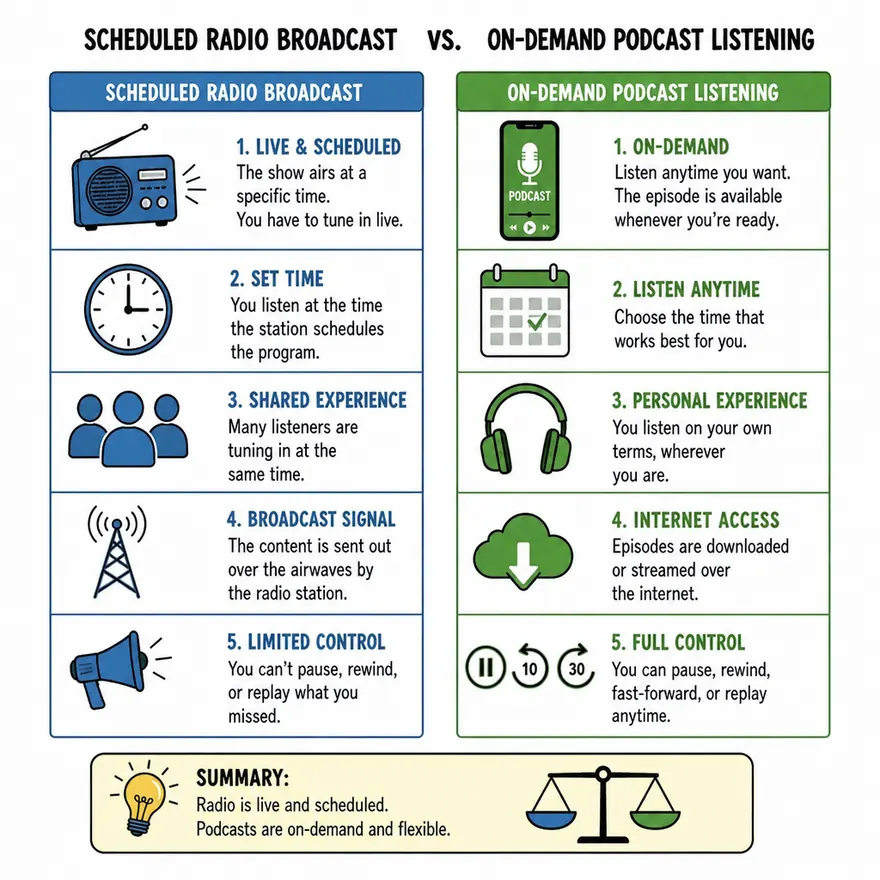
The main difference between a podcast and a broadcast is the listening model. A traditional radio or television broadcast follows a transmission schedule, while podcast episodes are available for audiences to choose and play on demand. A podcast is generally a series, not simply any conversation captured with microphones. The two can overlap when a transmitted programme is also released as podcast episodes. If you are new to the term, start with our guide to the podcast meaning in Hindi.
- Audience timing
- Traditional broadcast: people tune in to the scheduled transmission
- Podcast: people select an available episode
- Organisation
- Traditional broadcast: often part of a channel or station schedule
- Podcast: organised as a show with episodes
- Delivery
- Traditional broadcast: commonly associated with radio and television
- Podcast: distributed digitally for on-demand access
- Recording
- Traditional broadcast: may use live or prerecorded material
- Podcast: usually offers recorded episodes for later playback
These are working distinctions, not rigid boundaries. Radio can use prerecorded interviews, and podcast material can come from a radio programme. "Broadcast" does not automatically mean "live," just as "podcast" does not mean "unplanned chat."
For example, imagine producing a Hindi cinema interview. You could prepare an edited episode for listeners to play whenever they choose. Separately, you could arrange a scheduled transmission of that interview. Describe each version according to how your audience will receive it. Our explainer on the episode meaning in Hindi covers how episodes fit into a series.
For your own show, begin with the audience promise. If you are inviting listeners to join an event together, state the start time and where to listen. If you are publishing an episode, explain where they can play it rather than implying they must arrive at a particular hour.
Choosing a Broadcast Translation That Fits the Context
A good broadcast translation preserves the sentence's meaning instead of mechanically replacing one word. Prasaran is the standard noun to recognise, while the verb form expresses transmitting or airing something. A phrase about a televised programme therefore needs a different explanation from a phrase about sending a message widely.
The search phrase "broadcast in Hindi" also needs context. You might want the Hindi equivalent of the English word, or you might mean a programme delivered in the Hindi language. In a guest brief or episode description, make that distinction explicit. Write "Hindi-language interview" when language is the point, and use "broadcast" when you mean transmission.
You may also see the word in non-media settings: "new broadcast" in a messaging app usually means a list that sends one message to several contacts, and a "broadcast address" is a computer networking term. Neither refers to publishing a podcast.
Try these wording checks before publishing promotional copy:
- For an upcoming recording: "We are recording a Hindi interview with our guest." Avoid suggesting listeners can attend unless that is planned.
- For an available episode: "Listen to our latest Hindi podcast episode." Add a direct link to the episode.
- For a scheduled transmission: "Tune in at the announced time." State the date, time zone, and where to listen.
This keeps translation useful. Instead of debating a word in isolation, ask what action you want the listener to take. Then choose language that makes that action unmistakable.
Put the Distinction to Work in Your Podcast Workflow
Keep three stages separate in your planning: recording the conversation, preparing the episode, and announcing that it is available. Name each stage clearly in your checklist. This gives guests and collaborators a shared understanding without requiring them to learn broadcasting terminology first. A short outline also helps; see our guide to the script meaning in Hindi for how to write one.
Zencastr supports podcast recording with separate tracks for each participant and local recording that uploads during the session. Separate tracks give you more control when editing each speaker's contribution. As Zencastr explains how it records, you can fix a sound on one guest's track without affecting anyone else.
Use a straightforward preparation checklist:
- Define the format: Tell guests whether the session is recorded, live, or intended for later release.
- Prepare the conversation: Share the topic, audience, pronunciation notes, and any Hindi-English terminology you plan to explain.
- Check the setup: Test microphones and headphones, then confirm the intended devices are selected.
- Finish carefully: In Zencastr, stay in the room until every track finishes uploading before closing the session.
The Takeaway for Hindi-Speaking Creators
Use "broadcast" for transmission, "podcast" for your on-demand episodic show, and specific wording whenever messaging or networking is involved. For listeners, the most helpful explanation is what they can hear, where to find it, and when it becomes available. Keep that promise clearer than the terminology.
Ready to turn your next Hindi conversation into a podcast episode? Explore Zencastr's recording tools and prepare your next guest session.