In podcasting, an anchor is the presenter who introduces the show and guides its conversation. If you searched for "anchor meaning in Hindi," the key distinction is between a programme presenter and a ship's anchor: the same English word means different things depending on context. This article explains that difference and offers practical ways to approach your first podcast interview.
What Is the Meaning of Anchor in Hindi?
The meaning of anchor in Hindi depends on how the word is used. For a ship, the translation is लंगर (langar), the heavy object dropped into the water to stop a boat from moving, as the Cambridge English–Hindi dictionary shows. In a podcast or broadcast, "anchor" refers to the presenter. For that role, प्रस्तोता (prastota) is a useful Hindi equivalent: Cambridge translates presenter, someone who introduces a television or radio show, as प्रस्तोता. Don't use the nautical word when you describe someone leading a show.
If you searched for "anchor in Hindi," start by identifying the surrounding subject:
- Boats and ships
- Meaning: a heavy object used to hold a vessel in place
- Example: "The crew lowered the anchor."
- Broadcasting
- Meaning: a presenter who leads a programme
- Example: "The anchor introduced the discussion."
- Support, used figuratively
- Meaning: a person or thing that provides stability
- Example: "Her family was her anchor."
These are separate senses of the same word, not interchangeable translations.
For your podcast description, "host" or "presenter" communicates the role without needing a dictionary. Keep the wording consistent across your introduction, guest invitations, and episode credits so people understand who leads the show.
What Does a Podcast Anchor Do?
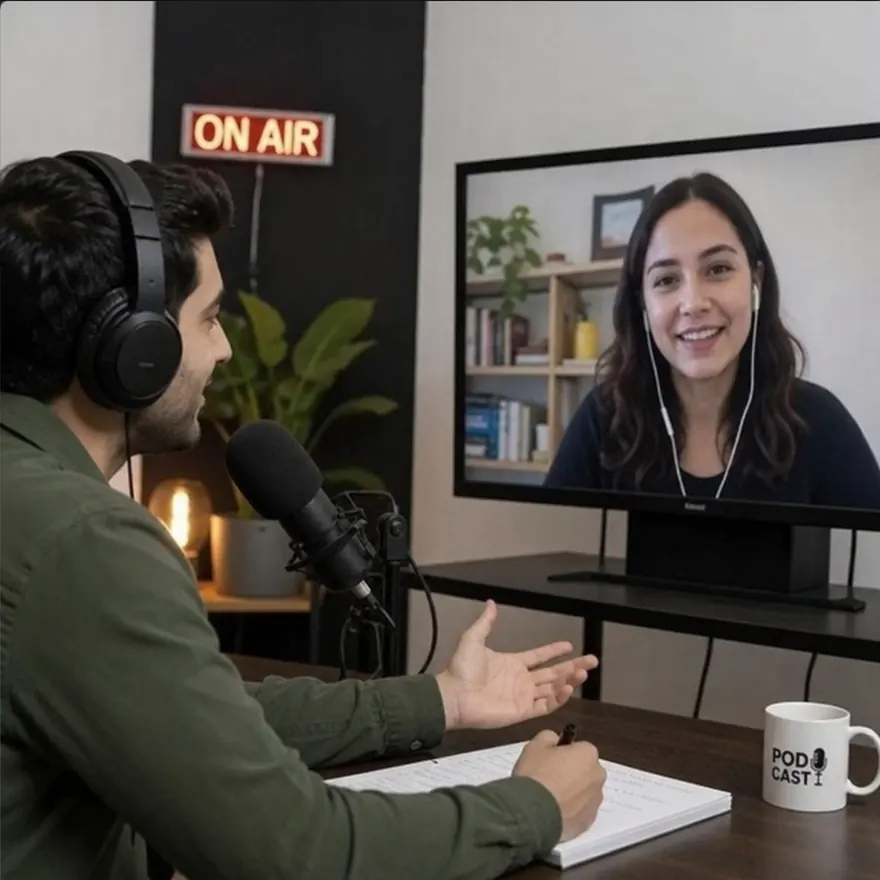
A podcast anchor guides an episode from its introduction to its closing takeaway. On an interview show, the role combines preparation, questioning, listening, and keeping the listener oriented. Rather than trying to sound impressive, aim to make the guest's ideas understandable and the conversation worth following.
Before Recording: Establish the Purpose
Write down one outcome for the episode. For example: "After listening, a first-time creator should understand how to prepare for a guest interview." Use that outcome to decide which questions belong and which interesting tangents can wait.
Research the guest's relevant work, confirm their name and pronunciation, and ask about topics they cannot discuss. Our guide to the guest meaning in Hindi covers the role from the other side of the microphone. For a Hindi-speaking audience, agree on whether the conversation will use Hindi, English, or a comfortable mixture. Treat that choice as an audience decision, not a test of anyone's fluency.
During Recording: Follow the Answer
Prepare questions, but leave room to respond to what your guest actually says. If they describe a difficult decision, ask what alternatives they considered. If they offer an abstract principle, ask for a concrete example.
Try these prompts:
- For clarity: "What would that look like for someone starting from home?"
- For detail: "Can you walk us through one example?"
- For context: "What happened before you made that decision?"
- For balance: "When might that approach not work?"
Ask one question at a time, and give the guest space to answer before introducing the next idea. For more ideas, see our list of podcast interview questions.
At the End: Deliver a Useful Takeaway
Return to the episode's original purpose and summarise the most useful point. Ask the guest whether anything important needs clarification. Then give listeners one relevant next step rather than several competing requests.
Is a Podcast Anchor Different From a Host?
For your own podcast, you can use "anchor" or "host" for the person leading the episode, as long as your team understands the responsibilities. "Anchor" has an established broadcasting sense, while "presenter" describes someone who introduces a radio or television programme. Neither label, by itself, explains how your production is organised. Our explainer on the host meaning in Hindi looks at the hosting role in more detail.
Define the work before choosing the credit. If two people share the conversation, decide who opens, introduces each topic, watches the time, and closes. If someone else handles recording, make that handoff explicit.
Anchoring doesn't require a formal newsreader delivery. Choose a style that suits the subject: thoughtful for a personal story, lively for entertainment, or measured for a detailed explanation. Practise sounding like yourself while keeping the structure clear.
Clear Language Matters More Than Elaborate Delivery
For a Hindi-speaking audience, plan how you will handle unfamiliar vocabulary. Rather than replacing every English word with a formal Hindi equivalent, prepare an explanation your intended listener can follow. Ask guests to explain specialist terms before you build a question around them.
For example, in an episode about starting a small business, try: "You mentioned customer retention. What did you do to bring existing customers back?" This keeps the conversation focused on an action rather than leaving the term unexplained.
Use these habits in your next practice recording:
- Read the opening aloud. Rewrite phrases that feel stiff or difficult to say naturally.
- Mark unfamiliar names. Confirm pronunciation with the guest instead of guessing on air.
- Leave a pause. Let an answer finish before adding your reaction or next question.
- Replace vague prompts. Change "Tell us about your journey" to a specific starting point.
- Check your summaries. Say, "Have I understood that correctly?" before moving on from a complicated answer.
When you review the recording, listen for moments where you needed more context. Those are chances to add a follow-up next time, not reasons to imitate another presenter's voice or accent.
A Simple Episode Plan for Your First Interview
Use a short running order instead of scripting the entire conversation. Write your opening and closing more tightly, then use prompts for the middle. This gives you a plan to return to without prescribing every answer.
Here is a sample structure for an interview with an independent creator:
- Opening promise: Explain what listeners will learn and why the subject matters to them.
- Relevant introduction: Introduce the guest through their connection to the topic, using details they have confirmed.
- Starting point: Ask about one situation that helps listeners understand the background.
- Main discussion: Explore the decisions, difficulties, and practical lessons behind that situation.
- Listener application: Ask what a beginner could try and what they should avoid assuming.
- Closing takeaway: Summarise the central lesson, thank the guest, and offer one next step.
For practice, record a short conversation with a friend. Afterwards, mark one strong follow-up, one interruption, and one question that needed clearer wording. Pick a single improvement for the next attempt rather than trying to fix everything at once.
"Anchor Thread" Is a Separate Search
If you arrived here after searching "anchor thread meaning in Hindi," you may be looking for a craft product rather than a presenting role. Anchor is also a needlecraft brand known for embroidery and crochet threads. In that context, "Anchor thread" means thread sold under the Anchor brand, not someone hosting a podcast.
Check the surrounding words before choosing a meaning. Stitching, colours, embroidery, or crochet point to the craft context. Guests, microphones, interviews, or episodes point to presenting. This matters most when a search result gives a translation without showing how the phrase is used.
Prepare the Remote Recording as Carefully as the Questions
If your guest is joining from another city, include a technical check in your preparation. Share the session link and brief instructions beforehand. At the start, confirm the selected microphone, listen for unwanted noise, and explain how you will handle interruptions or repeated answers. Our guide on how to record a podcast remotely walks through these steps.
Zencastr is a remote podcast recording platform for conversations with people in different locations. It records each participant on a separate track, giving you individual files to work with during editing. That separation helps when you need to adjust one speaker's recording without applying the same change to everyone.
Build a brief routine around whichever setup you choose:
- Ask everyone to use headphones where possible to help prevent echo.
- Record a short test and check it before beginning the interview.
- Explain how you will signal a pause or restart a sentence.
- Follow the platform's saving and upload instructions before closing the session.
Zencastr's recording FAQs strongly recommend headphones to help prevent echo and audio bleed.
Take the Role Beyond the Definition
Knowing the anchor meaning is your starting point. For your next episode, turn it into three actions: define the listener's takeaway, prepare questions that invite examples, and rehearse your opening aloud. Review the result for clarity rather than perfection.
Put your preparation into practice: record your next remote podcast conversation with Zencastr.