A podcast script is your episode's written plan: what you will say, how the conversation will progress, and where the recording should end. In a storytelling context, "script" translates into Hindi as पटकथा (patkatha). When it refers to a writing system, it means लिपि (lipi). This guide connects that distinction with a practical writing process, an adaptable episode template, and a remote recording workflow using Zencastr.
What Is the Script Meaning in Hindi for Podcasting?
For podcasting, think of a script as पटकथा (patkatha): the written material that guides your spoken episode. It is not लिपि (lipi), the set of letters used to write a language. The Cambridge English–Hindi dictionary lists both senses, because the English word can describe either prepared words for a broadcast or a writing system. Your podcasting task concerns the first meaning.
If you are searching for "script in Hindi," first decide whether you need a translation, a Hindi-language episode draft, or help organising your ideas. For an episode draft, focus on the message before worrying about perfect phrasing. Write a plain planning sentence such as: "This episode helps Hindi-speaking college students prepare questions for their first internship interview."
Then choose the language you want to record in. For your working draft, use Devanagari, romanised Hindi, or English notes, whichever you can read comfortably aloud. Keep names and pronunciation notes consistent so you are not decoding your own document during recording.
Choose the Right Amount of Scripting
Start by deciding how tightly you want to control the wording. Rather than scripting every episode the same way, try one of these approaches:
- Word-for-word draft: Write every spoken line for a carefully structured solo explanation or narrated story. Mark pauses and emphasis rather than leaving yourself an uninterrupted wall of text.
- Bullet-point outline: List the essential ideas, examples, and transitions for a discussion. Include the conclusion so an open conversation still has a destination.
- Hybrid script: Write the opening, the explanations that need precision, and the closing in full. Use prompts for interviews and conversational sections.
For a first episode, try the hybrid approach. If you are interviewing a Jaipur entrepreneur, script the introduction but prepare open-ended questions about their experience. Leave space for a follow-up when an answer reveals something more interesting than your next planned question. Our list of podcast interview questions can help with those prompts.
How Do You Write a Podcast Script That Sounds Natural?
Write for speech: use clear language, short sentences, and wording you would actually say aloud. Read each passage back and simplify anything that makes you stumble. The BBC Academy's guide to writing for radio or a podcast stresses this because the listener hears the words only once, with no visuals or graphics to help.
Use the following sequence to turn a topic into a recordable draft.
Start With One Listener and One Promise
Choose a specific audience instead of trying to speak to everyone. "People interested in careers" is broad. "Hindi-speaking graduates preparing for their first interview" gives you a clearer starting point. Complete this sentence before drafting: "After listening, you will be able to…"
For an episode about interviewing a local business owner, your promise might be: "You will know how to prepare five questions that invite useful stories." Keep that promise beside your draft, and remove sections that do not help deliver it.
Build a Beginning, Middle, and Ending
Open with a recognisable situation or a specific tension. For example: "You finally booked your first podcast guest. Now your question sheet contains twenty questions, and none feels like a good opener." Follow that with the episode's promise, then introduce yourself briefly.
Arrange the main discussion in a useful order: preparation, conversation, and follow-up. Give each part an example rather than adding another abstract tip. Finish by returning to the opening problem and naming one action the listener can take. If you are unsure how much material fits, our guide to what an episode is and how to plan one can help.
Draft Transitions and Production Cues
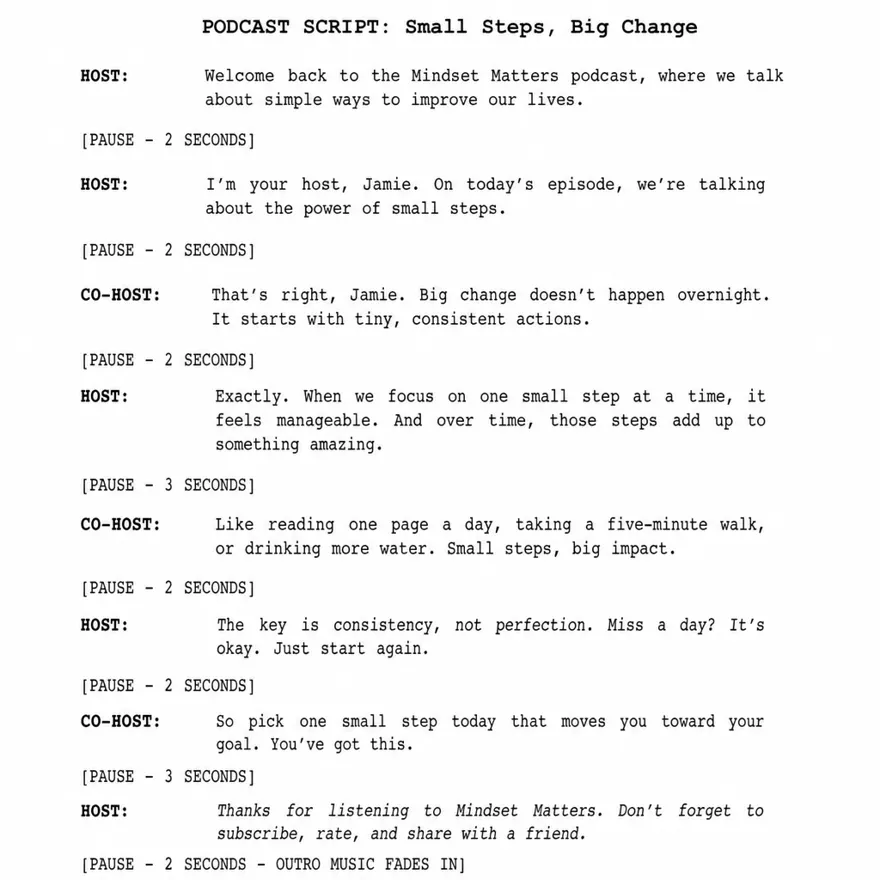
Write the bridges between ideas, not just the ideas themselves. A transition such as "We have chosen the topic; now let's turn it into questions" tells the listener where you are going. Add cues such as [PAUSE], [GUEST INTRO], or [MUSIC FADES] on separate lines so they are easy to distinguish from speech.
For an interview, prepare prompts such as "What happened next?" and "Can you describe a specific example?" Ask for the guest's preferred name pronunciation before recording. Avoid writing their answers in advance. Your script should guide the conversation, not manufacture it.
Adaptable Podcast Script Template
Copy this structure into a document and replace the sample wording with your own. The example is an imagined episode for first-time podcasters in India, not a real interview. Treat the cues as instructions for you, not words to read aloud.
- Hook: "You have invited a guest to your first Hindi podcast. How do you move beyond questions that get one-word answers?"
- Introduction: "Welcome to [show name]. I'm [host name], and today we're preparing a question sheet for a conversation worth hearing."
- Listener promise: "By the end, you will have an opening question, two follow-ups, and a clear way to close."
- Guest introduction: [Confirm name pronunciation.] Introduce the guest using only details they have verified.
- First discussion: "Imagine you are interviewing a Lucknow bookshop owner. What would you like listeners to understand about their working day?"
- Follow-up: "Can you take us through one moment that illustrates that?"
- Transition: "We have explored the experience. Let's turn that into advice for someone starting out."
- Recap: Restate the most useful lesson using the guest's actual answer.
- Closing: Thank the guest and give listeners one relevant next step.
Do not try to fill every section with equal amounts of text. Expand the parts that need careful wording, and keep conversational prompts brief. After recording, check whether the introduction still accurately describes the discussion you captured.
Prepare the Conversation for Remote Recording
Zencastr is a remote podcast recording platform where guests can join a recording room through a browser link without creating an account. On a computer, guests open the invitation, allow access to their camera and microphone, check their setup, and join the host. That keeps the invitation simple for a conversation between, for example, a host in Delhi and a guest in Indore.
Zencastr records each participant locally on their own device and provides separate tracks for each person. Those tracks give you individual control during editing: as Zencastr explains how it records, an unwanted sound on one guest's track can be fixed without affecting anyone else. Tracks upload progressively, and participants should stay in the room until their uploads are complete.
Send a short preparation note alongside the invitation. Include the topic, intended audience, approximate session length, and any names or examples you want to verify. Frame your question list as preparation rather than a demand for rehearsed answers. For the full setup, see our guide on how to record a podcast remotely.
How Can You Write a Podcast Script Using Zencastr?
Write your podcast script in a document, then use Zencastr to rehearse and record it with your guest. Zencastr does not write the script for you. Its browser-based guest joining and separate local recordings support the recording stage.
- Prepare the document: Add speaker names, the episode promise, essential questions, and a closing prompt.
- Share guest-facing notes: Send the topic and discussion areas without distracting production instructions.
- Rehearse the opening: Read it aloud and replace formal wording with phrases that sound like you.
- Record with room to respond: Keep prompts visible, listen closely, and leave space for unplanned follow-ups.
- Revise afterward: Note confusing questions or awkward transitions and improve the template for your next episode.
Give the Draft a Final Spoken Edit
Before recording, do one complete read-through aloud rather than proofreading silently. Mark every sentence you need to restart, then rewrite it in plainer language. Write numbers and times the way you would say them, for example "four o'clock in the afternoon" rather than "4pm."
Finally, verify names, quotations, and factual claims against your sources. Check that every production cue is clearly separated from dialogue. Keep one final listener action, rather than ending with several competing requests.
Turn Your Plan Into a Conversation
Begin with a clear promise, build a manageable structure, and write words you can comfortably speak. Use your script to stay focused without shutting down curiosity. When your draft is ready, try Zencastr and put your next podcast conversation into practice.