Transcript
Speaker: Welcome to the second season of the Yellow Van stories. More than a year has passed since the last episode. That sabbatical lasted a little longer than expected. And therefore, my gratitude goes out to all of you who have taken their seats today regardless. Thank you.
Speaker: As I'm sitting here in front of my microphone recording this trailer, the world back then almost seems like a nostalgic movie poster compared to the world today. And I struggled to find the right words to introduce this new season, at the heart of which will be the most terrible, most destructive word of all, war. But let me try anyway.
Speaker: I still remember the morning of the 24th February, how I stumbled out of bed, hardly finding my bearings as usual. It was a sunny day, switching on the kettle, heaping spoons of coffee into our French press with squinting eyes and letting the roast aroma eagerly fill the room. It was like any other morning, really, until I switched on the phone. I think we all remember that moment.
Speaker: when that headline smacked us in the face for the very first time. The sudden disorientation and disbelief, empathy and anger wrestling each other, the sadness and the rage.
Speaker: The truth is I could have woken up on any other day feeling just the same and being equally justified. There hardly has been a year without armed conflict since the beginning of recorded time. Killing each other is the plot of our history and all victims deserve our empathy equally. How we remember them will determine how the future will remember us.
Speaker: So why then did I feel this immense grief on the particular morning of the 24th of February, 2022? Because it was closer, because it had all the media attention, and because the rest of the world had plunged into a cold war on the brink of nuclear self -destruction again overnight. The future was dead.
Speaker: My first instinct is always to gather more information. Escape my own ignorance. Why is this happening? What part of the narrative am I missing? So the first book I thought of reading was a comprehensive history of Russia and the Soviet Union. An obvious choice I thought, right? And then I thought again.
Speaker: Something didn't quite sit right. Wasn't this the problem all along? This western reflex of understanding former Soviet states first and foremost as Russian satellites? Still, denying them a history before and after the Soviet Union entirely
Speaker: This Western perspective ties right in with Vladimir Putin's war propaganda, how the big brother is liberating its smaller sibling, how big Russia is stretching out its helping hand to little Russia. It is his greatest success that for more than 20 years the West, and especially Europe, has followed his post -Soviet historical narrative.
Speaker: And once you go down that rabbit hole, it is astounding how much cultural appropriation there has been. For instance, I learned in school that Kazimir Malevich, one of the founding fathers of modern art, was Soviet Russian. Not that he was Ukrainian. Jiga Vertov, a groundbreaking cameraman and director of the 1920s and 1930s who I admire very much, was introduced to me as Soviet Russian, despite being Ukrainian.
Speaker: and the list goes on and on and on. The famous Beatriceau Borsch, by the way, isn't Russian either. The Soviet Union wasn't a homogenous, philanthropic union of equals, it was the opposite.
Speaker: It was a hegemony with a wide variety of ethnicities held together by force and violence. How bitter and sad it must be when 30 years after the collapse of the Soviet Union, the theft of your cultural identity still hasn't been amended, but instead serves as a pretext to invasion and war. Don't you think it is about time to change this, this flawed Western perspective?
Speaker: to read books about comprehensive Ukrainian history, stories by Ukrainian authors, to watch films by Ukrainian directors, to eat food that originally comes from Kiev and not from Moscow. Now is the time to listen to all of Ukraine and hear what they have to say about their culture and be the richer for it.
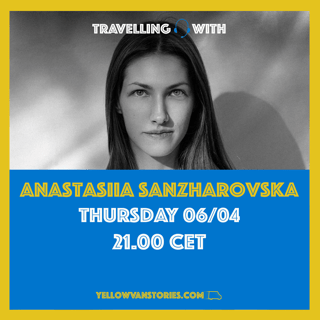
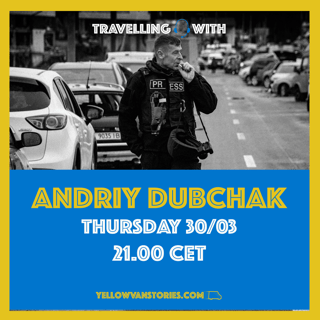
Speaker: Therefore, I will invite Ukrainians into the Yellow Van every week to hear their stories from their own lips. Let's finally listen to the manifold voice of Ukraine.
Speaker: Before we get started, I need to get something off my chest though. I feel immensely under qualified to host a podcast under the umbrella of the topic of war. You will have to forgive me for mistakes I make, phrasings I use and perspectives I hold as I am grappling with something I have never experienced and therefore no precious little about. But I will try it anyway because I can't think of anything better to do.
Speaker: And I call on you to tell me when I am in error or lacking a broader context. Because if there is one thing I have learned over the last months, it is this. To be vigilant with my thoughts because life is dynamic. And when in doubt, to think again.
Speaker: I look forward to welcoming you to a new episode every Thursday at 9pm Central European Time and I will keep you a seat, no matter what, just like you showed up today, no matter what.
Speaker: And now I leave you in the good care of my great friend Jim Croft with his song, Love in the Face of Fear. I am so grateful that for another season he is contributing this beautiful song to the podcast. No other song in the world could capture its essence better. Thank you so much, Jim, and take it away.
Speaker: It took a long, long time From the past rise to fallen skies But I'm lost, we're here And the world is ready for new ideas And I know my attitude distorts you and so it should And I know my fantasies are troubling to those like you
Speaker: Well, my message is clear Get loving in the face of fear
Speaker: When you find your place, work a lot of scones, I break a shame. There's a dream I breathe, gone loving man and those in need. And I know my attitude, it's both you and so it should. And I know my better scenes, I'm travelling to those like you.
Speaker: In the face
Speaker: Oh, you're standing for the rights It's the fact of your life Oh, you're standing for the rights It's the fact of your life
Speaker: Are you standing for the rats?