Transcript
Speaker: I bought off any underglaze that's standing on the wax with the damp sponge. Meet Ron Philbeck, a potter who makes some amazing, quirky, illustrated pottery. In this episode, you will learn why Ron treats pottery like a nine -to -five.
Speaker: It's just my routine. I built it into my routine. You will also learn how Ron started giving himself permission to make the pottery that he really wanted to create. For a long time I wanted to be this serious potter and I didn't think I could have like these playful pots. And as we continue down the interview Ron gives some excellent advice to anyone looking to start selling their own pottery. I would say really be
Speaker: yourself. Be authentic and genuine. Finally, we end with Ron's excellent advice to anyone looking to discover their own unique voice with their pottery. Just be yourself and do what you want to do. And there's so much more this episode. I hope you guys enjoy it and I'll see you guys in there. Ron, welcome ship your pottery and share with me what is something you believe potters should be doing of success in pottery. So I think for me, probably the biggest thing was just
Speaker: working a lot, making a lot of pots, getting out here in the studio, making time to get out here in the studio. I was pretty obsessed with pottery when I first started making pots. And so that was not a problem for me. I got out here and I worked. I found people to help me. I loved buying pots and looking at pots and going to shows and stuff. So I think for me, that was just a real big part of kind of
Speaker: the obsession and the love of it. You know, I just loved it. I mean, it took over everything. I dropped just about everything else I was doing at the time, hobby -wise. So I just really dove right into it. And I think that was really good for me to focus. Absolutely loved that. Shaping Nation, the more you make pottery, the better you're going to get at it and the more successful you're going to be. Yeah. But something I have come across a lot is that a lot of people actually struggle to get into the studio. What is something you do to help you get into the studio?
Speaker: I pretty much treat things these days like a nine to five job. I've never been a night owl. I've never worked in the studio late at night. I really am just, I get out. It's just my routine. I built it into my routine. You know, early on when I was just making pots part time, I was, you know, I'd come out here after my regular job or wherever I was working, you know, I would just make time to get out there. But once I went full time,
Speaker: You know, it was just like a nine to five job to me. I would get up, have my breakfast, do my morning rituals, journal, draw, meditate, whatever. Get out here in the studio, work until lunchtime, make pots, do whatever I need to do, you know, and then work until five or six. Early on, it was like six, seven days a week. As years passed, you know, I became better at taking some time off.
Speaker: But just having a routine, I think, getting out here and, you know, whatever that is for anybody. I've got friends who love to work at night. You know, they do all their other stuff during the day. And then they're out in the studio at six or seven o 'clock until midnight or 1 a .m. You know, I think it depends. So I don't have a whole lot of other daily commitments. So to me, to be able to work like that, I was really fortunate. Absolutely love that. Shaping Nation, find what works for you so that you continue doing that and build that habit. I love that.
Speaker: So now tell me the story how you got started making pottery. I got started around 1992 after I came home from college. I had studied mathematics and some other, I changed my major a bunch in college and eventually just kind of came home, got settled down here, found a job, started doing some odds and ends. And I had a friend who also came back to our hometown around that same time and she had been an art major.
Speaker: in college, and we've been big friends in high school and all through college and stuff. And she asked me to go take a pottery class at a local community college. So I had never touched clay before. I had always painted or drawn and different things like that, but never made a pot. So we went and took a class at a community college.
Speaker: It was a lot of fun. We didn't have very like the teacher wasn't really there to teach you how to make pots. She was kind of doing this other thing with these other students who were doing other kinds of things. But my friend Jamie, she knew how to how to center. She knew how to pull the wall up. And so basically, you know, she showed me what to do. And we stayed in that class for.
Speaker: I guess about a year maybe. And then during that time I went, we took a field trip with that class to Seagrove, North Carolina, where there's, you know, a hundred potteries in a couple counties. And I saw a lot of pots there. I met a man there named Tom Gray. He eventually became a good friend and a mentor to me.
Speaker: Eventually went to another community college. Later on went to John Campbell folks school here in North Carolina. I went to Arrowmont out in Gatlinburg, Tennessee. Eventually went to Penn.
Speaker: During all that time, I was making pots. I was just learning the way. I mean, it was just kind of an organic growth. Nothing really. I didn't really have any goals. I didn't really have this outset where I thought, hey, okay, I'm going to be a potter. It was basically just like, okay, I like doing this. And then I would find little nuggets along the way. I discovered.
Speaker: Warren McKenzie through Bernard Leach and those philosophies and ideas got me excited and kept me going down the line. It was just a slow, progressive step along the way as far as the way I learned. I went to the North Carolina Pottery Conference every year.
Speaker: They would bring in great potters from all over the nation and around the world, like people like Don Wright, Jeff A. Strike, Janet Mansfield, you know, just a whole range of great potters. So I was kind of like a sponge and I just took things in. And I knew what I liked early on. I saw all these pots made by this couple that was up in the mountains near Penland.
Speaker: Will Ruggles and Douglas Rankin. And they made these wood -fired, lightly salted pots. And when I saw those pots, this would have been around 1994, something like that. I saw those pots and I was like, those are the pots I like. And I like to eventually make pots similar to that sometime one day.
Speaker: absolutely love that. You mentioned earlier that you got a couple of mentors and you do contribute growth as an artist to finding mentors. Tell me more about this. Yeah for me it was really, I mean since I didn't have any you know university education or any sort of
Speaker: you know, like really dedicated teachers in like the community colleges and stuff that, you know, they were basically just showing me the basics. When I met Tom Gray in Seagrove, Tom had probably been making pots for, I don't know, 30 years. He was making great pots and, you know, that was his livelihood. And so when I met him and we became friends
Speaker: He was just an open book to me. He, you know, he showed me so many different things. I learned I never made pots for Tom, but I would watch Tom make pots and I would go there when he had his 2 sales every year. So I learned some of the business side of things from Tom.
Speaker: When I built my salt kiln in 96, around that time, 96, 97, I'd never even lit a gas burner. So Tom came down, helped me fire the kiln. So he was kind of held my hand along the way and he was also very encouraging. He really
Speaker: He just really encouraged me, which I think I needed. I needed somebody there to say, yeah, you're doing a good job. Try this, do this. And then we would go to the pottery conference every year, which was another kind of great thing we did together and saw all these great potters. And we would both be excited about it. And then later I had other teachers from different places and who became friends and I would say mentors, too, who I could call up or write and ask questions.
Speaker: It was just really beneficial for me to have people who had been in the field for 20 or 30 years who knew what they were doing. And they were just a great resource. So that was just really important. And I try to do that now too. I try to help folks along the way if I can. So I try to pass that along since so much was given to me over the years.
Speaker: What is something you learn from whatever mentors that help propel your own pottery? Like I mentioned earlier from Tom, probably was the routine of it. You know, he worked all the time, but the routine of it for sure helped me. And then also the dedication and the love and just seeing how certain folks that I
Speaker: latched on to how they live their life and how pottery was really important to them. Most of those folks lived very simple lives. They had what they needed. They really cared about what they did. They were just passionate and that was something I had really never experienced too much before growing up. So it was just like a great example of how to live
Speaker: how to live your life, how to do something important. Pots were very important to all these people and making pots and putting pots out into the world for people to use. That was very important to them. And so seeing that really resonated with me. And so I think that was kind of what they gave me was that love and dedication. Absolutely love it. How would you find a mentor to help you with your pottery?
Speaker: I think if you can find someone whose work you like and who you get along with and it's beneficial to both parties. I think something like that would be really great doing some sort of apprenticeship. Even if it's not that in depth, if you take a workshop or if you meet someone online or meet someone at a show whose work you like.
Speaker: If you could talk to them and just be genuine, be yourself. I think for me, it just happened naturally with Tom. And so it's kind of, I never really searched out folks. It just kind of happened. I know now there are also, there's a program called Clay cohorts, I think that Simon Levin heads up.
Speaker: and it's a it's a mentorship program. So I think there's some programs out there like that where folks could sign up to, you know, have a mentor. You know, it costs money, but you're getting a ton of help from folks. I mean, Lisa Orr has been a mentor in that program. Linda Christensen is a mentor this time. Simon, of course. So I think just
Speaker: looking around and finding someone you connect with. I mean the internet. Absolutely. Yeah the internet wasn't happening when I was when I was coming coming through that so for me it was just like the right time the right place kind of thing. I absolutely love that. So let's talk about your pottery. Can you tell me a story how you started making your quirky illustrative pottery that you make today? Yeah so what I'm doing today is sort of a
Speaker: It's just sort of evolved into where it is. And I've kind of taken some turns and tangents along the last 25, 30 years. What I do today, I feel like it's where I am today. Where I was 10 years ago was I was making different pots. But these pots have been informed by all the pots that I made.
Speaker: before then and all the things I was interested in. I was always interested in a pot that had some sort of decoration or brushwork on it or a pitcher or something. I never really knew, I never really let myself explore that very much for a long period of time. So I would have these little spurts. It was usually not very good. And so I would kind of just go back to doing whatever I was doing and
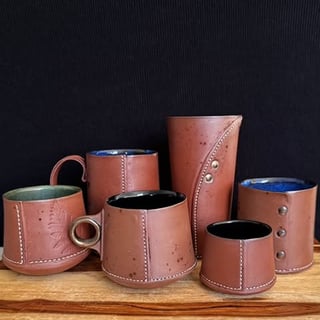
Speaker: kind of things just happened along the way. For a long time I was just making really plain brown salt -fired pots that concentrated on form and you know good form, good handles, good proportion, that whole thing was important to me. But in the back of my mind during all those times I wanted to put something on the pot and so I took a little holiday
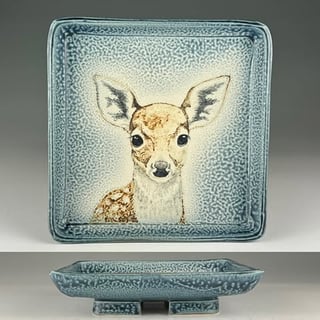
Speaker: It was only going to be for a year or two, but it ended up being about eight years. And I switched to earthenware and I started graffito on pots, red clay, white slip, clear glaze. And that was when I really started drawing on the pots. And I had also started journaling a lot more every day. And in my journaling, I was also drawing a lot with a ink pen, pen and ink in a journal and drawing things from everyday life. I drew a lot of pots. I would draw little quirky characters and things.
Speaker: And then all that kind of came into those earthenware pots. Then later, after about eight years, I wanted to go back to sodium vapor fired work. And I decided I was going to do soda instead of salt. But I didn't put any illustrations on anything. I went back to like really juicy soda fired pots, real directional firings.
Speaker: And after several years of that, somehow I married the drawings onto the soda -fired pots. I decided, okay, I'm going to do this. I'm just going to go all in and I'm going to put these drawings on these pots. And that was, I don't know, that was around 2016 or 17, maybe I can't remember, but
Speaker: It was just like a light bulb. And it was also a hit. People liked them, which was great. That work is still evolving. I'm still kind of figuring out the drawings. I'm figuring out what kind of characters. I'm looking at pots right now on the shelf up here and I'm thinking how at first it was like this rabbit and this owl. And then there was a cat. And then there was some of these other kinds of things that came along. But I've always liked kind of children's books and picture books and kind of real loose kind of fun illustration.
Speaker: And I looked at a lot of that and that kind of fed me and I would draw every day and I would just kind of get in here and transfer my ideas onto the pots. And the technique I used was something that I knew about beforehand and I eventually started doing what I do with that black slip on the soda fired pots. So you mentioned that you really took inspiration from children's books. Tell me why you took inspiration from that.
Speaker: I think it was the playful nature of it. I mean the particular things I was looking at and plus probably just from my childhood. My mom read to me, we had a lot of books in the house when I was a kid and we had the Richard Scarry books. We had like a lot of picture books and books with animal characters and fairy tales.
Speaker: All that was just playful to me. I mean, for a long time, I wanted to be this serious potter. You're going to make pots. They're going to be in a museum someday, you know, very like, and I didn't think I could have like these playful pots. I didn't give, I wouldn't give myself permission to do that. But when I did give myself permission, then that's when everything kind of fell into place.
Speaker: But definitely the playful nature of those children's books and the drawings. I love the way Quentin Blake draws. He's a British illustrator. He did a lot of the illustrations for the Roald Dahl books. So when I just accepted that I could be who I wanted to be or who I was and put that stuff on a pot,
Speaker: It was just like, you know, just the best. It was just like, okay, this is me now. I'm kind of doing what I love. It's okay. I give myself permission. And so things just kept moving forward. And that's kind of where I am right now. Why didn't you give yourself permission earlier to add the quirky illustrations onto your pottery? I probably just have a lot of hang ups.
Speaker: I think I just had like the pottery police in my head. It was like, if I do something that is not this, whatever the restriction I'd given myself, you know, the potters I'd looked at, these serious English potters, these Asian potter, people who I thought were like the real deal or folks who had studied with those people. I thought that was the real deal, right?
Speaker: So I had these rules and I just wouldn't give myself any leeway. But in a way that was good because it taught me a lot about making a good pot. I mean, looking at those pots and looking at the folks who made those pots and those historical pots,
Speaker: That really, I mean, because to me, the pot is the most important thing. The pot, the form, the handle, the lip, the clay wall, that's the most important thing to me. If I can't make a bad pot and put a picture on it and expect it to be good to me, I want to make a good pot. So the way things happen for me,
Speaker: that really worked out well because I do want to make a good pot first and foremost. And now that I am giving myself permission and kind of coming in to accepting doing whatever I want to, then that's really working together. Does that make sense? I love that. Shaping Nation. The most important thing is to make a great pot, but you don't have to restrict yourself into doing everything that everybody else is doing. You can do whatever you want with your pottery. I love that.
Speaker: Can you walk me through the steps of how you add your quirky illustrations to your pots? Yeah. So this technique is something that I saw the potter from Georgia. His name's Michael Simon. This was a technique I'd seen Michael Simon do a number of times. And he was one of my favorite potters. And so it's a wax resist technique. And the way I do it is a little different than he does it. He would work on greenware, but I work on bisque. So once the pots come out of the bisque kiln, I will take a pencil and I'll draw the
Speaker: animal or whatever plant or pitcher on the pot in pencil. And then I use a cold wax. I use this wax called Forbes from high water and I add a little bit of red food coloring to it so I can see it. And so I paint all the negative space around the drawing with that wax and also do any little details on the
Speaker: character in wax and then once the wax dries which is you know 15 to 20 minutes but I usually wait until the next day then I brush the black I use just black commercial underglaze onto the pot and that fills in the positive space and the image will show then and then I blot off any underglaze that's standing on the wax with a damp sponge so I'll work on maybe
Speaker: 20 pots a day. Like my kiln will hold 150 pots, my gas kiln. So it'll take me about a week to decorate a kiln load of pots. And so I'll sit and I'll work and I'll draw and then I'll wax and then I'll do the black. And then they go into the soda kiln, fire it up to column 10 and the soda
Speaker: I spray soda ash into the kiln, that vaporizes, combines with the silica and the clay and the slips. I use a few different slips and the black stays black for the characters and then the other parts of the pots may get flashed or be kind of a matte surface or a shiny surface.
Speaker: So it's kind of a long process sitting and decorating all the pots. I can throw pretty quick. I can sit down and make a kiln load of pots, but the decoration and the waxing is the part that takes the longest. That was an excellent explanation of that. I loved it. Yeah, there's some about go ahead. I just want to say real quick that there's there's definitely some process videos on my Instagram too. So folks want to check out my Instagram page. You can see that actually happen.
Speaker: Absolutely love it. Can you tell me about the moment when you decided to go full time as a potter? Yeah, so that would have been around 1997. I was working in a restaurant. I had been working for the Department of Transportation. I was also making pots whenever I could. And I had been having some like a little sale in the spring and in November right out in my dad's front yard.
Speaker: I was mailing out photocopy flyers that I would make, mailing them to friends or handing them out to my friends and family. And I would have a little sale out in his front yard on a Saturday. And that was going pretty good. You know, I was selling some pods, basically. They weren't very good pods, but I knew people liked them and it seemed like that was good. So I'm not quite sure that I made like a hard decision and said, okay, I'm quitting my job today. But.
Speaker: something happened. I can't quite remember what it was, but I pretty much dropped everything and just continued to make pots. And that became my job. And so I started applying to craft fairs. I joined a local guild. I just put everything into it.
Speaker: And I don't think I knew any better, really. I was just flying by the seat of my pants. I've never really had a goal. Things just sort of slowly happened. So there wasn't like an aha moment when I said, I'm done with that, I'm doing this. It just slowly happened. It seems like it was just a little transition from one to the other somehow.
Speaker: What do you think helped you the most with being able to sell your own pottery? I think I was just really passionate about it. And I think folks saw that. I mean, certainly the people that were buying my pots early on were my friends and my family. So that was just that. But I think I would also talk to people about pots. I would be like,
Speaker: You know, if you have a handmade mug, it'll change your life. You know, I believe that, you know, I was just, I really loved using handmade pots. And so I guess people just saw that I was excited about it. So I was making a lot of pots. I was trying to make good pots. I was putting them out there, you know, at these couple craft shows and at this sale in the front yard. I don't know if it was just, I was passionate about it. I was authentic. I wasn't trying to like sell you something like a salesman.
Speaker: It was just a genuine thing I was excited about. And maybe I got other people excited about it. I have a really good local group of folks who have bought my pots over the years. And I feel really fortunate that I got started that way. I mean, I started, you know, right here in my county selling pots. And we have a great arts council here. So.
Speaker: I think I was just, you know, maybe it was because I was like this local guy who some people knew and they came and bought my pots. And then that just expanded as I grew and went farther and farther out. Started here, got a little bigger, got a little bigger. And then of course the internet came along and the whole world is your market. I love that. So what advice would you give to someone looking to start selling their own pottery?
Speaker: I would say really be yourself, be authentic and genuine and make the best pots you can make. When I first started making pots, they were, but you know, they were the pots they were, but you have to start at some point to see if you can sell work. And I think if you take your work out somewhere to a show,
Speaker: And you meet people and you talk to people about your work and about why you think it's important. I think that resonates with people. That worked for me. I mean, I wasn't planning on like the strategy, but with the internet now and online marketing or online selling.
Speaker: There's lots of opportunities to do that. That's virtual. I mean, a lot of people do YouTube videos where they talk about their work. They do Instagram. They do different things. So I would also say maybe just try a lot of different things too, because I know friends of mine who do really great at shows, they do really great in person with selling their work.
Speaker: and they don't do so great with online sales. And then I have other friends who do really great with online sales, and so they've given up some of their in -person shows. So there's lots of different ways to do it. You know, maybe you do wholesale, maybe you do retail, maybe you do a little bit of both, whatever it takes. I think
Speaker: Finding a way and I remember very early on a potter told me don't necessarily put all your eggs in one basket Like don't rely on just this one way of selling your pots. I mean this would have been in the 90s So things have certainly changed but for a long time I had some gallery sales I had my home sales and then I would do shows so I had a few different things going on So try different things be yourself make a good pot Have fun
Speaker: and listen to your customers too. I think sometimes I was really hard. I wanted to do what I wanted to do and I'll be like, no, I'm never going to do that. But then sometimes somebody will say, well, we try, would you make this? And I would make it and I'll be like, oh, this is pretty cool idea. It's pretty cool pot or whatever it was, you know, whatever they wanted made. And eventually that led to something that I continue to make. So maybe being open would be kind of that advice being open. Yeah.
Speaker: some excellent piece of advice right there. So let's talk about discovering your voice. Can you tell me about the moment when you knew you were heading in the right direction with your pottery? I think it was when there were two steps. One step was when I started being not afraid just to make a generic pot. For many years, I just kind of thought I was going to make these generic sort of, you know, nice pots, but they weren't really individuals.
Speaker: Or they really, I didn't think they would be associated. I don't really know how to put that, but they didn't stand out. Okay. And that seemed fine. And that was sort of like my thoughts of being like this production potter who made a lot of pots and got the pots out to everybody in the world, all that, which is kind of my mentality for many, many years.
Speaker: And then I sort of decided, okay, I'm going to do a few things that really make these look like my pots. And basically it was just applying a few different colors of slip to the pots. That was sort of the moment, or it's the moment now where the pots are and that I feel like they're a reflection of who I am at this moment in time. I've changed
Speaker: Kind of what I've what I do over the years so many times, you know, I've probably had five or six different sort of styles of work within a style that. I'm where I am right now and I've been here for a few years now and it feels really good and I can see it moving forward.
Speaker: but I also feel like this is where I am now and I'm really happy with it but I don't know that this is my forever voice but it's my voice right now and it's what I'm doing and it's what I love to do and I and I feel like it's still growing and evolving so I don't I probably won't change anything drastically you know but
Speaker: When I did those two things, when I just really started giving myself permission to put my identity, my sort of playfulness and personality onto the pot, that was probably the moment. I absolutely loved that. What were you feeling when you gave yourself permission to put your personality into your pot? There was fear for sure. I mean, being vulnerable,
Speaker: You know, it's kind of a big thing putting something out there that people may not.
Speaker: like or think is I'm going to use that serious word again you know oh that's not very serious so so there was definitely fear there was definitely like oh well such and such whoever the pottery police aren't going to like this but there was also like this feeling of freedom and acceptance and joy I mean the pots would come out of the kiln and I would just be like smiling I would be like happy you know it's like
Speaker: These, I'm really pleased with these. They make me smile. And other people would say, oh, you know, your pots, I love using them. They make me smile. They bring me happiness. And that is very satisfying. So a few different things for sure. Fear, happiness, joy, concern of what others think.
Speaker: I can remember telling a friend of mine, I said, I'm just going to do what I want to do. I'm not going to worry about what anybody else thinks. And that was kind of my switch. Absolutely love it. What advice would you give to someone looking to discover their own unique voice with their partner? I would say pay attention to the things you like about
Speaker: Well, a few different things. So when I'm working, if there's something that I like to do, I make note of that. If there's something that I don't really like to alter things or work on things for long periods of time. So I know that that's not a direction I'm going to go down. And I've tried it over and over again. And now I kind of know, OK, this is what I like to do. This is the kind of handle I like. This is the kind of foot I like. So I pay attention to things like if I see some pots,
Speaker: at a show or that a friend's making or in a book or whatever, I kind of pay attention to what about it sort of moves me. Is it the shape? Is it the handles? Is it the proportion? Is it the foot? Is it the color of the clay? All those things pay attention to what moves you. The other thing I would say is don't be afraid to try a bunch of different things. It's okay to switch it up. You don't have to be this one thing forever. You can
Speaker: try something for a while and switch to something else and see how that goes. Basically what I've done is I've tried a bunch of things and brought the things that I like about all those things together into the pot that I make now.
Speaker: It's like I like this kind of handle, I like this kind of foot, I like soda glaze, I like illustration. So I've paid attention to all that stuff. It's taken me years. I mean, I think if I would went to graduate school, somebody would help me along and they would have said, okay, you're doing this, now do this. But for me, it took 10 years to get anywhere. But I would say that would be really important, to be yourself, to pay attention.
Speaker: And just to give yourself permission to change and to try whatever it is you want to try. I absolutely love that. Shaping Nation. The most important thing is to be yourself. Try new things. And also, I'm blanking on that third thing that you said. What was that third thing you said? Try new things. Give yourself permission. Just be yourself and do what you want to do. Pay attention. Pay attention to what you like. I absolutely love that.
Speaker: Ron, it has been great Champs today and as we're coming to a close here, what is one thing you want to hammer home with my listeners today? I would say work on your handles. That's my pet peeve, or handles. So work on your handles and
Speaker: make a good pot, really do the best you can right now. And I think everybody, you know, so cool to kind of have this community of potters that we all share. We all see each other online. I just got back from Inseka, saw a ton of potters there, lots of friends, made some new friends. So, you know, take advantage of the community that we all have.
Speaker: Don't be shy to reach out to folks and just say hi. Say, you know, I like what you're doing. This is what I'm doing. You know, be yourself. Have fun. Life's too short to get caught up in that whole serious thing for very long, but it will help. So lots of little tidbits, but just keep at it. I think persistence, persistence is also key. Keep at it. Get out there, make something as often as you can. Yeah.
Speaker: some excellent parting words advice. Ron, it's been so great champs today. Where can our listeners go and learn more about you? Probably the best place is my Instagram feed. It's at Ron Philbeck. There's also RonPhilbeckPottery .com, but I post every day on Instagram, so you can certainly find, just you can find me there. You can message me. Happy to hear from you.
Speaker: Hey thanks for listening to this episode of Shaping Your Pottery with Nick Torres. If you want to master the art of pottery and dive deeper into the techniques of the potters I interview, I created a newsletter that does just that. It dives deep into the techniques of the potters I interview. If you want to learn more, go to shapingyourpottery .com forward slash newsletter or click the link in the description to learn more.