Transcript
Speaker: Welcome to the Solarpreneur Podcast, where we teach you to take your solar business to the next level.
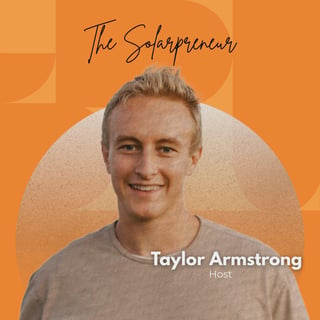
Speaker: My name is Taylor Armstrong.
Speaker: I went from $50 in my bank account and struggling for groceries to closing 150 deals in a year and cracking the code on why sales reps fail.
Speaker: I teach you how to avoid the mistakes I made and bring in the top solar dogs of the industry to let you in on the secrets of generating more leads, falling up like a pro, and closing more deals.
Speaker: What is a solopreneur you might ask?
Speaker: A solopreneur is a new breed of solopro that is willing to do whatever it takes to achieve mastery and you are about to become one.
Speaker: All right, what is going on?
Speaker: We are back with a podcast and I am super honored to have this guy on.
Speaker: He's been someone I've been following for a little bit.
Speaker: You might know him as a Super Bowl champion, but if you're a door-to-door nerd like a lot of us listening to the podcast, then I know him as someone that not only was in Super Bowl, but went and knocked doors after.
Speaker: So I'm super honored, super excited to have the one, the only, Satema Noli.
Speaker: Thanks for coming on the show with us, Satema.
Speaker: Taylor, it is an honor.
Speaker: I am so excited to be here with you because anytime we talk about door-to-door, man, my heart swells with gratitude and joy.
Speaker: And I'm just, I'm excited to share some nuggets today.
Speaker: And if there's something that can help the guys out there, the guys and the gals, man, what a blessing.
Speaker: Yeah.
Speaker: Well, thank you so much for being willing to come on.
Speaker: I know you're a busy guy.
Speaker: You run your own events, your own coaching programs.
Speaker: And so, yeah, we're just excited to have you on and jam for a little bit.
Speaker: So, yeah, I think a lot of our community, September, we sell solar panels.
Speaker: I knew you were doing alarms back in the day, but not everyone knows your story that you went from being Super Bowl champ to selling doors.
Speaker: So those that maybe haven't heard your story as much, they're probably thinking, what's a Super Bowl champ doing knocking on doors after he's playing in the NFL?
Speaker: Yeah.
Speaker: So do you want to just give us a part of your story and tell our listeners how you got into the door-to-door space and where you're at now, how that all went down?
Speaker: Got it.
Speaker: So 20 years ago, I was in the mortgage industry.
Speaker: I'd come home from New England, spent a couple of years up there, and my buddy was doing mortgages.
Speaker: So back then, man, you can make a killing.
Speaker: So I'm doing mortgages in the end of 2003, 2004, 2005, 2006.
Speaker: Four-year run, make awesome, awesome, life-changing money.
Speaker: I'm sitting down in Provo, Utah with my oldest at the time.
Speaker: It was a baby.
Speaker: He's on my chest.
Speaker: I'm in a 6,000 square foot home.
Speaker: I got about half a million dollars worth of vehicles in my garage.
Speaker: And I'm like, you know, this ain't it.
Speaker: Like, it was like, my soul was empty.
Speaker: Like, I felt like I was called to do more.
Speaker: What I felt called to do was go coach and speak and train and mentor, which is what I do today.
Speaker: I obviously wasn't ready back then.
Speaker: So I start to move that way.
Speaker: But the 2007, 2008, right, there was a huge recession, a huge crash.
Speaker: A lot of people in the mortgage industry, in real estate, we lost everything.
Speaker: And I lost everything.
Speaker: everything.
Speaker: When I say everything, my homes, I had a lot of real estate around the country.
Speaker: I had real estate, I had my cars, I had my offices, I had my employees, I had everything and millions and millions and millions and millions of dollars gone.
Speaker: By 2009, we are living in a 900 square foot townhome.
Speaker: I've got two kids at the time, like little babies,
Speaker: And we're miserable and I am miserable.
Speaker: I think my wife was good, but I'm so miserable.
Speaker: I'm like, this is not like, this is not it.
Speaker: I'm supposed to be successful and making a difference.
Speaker: I had made multiple seven figures.
Speaker: I had a Superbowl ring, I had a college degree, was all captain, all conference at BYU.
Speaker: And then now I'm losing.
Speaker: And so we can't even put food on the table.
Speaker: Can't even pay our bills because like nothing's working.
Speaker: So I take my Super Bowl ring, the one I won with the Patriots.
Speaker: I find someone who will buy it from me.
Speaker: I fly to New York City.
Speaker: I sell him the ring.
Speaker: I'm sobbing like a baby, man.
Speaker: I'm like, dude, how did I get here?
Speaker: This is, oh my gosh, I'm just so embarrassed.
Speaker: I'm humiliated.
Speaker: I'm in my early 30s and sell him the ring.
Speaker: I come home with cash and I'm still trying to work on business.
Speaker: Nothing's working.
Speaker: By 2010, we are so underneath.
Speaker: Nothing's working.
Speaker: I filed a bankruptcy.
Speaker: I was like, I'm going to pay all these creditors back.
Speaker: Man, I wasn't paying back $10 plus $9.
Speaker: So I filed a bankruptcy.
Speaker: And by 2011, I am now almost, I'm like 35 years old.
Speaker: I've got two kids and I am miserable.
Speaker: I don't know what the heck I'm doing.
Speaker: I'm barely making it.
Speaker: And I get recruited by a younger guy than me to go knock doors.
Speaker: And he had recruited me three years in a row.
Speaker: This is the third year.
Speaker: Takes me to Happy Sumo.
Speaker: Takes me to dinner.
Speaker: I go to his house.
Speaker: And this one, you know, he asked me the question, he said, what do you have to make in one summer for this to be worth it?
Speaker: Like, how do I get you to come out?
Speaker: Because I was just kind of like, man, I'm too old for this, man.
Speaker: I'm beyond that.
Speaker: It's too prideful.
Speaker: I was arrogant, prideful.
Speaker: And I said, man, if I could make, he's like 18 to 20 weeks.
Speaker: I'm like, if I could make 100 grand, like take home 100 grand in 18 weeks, I would do it.
Speaker: And he's like, done.
Speaker: I'm like, what?
Speaker: He's like, you can make that.
Speaker: You can probably make five times that in a few years down the road.
Speaker: So I decided to go do this.
Speaker: And I'm scared.
Speaker: But brother, I had no money.
Speaker: My confidence was at an all-time low.
Speaker: We were struggling as a family, just like nothing's working.
Speaker: And he looked at me and he was like, if you follow the system, if you put in the work like you did football, if you go compete, you can make as much money as you want to make.
Speaker: But this will be the hardest thing you ever do.
Speaker: And it'll be one of the greatest things you ever do.
Speaker: I never forgot that.
Speaker: So I jump on a plane, have no money, fly to South Carolina.
Speaker: And the rest is history, man.
Speaker: I mean, I worked like a dog.
Speaker: I drank Red Bulls, Monsters every day.
Speaker: I worked.
Speaker: I woke up early and studied.
Speaker: I went to bed studying, role playing.
Speaker: I didn't do Sundays.
Speaker: I'd go to church and study.
Speaker: I'd wake up every day and study and practice and rehearse.
Speaker: And it was one of the greatest summers of my life.
Speaker: That's awesome.
Speaker: That's cool.
Speaker: Well, yeah, now you're speaking our language, but I got to ask that this guy, because I'm thinking about the guy who first tried to recruit you.
Speaker: I don't know if you had known him for a while or whatnot, but for me, I would see Super Bowl champ, successful in the Morgan Street, 35 years old.
Speaker: I would think, okay, that's not my guy.
Speaker: He's way too established to come and knock doors with us.
Speaker: So I got to ask, was this guy, had you known him for a little bit?
Speaker: Did he know your situation?
Speaker: I've known him.
Speaker: I knew him for a few years, for like five years, and he lost everything too.
Speaker: And the thing is, he said, like everyone, he goes, you're on my hit list.
Speaker: He goes, I had a hit list of 10 guys.
Speaker: I knew if I could get these 10 guys, if I could recruit these 10 dudes, they would dominate.
Speaker: They would kill it.
Speaker: I was on that list.
Speaker: I was at the top of that list.
Speaker: And he recruited me in 2009 and then 2010.
Speaker: And by 2011, I was just ready.
Speaker: I was like 35.
Speaker: I'm established.
Speaker: I'm married with kids.
Speaker: Everyone else was these young.
Speaker: I'd run a multiple seven-figure business.
Speaker: I had had the cars.
Speaker: I had had the black cars.
Speaker: I'd had everything.
Speaker: And so when he came to recruit me, he was like, I just, and he was, he played it cool.
Speaker: He was like, if I can get you for one year, I think I'd get you for five.
Speaker: He was right.
Speaker: Because once I knocked that first summer, I'm like, me and my wife looked at each other and we said, hey, let's go do four more years, four more.
Speaker: And let's go get to a million dollars take home.
Speaker: Let's build our accounts.
Speaker: Like I had this path to regional manager.
Speaker: I was like, I'm doing five years and then I will, will reset.
Speaker: And I'm telling you, man, if you're a door-to-door guy, it is one of the greatest, greatest... I mean, I'm not exaggerating, Taylor.
Speaker: I loved my time on the doors.
Speaker: It was so freaking hard.
Speaker: It sharpened me.
Speaker: It refined me.
Speaker: It forged me.
Speaker: You know, like those old Viking swords where they're in the heat, pounding it, in the heat, pounding it.
Speaker: I mean, I'm in my mid to late 30s, and I'm out working these young dudes.
Speaker: I mean...
Speaker: I was a car driver, obviously, second, third year.
Speaker: And it's like 1030, and they're like, where are you?
Speaker: He's like, fool, I'm knocked.
Speaker: Get a ride home.
Speaker: I'm going to go get these glasses.
Speaker: I would knock doors at 10 o'clock, 1030.
Speaker: I'd see a home at 11.
Speaker: I'm like, dude, they just got home.
Speaker: Sweet shit.
Speaker: Boom, boom, boom.
Speaker: I get in there.
Speaker: That sucker would get installed.
Speaker: I mean, I'm sure they changed it now, but my deals would get installed, like finishing at like three in the morning.
Speaker: Like I was a dog, man.
Speaker: I just, I wanted it so bad.
Speaker: And you're going to have like these big goals.
Speaker: You got to have this thing that it's like, I will go pay that price.
Speaker: I will go recruit.
Speaker: I will go sell.
Speaker: I will go knock.
Speaker: I will practice.
Speaker: I will cut this learning curve by like 10x.
Speaker: I will cut into it so fast.
Speaker: We were rewarded financially, but we were also rewarded spiritually and emotionally.
Speaker: I loved my time on the door, Sato.
Speaker: I just, I love, changed my life.
Speaker: Yeah, no, that's so cool.
Speaker: And they had so many things in there.
Speaker: Like, I mean, first of all, just the guy who brought you on.
Speaker: I think that's a lesson right there.
Speaker: It's just like so many times I see guys who I think, oh, they wouldn't, you know, they're Super Bowl champ, different industry.
Speaker: They're not going to be a good fit for what we're doing.
Speaker: But
Speaker: In door-to-door, you just never know.
Speaker: We've had people come on in 60, 70 years old that have had success at this job.
Speaker: And so I think for those listening, you never know who can have success.
Speaker: And you just got to go out or you got to shoot your shot.
Speaker: And yeah, maybe you're not going to recruit guys like Satemo.
Speaker: He might not be selling slower with us now, but hey, you got to shoot your shot.
Speaker: You never know what's going to happen.
Speaker: But then number two, just the level of discipline.
Speaker: I don't know how much you know about solar door-to-door system, but it's definitely not quite... You don't see as many guys hustling compared to the alarm days.
Speaker: Just because in our industry, guys can go out and knock two, three hours, book a couple appointments, call up for the day.
Speaker: They can go make five, six, seven grand off one of these deals and be good to go for a month.
Speaker: But really, the people who have the greatest success in solar, they take that same mindset, they make it an obsession and go hustle.
Speaker: So for you, what would you say?
Speaker: Because there's sometimes a lot of laziness in this industry now, probably not way more than you would have seen in alarms.
Speaker: But do you think it was just taking that same discipline you had from football?
Speaker: Or what would you say to guys who maybe don't have that same level of drive?
Speaker: And they're like, oh, I don't know if I could
Speaker: take it to the level.
Speaker: So Tim, how do you get guys to go and have that dog mindset and just get out there and hustle and train, trying to work like you were working?
Speaker: Great question.
Speaker: So a couple of things.
Speaker: Number one, one of my mentors said, he was very wealthy guy.
Speaker: We're talking billionaire.
Speaker: And he says to the guy who recruited me, who then told me, he said, the Piper is going to be paid.
Speaker: You can pay him now.
Speaker: You can pay him later.
Speaker: Either way, Piper is going to get paid.
Speaker: Like there is no avoiding paying the Piper, a.k.a.
Speaker: paying the price.
Speaker: So to the guys right now who like go get a few deals, make some money and take their foot off the gas.
Speaker: My thing is like, what the hell are you waiting for?
Speaker: Let's say you're in your 20s.
Speaker: You have this opportunity to just separate from the pack.
Speaker: And in your 20s and even in your 30s, like your trajectory is either like this flat or if you're working like a dog, like you're like, could I be lazy?
Speaker: Sure.
Speaker: But being lazy means this trajectory, which eventually goes down.
Speaker: My trajectory has always been like this.
Speaker: I'm like, I have big, hairy, audacious goals.
Speaker: Like, I never wanted to be the average dude.
Speaker: I never wanted to be that, like, second place, third place.
Speaker: So I point my trajectory this way.
Speaker: And you got to just know, if you don't set big, hairy, audacious goals, then the goals that you set are average and your trajectory always ends like this.
Speaker: And the piper is going to get paid.
Speaker: So you can either pay that price in your 20s and 30s.
Speaker: And I mean, work like a dog.
Speaker: And I know there's guys who are like, oh, my wife, my kids, like if you got little kids, like babies, like I did, all they need is they need you for like an hour at night.
Speaker: Like you want to be wealthy when, like I got a 17 year old, a 14 year old, 11 year old.
Speaker: My boys are teenagers.
Speaker: I spend a lot of time with them because I got the resources, I got a team.
Speaker: I can spend time with my sons.
Speaker: I train them, I work out with them.
Speaker: Like we pray every night.
Speaker: I see them in the morning before they go to school.
Speaker: Like it's so good.
Speaker: But if I don't pay the price early, like if I was knocking solar now, I would tell my guys, like, here's how we roll, okay?
Speaker: We're going to be the best.
Speaker: You want to be average?
Speaker: This ain't the team to be a part of.
Speaker: We're going to be the best, which means we're going to be the sharpest, the hardest working, the most focused, focused, smart working guys because our goals are up there, which means our trajectory has to go like this.
Speaker: And if you don't want to be the best, like, go to another team.
Speaker: And it's okay.
Speaker: But my guys that I worked with, we just worked like dogs, man.
Speaker: I'm like cars, homes, retirement, legacy.
Speaker: And again, guys are younger.
Speaker: So they just, all they can see is like, oh, I made five to seven.
Speaker: I'm like $7,000.
Speaker: That's nothing.
Speaker: You think $100,000 is a lot of money?
Speaker: That is nothing.
Speaker: And I can say that straight face.
Speaker: Like, if you think, I tell my sons all the time, if you think $100,000 is a lot of money, go get a job.
Speaker: Entrepreneurs who know $100,000 is nothing.
Speaker: $200,000 is nothing.
Speaker: Even I tell my boys a million, I mean, it's pretty good.
Speaker: It doesn't carry like it used to.
Speaker: So I'm training my sons already, like,
Speaker: Dude, you got to be so hungry.
Speaker: Like, you got to have this mama mentality.
Speaker: I love it.
Speaker: We call it the dog mentality.
Speaker: You got to have a dog mentality.
Speaker: Like, I want that for my family, for my wife, for my kids, for my parents, for my community, my duty to God.
Speaker: Like, there's so many reasons why I would go choose greatness versus...
Speaker: Just settling for, you know, like $5,000 or $7,000.
Speaker: Come on, man.
Speaker: And I know some young guys that got a lot of money.
Speaker: It's not when you have a wife and when you have kids and when you have multiple mortgages and multiple car payments and you get older.
Speaker: Like if you're going, like there's a phrase that's like, make hay while the sun is shining.
Speaker: Right?
Speaker: Make the hate.
Speaker: Like, that means work your ass off when you got the energy and the skills and momentum.
Speaker: Yeah.
Speaker: No, I love that.
Speaker: Love that.
Speaker: So true.
Speaker: Reminds me, like, when I was growing up.
Speaker: I don't know if your parents did this to Timma, but they're like, hey, Taylor, you neither...
Speaker: You can either do your chores now.
Speaker: Then we're going to go do something fun on Saturday night.
Speaker: But guess what?
Speaker: If you don't got your chores done Saturday night, you're staying home.
Speaker: You're not going to the movies with us.
Speaker: You're not going out.
Speaker: And I think it's the same thing in life.
Speaker: Exactly what you're saying.
Speaker: So many times we're like, oh, you know what?
Speaker: We're going to spend time with the kids.
Speaker: And I like how you put it, too.
Speaker: It's like when your kids are young, they only need an hour.
Speaker: And I'm going to have to play that back for my wife when I get home tonight.
Speaker: Not that we shouldn't spend time with family.
Speaker: But it's like I would much rather have time to, you know, do workouts, play sports with kids when they're a little bit older.
Speaker: When they're younger, just go back.
Speaker: I got a four-year-old and a two-year-old.
Speaker: So I'll go hang out with them at night.
Speaker: But like how much more satisfying is it to have that time to be able to spend with them, do the sports with them, and be involved when they are way busier later in life too.
Speaker: So I love what you're saying with that.
Speaker: But yeah, obviously, you've carried the same level of drive, that dog mentality like you're talking about into all these other areas.
Speaker: You're running events now.
Speaker: You got your own company.
Speaker: But I got to ask, when you were going through this bankruptcy, I'm sure you were going through some doubts and wondering if you could keep providing for your family and all that.
Speaker: So what were your thoughts, feelings when you were going through those hard times?
Speaker: Did you doubt yourself ever?
Speaker: Were you like, man, this dog mentality, it's not paying off anymore.
Speaker: It's not working.
Speaker: or what were those feelings at that time?
Speaker: Of course I doubted myself.
Speaker: Of course I had doubt.
Speaker: I was discouraged, depressed, because I went through about four years where, I mean, I was probably making 30 or 40 grand a year, barely, barely that.
Speaker: Like just, we were on EBT, which is food stamps, government assistance for a year.
Speaker: Like we just, I went through this phase of like, man, nothing was working.
Speaker: And you get beat up long enough, you start to believe.
Speaker: Well, I guess that maybe my best days are behind me.
Speaker: You start to believe maybe God wants me to be poor.
Speaker: And you start to believe that, golly, maybe I should stop trying so hard.
Speaker: And I never gave up, but there were some dark moments, Taylor.
Speaker: I'm like, gosh, dang, man.
Speaker: And here's something that's awesome.
Speaker: I'm 48 right now.
Speaker: I still have those doubts.
Speaker: The difference is I have learned that I know how to get out of those.
Speaker: And I know that no matter what level of success, no matter how physically strong, how spiritually connected, how full my bank accounts are, it don't matter if you got a million or two million, it does not matter.
Speaker: There will always be some form of doubts and fears and discouragement at every level.
Speaker: The difference with those who succeed and those who don't is those who succeed, they just know this is temporary.
Speaker: And it's up to me.
Speaker: I get to choose what I do right in this moment if I stay put or if I move forward.
Speaker: And thankfully, I kept working, I kept hustling, I kept fighting and grinding.
Speaker: And then again, the doors just happened to be an amazing tool, amazing vehicle.
Speaker: I was ready for it.
Speaker: I put my hands on the vehicle.
Speaker: I started it and I never stopped it.
Speaker: I'm telling you, I worked so hard, man.
Speaker: I worked hard and I worked smart and I practiced and I rehearsed and I'd get up at six in the morning and I would study for four hours every day.
Speaker: Like no exaggeration.
Speaker: Like I can fail today.
Speaker: I'm so like,
Speaker: You know, whenever I hear these objections, oh, we got guns and dogs.
Speaker: Of course you have guns and dogs.
Speaker: People who have guns and dogs, they get these things.
Speaker: And the reason why is that they know that the guns and dogs can't call the cops.
Speaker: So let me just show you how this works real quick.
Speaker: You want me to take my shoes on or off?
Speaker: Let me step in.
Speaker: I mean, I can overcome the objections because I've practiced so much.
Speaker: We just can't afford it.
Speaker: So what you're saying is if you could afford it, you'd have it.
Speaker: Is that right?
Speaker: Well, yeah, perfect.
Speaker: That's actually why I'm here.
Speaker: Let me show you how this works real quick.
Speaker: Oh, my husband's not home.
Speaker: Of course he's not home.
Speaker: He's working.
Speaker: And the husbands that work and travel, they love these things.
Speaker: I practiced and trained over and over and over for every objection, for every smoke screen, like every excuse.
Speaker: And I just, I worked hard, man.
Speaker: And I practiced and I cut the learning curve.
Speaker: So like in, I think it was like 21 weeks because I did an extension.
Speaker: I carved out probably...
Speaker: God, Lee, probably 30 hours a week.
Speaker: I would role play at night on the drives home, brother.
Speaker: I was role playing.
Speaker: I'm like, how do you overcome this objection?
Speaker: How do you do that?
Speaker: How do you say that?
Speaker: I was like, people were like, dude, we're just, we don't want, we want to turn it off.
Speaker: And I'm like, I don't got time.
Speaker: I don't like we only not for 20 to 21 weeks.
Speaker: So I collapsed so much time, you know?
Speaker: And again, you take 30 hours times 20 weeks.
Speaker: There's like 600 hours.
Speaker: I was now ahead of everybody else and it worked.
Speaker: Yeah.
Speaker: Worked.
Speaker: Yeah.
Speaker: No, that's so good.
Speaker: And yeah, I mean, really that's, again, that's what it's going to take.
Speaker: I think that's what separates the, uh,
Speaker: contenders from the pretenders.
Speaker: There's so many people come to this industry.
Speaker: I'm sure you saw it too in alarms, but especially in solar, my industry, so many people think they can come in, knock a few hours a day, maybe go to training correlation.
Speaker: But we always tell our guys, hey, if coming to the sales correlation is the only training you're doing a week, you're going to fail at this job.
Speaker: You need to be hungry.
Speaker: You need to be going home, role playing, carving out time, practicing, drilling, rehearsing.
Speaker: But yeah, I got respect for you guys to tell me because funny enough, our company, they started doing an alarm system bundle where they will actually put an alarm system with their solar, kind of package it in as a deal.
Speaker: And it's like optional.
Speaker: They don't have to do it, but they'll pay for the monitoring for the customer for the first year.
Speaker: And I'm telling customers about this as I'm selling them solar.
Speaker: They're signing up for solar, signing the documents.
Speaker: I'm saying, hey, we do an alarm system too.
Speaker: They'll put it in for free.
Speaker: And all these people are like, oh, you know what?
Speaker: It's fine.
Speaker: I'm like, it's free.
Speaker: You don't have to pay anything.
Speaker: Like, no, it's fine.
Speaker: So I'm like, man, how do these guys sell these alarm systems?
Speaker: I can't even give it away for free as a package with my solar deal.
Speaker: But yeah.
Speaker: You know, it's just like anything you got to learn the objections people are going through because if not, you're not going to be able to give it away as I'm coming to figure out just because I don't know, you know, the benefits.
Speaker: I don't know that the alarm systems, but you can tell you got it down because it's been what, 15 years since you sold an alarm.
Speaker: When was it that you were selling?
Speaker: 15 years, man.
Speaker: I mean, if I knocked on the door and your wife answered and she's like, oh, we're good.
Speaker: My husband does this.
Speaker: Dude,
Speaker: Husbands love me because they love when I take care of their wives.
Speaker: They have some smartphones.
Speaker: We should have this work.
Speaker: So imagine your husband able to look into your home right now and just be able to monitor.
Speaker: You guys are okay.
Speaker: So like, he'll be grateful.
Speaker: Let me just kick my shoes off.
Speaker: I'll be real quick.
Speaker: If you don't want it, I'll leave.
Speaker: Let me step in.
Speaker: I mean, I can just like, I know this thing and I love it.
Speaker: And so, yeah, man, I'm, I'm very grateful for my time on the doors, man.
Speaker: Did you ever use, did people ever recognize you as like a NFL player?
Speaker: Did that ever come up where it's like, oh, Satema, I saw you playing.
Speaker: Come in, come in.
Speaker: They would always be like, man, you look like the rock.
Speaker: And this was 12, 13 years ago.
Speaker: Now I go anywhere and everyone's like, dude, you look like The Rock.
Speaker: I look way more, he's more famous, he's more popular.
Speaker: But there were doors in Texas, I'd knock on the door.
Speaker: And I was one of those guys that hugged the door.
Speaker: So I was like right up on it.
Speaker: So when they opened it, they would see me.
Speaker: Some guy stand back.
Speaker: Guys would come to the door and they'd have a gun in their hand.
Speaker: I'm like, you don't shoot, man.
Speaker: I'm just here to get some milk and cookies, man.
Speaker: And I'd crack a joke and you know what?
Speaker: I'd go close them.
Speaker: But a lot of miracles on the doors.
Speaker: Like I just, for anyone who's knocking solar, I would tell them like, you have an opportunity of a lifetime to number one, make crazy money.
Speaker: Number two, develop awesome skills that can transfer beyond the solar.
Speaker: And I mean skills like a lot of what I do today came from the door.
Speaker: I go to close, recruit, sell, retain, train like these negotiate.
Speaker: I'm working with, you know, $50 million companies, $100 million companies, you know, $1 million companies.
Speaker: And so much of what I learned.
Speaker: from the doors and it can transfer.
Speaker: So whoever's knocking solar, like don't waste your time.
Speaker: You'll be, you'll be sorry.
Speaker: And you'll have regret.
Speaker: If you look back and say, man, I could have made an extra half a million.
Speaker: I could have done more for myself.
Speaker: I could have sharpened my skills so much.
Speaker: Yeah.
Speaker: A hundred percent.
Speaker: I love that.
Speaker: Love that.
Speaker: And then I want to shift gears a little bit.
Speaker: So I know you grew some teams.
Speaker: You were in it five years.
Speaker: So what advice would you give people who want to start building their team more?
Speaker: Because that's another thing in solar.
Speaker: There's a lot of people that just want to go out and
Speaker: knock their doors, make some money, call it good.
Speaker: So I assume you got into like management, started running teams.
Speaker: Obviously now you're running your company, right?
Speaker: I had great teams.
Speaker: So my first summer that I knocked, I recruited like 12 dudes over from another company, like in June.
Speaker: And they came over.
Speaker: Like, here's the thing.
Speaker: If you want to make money, knock solo.
Speaker: If you want to build greater wealth, go build a team.
Speaker: Because number one, when you got, let's say 50 guys, and you've built a culture, and you've built a system, you're gonna train these guys and or guys, you're gonna train them, you're gonna get a piece of what they do.
Speaker: But not only the financial aspect is great, but you're connecting and creating value for people.
Speaker: But you're serving other people, you're training, so you gotta be good yourself.
Speaker: Man, I had two of my best guys are still, they're like big managers.
Speaker: You know, they're making great money.
Speaker: And they were the guys I recruited.
Speaker: I had one of the guys I recruited was crazy.
Speaker: I was living in Florida.
Speaker: He's a dentist down there.
Speaker: He moved into our area and he was like, the doors changed my life.
Speaker: Like it, it made me better.
Speaker: So again, for the guys who are, look, if you just want to go make some money, go knock.
Speaker: But if you want to make life changing money,
Speaker: and you want to develop skill sets that will serve you beyond the doors, go learn how to recruit, sit with eight to 10 people a week.
Speaker: You're going to pitch a lot of people and a lot of people are not going to sign up and you're going to make a list of people.
Speaker: And you only get really good at recruiting by recruiting.
Speaker: You only get good at basketball by playing basketball.
Speaker: You only get strong by lifting weights.
Speaker: So you got to go recruit.
Speaker: Even like someone like me, like people would see guys and,
Speaker: I'm never mad if someone approaches me about an opportunity.
Speaker: Now I'm like, I'm good.
Speaker: There's no amount of money that I'm going to stop doing what I'm doing.
Speaker: But back then, guys would recruit me.
Speaker: And if you want to recruit, you got to go meet with people.
Speaker: You got to learn how to recruit.
Speaker: You got to learn how to talk.
Speaker: You got to learn how to find out what they want.
Speaker: One of the greatest skills you can develop is recruiting and training and retaining your guys.
Speaker: Yeah.
Speaker: That's so important.
Speaker: And I don't know about you, but what I see a lot of times is guys will be like, oh, I suck at recruiting.
Speaker: I'm terrible at recruiting.
Speaker: And they went and talked to one person at Starbucks that said no.
Speaker: So I'm like, man, why don't you treat recruiting like you were knocking a door?
Speaker: Like you don't get a yes the first time you went and knocked on a door.
Speaker: So why do you expect with recruiting?
Speaker: You went and pitched one guy and he said no.
Speaker: And then all of a sudden you suck at recruiting and you're never going to do it again.
Speaker: It's like, I think it's the same thing.
Speaker: You got to develop the skill.
Speaker: You got to track the numbers.
Speaker: You got to go through the trainings, do that.
Speaker: So for you, like what do you think helped you develop that skill?
Speaker: Is there like...
Speaker: like off season, you guys do training, just practice it over and over.
Speaker: Is that something that when you were in the industry, were you like doing role plays for recruiting too?
Speaker: Or is there any, uh, tips?
Speaker: All you got to go and do is watch someone who's good at recruiting recruit two or three times and you're doing what a salesman does.
Speaker: I'm going to find out, like if I was recruiting you, Taylor, I'd find out your current reality.
Speaker: I just like, Hey, what do you love to do?
Speaker: Like, tell me, like, what are you doing currently doing right now for work, for school?
Speaker: Okay.
Speaker: What's your three to five year plan?
Speaker: All right, cool.
Speaker: Why does that matter to you?
Speaker: Okay.
Speaker: What are you committed to getting?
Speaker: Awesome.
Speaker: But what's your, like, what are you doing this, um,
Speaker: What are you doing this summer for work?
Speaker: How much is that gonna make you?
Speaker: Awesome.
Speaker: And I just ask him every question.
Speaker: I'm trying to find out who Taylor is, where Taylor is, and what drives Taylor.
Speaker: Once I find out what you want and what you really want and why that matters, I can provide the vehicle to get you there.
Speaker: And again, you gotta go, I met with hundreds of guys.
Speaker: I'd throw pizza parties, bowling parties.
Speaker: I'd take up big hitters to like dinner at Rodizio's.
Speaker: I mean, it took money and I'd recruit with guys.
Speaker: I'd have guys come and do a quick preseason trip with me.
Speaker: I mean, to certain guys, I'd like slide over the 1099.
Speaker: I'm like, here's what I did last year.
Speaker: And they're like, like, yeah, you got to be good.
Speaker: And I wasn't, I never oversold it.
Speaker: I never was like, this is the greatest thing.
Speaker: I'm like, this is hard.
Speaker: But if you want, like, again, my guy who was a dentist, he's like, I want to graduate from dental school with no debt.
Speaker: Well, how much debt do you think, how much money are you going to think you need?
Speaker: Probably 150, 200 grand.
Speaker: Give me two to three years, I'll have that for you.
Speaker: He's like, really?
Speaker: I'm like, yeah, let me show you how.
Speaker: So recruiting guys to knock solar is merely a game of providing a solution to help them solve their biggest problems on their financial path.
Speaker: And then, of course, the personal development, the growth, all the things that you got to know how to speak to them about.
Speaker: And you just, you watch someone recruit and you're like, dude, I can do that.
Speaker: And then you got to have the courage or the balls to go meet with people and get rejected.
Speaker: And again, you're not being like a network marketer.
Speaker: Like, hey, this is the best thing ever.
Speaker: Cool.
Speaker: It was calm.
Speaker: It was relaxed.
Speaker: And multiple times I've recruited, I'd meet with a guy two, three, four times.
Speaker: I'd meet with a guy once, then meet with him again next year, then meet with him again next year.
Speaker: Like, I'd keep trying.
Speaker: So...
Speaker: Yeah, that's good.
Speaker: Well, yeah, like I've seen you, I know you're pretty plugged in with like, you know, the ClickFunnels community, you do all my marketing, you're running your own business.
Speaker: So a question I always have for marketing guys I talk with is now knowing what you know now, having done door to door,
Speaker: Would you change anything about how you recruited, how you dealt with your leads, with alarms?
Speaker: I don't know, maybe plug them into your funnels or anything?
Speaker: Or what do you think?
Speaker: If you're starting door to door now, would you do anything different knowing what you know about business and marketing?
Speaker: It just depends.
Speaker: If I was doing alarms, I wouldn't change a thing.
Speaker: I'd go pick guys face-to-face.
Speaker: I'd go have him get his guys face-to-face.
Speaker: I'd go knock doors.
Speaker: I would not change a thing.
Speaker: Even if I was doing silver,
Speaker: I'm like, I'm not going to break a system that works.
Speaker: Like, solar, or in my opinion, it's like, this is face-to-face.
Speaker: This is, like, grass-level.
Speaker: Okay, that's good to hear.
Speaker: Yeah, because sometimes I think it becomes a distraction, too.
Speaker: Like, now we have all these, you know, AI chatbots, automatic follow-up.
Speaker: I talk to guys, like, oh, I went and knocked five doors, and then I spent five hours following up.
Speaker: And they didn't book a single appointment.
Speaker: They didn't get a single lead.
Speaker: I'm like, dude, yeah, we know it's cool to have to follow up.
Speaker: It's cool to have a quick funnel, all this stuff.
Speaker: But how about you get out there and get on the doors and go with the grind and, you know, not just look for all the ways to follow up endlessly and call people.
Speaker: What's reply?
Speaker: That's the name, man.
Speaker: Do what you got to do.
Speaker: And whatever is required, I would, you know, based on what we do with funnels, it works.
Speaker: But solar and door-to-door, I'm going to go build a team, grassroots, face-to-face, belly-to-belly, knee-to-knee, and then teach them how to do the same thing because there's plenty of, like, and again, I'd go to the colleges, and then I'm looking for my hitters, my hit list, right, my top 10.
Speaker: If I could get these guys, I know he'd go get 10 to 20 guys, and I'd go build my teams and build my regions.
Speaker: Yeah.
Speaker: So good.
Speaker: Well, it's, uh, yeah, it's awesome to hear about your experiences in door to door, Satema.
Speaker: And, um, I know now you're doing, like you said, a lot of things that's, um,
Speaker: you experienced in door-to-door are helping you now in your current business, in your speaking and all that.
Speaker: So tell just briefly, like, how did you end up transitioning out of it and what made you find and decide, okay, now it's time to hang up the clipboard and all that, stop going door-to-door.
Speaker: What called you to get more into speaking and coaching and everything that you're doing now?
Speaker: So I had just finished my third summer.
Speaker: We finished knocking in Iowa, Des Moines, Cedar Rapids.
Speaker: all of Iowa we had.
Speaker: And I come home and of course it's like October, I take my guys out to a Bakersfield.
Speaker: So we're docking Bakersfield, California.
Speaker: There's solar guys out there, we're the alarm guys.
Speaker: And I've got a group of probably 20 people out there that I'm on a pre-season trip.
Speaker: And man, I just, the most simple way to put it, it's like God said, you're done, it's time to move.
Speaker: I didn't want to move.
Speaker: I wanted to do another year because this next year I would have made a lot.
Speaker: I had teams, I had residual.
Speaker: And as a door-to-door guy, you never sit in your car, right?
Speaker: You stop and you get out.
Speaker: I'd never sat in my car before.
Speaker: And I couldn't get out of my car.
Speaker: And God was telling me, you are done.
Speaker: It is time.
Speaker: So I called up a buddy who was a coach.
Speaker: And I said, I'm going to start my coaching business.
Speaker: And within three months, I paid out 80 grand to three different coaches.
Speaker: Wow.
Speaker: And I hired coaches to help me learn how to be a coach.
Speaker: And never looked back since, man.
Speaker: That's cool.
Speaker: well, you just go all in.
Speaker: Was that another thing where you, where you never, like, haven't gone through all that, where you're like, okay, I know I'm going to go full force, have success in anything, or, like, were you at- Well, it's crazy, because I paid, it was like 50 grand, and then six grand, and then in January, there was another coach, he was like 25 grand.
Speaker: And I'm like, dude, I went to my wife, I'm like, I need to hire this other coach.
Speaker: She's like, okay, but you, like, this is it.
Speaker: From that time in 2013 to now, I'm probably a good $600,000 to $700,000 that I paid out to coaches, masterminds.
Speaker: I mean, it comes back.
Speaker: A great investment comes back, but the investment in the world of coaching is up to me.
Speaker: So if I do the work and I hire a coach and I execute and I listen and I'm teachable and open and coachable, I'll do that.
Speaker: I mean, that's why we moved to Southern California.
Speaker: We moved to Florida.
Speaker: We're here in Vegas.
Speaker: I love where we live.
Speaker: I love my company.
Speaker: I love my employees.
Speaker: I love my clients.
Speaker: I love the work that I do.
Speaker: It's a very special, sacred work.
Speaker: Yeah.
Speaker: No, I've seen you speak and it's powerful, man.
Speaker: You bring the heat on stage.
Speaker: So you speak at a funnel hacking live and just nothing but the whiteboard up there.
Speaker: Just marking things on the, you know, with the big marker out there and it's powerful.
Speaker: So definitely for those listening, if you ever get a chance to go to one of September's events, hear him speak, he's going to bring down the house for you.
Speaker: So definitely recommend it.
Speaker: But yeah, speaking of coaches, though, Satema, what is it that you feel that without hiring coaches, do you think you could have come to this same level eventually?
Speaker: Do you think you could have built your coaching business?
Speaker: Or what is it that made you decide to hire?
Speaker: There's no way.
Speaker: It is impossible for me to be here without hiring the coaches that I had.
Speaker: Even when I was at Vivint, right, that was the command knock with, my regional manager was my coach.
Speaker: I didn't pay him directly, but I paid him with production.
Speaker: And whatever he told me to do, I did.
Speaker: Even right now, I'm getting ready to do a bodybuilding show.
Speaker: There's a coach.
Speaker: It's like $1,800 every 12 weeks.
Speaker: And he's like, we probably got four cycles of that.
Speaker: So I was like, okay, cool.
Speaker: Like eight grand.
Speaker: All right, cool.
Speaker: Like eight grand plus the food.
Speaker: I mean, I'm looking at a $12,000 to $14,000 investment into my body of coaching and getting my body ready to do this.
Speaker: Like I so believe in coaching and mentoring.
Speaker: And of course I'm in an industry where I get paid to coach and mentor.
Speaker: So it would be absurd.
Speaker: It would be absurd for me.
Speaker: It'd be crazy for me to want someone to pay me, but me not to pay someone else.
Speaker: I always have a coach.
Speaker: I've paid a coach 50 grand for one month.
Speaker: We worked together.
Speaker: I paid a coach 50 grand for 10 hours.
Speaker: I paid a guy 25 grand for four hours.
Speaker: Then I've had coaches and mentors, you know, 50 grand for a year, 100 grand for a year.
Speaker: So I'm all about it, man.
Speaker: That's my industry.
Speaker: Yeah.
Speaker: No, well, it helps a ton.
Speaker: And yeah, I mean, I've told that story many times on my podcast.
Speaker: One of my breakthroughs in the solar industry was when I first hired a coach too and invested in myself because I think, you know, just the fact that you're putting money, that you're investing in yourself...
Speaker: whether that coach helped me or not, which he did.
Speaker: But even if that coach didn't help me, I think it was just me putting that investment on myself, having the conversation with my wife, hey, I'm going to put this money in where I knew, okay, whatever this guy tells me, I'm just going to go hustle, work like crazy because I just dropped 10 grand on this coach, which for me was a lot of money at the time.
Speaker: I've got to get out there and just grind.
Speaker: A lot of money no matter what.
Speaker: Yeah.
Speaker: Yeah.
Speaker: Yeah.
Speaker: But do you, for those that maybe haven't had a coach, do you have any advice on maybe how to recognize a good coach or like find the best coach for your situation?
Speaker: Cause we live in a world where social media, there's so many people who go out and post, I'm doing this course, this program.
Speaker: Maybe they just bought some online course yesterday and now they're selling their own coaching.
Speaker: So I think that sometimes can be a thing too.
Speaker: So for you, how do you identify what's going to be a good coach or what are some things that helped you find like the most effective coaches for what you're trying to do?
Speaker: I would say a phrase that Jesus said, by their fruits, you shall know them.
Speaker: So your coach is,
Speaker: Whatever coach you feel hired or feel inspired to hire, go look at their track record.
Speaker: Go look at the clients.
Speaker: Go look at what the clients have to say.
Speaker: Go look at how long they've been coaching.
Speaker: Go listen.
Speaker: Go find them on social.
Speaker: Go see if they're really who they say they are.
Speaker: Go vet them.
Speaker: Go have a conversation with them.
Speaker: Go spend time with them.
Speaker: And even maybe you buy their course and see what they got.
Speaker: And if you don't feel they can move you,
Speaker: They don't hire them.
Speaker: But, you know, there are a lot of fake coaches out there, I guess I'd say, coaches who have never done much.
Speaker: You just got to vet them.
Speaker: And only you're going to know if they're right for you.
Speaker: Yeah, it's so good.
Speaker: Yep.
Speaker: Love that.
Speaker: Yep.
Speaker: Follow Jesus's teachings.
Speaker: And I think that's a great, great thing to do.
Speaker: And yeah, that's part of why I have a coaching program too that people know about from the podcast.
Speaker: But part of the reason I'm still out there selling is because I never want to be the coach that's just saying, hey, go do this, go do that.
Speaker: But I want to be out there, you know, showing that, hey, this stuff works.
Speaker: I'm actually saying on the podcast.
Speaker: So I think it's important.
Speaker: And then last couple of things before we start wrapping up here, Satema.
Speaker: I've been following you for a while and I've always respected just how, like we were talking about earlier, you've been able to spend the time with the family.
Speaker: I think it's great the relationship you got with your kids, with your wife.
Speaker: So just as we start wrapping up here, what advice would you give for high performance salespeople?
Speaker: A lot of us are grinding like crazy, working a ton of hours.
Speaker: And I know, as we mentioned earlier, it's not always going to be this balance.
Speaker: You're not going to be able to spend 10 hours with your kids, especially in the beginning.
Speaker: But what are some things that have helped you to just be able to also improve your family situation, have a great leadership with the wife, with the kids, while building a business, while selling at a high level, all the things you do?
Speaker: What's some advice for some people to not have their families fall apart while they're grinding in business and in sales and all these different other areas of life?
Speaker: I would tell guys, first and foremost, you better have some clear agreements.
Speaker: with your wife, not expectations, agreements.
Speaker: You know, if the wife thinks you're going to be home at a certain time, but you don't communicate that and you're like, well, I got this meeting, you have to talk through, here's what it looks like for me to go work this job for the next year.
Speaker: And you talk through it.
Speaker: My wife knew when I went to knock doors in the summer, I was leaving early morning and I was getting home at 10, 11 o'clock at night.
Speaker: And they would see me on Sunday.
Speaker: Sometimes in the morning, if the boys were up, they'd be up and I'd wake up and then we'd have breakfast and then I'd leave.
Speaker: So managing, not managing expectations, but creating agreements.
Speaker: Like my wife knew in the off season, you guys got me from about 5 to 7.30.
Speaker: At 7.30 or 8, I put the kids down.
Speaker: I'm going to go recruit until 11 or 12 or 9.
Speaker: I'm going to go recruit.
Speaker: I'm going to go meet with people.
Speaker: I'm going to hustle.
Speaker: You got me on Sundays.
Speaker: And that was it.
Speaker: Like now, like my Saturdays and Sundays, I don't work.
Speaker: My family knows they got me.
Speaker: But again, it's the same principle.
Speaker: You got to have these clear cut agreements.
Speaker: Powerful people live in agreements.
Speaker: Like they know what's going to happen, when it's going to happen by, who's going to do it, how it's going to be done.
Speaker: So your wife will never get mad if she knows.
Speaker: We got our daddy and my husband.
Speaker: We get it for two hours a day.
Speaker: And we talked about the goals, we talked about it.
Speaker: And then you gotta make sure you build in the date nights, you gotta build in the vacations, you gotta build in the time to cut it off.
Speaker: Even on Sunday, early on, I would work on Sundays, I'd go to church, do my church meetings, and I'd spend two to three hours in the evening just working on things.
Speaker: As long as you have agreements on that, Taylor, you're good.
Speaker: If you don't have clear agreements, like two-way communication, two-way created promises,
Speaker: You're going to be in trouble because expectations are resentments and frustrations under construction.
Speaker: And that's what kills a lot of relationships.
Speaker: Yeah, love that.
Speaker: So important.
Speaker: Like you said, not expectations, but agreements.
Speaker: But yeah, just like everything we do in sales too, got to set the correct expectations, agreements with your customers, with your clients.
Speaker: A lot of us find that out the hard way.
Speaker: The customer had the expectation of getting their solar installed in a month.
Speaker: It takes three months.
Speaker: Now they're upset.
Speaker: Now they're frustrated.
Speaker: So yeah, I love that.
Speaker: Got to be a similar thing with the family, with the wife, with the kids.
Speaker: Well, Satem, before we wrap up here, where people want to connect with you, possibly come to some of your future events, maybe look into some of your masterminds, coaching stuff that you got going on.
Speaker: What's the best way to connect with you and find out more about what you're doing?
Speaker: Yeah, just go to my site, right?
Speaker: Satemangali, S-E-T-E-M-A-G-A-L-I.com.
Speaker: I've got a podcast called Game Changer.
Speaker: And, you know, you can find me on social, LinkedIn, Instagram, Facebook.
Speaker: But, you know, if you want something, come find me.
Speaker: You hit me in a DM, my team is going to reach out.
Speaker: And if you're serious, we'll have a real conversation.
Speaker: And I look forward to helping you.
Speaker: And if I'm not the mentor to help you, go find the right mentor and or coaches and or podcast to help you.
Speaker: But if there's something that I've said to help you, I can help you get there.
Speaker: No question about it.
Speaker: Yeah.
Speaker: Awesome.
Speaker: Love it.
Speaker: So for our listeners, go hit up Satema.
Speaker: Look into some of his events, his coaching.
Speaker: It's a game changer, just like his podcast.
Speaker: And then last question before we say goodbye here, Satema.
Speaker: You've won a Super Bowl.
Speaker: You've spoken on, I'm sure, hundreds of stages at this point.
Speaker: What's been like your proudest?
Speaker: What would you say is your most proud accomplishment up to this point after all the things you've done?
Speaker: Man, proudest accomplishment?
Speaker: Man, I'd say just my family.
Speaker: Oh, man.
Speaker: Family.
Speaker: Like, you know, Super Bowls, millions of dollars, this and that.
Speaker: But being able to go all into my family, oh, that's the best.
Speaker: And winning the Super Bowl definitely is a close second.
Speaker: Knocking that first summer of knocking doors.
Speaker: I mean, that feeling coming home was like the Super Bowl.
Speaker: We were driving through Atlanta into Tennessee, and we're like, we did it.
Speaker: Like, we did it.
Speaker: And it changed my world.
Speaker: But I'm going to say family.
Speaker: There's no doubt about it.
Speaker: Family is top choice.
Speaker: Yeah.
Speaker: Okay, good.
Speaker: Love it.
Speaker: You passed the test.
Speaker: If you said Super Bowl, I was going to send a copy of this to your wife and get you in trouble tonight.
Speaker: I'm just kidding.
Speaker: Yeah, well, September, thank you so much for being so abundant with us on the show.
Speaker: We appreciate you coming on.
Speaker: And yeah, can't wait to see what you do next.
Speaker: And guys, go give them a follow.
Speaker: Reach out, tell them thank you for coming on.
Speaker: And appreciate you again, September.
Speaker: Thanks for coming on today.
Speaker: Taylor, thank you so much, man.
Speaker: God bless.
Speaker: We'll connect soon, okay?
Speaker: I appreciate it.
Speaker: What's up, solopreneurs?
Speaker: Hope you enjoyed the episode.
Speaker: Before you run out and start selling more solar yourself, wanted to let you know about an exciting new cheat sheet we created specifically for you in mind.
Speaker: One of the top questions I get asked on Instagram, on Facebook by our listeners is, Taylor, where should I start?
Speaker: What episodes should I listen to in the podcast?
Speaker: And
Speaker: You got too many podcasts, man, because now we have over 200 episodes.
Speaker: So what we've done, we created the top 10 most downloaded, most listened to, and I would say widely accepted, most useful podcasts that we've done here on Solopreneur.
Speaker: We put them together all in one sheet.
Speaker: So you can go, you can hit the ground running, especially if you're new, you do not want to not have this sheet.
Speaker: So go download it right now.
Speaker: It's going to be at top10.solarpreneurs.com.
Speaker: Again, that's top10, the number 10,.solarpreneurs.com.
Speaker: Don't forget the S on solarpreneurs.com.
Speaker: We will have that in the show notes.
Speaker: Go download it right now.
Speaker: And especially if you have not listened to them, go listen to them and you can re-listen to them.
Speaker: That's going to show you how.
Speaker: So go download it and we'll see you on the other side.