Transcript
Speaker: Welcome to the Solarpreneur Podcast, where we teach you to take your solar business to the next level.
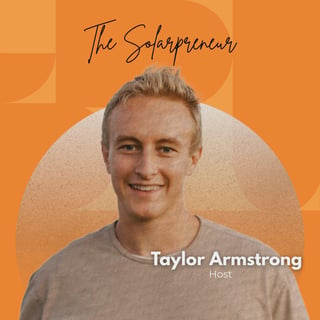
Speaker: My name is Taylor Armstrong.
Speaker: I went from $50 in my bank account and struggling for groceries to closing 150 deals in a year and cracking the code on why sales reps fell.
Speaker: I teach you how to avoid the mistakes I made and bring in the top solar dogs of the industry to let you in on the secrets of generating more leads, falling up like a pro, and closing more deals.
Speaker: What is a solopreneur, you might ask?
Speaker: A solopreneur is a new breed of solopro that is willing to do whatever it takes to achieve mastery, and you are about to become one.
Speaker: What's going on, solopreneurs?
Speaker: Taylor Armstrong back with another episode.
Speaker: Hope you're doing well.
Speaker: We are entering the fall season.
Speaker: It is getting dark earlier and earlier, but if you listen to this podcast, you don't care about any of that because you're going to keep closing deals no matter what.
Speaker: That's what this podcast is all about.
Speaker: And if you're here for the first time, as always, we are here to help you close more deals, generate more leads and referrals, and hopefully have a much better time in the solar industry.
Speaker: But today we're going to be talking about a crucial step in the presentation that if you don't get right, it's going to kill your closing percentages.
Speaker: So what is this step?
Speaker: You'll find out here in a second.
Speaker: But before that, a couple quick announcements.
Speaker: We have a new sponsor on the show, and I'm really excited to announce our first sponsor.
Speaker: You're going to hear about it on the next episode.
Speaker: So don't forget, make sure you're tuning in every week, Tuesday and Friday.
Speaker: And hopefully this is the first listen of your week.
Speaker: Well, I guess maybe not of your week because we come out on Tuesday.
Speaker: But hopefully when they drop on Tuesday and Friday, hopefully it's the first podcast you go to.
Speaker: As always, if you have suggestions of topics or people you want on the show, we welcome that with open arms.
Speaker: Always looking to feature more solar pros on here, more solopreneurs, people that are doing unique things in the industry that are breaking records.
Speaker: or that just have a good story to share, because that's what we're about on the show.
Speaker: And so before we get into the topic, just wanted to give a shout out
Speaker: To my boy, Young Abner, he gave us a five-star review the other week.
Speaker: He says, great freaking podcast.
Speaker: Taylor shared all the tips and tricks to succeed in this industry.
Speaker: My solar game has drastically improved from listening to the podcast on my way to area.
Speaker: Thanks, Taylor.
Speaker: 10 out of 10 recommend.
Speaker: Young Abner, you rock.
Speaker: Appreciate the five-star review.
Speaker: And guys, if you wouldn't mind, please share the podcast, leave us the review.
Speaker: That's how we keep this show going.
Speaker: And that's honestly what brings me the motivation a lot of times is hearing your comments and reviews.
Speaker: So with that being said, let's get into the topic.
Speaker: The reason I'm talking about this is because...
Speaker: There's a few changes I've made, and spoiler, the step we're going to be talking about is just the beginning of the presentation, and that is, some people call it different things, but could be called the fact-finding, could be called pre-framing the deal, whatever you call it.
Speaker: We're going to talk about the crucial steps that you need to take before you even jump into explaining solar and
Speaker: Before you start going through your numbers, before you start going through your facts on solar, you need to master the, you know, the first thing you do in the home, which is pre-framing, which is fact-finding, which is just setting the stage for what is about to happen.
Speaker: So I'm going to talk about a few things that I have mixed up a little bit, give you a few tips, things that I'm currently implementing.
Speaker: And then you can feel free to take what you want.
Speaker: Okay.
Speaker: And a few of these things I get from my friends over at Noxstar.
Speaker: As many of you know, I am in their Noxstar United program.
Speaker: Great way, you know, to network with other people is to get in a mastermind.
Speaker: or a group.
Speaker: And that's what we're doing with our app that we recently launched, the Soul Society app.
Speaker: You get to not only network with other top solar professionals and myself, but you also get direct feedback from us on your presentations.
Speaker: So this is something that we can actually help you with.
Speaker: So let's jump into it.
Speaker: So this fact finding, the first thing you do when you get in the house
Speaker: I'm going to walk you through the steps and we're only going to talk about this today.
Speaker: So we're going to get into what you should do.
Speaker: First thing you do when you get in the home.
Speaker: Okay.
Speaker: So before you start talking, it makes sure you go into the house with your pad of paper and pen.
Speaker: Crucial, crucial thing.
Speaker: And it goes without saying, maybe a lot of you are already doing this.
Speaker: I know I've talked about in the podcast, but I think it is absolutely essential that you carry just a, what do they call it, a yellow pad, yellow pad of paper.
Speaker: Make sure you have your pen at all times.
Speaker: And if you haven't read Grant Cardone's Closer Survival Guide, he talks about this concept of buyers believe what they see, not what they hear.
Speaker: So why should you carry around a pad of paper?
Speaker: Because they're going to believe what you write down.
Speaker: If you write down that Trump was the best president,
Speaker: of all time, and they're going to believe that.
Speaker: Okay, maybe not.
Speaker: But they're going to take a lot more validity to things that they see in front of them versus just you saying stuff.
Speaker: And it's going to help you stay organized too and write down what the homeowner is saying.
Speaker: Okay.
Speaker: So make sure you have that pad of paper.
Speaker: And what do you do next when you get in the home?
Speaker: The next step is just relax the homeowner.
Speaker: All right.
Speaker: So what do I mean by that?
Speaker: You need to just be a human being.
Speaker: I remember when I was first learning these steps of closing, our VPSLs, that was his thing.
Speaker: He just said, guys, just be a human in there.
Speaker: Don't be a robot.
Speaker: We shouldn't have to teach you how to do this.
Speaker: Just be a human.
Speaker: How would you talk to your friend?
Speaker: How would you talk to someone that you're getting to know?
Speaker: That's how you're going to talk to your potential buyer.
Speaker: is you're going to help them relax because if they're not relaxed, it's going to be tough for them to trust you.
Speaker: And something that I like doing is just keeping pictures of stuff you did in your life on your phone.
Speaker: Okay, so show them.
Speaker: In my case, I got my two-year-old kid.
Speaker: So that's one of the first things I do when I get in the home.
Speaker: So I'll show them a picture of my kid.
Speaker: If they have kids, I'll say, hey, do you have any advice on like how to deal with these kids?
Speaker: They're always bouncing off the walls.
Speaker: Do you have any parenting tips?
Speaker: People love giving advice.
Speaker: So just a little trick that you can do.
Speaker: Keep some pictures.
Speaker: If you don't have a kid, maybe you have a dog.
Speaker: Maybe your friend has a dog.
Speaker: Maybe you're an aunt or an uncle.
Speaker: Keep just some sort of picture on there.
Speaker: And it's a great way to get them talking.
Speaker: If you have a picture of your golden doodle, whatever, say, hey, you guys have been dog owners for a long time.
Speaker: What's your advice?
Speaker: I don't have a dog, so probably better questions with that.
Speaker: But point is, keep some good pictures that can break the ice with them.
Speaker: And then just be a human.
Speaker: You can ask them about their family.
Speaker: I always train my reps for them.
Speaker: If you don't know that acronym, it's family, occupation, relationships.
Speaker: And then I always forget the M, materialistic.
Speaker: Okay, I'm butchering it.
Speaker: I didn't come prepared with what the M was or motivations.
Speaker: I think that's what it is, motivations.
Speaker: So what are their motivations in life?
Speaker: So that's a good acronym if you didn't know.
Speaker: And then after you have just built some sort of relationship, built the rapport with them, the next step is you need to set the agenda.
Speaker: So what do I mean by set the agenda?
Speaker: You need to tell them exactly what's going to happen.
Speaker: And you can talk as long as they'll let you, pretty much, right?
Speaker: Unless you're in the hurry to get to the next one.
Speaker: Obviously, you're not going to spend, I guess, within reason.
Speaker: Don't spend hours.
Speaker: You need to be making money, get to other people.
Speaker: But the story with this last week, the deal I closed, this lady, she wouldn't even let me in her house.
Speaker: She was very hesitant.
Speaker: She said, hey, I don't do sales.
Speaker: I don't let sales people in my house.
Speaker: I said, ma'am, I don't, I'm actually not the sales guy.
Speaker: I'm just the one that submits the applications from the neighborhood.
Speaker: I don't even know if we can do this.
Speaker: So you pull back.
Speaker: That's a good way to get them relaxed.
Speaker: Do your takeaway, do your pullback.
Speaker: And they say, so yeah, I just have a couple things to, they just took like a picture of how your roof would look with the solar on there.
Speaker: So it's quick.
Speaker: We just go in the home and just check that out.
Speaker: But yeah, I have to be super quick myself.
Speaker: And then I flip the script on her.
Speaker: Those types of people, you do stuff like that.
Speaker: And what happened after that with this lady is I was in her home for probably 30 minutes.
Speaker: We talked about nothing.
Speaker: related to solar at all we talked about with my kid talked about her kids then 30 minutes later she says okay well anyways i guess you should tell me about solar go ahead she forgot all about the part where she hated sales people where she didn't want people coming in the house selling her stuff so this is why it's so important you need to build the rapport you need to get them to relax get them to chill out
Speaker: Do your takeaways and let them know that you're a human being.
Speaker: You're not someone coming just to sell them, you know, snake oil, whatever.
Speaker: And so after you've done that, make sure you set the agenda.
Speaker: And this is where I've taken a few things from the guys that were at Dockstar.
Speaker: And Taylor McCarthy, if you follow him, he has a great way to buy their, they have some slicks.
Speaker: He has a process of how to go through all this.
Speaker: So I've adapted a couple things from him and a couple things that I was doing before I learned their process.
Speaker: So I think it kind of meshes well, but if you want to go get Taylor McCarthy's exact way to do it, they have a couple slicks and some videos where he also goes through his process.
Speaker: And so a couple things I took from them is setting the agenda.
Speaker: Hey, I was already doing this for the most part, but it goes without saying, make sure you tell the homeowner exactly what's going to happen.
Speaker: Homeowners hate surprises.
Speaker: They don't know exactly the steps.
Speaker: They don't know, you know, generally how long it's going to take, what you're going to go over in their head.
Speaker: It's going to be strikes against you.
Speaker: So you need to be pre-framed.
Speaker: Then you know exactly what's going to happen in this presentation.
Speaker: So you say, hey, Mr. Homeowner.
Speaker: So here's what I'll do.
Speaker: Guess we should get to the solar stuff.
Speaker: So I do have to be a little bit quick.
Speaker: Hopefully that's okay with you.
Speaker: But today all I'm gonna do, pretty cut and dry here.
Speaker: I'm just gonna show you a picture of what it would look like on the roof.
Speaker: Go over some numbers so you can see a comparison.
Speaker: And then if it makes sense, I'm the application guy.
Speaker: So I'm the one that submits the applications for the neighborhood.
Speaker: If it makes sense, we'll submit an application, see if they even can approve your home.
Speaker: But if it doesn't, then we're not going to do anything.
Speaker: Does that sound fair to you?
Speaker: Okay, so that's pre-framing the deal.
Speaker: They know what's going to happen.
Speaker: And then once you've gone through a couple other questions,
Speaker: At the end of all that, I say yeah.
Speaker: So I'm just going to go through a few general things so you guys know exactly how the program works.
Speaker: Be pretty quick.
Speaker: And then after that, I'm just going to draw a line down the middle of this sheet of paper, giving an apples to apples comparison.
Speaker: So you can see exactly what it looks like.
Speaker: Then we'll go from there.
Speaker: Sound good?
Speaker: Great.
Speaker: So that's what I say to set up the deal to pre-frame it.
Speaker: Lots of other great one-liners that people are saying.
Speaker: So write down one-liners a year.
Speaker: Maybe it's your manager.
Speaker: Maybe it's other people on your team.
Speaker: This is why it's so important, I think, to be part of some type of team or at least some type of program mastermind is because you can take what other people are saying.
Speaker: And I'm constantly learning from the community myself.
Speaker: So make sure you're keeping a notes app on your phone or a notes section on your phone of just phrases you like and things that you can implement in your presentation.
Speaker: Okay, and so after you have set that agenda, you walk them through a set of questions.
Speaker: So my line is, hey, so before we even get to the solar piece, I just go through a couple questions with you just to be sure we can benefit the home.
Speaker: Is that okay?
Speaker: Great.
Speaker: And then my questions, I ask them, are number one, have you ever checked out any type of solar for the home?
Speaker: Have you ever looked into any solar type options?
Speaker: And I hear some people say, have you ever gotten a solar quote before?
Speaker: The reason I don't love this question is because you're putting in the homeowner's head that they should have looked at quotes.
Speaker: We want to be the people that are different.
Speaker: We don't want to think that we're just coming by with another solar quote.
Speaker: What we're doing, we're giving them an experience.
Speaker: We're introducing them to a solar program that they have not looked into before.
Speaker: If they get it in their head that this is just another solar quote being dropped off,
Speaker: If it's something that they already may have looked into, then it's game over.
Speaker: What are they going to do?
Speaker: They're going to go get more quotes.
Speaker: So that's why I think it's important you phrase it this way.
Speaker: Have you ever looked into any solar type programs and you want them thinking that this is different?
Speaker: You want to get it in their head that what you're doing, what you're presenting to them is different than anything they looked at before.
Speaker: And as you're doing this, you're interviewing them.
Speaker: You're writing down all the answers to their questions.
Speaker: So that's question number one.
Speaker: Have you ever looked into solar before?
Speaker: And then there's a couple things that, you know, depending on the home, you may have to go through.
Speaker: If you already got their utility bill, you need to make sure you're asking them, obviously, the questions.
Speaker: Do you plan on using more electricity?
Speaker: Do you think this is accurate for how much electricity you've been using?
Speaker: have their bill in hand, right?
Speaker: Make sure you go through that with them.
Speaker: Make sure you tell them that you want to design their system for what they're going to use in the future, not necessarily for what they use in the past.
Speaker: And something I've learned here from guys on our team is just make it an us versus them scenario.
Speaker: You want to put yourself, put your program against other, you know, against other things they may have looked at.
Speaker: They have heard things about solar, which in here in California, everyone's heard about solar.
Speaker: So you want to say things like, yeah, so Mr. Homeowner, you probably heard in the past where people still had to pay extra bills to the utility company or it wasn't covering all the energy they're using.
Speaker: So what we're doing with this program that's different is we design it for what you're going to use in the future.
Speaker: Because most people, they tend to use more energy.
Speaker: That being said, do you guys anticipate in the next year, do you anticipate using more energy than you did last year?
Speaker: Do you plan on getting your pool put in?
Speaker: Do you plan on getting the hot tub?
Speaker: Do you plan on buying a Tesla?
Speaker: Do you plan on mining some Bitcoin here in the house?
Speaker: Whatever it is, make sure you're designing it for the future.
Speaker: That's a great way to
Speaker: to kind of tackle that objection they had in their head that it's going to be the same thing that they looked at before.
Speaker: So make sure you're going through that.
Speaker: And then here's the part that I took from my friend Taylor McCarthy that I love, and I didn't think of it this way.
Speaker: And my old question, it used to be, what questions or concerns would you guys have about solar?
Speaker: And then they would say the typical, oh, how much is going to save me?
Speaker: What happens if something breaks up there?
Speaker: Yada, yada, yada.
Speaker: That's all good.
Speaker: And I will be writing those down.
Speaker: But what I learned from Taylor McCarthy that I thought was genius is take it on the offense.
Speaker: So you tell them the questions that they should have first and you tackle them.
Speaker: And why do you do this?
Speaker: It makes you look like the expert.
Speaker: It makes you look prepared.
Speaker: And we all know
Speaker: If you're knocking doors or overcoming objections, what's the best way to overcome an objection?
Speaker: It's to beat them to it.
Speaker: It's to bring up the concern before they can.
Speaker: Because if you do that, you're taking the wind out of their cells.
Speaker: They have nothing to hit you with.
Speaker: So when I heard this from McCarthy, I thought it was genius.
Speaker: I think it's great.
Speaker: So give them the main concerns that people would have.
Speaker: Then you can still ask them if they have questions after that.
Speaker: But I've found since I've started doing this,
Speaker: Probably, I don't know, 80 to 90% of the time, they don't have questions aside from these questions that I bring up.
Speaker: So Taylor McCarthy, he calls it the five main questions.
Speaker: And if you don't know these, I would write them down.
Speaker: This is the one big thing that I've changed in my presentation.
Speaker: And so the questions are, what happens to my roof?
Speaker: Number two, what happens if we move?
Speaker: Bottom line, what is the cost to me?
Speaker: Who maintains the system?
Speaker: And when do we start saving money?
Speaker: And if you think about it, these are basically all the concerns that people have with solar.
Speaker: You just brought them up before they could.
Speaker: And so you bring it up and you answer it before they can even ask them.
Speaker: Before you're even talking about solar, you answer these questions.
Speaker: So as far as the question number one was what happens to my roof?
Speaker: So the answer to that, Mr. Homeowner is the roof, the solar up there, it would actually keep the roof cooler.
Speaker: So it prolongs the life of the roof.
Speaker: And then the other nice thing is if they pick your home on the program, then they're actually going to warranty the roof where the panels are, or they're going to guarantee the roof where the panels are.
Speaker: Okay.
Speaker: Assuming you should, most companies have some type of basic penetration guarantee.
Speaker: but tell them that the roof is protected where the panels are.
Speaker: And the second question was, what happens if we move?
Speaker: Another big concern.
Speaker: And if they move, you answer this one.
Speaker: If you move, it transfers over the same way the utility company would, and the new homeowner is able to be more economical with their future expenses.
Speaker: Great answer.
Speaker: Question number three was bottom line, what's the cost to me?
Speaker: Okay, McCarthy's answer is your cost is diverting or redirecting what you would have paid to the utility company and now have the ability to start paying yourself.
Speaker: Question number four was who maintains it?
Speaker: As far as the maintenance goes, we're on the hook for the next 25 years to service and maintain the system.
Speaker: And something I've added into that is another takeaway type thing, which is why they are a little bit strict with who actually gets approved on the program.
Speaker: In the past, anyone that owned their solar would have to do all the maintenance with it.
Speaker: It w as a big added cost.
Speaker: Cool thing about this program is if your home is approved and everything goes well, then we actually cover for the next 25 years.
Speaker: And then the last question was when do we start saving money?
Speaker: As far as savings go, the idea is now that you're producing power on-site rather than you throwing your money away, it would now be stored in a piggy bank where you have an endgame.
Speaker: It's a great questions and answers from Taylor McCarthy again.
Speaker: This is something that I did change.
Speaker: Love what he's doing with that.
Speaker: So I would suggest definitely adding that into your presentation, into your intro there.
Speaker: And then the last thing that I do after we've gone through these, what do you, so first question again was, had you ever looked into any solar type options for the home?
Speaker: And then you're going through the five main questions.
Speaker: And then I also typically ask them, what's your goal with solar?
Speaker: A lot of people will say, we want to save money.
Speaker: And this is where you dig in a little bit deeper.
Speaker: This is a mistake I used to make as well.
Speaker: Everyone says we want to save money, but what does that mean?
Speaker: They're expecting to cut their bill down 90%.
Speaker: They're expecting to be zero.
Speaker: So figure out what their expectation is.
Speaker: And a good line I use for this, I say, okay, well, so if we cut your bill down, let's say 30%, and give you way more energy, would that be a win for you?
Speaker: I'm talking in California's market, so I know people outside of California, maybe that's not possible.
Speaker: Maybe you're even increasing their bill.
Speaker: But adjust it to whatever market you're in.
Speaker: Maybe it's, if we kept your bill the same as it is right now, but kept it at a set rate and gave you a little bit more energy, would that be a win for you?
Speaker: Most people, it's going to be a no-brainer to say yes to that.
Speaker: And then you've already got a pre-commitment.
Speaker: And then the last question I'll throw in there is, do you guys plan on moving?
Speaker: but you already, you know, brought up the answer to that question.
Speaker: So there you have it.
Speaker: So those are the questions I typically go through as you are doing your fact finding.
Speaker: And then to put a bow on all this, after I've gone through all these things, all the steps,
Speaker: I try to pre-frame it one more time, say great.
Speaker: So now, like I said, I'm going to go through just a couple of general things about solar with you guys.
Speaker: Make sure you know exactly how it works.
Speaker: And then, like I said, if everything does make sense and looks good for the home, we would submit a quick application, fill out a few forms, get the ball rolling to see if we can actually approve the home.
Speaker: And then another thing you can bring up at that point is credit.
Speaker: Let them know that there will be a soft credit check.
Speaker: So you can ask them about their credits too if you haven't already.
Speaker: A lot of times you'll do that before you even get into the house for the appointment.
Speaker: So these are what I'm doing.
Speaker: in my fact finding hope it helps and I'm sure I will continue to add more things to it make tiny adjustments but make sure you have a set process in your head something that makes sense so that's the steps that you go through asking those questions you can use a lot of those lines that I brought up let me know if you guys have any other one-liners anything else that's working really well
Speaker: As you set the stage for your appointments, hope that helps and send it to someone that is struggling with their closing.
Speaker: Because chances are, if you are not doing an awesome job, if you're not drilled this like crazy, then this could be a big reason why you're not closing the deals that you need to.
Speaker: So you set the stage like this, you get them to make that pre-commitment.
Speaker: then the rest of the appointment should be a breeze just going through, you know, the facts and the figures and button them up with it.
Speaker: Okay.
Speaker: So share this with someone, you know, that needs help in their presentation.
Speaker: And don't forget next episode, we're going to announce the first ever sponsor for the podcast.
Speaker: I'm so excited.
Speaker: You're not going to believe who it is.
Speaker: Okay.
Speaker: So tune into the next episode and we actually have,
Speaker: you know, the man behind the company that's sponsoring the show.
Speaker: He's coming on the podcast.
Speaker: So you're going to hear from him as well.
Speaker: A couple people on his team.
Speaker: So you're not going to want to miss it.
Speaker: And we will see you on the next show.
Speaker: Hope you enjoyed it and close lots of deals this week.
Speaker: Peace.
Speaker: Hey, solopreneurs, quick question.
Speaker: What if you could surround yourself with the industry's top performing sales pros, marketers, and CEOs and learn from their experience and wisdom in less than 20 minutes a day?
Speaker: For the last three years, I've been placed in the fortunate position to interview dozens of elite level solar professionals and learn exactly what they do behind closed doors to build their solar careers to an all-star level.
Speaker: That's why I want to make a truly special announcement about the new learning community exclusively for solar professionals to learn, compete, and win with top performers in the industry.
Speaker: And it's called a Solcitee.
Speaker: This learning community was designed from the ground up to level the playing field and give Solar Pros access to proven mentors who want to give back to this community and help you or your team to be held accountable by the industry's brightest minds for, are you ready for it, less than $3.45 a day.
Speaker: Currently, SolCity is open, launched, and ready to be enrolled.
Speaker: So go to SolCity.co to learn more.
Speaker: and join the learning experience now.
Speaker: This is exclusively for solopreneur listeners, so be sure to go to solcite.co and join.
Speaker: We'll see you on the inside.