Transcript
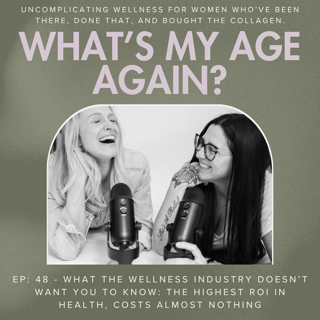
Speaker: Welcome to What's My Age Again, the realest podcast for women who are done chasing trends and ready to feel empowered. Hi, I'm Kim. And I'm Tanya, holistic nutritionists and childhood best friends who've been there, done that, and bought the collagen.
Speaker: more than once. Each week we provide actionable steps that you can start today to help you thrive through every decade to come. We're cutting through the wellness noise to bring you honest conversations about aging, hormones, health, beauty, mindset, and everything in between.
Speaker: You see, we're also on a mission to age gracefully one WTF moment at a time. Backed by research and real life, we're here to share what actually works, what's a waste of time, and how to truly thrive through the messy, magical midlife transition.
Speaker: We're so happy you're here. Let's dive in. Hello everyone and welcome back to What's My Age Again podcast. Thank you all so much for being here. hi Tanya.
Speaker: hi Kim. How are you? I'm good. i am good. How are you? i see that you got a big dump of snow last night, so spring is not quite in your air in your in the air in Alberta right now.
Speaker: The snow is in the air in Alberta right now, and we're just going to leave it at that because you know me. I love where I live. I don't want to be anywhere else right now, and I don't usually complain about the weather, so I'm not going to, but just let it stand that I'm not thrilled.
Speaker: I won't send you our cherry blossom pictures from Vancouver. I will not do that. All right. Today, you know, Tanya and i talked, we kind of switched things up and we thought we would program this episode in today because it's a topic that's come up a lot in the past couple of weeks for me personally, in my practice, and also Tanya has experienced this as well.
Speaker: And we thought it would be a really important conversation. um and the conversation we're going to have today is about how to be our own health advocates.
Speaker: And I think this is really important because, you know, what for example, this came up because my parents I've been was been talking with my parents a lot about health, Tanya, and like, you know,
Speaker: So often I talk to my parents and they're like, well, the doctor didn't ask me for that test or the doctor didn't, you know, tell me to do that. So I didn't ask.
Speaker: And i think for so many of ah many of us and Tanya and I both live in Canada and we have a great health care system here. But a family doctor, for example, a GP, things have shifted, at least for me in the past 30 years. When I was little, we'd go in for annual checkups.
Speaker: Our appointments could be half hour, could be 45 minutes. Our doctor knew all the details about us, our history, our family. They knew my grandmother, my grandfather, my mom, my sister. They knew us inside out and they would be able to ask questions and point us in the right direction.
Speaker: And the way things are changing now is, and what we've been sort of talking about is now, we're lucky if we get 10 minutes with our primary health care practitioner, our GP, and they might be absolutely wonderful people, but they may not have time to ask all the questions.
Speaker: You know, so many times it's like they have time to speak to one issue when we go in there. And we know most of the time this could demand a half an hour plus conversation. So sometimes they don't have time to ask us the questions that maybe they need to ask. And therefore we need to go in there prepared and ready to give them the information and to ask for what we need rather than the other way around. Does that make sense, Tanya?
Speaker: It makes perfect sense. And you said it so eloquently, and I'm just going to say what's on my mind is that the system is broken. I agree with you. The system has changed.
Speaker: The system is broken. So this is not an episode to demonize the medical system because that's not what we're doing. We need the medical system. It's just a lot different, as you just illustrated, Kim, than it was 10, 20, 30, even 40 years ago, right? And if we are not going into these appointments empowered and ready to really utilize those 10 short minutes that we're going to get.
Speaker: We're not always going to leave with the desired outcome. And then what we see happening is we're channeled into the wrong direction, because we just don't know the things that we need to be asking. and we're not exactly sure how to maximize our time, how to work in a system that's broken, where there's less resources for more people, right? And the most important thing is that
Speaker: Our power, we want to like reinstate like personal power and empower you guys during this episode to do that. Not a victim mentality, not us versus the medical system or natural versus medical. That's not what this is about at all. It's taking authority um and having knowledge because that gives us power for our bodies, and for what we want our health journey to look like, because that's going to help us understand better when we're navigating these appointments, these sessions, these tests that we'll get into, um how to take care of ourselves in the best possible way that works for us.
Speaker: Absolutely, Tanya. And I think that is exactly what you just said there. We need to realize that the person responsible for our health is ourselves.
Speaker: We are responsible for our We need to take that radical responsibility. And exactly as you said, there's that not a victim mentality, right? And it's not, you know, yes, things have changed, but I think we need to change our I think we need to change our thought process about it. Whereas we used to wait for the information to be given to us or requested from us. Now we have to sort of go in there and ask more questions and take responsibility for our health.
Speaker: And that's sort of what we want to dive into today. For sure, because if we're all, you know, coming from the same generation, you know, there's a big age difference and variance listening to this podcast, but in general, a lot of us have grown up, um,
Speaker: It's to be exactly like you said, Kim, that it's normal that our health is not handed over, but not necessarily in our hands. What I mean by that is when something was wrong, exactly, you went to the doctor and you probably got in the same day. I remember dr Judy Lane, if you're listening, you were a great family doctor. And I miss you immensely because leaving Ontario, like she was such a great doctor and resources were different. And you would go to the doctor and You would, you know, get your medicine or get your solution, whatever that was. And for me, it was like, repeat, repeat, repeat.
Speaker: we I didn't really ask questions. My mom, I, you know, we didn't ask the normal questions. You went, you got checked out. Here's what the issue is. And I think what the difference is right now too, is we're just living in different times and it's a different model. And that model might've worked back then. Cause like you said, Kim, our doctors knew us. Dr. Lane knew everything about me. And like, you know, you felt like almost like they knew you personally. And that's sorry not the model anymore. Totally. And I think too, they knew us because that I remember it was like, you would go in for your annual checkup. Like a, even as, as kids, like,
Speaker: ah after I had my, after I had Owen and Brennan, I asked the family doctor that I had at the time, okay, so do I bring him in for annual checkups? And the model here was that after three, no, no, you don't need to have annual checkups. It's you come in as needed. And so I think we've been, instead of this You know, instead of the annual checkup where you get to kind of touch base with your doctor and see how things are going and get the proper blood work or testing or whatever's needed, you're going in now because of something. There's a symptom, there's a reason for that visit, not proactively going in there to assess your health.
Speaker: Absolutely. And also, I think that goes back to what I was saying with the model. The model has shifted now, where that model was more of a preventative care. And again, the dia dynamic has shifted in terms of the amount of people and resources now are much different than they were back then. So even when you went in for an ailment or something, there was just more time there. there It just seems you know that there was more resources. So you're right, Kim, that model... of preventative, going in for the checkups, the annuals, it doesn't exist anymore. We're waiting, you know, five weeks to see a GP. So all of this to say, obviously, this is when the model changes, we need to change. So
Speaker: What does that change actually look like? What do we mean when we say like, we're going to empower you today, we're going have a conversation about becoming your own health advocate. And I think, to put it simply to begin, we really have to get serious about who is on our team.
Speaker: And yes, there's no I in team. We can't do things alone. It doesn't mean you need to have a team of 20 practitioners. Maybe that works in your lifestyle. But like, I think one of the foundations, and I know you agree, Kim, because it's something we've both done. And we're both part of many people's teams, thankfully, with gratitude, because we love what we do. But we need to start building our healthcare team. And not just helter skelter collecting these These people plucking them out, but like intentionally choosing people based on quality characteristics, things like people where where you feel truly heard and that truly listen to you because their model and dynamic is built that they can have the time for longer appointments and things are structured differently with, you know, different kinds of practitioners. Absolutely. Absolutely. And that will help with that preventative care that you talked about, Tanya, which is so important. And exactly what you said, our model has changed. It doesn't, and it just means that we have to have a different sort of, we have to have different expectations going in to our appointments with our GPs. And I think one thing that we can do, number one, is find a GP that you really resonate with.
Speaker: And You might be sit sitting there thinking here, and this is a very sort of in different areas in Canada or wherever you are listening, this can mean different things. There just not might not be enough practitioners and you might need to just kind of find somebody that you can actually get into and see.
Speaker: But if you're able, if you're able to, um if you're able to, My recommendation is to have an initial appointment with a GP and really see if you resonate with that person and and talk about what your needs are. and And if that person isn't the right person for you, go find some the next person that might be.
Speaker: I love that, Kim. And I will give a personal example, because like I said, I left my longtime doctor when I moved provinces. And I've been here for over three years. And I don't have a family doctor. I built my team in other ways. And I still, you know, get my blood work and do my thing. But I did. have um a meet and greet with ah a family doctor here. And one thing that's really important for a lot of people, myself included, is actually feeling seen, heard, and validated. Because what we go in feeling and what we feel every day, nevermind, is valid.
Speaker: And when we feel seen, and when we feel heard, and you know, we have those needs validated, it's It hits different. And i think those meet meet and greets that you're talking about, Kim, are so important because if you don't resonate, it's probably not going to be a great relationship, which is unfortunately what happened for me. And I didn't feel seen or heard. And i ended up having a period of time where I was felt very alone in in that and very upset until I built my old team. So I think finding practitioners who can help you feel seen and heard are important. And having the opportunity to do a meet and greet before to see if you resonate, that's a great idea because we want to feel that we are empowered in our health. And I felt dismissed in mine. And it just, you know, I'm not, it doesn't mean that she's a bad doctor and certainly not a bad person. She just wasn't mine. Yep, absolutely. And for you and for your family, you want a practitioner that you exactly, as you said, feel seen and heard and taken care of. So finding that person first and foremost is so essential.
Speaker: um I too, I love my doctor. I love my GP. I have a great relationship with him. He's been wonderful to my children and I feel very, very lucky. And also for those listening, I understand.
Speaker: When I first actually moved here, I found it very difficult. There was hardly any GPs that were open up for new clients. So I also understand how how hard that can be.
Speaker: um So we're just sort of talking, you know, ideal situation here. Yeah, for sure. Because any, exactly, I'm still, we're we're in opposite situations, Kim. I don't have a medical doctor, but, you know, I have found something in the interim that works for me. But truth be told, I know the importance of having an MD. There is a definite balance and, you know, in systems where we need all of these systems together. And I think that when we're looking for these practitioners, it's important that Not only, again, we're feeling heard, we're feeling empowered, but we're understanding what might be going on with our body um and not feeling disconnected from it as well. You know, we want to find somebody who is able to kind of know that they also...
Speaker: might be part of a bigger team, right? That your MD would be open to working with your ND and your holistic nutritionist and your osteopath. And knowing that when you go see a practitioner, all options can be put on the table and remembering that it becomes still our choice and we're going in with power and we have a team of people to guide us and show us the different options and put those pieces together. Absolutely. And this is and this is what I love about what I do.
Speaker: Because that is so often what I do with my clients, and I know you do too, Tanya, is act as a guide. Because as we said, sometimes with our primary health practitioners, we can't get in or we only get those 10 minutes. And what I like to do to support my clients is to really help them maximize their time with their practitioner. um And things that we can do to really support is Be that person who's actively listening and listening to the symptoms, helping to helping that client to write down specific questions that they might want to ask during their visit, maybe potential tests that they want to ask for and why so that they have the why to discuss with that primary care practitioner. um
Speaker: And I mean, before I moved into holistic nutrition, I had an ND, a naturopathic doctor who did just that for me because I could book an hour with her and go through everything with her. um And she really pointed me in the, in, in my, you know, on my health journey as well.
Speaker: For sure. I love that, Kim. That's a part of almost my daily is even down to tests that we, it's out of our scope to be able to, you know, give, suggest ourselves or give to our clients ourselves. We can empower them about things like that. And also reversed.
Speaker: Sometimes clients are coming from the doctor and saying, hey, I'm feeling frustrated or I'm feeling scared or i didn't and like I'm not understanding this. And we're like, OK, let's break this down together. Let me be your guide like you, Kim, are the guide for a lot of your clients as well. And I really think it's important to help my clients, my friends, my family, whoever's listening to this podcast, understand that it really does take a village.
Speaker: when it comes to anything, and that is including our health. And I want everybody to really understand that You always have a right to understand what's happening in your body. And it's your right to ask questions. And that can be difficult again in 10 minute blocks. So to be able to understand how to go in there, also not feeling going in there with your backup thinking you're going to be rushed or it's going to be terrible. It might be terrible. It might not be, but just going in there level headed and knowing
Speaker: it is my right to ask questions, it is my health, and having those questions ready to go, you know, and knowing that you do have the right to request tests, and how we can speak to people to, you know, try to guide the experience to go as positive as possible. Because again, I think we're going to be met with a myriad of practitioners, your doctor, Kim, doctors like that are probably going to meet these kind of conversations when their patients are coming in with concerns, with kindness, but firmness, knowing what they need and what they're looking for and what they won't take no for an answer will be met maybe different from those other different practitioners. And it's all about finding that common balance, but remembering it's our right.
Speaker: It's our health, you know, it's our right to be able to go in there empowered. Absolutely. And I think too, one of the things you mentioned after the, the, the The appointment and, you know, your family doctor isn't going to have enough time to dig into protocols and how and prevention and the diet and lifestyle piece that are going to support whatever it is that you're going through. And so having a practitioner to support that side of it and to flush things out with you and to really create a plan and to dive deep into how your diet and your lifestyle are also going to support you is so important.
Speaker: So many things that came up. Let my little brain try to work on this for one sec so I don't forget and put them out into this universe. One, You just described such a beautiful relationship where practitioners are able not to have that ego to say, that's not my area of expertise. So go and see a nutritionist for this. That's one huge piece of it because I think you mentioned this when we were just chatting candidly, Kim, that This can work so well if every practitioner realizes that we're not experts in everything and we stay in our own lanes and we work together so that you're not leaving that 10-minute session feeling dismissed,
Speaker: minimized or that you're not fully supported, where if you start to shift your mentality about really needing to build a team, you know, you're walking in there with the expectation. This is likely what I'm going to get. They're not going to go over nutrition protocols, or maybe it's a physio. Maybe you have a slipped disc. They're not going to go over this movement stuff. And that's where if we can all work together as practitioners and have clients that are empowered and realize that that team is important.
Speaker: Everything can overlap and be so amazing because there's not just one solution. And that goes back to what you were talking about at the start, Kim, the old model, the example of your parents, you know, oh, the doctor didn't ask for this test or, you know, he didn't say to do this, so I didn't ask. This is what we're trying to put out there to you guys is that you, you, we have to learn to ask. We have to learn to almost be coached and get that before we come in because your, your GP is a general practitioner.
Speaker: They're great. They're smart. They did not go to school for nutrition. They did not go to school for osteopathy, for example, like right? Like you, you get what I'm saying. Yeah. And they don't have a certain amount of time with you now and they might not have the history and they might not have the, so, so exactly what you said, Tanya, it's like,
Speaker: In an ideal world, I mean, and I hope that we're moving in this direction now where we all, all of these practitioners, as you said, stay in their lanes and work together to support a client. I had a great example and I'll try and be quick.
Speaker: My client, if you're listening, um she's she's given me permission to tell the story. So, but my client came in with some symptoms, right? And it was gut health related.
Speaker: um And she was working with a general practitioner and having a ton of testing done and had been on round and round of antibiotics and things weren't working. So she was coming into me sort of as a last resort, like, okay, I i think it might be this, or I think it might be parasites or candida or da, da, da. Anyway, we talked it through symptoms and I said, you know, i think what's best is to do some really targeted gut testing for this so that you know exactly what it is. So I recommended a wonderful new um naturopathic doctor who I trust and love. and And she went there, got the appropriate testing done, found out what was going on in there, found out that an antibiotic was in fact needed, but it was the wrong antibiotic that she was put on, which this test
Speaker: decided, figured out. So the naturopath wrote a script for her to take to her general practitioner, her GP, who completely aligned, gave her the antibiotic that she requested.
Speaker: I worked on the diet and lifestyle piece with her to support building back that gut health. And eight months later, she was feeling like her symptoms were gone.
Speaker: And I think it was just that combination of having the support from each of her practitioners, myself included, all working together, staying in their lanes and supporting her in what she needed. And I mean, that is an ideal situation, but it's it's it's it's what could happen.
Speaker: it's it's It's really what ideally we would love to happen. That's such an amazing story. i love it so much. And that is an ideal situation. And unfortunately- It might not be the norm of what we see the most times because I'm going to be honest with you, that is such an uplifting story and it makes me happy just to know it. And you should be so proud of your hand in that as well and all that you did. But these days, there's less and less of that. And again, this is why we want to try to make stories like this. the norm on a daily basis for me it's there is more frustration with you know not being seen and not being heard and I think one of the important things I'd also like to put out um I feel very strongly about this is that you're an equal in your relationships and that even includes your relationships with your health care practitioners um your practitioners are experts of course they are surgeons all of these things but But like we keep saying that example, let's stay with it, staying in your lane.
Speaker: Your practitioners are experts in their area of expertise. And sometimes... It seems like you're given one solution when you go to a practitioner because that's the solution that they know and it might not be the solution for you. And I think it's really important to remember that even though sometimes it might not feel that way because you're going to someone and they're telling you what's wrong because, you know, that's that's what you've gone there for. That...
Speaker: they so they don't have They have the knowledge, but they don't have the authority over your body. You live in your body. You experience your symptoms. You know when something is off and when maybe a solution doesn't feel right for you. And you don't have to be passive. We want you to be an active participant in your health. So if you are going, if you are, let's say, Kim's client and you get this amazing, you know,
Speaker: um direction and counseling from Kim and you go to your doctor and you feel like you've just ran into a brick wall because they're not open to that. No, that won't be it. No, I'm not doing that. This is again where you have to remember that doesn't have to be your final answer.
Speaker: Yes, it takes work. And yes, it's so frustrating that you might want to just get into your car and have a good cry because you feel like there's no one there to help you. But there is.
Speaker: And I just want to put that out there that It just takes that perseverance sometimes to find the right team, but we don't want you to give up. We don't want anybody to give up. I've been there as well. I had a great cry when I left that doctor's office one day. I had a terrible experience. It was actually terrible. And I'm like over it now, but it took me a long time, but it's your body. And no matter what the tests say, or what maybe the suggestion is, you have the right to check with other people and you still have the right to make the decisions, right? There's, Kim, why do we have, where did we grow up where I was like, there's more than one way to skin a cat. What is wrong with me? Like what I'm trying to say is that health, you can get to health by many different paths and you can choose that. Well, and I think what you said is so true. It's, and we, we constantly say this within our practices and on this podcast, like we're
Speaker: you you are You are in touch with your body. You live in your body. You experience those symptoms. So when something feels off to you, you're right, right? And as Tanya said, this is the whole point of this is to be our own health advocate, to keep asking the questions until you understand it. I had a great, in in event management, when it was my old world, I had a great boss that said, keep asking questions until you can actually see what it looks like. And it's true.
Speaker: Keep asking the questions until you feel comfortable with the advice that's being given and until it resonates with you. um you know, that's, I think, oh, go ahead, Tanya. Yeah. Sorry. i want to forget. That's a, I love that. The other thing is to keep asking questions. So you understand the protocols that you're being given.
Speaker: For example, if you go in and there, you know, a practitioner says, take this medicine, do this. Don't be that person who is like, hey, you know, why are you on this medication? I don't know.
Speaker: I don't know. You want to keep asking questions so you know. Absolutely. And education is so important, right? Understanding what testing, understanding the testing that you're being you're being provided or the testing that you want to get, understanding the why behind it, what your results actually mean, you know, understanding that because All of it is so important. The education piece is going to help give you the confidence to ask those questions during your appointments.
Speaker: And to make the best decisions for you. There are many paths to healing. I promise you, there's not just one way. There's not just one practitioner. There's not just one protocol to get to A and B. And there are a myriad of different ways because different ways are going to resonate and work or not work for different people. And I feel one of the times where I feel the most sadness and despair is when I see people that maybe don't have, you know, the knowledge that the model has changed and to be their own health advocates. And they just become somebody who, as we said, like how how I used to go the doctor, just blindly go in. And I'm not saying what I was getting was wrong, but not understanding there might be another way. And I see people go down paths of hopeful healing and it's actually... making them sicker and causing their demise, but they don't know. They don't know that they're not in this, or they don't have to be in this relationship of, I tell you what to do and you say, okay, and there's only one path. There are many paths to healing, but we have to advocate for that. And we have to, as you said, Kim,
Speaker: Ask the questions in all regards about the tests, about the protocols, about even, you know, what are the options? Absolutely. And finding the practitioners who have that education. Because again, the reason Tanya and I started this podcast is because there's so much information out there that is the online and in social and everyone's an expert these days that, you know,
Speaker: It's hard to sort through that and know what is true and what is accurate and what isn't. And so finding those practitioners that you can trust, that can sort through the information, that can look at the testing, that can give you solid advice is so important. And another piece of this is or um is that i'm also we're also very aware, Tanya and i that having these additional practitioners can be expensive. and cost money. And not all of us are able to do that.
Speaker: So we're coming from a privileged position where we can say, oh, yeah, go to your naturopathic doctor, go to your nutritionist, go to your physiotherapist, go to your osteopath, who are all amazing and wonderful people.
Speaker: um But also realizing that, you know, it does cost money, and there is an investment into that as well. For sure. And I'd really like to go back to something you just said about these days. And the reason why we started the podcast is everybody's the expert.
Speaker: I want to tell you guys, you're the expert. You are the expert in you. Everybody's an expert. I don't know why that feels sometimes a little bit triggering for me because sometimes I see so much about what you should be doing. Let's say for, since, Symptom A, B, and C. This is what you should do. This is what you should do. To the detriment where sometimes I'm like, am I doing things wrong?
Speaker: Absolutely not. I'm doing things in the way that works for me because I have researched those things. I understand what's going on with those things, whether it's supplements, whether it's things that I'm eating, you know, whatever the case may be.
Speaker: You're the expert. Get rid of that authority piece as well. The people on Instagram, I'm sure they, you know, things work for them. But when you see things that are telling you this is the only way to do it, you can only support your hormones by taking X, Y, and Z. You'll only be rid of these symptoms if you do A, B, and C. It's not true.
Speaker: It's, you know what I mean? It's true for the people that it works for and resonates for, but it doesn't mean it's true for you. And you don't have to say, i don't know, that's what my doctor told me. That's, you know, so that's why I'm doing it. Or I'm feeling worse, but that's what my, you know, so-and-so told me to do. You're the expert in you. Never stop asking questions. Don't be afraid to... You know, stand up for you, for your kids. I know there's a lot of you out there that are going through, you know, things with your kids. And it's the same thing, right? You feel like you're hitting that brick wall and just like know.
Speaker: Exactly two, that things are expensive, like Kim said, and we don't all have the means to do everything. But if you can find that one practitioner that can even act as counsel for you to help empower you, i.e. a Kim, a Tanya, someone in your life, then you have more power going into those situations where you're going with your 10 minute GP or your specialist that you've waited 12 months for. Right. Absolutely. Somebody who can help you look at the whole picture together. Somebody who can help you with the questions, the education piece um and help you to you know,
Speaker: Take that ownership of your health. Tanya, I think you ended it perfectly there, right? You are allowed to be the advocate for yourself. You are allowed to ask questions. You're allowed to look for better support and take ownership of your own health.
Speaker: Yep, you're entitled to. You are the expert of your life and of your body and never stop being that way because the only person who will ever put you first is yourself. So keep doing it. And if you're not doing it, start because that's what we have to do.
Speaker: Absolutely. So we hope this was motivational for you. um We hope you got a little bit out of this today. um Reach out if you have you know any questions and we look forward to chatting with you again next week.
Speaker: Okay, guys, take care. Bye. Hey, guys, thanks so much for hanging out with us today. If this episode resonated with you, we would love it if you would hit like, subscribe to the podcast, and share it with a friend.
Speaker: We love to hear from you because let's be honest, this show is for you. If you have a topic you'd love us to tackle or want to learn more about something we talked about today, send us a message. We got you.
Speaker: Stay connected with us on social media at whatsmyageagain.com. dot podcast for even more knowledge and inspiration between episodes. Kim and I aren't doctors or your healthcare care practitioners.
Speaker: Everyone's body is unique. So always consult your own healthcare provider before starting something new.