Transcript
Speaker: Hey, if you would like to discover what your unique pottery voice is, I put together a free quiz that you can take to help you discover what your pottery voice is. It's a quick four question quiz. All you have to do to take it is go to shapingyourpottery .com forward slash quiz, or you can just go simply go to shapingyourpottery .com. It'll be right there on the top. I'll see you guys in there.
Speaker: If you love pottery and want to take your skills to the next level, you're in the right place. Find your own pottery style right here on Shaping Your Pottery with Nick Torres. Let's get started.
Speaker: What is up Shaping Nation? This is Nick Torres here and on this episode of Shaping Your Pottery, I got to interview Andrea Keyes Connell. Andrea makes some really incredible figurative sculptures that she uses coil and slash slab building to make. In this episode, you'll learn how Andrea goes about designing her sculptures. You also learn about
Speaker: why you should be delaying gratification in order to reap the big rewards later. You also learn about why you shouldn't be giving a crap about what other people think about your pottery. And then finally, you'll also learn about why you need to be working hard in order to kind of make your vision come to life. Hope you guys enjoyed this episode and I'll see you guys in there. Andrea, welcome to Shaping Your Pottery and share with me what is something people might not know about you.
Speaker: I really struggle with this because I'm kind of a private person. So maybe something that people don't know about me is that I'm shy about certain things. I like to cook. How about that? I like to cook. Love it. So do you tell me a story how you got started in ceramics? Well, it's kind of like, I think many people's coming to clay kind of
Speaker: story. I was an undergrad. I was an art major, but I was a painter. And my junior year of college, I had an elective that I needed to fill. And I took a wheel throwing class for fun, thinking I could make some holiday gifts for my family. And I kind of just got sucked in. I quickly started to make my pots into figures, realizing that, like,
Speaker: I was not a potter. I certainly was a sculptor and more drawn to figurative work throughout all of my artistic interests. But yeah, that was kind of it. And I'll never forget my professor Ron Lang coming to me and saying,
Speaker: I see you in here all the time. Have you considered being a ceramic major?" And I was like, that's a thing. Like I had no idea that that was something you could do. I love that. That's a great story. So tell me about the moment when you got accepted into your first gallery.
Speaker: Well, I actually, I don't have a gallery. I exhibit a lot, but I went directly into academia from grad school. I went straight into a tenure track job. And like the pursuit of a gallery was never encouraged that much. Like it was more like get your work all over more in like institutional kind of settings, like museums and universities and
Speaker: and various galleries I would show in, but it wasn't really a pursuit of mine. And I was kind of strategic with that because I worried that I knew I was getting on an academic track like quite young. And I worried if I went straight into a gallery that my work that I felt was still very much developing that I wouldn't develop in the ways that I imagined for myself.
Speaker: I don't know if that is true or not, but I'm actually now in a place for the first time in my career that I feel like I might pursue a couple of galleries. There's a few that I've been looking at quite closely and feel like my work would fit really well with them. So I'm interested in what that kind of like nurturing of a relationship is like, but I have not done that.
Speaker: I love that so much. So shaping nation, sometimes you have to delay the gratification a little bit and continue to improve your pottery so that when you're able to, your pottery will just kind of naturally be able to evolve on its own. And a lot of other things that are happening to you as well. I love that so much.
Speaker: Yeah, I mean, I will say, you know, the like being in academia, like my, I teach at a university full time. So my concerns are not making a living off of my work. And the real privilege in that is that I can take risks within my work and develop it at my own rate, which sometimes is like hopping from here to over here, back and forth, and then sideways.
Speaker: And I think that I'm very fortunate to be able to do that. With that said, I would really like to be making more money from my artwork at this point also. Yeah, I love that. Definitely agree with that. So you mentioned that instead of galleries, you would try to get your sculptures into museums and other academic settings. What would you do to make that happen?
Speaker: Well, it started in grad school. I was pretty like had kind of laser focus in my final years of graduate school and made it a goal of mine to kind of give the appearance of having been more professional perhaps than I was.
Speaker: in exiting grad school. So I applied to many shows and did a lot of exhibitions, big and small. I applied to be on art axis and actually art axis at that time. So this was 2009. So it was still quite young.
Speaker: And it was easier to be visible on there. And I put my work from my thesis exhibition up and was contacted by the Museum of Art and Craft in Louisville, Kentucky. And Mindy Solomon helped to get me an exhibition at the Florida Holocaust Museum. And all of those contacts were made through Art Access.
Speaker: And they really like those helped to propel other opportunities. So I've been primarily working from invitational opportunities since then. I love that. That's really great. So let's talk about your pottery. In one sentence, can you tell me what you make with your sculptures?
Speaker: I make figurative sculpture that is narrative and like most good folklores kind of weaves a whimsical, dark, maybe sometimes moralistic tale within it. Can you tell me the story how, yeah, that's perfect. That's right there. So tell me the story about when you were a child, you would sneak into your mother's cabinet and collect her porcelain figures, figurines.
Speaker: Yeah. Well, so she had, her and my grandmother both really loved ceramics and particularly Myolica and Hungarian porcelain from the manufacturers of, and Herrand. And so there were little like pieces throughout the house and in our cabinets and things like that. And I was always really drawn to the figurines and kind of would play with them, you know, but
Speaker: My mom didn't always love me playing with them. I did have a history of breaking an enormous shelf of her most prized Myolica. So I don't blame her for not wanting me to play with them. But I think that seeing how precious they were gave them more value to me. But they were significant, which I didn't know at the time. But Xiong Nai in particular is a factory in the town called Page Hungry.
Speaker: which is where my grandparents were from. And they were Jewish and interned in, my grandmother was in Auschwitz and my grandfather was in a forced labor camp and, you know, they left Hungary to never return there. And I think that those objects were reminders
Speaker: of their, their home. So I think they carried a different, like most people who collect certain specific kinds of objects, they carried a weight to them that went beyond what the figurine actually was. Definitely agree. So what would you say this, how did this impact on the work that your own sculptures?
Speaker: As an undergrad, I was introduced by Adelaide Paul, who was one of my professors as an undergrad. She introduced me to the Hummel figurine through this book on ceramic kitsch for a project that I was kind of stumped on and I was flipping through and I saw the Hummel and I was
Speaker: kind of bothered by it. I didn't particularly find it cute. And so I made kind of a satirical Hummel series, not really understanding what their history was, but when I was in graduate school, I dug more into their history, which is rooted in World War II era Germany, and they were marketed to American GIs after liberation. And so that's why so many of them are American,
Speaker: home collections and why so many people have such strong feelings about them. And so I really started to kind of dig into that and thinking about the stories that these figurines carry that's not always recognizable on the surface. And that has in some regard been a theme that has come in and out of my work ever since then, sometimes in more extreme ways and sometimes in more subtle ways.
Speaker: Really, I love figurines. I love that they come often with their own stage, that sets their landscape, and they're sentimental and they're kitschy, but they typically hold a lot, and I'm really drawn to them. I love that story so much. Sorry. I love that. I love that so much. I love it.
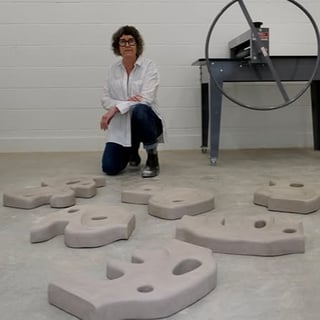
Speaker: So can you give me a simplified explanation on how you create your sculptures and how you think about designing your sculptures? Well, I primarily hollow build my sculptures. So mostly coils, some slabs and sometimes little bits of solid pieces that I hollow out. But they're primarily coil built.
Speaker: And I'm attracted to coil building, you know, I could like some people ask, like, why do you coil build rather than primarily slab build and I really enjoy.
Speaker: that your hands touch every part of the clay. And I feel like that gets embedded into the clay, which might be kind of woo woo, but whether or not you can see it or you can just feel it, I think there's a tactile sense to my pieces because they're handled in that way. I also enjoy the fact that to form most of the shapes I'm pressing from the inside out, which feels like breath to me.
Speaker: And in terms of designing them, you know, I still very much rely on my training as a painter and as a drawer, where what I am imagining first and foremost is like how those pieces, when I'm thinking about their actual form, how they're going to fill the frame of the space that they take up. So I think about their silhouette. I use a lot of
Speaker: painting techniques and composition like with the triangle to kind of like stir up to the drama, you know? But lots of just like charcoal sketching actually of shapes and forms. And then I find the forms within that. So you mentioned how your experience with painting and other art forms, how did this help you with your own sculptures?
Speaker: Well, I mean, my first grasp in understanding the figure was through like pretty intense figure study through drawing. And when I'm making my pieces, I still use all of the lines that I learned how to set up for myself in the composition to keep the figure balanced and find its proportions and everything like that. So I definitely incorporate
Speaker: a lot of those techniques that I learned. And, you know, when I'm surfacing my pieces, I'm very much thinking like a painter. And I love painting the surfaces of my pieces. And that's something, you know, just even the basics of like color theory and composition and color mixing and all of that stuff is stuff that I learned through my background and painting.
Speaker: I love that so much. Shaping Nation, sometimes if you have experience in another art form, you can use that to bring that into your own pottery. Maybe your painting or your sculpting or whatever you're doing, you can bring that into your pottery that you're working in today. I love that so much. So let's talk about discovering your voice. Can you tell me about the moment when you knew you were heading in the right direction with your sculptures?
Speaker: Yeah, I remember it really well, actually. I call it my FU moment in grad school. During grad school, rightfully so, like you are, you know, pounded with a lot of questions. And I was not like, you know, I have experienced some colleagues and as a teacher, some students who are just very clear in what their voice is. And I was not like that to a certain degree as a
Speaker: Student and so I would try to answer everybody's questions that they would ask me through my work and they landed in a lot of work that I was not convicted and. And then I just remember after having 1 horrific critique.
Speaker: that made me question my life's path. I had this moment where I remembered this scene from one of my favorite books, The Life of Pi, that I just really resonated with me.
Speaker: and with the content that I was interested in. And I was like, I'm going to make this piece and I don't give a shit what anybody has to say about it. I know this is what I want to make. And I just went into that studio and I've never, like I just remember that feeling of being so convicted. And I don't know, I think it was just being pushed off the edge.
Speaker: You know, like having bad critiques where like I couldn't stand next to the work and this happened. And I was like, I can stand next to this. I want to actually show this piece to the world. And I know what I would say about it. And if you disagree with me, I don't actually really care that much. I'll hear what you have to say, but I won't let it penetrate me in the way that I would before.
Speaker: And kind of ever since then, I knew where my work had to come from and have been trying to make from that space since then with ups and downs. It doesn't always work. People get in your head. I love that. I love that so much. Shaping Nation, sometimes the only way to find your voice is to not give a shit what other people are telling you about your own pottery. You have to start making for yourself first so that it starts coming alive.
Speaker: I love that, the way you explained that, I love that story. So you contribute your growth as an artist to becoming a mother. How has this helped you with your growth as an artist? I mean, it's so complex that it's almost challenging to simplify in through like verbs. I think in a lot of ways, like, I mean, obviously, like becoming a mother, it opened my heart.
Speaker: And I mean, I was already a pretty like sensitive person and like, you know, kind of weepy and all of that. But it opened my heart in ways to the world that I guess maybe made me more empathetic than I already was. And it also made me really very clearly understand where I was supposed to be.
Speaker: what I was supposed to be doing and articulate my values in a much more clear way and pay attention to whether or not the things that I was involved with were fitting those pieces and those values and providing me the space that I need to
Speaker: Be a good mom, be a good teacher, be a good artist, be a good partner, like all of the things that I really desire. Yeah, I don't know. It's kind of like a sensitive thing. Like it just, it changed me. Like it really just changed me and it changed my work. I also will say that, you know, I went, when I first had my first child, I was very conflicted because I was at a,
Speaker: Institution that did not offer maternity leave with my 2nd child. I got a research leave rather than a. Maternity leave I was the only mother within my program. I felt that, like, there were certain things. That I value deeply, but I couldn't bring to the table.
Speaker: And I also had like a very clear memory of a professor who I valued very much making a comment one time about a woman who was making work about her children and basically in a way that it was a cliche. And so I was very self -conscious about that. Cause my work was oftentimes about like nurturing and about relationships and all of this. But after I became a mother,
Speaker: I wanted to make some work about the experience that I was having and how it was making me relate to the world differently. And I had that voice in the back of my head that made me insecure about that. And I'm now in a place where I'm just like, screw you. That is like,
Speaker: How this is like one of the most like shared experiences in the world. How could that not be valid thing to make work about and I kind of realized that my role as a teacher is to one like not hide my family.
Speaker: you know to make sure that everybody knows that I have my family and sometimes they're going to come before you and within my work to say like I am a mom and these are the things that are beautiful and these are the things that are really hard and that is really valid content to have within your artwork but it took me a long time to kind of take that own that
Speaker: I love that so much. Shape Nation, your values matter. And you can put those values into your own pottery because that's how your voice is gonna help you grow and it's gonna really make pottery that truly is meaningful to you by adding your values to that. I love that so much. So as we're coming to a close here, what advice would you give to someone trying to find their own unique voice with their pottery?
Speaker: Don't listen to other people, listen to listen to people, but recognize when you are answering questions for them and when they're questions for yourself and also work hard. You have to work hard, like.
Speaker: I have had a lot of privileges in my life, but I've also worked my ass off. And everybody that I know that is in a
Speaker: a position where they are in some way making a career out of what they do, they have worked incredibly hard to get there. And so don't make excuses for yourself. You know that voice inside when you know you're making an excuse to not do something.
Speaker: You need to work really hard to do something that you love because our country doesn't support us to do what we love. So you have to make it happen. It's up to you. Definitely, Andrea. It was so great sharing with you today. Where can my arms go and learn more about you?
Speaker: You can go to my website, andreakeys .com. That's K -E -Y -S. And you can go to my Instagram, which I have been trying in the last year to be quite active on. And it goes like this.
Speaker: But it's had payoffs. I actually with my Instagram I'll just say I was always like kind of pooing it and then I realized I was pooing it because I didn't feel like I could make time for it and so I decided I was going to make time for it and do it for a year and if it paid off I would continue and it has. So
Speaker: I just put that out there for people who are reluctant to it. I was also, but my Instagram is Andrea, A -N -D -R -E -A -K, Connell, C -O -N -N -E -L -L. And I have Facebook, but everything on Facebook is just linked from my Instagram. I don't really go on Facebook very much.
Speaker: Hey, thanks for listening to this episode of Shaping Your Pottery with Nick Torres. If you want to discover how close you are to actually discovering your own unique voice with your pottery, I put together a free four question quiz. It's very short. It takes 30 seconds for you to take. If you want to know how close you are to finding your own unique voice, go to shapingyourpottery .com forward slash quiz, or you could simply go to shapingyourpottery .com and it'll be right there at the top.
Speaker: I hope you guys enjoyed this episode and I'll see you guys next time.