Transcript
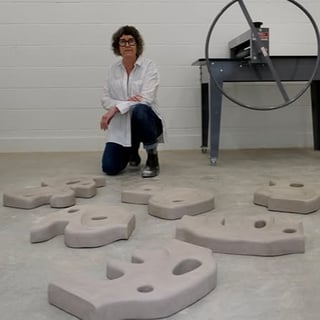
Speaker: If you love pottery and want to take your skills to the next level, you're in the right place. Find your own pottery style right here on Shaping Your Pottery with Nick Torres. Let's get started. Welcome to Shaping Your Pottery with Nick Torres. Today, I'm interviewing Megan Yarnell. She is a high school ceramics teacher as well as a mother of three children. She has her own studio in her basement.
Speaker: And she makes some really wonderful pieces of pottery. She makes some beautiful designs and you can really tell the really thought out. Megan, welcome to Shape of Your Pottery. Thanks for having me. Now, I thought I would like to start off by, if you could tell me what's it like teaching high school students?
Speaker: So I love teaching high school students. I've been teaching for 17 years. I taught sixth grade art for about 12 years and then I switched to seventh and eighth grade, taught that for I think like three or four years and actually last year was my first year teaching high school ceramics. So going from middle school to high school was a big change but
Speaker: High school students are really fun because they're kind of like cats where you just give them like some food and water Like some pets every once in a while and then they just kind of do their thing So they're they're good at self -starting. They have a lot of ideas. They don't need like step -by -step instruction I Like that I can have multiple things going on in my classroom at the same time Middle school is a little bit more crowd control Right. What's the craziest thing you've seen a student make?
Speaker: I mean, I've seen lots of crazy things. I'm trying to think, that's like crazy, like, wow, that was really cool. Or like, what in the world is going through your head? I've had a lot of interesting assignment submissions, but I don't know. What was one that kind of like stuck out to you?
Speaker: I mean, I had some really amazingly talented students last year. I had two students get work into the Amoka exhibition, which is like just an online exhibition for high school ceramics and it's all 50 states. They only take 100 pieces of art and it's all ceramics. So that was pretty cool.
Speaker: the one that got in was a relief of like a horse and it was her horse that she sculpted. And another one was kind of like an abstract like coral looking sculpture that got in. So those were both pretty amazing. Very nice. That's very creative. So what pieces of advice or advice in general would you give to your students who are just starting out in ceramics? So ceramics can be really frustrating when you're starting out with it. And it's,
Speaker: a little bit different than other art forms because it's a skill that you have to develop really before you can, you know, make art out of it.
Speaker: there's definitely, you know, you have, you have to put hours and hours into understanding the material and working with it because especially if you're using the wheel, like it's so frustrating when you first start using the wheel and you just have to, you just have to keep trying it and just keep, keep doing it. Like I tell my students when they say like, I make this look easy. I'm like, well, I've been doing this for 20 years, which is longer than they've been alive. So, right.
Speaker: Yes. You just have to make a lot of really crappy pots and get used to things not working out the way you thought they would in ceramics. I always say like, man, I should have just been a painter. Like there's just so many parts of the process that can go wrong, right? Yep. Like one little, like one little thing and it just ruins your piece. Nope. Nope. So it can be really frustrating at first. You just got to get past like over that, that hump to get,
Speaker: you know, into where you're enjoying it more. So like, when it comes to getting past that hump, how would you like kind of approach that besides like from just keep on making pots and pots and pots?
Speaker: Yeah. I mean, really, I think the best way is to keep on making pots and pots and pots. Um, and then, you know, there's always places you can look for inspiration if you're getting just too frustrated. Um, you know, I've had periods of time where I just like had to stop making and just try something different. And I would, but it's still something creative, right? So like maybe you're reading books or doing like some visual research or maybe
Speaker: taking like a painting class or a drawing class, I took like a watercolor collage class at one time. So just, just something to try and get your, you know, brain thinking in a different direction. You know, now with with social media and YouTube, it's so great because you can watch and talk to and
Speaker: hear you know other artists work and what they do and I didn't really have that available to me like when I was first starting out but you can like just you know search on YouTube beginning pottery tutorials and you'll get thousands of results. So I think that's so cool.
Speaker: And just the ability to, you know, ask an artist you respect a question and they'll most likely answer you back. I mean, that's just like an incredible tool that you have with social media and it's free. Yep. I definitely agree. That is one of the things that helped me the most. Yes. Just social media in general. Yes. So could you tell me the story on how you got started in pottery?
Speaker: Yeah, okay. So I took a pottery class when I was seven at a community studio and I enjoyed it, but I've always been into art and I'm very lucky that I had a family that supported me and just, you know, let me take art classes and took me to art shows. And my dad was an artist at the time, so I grew up going to like a lot of, you know, the art shows that he was participating in. But then
Speaker: I took art classes in high school. One of my high school teachers encouraged me to submit a portfolio to Bowling Green State University. So I did that and I ended up getting a talent scholarship, but it was for painting. So I went to college as a painting major and
Speaker: I liked it, but I don't think there was anything great about my painting. It's just a realistic painting, nothing special about it. I had to take a ceramics class for my degree and I just wanted to get it out of the way. I had taken ceramics in high school, but I
Speaker: Think I was too immature. Like I just got really frustrated by it. I was not not really a new it at all, right? I took this this house this college ceramics class at below Greece State University. They have an incredible ceramics program My instructors were Steve Roberts and John ballast very and I just got hooked on it That studio had like so much energy there were people in there 24 hours a day hanging out making stuff it was just a great community and so after I took that first class, I switched my major to ceramics and
Speaker: Yeah pretty much ever since then I graduated, got a job teaching, made a basement studio and just been making work ever since. So now you mentioned your dad being an artist. What effect did your dad have on you just being an artist in general? I think I just grew up like with parents who valued creativity and just
Speaker: You know, I was really lucky to have parents that took me to, you know, cultural activities like plays and musicals and art shows. And we always did, you know, stuff like that in the community. And they, you know, had me enrolled in art classes and I just had a lot of exposure to it. So I think that helped a lot. I just remember always drawing, like drawing all the time when I was a kid. Right. So could you walk me through
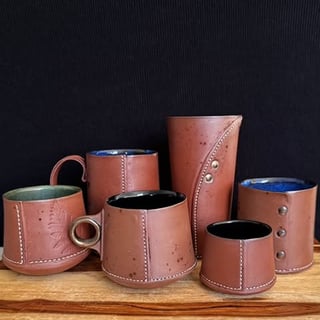
Speaker: how you make your pottery because it's very, very, very interesting. Yeah. So I start by, so I use a Cone 5 -7 Growlic Porcelain from Columbus Play. And I start all my pots on the wheel, love wheel throwing, and in pretty simple forms. And then I don't do any altering at all. I just
Speaker: do all my surface decoration pretty much when it's leather hard. So after the pot has set up a little bit and I trim it and attach a handle if I need to, I use a lot of different techniques like inlay and paper stencil and graffito, ceramic decals, resist, wax.
Speaker: There's a lot of little tiny steps. I just like to create layered images with lots of different techniques, I guess. Could you explain that layered images a little bit more?
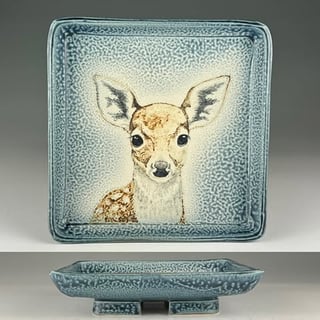
Speaker: Yeah, I can try. So it's kind of similar to the Mishima technique, where you're drawing with a needle tool, and then you inlay a watered -down underglaze, and then you wipe it with a sponge. So what happens is the underglaze just only stays where you did the drawing. So I start out a lot with that. And then I use paper stencils to create a positive image of an origami crane or a flower.
Speaker: After that dries a little bit, I wax pretty much the entire pot. And then after that dries a little bit, I use a diamond core carving tool to carve details into the stencils. And then I inlay different colors of underglaze into those carvings and wipe it with a sponge so then the underglaze only stays where I did the carving.
Speaker: Those are like the most of the techniques that I use and then I do do some like stencils with slip just made from my clay body or just like carving and then inlay that with glaze also.
Speaker: And then those stencils end up getting waxed after I fist fire. And then I dip it in glaze. So the stencils just remain on glaze. And that Amaco velvet looks really nice at cone six. It's got that, you know, some of them are almost like fluxed a little bit. So they're kind of shiny. They look really nice. So you, you mentioned like this origami thing and I, I do like the way it looks. How did you come up with that idea to kind of add like an origami paint stencil?
Speaker: I think at that point I was just thinking about art imitating life and just, I don't know, just how beautiful a red, I think the red -crusted cranes are, and then you're trying to mimic this real three -dimensional animal with a three -dimensional folded piece of paper. So just kind of the contrast between
Speaker: art and nature. That is what interested me about that particular design. I like it because you can definitely see the two coincide. Yeah, they're kind of flying around with each other. It's an interesting concept, I think. Definitely a very interesting good idea. Thanks.
Speaker: So on an Instagram post, you said you are inspired by human interaction with nature. Could you explain this some more? Yeah, so I grew up with woods and a huge field and like a pond by my house and a creek and like most of my happiest childhood memories are spent in those woods just having adventures with my friends and hiking and
Speaker: You know, we were gone all day and we packed lunches and no one really knew where we were. But it was almost magical just like being in these woods and seeing just nature. And I was really lucky to have that growing up. So I think it's always fascinated me. I've always been really interested in especially like the quirky parts of nature. You know, like I think mushrooms are really cool or like weird flowers. But
Speaker: I read a lot like constantly reading and I read a lot about climate change and just kind of like
Speaker: the effect that humans have on nature and it's usually pretty bad and it's starting to get to the point where it's not going to be reversible. And so I don't like that particular design that I use are like the cherry blossoms. So cherry blossoms are an early indicator of climate change because a record has been kept of when these trees bloom for over 100 years now. So they can see the date getting progressively earlier as the temperatures get warmer.
Speaker: So I have these decals that are around the flowers that are actually made from the wifi symbol. So they look like little wifi flowers. And that's kind of like my, you know, human, human component there, like around. And I also read this article about how we're killing all the bees, you know, because we have these beautiful lawns that are just, you know, green grass, which is not actually a native species, but you know, there's no bee food there if you're killing the dandelion and the clovers.
Speaker: So they're making these robot bees to pollinate things because like the real bees are dying. And I thought that was just the craziest thing that I read, like these robot bees flying around, you know, pollinating stuff because we've cabled all the wild flowers. So that's kind of like another like Wi -Fi, you know, human technology component, like in contrast with, you know, a beautiful flower. Right.
Speaker: When you're kind of thinking about new ideas, how do you just approach it? I don't know. A lot of times an idea is inspired by what I read. So I'll read something like Robot Bees and just kind of branch off from there. I have a sketchbook that I keep ideas in. I keep articles in. I write stuff down.
Speaker: I really like doing visual research. So when I start thinking like, oh, maybe I want to do something with, you know, like a ginkgo leaf. So then I start looking up ginkgo leaves and looking at lots of pictures and drawings and botanical illustrations. And I like to collect a lot of those images and then kind of, you know, combine them into something that I want to use. That is really great because I feel like it's like it makes everything more smooth, I guess. Yeah.
Speaker: When it comes to failure, could you tell me a time when a failure or a parent failure led you to later success? I've had a ton of failures. Probably the biggest one for me was when I got a brand new kill. It was my very first kill.
Speaker: I had it in my basement and I was super excited about it and it had a kiln sitter in it, which I don't know if you know much about how those work. You put a pyrometric cone inside of it and when the temperature is reached, the cone melts and the arm drops as the cone melts, which shuts the kiln off.
Speaker: so I remember firing this kiln for the very first time and I'm just sitting watching it and watching it and watching it and thinking like why is this taking so long it shouldn't be taking this long it's a brand new kiln though maybe I don't know maybe I don't know and of course I didn't have any backups like I didn't have um freestanding cones I didn't have um a backup pyrometer so eventually I shut the kiln off because I was like this isn't right something's not right and then I opened it the next morning and the whole kiln had melted
Speaker: like completely melted. The elements had melted. The shelves had melt, like sagged. And I had just a massive panic attack, you know, because this was a $3 ,000 piece of equipment that I had completely ruined. And I had fired hundreds of kilns at that point. And in college, we just left. Like we put the kiln on and we just left. Like we didn't sit there and babysit it, which is bad practice. So don't do that. Don't do that. That's a bad idea.
Speaker: So after I calmed down a little bit, it was an L and L and I still have an L and L. I emailed a company and they were fantastic. They ended up sending me replacements, like the mechanism had failed. It still was technically my fault because I should have had backup methods in place and I did it. Just, you know, just thinking like you can never get too comfortable with something with a piece of equipment like that, right? Where it's, it has the potential to like melt down your entire house. But,
Speaker: They were great, they replaced the kiln. After that happened, I did not make ceramics for a couple years. I had, I'm trying to think if I, I think I ended up, maybe I must have gotten pregnant or my son was really young. No, I don't think I'd gotten pregnant yet, just kidding. I'm trying to think the timeline here.
Speaker: So I didn't have any kids at that point, but I just, just that experience at the time that it melted, I was trying to get ready for a show that I had locally. And the work that I made then was a little bit different. It was more like a social commentary. So I would have like, like a cup that said happy on it, but it would have like pills all over it. Um, or it would say, um, happy with like dollar signs all over it. So I just,
Speaker: I was getting to the point where people didn't get what I was making, and it didn't really sell very well. I liked it, but no one else really did. And so after that happened, I did get the show done. I ended up using another film that someone let me use. And I got the show done, and then I was just like, I need a break. I need a break. So I took some classes at the Art Museum in Toledo, some painting classes, and a watercolor collage class, and a pen and ink class.
Speaker: That got me really like back into like nature -y things. So I was, you know, doing a lot of observational drawing and looking at like, you know, flowers and trees and stuff. And then I ended up doing some kids classes at my house just because I felt like I was not using my studio and I should have been using it.
Speaker: So I was teaching clay to little kids and I actually had a lot of fun doing that because kids are fun to work with. They're creative and they're excited about the material. And then I just was thinking that whole time. So I was just like, in the back of my head, thinking about, I want to make pottery again, I just don't want to make what I was making before.
Speaker: And then I got pregnant with my second child. And all through that pregnancy, I just remember getting some ideas that I feel like I can work with here. And after my second child was born, I got back into it and just started baking pots again. And they were really bad. A lot of really, really crappy pots. Because I totally switched gears from the stuff that I did before to the stuff that I do now.
Speaker: I was doing a lot of brand new techniques where this, this would have been like over seven years ago. So Instagram, you know, it was around, but it wasn't like what it is now. Yeah. It wasn't as big. Like static pictures. Right. So I was looking at a lot of stuff on Instagram, but now how you have videos and reels and Instagram live and, um,
Speaker: So I just started trying stuff out and, you know, evaluating it and then trying something else and then evaluating that and then trying something else. So hundreds of pots later, I have probably thousands of pots later, gotten to where I am now. What was like, when did you finally discover you're like what you're making now and like make it feel comfortable for you?
Speaker: I don't know exactly. I think I after I'd gotten back into it, it had been maybe like a year, a year and a half. And I felt like the work that I was making was okay. So I applied to some shows and I got into companion gallery last call. And that was the first like
Speaker: Big show that I got into and I couldn't believe that I got in I was like, oh my goodness like totally blown away like I just was mostly applying just like you know to practice and Then I got into the Charlie Cummings cup show and again I was like I could not believe like I remember like hearing about that and looking at the cups I couldn't believe that I got in And looking back at the work that I said to those shows. I was just like, oh my gosh I don't know why that got in but um that I think I felt like
Speaker: it was validation enough that I was like, okay, I'm going to keep, you know, doing this. So now the next thing I thought I would talk about would be the why you choose to use porcelain other than like stoneware or any other. It's just so pretty. Um, I don't know when I was in, in undergrad, I, in, in my second semester of ceramics, I tried porcelain for the first time and just fell in love with it and like never wanted to use anything else.
Speaker: I love just how smooth it is. I love how it's vitreous. It comes in six, so it's shiny. It's just so pretty. How annoying to work with, though. Oh, I bet. When you started teaching ceramics this last year, what clay did you use for your students? So we use all low -fire clay, just like a stoneware from Columbus Clay, which is kind of local clay company in Ohio.
Speaker: Eventually, I'd like to incorporate some other glaze in, but that's what they had in the studio that I took over, so I just kept using it. So when you're using porcelain, how does it affect your glaze and your designs? So porcelain, it's pretty white when it's fired, and it can be translucent almost. But all of the glazes that I use,
Speaker: It's the, I use a base glaze that I've mixed with different oxides. So I did just a lot of glaze testing. A lot of, I hate glaze testing. It's one of my least favorite things, but I did it. And I developed like five different variations of that base glaze that I use. And I pretty much stuck with those. How many, how many glaze testings did you do until you finally find the ones?
Speaker: a lot. And I, so I started by testing face glazes with my clay body, just to see how they looked like, are they going to be runny? Are they going to craze? Like, are they
Speaker: gonna be really clear. So I wanted like a clear base base and I ended up using kitten's clear, which is a pretty common cone six clear glaze. So then after I settled on that, I started mixing colorants with it. So then you test, you know, like cobalt oxide and copper carbonate, and then you try like cobalt with copper carbonate. And I tried some like nickel,
Speaker: all sorts of different things. I took a class on glaze mixing or glaze calculation in college, so that really helped. But it's a lot of chemistry and math, which are not my first choices. Yeah, a lot to think about. And like, so if you're mixing like a 100 gram batch, you know, you have to be so precise. And I am not a precise person. And I hate, I hate glaze testing is awful. So now,
Speaker: When you feel overwhelmed or unfocused, what do you do to get back on track? Yeah, so I definitely have ADHD where I move in a lot of different directions at the same time. And I really like how my brain works, but apparently it can be really annoying to people around me.
Speaker: So I think I've gotten better at noticing when I'm being annoying. But I'm usually working on a lot of things at once. So I usually circle back. So I'll start something, and then I'll start something else, and then I'll start something else, and then I'll go back to one thing, and then I, oh, wait, I forgot about that. When I get overwhelmed, I just start working on something.
Speaker: So just start somewhere. Because I do get overwhelmed really easily. But at this point, I always told myself, after I took that break, after I melted my kiln, if this gets to be not fun, then I'm not going to do it. Because I'm lucky. This is not my career. I'm not depending on making pottery to make income.
Speaker: And really, like, I mean, it's hard to depend on poverty to make income because it's tough to make enough income that way. But I'm just doing it because I like doing it. So if it gets to be not fun, I'm just not going to do it anymore. And telling myself that helps me to calm down. I'm the one putting pressure on myself. It's no one else. And since then, it has been fun. I mean, I've had moments where I get overwhelmed and stressed out, but not
Speaker: big moments. I feel that because I don't, I used to make like a lot of things that I kind of didn't want to make, but then I decided, no, I'm going to make what I want to make. And that made it so much more enjoyable. So I don't do commissions because I don't enjoy them at all. Commissions are one thing that really stressed me out. And I used to feel like I had to say yes.
Speaker: And I don't anymore. I haven't done commissions in a long time. And it's fantastic because I just, it wasn't something that was enjoyable to me. And I'm like, why am I doing this? And they always complain. It's like so weird. Yeah. And people don't really know what they want and they think they know. And then I, so yeah, so nope. Some people really like, you know, working with a client. I don't, I want to make what I make. And then if you like it, you can buy it, but I don't, I don't do custom orders.
Speaker: Yeah, I totally agree. Yes. And I can't, you know, say, Oh, this will be done in a month because I do have three kids and I work full time. And yeah, so I had a like an Instagram reel with the cranes that got pretty popular like a while ago. And I had a lot of people ask me to make things for them. And I did say no to every single one. And
Speaker: It felt good and I felt guilty for a little bit too. Cause I was like, Oh, you don't want to come across as being a jerk, but really I just told them, you know, I, I make work very slowly and I don't have a lot of time to make work. So when I am making work, I want to make, you know, what I want to make. Right. So if you were had to restart just completely everything, like you're a complete beginner, what would you do different? Whew.
Speaker: If I could restart, I would either take an extra year in college or after graduating, I would do some residencies or travel before starting my career.
Speaker: And I don't know if financially that would have made sense, but I feel like I was in such a hurry to graduate from college and to start teaching that I missed out on some really great experiences that I could have gotten if I had gone to another university as a special student or done a residency or a workshop, something like that. And now that I do have young kids, that's not really an option for me at this point.
Speaker: So now this will probably be my last question. What has helped you the most through your pottery journey? I just think having people to interact with, I really love Instagram because I have my people on there. And having a basement studio is super convenient. It's really the only way I can make work at this point, but it's also really lonely.
Speaker: I don't have a lot of people that I can, you know, dialogue with ideas and tell them, you know, ask them questions. But I found people on Instagram that I do ask those questions to. So it's almost like having like a mini built in community. And I think that's been huge. And just being able to ask questions or, you know, technical advice, people's opinions, you know, seeing their work, like that's, that's made a huge difference in my studio practices.
Speaker: I love it. So that was my last question. I really enjoyed our time together. Thank you for hopping on. Yeah, thanks for inviting me. We hope you enjoyed this episode of Shaping Your Pottery with Nick Torres. Do you have questions about pottery that you'd like Nick to answer? Send them to us on Instagram at Nick Torres underscore pottery. We'll see you next time.