Transcript
Speaker: keep going. I'm working at a lot slower pace now, but I keep trying to push myself and make sure that I'm creating the amount of work that I did in grad school. The quality is getting better because I can spend more time with it, but working in series, kind of trying new things, play, play is such an important part of my work. What is up, shaping nation? This is Nick Torres here, and on this episode of Shaping Your Pottery, I got to interview Courtney Seacrest.
Speaker: Courtney makes some really incredible chain themed pottery that is functional and also sculptural at the same exact time. In this episode, you will learn how Courtney makes her chain themed pottery. You also learn about why you need to learn to slow down so you go faster later. And you also learn about
Speaker: the power of repetition, how that can truly make something beautiful. And finally, you'll also learn about not getting too comfortable with what you are making. And there's so much more in this episode. I hope you guys enjoy it. I'll see you guys in there. Courtney, welcome to Shaping Your Pottery. And share with me, what is something you love besides making pottery? I really enjoy kind of like, I'm a hobby hopper sort of. So I just pick up on things here and there and stick with them for a few months. But lately I've been doing to like sewing, crocheting,
Speaker: I've always loved reading, so books are always something I go to and I'm not making. Absolutely love it. So tell me the story of how you got started making pottery. I was at the University of Oklahoma, and I was an art student. Thought I was going to do painting, drawing, sculpture, that kind of stuff. And then I had to take a beginning streamers class for the major, and I absolutely hated it. It was horrendous. Everything was breaking. It was cracking. Nothing was turning out how I wanted it to, as with clay.
Speaker: and it was like I got really annoyed with it and it was that annoyance that really pushed me to want to understand it more and then I had to take another clay class over the summer for an extra credit and that was the class that really kind of made me love clay because you have so much babysitting with clay you have to moderate the moisture levels when to attach things how fast you let them dry out and it was that kind of like babysitting that really dragged me in and made me want to pursue clay. Absolutely love it. I definitely agree with you about like
Speaker: The messing up made you want to like make me want to do it more, to figure it out. I got so irritated that I just couldn't do it. Feel that on a personal level. I love that. I ended up changing my major when I was in my last year of college to Clay and I like hyper loaded my course to make it happen. It was awesome.
Speaker: I love it. So tell me about the moment when you started to get your MFA at the University of North Texas. Yeah. So I really love the academic environment. I just feel like it exposes you to so many people, so many voices that you otherwise wouldn't have seen or heard from. And of course, there's like great facilities within that environment. I'm from Oklahoma, so I wanted to stay close to home. Family is very important to me. So I was mostly looking at Texas and Kansas as my two like top two schools. I ended up getting into both of them.
Speaker: I chose Texas because of the committee that's there. There's Brooks Oliver, Elisa Howe, and Valerie Baines Hancock. They are a very strong front and I love them so much. That's what made me decide to go to Texas. How did this experience help you with your own pottery? It pushed me much harder than I ever thought it would. It's a rapid pace environment where you're just making, making, making. You can't think too much about what's going on. You just got to keep going.
Speaker: And I think it's really easy as a potter to get kind of like stopped up and like get too far in your head and kind of get stuck on one piece. But within this environment, it pushed me to like just throw it aside, put it on the back burner and move on to the next one. So I think it really just helped me to keep pushing forward. And there's all these voices there, like I said earlier, to kind of help and guide you. And it just really helped me push in a better direction. So what is something you learned from this time that you still use today?
Speaker: Ooh, I think something that I learned was to just keep going. I'm working at a lot slower pace now, but I keep trying to push myself and make sure that I'm creating the amount of work that I did in grad school. The quality is getting better because I can spend more time with it, but working in series, kind of trying new things. Play is such an important part of my work.
Speaker: Burks is a huge advocate about keeping play in your studio to help you develop new ideas and also just not get stuck on pieces and not really hate the process. So if I ever sitting here making something, I'm like, oh, this could be cool. I go ahead and just try it. Just playing around is what I really enjoy.
Speaker: So how do you incorporate this play into the busy schedule of trying to make a bunch of pots? It's hard. I get distracted very easily in the studio. So I have to set some guidelines for myself. Like, oh, I need to throw these 10, 20 cups before I'm allowed to do something else. So it's usually setting my calendar, my agenda for the day, getting what needs to be done first, and then not allowing myself to like kind of play with maybe the pieces that didn't work out or like threw it a little bit too thick.
Speaker: play with those so that I know I would have scrapped them anyway. A lot of, I like making jewelry in the studio too and a lot of those pieces come from just like little scraps that I had sitting on my table and would have gone in like the recycle bin or the trash otherwise. So it's kind of stuff that I just fiddle around with as I'm letting pieces dry out too.
Speaker: I absolutely love that. Shaping Nation, if you wanna start incorporating play into your work, get the hard things done first. Exactly. Out of the way so that you have time to play. I love that so much. Exactly. But sometimes it's harder than others. I'm just sitting there like, oh man, I feel so bored with this. I can't do it. So those days I love myself. Just go ahead and have a play day. I love that so much. So let's talk about your pottery. In one sentence, can you tell me what you make? I make in a functional ceramics.
Speaker: that helps the user kind of meditate in the current moment they are in, helps them slow down. Perfect once in. So tell me the story of how you started making a party that you make today. It's kind of a funny story. In my undergrad, I was making a lot of these really big, tall bases. I love throwing. I consider myself a thrower. And then I slammed my thumb in my car door and I broke it.
Speaker: So I was like, okay, I can't throw for a while. And then I was helping our professors there make a soda keel. And then I dropped a really heavy metal channel on my middle finger. So like, okay, wow, my hand is really out of commission right now. So I started hand building because I could do that with these fingers. Um, cause of course I wasn't going to take time off. And then I stumbled across some artists, Ruth Borgenik, Cecile Kemperink, and I started kind of making these clay coils and rings and interlocking them.
Speaker: I was really obsessed with crocheting and fabric at the time and I was trying to make that in ceramics. So I just started making these blankets of little coils and it's kind of evolved from there. So it's like I really want this on functional pottery. How can I make that happen? And it's just like these joining of two different ideas. I love that. That's a that's a crazy story. So you are inspired by interact by the interactions we have with objects in everyday life. How does this impact the way you make your pottery?
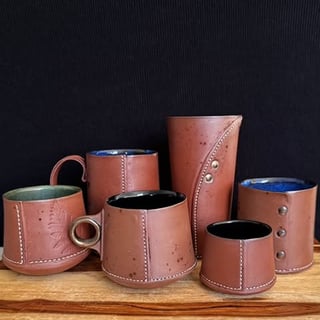
Speaker: I am really interested in these moments where we slow down and just embrace the moment that we're in, kind of like these moments of like a drink of coffee in the morning. We usually rush through that, speed on to the next thing. So I think I want to make my work something that forces you to slow down and embrace the moment you're in. So a lot of my cups will have these like really long chainmail skirts on them that kind of like physically weigh you down.
Speaker: and it's very fragile and precarious so it's something you have to be aware of how you're holding it and what you're doing when you are holding it. A lot of people are scared of like fragility with ceramics because I think it's something that can be easily broken but I really love it because it just makes you that much aware of the object that's in your hands and when we're that aware of something that's around us it just forces us to really really slow down be mindful of our own bodies and space.
Speaker: So you mentioned that people are afraid of a fragility and ceramic, and that is definitely true. So what helped you with getting over this? It's a lot of understanding that things do break, but that also makes them a lot more precious. I have a whole wall of cups that I've bought over the years that I've dropped or broken, but I still keep them around because there's a memories associated with that.
Speaker: It's a lot of the experiences that we tie to objects, and even if that experience is changed, where this object is no longer functional, it still serves as a memory holder. So I don't think an object's life dies whenever it's broken. So I think that helps me understand that fragility is okay in clay, because most of the time people are just going after that experience, that moment in time.
Speaker: I love that shaping nation. It's okay to break the pot or whatever you're making because there's always still memory and there's still lessons to be learned from that broken piece or that something that you made. I love that.
Speaker: So something I found interesting from your website is you said, my work utilizes a heightened sensory perception through sound, tactile, tactile experience and woven patterns to encourage introspection through handcrafted items and everyday rituals. Can you tell me more about this? Yeah. So as I was talking about earlier, it's easy to get kind of like swept up in like the busy nature of our lives and kind of rush through everything. And people, I have a lot of anxiety evolving around just like everyday life.
Speaker: And something that really helps me with that is these grounding techniques where you just focus on your senses and what's directly surrounding you and that helps ground you within the moment. It makes you feel calm, happier. It really just gives you a different perspective on life itself. So I was trying to incorporate these in my pieces by making parts of it just malleable things that you can move around that you can fidget things that like I make these really these cups with really long skirts on them that drape all the way over your arm.
Speaker: So they reference kind of like a weighted blanket, that sensation that there's something holding you down. So I think my hope is that by activating as many senses as I can, so you see it, you drink from it, you can move it around and be aware of it. It helps bring someone into the moment a little bit better. I love that. So can you walk me through how you get the chain look onto your pots? Yeah, it was a lot of trial and error to get that. My best friend is the handheld clay extruder gun.
Speaker: I started off using the dyes that come with it, but then I just wasn't getting the right shapes or sizes with them. So I took a sheet of an acrylic, and when I had access to the fab love at school, I cut out a bunch of different dyes with that. But I've also just used a drill to cut out these kind of like random floral shaped dyes, where when you extrude from it, you get these kind of lumpy bits come off on the coil. And from there, I just sit down and I construct hundreds of thousands of dry rings, and then I connect them together with wet run.
Speaker: wet ones. A lot of my practice is just like sitting here in the chair, just doing the same thing over and over for days on end. So a lot of it is just getting the chain done first, seeing the size of it, and then building the form of it to go around it, especially with these new like fidget spinner cups that I've been making. Because it's, it's hard to work with pieces when your cups are really wet and the chains are really dry because the shrinkage is different. So it's a lot of measuring, changing, measuring and changing again.
Speaker: It's very delicate. A lot of the times I will bisque set my forms. So the cups that have like the chain skirts coming down from it, I will make the cup. I have my attachment rings around the rim. I'll bisque set that and then I'll add the cream or chains onto the outsides of it so then I can bisque it again. So it's also a lot of bisquing.
Speaker: I love that shaping nation. Sometimes in order to make something look incredibly good, you have to be able to repeat things a lot and over and over and over and over again to get the look you want. Yeah, I think there's some beauty and repetition to it comes like it's also meditative. I find it very therapeutic to do the same thing over and over again. Just like it's my space and this is very like intimate space that I'm into. How long would you say it takes you to make all of your rings? It takes a long time. I had
Speaker: this so i have these really long chain skirt cups and there was one that was going into my thesis and it was like a week before my thesis and i was going to load it into the kiln and i accidentally tilted it wrong and the entire chain snapped off and broke onto the floor and i had spent maybe two weeks on this piece and i made that piece in two days so it depends on how much adrenaline i have coursing through my veins but i want to say i've gotten down to i can make a ring and maybe like
Speaker: 30 seconds, depending on the size of them. So I do have a lot of varieties of sizes, but I can make an entire like standard cup and maybe a day now. That is pretty crazy. That's actually insane. So let's talk about discovering your voice. What would you say was your biggest obstacle when it came to discovering your own voice? I think the biggest obstacle was
Speaker: maybe like comparing myself to people I saw online. It's really easy to kind of like see people who've been doing this for years and years and being like, oh man, why can't I figure it out like they did? But what you don't see is all the time and dedication that went into it. And just kind of like doing things that make you happy. It's really hard when you have this vision in your head that you can't quite get there to your skill set isn't there yet. So kind of doing the things that you're comfortable now and then slowly starting to make it harder as you go.
Speaker: So like I said, I started making these blankets with this chain mail and I was only ever able to work on a flat surface on a sheet because I just couldn't figure out how to move it in space without breaking it. And eventually I started figuring out tips and tricks along the way. So I think the best way that I found my voice was just kind of slowly letting myself feel uncomfortable with the process and continuing to do things that I visually and physically enjoy making.
Speaker: I love that so much shaping nation. If you will have a big idea, but you don't know how where to start, start very small and then continue working way up slowly and slowly and slowly until you're able to do it. Exactly. The easiest thing you can do. I love that. So you mentioned that you would compare yourself to other potters. What did you do to help you kind of get over this a little bit? It's from online is a really big help.
Speaker: I found that looking at historical arts also helped too because it's kind of like these forms and shapes that you see now but they're more simplified and they're kind of, there's more of a distance from you and these people who made them so you can't really compare yourself with the person of the making skill. But I think distance is just the biggest one and it's hard when like Instagram is such a high and popular thing lately and it's like hard to be an artist without putting your presence out there on Instagram or other social media platforms.
Speaker: just allowing yourself maybe like an hour on those apps a day and then just like forcing yourself to be in your own headspace for the rest of it. And also just like, yeah, exactly. Great advice right there. So can you tell me about the moment when you knew you were heading in the right direction with your pottery? I became so much more happier. I
Speaker: When I was making pottery just to make pottery, it was oftentimes I get it out of the kiln. I'll be like, yay, awesome. Into my closet you go or hide it at my parents' house or something. But I really started to feel like this excitement, like that Christmas morning buzz when you open a kiln. And I was like, oh, this is getting good. And then when I started to have more of a chance to interact with the pieces I made, they felt like they had more of a purpose to me. And that made me really excited. And I was like, okay, we're on to something here.
Speaker: I love that. So you contribute growth as an artist to never giving up when an idea is too ambitious or impossible. Can you tell me more about this? It's so hard with clay because everything is just so fragile. It's delicate. You really have to watch it and keep your eye on it. So a lot of times it really is hard to stick with it, especially when you miss that one chance. There's so many stages in clay that one step can make it all go wrong.
Speaker: And I think it's really important to just keep that visual idea in mind of what you have and just keep stretching for it. A lot of times I'll start out with a little sketch in my notebook of what I want to happen. But as I'm making it, I'm starting to realize like this is not going to work now. This is impossible right now. So I'll let the idea evolve into something else. I kind of like push the sketchbook away and I just don't look at it anymore.
Speaker: So I settle for what is working and I really really congratulate myself for those little moments because it's hard to especially when the full idea isn't being resolved. But if you get one out of the ten pieces working, that's awesome. So it's really just kind of like reminding yourself that you are making progress. You're in the studio. That's the biggest thing. That's the most important thing is you made it to the studio and you're making and that's the biggest congratulatory thing that you can do.
Speaker: absolutely great shaping nation. Your ideas may not be coming to life right now, but you are making progress. You are making progress to make an idea come to life. It's just building it up slowly. I love it. So what is something you are doing to evolve your voice even further? Not letting myself be too comfortable with what I'm making. So I had been making these really long kind of like skirted cups. I am definitely a maximalist at heart. I don't
Speaker: do simple things. It feels too easy almost. So I think what I started doing with this new matcha cup that was kind of inspired by my partner, because he's a minimalist by far, was to let myself do something simple and see what happens. Which was really hard for me, as surprising as that is. I feel like something's not good unless I dedicate hours and hours and hours on to something. But there's beauty in simplicity. You can let the cups be more by letting them be simple.
Speaker: I can make more of them and it just makes me a lot happier. So right now my biggest challenge is kind of like simplifying things. I love that. That is excellent advice with there too. So what advice would you give to someone that is trying to look for their own unique voice with their pottery? Don't give up.
Speaker: Just keep doing stuff that makes you happy. It could be as simple as like if you love dogs, put a little dog head on your cup or something and then see what you do like from it. Evaluate it once it's finished and make a list of maybe like what you enjoy, what you don't enjoy. And then continue making a new piece based out of that. I think it's easier to see the evolution of pieces when you look at the piece you made prior and bounce off of that one into the next one.
Speaker: which it also is challenging in the stream since we have such a really long waiting period until we can see the piece fully finished. But just keep having fun playing around. Notice what you notice. Definitely agree. I love that advice so much. So as we're coming to a close here today, what is one thing you want to hammer home with my audience today? Keep having fun. Clay is such a wonderful, beautiful material. It keeps us humble, but there's so much to learn in it. And even if Clay isn't your medium,
Speaker: Keep having fun, don't take yourself too seriously because it's so easy to do in these day and ages. Definitely, Grice, an excellent partner with Words Advice. Courtney, it was so great chatting today. Where can my artists go and learn more about you? I have my Instagram is at Courtney's, C -O -U -R -T -N -I -S -E. I also have a website, which is just Courtney's. I have a TikTok, but I'm not really active on it. I haven't figured that one out yet, so Instagram and my website is probably the best too to go to.
Speaker: Thanks for listening to this episode of Shaping Your Pottery with Nick Torres. If you want to start discovering your own unique voice, you must first start with the right questions. That's why I put together a free 15 question booklet for you to start discovering your own unique pottery voice. All you have to do is go to shapingyourpottery .com forward slash questions to get this free booklet.