Transcript
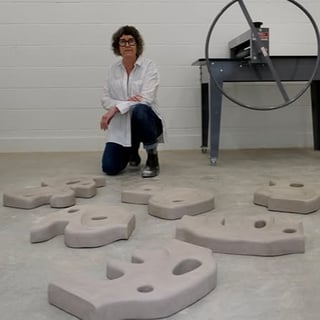
Speaker: If you love pottery and want to take your skills to the next level, you're in the right place. Find your own pottery style right here on Shaping Your Pottery with Nick Torres. Let's get started. What is up, Shaping Nation? This is Nick Torres here. And on this episode of Shaping Your Pottery, I got to interview Becca Otis. Becca makes some really incredible tactile, modern, precise pottery.
Speaker: Becca also co -runs the Wheel Talk podcast, so you can check that out by going to the Wheel Talk podcast. In this episode, you will learn how Becca makes her tactile modern precise pottery. You'll learn about why you need to be dedicated and keep on being dedicated to see results to find your voice. Finally, you'll learn about why it is so important to make for yourself first and not try to keep up with the Joneses.
Speaker: in order to find your voice. I hope you guys enjoy this episode and I'll see you guys in there. Becca, welcome to Shaping Your Pottery and share with me what is something potters should be doing to make the best possible pottery they can? Let's see. Well, I think that probably repetition is something that I always say is the best way to improve like the pottery that you're doing and making the best you can because the more you
Speaker: like are making pieces and the more you touch the clay, the more that you realize what you want to be doing differently or what you can be doing faster or more effectively. But that's pretty much what I always say is efficiency. I mean, it's, it's kind of like a quantity versus quality thing, but if you do quantity, usually you end up with quality in the end. So that's kind of how I approach it. So.
Speaker: Definitely agree, like put in the reps, put in the reps, put in the reps, and you will make the best possible pottery that you can make. I love that. Yeah. So tell me the story, how you got started with ceramics.
Speaker: So I actually started in college and I, I told my professor that I knew how to do pottery to get an independent study in pottery. Cause I needed like a couple of credits and I did not. So I actually ended up doing an independent study like alone and like, she soon found out that I had no idea what I was doing.
Speaker: And I actually learned from a lady that got her master's in ceramics and she would come in like late at night to the pottery studio and we would throw next to each other and she kind of like taught me the basics. And then I kind of went from there.
Speaker: I learned how to take wheel, which is not normal for most people. And yeah, and so I kind of like did the best I could in college. And then after that, I actually studied under a production powder. And he taught me like, how to kind of refine what I was doing and refine my movements. Love it. So you are currently living in a van. Can you describe to me the moment that you decided to move into a van?
Speaker: Sure. So I pretty much always lived in my car at some point in my life, like back in, well, after college, I suppose. So back in 2012, I lived in my van and like traveled around. And then when I was doing pottery in Washington,
Speaker: I would always sleep in my van on the weekends when I went to shows and stuff like that. So it's always kind of been a natural position for me, but I know that the economy is going through some fluctuations right now. And I really would love to not be pinned down to a certain location, but always have a bed. And so that's kind of why I chose to.
Speaker: live in a van now just because it's a lot easier to kind of like I can always park a van on a piece of like land that if I want to buy it or anything like that I can't I've already I've already owned a house I already know like what that entails
Speaker: Rent is just getting higher and higher. Mortgages are just getting higher. So I figured this was a good way to be as mobile as I can, but also be as stable as I can at the same time. So what are you doing to still be able to make pottery while living in your van?
Speaker: Sure. So I actually have two, there's two options. So I'm based out of Indianapolis and I actually have a studio in Indianapolis. That's what I'm doing right now. And that studio is obviously stationary. So it's, so I come here, like I would go to work every day and I make out of here. And so the plan.
Speaker: is to make all of my larger pieces in the month, like the couple months that I'm here. And then I have a shimpo spire, which is a small portable wheel, one of the scat fire boxes, which is a really small kiln.
Speaker: And, and, well, and also I have a diet, not down here, gift and grip mini. And so that fits on the Aspire. So I actually can do everything that I need to do on the road. That doesn't mean that I can do it all in the van. It just means that wherever I set up, I can find some power and do it there.
Speaker: Or I can go to another studio and use their studio set if needed. I have a lot of friends, I have studios. So that's kind of, it's not all in the van. I think the new hand building in the van, but it's not like, I'm not like making everything in the mayor. It's just,
Speaker: you know everything that I have that's like under my bed in my van is all pottery related stuff so it all can kind of fit there and I can like use it wherever I go. I definitely loved it. I was definitely curious on how you were actually doing that and now I know yeah because I kind of want to live in a van too like eventually not like now but I was just curious about that. So I actually want to skip this this question
Speaker: So I asked him to skip this question and I went into the van question right away, but can you describe to me the moment when you decided to become a full -time potter?
Speaker: I was in, let's see, I was in Washington and I was taking classes from this production potter and I, you know, when I was in college, I didn't really have a lot of, like I never really saw anybody that was making money doing pottery. So I didn't think that was a thing that you could do. And then when I got exposed to production, I was like, oh,
Speaker: That's it. So once I took like one class with them, and then I started doing, I started like gearing towards that in the sense of I started making the same thing. Like one class that was six weeks or eight weeks, I would make cups. And that's all I'd make. In the next class, I'd make bowls.
Speaker: That's all I'd make. And I always try to make them the exact same way I'm out and do that. So it was pretty, I think I was just watching Larry, Larry Birning is who I learned from. And I was just like, I can do that. Like that's what I want to do. You know, I had a job at the time. So it wasn't, you know, it wasn't like I was struggling to make ends meet, but I definitely felt like
Speaker: I was made to do pottery and not that it's my like favorite thing in the world, but it is definitely what I like, I'm supposed to do. So. Love it. So let's talk about your pottery. In one sentence, can you tell me what you make? I make tactile, a modern, okay. I make tactile, modern, very precise pottery and jewelry. That's my one sentence.
Speaker: So can you tell me the story of how you started making your tactile and modern, modernly precise pottery? Yeah.
Speaker: So I, I have been making kind of like what I referred to as basic bench pottery for a while. And that's just like, it's not bad. It's just good quality pottery, but it's kind of like a classic reds and greens and blues, a classic glaze, maybe some throw lines. So I was making that forever. And I, when I moved out to Indianapolis, I kind of needed something that was a little bit more.
Speaker: A little bit more something that wasn't just pottery and so. can't remember what I was feeling, I think it was the bottom of maybe Isaac shoes mod. Or it was the bottom of one of Ryan rykes mugs and I was thinking about how smooth it was and how it'd be cool if you can make that.
Speaker: that texture and the smoothness all over the entire mug and so I started making cups and sanding them down and then when I started doing that I started adding layers of glaze on top of that and those made certain textures that were really appealing so like
Speaker: specifically like dots in a grid. And as somebody who's neurodivergent, who I am, I'm very ADHD, you know, that's just like a really nice texture, especially when it's on top of something that's smooth. So I think that that's kind of like how I got to it. It was, it never started, it actually didn't start as like an aesthetic thing. It started as I was going to, I was trying to make pieces that were
Speaker: single dimension pictures on top of three dimensional items and On the back of those I was putting a finger grip Essentially in the back so that when you hold it with your hand like your thumb would go in a specific place and your fingers would go in a specific place and with wine In the back with these dots that were a little bit more textured so you could hold on to it So that's kind of how it started and then it kind of like turned into something that was a little bit more intentional and
Speaker: So now you mentioned that you were kind of like inspired by texture, but you're also inspired by efficiency. How does it impact what you decide to make?
Speaker: Well, as far as efficiency, guys, I don't know if that necessarily impacts what I'm going to make as much as much as it impacts the process of how I make that piece. Typically, I don't make anything with a handle. That's mostly because I have to sand everything and it's hard to sand it with a handle. But whenever I'm going to make those pieces, I'm always going to make them the exact same and like with the same amount of clay, the same shape, the same
Speaker: move hand movements that I'm doing so that's always gonna be the most efficient and then like When I'm painting them if I'm painting a certain color I'm gonna do for those at a time and so it's just like certain things throughout the throughout the process that kind of Like add into that and then that's the first part the second part of the question What was the second part?
Speaker: It was, you are inspired by efficiency and texture. How does this impact what you decide to make?
Speaker: Oh yeah. And then, and then obviously the texture helps. Like I've been making these things called fidget stones and they're, they're just little stones that are, they just look like little rocks, but they're clay. And I put drips of glaze on them and that makes them bumpy. And so like, you can rub them like in your pocket if you're nervous or you need a fidget on something. And yeah, so I wouldn't say I.
Speaker: I mean, I feel like I am inspired, but at the same time, it's more like this is just what I should do. Like, I just feel like it's something I should do, not necessarily like an inspiration. It's just like, oh, this makes sense, you know?
Speaker: I love that. So shaping nation, there are sometimes where you just like things where you kind of feel like you need to be doing certain things with your party. You know, you don't always do things, but there are certain things where you feel like you must do things in order to incorporate that and roll with those feelings. If you have those feelings, keep on going with those feelings. I love that so much. So can you give me a simplified explanation on how you create your cup designs? Sure. Maybe.
Speaker: I, let's see, I, well, I make my base shape and the shape is designed as, it's not, I didn't want it to be a tea bowl because I didn't want to kind of like dwell, delve into that culture, but I also didn't want it to be.
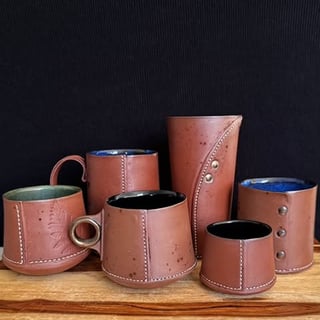
Speaker: a standard cup so it actually kind of looks like oh it's like it kind of looks like a wine glass but also kind of like a tea bowl but without the foot so there's a lot of aspects taken out of it and there's hard lines on there and so when I go to paint them
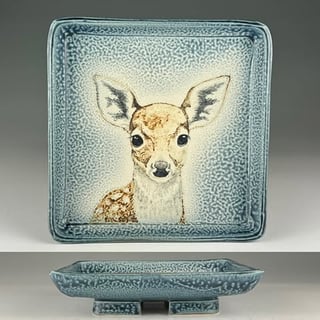
Speaker: I do a pretty like it's I would say it's more of like a mathematical equation nowadays because I'm always going to do geometric shapes and designs on the front. And those are typically with a gradient. I really love gradients and people seem to like them as well. So that kind of goes into the design and I like the dots and the texture like I was saying earlier. So it's
Speaker: I'm very, I guess I'm very quote unquote inspired by like Kandinsky from the Bauhaus movement and very like mid -century modern art. That's why my cups are, they are a speckled clay. It kind of like emotes more of a 1960s kind of like airing and just it kind of
Speaker: There's matte with shiny. So there's a lot of dimensional aspects to it, but it's still just like a picture. You know, I try to make it so that it's just like one solid piece of art on like I said, on a three dimensional item. So that's what I'm kind of like looking at when I'm making them. So earlier you mentioned that you also make jewelry. Can you tell me the story how you why you started making these?
Speaker: Sure. I started doing jewelry because, well, there's a couple of reasons. I've always been interested in jewelry, but, um, I was actually sitting at a father's market next to one of my friends who makes jewelry as well. And I was like, Oh, I really want to make jewelry. And I have this idea for something super simple. And she was like, you need to do this. And I was like, okay. And what's great about it is that it's a small footprint. And so.
Speaker: When I do the jewelry, I can do it in a van and I don't have to worry about the space that it takes up. It's a lot smaller of a space and everything can kind of like fit in one spot. So that's one reason because it travels well. And also because I really enjoy it. I love wearing earrings. I pretty much only make earrings.
Speaker: And I love wearing earrings, and I love the variety that can come with it. And I've always kind of made clay earrings. I just haven't really found what was right. And so when I finally figured out what was right, it was really good. And I'm still pulling out of the can. I'm like, oh, this is really cool.
Speaker: So I like that, you know, for me, pottery doesn't do that for me anymore. Like, I've made so many things that it's not really exciting to like, open up the kiln. It's just like, oh, yeah, that's what it's supposed to look like. And with jewelry, it's a little bit more exciting. So I love that. So shaping nation, you don't always have to make like, you know, the typical cups, bowls, teapots, whatever you can start making whatever you want, as long as it's making you more happy and bringing you joy.
Speaker: So let's talk about discovering your voice. What would you say was your biggest obstacle when it came to finding your voice? I think that the biggest obstacle, and I would imagine most people would identify with this, is making things that people like.
Speaker: you know, instead of what you like. It's really easy to, at the beginning stages, start making things that you think other people will buy instead of making something that you are really stoked about. And when you start making for people instead of for yourself, that's when you start, you know, kind of
Speaker: getting off of a path that is satisfying. So when you start like actually saying like, no, I'm going to make this, even if nobody likes it, I'm still making it. I think that that's like the hardest part to, to kind of like be confident about. And once I started doing that, cause I'm like a weird person, right? So once I started doing that and like doing the things that I actually liked and
Speaker: Definitely great. I love that so much. I also went through that. You definitely are making for other people at first, but then as you grow, you want to make your own things. And when you start making your own things, that's when it starts truly becoming your own voice. I love that so much. So you contribute your growth as an artist to dedication. How has this helped with growing as an artist?
Speaker: 100 % degree shaping nation, you have to like, build up your skills and build up your skills and trust that process. Because eventually you will be able to find your voice, you will be able to sell your potter, you just have to trust that process and keep on being dedicated to it. I love that you said that. Now, now can you describe to me the moment when you knew you found your voice or you knew you were heading in the right direction?
Speaker: I definitely agree. So Shaping Nation, a really easy way to know that you're going in the right direction with your voice is to let the market decide. If your pottery is starting to sell, then you know you're probably heading in the right direction. I love that so much. So as we're coming to a close year, what advice would you give to someone trying to discover their own unique voice with their pottery? Definitely agree. Definitely agree. 100 % agree with that. Becca, it was really great chatting with you today. Where can my audience go and learn more about you?
Speaker: You can learn more about Becca by checking out her Instagram at 5lionspottery. You can also check out her own podcast, The Wheel Talk Podcast, where she talked all about pottery as well. Hey, thanks for listening to this episode of Shaping Your Pottery with Nick Torres. If you want to discover how close you are to actually discovering your own unique voice with your pottery, I put together a free
Speaker: 4 question quiz, it's very short, it takes 30 seconds for you to take. If you want to know how close you are to finding your own unique voice, go to shapingyourpodtery .com forward slash quiz or you can simply go to shapingyourpodtery .com and it will be right there at the top. I hope you guys enjoyed this episode and I'll see you guys next time.