Transcript
Speaker: Hey, real quick before we get started, if you would like to find your own theme for your pottery so your voice really stands out and you're not getting bored with making the same thing over and over again,
Speaker: I put together 53 themes for you guys and it's completely free. All you have to do to get it is just go to shapingyourpottery .com forward slash 53 themes. That's shapingyourpottery .com forward slash 53 themes. I was at the Mesa Arts Center and I chatted with someone and she was working on her masters and she goes like,
Speaker: What do you really like? And what do you, you know, want to do? And I just remember thinking like, I really like flowers and I like functional pots.
Speaker: What is up, shaping nation? This is Nick Torres here. And on this episode of Shaping Your Pottery, I gotta interview Michael Hall. Michael makes some really incredible premium functional pottery. In this episode, you will learn how Michael creates his pottery designs using a projector and using underglazes and various other different techniques. You'll also learn about why you shouldn't fall in love with every single piece you make so you can continue growing your pottery.
Speaker: Finally, you'll learn about how to incorporate your pain from your life into your pottery. There's going to be a lot more as well and I hope you guys enjoy this episode. I'll see you guys in there. If you love pottery and want to take your skills to the next level, you're in the right place. Find your own pottery style right here on Shaping Your Pottery with Nick Torres. Let's get started.
Speaker: Michael, welcome to Shaper Your Pottery. And share with me, what is something potters should be doing to make the best possible pottery they can? I think potters should not be attached to stuff and just make as many pieces as they possibly can, hundreds if possible. And you don't have to fire everything, you don't have to keep everything, and you don't have to glaze everything. So you can always just keep making more and more and more.
Speaker: Definitely greet. Shape Nation is important to not get too attached to every single piece of pottery you make because that's how you're going to grow. The more you learn to throw away stuff, the more you're going to learn to find out what you truly like to make. I like that a lot. So tell me the story how you got started in ceramics.
Speaker: Honestly, it was in high school. I had a teacher, his name was Mr. Poindexter and he treated me like an adult. He didn't pressure me about going to college and what you plan and all these things. He was really just kind of in the moment and generally positive, generally supportive.
Speaker: And I was really drawn to that because I didn't really have that in my life. And I knew I needed to go to college and went to undergrad, Arizona state, Go Devils. And I remember thinking like, well, I want to get a paycheck.
Speaker: I like video games. Maybe I could be a concept artist for a video game company. And I started to realize I didn't like to draw that much. And I talked to a grad student at the time who was in ceramics and I was like, do I chase a paycheck or do I chase happiness? And she was like, dude, chase happiness. And my brain immediately went to ceramics and I just haven't stopped since then. I love it. I love that. So.
Speaker: Tell me the story about why you decided to attend grad school. Well, I went to Encica in 2016 and I was a high school ceramics teacher at the time and I had my bachelor's and I had my teaching certification and I was unaware.
Speaker: really the, I think that depth of ceramics at the time, I only had kind of a surface level understanding. And when I went in SICA, I was just like, completely blown away. I met my mentor there and built a lot of like,
Speaker: connections to people really fast. And it was kind of like this like club that I was totally aware of. And so my life took a turn as they do. And I was like, what do I do now? And I decided that I needed to create as many opportunities as I could with a master's. And so I decided to give that a shot. So how did, how did going to grad school help you with growing your own pottery?
Speaker: I think it helped me, it gave me an opportunity to do like, as far as the academic side, it gave me a lot of opportunity to do a ton of research and make connections that I kind of had in my gut about what means what to me and why this or why that. And then I had, you know, access to.
Speaker: tons and tons of academic articles and books and an amazing art history professor and other good professors on my committee. And I really got a chance to just kind of like reinforce some of the ideas that I have about making my own work in an academic sense. So it kind of gave me, it gave me a chance to be able to talk about, you know,
Speaker: historical and art historical aspects of like where I fit in to making pots as far as art is concerned. So you mentioned that you were doing a lot of research. What were some of the research you were doing?
Speaker: So the work I made in grad school was kind of focused on pain as far as like emotional pain and some physical pain. And I did that in the lens of like tattooing. Um, the subject matter was like related to like heartbreak and loss and abandonment and, you know, just sad stuff that everyone goes through. And so I discovered that, you know, the gourd
Speaker: Is a form that in China some folks will put like over their kids bed to absorb chicken pogs they're used as like life preservers and I mean even Sherlock Holmes this pipe is made out of a gourd
Speaker: And as I mentioned in the questions beforehand, it's like a universal thing, like gourds were used for tools. Gourds have been domesticated. They're used to put water in to keep you alive. They're used as life preservers. They absorb pain. And so I was like, Oh, that's so great. Cause it's this.
Speaker: almost ubiquitous vegetable or fruit that humans have a relationship with. And so I was like, sweet, this makes perfect academic sense for me to put like sad shit on a thing that's absorbing pain. And I mean, it, it worked out like it helped. It was free counseling, basically. So what made you want to focus more on the pain aspect of life?
Speaker: Oh, I think I was just going through a lot of pain. I think that was kind of what prompted me to, to get into grad school. And I think I'm on the autism spectrum and I have Alexa Thymia, which just means I don't have a really good toolkit to work through emotions. And as I've been aware of the diagnosis and I've done research, like side note, some of the research I did was on the autism aesthetic.
Speaker: And kind of feeling like I didn't belong. And then I'm like, Oh, outsider artists, you know, I, I'm on the spectrum. What does that mean? Are there artists that do that? And anyway, from those observations, like, I think for me, processing emotions just takes longer, maybe than a neurotypical person.
Speaker: And so I think because the world of sometimes is so intense, there's so much information coming towards me that I create a lot of connections with emotions. And therefore it takes me a little bit longer to detach connections of stuff. And I think I really like symbolically thinking. So if I could put like the heartbreak of my divorce from five years ago onto a pot.
Speaker: And make some symbols out of it. It really helped like suck away some of that, like crappy feeling that was kind of leftover. So I could put it in a pot, I could fire it. And I sold that one. Luckily, thankfully. And other ones, like I've, I broke, like I broke everything I made for my thesis, except for the stuff I've sold as a way of just like, you know, letting me go.
Speaker: Shaping Nation, you can add the pains that you've experienced in your life and you can put it into your own pottery. That is a great way to start, really start putting more emotion to it and also putting your own spin on things as well. I love that so much. So what is something you learn from your time at grad school that you still used to stay? You know, honestly, that like, it's about me. It's about what I want to do. It's about what I want to say.
Speaker: The academic side of it has value. There's no doubt about that. Just because I have a master's doesn't make me better than anyone. It doesn't make what I have to say more important than anybody else. I think a kid in grade school or high school who makes a piece and they put their energy and effort into it. And they're like, this is about my favorite cat that I had, or this is my favorite grandma or.
Speaker: A really fun experience from a summer once and a positive memory. That's just as valuable as me making the stuff that I make after 20 years with that piece of paper. I just think it's like, it was a long, long, difficult academic process to kind of remind myself that like what I make and, and whatever meaning I assigned to it matters. And, you know, like.
Speaker: Everything I make has a meaning to it or has connections to a meaning, but the second it sells, whoever purchased it, their meaning overrides whatever I've attached to it. And that's just kind of like, that's, I think to me, that's my compromise between what a lot of people say is like, well, art means whatever you think it does.
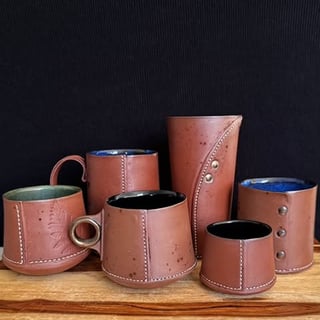
Speaker: Yeah, sure. That's valid. My take on it is art means what the maker says it does until it's sold. And then you put whatever meaning you want on it because it's your property. Yeah. I love that so much. Let's talk about your pottery. In one sentence, can you tell me what you make? I make premium pottery that looks pretty and the world is ugly. So why not take a moment to look at something nice and forget about it?
Speaker: So tell me a story, how you started making the part that you make today. In undergrad, I had always kind of thought about tattoos and stuff. I have some, I was exposed to a professor that did a lot of China painting and I really got drawn to like surface. But at the time I didn't have the sharpest surfaces I made for my bachelor's show. I made a bunch of like Super Mario Brothers characters.
Speaker: And they're all slip casted and it was kind of like this little installation piece. And I made sure the colors were correct and everything on the pieces, but I didn't, I didn't do what was kind of like happening in my head. Like I wanted to make figures with tattoos and stuff on them because I really liked the idea behind tattoo symbolism and things like that.
Speaker: And how permanent they are and pain that you have to go through to get them. And after I went back to Kansas city in 2018, I was talking with my mentor and I'm like, Hey, I want to get to grad school. I kind of feel like I'm just going through the motions. Like, what do I give me an assignment? And he basically just said, like, focus on form, take your time and quit copying.
Speaker: it basically. And so I really needed that nudge because I like assignments. I like kind of like, whether, whether or not I'm going to do it, I still want someone to be like, Hey, you should try this because I need as much input as I can. I can't just be left to my own devices.
Speaker: And so it just kind of popped into my head, like do the flowers. My grandmother on my dad's side put flowers around her house. Unfortunately she took her own life and I wanted to honor her cause I've always had flowers kind of like around me.
Speaker: And so I think I was really drawn to the yellow chrysanthemum at the time, which is like unrequited love or kind of like, you know, putting energy into something that you're not getting anything out of. And so I just kind of held that as like a sacred cow for a minute. And I, I asked a friend, I'm like, what's your favorite flower? And she's like, you know, peony. And I was like, okay. And I just.
Speaker: decided to just like let go of whatever attachments I had and like be uncomfortable and learn while I was doing it and spent 20 hours putting a flower on a mug and got lucky and sold it to one of my friends' partners. I love that. So you are inspired by universal aspects. How does this impact the way you create your potters?
Speaker: I mean, it's going to sound devious, but I could put everything personal, super personal into my stuff. And at the end of the day, it's bright. It's got gold on it and there's flowers and a fish and 99 % of the population is going to not reject what they see because we're used to vessels keep us alive. We all are familiar with flowers. We're all familiar with goldfish on some level and bright colors.
Speaker: I mean, I like them. They stand out. There's a high contrast. And I think it just like, there's a thing in education called the effective filter and high effective filter is like, you're stressed out. You're hungry. Your teacher's being mean or whatever. So you're not going to learn anything.
Speaker: And the low effective filters, like you've rest. Well, you've eaten your teachers, like being patient, the information is accessible. So you're going to learn the maximum. And I honestly just think not by not on purpose, but on accident, the stuff that I make ends up giving people a low effective filter that it's there's.
Speaker: Not a high bar pass. You don't have to think too much about it. Like the stuff I made in grad school had a ton of words on it and there was, they were very packed information and that was a much higher bar for people in a pass. And I think I just want it to be, I mean, aside from pretty, like I just want it to be easily digestible because I think the world is generally overwhelming. So why not make stuff that's not as like, as small as what I did in grad school.
Speaker: I love that. Shaping Nation, you don't have to put a super deep meaning into all of your pottery. You can keep it as simple as you want. And however you make it, that's how people are going to feel about it. You can keep it simple. You don't have to keep it overly complicated. I love that. So something I found interesting is you use a projector to help you with some of your designs. Can you tell me about how you started doing this?
Speaker: Yeah, when I taught high school in Mesa, Arizona, the two guys in the, the art department, there was a jewelry maker who taught painting and a drawing instructor who taught stained glass. And I came in to help teach our stained glass and teach ceramics. And I just.
Speaker: In their classrooms, like one of them had Calvin and Hobbs on the wall. One of them had like the school mascot. And I was just like, Hey man, how do you, how do you do that? Like, did you just like draw it with the ruler and stuff? And the guy's like, dude, no, we just project it. And my mind was kind of blown at the time. I'm like, Oh, that makes so much sense.
Speaker: And so like we, we went and got pancakes at this guy's house. He had like a big, big family and big get together on a Saturday and he's like, yeah, come check this out. And his, I think his son was like 13 at the time. And there was this full captain America, like over his bed with the shield and everything. And I was just like.
Speaker: Dude. And he's like projector. So I just thought like that makes perfect sense. And I bought a little projector while I was in grad school and there's like 120 bucks off Amazon. I think the trickiest part is like you want the highest light output you can get.
Speaker: And I got one that works like it's okay when the lights are on, but it's best when the lights are off. That might be because I'm almost 40, but I don't know. And I just, you know, I have counts that I follow on Instagram that sell goldfish. And I have pictures of goldfish I took when I used to keep them when I had a house and then all that. And I have cell phone pictures of flowers that I've taken. And I just put all those into my Mac book and trace over them in a program called Vectornator.
Speaker: which just makes vectors which are really useful to put into like plotter cutters or laser cutters or making for business cards because you can expand them infinitely almost and shrink them down and they still kind of retain their lines. So yeah I just made a bunch of vectors and then started projecting them onto pieces and I really like it because you can
Speaker: Most of the time I like it. It's a tedious thing, but I'm okay with tedious stuff. You have to kind of like move the piece a whole bunch and then shift the projector around. And then I think because of the way my brain works, when I draw the goldfish, I draw as many scales as I can. And then when I project it on the piece, I have to make these sacrifices and scales in detail. And it's kind of like a back and forth thing, but it just kind of relates to like how my brain is. I, I.
Speaker: I do freehand a bunch of petals. Once I get the main flower on all freehand petals or freehand leaves. Sometimes if I want to overlap petals or wrap it around a fish, I'll do that freehand. But for the most part, I think there's less stress in projecting the image because I get the image that I want and I don't have to.
Speaker: given to being frustrated that it's not like progressing the way I want it to at the time. I love that. Cause that is like something that anybody can do. I mean, as long as you pay for the projector, you don't have to be good at drawing. You don't have to be good at all this other stuff, but projected makes it so much easier. I love that so much. So can you explain to me how you create your designs onto your file?
Speaker: I think that's probably the most intuitive part of what I do. I guess that's a fancy way of saying that. I have to think about the answer for a second. I think usually if I look at a piece and there's like a belly to it and I look at the fish, the fish have a big belly, I want to kind of match the belly of the fish to the belly of the piece. I typically put the focal point of the flower kind of like on the belt line if it's like a tea bowl. Otherwise, I
Speaker: I just kind of find a chunk. Like if I'm doing cherry blossoms, I'll find a chunk of the cherry blossoms that from a line work point of view, I'm just like, yeah, I like that. I like the way that looks. So I'm going to do that. And then I'll just move the piece and move the projector and rotate and shift things around and just kind of fill the space in a way where kind of that like.
Speaker: It just moved me closer to accepting how the surface looks instead of like, well, I think I need more, or what can I do here? Or do I need to add this or add that? And eventually it just kind of works out. I mean, some of the flowers.
Speaker: Don't, I don't quite do what I want. And I think there's always like an opportunity me opportunity for me to change things or reconsider stuff. And, you know, a vase that has a outward bubble and then an inward and then another outward is, is difficult to project over like a plate, you know, projecting onto a plate is super easy. So just kind of depends on the form and the image I want to put on there.
Speaker: What do you use to color your designs?
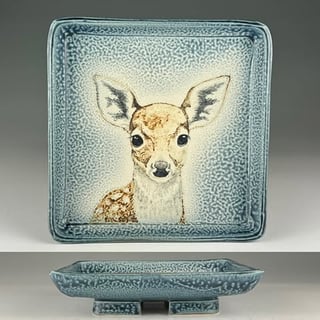
Speaker: I use underglaze. I use Famicose Velvet underglazes. I also add a gum solution into it. So the gum solution is, I think it's like two quarter cups of water and two tablespoons of gum solution. And I mix that up. And then I do about 50 -50. And I use a squirrel hairbrush. The ones that are kind of like bulbous and they hold a bunch of liquid.
Speaker: And because I project onto the piece with an ink brush, brush the lines on, and then I wax the piece, and then I'll carve it out with a, I don't know, what is it called, like a dry point needle, like a dry point stylus, because it has a really nice like V -shaped tool steel, like it's hardened steel at the end. So I try to keep that as like perpendicular to the piece as I can. And then I flood it with underglaze, biscuit,
Speaker: and then getting to the point like
Speaker: Because I've outlined everything, I basically have like these little islands of shapes. And so I can flood each island with that V gum solution and the underglaze and it eliminates brush marks. And all of the pigments just kind of like settles to the surface. It gets sucked in from sedimentation. So all the peg pigment just kind of like lands really smoothly. It looks like it's been sprayed on, but it takes a lot less time than spraying it on.
Speaker: And because the gum solution is in it, I can put that latex over the top as a resist and then I can spray the background. I can peel latex off. It's not going to take the underglaze with it. I love that. So let's talk about discovering your voice. Can you tell me about the moment when you knew you were heading in the right direction with your potter? I think it's when I just kind of like did what makes sense to me. Like I just kind of.
Speaker: I kind of let go of all the practice of making stuff that kind of looks like my metaphor. And I've thrown between 2016 and 2018, I'd thrown hundreds of pieces because I was a high school teacher. So I could kind of use that as a little side of classroom management of like, I'm working. You got to work too. Kind of thing.
Speaker: And I talked with someone who was getting their masters. I was at the Mesa Arts Center and I chatted with someone and she was working on her masters and she goes like, what do you really like? And what do you, you know, want to do? And I just remember thinking like, I really like flowers and I like functional pots.
Speaker: And then I went back to Kansas city and got that assignment from my mentor and I made my first piece and the studio that I'm, I'm in at three, two, three clay and independence is the most like welcoming and supportive studio I've ever worked in. I think all studios should be like that because it's not like so.
Speaker: It's not so nice that people don't like progress, but I think everything is like communicated between everyone in a really like supportive and, you know, Hey, we want to help you grow kind of a way. And so I got positive feedback and like any, anyone.
Speaker: Who gets positive feedback or like, okay, I must be doing something right. And now I'm going to keep trying that out. And I think as far as like.
Speaker: Finding the voice. I think sometimes like the idea of finding the voice is like inhibiting to students. I remember in undergrad, I was just like, I'm just making stuff. I don't, I'm never going to find my voice and it really like bummed me out.
Speaker: And then I think like I was frustrated about it and then I turned the narrative into, you know, something false, which is, oh, these people just make the same thing over and over again. You know, that's boring. And I think, I think whatever you do is valid. And the idea of like, that's my voice. Like if you want to attach that to what you make, that's fine. Totally. Like you should do it. Cause it is like.
Speaker: The cup that I goof around with that has a giant handle on it, that's teeny tiny. And I think it's funny when I look at it. That's my voice. The stuff I made in grad school is my voice. The, I punched porcelain cup once cause it failed and I used stamps and I wrote fucking porcelain in it. Like that's my voice.
Speaker: But I think as far as like what I'm doing now, I'm not tired of it. Although it doesn't necessarily say much to like a viewer or someone asked me like, what is this? Like, what are the connections? What's the symbolism mean? Like, yeah, I can, I'll tell you, but it's not like, Oh, I have to say this kind of a thing. It's that I, I'm still curious about it. I still want to do it. I still don't feel like I'm done. I think there's forms that I can use that are.
Speaker: more or less difficult and I can keep kind of pursuing that in an academic sense. Like I had, you know, more characters and like there's a rooster called a boss on, which is like, it's fits blue fire and it's a giant rooster, but the blue fire feels like a cool breeze, like a refreshing breeze.
Speaker: And I thought of like a person in my life at the time that was really big and loud, mean. And I'm like, Oh, that dude is totally a boss on he's all talk. And he's like a giant rooster that spits like cool breeze of a fire that, you know, like cares kind of a thing. So anyway, long story longer, I think if you can find like something that you're interested in and it keeps you curious.
Speaker: And if you translate that to an object or a drawing or a performance or, you know, pottery, then heck yeah, you should keep doing it and, you know, do it to keep your brain, you know, keep, keep making those wrinkles in your brain kind of thing.
Speaker: Definitely great shaping nation. You already have a voice out there, whether you made it a year ago or you're making it today, or you make it in the future, you already have a voice and keep making things that you are interested in because that's going to evolve your voice even further. So as we are coming to a close here today, what is one thing you want to hammer home with my audience today? Everything that you do is fine.
Speaker: Who gives a shit if it, if it fails? Failure's good. I think my favorite thing that I tell every class that I can is this story where I was a technician at the Tempe library at the Edna Vale Ceramic Center. And there was this guy there. His name was Kazu. He's from Japan. Really interesting guy. Like he worked at Honda. He told me about Honda's like design philosophy for cars. And that like, when you sit in the driver's seat, you don't see the hood.
Speaker: Cause Honda doesn't want to like remove you from the road. And then I went, I had a hot at the time it got in the car and I was like, Oh, okay. All right. I get it. And he's like, well, American cars, you see the hood. It's like roll muscle, like, you know, especially like Mustangs or stuff like that. And I was like, that's really neat. But anyway, he asked me, he goes, how did it go to it? And I was like, I was awful, man. I didn't get anything done. And he goes, you Americans not perfect destroy.
Speaker: Us Japanese, not perfect, evidence of our learning. And like that is something that I wish I knew the day I was born because I think we have this really strong desire to make the plate or make the bowl or make the vase or make the mug or the perfect handle. And I think if we did at the perfect handle, the first try, we would lose interest. I mean, it's like.
Speaker: It sure it's, it's fun to play a video game and like not die the level or game or whatever. But if you like, if there's nothing in the way that kind of slows you down or nothing that makes you think. Then it's kind of boring, but on the flip side, you don't have to be hard on yourself. If try like a 10 pound vase, if the highest you've ever thrown is like two pounds and you want to try 10 do it. And if you fail, then that's evidence of your learning. And that's a good thing.
Speaker: So like fail as much as you possibly can. Absolutely reshaping nation, fail as much as you can and learn as much as you can. That's how you're going to grow as Potter. I love that. There's some excellent parting words of advice. Michael, it was so great chatting with you today. Where can my audience go and learn more about you? I'm at on Instagram, Michael dot hall dot pottery. And I mean, sadly that's about it. I need to get a website going, but I'm, I don't have one yet. So.
Speaker: Find me on Instagram and then you can message me there like literally anything about pottery. I'm happy to share I don't like have The best answer or whatever, but I'll do my best to share what I know and we're all a team So why not like, you know play together?
Speaker: We hope you enjoyed this episode of Shaping Your Pottery with Nick Torres. Do you have questions about pottery that you'd like Nick to answer? Send them to us on Instagram at Nick Torres underscore pottery. We'll see you next time.