Transcript
Speaker: Hey, real quick before we get started, if you would like to find your own theme for your pottery so your voice really stands out and you're not getting bored with making the same thing over and over again, I put together 53 themes for you guys and it's completely free. All you have to do to get it is just go to shapingyourpottery .com forward slash 53 themes. That's shapingyourpottery .com forward slash 53 themes. I'll see you guys in there.
Speaker: taking a class or getting themselves set up with like a few really basic materials. And what I mean by basic materials is like a sheet of canvas, a bag of clay, like the basic pottery toolkit, like your needle tool, your basic round pottery sponge, like your rib, like you should just get set up with some real bare bones basics and just play around with the material
Speaker: What is up, Shaping Nation? This is Nick Torres here. And on this episode of Shaping Your Pottery, I got to interview Nicole Thomas. In this episode, you will learn how going to craft schools really helped with Nicole's growth. You'll also learn about why you shouldn't be making pots that are perfect. And finally, you'll also learn about Nicole's best advice if you are just starting out in pottery. And there are so much more in this episode as well. So I hope you guys enjoy this episode and I'll see you guys in
Speaker: If you love pottery and want to take your skills to the next level, you're in the right place. Find your own pottery style right here on Shaping Your Pottery with Nick Torres. Let's get started.
Speaker: Nicole, welcome to Shaping Your Pottery and share with me what is something people might not know about you? Something that people might not know about me is that I didn't actually go to school for ceramics. I don't have a BFA in ceramics or an MFA in ceramics. I actually went to school for art education and ceramics is just something that I've been kind of doing on the side as I've built my teaching practice.
Speaker: love it so tell me the story how you got started in ceramics so how i got started in ceramics was freshman year in high school i was not able to get an art class on my schedule guidance was saying that all the art classes were full so i just didn't get to take an art class that year which was pretty disappointing you know like you're starting high school and you're excited for those
Speaker: upper level art classes. So my sophomore year, I finally got into an art one class. And my art one class happened to be in the ceramic studio. And I kind of like had a conversation with my ceramics teacher and just made a deal with him. I was like, I'm not interested in art one, but I really want to do the pottery wheel like
Speaker: can we work something out here and at first he was kind of like I don't think you're gonna be able to do the wheel like you can try to do it but I don't think you're gonna be able to and just hearing someone tell me that I wouldn't be able to do something like totally sparked a fire in me and it made me really want to do it so I just kind of sat down at the wheel and things started coming together and I've been making pottery ever since that moment.
Speaker: I love that. I love it when people tell me I can't do something. That is such a fire. I love that so much. I will succeed using pettiness as my energy to thrive.
Speaker: Exactly. Save here. I'll prove you wrong no matter what. I love that so much. You contribute your growth as an artist to participating in a work study programs at major craft school. Can you tell me about these experiences? Yeah, definitely. I was actually googling a little bit this morning to make sure that some of what I was sharing would be up to date.
Speaker: So there are craft schools all over the country. Some of my favorites are Aromont School of Arts and Crafts in Galliburg, Tennessee. You have Watershed Center for Ceramic Arts in New Castle, Maine. You have Panaland in North Carolina. All these schools, they have work study programs or they have
Speaker: studio assistantship programs or they have scholarship programs so if you were really interested in ceramics and you wanted to go someplace to learn more about ceramics but maybe you didn't have like all of the money you needed up front to do something like this what you would want to do is you'd want to visit all the websites for these different craft schools and kind of like get a list together of all the opportunities to apply to and something that i think is important to keep in mind when you are applying for things is
Speaker: it's easy to feel like nervous to put yourself out there but you also have to think like these schools need to fill all of these studio assistantships, they need to give away all these scholarships and they have to fill all their classes so it's almost like a numbers game and if you go into it thinking about it like that just get your portfolio of 10 images together, get your resume together, get your cover letter together and then in January
Speaker: Most of these applications are due and you should just apply to everything you see and then see which opportunities you get accepted to and take the chance and go do a workshop there and see how you can learn more about ceramics and how that will influence you. I love that. That was probably the best explanation about doing that I've heard so far.
Speaker: So how did participating in these programs help with your growth? I feel like they gave me opportunities that I didn't have inside of an art education major and that I didn't have at a school that wasn't like a ceramics forward or ceramics focused program. Like being at the craft schools, I got opportunities to do wood firings, salt firings, raccoon firings.
Speaker: you had opportunities to take workshops with different artists that were there. And then in some of the situations, if you're doing like a work study program for the school, you're also working with the people who worked their full time. So you see how people are running a nonprofit organization, you see how they're
Speaker: working to fill classes, you see how they're working to fundraise or talk with donors about things. And if you have one of those jobs like an office job, you get to see more about how they're running the business too, which is really great because as an artist, one day you're going to want to sell your art and that's going to be your own business. So it gives you a chance to learn about some of that stuff too. I love that so much. So what is something you learned from these programs that you still use today?
Speaker: I feel like something I learned from these programs is being there, I got more comfortable working with kilns and being around kilns. And that was something that I didn't have as much experience with. So when I came home, I was a little bit more comfortable with loading different types of kiln. And I had some ideas about maybe equipment that I would want for my own ceramic studio. I love that. So let's talk about your pottery. In one sentence, can you tell me what you make?
Speaker: I make small batch handmade ceramic objects. Perfect one sentence. I love it. So tell me the story how you started making the part that you make today. So I've been making pottery.
Speaker: since I was 15. So that's 20 years, which is crazy when I sit down and think about it. I cannot believe that it's been that long. But the pottery that I'm making today kind of came out of a residency that I did at Watershed. And at that residency, Jack Troy was the lead artist there. And we all went there to do a wood firing with him. And I got a chance to watch him throw on the wheel one day. And he showed me a little bit about how he alters the lip of his pieces and how he adds a little bit of texture to the body of his pieces.
Speaker: At this time I had been doing different types of atmospheric firings and I was looking for a way to kind of embellish my surface without necessarily going in and like painting a design on it because I didn't want to do a detailed underglaze painting and then have it get like covered with wood ash and wood firing. I wanted the surface to be open so that if you get like a good flashing spot it would highlight something like that.
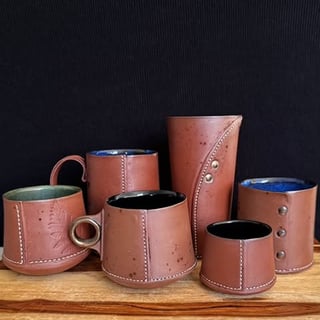
Speaker: So what I do now is I do what I call my signature style and it's kind of inspired by Jack where at the end of throwing my piece on the wheel I alter my lip a little bit so it has a little bit of like wobble a little bit of fluidness to it and then I'll drag my finger all the way up and all the way down the piece and kind of put these organic ridges in the side of the pieces like actually you could see it right here this is the the
Speaker: physical texture that I make on my piece so I do this up and down once when it's on the wheel and then I come back a second time on the day that I trim and I do it again with the edge of my loop tool and this style pottery is like what I've come to currently and what I'm creating and I want all of the bodies of my forms to kind of have this signature style on it so that people know that I made it.
Speaker: That is so interesting because I would always get those by accident, but you're doing those on purpose. I love that. I feel like it takes you a long time in pottery to come to a point where you're comfortable making pots that aren't perfect. Like when you first get started on the wheel, you make this bowl and the bowl has a circle shape and you don't want to even move the bowl off the wheel head because it's like perfect and you don't want to ruin it. But when you get to a point where you're like,
Speaker: I have the skill to make the piece. How do I put my signature style onto this piece? How do I make it own, put my thumbprint on it? How do I make it look like it came from my hand? So as you mentioned, you got comfortable with messing up the pottery. When did you start becoming comfortable with messing up your pottery? Well, I don't know if I'd really say messing it up or if I'd say becoming more comfortable with
Speaker: changing the format of the surface, like wanting the surface to have a texture on it versus wanting to make like a perfect bowl that didn't have a texture on it. I'd say it took me a couple of years into ceramics, like probably like a good, a good like six to eight years to come to the point where I didn't want to make things that looked like you could buy them from a store that came from a factory. I wanted to make things that looked human, that had my thumbprint on them, that really had that handmade quality.
Speaker: I love that. Shaping Nation, if you could add that human element to your pottery, it just makes the pottery that much better. So try to keep those human elements in your pottery. It doesn't have to be perfect. Yeah. Love that so much. Yeah, absolutely. So you are also a high school teacher. Yes. Can you tell me the story how this came to be? Okay, I'm going to tell you the full story of how this came to be. So I was
Speaker: I was teaching elementary school are on a cart in an extended maternity leave position. So I'll explain that there was a teacher who was on maternity leave and she knew that she was going to extend it and be out for almost two years. So I had agreed in advance to work at this job for two years and
Speaker: It was a really great opportunity to have this job, but my goal was to be a high school ceramics teacher. Like I had known when I started art education in undergrad that I wanted to be a high school ceramics teacher, and this is just something that's been churning in the back of my mind for years and years and years. So I'm working at this elementary school teaching Art on a Cart, and I see the opening for my current job online.
Speaker: and i apply for it but when you apply for it they ask you if you're currently under contract which i was so they will filter the applications and they don't even call you if you're under contract because they need somebody that is available because the job is open so i like don't even get a phone call for the job and i thought about it for months like i had applied for it in
Speaker: march and from like you know the the winter into the spring into the summer i'm just thinking about this job and thinking about how i really wanted this high school ceramics teacher job and for months i'm just thinking about it so we're coming to the end of summer and i don't have a job lined up for the fall so i'm panicking you know i'm really thinking like what what am i gonna do with myself
Speaker: So I see the same school district posts a part -time elementary job and at this point like my contract has ended with the elementary school job. I don't work there anymore. I'm looking for a job. So I see the school district they post an elementary position and I apply like lately.
Speaker: on in the day like 3 p .m i finished the application and then the next morning at like 8 a .m my now boss calls me and he says hey we saw your application do you want to come interview for the high school ceramics job and it's this job that i've been thinking about for maybe six months that i've been really wanting to have and he doesn't even bring up that i applied for a part -time elementary job he doesn't bring up like i just submitted the application yesterday he's just like so how soon can you get here to interview for this job and i go
Speaker: and I interview with them and it's it's the end of summer so there's no sample lesson you know they're like if you can sit down with three people and make a good impression like we're gonna we're gonna let you shoot your shot and come to the school and try and teach here and it worked out for me they gave me a chance and I've been working there ever since I'm about to start my sixth year at this high school. Let's go I love it so what made you want to become a high school teacher?
Speaker: Definitely the relationship that I had with my high school ceramics teacher, he just, he did a lot for me. And I feel like in my job as a high school ceramics teacher, I'm drawing more from the lessons that I was taught in high school than I was for maybe some of the lessons that I was taught in college, just like
Speaker: thinking back to what my high school ceramics teacher would do with us I'm trying to really pull from that and do that with my students because I think that some of the I guess what we would call today like student -centered approaches some of the student -centered approaches that he used I really liked them and now we're at a point in education where like we've rebranded that like we've given it a new name and we call it something different but still that idea of like asking kids about the type of art that they want to make and then supporting them in a space where they can make that art
Speaker: I love that. So you are inspired by your high school students and the opportunity to teach. How does this impact the way you make your pottery? I feel like this impacts the way that I make my pottery because sometimes when I'm feeling tired or frustrated or I'm not feeling experimental and I'm not in the mood to like break into something different.
Speaker: sometimes the kids will ask. They'll see an Instagram video or they'll see a TikTok and they'll be like, hey, I saw all these materials. Can we do a firing like this? Or do you have this type of clay? Or do you have underglaze? I want to make this piece. And when they want to start experimenting, it'll make me start to experiment with them. And then it kind of gives me the juice I need to keep going and not just sit down and take a break. I love that so much.
Speaker: If someone was pretty new to pottery, what is something they should know to start seeing the success in pottery? That's a great question.
Speaker: So if someone's new to pottery, the first thing I would say is that they should definitely consider taking a class or getting themselves set up with like a few really basic materials. And what I mean by basic materials is like a sheet of canvas, a bag of clay, like the basic pottery tool kit, like your needle tool, your basic round pottery sponge, like your rib, like you should just get set up with some real
Speaker: bare bones basics and just play around with the material and get yourself to a point where you are making things that are I don't want to say like successful but I want to say like things that are made I guess efficiently so if you're coil building you want to get to the point where you're building with coils and your coils are like drying and there's no cracking in between your coils or
Speaker: to the point where you're like building the form you want and the form is like staying and drawing appropriately and you're not having any S cracks or any other issues where pieces are attached. So I'd say like get yourself some materials and get comfortable with the foundational skills. You're slipping and scoring, you're rolling coils. If you're on the wheel, like centering on the wheel, build those basic skills
Speaker: Before you get too far into it and say like, oh, well, I'm going to buy a wheel. I'm going to buy a kiln. Like I'm going to sign up for like a 10 week course somewhere. Like get yourself to the point where you worked on your skills. You got your, your pottery reps in and you know what you're doing. And then when you know what you're doing, decide what you want to do next.
Speaker: I love that so much. Shaping Nation, you don't need to make it super complicated to get into pottery, especially if you're new. All you need is a bad clay, some tools, and that's it. Just start playing around with the clay. You don't need a wheel or anything. I love that so much. That is great advice. I would add one more thing to that. I've gotten a lot of questions about this recently. I've even encouraged people who will ask me for material recommendations.
Speaker: to order a bag of air dry clay because it's it's not it's not going to be exactly like your kiln fired clay obviously because they're different materials but if you are just getting started and you need to do like below bare bones basics do the air dry clay you can even find kits that have lots of tools and once you're ready to upgrade to your kiln fired clay all your tools are going to be exactly what you need so it's still the perfect jump off point.
Speaker: absolutely love that advice so much. So now can you explain to me how you create your unique designs onto your pottery? Yeah, we talked about that a little bit, but I definitely want to talk about it again. So I create my unique designs on my pottery, I call it my signature style. And what I do is on day one, when I'm throwing on the wheel, the last thing I do is I kind of like stick my fingers all the way into the form.
Speaker: And as the wheel is moving, I will pull up to the lip and then down again, kind of creating a little bit of a wavy texture. And then on day two, when I trim, I repeat that same up and down motion with like the little corner of the squared end of the loop tool. So I have a little example right here. This is one of my wave mugs, but you can see how I have just a little bit of this physical texture on the surface. That is my signature style and that is how I make it.
Speaker: I loved it. That was a very great explanation of that. So let's talk about discovering your voice. Can you tell me about the moment when you knew you were heading in the right direction with your pottery?
Speaker: I feel like a moment where I knew I was heading in the right direction with my pottery was when I got my signature style kind of worked out and I knew that I was creating forms that would be successful in a low firing, they would be successful in like a mid range cone six firing, they'd be successful in a wood firing or a high firing, like pieces that would transcend the different firing methods and still just have like a strong form and a good surface to take on any type of glaze. I love that.
Speaker: Outside of attending your work study programs, you also contribute your growth to establishing a home studio. How does this help with your growth? I feel like the home studio helps so much because when you're interested in firing your kiln, you can just get yourself organized and fire the kiln and you don't necessarily need to be in a community setting where you need like other people to have work to fill the kiln. Like you can just
Speaker: work by yourself, which is kind of what I like to do. Or you can work on your own timelines, where sometimes when you're at a community studio, they have their own firing schedule. And you know, like around the holidays, for example, like you have to be organized around their final kiln before Christmas. But when you have a home studio, you're not limited like that. So I feel like your creativity can really just soar because you're not working on someone else's timeline.
Speaker: When was the moment when you knew it was time to build your own home studio? That's a great question. So one summer I waited tables and I had the cash from the tips from waiting tables. I was like 17 when this happened and I just went ahead and I bought a pottery wheel off of eBay. And then after I bought the pottery wheel, I told my parents, by the way, I bought a pottery wheel and
Speaker: they they were like they were okay with it they said oh we have this space like you could put it in this space and my dad owns a business so i think we actually worked it out where like they brought like the freight shipping company that brought the wheel actually brought it to his business so it worked out better than a home delivery and that was when i first got my wheels when i was a teenager and when i was taking classes at school i just said you know i'm really into this i really want to have the wheel and
Speaker: I actually have students like current high school students that have done similar things like they've decided that they want to set up studio spaces and they've gotten themselves wheels and they're like rocking and rolling and making pots in their garage this summer so it's definitely doable so when I was 17 that's when I first was like I really want to get the wheel so I had the wheel and I would throw it home and then I would bring my pieces in to the high school that I went to and I would fire my pieces at the high school
Speaker: A few years later, when I was 19, I was looking on Craigslist a little bit, and I found my first kiln. It just felt like the right time. The kiln was $300, which was a reasonable investment. It's a tiny kiln. It's a Paragon China Painter kiln. The interior of it is maybe 17 inches by 15 inches, so it doesn't hold a lot of pieces. For a teenager, that was the perfect kiln.
Speaker: I went and I bought that when I was nineteen and I've been I've upgraded my count since but I'm still using the same wheel so like a lot of those Materials and pieces of equipment that I first started with those are the things that I'm still using today. I love that how long have you had we said you were seventeen so how long have you had the wheel that you have today. I guess I've had it for eighteen years.
Speaker: That's a long time for a wheel. I remember I was around the same age when I decided to get my first wheel. I had just turned 18. I was like, I want a wheel. And that's when I got one. I love that. And you know what I would say to people too? I would say buying the pottery wheel is a lot like buying a used car. So if you buy a car, like for example, if you get yourself
Speaker: a sturdy, reliable Honda CRV, and you drive that thing around for a few years, it's not going to be worth exactly what you paid for it, but it's going to hold its value because it's a reliable car. Everybody knows the Hondas are good cars. If it has the all wheel drive, you're like the chef's kiss, right? You can sell that CRV and get some of your money out of it. It's like the same thing with pottery wheel. If you get a good one, if you get a creative industries or you get
Speaker: a shimpo wheel or a brent wheel those wheels are really going to last the test of time so if you come to a point where maybe you're moving or if you come to a point where maybe you're ready to to like sell your old wheel and buy a new one they're going to hold their value and you can sell it if it's something you lose interest in or something that you're looking to like upgrade so i feel like people should be
Speaker: more open to getting wheels and maybe like less excited about buying kilns. Because I feel like the kiln, you really need to have things set up in your home to have that kiln operating safely and effectively, but you're not having all of the safety concerns with the wheel that you have with the kiln. So I think the wheel is like a much better place to get started. Absolutely agree.
Speaker: The better investment between a wheel and a kiln is the wheel. Go the wheel every single time. I love that. So if people want to start making their own style come to life, what should they focus on to make that happen? Oh, that's a great question.
Speaker: I think what they should focus on and something that I've been trying to think about, like when I'm coming into working in the studio, I think about preparing my space before I'm ready to be there. So if I have studio time, I want to wedge my clay the day before. And I know this sounds a little bit silly in terms of like finding your voice, but if you aren't walking into your studio, actually prepared to work, like if you're walking into your studio and you can't find your paintbrush or you don't know where that box of clay is or
Speaker: Your wheel has the clay bucket from last session still full with all the slop from the last time you're on the wheel. If you're not cleaning your space and prepping it before you go into it, you're not going to be able to do your best work and find your voice because you're spending all your time playing catch -up on the things that you should have already done. I would say being more intentional about your studio time, prepping yourself the day before you get into the studio is the best way to find your voice because then those studio sessions are going to be more meaningful and engaging because you set yourself up for success.
Speaker: I love that. Another good thing people could do is to leave everything where you found it. So like it's easy to find again. Yes, yes. And another thing, always, always make sure you have two needle tools because it's always going to be the needle tool that you lose. It's just going to like, if you don't have the mud shark needle tool, like if you just have the round one, it's just going to roll away. It's going to fall off your, your tabletop. It's going to go behind the desk and all of a sudden you're like, where did the needle tool go? So always get the second needle tool.
Speaker: Great advice right there. I can't tell you how many times I'm like, where the heck is this thing at? I love that. So what is something you are doing to evolve your voice even further?
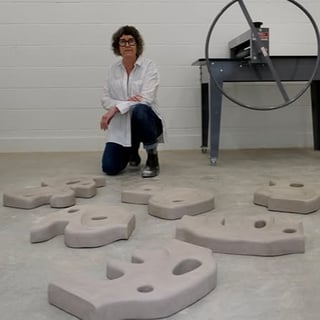
Speaker: Ooh, that's a great question. I think something that I'm doing to evolve my voice even further is I'm working on an amphora series. So I'm really interested in Greek vessels, the Greek vessels with the two hands on them or the two handles. So I've been trying to push myself to throw bigger and push myself to make these amphoras. And I feel like it's a little tricky to go bigger because then I need more storage for all the things that I'm working on, but pushing myself to make bigger work and trying to find work that has
Speaker: narrative that's also like pulling in ties from art history and being like this is this is like what I'm nodding to like I'm nodding to these Greek vessels and I'm recreating them in my own studio practice and this is a story that I'm trying to tell with these pieces. I love that so as we are coming to a close here what is one thing you want to hammer home with my audience today? Always keep creating.
Speaker: love it. That was excellent. Always keep creating because that's where how you're going to find your unique voice. I love that so much.
Speaker: Nicole, it was a really great challenge today. Where can my artist go and learn more about you? You can follow me everywhere the internet exists at Classic Clay Works. I am on Instagram, I'm on TikTok, I have an Etsy shop, and I also have a newsletter that you can join. So if you go to the link tree, link in my bio, you can join my newsletter. You will get a coupon code for 20 % off your first order, and I'm actually dropping my next collection on
Speaker: September 15th, Friday, September the 15th. So you have like the breaking news exclusive on that. I haven't shared that anywhere yet. I haven't even shared it on Instagram. That is the deadline that I'm looking towards for launching my collection. So if people are interested, those are places you can follow me. And the newsletter is just the best way to stay, stay on the list, say as like the first person to know when the collection launches.
Speaker: We hope you enjoyed this episode of Shaping Your Pottery with Nick Torres. Do you have questions about pottery that you'd like Nick to answer? Send them to us on Instagram at Nick Torres underscore pottery. We'll see you next time.