Transcript
Speaker: Sign up for my newsletter to never miss an episode of Shaping Your Pottery.
Speaker: Welcome to Shaping Your Pottery with Nick Torres. Today, I am interviewing Dolores Farmer. She makes some wonderful pottery. Each piece is truly unique and you can really see her passion for her pottery. She is recently gonna be starting a new pottery studio. You can learn more about that on her website at DoloresPottery .com. And also follow her on Instagram at DoloresPottery. Dolores, welcome.
Speaker: Thank you. Thank you for having me. So I thought we would we could start off with something that you kind of did recently. And that was a craft show that you just did. Could you tell me how that went?
Speaker: It was good. It's very different since the pandemic. The crowds aren't quite the same, but I find that people who do come out are coming out to actually support artists. So it's a little bit less of conversation and more people actually on the hunt to buy things, but it was really good. It was refreshing because it was one of my first shows in a while since the pandemic started. When was the last time you did a show?
Speaker: Well, the last part of the in -person big show, at least a year ago, I did some small farmers markets. I did that for a while, but a big, big show was right before the pandemic started.
Speaker: But I definitely did a couple of small farmers markets last year. The online sales has been the way to go now. Yeah, online people can buy things for me now. It's a lot easier and especially easier for me because dragging around lots of pottery. You can throw your back out doing that. Yeah. Do you plan on doing more shows like coming up this year?
Speaker: I plan on doing just a handful. So I'm in Durham, North Carolina, and here we have a big festival for the Eno. And it's a way for the Eno to raise money for the natural park and to preserve all the acres that are there. And so I participated in that. It's one of my biggest shows of the year. And that's July 4th weekend. So I'll do that show and some Christmas shows, but I'll be focusing my efforts
Speaker: to sell my pottery through my new studio that I'll have up and running next month. So now, you mentioned this new studio. Could you tell me a little bit more about that? Sure, sure. So honestly, when I first started making pottery, I didn't think I would actually build a pottery community. It was more like, I want to make pottery, I want to sell it.
Speaker: And I'm currently at a art collective at Liberty Arts in Durham, and I was able to grow this space from a personal studio into a whole entire pottery community where we have six -week classes, people can rent space for me, and fire in my kilns. And last year, East Fork Pottery partnered with me to raise money for a new place. So my current studio doesn't have heat, doesn't have AC, it's really hot in here.
Speaker: And for those who work in clay know that heavy fans in the clay studio is not an ideal situation. And so we were able to raise some money and I mean Durham is it's like an up and coming place like the rent is going up there's a lot of money moving into town, but I was able to find a place just two miles from where I met currently.
Speaker: I'm like, all right, we're going to go ahead and do this second studio because we were kind of bursting at the seams here in this place. We'll have heat and we'll have AC. So we'll be really great. But the new space will also have six -week classes. We'll have one -night party classes, open studio passes where if you have some experience, you can come in and rent space for six weeks and just kind of work in the studio. There's supplies provided.
Speaker: And it's just kind of grown and I'm fairly surprised because I thought I would be strictly focused on making pottery. But there's something about coming in and other people are working and you can kind of talk and talk shop about pottery and share ideas. It's been really rewarding for me as an artist here. If you wouldn't mind telling me, how much money did you raise for this new pottery studio?
Speaker: Well, we raised about 40 ,000, which was, blew my mind for that. But, you know, equipment's extremely expensive. We're gonna purchase nine wheels. There's a lot of renovating we'll have to do to the place. I actually have an electrician coming in and get stuff set up for the kilns, but purchase kilns. And when I started this budget a year ago, I was like, okay, I think we can do this, but everything's gone up.
Speaker: everything's gone up in price. And so we've had to shift some ideas about what we're doing. So now I'm like looking at some more used equipment to offset some of the costs of newer equipment. There's a lot of shipping and supply issues with newer equipment. So that in and of itself has been quite challenging. But I think we're gonna make it. I think it's gonna work.
Speaker: That is awesome. So when it comes to kind of getting, I guess, people into your community, how would you approach that? So right now I have, I mean, well, the pandemic kind of threw off a lot of things, but the farmer's market was a great source of community connection for me. I mean, I was out there every single Saturday for most of the year. I know there are people who've been following me since I started doing this seven years ago.
Speaker: So they have some of my earlier pieces. And so that was a huge way for me to connect with my community. And now it's a lot of social media. And people subscribe to my newsletter, which should go out every month, but it really kind of goes out every other month. But that's been my way to connect to the public in terms of letting people know what's happening. And so this week, actually, we'll start seeing a newsletter to let people know we had the new space coming. You could sign up for classes. This is how you can support.
Speaker: And so yeah, social media has been the saving grace during this pandemic. That is some really great advice. I might start doing that as well. So the next thing I thought I would talk about would be your flower mugs or your decal mugs. Could you tell me the story behind that a little bit?
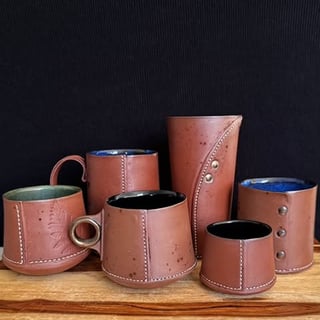
Speaker: Hey, I like trying new things. I have a set style that I do, and it's very similar to these tree bark mugs, I mean, bowls. And these are actually just featured in pottery and making illustrated, and we had we did an article on this. And so this kind of texture slip and color, my main focus is what I do all the time. But as a production potter, it can get a little boring to make the same thing over and over again.
Speaker: And so I was really interested in having more color on my mugs and having some sunflowers. I grew sunflowers for the first time during the pandemic. And I was like, man, if I could have some mugs with sunflowers on it, that would be pretty awesome.
Speaker: And so there's a company called Milestone Decal Art. And I've used them before for some other things. And they had sunflower decals. I bought a sheet. And I was like, I'll try it out. And then she came out really well. And I was like, wow, all right. Well, we're going to make more of these. And it just kind of became a thing. And so I normally make them in the spring and the summertime because people, their sunflowers are growing. They got their pollinators out. And the bees are out and about in their gardens.
Speaker: And so it's something different for me. So I can take a break from my normal routine of what I make, make something different. And so when I go back to my normal production cycle, I feel a little more refreshed. I feel like I kind of let out a little bit of the creative energy that sometimes gets bottled up when I'm making things over and over again. And would you say that kind of helps with your workflow a little bit?
Speaker: Oh, yes. Yes. I'm kind of much happier with my production cycles now that I break it up. So it's like, oh, I'll do my normal setup. I'll try something different and then I'll go back to my normal setup. So things don't get stale. It always feels like I'm doing something new every time. Right. So now, could you explain to me how you actually used to be cows?
Speaker: Sure. So these particular decals are printed with a special ink that fires onto the clay. So you can think about it like the fake tattoos you would use as a kid. So the sheet of paper, you soak the decal, it comes off the paper, and it's on this kind of
Speaker: clear, sometimes pinkish yellow film that burns off in the kiln. So I'm able to rest it on the pot, move it around, smooth it out. And then when it fires, the excess film burns off and the ink remains onto the pot. And so it's completely fired onto the pot. It's not like a sticker decal where you can scrape it off. This is the set and it's adhered to the clay and the glaze itself.
Speaker: So it requires a third firing. So anybody who does probably, you know, you bisfire your pieces and then you blaze them. And then with decals, it's an additional firing on top of that. So sometimes people ask about prices like, oh, these are more expensive. It's like, yeah, there's a whole nother step on top of making those mugs. So normally when other mugs would be done, there's a whole nother round with this one. Are you able to put them in the dishwasher?
Speaker: After this, you can put all my pottery, my functional pottery in the dishwasher with the decals. I normally recommend not doing that, the longevity of the decal itself. But I do it at home in the totally fine. But I normally just recommend to customers not to, but I totally put all my dishwasher.
Speaker: I like it makes nice. Yeah, so I think the next thing I like talk about so use a wide, a pretty wide variety of techniques. Could you tell me what technique would be your favorite. Well, you know my favorite.
Speaker: It might be a tie between pit fire and raccoon fire, and those are more of my decorative pieces. So they're more primitive, they involve open flame or a blue torch. So really quick, what I have in front of me is this kind of coppery color vase.
Speaker: And this is a rectifier piece. So this is one where I glaze it. I put it in a kiln that's been gutted. I hook up a blowtorch and a propane tank and light it up. And it heats up until about 1850. And at that point, I suit up with some leathers and some face shields and some gloves. And I pull this piece out and put it in sawdust and it catches fire. It's really cool.
Speaker: And then I cover it, starve it of oxygen and the copper and the glaze turns this reddish pink color. So with raccoon fire, I mean, I love it. It's the whole flame aspect that's slightly dangerous. You're not quite sure what's going to happen. And it's always different, every single firing.
Speaker: I love it. So that's definitely one of my favorites. Pit firing is even more permanent. It's where you dig a hole in the ground, you put your pots in there. I normally throw some sea salt, maybe a little bit of copper scrap pieces, some pimp string, soaked in sea salt solution, set it on fire, and then you come back the next day and there go your pots. So it's like as simple as you can get with firing pottery.
Speaker: And I like the simplicity of that. And most of the time, the pieces that I get from that firing will have a very abstract look to it. So the copper in the firing will blush pink. And so if you have a piece of copper right inside a pot, it may be really intense pink or magenta in one spot, and you kind of fade out, almost like a smoky effect. It can be very beautiful. And every single piece is completely different. So I think it might be a tie between those two, those type of things.
Speaker: Now, when you're doing pit firing, how do you keep it manageable? I guess like the heat is getting hot enough. Well, it's.
Speaker: For me, I feel like I have a wide range for error in that firing. So I only let it run for about two hours. So I lay wood in the air. Once it starts to die down a little bit, I'll throw some more on. But after two hours or so, I let it die out on its own. And so it smolders the seesaw and the copper continue to fume on the pot. And I normally just wait until it's cool enough for me to dig the pots out. I know some people who fired for longer.
Speaker: But I found that I get the same results from like a short firing versus the firing in less seven or eight hours. How long have you been doing these pit fires and RACU firings?
Speaker: So I've been doing them almost as long as I've been doing pottery. So I'll show you about six years. My very first year selling pottery full time, I didn't realize that if you're trying to apply for Christmas shows, you have to apply like in February and March.
Speaker: and so it's like November and I'm like oh man I don't have any shows for Christmas and I need some money so I decided to have a home sale so I made some flyers I'm posting them all over town and I was like hey I'm gonna have the sale at my house please come by probably and as a draw I decided to do a pit fire and I've never done a pit fire before in my life I like googled it and I was like okay I think I can just
Speaker: make a fire, throw some pots in there, and it'll be okay. And they actually turned out really well. They were very lovely. It was a two -day sale, so like the first day, the Saturday, people saw the fire, and then some people came back the second day to actually purchase the pieces that they saw being fired the day before. And so I think also part of the reason I love it so much is I like took a chance on it several years ago, and it worked out, and it's just kind of always worked out for me since.
Speaker: I love it that I, I liked that a lot. Cause I kind of did the same thing when I was first trying to do a raccoon and I was like, whoa, this actually works. I love it. It's pretty exciting, right? I can do this. So now the next thing I would like to ask you would be if you have to choose a tool or equipment that kind of helps you out the most, what would that be? What tool would that be? Oh man.
Speaker: Oh, that's a tough one. I guess my most used tool is the Sherman, what's it? It's my tool, Sherman mod tool. It's this particular one here. So when you buy your first pottery tool kit, you're gonna have a lot of different tools in there. And one of the ribs that they have will be a wooden version of the same tool here.
Speaker: And I find that it's a little thick, it's a little chunky, and it's not flexible. So I find it very hard to make straight cylinders with it. And so what I have here with the Mutt tool is this green rib, it's a plastic, it's stiff, but it has a little bit of a give to it.
Speaker: And they have different ribs and different stiffnesses. But this is like perfect. I use this on almost every single piece that I throw. It is, yeah, it's my favorite one. When I can't find it and I have to use something different, I'm not a happy potter. This is probably the number one tool in my tool chest here. How did it help you with like your actual making of the pottery?
Speaker: Well, it helps to get really straight form. So you always want to compress when you're drawing pieces. And a lot of my pieces at some point are a cylinder before they're being shaped. And so I'm able to compress this and shape the pieces with this tool. And it's a finer point than the wooden ribs. So I'm able to, for me, pinpoint certain areas that I can't with the chunkier tools.
Speaker: So it's just extremely helpful. And so like, you know, making a face like this, I can get a nice straight form with this rib. Even with this mug here where it's slightly angled in, I can use the tool to slant it in and shape it. So I'm just able to manipulate the clay better with this particular tool. That was fascinating. I might have to give myself one of those. So could you tell me,
Speaker: about the day when you decided to go all in on just your pottery? Oh, yeah. So I think there were kind of like stages. So the first time I thought about maybe doing it, I was in college. I was an English major, I was a junior, had no idea that I was going to do after college. And I took a pottery class because you know why not?
Speaker: And I was like, oh, this is awesome. I made a sculpture, like a torso piece, and the art department decided to use it as a promotional piece for the gallery that they have there. And I was like, oh my god, they have my piece like all over the marketing and the flyers and stuff outside. I'm like, oh, OK, this is something. And so that was like my first step in trying to explore what I was going to do.
Speaker: That same year I got an assistantship at Claymakers in Durham and what they do there is in exchange for working there, you get free classes and access to the studio. And so I stayed there for five years and I was able to learn everything I needed to know about making pottery, how to run my business. And I was still working several jobs, part -time jobs here, part -time jobs there. And I was working at a call center
Speaker: And my little cubicle, I was like, I don't think I can do this anymore. And so I left. I left work. And I was like, I can't come back. And I need to figure out what I'm going to do. And that was the day I was like, all right, I need to look at markets. I need to figure out how much pottery I need to make and sell every week. And I did that for the first year. I got another part -time job. And I worked, but I sold at the markets every single Saturday. At any event I could go to to sell pottery, it will go.
Speaker: And that was the day. It was like, I'd rather be outside, anywhere outside, instead of in my cubicle. And I was like, yeah, that was the day. I just never looked back. How did it make you feel when you were able to like, able to start doing it full time without kind of much worry?
Speaker: I mean, it's very freeing. You know, there's all this, I don't know if you're like a TikTok or anything, but there are all these videos where it's like, oh, I didn't want to work in nine to five. So I went to business for myself and I worked 24 seven, which is like very true. I didn't want to work in the cubicle. I work all the time now, but it's such a freeing feeling, even though I am still tied to my studio quite often and I have to work a lot.
Speaker: but I'm the boss and I like me. So it's like, oh, this is actually a great partnership. Totally works out. But no, it was terrifying. It took about two years for me to get really stable where I could not have to worry about paying bills for poverty. So the next thing I thought I would talk about would be how has a failure or a parent failure led you to later success?
Speaker: Well, let's see, I guess it's not quite a failure, but it's more my most recent.
Speaker: Six months before the pandemic started, I started to build a wood kiln here at my studio at Liberty Arts. And it was going to be the first wood kiln in downtown Durham run by a black potter. It was going to be amazing. And we got it built and we fired it and it didn't work.
Speaker: I was like, oh no, because it was a lot of volunteer community time, a lot of money invested. We fired again, it didn't work. We made some edits and fired again, it didn't work. And that was the first time in my whole pottery journey where
Speaker: something didn't work out regardless of how much energy I put into it. So I know what my motto is, if I work hard and I read up on it, I can make it happen, just like my very first pit fire. I can read it, understand it, do it. And with building a wood kiln, it's not quite the same thing. There's a lot that goes on building something so large and managing the fire.
Speaker: And it was the first time that something just didn't work out. And even to this day, like it's still sitting out there and I see it every single day, it's out to the studio. And it's been tough to accept that things don't always work out. So with this new studio that I'm building, I had a lot of hesitancy before signing the lease. I was like, man, the last time I took such a big leap and asked a lot of the community in terms of support, something didn't work out.
Speaker: And I'm like, no, I still have to rely on my old saying words. If I put energy into it, I've done my research, and I kind of have to just move forward. And so conquering that fear of something not working out has been the biggest, biggest lesson for me. Because I was pretty like, oh yeah, if I put my mind to it, it's totally going to happen. And that was the first time where it really didn't.
Speaker: And so it's kind of like a reality check, an ego check. It's like, you know, it doesn't always work out, you know, and kind of move forward. So, yeah. First time. You know, there's this quote I like by Tony Robbins. He says, where energy goes, focus flows, or where focus goes, energy flows. And that's what kind of made me think of that just from how you approach things.
Speaker: It's tough, but yeah, absolutely. So now, the next thing I thought I'd talk about, so when you feel overwhelmed or unfocused, what do you do to kind of get back on track? So I actually have an anxiety disorder.
Speaker: And so running a business does not help that. My husband has helped a lot with that. So I used to call people and try to talk through exactly what's triggering the anxiety, what's making the stress really high.
Speaker: And a lot of what I do now is I go on walks. And so when I used to have a home studio, my dogs would be home, you know, take the dogs out, kind of get out in nature. I still do that here at the studio, even though I'm in a warehouse. I'll step outside and walk around the block.
Speaker: But sometimes if I still need to stay in the studio, I'll clean. And you can't see it here, but my wheel never gets clean. So when the stress is high, it's a way to step away from the long to -do list or like figuring out a production schedule. And it's like, just focus on something that's really easy. Let's clean the table in front of you, right? And it's focusing on really small tasks, getting those down. And those for me have been extremely helpful.
Speaker: in getting past like the anxiety spikes or the stress of everything that's happening. And I mean, I'm in the middle of moving stuff over to a new space, buying different things. So that it's been really key for me lately. The studio is looking pretty clean. There's been way more walks. But yes, just kind of stop stopping and taking a step back. Extremely helpful. And this helps you like keep your workflow going, I guess.
Speaker: Well, when my anxiety is too high, I can't actually work very well. Like I'll start throwing stuff and the pieces will start collapsing or not working out. So stepping away from actually working for a second has been helpful. So then when I come back, I'm calmer and I'm able to center a piece correctly, throw a wall nicely. So it does, it helps the workload a lot.
Speaker: That is great. I always tell my sister that, cause she also has pretty bad anxiety. I was like, go for a walk, go do some exercise. It'll help you. I know. It seems like, man, he used to tell me, I'm like, oh, I'm already like working. I don't want to have to like go exercise, but it's, it's not that it's, it's so beneficial, especially when it's nice out, just clear your mind, go for a walk. I totally agree. So now.
Speaker: Next thing I thought I'd talk about would be you teaching classes. So how did you get to the point where you were teaching classes? So when I first moved here at Liberty Arts, I could barely afford the revenue. And I moved in here with two wheels, a cone, and
Speaker: Not a lot. And so I started having classes to try to offset some of the rent. And so initially the community aspect wasn't trying to build a community so I need to pay bills so I could teach people how to make pottery. And so I would have one student every six weeks, which
Speaker: When you divide that up by the hours that you spend it's not a lot of money. And so I decided to over time invest in buying more wheels so that when I had classes I could be more people here and that turned into buying more tables and equipment and I mean now we have nine wheels and this space is huge now. But it started out with just trying to make ends meet and then
Speaker: It slowly became something that I just fell in love with. So I used to work every single day. I try to set hard boundaries now. Whereas if I have a day off, like Sunday, I don't want to come to the studio. I actually want to garden or just be at home when I think about work. But if I have to come in here,
Speaker: It's nice to walk in here and see people creating and just having their therapy time, basically. Because for me, it's work. But for other people, I'm providing the space where they get to step away from their life and from their stress and create these beautiful pieces. So it's, yeah, the classes started out as one thing and now they're another thing.
Speaker: If you had to give advice or, sorry, what are the most common mistakes that you would see beginners be making? Like students when they're drawing pieces. Yeah.
Speaker: I guess the biggest one is expectations. So I have some students who've only been throwing pots for maybe a year. And a year seems like a long time, but in pottery, it's really nice. And so I think people hit a wall where it's like, I can't make this really tall piece. And it's like, it took me several years to make a really tall piece. So changing your expectations and what you think you're gonna make,
Speaker: is key. And so for a lot of students, I'm like, you know, if you can't make this 10 -inch base, try making a bunch of five -inch faces. And it's like, wow, look how many you made. If you change your perspective on what you're doing, and you could totally change attitude towards it, instead of it being negative, it's now something positive.
Speaker: And a lot of times with pottery repetition, doing things over and over again is key to making pieces better. And so after a while of making lots of five inch vases, when you've got to throw a ten inch vase, it's going to be better than the first one you ever threw because you have such great practice with throwing the small ones.
Speaker: And so mainly what I'm telling people now is to don't be discouraged, change your expectations with what you're working on. And you'll be surprised at your progress when you step back from expecting to make an amazing piece every time he's sitting under the wheel. I definitely agree. Cause I did the exact same thing. I wasn't able to throw like big pieces, but I went and made like tons of mugs and that helped out a lot. I definitely agree with that. That was great. So this will probably be my last question.
Speaker: Oh, yeah, we probably got to make this quick though. What advice would you give to new potters? Have fun. Don't lose the joy of it. It's really easy, especially, you know, if you get caught up in your expectations. Make something that you want to make. You see something in a magazine or in a pottery book or try to make it. Have fun with it and explore. That's my best advice.