Transcript
Speaker: I need to have confidence in making decisions about where I want to go with a piece. I can't always rely on external feedback. What is up, shaping nation? This is Nick Torres here, and on this episode of Shaping Your Pottery, I got to interview Kendra Harvey. Kendra makes some really incredible detailed sculptures and awesome illustrations on her pottery. In this episode, you will learn how Kendra makes her unique and awesome sculptures and pottery
Speaker: You also learn about how Kendra developed confidence in our own pottery and our own self. You also learn about why you need to learn to develop your pottery naturally instead of forcing it. And finally, you'll learn about why you need to get out of your comfort zone to grow as a person to grow as a potter. And there's so much more in this episode. I hope you guys enjoy it. I'll see you guys in there.
Speaker: If you love pottery and want to take your skills to the next level, you're in the right place. Find your own pottery style right here on Shaping Your Pottery with Nick Torres. Let's get started. Kendra, welcome to Shaping Your Pottery and share with me what is something people might not know about you.
Speaker: Yeah, I thought about this for a bit because I feel like I'm such an open book. But I think given the fact that I am an artist, I think it would probably be surprising that I am really, really into competitive combat sports. So I love the US UFC. I love MMA. And I do Brazilian jiu -jitsu as my main sport, like my main method of being active.
Speaker: Damn, you're shit a badass that damn sanctioned violence. I love it. I love it. So tell me the story about when you made a switch from being a criminal justice major to getting your BFA focusing on ceramics and painting. Yeah, so I originally went to college with
Speaker: the idea in mind that I was going to be in the justice field. In some capacity, I couldn't make up my mind. I was thinking maybe the FBI. And so when I initially applied for UAA, it was a criminal justice degree with a minor in Russian. And then I was like, no, I think I want to work as a detective. And then I was like, no, I think I'd rather work in pre -law. I was always interested in
Speaker: investigative work because I had this idea that I really wanted to help people. And then the further I got into the field, the less satisfying it became for me personally. And I sort of felt like nothing fit, right? Like I had good intentions, but I just didn't know how I was going to turn this into like a career that would make me happy. And I've always been an artist. And so I was like, whatever. I had a, you know,
Speaker: only a semester left of criminal justice. And I decided I'd need to take an art class because I'm going crazy. Like this isn't satisfying for me. And a part of that was you have to take a three -dimensional course. I ended up taking hand -built ceramics, which I was dreading to be honest, because I did not like pottery at that time. I was very wrong and ill -informed. Ended up taking a sculpture class with Potter Steve Godfrey. And I loved it because I was like, oh my gosh, this is an entirely new way of creating that just completely blew my mind.
Speaker: before that I only painted and draw it. I love it. That was a great story. So tell me a story about why you decided to intern at the Archie Bray Foundation. Yeah, I at that point, I had just gotten done with a post back at UC Boulder that actually didn't finish because of other personal reasons. But I really
Speaker: was at the point in my life where I wanted to create outside of academia, like outside of a college environment. I didn't want deadlines. I didn't want
Speaker: finals, I didn't want midterms, I didn't want assignments. I just was like done with that. Making art in such a truncated period of time, I mean, you only get three months to work on a body of work really at a university. I was just like, this is not conducive to how I want to grow as an artist. And Archie Bray is such a cornerstone for ceramics history and a huge melting pot of the ceramics community. There's always stuff going on there. I mean, this was before the pandemic.
Speaker: And they have a great internship program. So I decided to apply and go down there. And it was it was awesome. You know, while it lasted, you know, COVID hit when I was halfway through that. And that changed the trajectory of my life, but I really enjoyed it while I was there. So how did this experience help with your own pottery and your own sculptures? Well, I got independence for the first time in my
Speaker: sculpting, quote unquote, career. I wasn't, not that I, not that I didn't like my professors or anything. I've always had amazing professors, but I for the first time was able to just create on my own pace, not have to worry about, oh, how am I going to explain this in critique? I think that is very useful and absolutely, you know, well, maybe not absolutely necessary. Who am I to say? But I think that working
Speaker: in school is very helpful. But like I said, I was just kind of done with that. And so I got to really rely on my own feedback and my own inner critic and my own voice to kind of steer my art rather than being like, oh, well, just let my professor let me know if this is right or not. Yeah, just made me more independent.
Speaker: I love that. Shaping Nation, the best voice and the best critic for you is yourself because you're the one that's going to know where your voice is going to go, where your pottery is going to go. I love that. Yeah. So what is something you learned from this time that you still use today? I think it would just be that, like I need to have confidence in my own decision making, like my own
Speaker: I need to have confidence in making decisions about where I want to go with a piece. I can't always rely on external feedback. You have to, as an artist, have confidence in yourself, I think. And it's not always going to be perfect. And obviously, it's amazing to rely on people with more knowledge and more experience than you. But I think that, yeah, it just really helped me build this internal compass on how I want to approach my pieces, I guess, if that makes sense.
Speaker: I absolutely love that. And I definitely agree. Confidence is the number one thing. You've got to have it as an artist. So let's talk about your pottery and sculptures. In one sentence, can you tell me what you make? Yes. So I sculpt pseudo -realistic animal figures depicting the human experience through narrative and archetypes. I don't know if that makes sense. It's hard for me to boil everything down into one sentence, but yeah.
Speaker: Awesome. So tell me a story how you started making the pottery and the sculptures that you make today. Yeah, I think that my work is just it's it's the natural progression of my interests throughout, you know, time. I never really like woke up one day and was like, I'm going to start making animal sculptures now. I think it just I kind of let it develop naturally when I did.
Speaker: Start taking sculpture though. I was always interested in the figure like human or animal and I just as time went on I became more Naturally inclined towards animal figures because there's you can go so many places with that, you know but yeah, I love that shaping nation and
Speaker: If you let your pottery and sculptures just evolve naturally, your voice will show up naturally and you don't have to worry about it. Yeah, exactly. Exactly. Yeah, for sure. So something I found interesting that you do is you like to let inspiration come to you naturally as you just kind of hinted at. Can you tell me more about this?
Speaker: Yeah, I really don't like to force it. When I first started out, when I decided, I was like, OK, I'm going to get a degree in art now. I approached it like I would because I like to be analytical. There is a reason why I was interested in justice and wanting to be a detective. I was like, I'm just going to manhandle all the art that I make. I'm going to force myself to be inspired and have every piece figured out down to the last nook and cranny. And it just doesn't work.
Speaker: in times when I'm like, I don't know what to make, or I just feel a little bit burnt out, I literally just let myself enjoy the things that I love, you know, music movement, the natural landscape around me, I live in Alaska, so that's, you know, there's a ton of it. And then the people in my life, I just approach
Speaker: enjoyment without really this like burden of being like, okay, what am I going to make out of this? How can I use this to create a piece? It's just too, too much, I think. And so I find that if I just do what I love outside of art, art pieces seem to find their way to me. I love that so much. And I could definitely see it in your own pottery and your own sculpture. I love it so much. Yeah. So
Speaker: Now, can you walk me through how you create your sculptures and also can you walk me through how you create your illustrations on your own pottery? Yeah, so.
Speaker: When it comes to creating a sculpture, I usually like to try and make sketches. I try. It's hard because I'll sketch something and then I'll go completely off book, but at least it kind of serves as a foundation for how I want to approach a piece. But pieces come to me in different ways. It could either be just a composition that I want to really try, or it could be a color scheme that I'm really interested in.
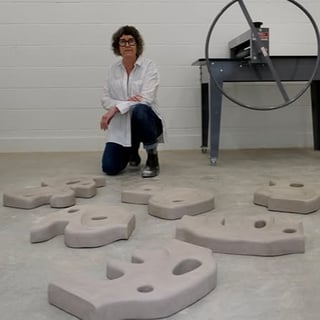
Speaker: But beyond that, for the actual sculpting process over those non -sculptors out there, I use a process called solid building, which is to work with just one mass of clay and then reshape it, add, subtract, and change the form however I want. I'm a pretty mercurial person. I change a lot. Obviously, I have a ton of interests.
Speaker: If anybody looked at my degrees on paper, they'd probably be like, this is really weird. But solid building allows me to change my mind at a whim. And then I also just like the hollowing process. So after I have the shape of the animal put together and to a point where I'm where there's like most detail, but not all, I cut it up. I hollow it out.
Speaker: and then I put it back together. And for these surfaces, I just use underglaze and a drop gravity spray gun. I pretty much spray all my pieces that way. And for the actual glaze surfaces, so I make my glazes out of raw materials. And that is a very rewarding and complex process with a lot of
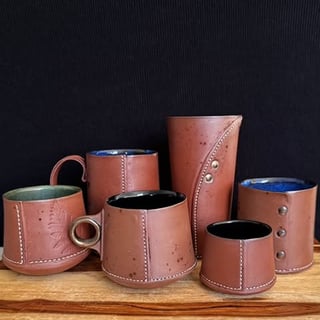
Speaker: experimentation involved and it's yeah I spray my glazes on my sculptures pretty much the same way or my pottery I'm still learning how to make pottery I feel I use slab building and I let the clay become leather hard before I put layers of underglaze on it so I don't use slip on my pottery I just use underglazes I find it works just as well as slip and not that I have anything against slip I love slip but
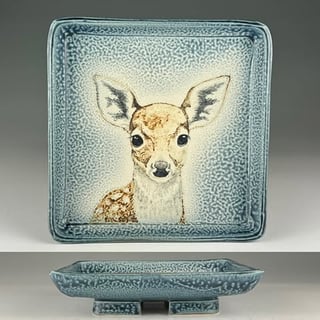
Speaker: Yeah, I let it become leather hard, and then I scurfido on it. I just use a needle tool. Like I said, I started out drawing and painting first. I used to sketch a lot. And so I literally just sketch on the clay like I would paper. And yeah, go from there. I do not make my own glazes for the pottery, though. I do buy commercial because I just don't want to mess around with a non -food -safe, low -fire, clear glaze. So I just buy that offline.
Speaker: you mentioned that you were before you got into pottery, you painted and you did a lot of stuff around that. How did that background and painting help with your own pottery and your own sculptures as well? Yeah, I love texture. And I love big
Speaker: brushstrokes full of expression and I mean one of my paintings is kind of behind, it's not finished but this is one of my paintings. That really helped me in sculpture because it's a three -dimensional art form and I love just using clay to make thick brush like brush like strokes on my pieces. You can kind of see that like in the birds that I make in the wings. I do all that with
Speaker: a butter knife and I paint the clay like I would be painting with acrylic. But I think that it really like painting and sculpture they go hand in hand. I become a better illustrator as I become a better sculptor and I become a better sculptor as I become a better illustrator.
Speaker: Yeah, also color painting allows me to really just experiment with color without you know, it's kind of low lower stakes. But yeah, I love that so much shaping nation. If you have any other experience in other art forms, try to bring that experience and put it into your own pottery because your pottery is going to go a lot further that way. I love that. Yes. So let's talk about discovering your voice. Can you tell me about the moment when you knew you were heading in the right direction with your pottery?
Speaker: I looked at this question. I don't even know if I'm still heading in the right direction. Gosh, I've always done art and I will always do art.
Speaker: It's hard for me to say when I, the turning point when I knew, I think maybe it was when I changed my major in college because as soon as I did, I was like, oh, this feels right. But with my own artwork, I'm still learning, you know, I'm still learning about the direction that I'm going and learning a lot about myself and
Speaker: I have a solo show coming up next March in Homer, Alaska, and I'm making this entirely new body of work, which is something I haven't done for a number of years. And doing that, I'm like, wow, I'm still learning things about what direction I'm heading in with my art and where I'm going. So I don't know. I love that. Shaping Nation, you don't have to have a direction for your own pottery at the moment. You can still be figuring out things as you go and still be able to have your own voice as well.
Speaker: So earlier you mentioned that confidence is the biggest thing that has helped you with your own pottery. What is something that you have done or still do to help you build confidence with your art? Like I said, trusting in your own voice and your own decision making skills is just really how I approach that.
Speaker: Sometimes I don't have all the confidence I need when I'm making a piece. Sometimes I'm making a piece and I'm like, I'm really not sure about this. But yeah, I don't know. Can you repeat the question? So it was earlier you were mentioning that confidence plays a big role in your art. What is something that you have done in the past or still do to help you build confidence with your own art? Yeah, I guess. Yeah, I think my original answer is like,
Speaker: pretty apt, but I don't know if I strictly know how to build my own confidence other than just to keep going and to keep making and keep doing.
Speaker: one thing or trick that I do to really boost my confidence when I'm making a piece other than to keep going if I don't if I'm not sure about it and just finish it and sometimes I'll have to revisit stuff to get a better gauge on it like old pieces and things like that.
Speaker: Yeah, I think that's probably that's probably it. Yeah. I love that so much. So you contribute growth as an artist to exploring unknown territories and also being consistent. Can you tell me more about this?
Speaker: Yes, I think it's absolutely crucial as not just an artist, but any person to push yourself out of your comfort zone and constantly experiment. I stand by that wholeheartedly. And I'm not just saying like, Oh, usually I work with purple, so I'm gonna work with blue. I'm talking about like completely going outside your comfort zone. I for a whole semester, I made architectural work out of clay and I
Speaker: learned a lot. It was horrible. All the pieces that came out of that time period are not pieces that are in my portfolio. But I learned a lot about how I can portray pieces compositionally. It really helped me with technical stuff like slab building. I think that that kind of stuff is important. And like I said, not just for your art, but also in your personal life. I have, you know, I work in administration for a museum. I do martial arts. I love martial arts.
Speaker: And I'm a fine artist on the side. Having these vastly different, you know, lives and activities that I can engage in, it keeps me inspired, fulfilled, and it constantly keeps my brain working and fresh.
Speaker: But I would have never done a lot of what I had done had I not done, had I not gone for things that I was absolutely scared of. Like, you know, applying for the Archie Bray kind of scared me and starting jujitsu really scared me and starting doing ceramics. I mean, I hated the idea of doing ceramics when I signed up for that class, like five, seven years ago. And now I'm a ceramic sculptor. You just never know what you're capable of if you just really only stick within your
Speaker: you know, bubble. I love that shaping nation. Get out of your comfort zone, whether it's in pottery or outside of pottery, because you're not only going to be make better pottery, but you're also going to become a better person. I love that. So what would you say was your biggest obstacle when it came to finding your own voice? Definitely forcing it. When I first started art, like I said, I was trying to like really manhandle how I approached my own
Speaker: style. And I was, I think I sat down with one of my professors, I think it was Steve Godry. And I was like, I really just want to develop style. I want my art to have its own style. And he was like, don't worry about that. Just make art and your style will come. And I, and he's right, like he was right. I think that when people force it, you know, it just inhibits yourself when you get in your own head. So I literally just let things happen naturally. And
Speaker: But yeah, when I think about it too much, it becomes an obstacle. Definitely agree 100%. So what is something you are doing to evolve your voice even further? I, so I like I said, I stay consistent. And I mean, this kind of like ties in with other things that I've said, but I really just, like I said, enjoy the things that I that I love. And I
Speaker: kind of get to know myself, not to sound super cheesy or cliche, but once you kind of, as a person, not as an artist, enjoy your life and explore and experiment and get to know what you love, that will then come through in your art. Yeah. Definitely agree. I love that so much. So what advice would you give to someone that is looking to discover their own unique voice with their pottery?
Speaker: Just keep making, just keep going, keep messing up in the studio, make mistakes, just keep on making and your style, your voice will come to you. And it might not be like for a year or so, it took me like three years to develop a distinct, I guess, style or voice in my work, but we're all inherently unique. And so our art will be, like, I don't think people need to worry about that a lot because it'll come.
Speaker: Definitely agree. I love that so much. So Kendra, it was so great sharing today. And as we're coming to a close here today, what is one thing you want to hammer home with my audience today? Be curious, be curious and be unafraid. Do things that scare the shit out of you and just keep on learning. Turn over every rock and open every book. Just, yeah, get out there and explore. Some excellent parting words of advice. Kendra, where can my audience go and learn more about you?
Speaker: Yeah, so I have a website. It is KendraHarvey .net. And I also have an Instagram. It is KendraHarvey .art. And those are the two main spots that you can find me at.
Speaker: Thanks for listening to this episode of Shaping Your Pottery with Nick Torres. If you want to start discovering your own unique voice, you must first start with the right questions. That's why I put together a free 15 question booklet for you to start discovering your own unique pottery voice. All you have to do is go to shapingyourpottery .com forward slash questions to get this free booklet.