Transcript
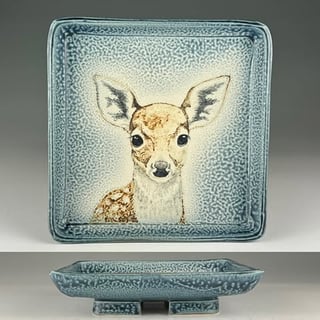
Speaker: Welcome to Shaping Your Pottery with Nick Torres. Today, I am interviewing Sarah Anderson. She makes some really great pottery. She uses a technique called scraffito to carve characters onto her pottery, and it makes your pottery look really her own. There we go. Are we good? Awesome. Yeah, you're frozen a little bit. It's okay. So I thought I would talk about first something that you did recently, and that is mobile makers. Could you tell me the story behind that?
Speaker: Oh yeah, for sure. I could talk so long about that. So yeah, so I had this trip planned with me and my friend, Mary, she's also my studio mate, and my, I live with her too. So we're really good friends. So we had this idea, so ceramics is such like a stationary medium. And so we were like, how can we get this to be not stationary? How can we like take this out into the world? And so you know, COVID's kind of made things really difficult with like residencies and going to different places.
Speaker: to meet people network and that kind of stuff. So we're like, well, we have this idea that we can just take a residency on the road and go and travel and meet a bunch of different people and just make our own little residency for a month.
Speaker: Um, so the main goal behind it was kind of just like network with people, meet people. And then also in SICA in Sacramento, it's national ceramic conference and it happens every year. So that was kind of our big goal was like, Oh, what if we just kind of made this the highlight, uh, of the trip and just get there halfway and then on the way there and back, we can just hit up all the national parks, throw, do all kinds of clay stuff and meet people along the way. Um, so that was kind of our inspiration behind it was just to meet people and just like create our own little,
Speaker: like mobile residency for a month. So yeah. Now, what was the best part about this entire process?
Speaker: It's a great question. All of it. Everything was really cool. But when we started, we actually, the second day that we started, we went to, we went through Oklahoma and we got there and we're about to camp for the night. And I had somebody message me on my Instagram and they're like, oh, if you're coming through Oklahoma, you should stop by the University of Oklahoma. We're going to have an artist talk and you should come see Beth Kavaner. And if you're not familiar with Beth Kavaner, she's like this goddess of sculpture.
Speaker: And she makes a lot of amazing things and was an honorary Enceca member this year too. So she is a big deal and has been like my idol for quite a while. And so literally we could have just driven out the first two days and made it worth it just to see that. It was so stinking cool. So we got to see her and meet her.
Speaker: watch her demo watch her do for giant she does giant sculptures of like rabbits and different animals and creatures predator and prey and she just has an incredible talent for making things just look so
Speaker: incredibly lifelike and the gravity of her pieces are just like, it's just defying gravity the whole time you're seeing it. So that was super cool to see just on the second day, like one of my idols of ceramics. That was super cool. And so we could yeah, I guess so we could have just went back on the second day and like totally been worth it. But we kept going.
Speaker: And I think in Seeker was definitely a huge highlight. I loved meeting so many different people. That was awesome. And just honestly, I love just meeting people and connecting with people like this. I love doing the podcast and they talk to different people about different things. So that was really cool just in general to meet so many different people in the medium that specifically I'm working in. So that was really neat. That is awesome. So yeah, could you give me the name again of the
Speaker: the first name that you met? Yeah, the artist. Yeah, her name is Beth Kaffner. So if you just Google her name on, I'm sure all of her work will pop up. She's really cool. What was something like specific that you learned from her when you went and saw her?
Speaker: Oh, gosh, everything. Specifically, I think it was really interesting to learn because she does a lot of different hanging sculptures and different lot. They're huge. They're huge creatures. It's like six feet tall. It's like how in the world do you fire all those things because comes aren't that big. So she deassembles them cuts them out into sections and attaches them cold process. And so I'm a sculptor at heart. And that's what I
Speaker: of course. So I did a lot of figurative work before I started doing more functional work. And so learning her process of like how she cut up all that and how she resembles things cold and finishes things afterwards without any glaze. She does all house paints and just paints everything on afterwards. So that was really cool to see how she just flawlessly attaches things back together. That was really cool. That sounds actually insane. Six feet. That's amazing. It's huge. It was really cool. Yeah.
Speaker: Now you had sponsors for this trip. Could you tell me how you were able to get those sponsors? Yeah. So we had Amaco is a really big, I've got some of their stuff right here, but they do a lot of underglazes that I use. And so it's just like a colorant, um, like not a paint, but paint for ceramics. Um, and so I'm in a co -op here in Indianapolis, Indiana, and one of our co -op members is the marketing director over there. And so I kind of got into communication with him.
Speaker: And so he was like, yeah, we should totally.
Speaker: We'll help sponsor you and do all of that. And then diamond core tools. I've got some other tools around here somewhere. Here's one of them. They have a lot of like fine tipped, really sharp durable tools. And they've reached out to me and have given me a lot of tools to use on my stuff. And so I reached back out to them. I was like, Hey, we're doing this trip. And if you would like to sponsor us in any way, let us know. So that was really cool. And just kind of along the way, we picked up a few things too, but those are our two main sponsors.
Speaker: that helped us out a lot. And then Ceramics Monthly is a ceramic magazine that has a lot of really professional people and things in that. It's a really good magazine to check out for some resources. They reached out to me through my website and they said, hey, you're doing this really cool thing. They reached out to me in like December, I think. And so they were like, would you like to write an article and be in our spotlight article for the month of February, which was perfect because our trip started in March. So we were like, ah, it was great. So we wrote a whole article on
Speaker: our trip, what we're doing. And through that, we found other people to stay with on our trip. So we found somebody in Pismo Beach, California, right before in secret, they're like, Hey, come stay with us for like two or three days. You don't have to pay for camping, use our showers, whatever. And so we got to stay with them and do all the things with them, which is really cool. Cause California is so expensive. So we're like, Oh yeah, it's great to have a place to stay and like not, you know, pay for everything. So that was really cool.
Speaker: So when you were able to get your sponsors, what were your reaction when you like got each of them? Oh gosh. Um, I think that it was more well, specifically with Amico, I was talking to his name, Steven, I was like, Hey, what do you think about this idea? Like, I honestly have never done this before. What do you think about it? And that's how most of my ideas come about where I just like randomly ask a really like general question to somebody that I have no idea what I'm talking about. And they're like, Oh, maybe you should do this and this. And then I can kind of like,
Speaker: you know, like narrow it down a little bit more for my broad question. So mainly just started with him like, hey, is this even like a thing? And so my reaction to that was just like, cool. Like I did not think that that was gonna happen, but like, all right, let's try it with more people. So then I wrote out like a general statement and just sent it to a bunch of companies and was like, hey, if anybody wants to like help us out and you'll get like 10 nos to one yes, but like you still get a yes in there. So,
Speaker: I think it was just having the ignorant confidence of just sending it all out there and just seeing what you get back. And yeah, so the reaction was just like, oh, sweet. I did not think that was going to work at all, but it did. So yeah, that was pretty cool.
Speaker: I have the same reaction because I, I will like DM people like left and right for my podcast. I'm like, I have the same reaction when they respond. Oh yes, let's go. So the next thing I thought I would talk about was your pottery. Could you tell me the story behind how you make your pottery, how you started making your pottery like that? Yeah.
Speaker: Great question also. I honestly don't even know how it came about. Like I said, I was a sculptural artist when I was in school. My concentration was sculpture and metal and forging and casting.
Speaker: glass art and did pretty much anything but ceramics. And so then my last two years in school, I knew that I loved clay. I went in wanting to be a ceramic artist. And then I was like, I don't know anything. So maybe I should get like a broad knowledge of everything. And so I kind of started looking into more ceramics and playing around with that. And I got into lost wax casting before ceramics. It was very malleable. Oh, this is really interesting. So I can
Speaker: I know that I really like things that I can move with my hands. So like glass and metal, you have to use tools really to use any of that because your hands can't do it. So that was kind of debilitating in a way. So I was like, I want to move into something where I can just use my hands. So that's where that started. And I did some more figurative stuff. And that was really cool. But it doesn't sell as well. You can't really sell a whole lot of that unless you're living in New York or whatever. So being an indie, I was like, OK, functional things are the way to go. Let's start looking into that more.
Speaker: And growing up, I always, my brother and I, you know, told stories, very, had big imaginations. We had all kinds of characters and things that we would always come up with. And I think I started doing, I love printmaking, but I didn't do a whole lot of it. And so the style is very reminiscent of printmaking. And so it was, yeah, I think it kind of stemmed from like, okay, I want to like put some type of,
Speaker: like surface design on my pieces because I hate glazing. I didn't like just the stereotypical glaze look of things. So I think, and I had a residency out in Ohio that allowed me to use underglazes. It was all free and so I had free clay and free underglaze. So I would just paint a bunch of pots, different colors. And then I would, I found some carving tools. I was like, oh, I'm just going to carve some designs into this. Because I had done that for a project in school. They'd kind of given us, like we had to hand build these big sculptural Greek vessels.
Speaker: And so I was like, okay, okay, I've done this before. So that was kind of familiar to me. So it was kind of like a class assignment I had two years ago. So I was like, okay, I'm going to try this again and just see what I can do with that. And I was surrounded by kids, teaching kids all the time. And so just like a lot of that imagination kind of was just coming back to me. And so I think my first things were just very floral designs and like rabbits and just like the things that were very garden -esque because my family is a big family of gardeners. And so that inspired me a lot outdoors. I lived on a farm.
Speaker: whole life and just like that type of energy was, you know, Midwest, very, very Midwest. So that's kind of where it started. And then just kind of evolved into having those different characters and creatures and starting to kind of form and grow. And I really am interested in just like, I don't know if it's the right word, but just like,
Speaker: Not really grotesque things but just things that are that are like a mixture of beauty and like not and like how I can combine those two and get away with it. So like, I'll make these tea cups and they're supposed to be such a beautiful thing and so you know porcelain supposed to be like the most pristine perfect thing. And then I add
Speaker: on like rats or like pipes and different like things that are just like, oh, interesting. Like why would you combine those two things together? So that's recent. That's kind of what I'm playing around with right now, like how I can incorporate something so beautiful and precious and then add something in it where people are like, oh, like do these go together? I'm not really sure. And trying to make that work and trying to get people, just starting that conversation I think is really interesting. So kind of where I'm at right now. So when you say conversation, could you explain that a little bit more?
Speaker: Yeah so I have my artist statement right now actually that's like the last line of my artist statement is I think it says if I start a conversation like no matter what that conversation holds I've created a successful piece of art and so I think that's a really important thing about art.
Speaker: in general is just starting some sort of conversation and just leaving it. So just dropping in like a little starting point and just seeing where that conversation goes because I'm really big about community and building connections with people and so having like a starter piece conversation starts like just something to like talk about I think is really cool to start and build friendships and build community.
Speaker: And so creating something that can start that is really interesting. And creating just like a talking point, I think is a really interesting thing. And whatever way I can do that, I think that's pretty, pretty cool. So it doesn't necessarily have to be, you know, it's broad. It kind of can be with, you know, my old work, my new work. So I've had that sentence in my understatement for quite a while.
Speaker: just because I think that's an important part of the work that I make, regardless of what it is. That's kind of like always my bottom line of what I'm trying to accomplish. So yeah. Would you say that this has like kind of helped you get more imaginative with your pottery or your art in general? Yeah, maybe. I think that definitely I felt a little bit more loose in school to be able to play and just create a little bit more.
Speaker: Right now it's definitely in the nitty gritty of like, okay, I'm trying to like make a living with this. I got to focus and like, do my commissions and get everything done that I need to get done. But I enjoy teaching a lot. And so I do a lot of virtual classes and in -person classes and workshops and that kind of thing. So I can be a little bit more squirrely whenever it comes to teaching and that kind of thing. But yeah, so it's just the, I think a little bit of a mix of both. I feel like right now specifically it's a little bit more
Speaker: production going into seasons of like art fairs and that kind of thing. But it still obviously has the creative elements to it. And so I think I'll switch back and forth of like, when I'm dying down a little bit, when I have a little bit of a less hectic month, I can start playing around and feeling creative again. I just had a few shows to get ready for. And so I made some new pieces for those shows. And so that was really fun to just kind of, I'm kind of writing that way of like, I want to keep creating and doing like the fun things.
Speaker: And like all of it's fun, but just playing around and like working on one piece for three days in a row is really cool, but I don't have the luxury to do that all the time. So I'm kind of switching gears now and going into art fairs and trying to make a lot more work instead of focusing on just creating one specific new piece. So it's kind of a tricky balance. How often are you doing like art shows and stuff?
Speaker: Um, the art shows are more, um, let's see, the art, like art fairs specifically like outdoor art fairs are definitely during spring, summer, fall, whenever it's nice outside. Um, so that's kind of what I'm gearing up for right now. Um, but I do gallery work pretty much
Speaker: As often as I can, I have a lot of stuff in permanent galleries and also have different shows that I'm invited to and stuff off whenever that happens, probably like every three months or so, give or take. But yeah, usually I have like my foot in the door of like
Speaker: a commission, a regular art gear show, a gallery, like three or four different things like that per month. So I stay very busy constantly all the time, which is great, a good problem to have, but it is exhausting sometimes. So that's kind of where I'm at right now. I was like, what else do I have to get done today? It's a lot, so it's never a dull moment. So if you had to explain your process for making your pottery, what would that process look like?
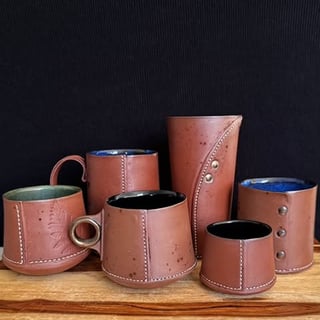
Speaker: The process is, so I use the wheel as a tool to make my pottery. And so I throw different functional pieces. And so I have right now, I've got some wine glasses that I've been making. So I'll throw that on the wheel, just like a tall little cylinder. I'll trim off the bottom just to make the bottom sit flat on the ground without a nail or anything crazy. And then I'll use that underglaze. I showed you a second ago of just like painting on a color. And it just looks like paint.
Speaker: And I'll let that set up just a little bit and I'll use my different carving tools. There's a smaller one I use too. So I carve different designs out of my piece, like the characters and different and whatever things I want to carve out of it. And like you said, that technique is called graffito. So I'll carve out a bunch of different things and I'll let that dry completely, put that in the kiln.
Speaker: And then that stage after it gets out of the kiln once it's called bisque ware and then glaze that with a clear coat do whatever you know sanding or whatever else I want to do to it if it needs it. Put it back in with that glaze coat over top of it and then comes out for glaze ware and it's all finished ready to go so that's kind of my whole process on just one piece so yeah.
Speaker: i'm sure you know you work on poverty yeah well you get the whole thing it's a lot when it comes to choosing your shape because your shapes your shapes are pretty unique, how do you go about choosing what shape to choose. yeah I think that kind of depends on like i've got some different drawings and carvings around but i've always been drawn to like.
Speaker: More I don't know more extreme shapes more extreme forms I don't really prefer for my things to be like a. I don't even know what you call it an in between, so I don't really care for anything that's like if it's if I want it to be angled like this that i'm going to make it like this i'm going to make it pretty drastic compared to I don't like to do a lot of in between things.
Speaker: And then I also am a really big fan of, since I was a sculpture major, I did a lot of sculpting. And so I love using the wheel as a tool, but then I also love manipulating the clay off of the wheel and adding in hand building elements. So like things that I've been really excited about lately, I've been doing a lot of pipes and I've thrown little tiny cylinders off of the wheel, cut those and adjust those and make those into little pipes and then fitting those together on
Speaker: of creating that functional, but also like a twist of sculptural into it as well. It has been pretty cool lately to you too. And honestly, I have no idea how I even, I'll just look at different things for inspiration. Like on the way back from, I got a lot of inspiration from mobile makers too.
Speaker: But we stopped on the side of the road at Death Valley and I found a bunch of canyons out there somewhere in my studio, but they're just like a bunch of rusty cans and I thought they looked so cool. I was like, nice, I'm gonna sculpt some of these, I'm gonna put these in my studio, check these out, sculpt them, whatever, add them to something. So just like anything that I find interesting, like, oh, that's pretty cool. And I'll just throw it in my studio.
Speaker: add it to my sketchbook, start sketching things out and then going from there. So it kind of goes back and forth between, you know, if I'm inspired by the surface design, if I'm inspired with something out of nature or like another form or piece of powder that's made, and then the form is influenced by the surface design. So it just kind of goes back and forth on what I'm influenced by that day, but I'll do a lot of sketching beforehand. I like to do a lot of big sketches. So I have a lot of like giant sheets of paper that I'll just like,
Speaker: draw massive shapes on and just see what kind of comes out of that. And I'm super influenced by like movement and the way lines move. And so that kind of gives me the general outline shape of things whenever I start kind of sketching the movement of pieces. And usually I have, like whenever I'm sketching those things out, the movement comes out into something and I'm like, oh, I can't make that on the wheel.
Speaker: So that's whenever I'm like, okay, that's how I need to, how can I throw this and then manipulate it down to the form that I need to do this to the handle part. Or if I want the bottom to not be flat, if I want it to be like a curve, I just made a teapot that has more of like a wave shape than the bottom. And so I drew that out and I was like, okay, I've got to make this form on the wheel, but then I've got to cut this out and add this handball element onto it. So drawing that out and kind of cutting down with things and just planning out where I need to
Speaker: to cut and manipulate things has been really interesting lately too. So, but I don't really know where those ideas come from. They just kind of like, I just draw some, yeah, sometimes it's just, and it's really just from like looking at things, like just being hyper aware of what I'm influenced by. And like, I've been trying to, I've been digesting all of these ideas for like two years now. So it's just kind of, you know,
Speaker: compounding on top of each other of what I saw two years ago or whatever, what's in my sketchbook from two years ago, it all just kind of comes back up. So it's just looking, being very aware of what you are influenced by, drawing that down, writing that down, and just like seeing your pattern, like seeing what keeps repeating. And that kind of got me a little bit further in my sketches too, so.
Speaker: I totally agree with that because I look at other things as well and that to try to help me with my pottery and it does help a lot. Yeah, for sure. Yeah. So the next thing I thought I would talk about was you mentioned earlier was that you do workshops. How long have you been doing workshops for? I think I started well, really, I started all of this during COVID. And so I started the workshops
Speaker: like probably soon after that, just because everything went virtual. So it was like, well, this is the easiest way to communicate and talk with people. So yeah, I think it was probably right around there. What would you say your favorite part about workshops is? Community, building community, talking to so many different people across the world. I would never have this opportunity
Speaker: Um, if COVID hadn't happened and I mean, I'm, I'm sure it would have, it just escalated it a lot, um, virtually. So I think building community over vast amounts of areas is really, really cool. So if you had to give advice on like people looking to start doing workshops, what would your advice be? Like teaching workshops. Yeah. Or just joining.
Speaker: Teaching workshops, I think you just kind of have to build your base first because I didn't do anything, like I didn't produce anything. I had an art center that I worked at and they had me do different online workshops and teach different things that way. So it was through them mostly. And then it started to compound whenever I got more of a presence online. That's whenever I had people start reaching out to me and asking me to do workshops and that kind of helped expand my
Speaker: community in that way and people saw me as more of a teaching artist which was really cool. So that's been I've been writing that way for like six months to a year now of just kind of doing virtual classes on and off every other month give or take. So yeah I think just kind of building up a community and a presence and that's kind of how I did it. There's obviously tons of other ways to do it too but but yeah just kind of getting your name out there and just like
Speaker: knowing who the different people are that you want to work for or want to do workshops with or that kind of thing. Just building your community and just seeing who you want to work with and then just kind of connecting with them and seeing no harm in reaching out to anybody to see if like that's something that you want to do. I think that is amazing because I feel like a lot of people eventually want to start doing and teaching more about pottery. Yeah, absolutely. It's a movement for sure. So now
Speaker: You have mentioned a lot that you were in school, you focused on sculpture. How has that really transformed your pottery? I think it helped. It's helped me a lot with my, like what you asked a minute ago with like the shapes and how I build things. I think a lot more sculpturally than I do. I don't have a foundation of functional pieces. So I think that's why maybe my shapes and things are a little bit more different because I don't
Speaker: have as much of a background in traditional functional pottery. So I think that's just kind of helped me experiment with different pieces and like how they look and just from like, just as a background and that it's just a little bit different than functional pottery. So
Speaker: I have it right here. So now if you, do you mind telling me the story on the day you decided to become a full -time potter? I remember the day I quit my studio manager position at an arts center here in Indy. And I started full -time this past August 1st. It was my first official day.
Speaker: And I don't really, I think it was whenever I started to switch the, like, like making equal incomes with my full time job at the Art Center, and then also producing pieces at the same, like both of those for the same, like, cost, like I was getting equal amounts of money from both things. So I was like, yeah, I think maybe this is the time to go ahead and make the shift there and just kind of go full into the,
Speaker: self -employed pottery game, which was terrifying and very exciting, but I really built up an extremely strong community around me. Again, I'm super involved with community and other people and I would never be able to do this alone. So just having like a really supportive community behind me and supporting me. And like I found a studio space and I've been here since I think September or wait, no, October, I think.
Speaker: Um, so I worked down in my basement for a couple of months and that was awful cause I was alone by myself and I just hated it. Um, so I'm really grateful to be a part of like a, it's a community, um, artist space warehouse that I'm in right now for, um, my studio and then I teach different places and I'm involved, um, in other ways like that. So that answers your question. What were some of the challenges that you face when you branch off to doing on your own?
Speaker: Um, same as any other startup of any small business. I mean, obviously it's just me and it's, it's a lot different. Um, and it hopefully will be something bigger at some point in the future too. But, um, just learning the basics, like, okay, how do I do taxes? Like, how do I do all of this stuff that like, no one's ever taught you before? And I was really blessed because my mom is a self -employed graphic artist. So she freelances and does a lot of things. And my brother also started,
Speaker: his own business here in Indy as a videographer and animation producer kind of thing. So I had a lot of help from them and they hadn't done that before and so I got a lot of advice from them. And coming from a big family of artists, you know, it was very encouraged to do what I'm doing and very supported and very grateful for that. But, you know, it was, yeah, it was just like all the same things of like,
Speaker: Yeah, how do I do taxes mainly? That was a lot to figure out and studio space was a huge thing. Figuring out kiln situation, how am I going to do this and a lot of things beautiful things just fell into place.
Speaker: one of our studio mates that actually got us a space, her name's Becca Otis and she's, her name's Five Blinds Pottery on Instagram. And so she had a kiln and the studio space needed two people to move in. And so me and Merritt were like, yeah, we'll take that for sure. So a lot of things really fell into place and just like surrounding ourself with community where people had these opportunities. And so I would have never known about it if I hadn't have been friends with Merritt who just started a job with Becca at another production pottery place and they became friends and started talking.
Speaker: It's just all about who you know and resources to use. And yeah, it's just kind of a learning game as you go for sure. But you know, each month you learn something new and just add that to your little inventory list of things and check that off. So yeah, still constantly learning, but I got my taxes done this year. So let's go. We're off to a good start. It feels good.
Speaker: If you had to do anything different, what would you change or what would you keep? If I had to change anything thus far,
Speaker: Like I said, I haven't been doing it for that long, but if I could change anything, I think I would have, I was gonna say maybe I would have quit sooner, but I really needed to, I'm glad I did things the way I did. And it was a smart financial move as much as I would have loved to say, oh, I shouldn't have started immediately jumping into full -time pottery. But getting your bearings and getting up a savings so you have something to fall back on if something doesn't work out was really important, just being realistic with yourself.
Speaker: And I think that's really important. But then also chasing your dreams and doing what you want to do. So I think if I could change anything, somebody offered me a kiln while we were in California, and I should have taken it. I really should have taken it, but I wasn't here. So I have a little bit of regret about that. And some other little things, I guess, where I'm like, oh, I wish I would have had that opportunity a little bit sooner or whatever. And I wish that I would have stuck with
Speaker: After I quit this past art center job, I had a rough experience with some teaching. And so I had to stop teaching there for a little bit. And that was unfortunate. But I think I would like to have got back into teaching a little bit faster, like in person. So I'm starting up classes again at a place here called Downton Square Clay Center. And so I'll be teaching in person starting next month, which will be, which is not that long. Yeah, it's a couple of days.
Speaker: So yeah, that's gonna be exciting. So yeah, honestly, pretty, pretty overall happy with decisions. Like, I wouldn't have anything, you know, that I have right now if I changed anything. So I'm pretty happy with how it's turned out so far. So this last question will probably be my last one. If you had to give three pieces of advice for someone looking to start pottery and or a business, what would they be?
Speaker: Okay, I'll do three of each of those. I'll do three for if you're wanting to start pottery. I would say get yourself a local studio place to go and get involved with other people. Learn with other people, grow with other people, because that will eventually lead if you want to go into the full time or whatever. If you want to sell pottery, do things, can't do it alone. So get involved with something immediately and surround yourself with people.
Speaker: I would give yourself a lot of patience and a lot of breaks. I would stand up a lot. I would take up yoga or running or something active where you're not going to be sitting and crouched over. You know, you want to get yourself limber and it's a very demanding art form. And so I have to do a lot of stretches and constantly remind myself of the posture and the way I sit and the way I am because I want to do this for a long time. So I really need to make sure that
Speaker: You know, I'm taking care of my body and doing those things right off the get go. Only been doing it for a couple of years. So I just got to start those habits immediately. Um, so that'll be, that would be a second thing for specifically pottery. Um, a third thing for pottery. Yeah. Like I said, given, well, that was kind of two and one giving yourself a lot of patients, I think is really important because it's, it's hard. Like it's a really difficult thing to learn. Like.
Speaker: I told people it took me, you know, um, like a straight two weeks every single day for like three or four hours a day to come in and just throw, throw, throw muscle memory. You just got to do it. You literally just have to do it. And it's not, some people are quicker than others and that's okay. But like usually everybody that sticks with it can like get that aha moment.
Speaker: So I just give yourself patience and just muscle memory and practice. You can't do anything like you're not going to be a star athlete going to the Super Bowl without practice. So you're not going to be automatically good at this. So just practice at things. Visit the way for business or starting your own ceramic business.
Speaker: I, you know, like I said, it just really for me, it's all been about community and making sure that you have connections with people that can help you. So again, probably those first two things for starting pottery and starting your business community surrounding yourself with people that can help you and
Speaker: have people to fall back on and so I think a huge thing for specific art related jobs is I would also teach probably my second thing is make sure that you have a sustainable way of income also so like teaching is a very easy like teach one class a week add a little bit onto your income that kind of thing.
Speaker: um and I'm not necessarily teaching but but that's what I do for my um like each week I have this amount of income coming in um so finding something like that that can help you balance that money and because it does you gotta be realistic with it too um so those would probably be a couple of things for starting a business um let's see and then just having um knowing what your
Speaker: knowing what you're selling and knowing your audience and also being realistic with that. So like I knew I couldn't sell a lot of sculptures in Indianapolis, Indiana. It's not that big of a market. So I had to switch to other things. I had to kind of figure out what things are going to work and what isn't. And if I wanted to do that specifically, maybe I moved to New York, maybe I go and do residencies and that type of thing where that's
Speaker: actually doable and you still have to teach alongside of that most of the time, but specifically for resumes. But yeah, just making sure that you know your market and what you're doing and just researching, you know, how to actually make a living at what you're doing and being reasonable with yourself on that. And I did all of that during the time that I was working at the arts and I was like,
Speaker: Okay, how am I going to actually make this happen got to write down the numbers got to be realistic with this. So it's not all fun and games at all. It's like maybe 10 % is the fun and games and the rest is really hard work. So doing that hard work while you have a good income is really important. That's how I really think that I
Speaker: started out pretty strong as I gave myself the time to build up to it and have an income at the same time. And then switching over and being able to jump full force into it automatically kind of knowing what I needed to do was really, really important for me. So yeah, good things. Those were pretty great advice.