Transcript
Speaker: What if a prospective student decided that your school wasn't right for them. without even visiting your site. without googling you. Without anything no landing page visit no program page visit No click for you to track.
Speaker: Welcome to r ROI University. A higher ed marketing show for people turning big ideas into real results. Join Rustem Arani and Chris Shepard as they explore the strategies, stories, and technology shaping how institutions connect with students.
Speaker: From marketing and enrollment to data and AI. Every conversation brings a fresh perspective and something you can put to work. This is ah ROI University.
Speaker: Welcome back to ROI University. podcasts for higher ed marketers and leaders who want to change the game and themselves. I'm Arisa Mirani, your co -host. recovering engineer and former higher ed CMO along with Chris Shepherd.
Speaker: A 20 -year... Plus, marketing veteran. and our tech guru. Chris? Welcome back. I'm excited for this episode. This is going to be a fun one. Yeah.
Speaker: you know What happens? You know, when the zero cook world kind of comes to be, right? And you hear all about GEO and AEO and how people are and students are finding.
Speaker: out about institutions and so on, but. I also think that this plays really well with our last conversation we had in our last episode where we talked about the funnel.
Speaker: Is it still a funnel? Is it not a funnel? And I think we also mentioned about HubSpot and how they re are re -looking at things and they're calling it a loop. right They talked about that at at Unbound. They've written a book about it.
Speaker: So. I think this is a cool topic. I think this is something that's going to continue to be an important topic. But let's jump right into it and let's kind of think about. Yeah. Is the student experience changed?
Speaker: Yeah. Well, first of all... Great to be here again. I want to say. I don't think the funnel's dead, and so I'm going to stand on that. Mountain. I don't think it's dead. I just think it changes just like everything. And we're going to talk today about how that's changing.
Speaker: and the differences between now and two years ago and now and 10 years ago, or even, you know, I... kind of age myself, but you know. 20 plus years ago when we were looking at colleges and what that actually looked like. you know, and how we actually got the information in front of us and how we made decisions, um, wildly changed, but a lot of the same things are happening just in different.
Speaker: ways different mediums. different output, or input rather. hub And so Yeah, I think we could talk. through that today. I think the funnel is alive and well, I think that it changes.
Speaker: the way that maybe leads and prospects come into it and how they know, like, and trust you, how they find that information out. And I think that's a lot of the stuff that we'll talk about today. So, yeah, what what does that look like? I mean, what what are we actually going to talk about today?
Speaker: Yeah, and Here's the thing. If you go back to, again, like you said, 20 plus years, right? I actually. My first dive into higher ed marketing, at least, was back in 2008. And eight and um yeah it was definitely different back then, right? Google was still there. It was definitely our number one.
Speaker: way folks were finding out about us, at least online. And that traditional look was They would do a Google search query. They come to your .edu. And then inquire.
Speaker: right or contact us and so on you know And I think the reality of... today, whether it's, and I know you're you're a big believer in in the funnel, because at the end of the day, it's still like you you always say, right? Know, like, trust.
Speaker: yeah Those are the core components. Now, whether it's a loop, whether it's a funnel, like all of those things, I mean, there's many different ways to look at it. but at But at the end of the day, like when you think about it. today.
Speaker: There's definitely in the no part of that. Right. How are students? or prospective students learning about you or about your institution. And that's where, you know, they could be doing a prompt. in ChatGPT. They could be getting an AI answer on that end.
Speaker: You know, are you in that shortlist? If you're not in that shortlist, are you even in consideration? anymore. And so. You know. That part of the no, I think is, is huge. And I think that's where things are evolving a bit now.
Speaker: Still a part of the funnel. Yep. But that's where it's evolving. And I think that's where the key is. How are... We coming up in those inquiries and those searches, wherever those searches are. happening That's right. However, they're gathering that information, right?
Speaker: Yeah. Because... that's That's what I see is kind of the switch is like. It's almost like. Again, google .edu inquiry. Where now it's... prompt, AI answer, shortlist, and they're validating the the data that they're getting. Then they go to your .edu and then they inquire. And the one interesting thing that we're seeing with a number of our clients is.
Speaker: even after this process you may have less people that are actually coming to your site. to your .edu. But the quality of people and the intent of those people is much higher.
Speaker: because of the no part of the funnel that they're finding out this information on their own. Yeah. Right. Which. Brings in a higher intent student, potentially.
Speaker: Yeah, i I agree with you. And look, I'll go back even before, you know, SEO and all that, like, how are we finding out about schools, you know, 30 years ago? Well, colleges were coming to your school, we had college fairs, you left with a big stack of pamphlets, you put them on your kitchen table at night with your mom and dad, and you look through them, and you started comparing and figuring out where your friends are going to go and all those things and building kind of like that know, like and t trust through that there was no SEO back then. Right. And so those funnels and those stages still.
Speaker: were They were there then. They kind of lived through SEO. They evolved. And now we're seeing that. Other evolution, I think you kind of alluded to this, where it might look something like it's not necessarily breaking or it's not still there, but maybe we have another stage that sits on top of of the funnel that we can't necessarily see or even measure. um You mentioned zero click and some of these other things, but what does it look like when...
Speaker: um A high school student, for instance, is going to CHATGPT and now they're all of a sudden doing discovery research, comparing, they're filtering, they're summarizing all the different schools for all the different programs that they're either interested or not interested in. And they're doing it all in one swoop um and then going from there. And so I think that that might be something else that we're seeing that we just don't have enough data on yet. Because again, to your point, we don't really see that happening. We have studies. We have the EAB study. for instance. I think they were previous education advisory board, but they they've got quite a bit of studies. And one study showed that 46 % of high school students use AI in the college search. and then it' only
Speaker: I think. I think that's up from, what was it, 25 %? Yeah, 26%. The year before, right? That's right. ah Yeah. And so, but here's, they say. Boing! About 7 % go to a chat. bought first when researching a specific school. So it's a lot of discovery.
Speaker: And then I'm reading some other facts here. AI isn't a step in the journey. It's a second opinion. Okay. 62 % use it to find good fit schools. 48 % use it to discover institutions they've never heard of. 25 % use it to write application material. One in four have an ongoing conversation with AI. And then finally they ask before they find you. And so that was your point. They're starting to ask before they're actually either getting to your website or actually going.
Speaker: that next step for like a request for information or whatever that lead might look like. Yeah. and And I think the other one that stood out to me as well, the stat that I saw was like.
Speaker: One in four, so like... 25 % of students are basically removing schools from consideration based on the information they're getting.
Speaker: in their research. Yeah. And so if a, you're not there. That's one thing But be - They're eliminating based on the data and the and the actual content that is being pulled in these searches.
Speaker: So it's not only just enough to be in these, right? That's right. It's the fact that what is the actual information about your school that's showing up in these searches? That's critical too. because I hear this all the time. we're We're in conversations like. hey, we need to be showing up more in these LLMs. How are we showing up? And we have tools, like we have an AEO audit tool that will show you exactly kind of how you're showing up, what your sentiment is for your school. There's a lot of different things. There are a ton of these types of tools.
Speaker: But. If you're showing up and how you're showing up. Those are two completely different things. yeah Yeah. I would say on the flip side of that number is. 34%.
Speaker: Said AI research made them more interested in a school. And so maybe they didn't even know about a school or had some. you know, Little thoughts about a school. And now all of a sudden they're getting all this data back because the school did show up and did present well inside of those LLMs. And now they're more interested. Look at that. I mean, how great is that?
Speaker: 100%. Exactly. And that's the thing. And I think that's the other side of this where it's exciting because... You know, you don't need to have The SEO budget of right. One of these large institutions that has.
Speaker: 15 different content writers and are constantly pushing out. you know a ton of relevant content and so on. Like. If you are very specific in what you do, what you do well, and you're showing up for those in the results because.
Speaker: It's very clear. that that's what you do. You will show up. And you will be able to be in those searches and have that same opportunity as somebody who might show up for the number one spot. from an organic listening.
Speaker: Or an organic s search. That's right. to your point, is a great opportunity, right? That's that's fantastic. I mean, I think... That's where... The opportunity is, is again, it goes back to.
Speaker: who you are as an institution, what do you offer, what makes you unique. What are you really good at? Those are the areas where there's opportunities for you to show up.
Speaker: in these listings, in these rankings. and What's the strategy to do that? I'm a big believer in that. not just showing up in the llms Yep, I agree. I... was i I know we should talk a little bit about kind of like what that looks like from a marketing perspective, but I. I wrote a blog post or a newsletter post on LinkedIn a couple few weeks ago, and it was around this Pew.
Speaker: research article about Kind of like what, how, what percentage of the internet is now written by AI. i i saw I saw that, yes. i'm It's incredible, right? i'm ki Yeah, I'm kind of going into this because... all right I have a thought on the other end and it's like what not to do and how. you know what not to do. And so.
Speaker: it's like some huge percentage is actually ai written nowadays like all the you know, .com, .org, .edu sites. And so. It was, I think it was like.
Speaker: One in 10 pages with a .com domain shows signs of AI authorship. so
Speaker: That means like one in every 10 pages is written by AI and across the internet about. Yeah. Double the share on .org domains and 10 times the rate on .edu or .gov domains. So that's actually good for us, .edu, because that means that only 1 % of pages on .edu um are written by a AI. So my point is that you probably shouldn't be just putting, what do they call that? Like slop or AI slop? Yeah, yeah you AI slop is a term now. yeah you You definitely shouldn't be, if you want to get into LLMs, just be writing. all of your posts and all of your content with LLMs. I think it's a great opportunity to try to understand ideas and try to understand different. things that you should have on a page, but it definitely should have a human in the loop. And we can kind of get into that a little bit more, but I thought that was interesting to see that there's actually kind of like a correspondence between what
Speaker: What LL? use and what they actually deem as really good content and how they show it. in their LLM versus what they don't. And a lot of it is around actual experience based human based content on a website.
Speaker: 100%. And I think it goes back to the core. of any of this, right? Which was back to like eat, right? Authority, experience, trust, like those are the core components at Google. And actually I've heard this.
Speaker: I was even talking to somebody, I think it was last week, and they were telling me like, yeah, a couple of our sites just got slapped by the last Google update. You know, I was like. Yeah. well Are you using a lot of AI to write the content? It's like, yeah, but we're using some of these tools. And I'm like.
Speaker: Great. But it's still AI. Like, I mean. yeah And. So I think this is where experience is is just so critical in all of this.
Speaker: Because you want to be building that authority. And the only way to do that is through actual experience. Yeah. Content that relates back to experience. And I think that's goes back to the schools.
Speaker: If you want to show up, if you want to be in those conversations, like. There's a lot happening on campus. There's a lot happening with your instructors, your TAs, your students, your alumni.
Speaker: Those are the experiences. Those are the, you know, articles and and viewpoints that are powerful. to share. Those are the ones that are going to show up and build that authority.
Speaker: right yeah speaking of that i i couldn't agree more with that i think like That's a big part of what we do and kind of our whole outlook. Like you've heard of the story brand kind of framework and model, you know, and they kind of be the. The Robin to the Batman, like the sidekick to the hero and the hero is your actual, your your client or your customer, or in this instance, maybe the student is the hero. And so how do you actually do that? And a big part of that is, and like you just said. There's so much going on internally that you can use to tell stories and invoke that know, like, and trust signals and help people to really understand what you're about and what you do and what it looks like when they're in there. Because it's just like.
Speaker: ah yeah Anything you want to picture yourself. Like if you were a prospect. They want to picture themselves. In that school, what does it look like? What does their day -to -day look like? What are they learning? How are they interacting? What does it look like on the other side when they graduate? Like everything is built around that emotional trigger trigger and what is actually happening. and so
Speaker: AI can't write that. They can help you come up with ideas, but they just can't write it. And so to use all the content and the stories that you already have baked in and built in, like you said, your current students, alumni, all that kind of stuff, just.
Speaker: helps with all of that. Yeah. i And I think. You know, another aspect of this that I've seen a little bit more of a push around is this notion of digital PR. which is basically kind of.
Speaker: Writing SEO articles that utilize expertise to push out. you know, any particular kind of A viewpoint from a school's perspective or anything, you know, that is unique. And I and i think that can work really well, right?
Speaker: But. Again. That goes back to... the trust the authority like all of that I guess see the other side of this. and You know, Chris, like We keep talking about this on our side as well as because again.
Speaker: There's all this conversation about the funnel and the funnel being broken and, you know, what happens when students stop. Googling, right? Are they ever going to stop Googling? Is a funnel really going to be? you know, still a thing. And again, You have ah the way you look at it, right? No like trust.
Speaker: But. you know, Marketers have spent a lot of time trying to control. And we have as well, the fun, right? right yep From an attribution perspective, which channel is generating what? down funnel.
Speaker: I was on a call just recently as well, where we were looking at GCLID data that wasn't clean all the way through. because we didn't have all of the data and insights for all of the different ways students were coming in. to our CRM.
Speaker: So it was only one piece of it. So when we look at that funnel, we're optimizing for what? The keyword, we're optimizing for ad sets, we're optimizing for landing pages. you know We're doing all these things. relayed back to the funnel. Right? Yeah. Yeah. But when we move it outside of that.
Speaker: How relevant. Are those things still, if we're like getting to where there's, it's getting a little cloudy and maybe there's a no click. kind of attribution there for a lot of this. like What are we going to do about that?
Speaker: Yeah. Yeah. I think, I mean, we're seeing that right now with just zero click or even Like consent. you know, now on web pages and not actually carrying over.
Speaker: analytics, not. everyone. It kind of depends on what state you're in there too, but you do see it, you know, and so you lose that touch, you lose those signals, you lose all that through GA4, even carrying on to your CRM. And so how are we actually tracking all of that? You know, luckily for us, there's like,
Speaker: tools and advancements. I mean, even with Google's like so Google search console and search queries. And they're putting some advancements there and which is great to see them working on that. But there's a lot of things that we could do and a lot of tools like you mentioned that we could use to be able to show a lot of this data. But I think like building content and doing all this stuff around keywords might be also fading out a little bit and kind of building it more around like queries and what folks like these. bigger.
Speaker: like intent of these bigger actions. As you start looking into the data more, you're seeing these really long questions, you know, like people asking very specific or high level questions, but they're not like. best nursing school near me. i mean They could be. But. A lot of times they're like, Hey.
Speaker: I have a full -time job and would like to go to get advanced my nursing degree. And here are the stipulations. Here's what I need. I can only do it so many hours. I mean, it's just... paragraph they're asking you know Yeah. yeah and And they need to get the answers back. So how are we getting the answers back to them?
Speaker: Yeah, and here's... here's The thing about all of this again is there's a lot of tools in there. Every time we get a little bit of. Claw. It's something that's cloudy and we're not. too clear there's tools that are being built to be able to look at some of this stuff right again When and we look at this from from our perspective, right, we've got kind of our AEO monitor dashboard tool that basically looks at.
Speaker: visibility rate again going back to like are you even showing up right If you're showing up, you can kind of understand where, or when across all of the LLMs. Then you've got your share of voice.
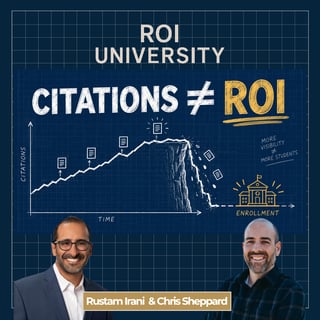
Speaker: How often or how much are you showing up? Right. Then you get your citation rate. What does that look like when you do show up? How are you showing up for those responses? and then like when you do show up is it good bad is it neutral which is kind of the sentiment right Those are the four key kind of components that I would say. You'd want to be tracking when you're looking at some of this. Now, again, There's tons of tools out there.
Speaker: Yeah. you know And if somebody's interested, we'll we'll leave a link for the AEO. dashboard tool, there's actually a free audit that you can do on the tool as well, but that'll show you versus a couple of the competitors, your visibility rate. your share of voice, your citation rate.
Speaker: and your sentiment, right? Because... Again. It's not. All. The same. as it used to be. it's It's just not. Things have definitely changed. Things are evolving.
Speaker: And it's just a matter of understanding, you know, what's happening. And I think that's that's where it all kind of comes together. you know from that perspective. Yep. yeah I agree I...
Speaker: I'm right there with you. I'd say on the Other thing with that is just making sure that, you know, as as folks are searching you on these tools, LLMs, all the things, I mean... you really want to have positive set sediment as well that's the quickest thing that
Speaker: kind of gets launched out there as negative reviews, negative. subreddits, yeah all these things. I mean, they surface pretty quick. So if you're internal and working in an institution, higher ed, and you're in the marketing, definitely something to be aware of and definitely something to be monitoring. There's tools out there again that can monitor these things, but I don't want to like only focus on all the positive things that can come out of it. but there are a lot of negative things that can surface too so it's definitely worth monitoring that
Speaker: Yeah. and If you were to look at kind of. This is kind of how we look at it as well. Like if you look at it as like an ecosystem, right? Where does all of this fall into this ecosystem, this new world, if you want to call it? And I think the ecosystem really boils down to some core components. And we chatted about a little bit of them. But if you really want to look at kind of the core components, you've got SEO, your core search engine optimization.
Speaker: your schema of your site, like You know, the content is irrelevant, all this, all of those things. the usefulness of your content. the structured institutional information on your site, how it's structured.
Speaker: I talked about digital PR. That's key on that end. You know, your third party authority, like. Are you getting link backs? Where are they coming from? Those sort of things. Then the other component, which is definitely a part of the new ecosystem, is the AI visibility.
Speaker: where you're showing up, right? And what does that experience look like? finally kind of on your site because everything in that ecosystem, it all kind of reinforces. each of those other components and i think that's where it all kind of comes together in this like ecosystem. At least that's that's the way that I kind of see it from a holistic standpoint.
Speaker: Yep. And I would say just add in reviews to that and making sure that you're. Yeah, that's a good point. Getting reviews, good reviews at that. But yeah, I think whether you agree that the funnel is that or not out there and in in the world. it It's still, in my opinion, valid. It might be changing the way it works, but it's definitely know, like, and trust is still there. It's how they're how they're finding you, how they're researching. It's one swoop now. I mean, you could write.
Speaker: chat GPT a paragraph and get all the data you can ever want and not have to carry a backpack full of pamphlets home with you. And so it's changing, but yeah. yeah Yeah, and I think ah to kind of so sum it up, i think You know, the number one thing that you can definitely do easily is to find out if your institution is showing up, right? Are you showing up? But more importantly, like.
Speaker: What does the answer say about you when you do show up or if you do show up? Because... As you heard in some of the data, There are literally students right now that are eliminating your school.
Speaker: Even if you're showing up. because of why you're showing up that's right i think that's the ah yeah and i think that's the other thing like It's not just showing up, right? it's It's the kind of why and how and making sure you're in in the right places.
Speaker: well Chris. I appreciate it. I mean, I think this is a huge, huge part of you know what... we're doing kind of on our side, how we're looking at things again.
Speaker: There's a lot of different ways to, to kind of. talk through different core marketing principles and what they look like and so on but The reality is I do believe that. you know, there is a new ecosystem out there and I think it's important to kind of see how you're showing up.
Speaker: You know, I've heard CO being called search everywhere optimization nowadays. Right. yeah And I think that's the key is like, it's, it's in a lot of different places and knowing where you're showing up, how you're showing up. I think that's at the end of the day, the key. Well, Chris.
Speaker: Awesome episode. Appreciate it. Look forward to the next one next week. And that's all for this class of ah ROI University. But the biggest ah ROI is personal.