Transcript
Speaker: Hey, real quick before we get started, if you have been struggling with choosing what you would actually like to focus on with your pottery, I created a free seven -part audio program that will help you find exactly that what you would like to work on with your pottery. Click the link in the description or go to shapingyourpottery .com forward slash ace. I'll see you in there.
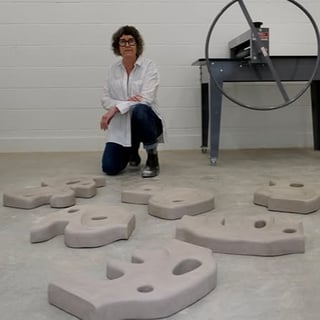
Speaker: Welcome to Shaping Your Pottery with Nick Torres where we help you discover your own unique voice so you can stand out from the crowd and have more fun making pottery so you make pottery that is truly amazing. What is up everybody and welcome to Shaping Your Pottery with Nick Torres. In this episode I got to interview Lynn Mead. Lynn makes some incredible pottery that is really really incredible using a technique that she calls puncturing.
Speaker: In this episode, you will learn how to make one of Lynn's punctured pieces, and of course, discovering your own voice as well. Lynn, welcome to Shaping Your Pottery, and share with me what is one thing you believe potters should be doing to have success in pottery. I think they should be really clear on how they define success.
Speaker: There are certain things you can get from your work. You can get financial rewards, or you can get recognition, or you can get just personal satisfaction. And depending on which of those things and how many of those things you're really looking for, let that determine how you pursue your career.
Speaker: awesome awesome so we're going to have a really great show today we're going to talk about how you make your pottery and your experience with 52 years of pottery and discovering your voice as well so can you tell me the story when you were little and you were selling animals as a kid
Speaker: Oh, I was probably one of the most anti -social kids you would ever meet. I stayed in my room by myself all the time and my mother got me some clay. So I started just making things and making things and making things. I just took to it.
Speaker: I don't know what possessed me to go to a store to try and sell these little things that I made, but the women at the store were incredibly kind and patient, and this little eight -year -old came with a shoebox full of art, and they were so kind and so validating, and they sold them for me. They took orders. I sold a bunch of them. I mean, I was selling them for nothing, but it was the beginning. It was formative.
Speaker: How would you say this experience led you to pursuing Clay further? I was obsessed with making things anyway, but the idea that I could make things that people would buy and would want, it just, it set off a light bulb of, this is fun. I enjoy it. I'm good at it.
Speaker: I'm eight years old, there's nothing else I feel like doing, so it just led me on a path. I love it so much. That's so awesome. Such a great story. But can you tell me the story, how you started making the ceramics that you make today? Yeah, actually, it was a confluence of several things. Right now, I'm doing pierced work. And prior to that, I was doing carved porcelain.
Speaker: and a company called Hagar Pottery contacted me and wanted to license my carved designs and mass produce them.
Speaker: So I was excited about that and I agreed to it. So basically, the work I'd been doing for 17 years no longer belonged to me. I licensed it to another company. I would make their prototypes. They would make molds. They would mass produce it and market it to places like Crate and Barrel and Target, things like that. So I needed something else to do. And so after 17 years of dedicating myself to one skill set,
Speaker: I was suddenly free and I was teaching and a student came in and wanted to know how to pierce something because she wanted to make a light, a lamp, you know, a candle lamp. And so I needed to, you know, whenever students came in with things I didn't know how to do, I would then go and learn it and figure it out so that I could help them with it. And so I started playing with piercing in order to help the student and then I just kept playing with it and it just
Speaker: than to be at a time when I needed to create a new body of work. It just one thing led to another and I just got more and more interested in it. So that's how I got to work. So you mentioned like you would license it. Were you getting like royalties for it and stuff? Well, here's the thing. This company, Hager Plattery had been in business for 140 years.
Speaker: And they licensed my designs because they wanted an infusion of contemporary artists creating for them. Unfortunately, I did all the work. I made them many pieces. They made the moles. Everything was set to go and they went out of business.
Speaker: but so i did all the work and nothing happened and i was heartbroken because i thought finally i'm gonna make a living i'm gonna you know do the design work that i've always wanted to do but i would have been receiving royalties from that it was a great way to design something make something once and then collect royalties on it so that would it would free me in the rest of my time to just make
Speaker: fantasy work, work that I wanted to make just because I wanted to make it. But it didn't happen and it broke my heart. But it led me to the work I do now, which has been successful beyond what I would ever, you know, expected. So in the end, it's great. But at the time, it was devastating. Love it. That was a really great story. So can you walk me through how you make one of your pierced pieces?
Speaker: Sure. I start by throwing a form and I, you know, about two hours after I throw it, I start to map out the design. I use
Speaker: a lot of baking tools, fondant cutters, cookie cutters, leather tools, pieces of pipe, anything that I can get that I can just push through a piece of clay to make a hole. So I start mapping out the design and then within a couple hours after throwing it I start to pierce it, but I make the holes a lot smaller when it's wet so that it doesn't
Speaker: collapse on me. And then once the piece becomes bone dry and it's firm, it's rigid, it'll hold its shape, I'll go back and enlarge each hole until it gives me the look that I want, that almost see -through look of a lot of the pieces, the lacier look on some of them. Then I just fire it. What was your question? How do you enlarge the holes when they are in a bone dry state?
Speaker: That's the interesting thing about bone dry clay is it's water soluble. So I take big sponges, like car wash sponges, and I cut them into long tubes, either square tubes or round tubes or teardrop shapes or ovals. And I take the sponge and I wet it and I just sort of pass it through the hole back and forth almost like dental floss. And it erodes away the clay. How did you figure that out?
Speaker: trial and error. I was again trying to help this student figure out how to do it and I tried first paint brushes with water. I tried so many different things and then I just happened to try taking my sponge and wiping and from there it led to you know cutting the long strips of sponge to the shapes that I wanted and you know it's all an evolution. It's like
Speaker: anything that we do we're usually just making this stuff up as we go when we're working on new techniques and so you just try everything until something works and that was a long evolution but it worked. For those that are listening it's important to just test things out and just really dig deep and try everything out.
Speaker: Absolutely. So you make all kinds of like things with your puncture technique from lamps to like everything else. Yeah. But you also make ceramic furniture. How did that come to be?
Speaker: I have always loved interior design and environments. I'm a huge fan of Frank Lloyd Wright. And what I loved about him was he created entire environments. He would design a hotel and he would do everything from the carpets to the furniture to the architecture to the china that was in the restaurants. And I love that. I like creating an entire environment. So I started out doing tiles.
Speaker: because I wanted to do something that was more room -side and could have a big impact, and tile can do that. After that, when my baby was born, my son was born, I needed something to do.
Speaker: And he was napping. So I redid our entire kitchen by hand. I refinished all the cabinets by hand. I made the backsplashes. I made dishes to go with it. I made canisters to go with it. I did everything from start to finish. And it was the first time I ever created a whole environment. I loved it. And it got me hooked on interior design. So I started, I wanted to do more than traditional
Speaker: and I wanted to do more elements of a room. So that started lighting and doing pendant lamps and table lamps. And from there, furniture was just a natural progression and a huge technical challenge of trying to throw that big and trying to make it
Speaker: work and I went to an interior design trade show with my pieces and I just kept looking at the wooden furniture and every every kind of furniture there was and I thought well why not I could do this it was a lot of trial and error and a lot of failure a big stretch of my skills but it was just one more element toward designing an entire environment
Speaker: Which I, you know, these are side tables. They're not dining tables, but I would love to make a dining table if I could figure it out, right? You know. That would be nuts. That would be really, that would be a lot of clay. And you're already using a lot of clay for that. It would be. And what I found is as the tables get larger and people want them larger, I can't make the tabletops anymore because they're bigger. So I started ordering them in marble. But like, you could make the legs of the table.
Speaker: and then have a marble slab on the top, do an altar table that way, do a coffee table that way, make beautiful sculptural elements to support a piece of stone or a piece of glass. And once you start thinking that way, clay becomes something else. It takes it out of the traditional realm of pottery, of dinnerware, of, it just, it opens so many ideas. And it's fun.
Speaker: Yeah, that's a really, really cool idea because when I saw it, I was like, wow, that is insane and super awesome. It is a little insane, but that's the fun of it, right? What would you say is like the average amount of clay you're using to make your coffee tables? Well, I haven't made coffee tables yet. That's an idea that's brewing.
Speaker: But for the side tables, I have one design that takes about 75 pounds, and then another design that takes about 150. How long does that take you? Well, the ones that are 150 pounds, I throw in 30 -pound rings and then stack. It can take, you know, if I have to throw five 30 -pound rings,
Speaker: It can take all day to get that sort of thrown and assembled and pierced and then another whole day of enlarging the holes and then glazing and firing isn't that big a deal. Getting it into the kiln is a big deal because I have a top loading kiln and lifting that up and into the kiln when there's
Speaker: It's as wide as the kiln, minus about two inches. So there's no room for my arms on the outside, so I have to grab it by the holes from the inside, stand on the ladder and lower it in. It's... Wow. That is really, I think a good idea for you would be like a pulley, where you like lift it with a rope and then put it into the kiln. I think that might be a good idea for you. I think so. I liked the old scut kilns where there was just a plug between
Speaker: the sections, and you could take the sections apart, put the piece on the floor, and then rebuild the kiln around it. I did that with a friend once, and that worked well, but they don't make them anymore, so. That's a bummer. Those are some really awesome pieces. Thank you. So, you have been making pottery for 52 years. What would you say has been the best lesson that has helped you the most? I have friends who are potters.
Speaker: Like, we're out here on our own and we're weird and we're doing something that not many people do. If you can find friends who love what we do and do it, having that network of friends who are out there doing this is so important and so helpful.
Speaker: Not only for technical information, somebody out there has technical information you need, but just not to feel like a freak and a weirdo and somebody doing something so out of the norm. You need your tribe. And I can't tell you how important it's been to have friends who are potters, be in community studios with all my students,
Speaker: and just be a part of a community of people who are doing this as well. I'm so glad you said that because like one of my favorite things when I first started was making pottery with my friend and that like drove me to make better pieces. I love that advice so much. Yeah, it makes a big difference. We are we are weird. Not everybody can relate to this or understand how hard it is. And just having people who get it is nice.
Speaker: Yep, I really love that advice. Thanks. So when you found your unique voice, what changed for you? What changed for you in general? I'm not sure I have a unique voice. I mean, I've had three bodies of work that I've sold professionally over the years.
Speaker: And all of them have been appropriate for me at that age. The body of work I sold when I was 20 was me then. And now I look at it and I go, you were 20 when you designed that. I wouldn't design that now. But I think when I found my identity as a potter and became okay with the idea of this is who I am,
Speaker: the work that flowed like the pierced stuff that I took to, I mean, I have a little bit of like obsessiveness in my personality, and it was a great way of channeling the obsessiveness in a very productive way that added to my life instead of my life. I'm not sure if I'm answering the question. But no, you're doing great. That's that tapping. I love it.
Speaker: Having into my brain and my quirks and my likes and dislikes and listening to that as opposed to thinking, oh, what should I make that will sell? What will people like? You know, when it's connected to you and connected to your psyche, I think that just works.
Speaker: And that's the difference. I love it so much. Love it. So when you feel overwhelmed or unfocused, what do you do to get back on track? A good hike before going into the studio, because then I can take a couple of hours of walking, hiking, to focus and to think about what it is I want. So it's almost like time away from the studio with a clear mind
Speaker: will help to focus on what I want to do in the studio. And then just, you know, you can, I will tend to procrastinate if I don't know what to do. And just saying, cut that out and just physically moving your body into the studio, whether you feel ready to be there or not.
Speaker: and starting to work on anything. It doesn't matter what it is. Just get your hands in the clay and the rest will take care of it. So it's partly just physically getting into the studio. I love it. For those who are listening, sometimes you need to step away for a second, get a clear mind, but force yourself to get into the studio anyways so that you can make that work and start creating. We don't always want to make it, but we have to sometimes force ourselves to do it.
Speaker: What advice would you give to someone looking to find their own unique voice with their work in their pottery? Tune out everybody else. If there's someone who can teach you technical things, a teacher, great. But as far as your aesthetic, what you want to make, don't listen to anybody. People will pour their own crap onto you and onto your vision.
Speaker: and you have to not listen to them because they've got their own agendas, they've got their own emotional strains and stresses and things and you have to be strong enough to turn them out and have confidence and faith in your own vision, even if it's wrong, even if it sucks, it's yours and then no one should interfere with it.
Speaker: That is some really, really great advice. Love it. As we're coming to a close here, what is one thing you want to hammer home with my audience today? That's a great question. Yes, we're so lucky. We're so lucky to have so many people in life. They go through life and they don't know what they want to do. They don't know what they're interested in. If you are in love with something like this, you are just
Speaker: so far ahead of the game and so lucky and we should just remember that when times get hard, when you have those huge disappointments, when you open the kiln and everything is terrible. Just keep the big picture in mind. You get to do this and hopefully you get to do it often and if you can do it for a living, even better.
Speaker: That's some awesome advice. Persistence. Persistence, persistence, and perseverance is everything. Perseverance. Persistence. Awesome. Love it. Lynn, it was really great chatting with you today. Where can my audience go and check out your work? There's my website, LynnMate .com. I work with several websites, ArtfulHome .com, First Dibs, Cherish,
Speaker: Fingal art, if they're in Europe. Yeah, different websites, but if you just Google then mead, you'll find stuff. But thank you for asking. I would love to have people come check out my work on Instagram. Instagram, definitely.
Speaker: Thanks for listening to this episode of Shaping Your Pottery. If you have questions about developing your voice or just pottery questions in general, send them to me my way. Go to shapingyourpottery .com forward slash contact to send me your questions.