Transcript
Speaker: If you love pottery and want to take your skills to the next level, you're in the right place. Find your own pottery style right here on Shaping Your Pottery with Nick Torres. Let's get started.
Speaker: Welcome to Shaping Your Pottery with Nick Torres where we talk about ways to help improve your pottery and help you find your own style. Today, I'm interviewing Andrew Linderman. He makes some amazing pottery and he focuses in on wood firing and his pieces look really, really great. Andrew, welcome to Shaping Your Pottery and tell me one thing that most people don't probably know about you.
Speaker: Well, we just moved across Wisconsin. So that's not quite out in the sphere yet. So yeah, we spent the last eight years or so in Milwaukee while my wife was working on her PhD. She graduated a little over a year ago in the spring. And then right before I left for California for three and a half months, we moved. And now I'm back and just trying to get the rest of our new house projects done.
Speaker: That is awesome. So now tell me the story how you became a resident artist at Cobb Mountain Art and Ecology Project. Yeah. So this was, let's see, I was through Instagram. I had purchased some work from Ryan Blacksmith, who had been a resident out there previously. And I think he shared or someone else shared that they were doing a call for applications for the residency.
Speaker: And I kind of talked it over with my wife and she was finishing up grad school. We weren't really sure what.
Speaker: this year was going to look like. And so I went ahead, filled out the application, and told them, Mike, I would like to go out for Inseka this past spring, which was in Sacramento there about two and a half hours from Sacramento. And I said about two to three months either beforehand or immediately after Inseka would work great.
Speaker: Ended up having an interview with Scott Parity who runs the program and one of the other residents who's sort of like the resident manager on Yvonne and they said they'd like to have me out there and then we kind of worked around the dates and that sort of thing. I ended up staying out there about two weeks longer than I'd originally planned but
Speaker: Yeah, basically just submitted a portfolio of images and a little letter of intent and they liked my work enough, so I got it.
Speaker: How long did you stay out there for? So I was out there for about three and a half months. And Sika was at the end of March. So I drove out with my two dogs, was out there for Sika, and then stayed out until 4th of July weekend, which is when my wife, she flew out the week prior, and then we drove back together. What's the number one thing you learned from this residence?
Speaker: Um, so kind of the motivation behind me doing the residency had less to do with furthering my body of work, which is kind of a typical thing for most residences is like focusing on some certain specific aspect of your work. Whereas my focus was more about firing some different wood kilns that I had
Speaker: that I hadn't fired before. Scott fires quite a bit differently than how I learned to fire. I learned, mostly learned how to wood fire with Simon Levin, who's used to live in Northern Wisconsin, still has his Onagama up there, but recently, well, not that recently anymore, moved down near Springfield, Illinois.
Speaker: So I went out there, they've got three different wood kilns and was able to fire their train style kiln and then their wood soda kiln. Then we did a big firing with the Anagama simultaneous to firing the train kiln again and then right before I left to finish some of my work Scott and I fired up one of the reduction kilns. So
Speaker: four wood firings in three months or so, and then thrown in a extra gas firing at the end was a lot of work, but definitely worth it, so. What is the difference between, you said, the train one and then the soda? What are the two differences?
Speaker: So the train style wood kiln was developed at Utah State University by John Naley. So it's kind of like, basically, how do we take the effects that a huge autogama kiln has and be able to concentrate that ash effect onto the pots in a more efficient manner?
Speaker: It's kind of like, I think of it like it's like the sports car version of a wood kiln. So they've got a firebox that's up at about chest or eye level, depending on how tall you are. There's a series of great bars. So the fire actually burns from the bottom of the fire. Then there's a set usually of stair -step grates. Scott's kiln does not have a set of stair -step grates, which I can talk about later, why that is.
Speaker: Um, then you've got usually two or three stacks of pots in the center and then the chimney. So the whole thing kind of looks like a steam engine. So that's why it's called the train kiln. Um, whereas the wood soda kiln, they actually share a chimney, um, is just a regular old catenary arch kiln with an internal firebox. And it actually has gas burners to fire it just with gas as well. Yeah. That's kind of the main difference between those. Now, could you tell me the story on how you first started doing wood kilns?
Speaker: Yeah, so this would have been probably in like 2016 or 2017.
Speaker: I had some friends that I knew via Instagram and that sort of thing and wanted to try this whole wood firing thing, heard about it. Ended up reaching out to Simon Levin and his kiln was about two and a half hours north of us in Wisconsin. A good family friend of ours who's a potter. He doesn't do a lot online or social media wise. Steven Rolfe, I suggest everybody check him out. He makes amazing.
Speaker: Amazing work. But he's a good family friend of my wife's and I's, and he was like, Oh, no, just reach out to Simon, like, you know, basically, like, ask him if you can go up and would fire with him sometime. And Simon said yes. And so I fired his on a gamma, I think three or four times.
Speaker: And not recently he's actually firing it right now so I'm trying to figure out if I can drive up there to say hi to everybody, but.
Speaker: That's kind of how I got started and then took some of that information. I really liked the services on my work and trying to figure out how I could kind of relate that sort of language back into my electric fired work. And I still think like I do make quite, I'd say about half the work that I make at least is electric fired.
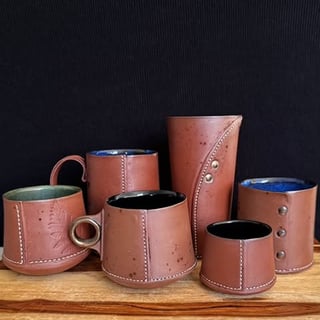
Speaker: And so the surfaces that I get in the wood kiln kind of inform decisions that I'm making when I'm putting surfaces on my electric fired work. So most of my stuff is kind of like dipped or poured glazes, but I'm using glazes that I formulated myself to kind of run and mimic
Speaker: some of the surfaces that I've seen in the wood kiln. I have some like really stony mat glazes that remind me a lot of like some of the more matted out surfaces that I see in a wood kiln and that sort of thing. How are you able to kind of like mimic the results of a wood kiln to your electric kiln?
Speaker: So basically I started toying around with ash glazes fired in electric kilns so taking wood ash sieving it, mixing that with a couple other ingredients and then coming usually like a clay slip so like red art, for example.
Speaker: And wood ash, if you mix red art and wood ash, like 50 -50, you'll get like a cone six glaze. We're pretty close. And basically just kind of adjusting that recipe to work with my clay body that I fire, which I use for electric firing, is mostly Brooklyn Red from Standard, which I fire up to cone eight.
Speaker: And so basically I just, I basically decided I don't like sieving wood ash because that's a pain in the butt and you always have to like find wood ash or be collecting it from your bonfire or your fireplace or whatever. And it's a whole hassle. So reformulated it to basically it's a fake ash glaze. So it has a really high calcium content. So when they melt on the pot, it kind of mimics the rivulets that you'd see in a wood fire.
Speaker: really ashy pop. How did you find this kind of like fake ash glaze?
Speaker: Back in college, there was one glaze that we had mixed up for a cone 10 firing that was a fake ash glaze. And I didn't really know what that meant at the time. And then after wood firing, it's doing some research. John Britt's two books that he's published, his high fire glaze book and his cone six glaze book are both a really good resource as far as just a whole bunch of recipes.
Speaker: He doesn't go very deep into like some of the science behind it. I actually, my degree is actually in chemistry and I taught high school chemistry for six years. So having that background knowledge
Speaker: I was kind of able to kind of break apart some of these recipes. More recently, it's been plugging things into glazy .org and using some of their glaze calculation software to substitute out some different materials and that sort of thing to see if I get some results that I appreciate more. I've done some stuff where I've taken some electric work and side fired it on seashells in an electric kiln to kind of mimic
Speaker: some of the directionality that a lot of times you'll see in a wood -fired kiln. I don't know if that's necessarily the answer to what I'm looking for, but. What did the seashells do to the pottery? So seashells, which are mostly calcium carbonate, when you heat that up, it calcines and oxidizes into calcium oxide.
Speaker: And then as the kiln cools down, it reacts with the water vapor in the atmosphere and turns into calcium hydroxide, which just dissolves in water. So to leave the glaze will melt into the seashell and leave a pattern of where the seashell was and what the seashell looked like. But the actual seashell, when it comes out of the kiln, they'll look like this crumbly white substance, just let it soak underwater.
Speaker: I usually just like put all my pieces that I've seashells in like a five gallon bucket fill it up with water let it sit for a couple days and then clean up the pots and that sort of thing and it'll leave a nice impression. When I was out at Cobb. One of the other residents learned a little trick from Tara Wilson who's a wood fire potter out in Montana.
Speaker: and they obviously don't have seashells in Montana so she actually takes whiting which is calcium carbonate and plaster which is primarily a calcium phosphorous and calcium or calcium phosphates and calcium carbonates. Mix them 50 -50 and you can basically like stamp out some patterns on clay
Speaker: pour that mixture over the clay, let it harden up and you've got like synthetic homemade seashells. So that's something I tried a little bit when I was out at Cobb. They left some different patterns. I use a lot of textures on my work, so I'm excited to take some of those textures that I'm using on my work and make seashells with those textures. So instead of having a seashell mark, which is beautiful, but
Speaker: I like that's not something that relates to my experience in life other than like oh cool I can fire pots on seashells. So trying to get some you know some of these marks that are getting left on the pieces from the wood firing process or from the firing process trying to make be really intentional about those marks and
Speaker: I've got some ideas about using some like rocks or wood texture or some other sort of patterns and textural motifs that I'm already using at my work as sort of like the seashell substitute. Right. So now this is something from your website that I found pretty interesting. So it says, my pottery ventures to make not only the profound moments, but also the mundane actions of daily living, more artful, cherishable and fulfilling. Can you explain this some more?
Speaker: Yeah, so, you know, I make pots that are made to get used every day. So when I was growing up, one of the sort of experiences that I have and memories that I'm really fond of is family get togethers. When I was growing up, my grandparents actually lived in the lower level of our house, so
Speaker: A lot of times I was down like helping my grandma cook dinner or helping my mom or dad cook or my dad always made the, we'd have, you know, 20 some people, 30 people for Thanksgiving and my dad was the one who always cooked the turkey. So like that sort of communal and gathering aspect around food and that sort of thing has really kind of contributed to, you know,
Speaker: the work that I like making, you know, whether it's like a big serving dish or a large bowl that you might have like a turkey on or like a big bowl of mashed potatoes or something like that, or it's just like your daily coffee mug that you drink coffee out of every single morning. I think especially for some folks that might not be makers or might not be
Speaker: as connected to that sort of process. I think using like a handmade object really helps you connect with the people around you and kind of enriches your daily life.
Speaker: Chinese made coffee mug that you're buying at IKEA or Target. Even if it says, oh, it was glazed by hand, that's some dude or lady in some factory dripping a glaze on by hand. And there's not any thought process or intentionality behind it other than, hey, I'm going to get my paycheck. And that's putting food on their table, which is great. But there's not any intent behind it other than maybe some designer that said, oh, this color will look nice on this.
Speaker: um so I think being able to slow down um in some of those sort of like daily rituals whether it's coffee or tea or or whatever it is um and kind of take in the artistic side of a handmade object um not just like well -made well -crafted work but also like something that's made with an intent um I think is really
Speaker: you know, helpful to our lives, especially with like the amount of time we spend on phones and other sort of technology really distances us from each other. And so I think this is kind of counteracting that. I love that so much. That was so powerful because it's so true that like we do have loose connection, but like with handmade stuff, we have that connection again. Definitely. Now,
Speaker: Could you tell me how has a failure or a parent failure led you to future success? Well, the probably the most relevant example or
Speaker: most recent when I was out at Cobb, I had six teapots, one I had made here and then five teapots I made there. And if anybody's made a teapot before you understand how much effort and work is required to make a teapot. And pretty much everything that we were firing there was getting fired green. So I'd throw it, I'd put slipper glaze on it while it was between leather hard and bone dry. And then it would go in the kiln and get fired. So there was no bisking.
Speaker: just because the kilns are right there. Fuel energy costs in California are probably about three or four times what they are here in the Midwest on a good day. Yeah, so I'm glad I'm paying Midwestern prices for gas again, because like $7 a gallon for gas is kind of painful. But the teapots, zero of them came out of the kiln.
Speaker: in a usable manner. The one that I had brought out with me was bisqued, but it was too close to one of the stoke aisles or something. And, you know, the spout got knocked off or like the tip of it broke off. So that was no go. And then the other five that I had made there, I found some issues with when I'm green glazing,
Speaker: completely closed forms. So I also had the same issue with some of the flasks that I made. So you're pouring the liner glaze in there, the clay's bone dry. And then it's in there, you're rolling it around and you're dumping it out. And with the closed forms, it sits in the bottom a lot longer than it does with, let's say a mug, because mugs, like if I'm putting a liner glaze in sand, it's out, done.
Speaker: Whereas some of the clothes forms that you're rolling around and then tipping it out and it sits there a lot longer. And I didn't notice anything right away, but when they came out of the kiln, they all had these like really gnarly cracks on the bottom parts of them where the slip or in this case, a liner glaze had sat on the inside and over hydrated part of the piece. So the bottom portion over hydrated, but the top hadn't. And so they had all these
Speaker: gnarly they weren't s cracks they were like really weird and they happened on the way up in the firing because everything was like filled in with.
Speaker: would ash and that sort of thing. So that's how I knew that the crack happened before the kiln was at temperature and not cooling on the way down. But that's just kind of a painful lesson in, you know, next time I'll be bisquing all my teapots beforehand. So it's, I don't know, ceramics is always really humbling and it's, you do your best to figure out what you messed up on and
Speaker: change your process or alter the way you're doing something so you're more successful the next time. Right, I totally agree with that. So now, I don't know if you still do this, not because you just move, but you sell your pottery from your home sometimes. Could you tell me how you started doing this? Yeah, so pre -pandemic, my primary source of selling my work was at art shows and art fairs.
Speaker: And if anybody's ever done that, which it's not for everybody, but I'm too extroverted for my own good. So I like really enjoy seeing all the people and interacting with folks. So that's kind of why I deal with all the effort of, I've got a trailer that I put everything and go to shows with. But when I do my home sales, basically it was like, okay, how can I,
Speaker: you know, participate and sell some more work that I'm not necessarily paying a show fee for or the money that I'd spend on a show fee.
Speaker: Pardon me. The money I'd spend on a show fee I can use to like have some beverages and snacks for folks because someone's got a glass of beer, a glass of wine, they're probably going to spend more money. So, you know, I've got a lot of other colleagues in ceramics and art that, you know, whether it's a studio tour,
Speaker: or some sort of home sale or a kiln opening sale. I think that's pretty common. I think your patrons and the public in general like being able to see where you work or I think there's a certain amount of novelty of like, oh, you're an artist. How do artists live? Like we're some novel creature. But it's just kind of how things go. Like people like spectacle might be a little bit of a,
Speaker: might not quite be the right word for it, but I think people are intrigued by it. And so if they can see your studio or interact with you in a more personal way, that's I think really nice for the home sales.
Speaker: I generally sell pretty well. The big thing is having like your own email list or mailing list and then the other shows that I do that are around my hometown. I'm giving out obviously my card and that sort of thing asking people to join my email list but once it's closer to like my holiday sale I'll have I'll put make like a little
Speaker: You can print out pictures at like Walgreens work really well or this to print make little postcards or something like that to basically hand out saying hey I'm having this home sale this is where it's located this is the times like it's any other show that you go to but you're hosting it at your own studio there's less overhead I get to sleep in my own bed I'm not traveling.
Speaker: It's a good motivational factor to get my shit cleaned up from all over the studio. Our old house, I basically would take everything off of our shelves in our living room and our home office and put those upstairs and then move my booth set up into our actual house because we lived in a tiny little like 1300 square foot
Speaker: Cape Cod with like a postage sized yard in right in downtown Milwaukee. So, you know, I think living in like an urban environment was really helpful as far as getting traffic. You know, you're not gonna get as much traffic as like you would at like an art fair that's got 50 ,000 or 80 ,000 people visiting it. But mostly everybody who showed up for the sale is buying something.
Speaker: or is with someone who's buying something. So that's kind of nice. I'd rather talk to 30 people over the weekend that all buy something or multiple somethings than talk to, you know, 300 people and only a tenth of them buy things, if that makes sense. Yeah. So now what is your kind of, I guess, your favorite part about this?
Speaker: Um, so I think one of the big things I really like about ceramics is just the problem solving, um, that's involved is there's, you know, even if you get like one thing figured out for you anyways, or you're, you're done developing it. Like, um, I feel pretty good about my mugs that I've been making for like nine years now. Like the design slowly changed over time, but like.
Speaker: I can sit down and throw mugs and I can just kind of get in the zone and do it. But then there's other things like teapots or pitchers or I've recently started working on some larger combined forms and pieces like that, that there's always something new that you can kind of figure out or try to
Speaker: Think about what your intent and your purposes behind making what you're making and then trying to make sure that what the object that you're making is expressing your voice and communicating what you want it to commute as a communicate as effectively as possible. So in my opinion, this kind of directly relates to like
Speaker: So like big question, oh, what's art? Like that question always gets thrown out sometimes and which I don't know really what a good answer is, but I feel like
Speaker: art can be anything that you're using to communicate an idea, right? Like that's the idea behind artwork is you're trying to communicate something. It's just, maybe it's a verbal artwork, you know, poetry, but that encompasses everything. So with ceramics, you have some ideas that you're trying to communicate. And so if you're, have some self critique or reflection, once you're making some work, hopefully you can say, okay, well,
Speaker: I think this piece talks about or lends itself to conveying, you know, things that are organic in nature or this seems really rigid and I don't want it to seem rigid. So what can I do?
Speaker: to change that moving forward. So this kind of constant back and forth conversation from finished work to new work that you're making is kind of this constant problem solving keeps my brain engaged in the process. And that's what I really like about ceramics. So. I love it. Cause I feel the same way. Cause it's like all about problem solving. And then once you find something, you're gonna be like, oh, this is so great. And there's always something new. Yes, totally. Now,
Speaker: If you had to give advice to potters looking to find their own unique style, what would you say? Make and make and make and make more stuff. Which, I mean, A, you'll get better, you know, the technical aspect behind ceramics, I think, more so than a lot of other mediums, some of the other like fine craft mediums or whatever, like the technique involved to make the finished project.
Speaker: is such a huge component for you to be able to communicate effectively using your medium. So for ceramics, if you're a wheel thrower, if I want to be able to make a large water pitcher that might hold a little over half a gallon or something like that, or a one gallon pitcher, I probably need to have the technical prowess to throw something about twice that big.
Speaker: So that when I go to make that object, I can really focus on what I'm trying to communicate and the form and not on the technique and what my hands are doing. So bringing that back to what you're saying is like, how do you come up with ideas? You know, we're so inundated with
Speaker: visual stimuli, whether you're on your phone on Instagram, I know I'm guilty of that, or Facebook, or just the natural world. Like I'm looking at milkweed plants blowing around right outside of our window, which is really cool to watch.
Speaker: getting past the technical side and being able to think about like, okay, well, I want this to look like this thing that I saw or have the same gesture as this other thing that I experienced. And so you can really focus on that. And to that end, just doing it a whole bunch of times, I find that the best, when I come up with new ideas that are successful ideas, it's usually from me doing something that I've done
Speaker: a hundred times before and then that hundred and first time I was like, oh, hey, what if I do this one thing different that I hadn't ever thought about before, but I never would have gotten to that point if I had done it previously that hundred times, you know, and that could be, that can relate to the craft of our work as well as just the artistic nature and the way I think through process, so.
Speaker: I totally agree. That is why repetition is so important and so important in pottery. So that was my last question. Where can my audience go and check out your work? Instagram is probably the easiest way to see my work. A, Linderman pottery or sorry, Linderman pottery is Facebook and Instagram. And then my website is also Linderman pottery. I've got a little bit of portfolio on there, some work for sale and that sort of stuff. So otherwise feel free to
Speaker: you know, send me a DM or my email and contact information's all on my website. So if someone's got any questions, feel free to reach out. We hope you enjoyed this episode of Shaping Your Pottery with Nick Torres. Do you have questions about pottery that you'd like Nick to answer? Send them to us on Instagram at Nick Torres underscore pottery. We'll see you next time.