Transcript
Speaker: Not everything is going to be a winning piece. Not everything is going to be a success. And like every failure gets you closer to the work that you're meant to be making. And every failure is a data point. That's the way that I look at it. But I love this idea of like sometimes you have to make something really ugly.
Speaker: What is up Shaped Nation this is Nick Torres here and on today's episode I had the great pleasure of interviewing Carolyn Hansen. Carolyn makes some really incredible sculptures that she incorporates post -traumatic stress that she's had in her life and she adds it into her own sculptures.
Speaker: In this episode, you will learn why Carolyn does this. You'll also learn about why sometimes you need to do unexpected things and wild things to your pottery to make something that is truly worth making. And finally, you'll also learn about how success can be different for every single person. And there's so much more in this episode. It's filled with tons of tips. Hope you guys enjoy it. See you guys in there.
Speaker: If you love pottery and want to take your skills to the next level, you're in the right place. Find your own pottery style right here on Shaping Your Pottery with Nick Torres. Let's get started. Welcome to Shaping Your Pottery and share with me what is so keen love besides making pottery.
Speaker: Well, something I love besides making pottery is my two dogs. I have two pugs and I've been, this is kind of a random thing to be involved in, but I've been involved in pug rescue for about 10 years. And these are my third and fourth rescue pugs and they're sitting next to me right now snoring and they just make me really happy. They're like little cartoons and there's nothing better than if you've had a hard day to come home and
Speaker: Just has animals that are you know overjoyed to see you so they're my favorite things in the world other than clay Absolutely. I love that so much. So tell me the story how you started making pottery
Speaker: Sure. I came to pottery in a bit of an odd way. I was an undergrad studying history and it was in my last semester and I was required to take one fine arts course to graduate. And I chose ceramics just sort of on a whim and I actually, actually hated it.
Speaker: when I first started, I didn't like the fact that I had so little, I felt like I had so little control over the clay. And I started making these like really kind of like clunky, chunky functional wear pieces. And I was like, what, what are these things that I'm making? And then my career kind of took a trajectory that wasn't arts based. I graduated from school and I went and got an MA in history and I was going to be a history professor. And I was doing a PhD program and I left
Speaker: the program and then I became a librarian and I was actually in libraries professionally for about 10 years and was an academic on the tenure track and
Speaker: kind of thought that that was going to be the way my life was going to keep going. And I didn't really make anything for about 10 years while I was working. I missed clay, but it seemed like something that wasn't, seemed like something I wasn't able to do as a career. And, you know, I think it's easy once you get on a certain kind of track or trajectory in your life to keep going on it and not necessarily, you know, think in a conscious way about whether you want to keep pursuing the same line of work.
Speaker: And then about three and a half years ago, my life sort of exploded or imploded. You know, during COVID I got divorced. I'd been married for a long time and my mom got sick and she needed me to take care of her. So I was living in New York city.
Speaker: And then I moved out to California and I was my mom's primary caregiver for about two years. And during that time, I started coming back to Clay because I had time and I needed something that was a release from the emotional and physical demands of caretaking. If you've ever cared for someone, it's tremendously difficult. And so Clay was like a safe place for me. And I started pursuing the work more seriously and could see myself
Speaker: in a professional capacity that I hadn't seen myself before. And so I've kind of just been pursuing that track and hoping that a career can be like a feasible outcome. I think it's really easy for us to see people on Instagram and think
Speaker: Like, oh, that can't be me. And there's no reason I think that we can't be successful if we put in the work, but success looks different to everyone. And so that's kind of how I went from one area of my life to another. My pottery journey has been so far 20 years of making, but it's been very like on and off.
Speaker: And there were times when I thought I would never make anything again. So it's never too late to... I guess it's never too late to change. Definitely agree. And what would you say made you continue going through pottery now?
Speaker: Oh, I think clay is where I feel the most myself. It's where I feel the most safe as a person. And there's nothing that makes me feel more tired and calm than when I'm working.
Speaker: I love the tactile experience of clay. I love the smell of it. I love the way that it feels. I love the way that it sounds when you open a bag of clay. There's still such like a sense of excitement and freshness about it to me that can't be duplicated in any other area of my life. And it's just such a privilege right now to be able to explore that.
Speaker: And some days are hard, right? I think as artists, it's a practice and you show up and some days are wonderful and easy and everything kind of feels like magic. And other days it is a slog and you just keep showing up. And I think that the work, for me, the work has reflected my development as a person. And it's just such a special, it's just such a special place to be for me right now in the studio.
Speaker: Absolutely love that. And I definitely agree. Shaping Nation, there are going to be days when you're not going to maybe be all in that. You're not going to be in that zone. And then there are going to be days where you are in that zone. But the most important thing is to keep showing up, keep making pots. I love that. So right now you are in the middle of a three year mentorship at Anderson Ranch Art Center. Can you tell me the story about why you decided to do a three year mentorship? Yes. So I last year was able
Speaker: to take three classes at Anderson Ranch, which is like a tremendous opportunity that I don't know that I'll ever have, you know, the resources to do that again in my life. And it really kind of opened up my eyes to what it meant to be a professional artist, watching visiting artists and watching faculty.
Speaker: them come to work and seeing their thought process and their artistic process. And I just wanted to delve more into that. And I'm, you know, right now I'm focusing on trying to decide what my next step is, whether I'd like to go to graduate school or pursue residencies. And the mentorship program at Anderson Ranch seemed like a kind of nice, like a nice compromise between
Speaker: like a formal education program like a master's program which requires you know usually you have to move or requires more of a time commitment and the way that the Anderson Ranch program is designed is that you go for two weeks every summer for three years and then you meet every three months with either the faculty members or the faculty and the cohort of artists
Speaker: So it's really great because it gives you a community of artists who are in all different stages of their artistic lives and their physical lives. We have folks that have just come out of MFA programs who are in their mid to late twenties. We have folks who are in their sixties and
Speaker: I've been working artists for decades. And there's also a wonderful woman in our program who finished her MFA when she was 50. So like, again, it's, it's never too late and being able to be part of that cohort has been really great, even though it's just started, we just started in August of this past year. And it's also giving me the opportunity to have this sort of low residency quasi graduate experience. You know, we have critique.
Speaker: And that's really important as well. I think it's easy to kind of get into an echo chamber with the community that you're in, in your local studio or your individual studio and in the echo chamber of your own head. You know, we see the work over and over again that we make with.
Speaker: our own eyes, but having that fresh perspective of someone else to say, you know, that doesn't really work for me, or did you consider trying this? It really opened my eyes to the ability to think more broadly about both my process and the outcome.
Speaker: And I think that the arts and crafts programs that we have in the US are just really tremendous. You know, Anderson Ranch is one of the places that I've been, but there are so many wonderful places where people can do professional development. And I mean, I can't speak highly enough of the people at Anderson Ranch right now.
Speaker: And Betsy Alwyn is the head of, she's a really long title that I can't remember, but she's the head of ceramics and mixed media. And then Joanne Lee is there and she's a tremendous teacher and a tremendous ceramic artist. So it's just a great place to be. And so far, how has being in this mentorship helped with your own pottery?
Speaker: I think it's expanded my horizons in terms of what I think is possible in making. Like for example, for a long time I was making pieces that were really kind of more vessel than sculptural object. And I was really kind of focused on this idea of like a circular kind of round bottom or I was doing the same process over and over again.
Speaker: Adele Harrow, who is one of the instructors, and Abby Barley, who are both great, great faculty members. Adele was looking at my work and he was like, you know, gravity sucks. And he was like, gravity sucks. And I feel like your pieces want to fly. And he's like, how can you make them fly?
Speaker: And so he had this idea of like maybe using a slab base or, and then I kind of took that and was like, well, what if we did sort of extruded coils and then build sculptural kind of pieces off of the extruded coils as like an under structure?
Speaker: So it's been just great to kind of have that dialogue and challenge. At my own studio, you know, I work in a community studio. I live in Santa Barbara, California. You know, it's a lot of folks that really have like a certain expectation of what the work should look like. And the expectation is that it should be like functional wear. So I'll often get people coming up like giving me unsolicited advice, which sounds like, are you going to put that foot on that? Or
Speaker: Are you going to keep it like, or are you going to do something weird to it? Like they really have, and they mean well, but I think they have an expectation that the work is going to book a certain way that they're comfortable. And like, when I go to Anderson Ranch, the people there are like, do whatever weird thing you want to do, like really push yourself.
Speaker: to make something that you wouldn't normally make. And Dell said something really like that I've thought about a lot. He said, you know, sometimes you have to make something really ugly before you can make something beautiful, like in your process. Like not everything is going to be
Speaker: winning piece, not everything is going to be a success. And like every failure gets you closer to the work that you're meant to be making. And every failure is a data point. That's the way that I look at it. But I love this idea of like, sometimes you have to make something really ugly. So when I have something come out of the kiln and like the glaze doesn't turn out the way I think it's going to, or the piece just isn't, it's not something someone might find attractive or pretty.
Speaker: Like, I don't think, like, this was a failure. I think this is just the next step on the road to where I need to be. And everything is a learning experience. Absolutely great. Shaping Nation, your failures aren't failures. They're only a failure if you let it be a failure. That's a learning experience. Take those lessons and apply it to your pottery. Make your pottery even better. I love that. So let's talk about your pottery. Can you tell me the story how you started making sculptures that you make today?
Speaker: Sure. So again, when I started making pottery, I was working in kind of more functional wear, but I kind of hated it. I hated the fact that there were like expectations about what the functional wear should look like or do, which is like, you know, it's meant to do a certain thing.
Speaker: And I just didn't really like those restrictions. And so I started working thin pretty early. And I only hand -built. I worked on the wheel for maybe about a year. And I actually had a teacher say to me, I think you should go back to hand -building, because I was so bad at it. I gave the wheel, I gave it everything I had, and I was just terrible at it. And everything I made on the wheel, I ended up altering really significantly. So it just didn't make sense.
Speaker: So anyway, I went back to hand building. I started working really thin. And I would say in the last like six months, my sculpture has become like more unapologetic. I think before I was kind of flirting with this idea of like vessels that have a sculptural component, like maybe a sculptural rim.
Speaker: But now I've kind of come to the point where I'm thinking, I just want to do things that are kind of unexpected and wild and that are like an expression of where I am in the moment of making. I'm a really tactile maker. I think a lot about the clay.
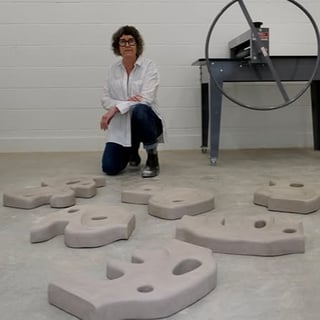
Speaker: I think about it as a different medium almost. I had a teacher in New York who's an amazing sculptor. His name is Derek Weisberg. And he used to say, I treat the clay as if it was paper or fabric. I crumple it, I smoosh it, I tear it, I rip it. Like I just am really physical with the clay and I kind of almost abuse it. And then I take that and kind of build off of the kind of trauma that I inflict on the piece.
Speaker: and try to make that into something beautiful. So I'm really pushing shapes as far as I can push them, and I'm having a lot of fun with this idea of also playing with negative space and just being really
Speaker: free and wild. That's not how I am in my personal life. Like, I'm a pretty quiet and controlled person. But I love coming to the clay and just being unexpected and in the moment and just letting my hands do whatever they want to do in them with this kind of really intuitive physical process. And, you know, sometimes things come out beautiful and sometimes they come out ugly. And I sort of celebrate
Speaker: both of those experiences as part of my artistic journey. Absolutely love that. Shaping Nation, you don't have to be with the traditional mode of making pottery. If you want to get wild with your pottery, get wild with your pottery so that you can make pottery that looks absolutely amazing and you like. I love that. So something from your website that I found interesting is your work focuses on the exploration and expression of post -traumatic growth and an adaptation of the natural world. Can you tell me more about this?
Speaker: Yeah, I think I touched on that a little bit about like in my own life as having gone through this period of just really difficult change personally and professionally. You know, I left my home, I left my marriage, I left my job, I left a life that was really established and I became something new. I became a new person and
Speaker: I think we all experience, and we've all gone through with COVID, for example, this kind of collective trauma. And sometimes out of trauma comes the most beautiful growth. It's not what we would choose for our lives to go through pain and loss.
Speaker: it's an inevitable part of being human. And so one of the things that I focus on in my own life is, you know, what lessons can I learn from the difficult things that I go through? What growth can I experience as a person that I can bring to the relationships that I have in my life and into my work? You know, there have been so many times in my life where I have been stretched
Speaker: And I thought, I can't, I can't do, I can't do what I need to do. And I did it anyway, because I didn't have a choice. And so when I think about clay and the way that I'm working right now, again, really thin, almost in this sort of lattice -like formation where I'm taking pieces of clay and really stretching them and forcing them to kind of endure
Speaker: almost in a way trauma. Like I will actually, you know, for example, make a vase shape and I'll punch it, I'll rip it, I'll tear it, and then I'll build something off of that destruction. And that to me is this idea of post -traumatic growth, of taking trauma and trying to make something beautiful from it. And I see that also in, you know, in our world right now in the way that we're all trying to adapt.
Speaker: After the pandemic, we live in a world with so much instability, so much violence. We're undergoing climate change, which is this huge existential threat, and we don't know how the world is going to adapt and evolve.
Speaker: in response to all of these changes. And so I think about the natural world and how animals and plants have evolved over millennia as a result of the external traumas that they endure. And I see that reflected in my own work as well, this kind of relationship between trauma and the both human and animal experience. And what is our world going to look like in 100 years?
Speaker: what kinds of technological advances are we going to have to create in order to survive as a species? And so those are some of the things that I've been thinking about. And so at first glance, you know, the work might look really, you know, I get people say that, oh, it looks pretty. And I think there is a beauty in what I'm making, but there's kind of an underlying tension and violence that's actually happening in the process at the work.
Speaker: that is really part of the process for me and it just sort of mimics, I think, some of the growth that I've been having in my own life. I absolutely love it. That was really great. So let's talk about discovering your voice. Kitty, tell me about the moment when you knew you were heading in the right direction with your pottery.
Speaker: That's a really good question. I don't think there was one moment. I don't think there was one moment. I think there's a chorus of many moments. I think the moments where I feel the most confident in what I'm doing is when I'm alone with my own work, when I am making it and I look down and I see the work and I think I haven't seen this before from myself. I think that's really important to me, this idea of being authentic.
Speaker: to who I am as a person. And I feel like the more I've become myself as an adult and as a woman and as a single person, the more I become myself, the stronger my artistic voice is.
Speaker: I think we can't really separate the two, like who you are in your life versus who you are as an artist. I think those two things are really intertwined. And I think what I feel most confident about my own voice as an artist is that
Speaker: I make for myself in a lot of ways. Like it's important to make things that people are going to want to buy if you want art to be your career, but also like I'm not a functional maker. I make sculptural work. I think sculptural work has to have a really strong voice. It has to have a point of view. Otherwise, you know, what's the reason to have it? You know, that doesn't make sense to me. So I think my voice is
Speaker: currently becoming stronger every day with every piece that I make that I feel is an authentic representation of both the process of making the work and an authentic representation of who I am as a person. And then if people don't like it, I accept that.
Speaker: Like, one of the things that I say to myself a lot, and this might be a horrible marketing strategy, I don't know, but I say to myself like, it's not my value, it's not my job. It's not my job to make people see my value. It's my job to go where my value is seen.
Speaker: You know, like I am not for everyone and that is okay. Like my work is not for everyone and that's also okay. I'm not making for the masses. I'm making for people that see value in the work. And it's my job to go and seek out those people and those collectors and those curators and those teachers who see the value. I see it and I believe it's there. And it's my job to go find those people that also see it. Yeah.
Speaker: I love that. Shaping Nation, you're not going to please everybody with your work and that's okay. What matters most is if you're making a party that you find truly loving and that other people are starting to notice it as well. I love that so much. What would you say are some of the opportunities that started to come to you once you found your voice with your sculptures?
Speaker: Thanks. The opportunities have come. So this is just sort of starting. I mean, I'm kind of in the infancy stages of being a professional artist as a career. You know, one example would be this podcast. Another example would be that, you know, a couple of weeks ago, my mentor here in Santa Barbara, whose name is James Hagerty, who is an amazing artist. He, you know, brought me to one of the local galleries here in Santa Barbara that's
Speaker: know, really well known here. And I met with a curator and was able to talk about my work and have them look at some pieces. And they're excited to show some of the work in the summertime, a couple of pieces. So, you know, it's also like little steps, right? Like, I think there's this idea or this fantasy as an artist that someone's going to discover you and then
Speaker: you know, you've made it. And maybe that happens for some people, but I think most people as artists, you know, opportunities come locally and they come often kind of small and they build on each other, right? Like, so there's this idea of building momentum. And I think momentum is something that is important and that takes time. Some people are, you know,
Speaker: artists for their whole lives and never have commercial success. And how we define success is also so different, right? Like, whether that's like being able to financially support yourself with your art, or maybe success is, you know, having artistic practice.
Speaker: that continues your whole life while you're doing a day job. You know, I think that there's, for me, opportunity is also something that I am actively seeking. I think that's important too is that we're not sort of waiting for people to come to us again and see our value, but going out
Speaker: And making those opportunities and I think so much of that is also through just being part of an artistic community. So opportunities that are coming for me are, you know, they're just starting, which is a really exciting place to be. I mean, it's scary. I don't know if I can financially be successful as an artist. I'm just starting to pursue that line of work.
Speaker: in a financial capacity. But we kind of build on every little step that we take. And I think about that too, right? That every little step adds up. And it's okay to also take your time. It's okay to do other jobs.
Speaker: It's okay if art isn't something that you ever make money at. There was a really amazing article in Jacobin, the magazine, maybe in like 2015, that was really kind of influential for me. It's called something like For the Love of Work. I can't remember exactly. But the idea was that, you know, we are told kind of as we're growing up, like you should find something that you love and do that for your job.
Speaker: And the article was sort of like, well, find something you love, but you don't have to make money at it, right? Like you don't have to turn that into a capitalistic endeavor. Like maybe what you love is just what you love, like as a hobby, as a pleasure, as something you do because it makes you feel whole and it makes you feel happy and good. It doesn't necessarily have to be something that you translate into a money -making venture.
Speaker: Like, if I have to go back to libraries tomorrow, like, to make money, I'll do that. And I'll always be an artist. I'll always keep making. You know, the two don't have to go together in terms of, like, being an artist and making money from your art. I just think that, like, we also have to think about that in a really different way as artists, because otherwise, otherwise I think that the art
Speaker: isn't yours in the same way as when you do it for love. I hope that I can do it for love and for money. I don't know, we'll see. Absolutely love that. Shaping Nation, the most important thing is if you are making pottery that you love, even if you're not making money on it yet, or even if you want to make money on it, the most important thing is make pottery that you love. I love that. So now, what advice would you give to someone that is trying to discover their own unique voice with their pottery?
Speaker: I think the advice I would give someone who's looking for their own voice is to develop as much as they can as a person in every area of their life. Develop relationships, develop what you love to do outside of the studio.
Speaker: develop hobbies, develop friendships. And when you go to the studio, I would say, play, have fun, take risks. I think ceramics is, for me, like a very kind of interesting balance between like being really intentional and being detached and to the result. Like the result to me doesn't matter as much as the process and the experience that I have making the work.
Speaker: I love when the work turns out beautifully, but that's not the goal for me. Like the goal is to experience making the work. The goal is to have my hands in the clay. The goal is to be excited when the kiln opens.
Speaker: And the stronger my voice gets as a person, the stronger my voice gets as an artist. And when I feel confident about the work, when I feel like it expresses who I am as a person, like I'm also much more resilient in terms of like failure.
Speaker: or people not liking the work. When I feel like I've expressed myself in a way that's authentic to me, like if someone doesn't like the work, I can accept that. And I just think that the more developed we are as people and the more just sort of centered and confident and
Speaker: happy we are in our own lives. I think that just translates to the work. I think the work becomes longer. I think it becomes more whoever we are. I absolutely agree. I love that so much. Carolyn, it has been great chatting with you today. And as we're coming to a close here, what is one thing you want to hammer home with my audience today?
Speaker: Um, experience clay in whatever way makes you the most happy. If you want to throw, throw. If you want to hand build, hand build. If you want to make molds, make molds. If you want a 3D print, 3D prints. Try everything that you have the opportunity to try. Because you don't know, you might actually find something new that you like, that you didn't realize you would like.
Speaker: This is a medium that is like, it's so playful, it's so fun, it's so physical, it's so demanding, it's so exhausting. So also like, take breaks, live your life, be the most in your body and in your studio that you can when you're with the material, like engage, but also detach.
Speaker: Just let it be whatever it needs to be in your life, whether it's your job, whether it's your hobby, whether it's your passion, whether it's your best friend. Clay will always be there for you. Clay has always been there for me.
Speaker: And when I was able to come back to it, I found a voice I didn't know I had. And being able to hear that voice and follow it and experience clay, just as it is, is such a gift. So I would say, enjoy it. Whatever clay looks like for you, make it special and a passion in your life.
Speaker: That was some excellent parting words advice. Carolyn, it was so great chatting today. Where can my audience go and learn more about you? Well, you can go to my Instagram, which I think will probably be linked on here and also my website. I can just Google my name and you'll find me. It's been a pleasure talking to you. Thank you so much for having me.
Speaker: Hey, thanks for listening to this episode of Shaping Your Pottery with Nick Torres. If you want to discover how close you are to actually discovering your own unique voice with your pottery, I put together a free four question quiz. It's very short. It takes 30 seconds for you to take. If you want to know how close you are to finding your own unique voice, go to shapingyourpottery .com forward slash quiz, or you could simply go to shapingyourpottery .com and it'll be right there at the top.
Speaker: I hope you guys enjoyed this episode and I'll see you guys next time.