Transcript
Speaker: Hey everybody, real quick. The first step to discovering your voice is finding what you actually like to make with your pottery. That's why I created a quick start guide so that you can start discovering what you like to make with pottery without having to give up experimenting on your pottery. Now let's get started. Go to shapingyourpottery .com forward slash ace to get this free guide.
Speaker: Do you love pottery and are ready to stand out from the crowd? Then you're in the right place. Welcome to Shaping Your Pottery with Nick Torres where we help you discover your own unique voice. Now let's get started.
Speaker: What is up everybody? This is Nick Torres here. In today's interview, you guys get to meet the cooks. We have Austin and Courtney Cook, a husband and wife tag team that makes some really incredible pottery. In this episode, you will learn how to run a business as a husband and wife for pottery
Speaker: being more efficient with your pottery and your making and keeping it simple and making time to experiment with your pottery. Courtney and Austin, welcome to Shaping Your Pottery and share with me what is one thing people might not know about you and let's start with Courtney.
Speaker: Hi, Ray. Thanks so much for having us. One thing people might not know about me is that pottery is a side thing for me. I also own a marketing agency. So that is my full -time job. And we specialize in social media, website design, and brand identity. And Austin, you?
Speaker: Thank you for having us on. And I think the interesting, I guess, what most people don't know is my passion really is in technology. Growing up, I thought that was going to be my career path. And I thought that was, you know, that's where I put all my effort behind until I met Courtney. Well, he's being humble.
Speaker: So the first thing I thought we could talk about was how you guys got started with ceramics. So Austin, would you mind going first?
Speaker: Yeah, it kind of butted in like elementary school. We have a pretty neat place near us called Billy Creek Village and it's kind of an old -timey village where they kind of set kind of like they make it look like the 1800s kind of and there was a potter there and he was a local teacher that I got to see and it was really neat to you know, he inspired me to really get into it and
Speaker: Towards high school, I took a couple of pottery classes and I was really lucky that we really didn't have a pottery class, really. Our school just had a couple of wills. Small town life. Very, very small town. I mean, we had 20 thumb in our graduating class. And one nice thing was our teacher just let me do whatever I wanted. So she actually made a class specifically for me just to do whatever I wanted with Clay.
Speaker: Going into college, I needed some elective classes and this is where it kind of really kind of started turning serious. I had a couple, like I said, elective classes I needed to take. I ended up taking one, 200 and then I had to get special permission from the professors to get into 300 level classes because my major was in technology and they were like, why are you doing this? Why are you taking so many ceramics classes? And I just really enjoyed it.
Speaker: And yeah, then it kind of exploded once I met Courtney and she was like, I was making some stuff at home just for me and family and she was like, well, we can make a business out of this.
Speaker: Love it. And Courtney, you. Yeah. So, uh, yeah, I had a similar story. I mean, I started ceramics in like middle school and did it through high school and everything. I was very involved. Like I even started our ceramics club at my high school. Um, but yeah, so then I, I continued it in high school and in college. Um, but I mainly was studying like graphic design and marketing. So it was again, kind of like an elective thing, but yeah. And then whenever Austin and I met, it was.
Speaker: very much like it was one of those shared things. Like when we first started dating, we're like, Oh, you do pottery. I do pottery. And so that was like something we connected on. And yeah. And then we, I mean, we like, once we moved in together and everything, we kind of started doing pottery together. Awesome. So when did you guys start making, like actually making pottery together and we'll start with Courtney. Yeah. So I, I'm pretty sure it was 2017, maybe 2018. Um,
Speaker: We actually have a barn in our backyard. It used to be called the party barn, because we used to have fun get -togethers there. And then we started making pottery for fun. And then pottery took over the barn. And now we can't literally do anything else in this barn now other than pottery. And Austin, do you have anything to add to that? I mean, that's just about really it.
Speaker: it really was just starting out as just a fun hobby that we weren't really trying to, it was to give ourselves break from our regular day jobs. And yeah, that's - Yeah, and Austin loves cooking. So like he loves like gifting pieces of pottery. Other people who love to eat and everything. So a lot of our stuff is very functional for that reason. I would say that that was something I struggled with was seeing the,
Speaker: I really struggle seeing the art within things. I see the functionality and I think that has been a big contributor to where we are. Love it. So can you guys tell me the story how you guys came up with the name Clay Plant Road and we'll start with Austin. Well, this one is actually, I don't know if it's cool.
Speaker: Kind of lame. It's just a road I grew up on. It was just Clay Plant Road. Growing up, it was actually before me. So in the 70s, there was this massive clay tile facility on our road. And we're very rural.
Speaker: beside the Amish it was it was just us and my you know where my dad where I grew up and and this massive clay tile where the railroad would stop and you know drop off train cars full of clay and stuff so that was
Speaker: just kind of paying tribute to, you know, where I grew up, yeah, where we grew up. And basically, everyone, you know, older than 40, 50, all remember, or all had a family member that worked out there at one point time or had stories for it. So again, it was a local thing at the beginning, we didn't ever imagine growing to the size we are. And then Courtney, do you have anything out of that?
Speaker: I mean, not really. I mean, we struggled like everyone else. I feel like to come up with a business name. So I mean, it's so hard. I mean, the best advice I can give to people is keep it, you know, general so that if you do want to expand into other areas down the road, I mean, yeah, because it's like if we ever want to offer, I don't know, like woodworking or other other things down the road, I feel like there is an opportunity for us to still do that.
Speaker: What would you guys say was your biggest struggles when you first started making pottery together? And we'll start with Courtney.
Speaker: Um, well, it's it's not even like when we first started. It's just a something we continually talk about and think about it. And even recently, it's it's so recent. So it's kind of funny that we're talking about this now. But like, we like different things. And it's so it's hard to work with somebody when you have, you have different tastes. And also, like our online people, they also like different things. So it's really hard, you know, understanding am I making things for myself? Or am I making things for customers or just to sell things basically, because
Speaker: Even just a few weeks ago we had a bunch of seconds or things we did not like on this table and my mom came over and she was like, oh my gosh, I love these. And you're like, why do you like those pieces of trash? So anyways, that's something we go back and forth with a lot is we have different things that we like. So we have to really try and be cautious about not
Speaker: being negative when another comes up with an idea and trying to make sure that we're giving it a chance and everything. How do you keep yourself from being negative?
Speaker: I mean, we have to literally in the moment try and remind ourselves to not shut an idea down right then and there. Because I mean, you know, Padre, I mean, some ideas are very out there. And I don't know, how do we? We're still learning. And then Austin, what would you say your biggest struggle was or you think was?
Speaker: We I feel like we've had a couple I mean at the very beginning there was a couple times where. Our relationship was also growing because I mean we.
Speaker: we moved in together after about four or five months. And we built that barn probably four or five months after that. So we were really only together for a year as we were starting to build. So we were learning each other. We were learning egos and what each other liked. So that led to a lot of friendly disagreements at the beginning of the direction.
Speaker: It was a great test of our relationship very early on. Yeah. That's a, you know, a good statement that if you want to know if you're going to be able to be with someone long -term, like start a business with them. I think too, though, you, you always tell people about like handles was your, is your biggest obsession. So.
Speaker: As a functional potter, again, I don't see art in my pieces. I just see functionality. And from the tech world, I never had the mind of just, oh, it has purpose. It's pretty. I wanted it to work. And there is no shortcuts. I'm used to being on computers and learning back ways of doing things and quicker ways to do things. What I've learned is there's just
Speaker: There's no, our pottery right now is like as efficient as it possibly can. I mean, yeah, maybe we've gotten very efficient though. So now it's hard to, you know, without moving towards a complete different, you know, forums or something, it's hard to get any more efficient. Yeah. Excellent. Excellent advice. I definitely agree with that being like efficient is like, it's hard to make it efficient, but once you find it, it's,
Speaker: makes everything kind of flow better. Oh, absolutely. Yeah. So I wanted to mention this before I go on to anything else. So you guys are building a new pottery studio. Can you tell me the story behind that? And we'll start with Austin. Well, this one has been a tough story for us for the past about four and a half.
Speaker: four and a half, five years. We actually contacted our contractor that is building it now four and a half, five years ago. And it's taken this long to get through it between nailing down exactly what specifications we wanted between our house and the studio that we're building. It's been, then we had, we're hit with the pandemic. So it's everything is kind of, yeah, we've just had a lot of bad things happen in a row to kind of keep us from
Speaker: expanding as quickly as we'd like to. But yeah, and an exciting part of it is that it's being built right now, and we're right in the midst of it. So lots of big decision making. And Austin is crazy, crazy good at planning things out to an extreme level. He could probably tell you where all of our electrical outlets are going to be in the studio. Everything is completely planned out, which he's been
Speaker: had in his head for years. But it's exciting and stressful. There's lots of things to figure out. Our studio, we hope, is very unique. We're going to have solar panels. Our kiln will be solar powered. We have a lot of special. Well, for our area too, being in the middle of Indiana, especially in our county,
Speaker: Indiana's really lagging behind the rest of the world and moving to green energy. And we're an oddity in our area. So that is awesome. I can't wait to see more about your studio. Now, let's talk about your guys' pottery process. Can you tell me the roles that you play? And we'll start with Courtney.
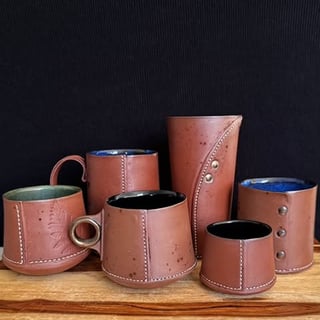
Speaker: Yeah, so I might answer for both of us because Austin comes first. Austin throws everything. He is the one who makes all of the forms. And I really put on the final touches so I glaze everything. But yeah, that's really our procedure for pottery. Yeah, so for the most part, yeah, I throw everything.
Speaker: all the studio stuff that's not fun, taking care of the kiln, the kiln shelves. And one thing is if you'd know us, we have a lot of drippy mugs and the pain that comes from cleaning kiln shelves day in and day out and re spraying them and all that fun stuff is
Speaker: is my day -to -day stuff. And I try to keep her limited. Because again, I don't see myself as an artistic guy. So I really let her do a lot of the playing with glazes and that. I've learned glaze chemistry. One thing I can say is I've taken ceramic materials workshop glaze classes over the past year. And I've learned a tremendous amount. And it's really
Speaker: I haven't been able to really sit down and make a lot of glazes yet, but that's one thing that we're going into this fall, going into the winter, going to next year is just concentrate on making our own studio glazes. Because as you know, it's extremely hard to be unique in today's world with Instagram and the amount of pottery that's out there. And I think making your own glazes is just another step and
Speaker: taking your work or our work away from making it more unique.
Speaker: I definitely agree with that. So what would you say a typical day in the studio looks like? And we'll start with Austin. Typical day. So I'd say like the our big days are the weekends since we do have jobs outside of this. And so well, you he's moving away from I'm moving. Yes, I'm moving away from my full time job as a network technician for local Internet service provider that my family owns and it's.
Speaker: going into pottery has been, this is my first year of, I would consider working full -time as a potter, or partially full -time. But the weekends really consist of, my goals are usually to throw about 60 pots, so, you know, from different sizes, mugs, or whatever. And that's really my limitation of about how long it takes me to put on handles the next day to trim everything, because that's what I usually try to do. I try to throw everything one day,
Speaker: and put handles up trim and handles the next day. Outside of that is usually using our glaze fountain that we made to, you know, we glaze all of the inside of our mugs with our glaze fountain because it just saves us so much time. We used to hand paint and then that was difficult. Three or four coats of trying to get glazed on the inside of hand painting was when you're doing hundreds of mugs is just not realistic.
Speaker: Stuff like that. And then outside of that, Courtney's mostly glazing, waxing, carving, just everything else that goes along with it. I mean, if we're getting near a restock date, then it's pictures and putting everything online and everything. Yeah. How'd you come up with the idea for the glaze fountain? Austin is very into everything efficiency. So he made that back when we
Speaker: realized that painting the inside of mugs was going to be treacherous long term. So yeah, he made that you can talk more about like how it was made, but also it's like his efficiency is something that's made us really successful like we and you have to be also willing to like invest when you're and when you're able to, you know, we recently bought a pug mill that was very expensive, but absolutely worth it because Austin no longer has to wedge clay. So
Speaker: A lot of our, like the last few years have just been, you know, making small steps to get more and more efficient. And, you know, we just bought a new wheel too. So not everything has to come all at once. It's definitely taken us years to get all of our equipment out there. You can talk about, you want to talk about the glaze fountain? Yeah, for that glaze fountain, it was dipping, like, I wouldn't say I'm a perfectionist. I don't have like the OCD thing, but
Speaker: I feel like I do in that situation when it comes to pottery mugs because everyone's been there where you dip something and then you ruin it by a tongue, a finger or something. And there's really no good way to really, unless you like wash the pot off completely and read, you know. And then sometimes you don't get the absorption, you know, you did the first time in it.
Speaker: I was looking for a way to be more efficient because I was dumping glaze in and then turning it out. That worked, but it just wasn't quick enough. I started looking online for
Speaker: some glaze fountains and I found a couple different DIY ones and I just didn't like any of the ones I saw. Also a lot of them you had to submerge the pump into the glaze, meaning you either have to empty it every single time or you have to have a pump for every single glaze basically. So I was just trying to figure out how to keep my pump outside of the glaze, which those pumps, they do work well and they do work.
Speaker: by how often we switch glazes it would just be so tedious of you know after taking an extreme like red iron oxide glaze and putting it into a clear glaze like there's not a good chance you're going to contaminate your other glazes so i just found a an outboard it's like a boat pump and it so you don't have to prime it you can just shove a you know a tube in your glaze and a tube that shoots up and uh
Speaker: It was just really about efficiency, the whole thing. It's really good. For those that are listening, it's important to find ways to be more efficient with your pottery and your work just to make things easier for yourselves. Absolutely. Now, Courtney, can you walk me through how you glaze the mugs and everything else because you don't dip or spray, you paint on everything. Can you explain that to me?
Speaker: Yeah, so I mean, we use a mixture of commercial glazes and glazes that we've made. And I mean, we also use those to mix together as well. So I mean, we do an insane amount of testing. I mean, tons and tons. I mean,
Speaker: Thousands of test tiles are out in our barn right now. We really need to organize them, actually. But yeah, so we do tons of testing to start off with, and we're really good about tons of notes. We have a spreadsheet that has all of our glaze combos down to me writing out this is
Speaker: two coats of this brushed on thickly and this is a thin glaze so you know it's very detailed because we've had to you know try and especially with our our drips we have to try and be as consistent as possible because like Austin said you know that we have had kilns where everything ran and everything was ruined but you know as we've like
Speaker: grown, we've definitely gotten more and more consistent because of our note taking. And as far as us just like experimenting with new things, there are literally with all the glazes we have out in the barn right now, there are a million of combos that have been created yet, we just, we have to like very much take the time to to create new ones. Right now, we actually just like the last few months, we've kind of realized we've been in a rut the last
Speaker: year and we were like oh my gosh we've only like released really like two new glaze combos this last year and it was kind of disappointing for us so that's why you know we're doing a restock late november but after that we're taking the rest of the year basically just to experiment because you you have to schedule that time in for yourself i i would say to to add what she just said it
Speaker: What we ended up doing is looking back is we kind of concentrated on our online community and we got into a production mode, I would call it. It's just we knew that from all the messages, we couldn't get enough mugs out to keep our community happy. So instead of spending the time coming up with new glazes, we just plowed into making as many mugs as possible.
Speaker: just to make our community happy. But at the end of the year, we realized that if we don't take time out to create new things, we're going to burn ourselves out. As much as we want to make our online community happy, we need to. And make money. Yeah, we going into building our studio stuff, it was about making money to afford our studio so we can do this for a long time to come.
Speaker: That was some excellent advice. For those who are listening, it's important to schedule times to just experiment and play. This is going to keep you out of that rut and you're going to get a lot better ideas this way. Absolutely. Austin, outside of the glaze fountain, how else do you use your technology skills to incorporate into pottery? I think the best answer to that is
Speaker: I've learned through college and at least in my tech field and the networking field, it was really they taught us, I wouldn't say in college, they taught us networking, of course, but they really taught you how to find answers. And using those skills and being able to, being someone who has ADHD and being able to have a very fast internet, I can find answers to just about anything I want.
Speaker: And that's really been a big drive for me to find unique ways or odd ways that other people haven't thought about with, uh, with our efficient, you know, Austin's a problem solver. So when he sees a problem, he's immediately looking for a solution. I do enjoy it. Yeah. That's definitely your, your brain. You like problem solving. I do. I love it. Love it. So.
Speaker: Can you guys tell me what is something you guys do to keep the actual pottery process a little bit more exciting besides the scheduling out and experimenting? And we'll start with Courtney. Gosh, well, yeah, I feel like that is kind of the answer, the scheduling. I mean, to keep it exciting.
Speaker: The first thing that comes to mind to me is I'm a designer by trade and I have a really hard time. I just want to design new shirts or new logos or new stuff for Clay Plant Road. So that's kind of one thing on the side that keeps it fun for me.
Speaker: a random night, I'll like redesign the website just because I feel like it. So that's I mean, that's honestly where I have fun is like mixing my my day job with with the pottery. So in Austin, I find my my my enjoyment is
Speaker: days that I'm throwing a lot of times I'll set aside like if I'm throwing 50 60 months that day I'll throw aside maybe the last 10 to do new forms or just just do something fun a lot of times I also
Speaker: try to make it. I like to listen to podcasts when I'm throwing. If I'm out there for four or five hours, I'll just be listening to podcasts after podcast because I find that there's so much information that you can learn from fellow potters, fellow just scientists, just anything in the industry. That to me is anytime I get to learn a new skill or learn a new, it may be frustrating at first, but at the end, I get a lot of enjoyment.
Speaker: I'm so glad you said that you take the last 10 pots and you just experiment with them because I find that is probably the easiest way that you can actually start experimenting is just to do it a little bit at a time. I love that. Yes. So let's talk about social media just a little bit. What advice would you give to someone trying to up their social media with their pottery?
Speaker: Um, so I'd say first, you know, decide what social platform you want to grow on. And I would say, you know, it's not realistic to honestly choose like four of them or something. I would say, you know, pick one or two, like Instagram and TikTok or something along those lines, especially those two are great because together because you're creating video content for both of them. Um,
Speaker: But yeah, so I'd say kind of figure out what social platform you'd want to be on, figure out your niche, so like what sets you apart. And then as far as actual, you know, content creation, I do a lot of batch content creation, so I'll spend
Speaker: you know, it works out nicely because we normally look like absolutely homeless when we're out in the barn. But there's like one weekend every month or so that I'm like, Austin, you need to like shave your face wearing a shirt because I'm taking videos of you today. So you know, it's bash content creation. So I really
Speaker: you know, get all of my content like in a couple days and then I reuse it a lot. So that's really, I mean, my biggest social media content tip. And also just creating a community and trying to, you know, make other friends with potters or people in the industry. Communicate back to people, you know? Yeah, I always try to respond to DMs and messages as much as I can, but.
Speaker: Great tips. So let's talk about finding your voice just a little bit So what advice would you give to someone trying to find their unique voice in pottery and we'll start with Austin So this is where I really struggle in college. There's a sorry There's a story that I tell a lot of people ask me When we start talking about this is
Speaker: We used to have critiques a lot where in college, he would set us a goal to make 10, 15 mugs and we would have to have an artistic thought behind it. What was the purpose? Why did you build it this way? And I really struggled because it was just like he would be like cylinders and bowls and like lidded jars. And at the end of the day,
Speaker: I didn't have anything to tell him other than like when we made bowls, he was just like, well, what was your vision behind this? What, what were you thinking about when you're making this? I was just like, I want a bowl to eat cereal out of that's big. And that, that, that was like, I really struggled in critiques. I think what I was saying is like, you don't have to think so much about it. Also sometimes like we just try to make things we like ultimately.
Speaker: Yes. And yeah, I mean, like I said earlier, Austin loves cooking and we love we love food. So I mean, a lot of stuff we do make we, you know, try to think about, oh, with like, I mean, a meal look good plated on this, you know, and that's definitely something that we care about. But yeah, the unique finding your voice is really, it's really tricky. Definitely would love to hear any tips.
Speaker: Anyone has any. Yes, we listen to all of them. So yes, I love I love that advice, though, because you don't need to make it super, super complicated. You can keep it super simple if you want. It doesn't matter as long as you are enjoying it. That's what I always say. As long as you're always enjoying it, then it's fine. That's your voice. So as we're coming to a close here, what is one thing you want to hammer home with my audience today? And we'll start with Courtney. Oh, man.
Speaker: I think this answer would change based on what time you're talking to us. But I really have to reiterate the importance of not getting into a rut. And I know it's hard because we all have bills to pay and everything. But taking the time out to experiment because you will burn yourself out like we just recently did in making the same thing, going to a show, and then looking at our work.
Speaker: all together and being disappointed in it. So I think if you don't experiment and enjoy the stuff you're making, it's going to get really frustrating. Anything to add to that, Austin? Yeah. For me, the biggest thing I would say that I have to remind myself often about is whenever I'm trying something new, whether it might not be new, for instance, I'm getting back into throwing some lidded jars right now.
Speaker: And that's just another skill that if you want your work to get to a certain point, like either with lidded jars or at the beginning, it was handles. Handles were extremely difficult for me to get where I liked the way they looked and they felt decent good in your hand.
Speaker: There is no shortcut to this. It's just the 10 ,000 hours. The more you do it, if there's something that you're not great at, just keep making them. Keep recycling the clay. Keep making them. Keep doing it. And eventually, something just clicks.
Speaker: And sometimes it's frustrating when you're doing things for when we were going through my new shape designs. I spent four or five hours throwing just new style mugs and it was a grueling day.
Speaker: And honestly, it took me to the last 15 minutes when I finally threw a new shape that I almost immediately fell in love with. So it really was like I was disheartened, I almost quit a couple times, but I just kept throwing and throwing and finally something came to it. So it's just stick with it. When things are difficult, stick with it. You'll have a breakthrough.
Speaker: Two really great parting advice. Austin, Courtney, it was really great chatting with you today. Where can my audience go and check out your work? They can visit our Instagram, ClayPlantRoad, or our website ClayPlantRoad .com.
Speaker: Thanks for listening to this episode of Shaping Your Pottery. If you have questions about developing your voice or just pottery questions in general, send them to me my way. Go to shapingyourpottery .com forward slash contact to send me your questions.