Transcript
Speaker: Hey, real quick before we get started and get into the episode, if you want to figure out how close you are to discovering your own unique voice, I put together a free little quiz for you to see how close you are to finding your own unique voice. If you would like to take this quiz, go to shapingyourpottery .com forward slash quiz, or you can just go to shapingyourpottery .com and it'll be right there.
Speaker: What is up, Shaping Nation? This is Nick Torres here, and on this episode of Shaping Your Pottery, I gotta interview Will Donovan. Will makes some incredible hero -themed pottery that he takes inspiration from stories that he likes, like Lord of the Rings and other things as well. In this episode, you will learn how Will makes his hero collection pottery. You'll also learn about how one of Will's failures led him to having future success with his pottery. Finally,
Speaker: you will learn about allowing yourself to be open to inspiration. I hope you guys enjoy this episode and I'll see you guys in there. If you love pottery and want to take your skills to the next level, you're in the right place. Find your own pottery style right here on Shaping Your Pottery with Nick Torres. Let's get started.
Speaker: Will, welcome to Shaping a Pottery and share with me what is something potters should be doing to make the best possible pottery they can. Hey Nick, first I just want to say thanks for having me here. This is a really cool opportunity. When it comes to making pots as best you can, I think there's really nothing to it but to do it and that making the best potter you can is really a process and progression and to do that you just have to make. To make pots I think as best you can, I think
Speaker: you have to allow yourself to be open to inspiration, so giving yourself time to do the things that naturally inspire you and also take the time to process that inspiration and figure out how to communicate that through clay is one way that I think I make my best work is when I notice that I'm doing those things, being inspired, taking time to reflect on the inspiration, then figuring out what that looks like in clay.
Speaker: how I make my best work. Definitely 100%. Definitely 100%. So tell me the story how you got started with ceramics.
Speaker: It's kind of goes back. I grew up and I'll start at the very beginning, but I did grow up in a small school where there was no arts involvement. There was no arts class or fine arts department was so small. Really just consisted of like choral or choir or like handbells, some music elements, but nothing in the visual realm. So I really had no exposure to any kind of three -dimensional artistic training until college where I
Speaker: I became an art major kind of out of a just desire because I hadn't had any of that exposure in my high school teenage years. I got to a place in college where that was an option and it was always interested me. And I thought, well, if I'm going to school to learn to go into a job in a career path, I want to do something that sounds interesting versus like becoming a business grad.
Speaker: So I became an art major and was in it for a year before I took my first clay class. And even that, I just took as an elective to fill up a spot. I was trying out different mediums and finding out what I liked and what I didn't. And I didn't think that clay would be the one thing that I really liked, but I remember that first clay class and
Speaker: being able to well first see the teacher like create something in a moment that had a function and utility that was also beautiful and the process of creating it looked satisfying and intriguing and romantic and it just right then I was hooked I started spending more time in the clay studio I neglected my other classes and learned as much as I could in the clay studio
Speaker: My girlfriend at the time, which became my wife, I dragged her into the clay studio at every waking opportunity. So it was just where I spent all my time. After I graduated, I faced the challenges that probably most potters do after they graduate. Most people who want to be ceramicists do, which is I don't have a kill and I don't have a wheel. I don't have a space to make all this stuff. So how do we make that work?
Speaker: And I connected with one of my previous professors who had a pottery studio at his house. And we just did a work trade where I mowed his yard and raked leaves and did all sorts of yard landscaping work in exchange for studio space. And he became kind of my first mentor and coached me through what it looks like to live as an artist and what it looks like to make a living off the things that you make.
Speaker: And that was really helpful. After a year or two, I left his studio. We bought a house of our own that had the space he's sitting in now. And yeah, I've continued potting since. I love that. So tell me about the moment when you decided to become a full -time potter.
Speaker: The moment I decided I wanted to become a full -time potter was probably the same moment I decided that first art class. I remember being in ceramics one, thinking, this is what I want to do with my life. I'm receiving a lot of validation that I'm good at this. I personally enjoy this. It's a very rewarding art medium. And from then on, I was kind of stubborn to my way through until I'm here.
Speaker: I think it's been a long journey in becoming a full -time potter. It's when I'm still on. I'm like 90 % there. I still have a retainer job where I manage social media for a ceramics company, but 90 % of that's remote. It's a little income supplement to keep me going through the week.
Speaker: You contribute, I guess, like you're almost successful for your pottery to your parents. Can you tell me about the impact that your parents has had on you pursuing pottery? Sure. They were very encouraging. Both of them came from backgrounds where they didn't have a lot of
Speaker: guidance in terms of career or like professional goals. And so to have them be as open as they were to a kid who wanted to pursue kind of an alternative career path was really nice because both of them had this, I believed at the time had this idea of you finish high school, you go to college, you get a job. And that job was, at least in my perspective at the time was our family business, which my dad had worked in.
Speaker: And when they realized that really wasn't where my heart was and where I wanted to go, they were very supportive. My mom is my biggest pottery collector. She buys way more than I try to let her buy. She always sneaks in and snags something from the website. And she's done that since day one. I really wouldn't be here without the guidance and support from my parents.
Speaker: I love that so much. That's really amazing. So let's talk about your pottery. In one sentence, can you tell me what you make? I make pots that tell people's stories. That was probably the best one sentence I've heard yet. So tell me the story of how you started making this pottery that you made today.
Speaker: Well, so growing up, I didn't have a lot of, so I probably should say that the pottery I make right now is primarily functional. We do a lot of decorative work on the outside of the pots that is encouraging or motivational in some capacity and oftentimes connects people with a story that they may already be familiar with.
Speaker: And I really started making that because I saw in myself a lack of either a personal accountability or I often felt like myself, you know, in a video game, you have your player, your main character, and you have all your NPCs, your non -player characters.
Speaker: And for a lot of time growing up, even probably through the past couple of years, there were like parts of my life where I realized like, I don't feel like I'm in the driver's seat. I don't feel like I'm the hero of the story. I don't feel like a main character. I feel like I'm an NPC.
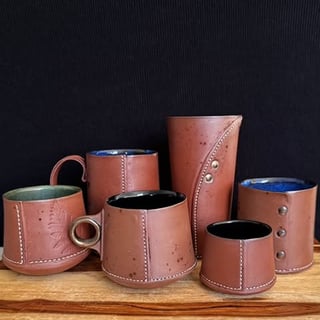
Speaker: So I started making these, the mugs, I call them my hero collection. And what it is, is it's references to popular stories or characters that people may be familiar with. And then I've added a bit of text in there, just a little bit of encouragement or a little bit of wisdom, a little bit of guidance that kind of relates to the story or the hero. And I use that as like a personal daily reminder or like an environmental cue to like
Speaker: Hey, remember, this is your life you're living in. So for instance, we have a set that's kind of inspired by Lord of the Rings. And there's, I use one of the images is the Gate of Moria. I'm not sure if you're familiar with Lord of the Rings. We use the Gate of Morias. We have it in gold on a lot of our mugs. And then underneath it, we just use the text Dare to Tread.
Speaker: And it's a nod to the fact that the people in the story had to dare to tread through this dark and scary place. And at the end of it, there's reward. And for me in my life, those little words are just environmental cues to remind myself, hey, you're in control. Like do the hard thing, make the hard choice, dare to be the hero of your own story. So that's what I want my pots to relate.
Speaker: definitely good. Shaping Nation, sometimes you have to do those hard things in order to become the hero of your own stories so that you can start making the pottery that you truly know that you want to be making. I love that so much. So you, like you said, you are inspired by stories and space to think. Can you tell me how these things impact how you create your pottery? Definitely. I mean, stories.
Speaker: There's a truck going by. The story is like we kind of just touched on directly.
Speaker: inspire what I'm interested in. For a long time I really loved Lord of the Rings and the characters in that kind of taught me how other heroes kind of take control of their lives or take control of their situations and kind of draw inspiration from that. And that's true for many different stories. The space to think side of it is I really enjoy sitting in solitude. I'll sit and think. I'll mull things over. I probably do that
Speaker: too much and I get caught in my own head and versus in action. But in everything that I've created, I've spent way more time thinking about than I ever have making it. And I just at this point, I just associate that with part of my creative process. I just kind of own it. I love that so much. I think that is I think that's a really great way to help you build ideas from the stories and also just taking time for yourself. I love that so much.
Speaker: So can you give me a simplified explanation on how you create your hero pottery? Sure. Our hero pots in the hero's collection are made by, first we hand make all of the mugs and we can make the mugs and batches of
Speaker: 10, 20, as many as we want. The illustration side, the gold decal that we apply, we hand draw those and send them off to a decal printer and they send us back 22 karat gold decals that we then will put on the cups and fire. So we can, we have our system down where pretty much everything is uniform. I mean, they're still handmade, so there's differences, but we can take a product picture of
Speaker: a hero cup and list it for sale online. And then as sales come in, we just have stacks of decals that we can just fly, fire, send. Where do you send your drawings off to? We use a company called Milestone Decal Art. Milestone decal makes custom ceramic decals and they've been great to work with. Awesome. Yeah, I'd highly recommend working with them.
Speaker: Let's talk about discovering your voice. You contribute your growth as an artist to failing and perseverance. How have these helped you with growing as an artist? I don't think you can grow without failing and being persevering through it. I fail at something probably every single day, or at least I don't do it as best as I could. I think for me personally,
Speaker: as the setting out to become an artist and saying, that is my career path, it requires perseverance. There's not, for artists, there's not like a template that you can follow that says, okay, I'll follow this career path until I get here. It's, everyone's kind of in their own co -cosm of what being an artist looks like. So for me, it required, it took tons of failures of trying ventures, trying processes, or
Speaker: things that didn't pan out, but taught me how to become a better business owner. It taught me how to become a better team leader or a better potter. And all of that, I feel like my pots reflect all that I am in some way. So as it become a better, all of these other things that I've learned by failing, it's reflected in the work that I create. Definitely great. Shaping Nation, it's important that you
Speaker: are you are able to persevere through your failure because pottery you will fail a lot. You will fail probably quite often. It's good to persevere because that's where you're going to learn the most and that's where you're going to truly find your voice. So can you tell me about a time where you failed or you had an apparent failure that led to future success with your pottery?
Speaker: For sure we had 1 this this past year. We were invited to become a vendor at this. It was a new hotel that had opened up in Greenville and it was a big. Deal the hotel had a lot of name and reputation, a lot of media coverage. It was a big deal for our city. And they were having a.
Speaker: Christmas market where they had several booths set up and they invited some artists from the city to come and be a permanent fixture there, but it was a high price tag to enter. It was like five grand for the month that you were there. And I really wanted to participate because of the exposure that I knew that being in this location would give me. And because it was associated with this new thing that was happening in town that already had a good reputation, it
Speaker: was attractive as an idea. So we spent a lot of time figuring out how to make that work. Ultimately, because of the price tag, we decided, no, we're not going to do that. And so at the time it felt like I had failed in my ability to require the resources to
Speaker: go pursue that opportunity. What was really interesting is right almost the weekend after I said no to that opportunity, I listed my hero collection of mugs for the first time. And this is another failure kind of in the works that led to opportunity. When I listed those mugs on our website, I had 30 to begin with, and I had about six of each. And I thought in my head, six of each, that's plenty. I will never sell six of each all at once.
Speaker: I'm not going to adjust the stock quantity on our website. I'm just going to leave it at infinite. Not even worried about it.
Speaker: No, that was maybe a mistake because we had put out a, I made a TikTok video that ended up going viral and we had over 300 orders for the 30 pots that I currently had. So that was kind of a failure that led to opportunity is we said no to the, the opportunity at the hotel locally. I felt like a failure, but it opened me up to fail again by not
Speaker: putting the stock quantities on our order. So we had 300 pre -orders for this collection of pottery that we now had the opportunity and the time because we weren't committed to that other thing to make.
Speaker: So I was kind of back to back. It felt like two failures. So at first I felt failed in my ability to acquire the resources to attend that, that function, that art fair. And then I failed at first, I saw the orders coming in and I realized I didn't update the stock quantity. I know all these people are going to be disappointed when I tell them I don't have the pots on hand to be able to ship them. So I felt like I had failed these potential customers that were coming out of the woodworks for me. And.
Speaker: Then we realized, no, we can kind of sort this over through communication. So we just communicated with everybody through email and messaging and said, Hey, this is kind of like, which is what happened. And everybody was really cool with it. Everybody was really supportive and we got the 300 mugs made and that kind of set the trajectory for our studio this year. And it's been really well. That is amazing. So would you say that you.
Speaker: are going to start doing pre -orders now or just like have a set quantity still? We do a mixture of both. We have the set stock that we have in -house. We've got a lot of product here. And then for the hero cups, anything that has the gold decals on them, every order is kind of pre -order. We have a little bit of a back stock, but we have it listed on our site now that
Speaker: if you order this expected lead time about one to two weeks. And so almost all those are made to order. But what we've learned is that we can make the mugs ahead of time, have them ready and bisqued. So when we receive the order, all we have to do is check to see what glaze option they want and what decal option they want. And then we can make the mug and have it ready to ship pretty quick.
Speaker: I love the idea of pre -order because I feel like it just kind of keeps everything in line and you're able to have sales at the same time. I like that idea a lot. Yeah, it's been really helpful. So can you tell me about the moment when you... No, I already asked you this question. I'm sorry. Did I? Did I ask you the question? Can you tell me the moment when you found your voice or you knew you were heading the right direction? No, I haven't talked to that yet. Okay.
Speaker: My mind went blank right there. Sorry. You're good. I still don't know if I've found my voice. I feel like that's something all artists talk about doing is I'm going to find my style. I'm going to find my voice. And it's for me that that's a process like I'm here. I'm talking to you today. I'm using the voice that I've developed up till now. But I still don't think that it's the voice that
Speaker: truly reflects who I want to be. I feel like that's a continual process. So we have, I feel like a voice as an artist is just a long time and a lot of experience doing the work, talking about what we want to talk about until we're efficient from that. We become more efficient. I say I get better at it every day.
Speaker: I'm not perfect and I'm not where in my head where I want to be and how I communicate about my work or how my work communicates on its own. But I'm happier than I was yesterday in the year before. And so I definitely agree. My milestones. Do I feel like my work communicates better now than it did yesterday? Was it now versus last year?
Speaker: That's a very powerful question. Does my work communicate better than it did last year or like last month? I like that question a lot. That's a really great question. Thanks. So what is something you are doing to evolve your voice even further? I would say I'm pushing myself out of my comfort zones in small ways.
Speaker: For me, it's doing things like this. I, I don't like talking about myself very often, staying active on social media. It's, I feel like that is another way I learned to grow my voice. It's such that those daily reps of I have to talk about this. So I'm going to talk about it. And just like going to the gym and building muscle, like doing the reps, talking about it is how you learn to grow your voice, making the pots, talking about the pots. That's how you get better.
Speaker: Definitely great. Shaping Nation, it's important to put in the reps in order to find your voice, but it's also important to talk about your voice, talk about these things, because that's how your voice will continue to evolve even further. I love that so much. So as we are coming to a close here, what advice would you give to someone trying to find their own unique voice with their pottery?
Speaker: and say, do the reps, talk about it, continue to work, continue to put your thoughts on the paper, put your thoughts in words, take every opportunity you can to share those thoughts with others and gather feedback, as much feedback as you can, and then hone and sharpen. Continue to do that over and over and over and over again until never always continue to develop your voice. That's just practicing your skills and talking about your skills.
Speaker: Absolutely agree. Shaping Nation, that is the easiest way that you can actually find your voice is to simply put in the reps. That is the most simplest, easiest thing you could do to find your voice. Will, go ahead. I was going to say, it's not the fun answer because it requires like, yeah, that's going to take years of work, or it's going to take a long time, but that's kind of the only thing you can do. Definitely agree 100%. Will, it was so great chatting with you today. Where can my audience go and learn more about you?
Speaker: Thanks Nick. If you want to learn more about me and my work, you can find me on Instagram at Donovan pottery or our website, Donovan pottery .com. Just a heads up. If you're listening to this very soon, we just launched a new website that may have some potential bugs. So be gentle if you're going to their website today. We hope to have those worked out soon. Ross on TikTok and other social media platforms.
Speaker: We hope you enjoyed this episode of Shaping Your Pottery with Nick Torres. Do you have questions about pottery that you'd like Nick to answer? Send them to us on Instagram at Nick Torres underscore pottery. We'll see you next time.