Transcript
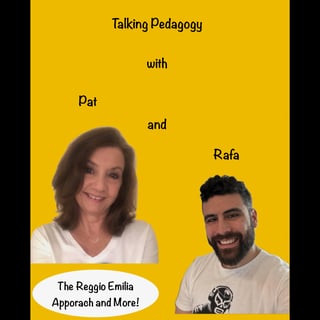
Rafael Perez-Segura: Hello, hello. Welcome to Talking Pedagogy with Pat and Rafa. I'm Rafa.
Pat Watkins : I'm Pat, and it's so good to be in your presence again, Rafa. And I'm just going to comment again on how much I love the textures in your background. And, you know, that's so Reggio to think about the aesthetics.
Pat Watkins : And you've captured such a wonderful feeling that I just appreciate it. I love being in places of beauty. We don't have enough of them. So thank you.
Rafael Perez-Segura: They appreciate that. I mean, I think Reggio has, it's actually Reggio that has taught me to pay more attention to these things and then learn more about the aesthetics.
Pat Watkins : Yes, me too.
Rafael Perez-Segura: I'm Mexican, right? Mexican-American and the Pay more attention to what I love about my family and the home, the blue house in Coyhuacán in Mexico City, and which inspires my apartment.
Rafael Perez-Segura: So if you're not if you're on the podcast and not seeing the video, my my background is marjorelle blue. It's that really intense blue from Freedom Diego.
Rafael Perez-Segura: So thank you.
Pat Watkins : Beautiful. Yes.
Rafael Perez-Segura: Thank you.
Pat Watkins : So, yeah. And, and it's funny that you're talking about that because, I don't know that we talked to a little bit about it. I think, yes, we did in one of our podcasts about, uh, how important it is in the Reggio approach to really connect and bring in the culture that surrounds your school.
Pat Watkins : We talked a little bit about, i think, Bronfenbrenner and, ecological systems.
Rafael Perez-Segura: the ecology, right? Like the child's at the center.
Pat Watkins : Yes.
Rafael Perez-Segura: And the other outside is the educators and the families maybe, and outside of that is the wider school community. But the circles get bigger and wider. I think it's like bigger society, right?
Pat Watkins : Yeah. and And how do teachers bring not only the individual cultures of the families in, but the culture that surrounds them that is their neighborhood? How do they really, you know, kind of get in touch with that and and honor it? So, yeah, we I think we talked about that in our last podcast. But, yeah, so it's funny that that your blue wall kind of brought all of that up.
Rafael Perez-Segura: Yeah, that's true. In terms of me at the center of my world, I guess, and then going out and to my ancestors and just what I love about Mexico.
Rafael Perez-Segura: Not afraid of color, that's for sure. Not into the beige. the what Neutrals has has has a space.
Pat Watkins : Yeah.
Rafael Perez-Segura: and We talk about actually that with classrooms. But in terms of my home, i like playing with color more than I ever have.
Pat Watkins : I love that. it's yeah It's important what brings us comfort. you know It's really important to think about those things.
Rafael Perez-Segura: Yeah.
Pat Watkins : And sometimes we'll talk to teachers when they're thinking about the environment as a third teacher and say, you know really think about where is it you find yourself gravitating towards in the classroom. and And why? And just being so aware of of that nuanced feeling that each of us have in environments and and thinking further about it, digging deeper about what do children feel when they come into the space and the room? Yeah.
Rafael Perez-Segura: Yeah, especially now. I mean, it'd be remiss if we didn't talk a little bit about what's going on at the time of this recording, you know, the murder of two people in Minneapolis and
Pat Watkins : Yeah.
Rafael Perez-Segura: by federal slash ICE agents. And that also has an impact on our work in the classroom, right? In terms of how we're feeling, our children can have questions, we also have to protect our children.
Pat Watkins : Yeah.
Rafael Perez-Segura: So all of that has to do, I guess, to bring it back to the theory little bit with Broffenbrenner and that they call it, that that that way of thinking is really helpful to really center myself at least in terms of what they consider.
Pat Watkins : Well, agreed. And I think young children especially need that sense of being able to feel safe. And and I agree with you that that we as adults right now don't feel so safe.
Pat Watkins : So how is that coming into the classroom?
Rafael Perez-Segura: Yeah.
Pat Watkins : And and you and I spoke about it's hard to to just begin any conversation without holding a moment to say where we all are right now in this country. It's a big...
Pat Watkins : deal a lot of the things that are happening. And, and educators are having to hold a lot of that when, you know, a child can be, we saw it, a child taken this, yeah, with this month won't be in real time when you're listening to this podcast perhaps, but, in this month, January, of 2026, a five-year-old was separated from their parent as they were both taken in.
Pat Watkins : And the educators tried to say, let us keep this child.
Rafael Perez-Segura: Liam. lea
Pat Watkins : We'll be responsible. We'll take responsibility for the child. And that wasn't allowed. So, yeah, just imagining, you know, what what educators have on their plates right now.
Rafael Perez-Segura: And also the possibilities of the and the highlighting the importance of our work in countering those narratives out there, that that's okay, that children and people in general can be treated as inhuman, as less than human. So a lot of work on our plates. But going back to the comfort, to the importance of us having our grounding and our comfort.
Rafael Perez-Segura: And a lot of that has to do with accepting what is not as Prentice Hempel, who I listen to every once a while, who said that acceptance not as apathy, but acceptance as grounding so that you know what the ways forward are at any moment.
Rafael Perez-Segura: think that's really important.
Pat Watkins : Yeah, and that even if you don't, that you've built a strong enough community with and culture within your school, hopefully, that everybody holds all of that pain and and uncertainty for one another.
Pat Watkins : But also, I think, Rafa, thinking about the fact that children are seeing a lot of images now, they're hearing a lot of these stories, and adults do have to be sensitive enough who are working with young children to create in your meeting times that Being sensitive enough to know if there's a reason that maybe you need to find a story that, you know, could bring some of those questions that children might be having out and hold space for that time.
Rafael Perez-Segura: Mm-hmm.
Pat Watkins : And a lot of times families are so stressed. And so when you as an educator can create those spaces in your classroom and unpack some of the fear and uncertainty with for young children if they're feeling it, it's just another part of the job, you know.
Rafael Perez-Segura: Yeah, and I would say as a general guide for for myself with those things, it's just knowing that you don't need the answers. You really just need to listen and i think reflect and make sure to let let those topics live over time. If you have answers that you're confident in,
Rafael Perez-Segura: Definitely bring them up, but lots of times I listen and document the children's conversations or questions and I might bring them up to colleagues, I might bring them up to families and be like, what do you think about this?
Rafael Perez-Segura: This came up for a bit when we were doing lot of work around the day of the dead, El Dia de los Muertos in November, leading up to November.
Pat Watkins : Oh, yeah.
Rafael Perez-Segura: And most, a lot of families were definitely on board, but some families understandably were like, you're talking about death with children. And yeah. Yeah. And what I found interesting, you adults had a lot more discomfort around it than children.
Pat Watkins : yeah. yeah Yes, because children have awareness of it from very early on and parents do want to shield them because, you know, it is, i mean, we all grapple with it in our our adult lives, trying to understand this journey of being human. But you want to protect your young child from from that insecurity or that,
Pat Watkins : that anxiety that can happen when they realize that there is death, but they do realize it. And that goes back to the strong image of the child and, and really knowing that children are so aware, so sensitive and pick up on so much and do have questions and have thoughts and to not honor that is not a, it's not, you know, it's not the regio way.
Pat Watkins : Regio way is definitely to step into it, but be careful and, and respect to the cultures of the families who are,
Rafael Perez-Segura: at all.
Pat Watkins : are concerned and help build the bridge to saying, look, we're going to keep you in the loop. You know, this is, and we'll let you know how we're doing these things. But this is a topic that is coming up and that we're talking about because I can understand that parents do want to understand what it is that you're, you know, transmitting.
Rafael Perez-Segura: Yeah. I mean, just the other day, actually, one of my kiddos came up to me and asked me about my grandfather. This is just this past week, actually. And we had talked about this months ago because I made a story, a short story on Google Slides of my grandfather and I read it to the kids.
Pat Watkins : Please share it with me after this.
Rafael Perez-Segura: Oh, I will.
Pat Watkins : i would love to see it.
Rafael Perez-Segura: I'll send to you. Yes. And I read it to them several times. like a storybook. And it was basically about my grandfather and what he was like. And then one day as he was sleeping, his heart started to to pump less and less until it stopped.
Rafael Perez-Segura: and then And how then what we did to bury him and how we cried and we also celebrated his life. And the other day someone was like, well, in Spanish, I go like, Rafa, ¿qué pasó con tu abuelo? What happened with your grandfather?
Pat Watkins : Oh.
Rafael Perez-Segura: And so these stories really stick with children. And that same child also back in November was telling her mom, one of her moms, that we need, grandpa's really old and we need to start taking more photos between to remember him when he's not here.
Pat Watkins : Oh.
Rafael Perez-Segura: So i just I just think it's really powerful that she was able to grapple with that and with such ease, with such ease and had a clear comfort with the ambiguity of it all.
Rafael Perez-Segura: And I think that's kind of what, that's one of the one of the goals that I have whenever I'm working with children and adults is to navigate that ambiguity.
Pat Watkins : Yeah.
Rafael Perez-Segura: That's the way the world is.
Pat Watkins : That's a great story. Yeah.
Rafael Perez-Segura: So.
Pat Watkins : Thank you for sharing that. And please do send me that. I would love to get to know your grandfather.
Rafael Perez-Segura: Yes.
Pat Watkins : I've heard you talk about him, but i I'd love to see the photos.
Rafael Perez-Segura: Yes, absolutely.
Pat Watkins : Yeah, time, time, something that we never can completely control, right? and And yet it's such a big thing that we grapple with again every single day. And especially in the classrooms, that's something that we've been talking a lot about in some of the coaching sessions. How do we as adults, you know, step into this making more time, right?
Rafael Perez-Segura: Mm-hmm. Mm-hmm.
Pat Watkins : when something of interest is happening to really let go of something else, like quickly kind of check in with yourself and and say, how important is it if I don't get to this other thing today?
Pat Watkins : Why can't I say we're going to do this for another 15 or 20 minutes and we're going to take something else out of our daily schedule away? Because this obviously is more important. And so I don't know if that's not such a graceful segue into another topic, but but I do think that is something that I've been working a lot with teachers on is like really trying to be mindful of children need more time. And how do you make that when you're feeling the pressure of your schedule?
Rafael Perez-Segura: Mm-hmm. How are in the context you work in, did they both schools have a good amount of autonomy over schedule? or
Pat Watkins : They do. But, you know, they you know, I think what we were also grappling with is routines. Like how much do you want to disturb a routine because they're so important to young children? And I think getting them to understand that those meetings where you come together and say, oh, we have a decision to make.
Rafael Perez-Segura: Mm-hmm.
Pat Watkins : You know, we have something else that we could do today, but it seems like everybody's really enjoying this center time and that you're all very busy or we're doing a project and so many of you are not finished.
Pat Watkins : I think maybe we should talk about what we're going to do here. Should we continue or should we? So bringing them in as your collaborative partners about having some of that those decisions. That's a real shift for a lot of people, you know.
Rafael Perez-Segura: Absolutely. i mean, i was just talking to one of my assistant teachers who started recently.
Pat Watkins : Okay.
Rafael Perez-Segura: and We had someone go on maternity leave. and i they were they were looking to change diapers, two-year-olds, change diapers and keep on things moving to get the circle time. And I paused and I'm like, I noticed youre we're really in a rush. Like, what are we in a rush for?
Rafael Perez-Segura: and like, guys, we just have to get a circle time. And I'm like, why? What's the plan for circle time? And it was something along the lines of like, wanted to make sure that she's newer. She wanted the other teacher to feel like she what knew what the routine was.
Rafael Perez-Segura: And then I said, well, if you want to change diapers, why interrupt the play? when they want to do that and you need to, they they need, we want our children engaged anyway, because you need to step out for our, type our changing tables right outside.
Rafael Perez-Segura: Like we don't have walls in our school, but you kind of have to leave little classroom area, but you can still see everything.
Pat Watkins : Yeah.
Rafael Perez-Segura: So let's change the diapers as children are continuing to play. Why, why would, Why would we interrupt children's play, then have them sit down and then change their diapers and then they struggle to sit down because they're two, right?
Rafael Perez-Segura: So anyway, just a reminder that a lot of times allowing kids time, then it's just more developmentally appropriate and resultss in more learning because if they're playing, they're learning.
Pat Watkins : Yeah.
Rafael Perez-Segura: so
Pat Watkins : Yes. And as they get older, to have a say-so in some of the choices that are going to be made throughout the day when changes are made. And to understand that children can be flexible, you know, like, yeah.
Rafael Perez-Segura: That's a huge one, yeah, that they can be flexible. think it reflects a strong image. I think sometimes I hear that we can't, like, let's say like there's an opportunity combine classrooms and so sometimes I hear that, like, well, it's not in the interest of the children because it's not a clear routine, which to an extent, yes, you want a consistent routine. And on the other side of that is you build community through surprises, right?
Rafael Perez-Segura: And you have you need a way to communicate that surprise. So like, oh, the schedule is different, right?
Pat Watkins : Right.
Rafael Perez-Segura: so like So I guess it goes back to so much of what we do is addressed by strengthening our own capacities and our own capabilities.
Pat Watkins : that's a very, yeah, exactly.
Rafael Perez-Segura: The scaffold for children who are capable with the right supports of handling transitions, and it helps them then handle future transitions because they get more tools, right?
Pat Watkins : Absolutely. Yeah.
Rafael Perez-Segura: So...
Pat Watkins : Yeah. children Like you said, children do like surprise and they like routine. They like both and, and not being afraid to mix things up a bit is, is a good thing.
Rafael Perez-Segura: Yeah.
Pat Watkins : And it also, once you get to know your students well enough, your children well enough, I think you can have more of that trust. I think at this point in the year, and again, this is January, you should have a pretty good understanding of, of,
Pat Watkins : the community that you've been kind of developing and the connections with your children and kind of be able to forecast a little bit about how much you can have more flexibility.
Rafael Perez-Segura: Yeah.
Pat Watkins : But I think meeting times are something that I'm finding with the Reggio approach anyway. Teachers are still, a lot of the teachers I'm working with are still becoming more acquainted with as as to what are these meeting times supposed to be about? And how can i get more information from the children from this meeting time so that I can understand more about what an interest might be that is starting to develop? And how can I support those conversations? And so we've been talking about bringing artifacts to those meetings.
Pat Watkins : And just threes, fours, fives.
Rafael Perez-Segura: How old? How old are the kids? Of course.
Pat Watkins : But, but.
Rafael Perez-Segura: Mixed age, so or is up separated.
Pat Watkins : there's Well, there's some some of them are a bit mixed,
Rafael Perez-Segura: Okay, I'm just curious.
Pat Watkins : but but but I would say threes and fours are together and and older fours and fives pretty much.
Rafael Perez-Segura: Mm-hmm.
Pat Watkins : But I would say that that is something that if you're not used to doing that, again, not used to looking at your children as your collaborators,
Rafael Perez-Segura: Yeah. Mm-hmm.
Pat Watkins : then you're not quite sure what that meeting time really is there for besides to tell children what they're going to be doing. And what we're doing is a mind shift of saying, no, it's really about finding out more about what they are doing so that you can have a better understanding of wow, tomorrow when I come in, what
Rafael Perez-Segura: yeah
Pat Watkins : what invitation can I make for children that might really support furthering that investigation? Because I just heard from our meeting time, because I had some very specific wonderings and I had some pictures and I was able to give them some examples of things that I'm seeing and find out more about, is that what I'm seeing or is it not?
Pat Watkins : Then I, then I, as that engineer, architect, and designer can have that time when I'm preparing for tomorrow to say, wow, I think I have an idea of something that could be.
Rafael Perez-Segura: Mm-hmm.
Pat Watkins : It came up more specifically, and a new teacher was sharing that she had two projects that seemed to be getting ready to launch.
Pat Watkins : And one was about different ways that animals move and their footprints and their ways of movement, walking,
Pat Watkins : jumping, whatever it might be. And the, I can't quite remember what the other one was. Oh, fairies and and fantasy and fairy tales.
Rafael Perez-Segura: love that.
Pat Watkins : And so she was very curious, like, how do I hold both of those?
Rafael Perez-Segura: and of that
Pat Watkins : And so we we had to dig deeper as to how she decided that those were projects that the children needed more of her guidance or support with.
Pat Watkins : Or if, in fact, the fantasy play in the drama center was just something that they were doing because it was fun and and that might be okay. You know, that there was not really more to do with it.
Rafael Perez-Segura: Mm-hmm.
Pat Watkins : At this point, like why are you, what are you working to make decisions around? Do you have enough information about what they're doing? What is it, do they have everything that they need and and maybe what they're doing is all they want to do right now?
Pat Watkins : Is it that you're looking for a project? Is it that you're looking to see how you can interject? And that's, I think, the challenging thing for a lot of people who work in the Reggio Emilia approach, and especially when you're first starting, is how do you make those decisions?
Pat Watkins : And that's where those meetings come in. And it's also where time, like we were talking about earlier, where that comes in, where you're not in a rush to define something for children, but instead you're just kind of waiting to see.
Pat Watkins : So then it was a rich discussion because actually this teacher who's very self-reflective was like, you know what, I'm in a rush. I'm really in a rush because I wanted to i want to hold on to these things.
Rafael Perez-Segura: Yeah.
Pat Watkins : I want something to hold on to. And, and so then we talked about invitations that she could make with the other one with the animals. And was it, you know, that one seemed to have a little bit more of need of support from her as far as like different invitations, because the children did seem to have questions and have more things that they were looking for.
Rafael Perez-Segura: It was more of a back and forth. It was more of a ball toss, as you would say.
Pat Watkins : Exactly. Thank you.
Rafael Perez-Segura: It was more of a ball tossing happening.
Pat Watkins : absolutely. Absolutely.
Rafael Perez-Segura: That's interesting. Meeting times tricky. I should say that. like They're tricky because and there's right like i think meeting times are important time to sing together to.
Rafael Perez-Segura: There's a limited amount of attention depending on the ages.
Pat Watkins : Yep. Yes.
Rafael Perez-Segura: and like so Sometimes it's like multiple meeting times, interspersed throughout a day.
Pat Watkins : Or small group meeting times that are built in.
Rafael Perez-Segura: that sometimes organically happen during the during open playtime, right?
Pat Watkins : Yes.
Rafael Perez-Segura: And I just think about all the social skills that are, that need to be modeled and reinforced and to an extent taught about conversation, how the questions about how does it look like for twos versus three versus four versus fives and things.
Pat Watkins : yes
Rafael Perez-Segura: Anyway, it's just, this it's really, it's it has it rate it demands a lot of thinking and intention to do well, but it's worth it.
Pat Watkins : Thank you.
Rafael Perez-Segura: It's worth the messiness. Yeah,
Pat Watkins : but it's worth the messiness. And it's really, it's key because if you don't have that time, and again, it can be small meeting time. And it doesn't have to be, like you said, an organized meeting.
Pat Watkins : It could be when the children are in an area and they are exploring something.
Rafael Perez-Segura: it's.
Pat Watkins : And that becomes that back and forth ball toss that you're ready for, you know, and that you know how to have your wonderings and you know how to Without disturbing or interjecting too much, but finding your way in to find out what's going on can happen in a lot of different ways.
Rafael Perez-Segura: I mean, i yeah
Pat Watkins : Yeah.
Rafael Perez-Segura: yeah. i find I find when children are already naturally making groups and then I approach... and I observe and it depends and often tend to try to just be next to them and then see if they notice me, which tells me that they kind of want to engage and if they don't stay longer or sometimes I will say like, oh, I noticed X.
Pat Watkins : Yes, yes.
Rafael Perez-Segura: And that's when lots of times the richest conversations happen, but then it's an opportunity to bring it to the carpet, to the circle form more formal circle time and had them have others see what's possible, right?
Pat Watkins : Yeah.
Rafael Perez-Segura: So, both both the organic and the formal circle times can really do a lot together
Pat Watkins : Having inviting children to share in the meeting time what you've observed and, and give them that opportunity to kind of tell the rest of them what they were doing or what they were working on is a perfect, oh my gosh, that's so empowering for young children.
Rafael Perez-Segura: so empowering
Pat Watkins : So carving that time out into your meetings is, is really important. yeah. Children's voice, finding more and more time in your day for, for children's voices to be heard and to be, be, um,
Pat Watkins : just shared and, and, you know, that's how we learn the most in this approach is and also just being quiet and observing, like you said, Rafa, that's so important. I've had teachers who set up cameras and I think we might've talked about this and, you know, not, not in voyeuristic way, but in a way of just wanting to know what is really happening that sometimes you cannot have the time, like you were saying,
Pat Watkins : And I've seen when the teachers look back at it, they're like, I never would have guessed that that's what they were doing.
Rafael Perez-Segura: That's so cool. That's the best.
Pat Watkins : Yeah, like they were so like they were figuring out trajectories and, you know, how a ball is going to move if they turned it this way or that way. And just really deep thinking was going on. But the teacher would have missed it had she not, you know.
Pat Watkins : had that up or if she had gone over and started interjecting or maybe interfering and in the play. So just finding ways to, you know, observe when you're very busy, because we know that teachers are.
Rafael Perez-Segura: Yeah, yeah, observe when you're, you know, what one approach that I've been playing with at Mi Casita is more with myself, but slowly I'm introducing it to the team, because I'm in the classroom, right, too, so i i i think about, like, yes, it's really, you can't change everything at once, nor should you, right, and you want to do things with your children and change things with the children also, ideally, but I find, like,
Pat Watkins : Yeah.
Rafael Perez-Segura: again, really paying attention to the organization of materials, when materials are getting touched, which are not getting touched. And maybe like even once a month, even though once a week is probably better, switching things out or daily if something's just super evident from one day to the next to change.
Pat Watkins : yeah
Rafael Perez-Segura: that's that's That keeps things dynamic and children are, and and help you see children interact with materials in different ways, which is,
Pat Watkins : Absolutely. Yeah, that environment as a third teacher again, going back to, yeah, not letting it become stagnant, but yeah, those invitations.
Rafael Perez-Segura: And like, and like your environment is your planning.
Pat Watkins : okay
Pat Watkins : Uh-oh, Rafa, for some reason we couldn't hear you. Yeah, perhaps your mic went off.
Pat Watkins : But agreed, yeah. Like the planning is
Pat Watkins : is going to be coming so much from observations. I'm just vamping everybody while we wait for Rafa to come back with us. but But I just find that that's just a challenge too is like how do you have the time to make those observations when you're thinking about all of the different balls that you're tossing around in a day?
Rafael Perez-Segura: Can you hear me?
Pat Watkins : Yeah.
Rafael Perez-Segura: Okay. I died. my other one died. haven't used these in a second.
Pat Watkins : So you've got two clip-on mics now?
Pat Watkins : My gosh, you're getting high-tech, Rafa.
Rafael Perez-Segura: I ordered one and it didn't work. And so I returned it. And then they sent me another one immediately. But they ended up sending me the two-pack instead of the one-pack.
Pat Watkins : So you're lousy with these mics now.
Rafael Perez-Segura: Yeah, yeah, i just i just got I just got that. Wait, this one sounds better, I feel.
Pat Watkins : Sounds good.
Rafael Perez-Segura: No? Did the previous one sound okay?
Pat Watkins : Yeah, they all do.
Rafael Perez-Segura: Okay. But you know I was just I was just briefly saying that like the the environment is Planning like I guess for me that has helped because sometimes that before I thought that like why have to plan everything all the time and realize I like no like looking at the space is a big part of the planning so if the space is developed and the space is engaging and planning is successful And yeah, and then there's a part of planning that's like, what might I do in the future?
Pat Watkins : Yeah.
Rafael Perez-Segura: And that's important too. But that's and that's a part of it, I guess, is what what ahve what I've learned from my own.
Pat Watkins : Yeah. Yes. Yes. And I think in our, one of our next sessions, I would love to, to, to get back to how the hundred languages show up in some of that, that planning, that intentional planning.
Pat Watkins : really being a little, you know, having some, some conversation with you and, and bringing in some of the thoughts that we might have from having worked with, Atelier Ristas and, and the way that that, work that they're doing with young children is giving them the tools that they need to really express themselves in all these incredible ways with materials. And how does that, how do you plan that?
Pat Watkins : How is your school planning that?
Rafael Perez-Segura: I would love to, I mean, even very briefly, I feel like such a powerful next step so often is what's another material, especially with threes, fours, fives, as they're, as, and some two year olds, as they're really leaning into representing things, like what are other materials that they can represent this concept with?
Pat Watkins : how Yeah. Yeah.
Pat Watkins : Yes.
Rafael Perez-Segura: You know, what are other ways we can make planes? What are other ways, and yeah, which involves the the other, the hundred languages.
Pat Watkins : Yeah.
Pat Watkins : Yes, and I think teachers being, again, that word flexible towards children's expressions when they bring in another language to something that you weren't expecting in a project.
Rafael Perez-Segura: Mm-hmm. Mm-hmm.
Pat Watkins : I had a teacher tell me a great story about she wanted to do this whole thing exploration of fall and and trees and leaves and, you know, do autumn basically. And the children, one of the children said, I'd i'd really rather be a talking tree.
Pat Watkins : And so she was like, well, okay, well, how can we do that? And then they had a whole conversation about how they could do that. And they ended up, the children all got excited to become talking trees. And she let them make their own masks using paper and paints. and But, i you know, I thought that was a really great example of they had another language that they were more interested in.
Pat Watkins : exploring around trees. And so anyway, yeah, it's just, there's so many ways and in using the Reggio Emilia approach, there's so many ideas that can come from the dance that you do with children, but it's, for me, it starts with adults being flexible enough.
Pat Watkins : to agree to the dance changing whenever that happens and not being afraid of it, but going, all right, well, let's see what happens. And then, you know, one of the things we were talking about from that story is, and then when that was over, what happened next?
Pat Watkins : And the teacher was like, what do you mean? And I said, was the forest finished or was there more that you could do
Rafael Perez-Segura: Mm-hmm. Mm-hmm.
Pat Watkins : You know, and that's when you as the architect, designer, engineer step in and say, I have another invitation that could bring us into a whole nother level of learning about nature, about trees, about trees being homes.
Pat Watkins : The children might have other interests. And that's when you get to dance back with them like you get to offer another step. Does that make sense?
Rafael Perez-Segura: Yeah, yeah, yeah. The dance. It reminds me of a conversation had with Eva who founded Mi Casita and she's in the classroom at times too. She does something called El Lab, El Labarinto, which is a really magical space. She comes into the classroom. it's also allows teachers to step out. But during this, they were making nests and children, this child, like with different with with cart with like carton, whatever they found. And some took toothpicks and then took the clay that was on the table and put little egg made eggs out of them.
Rafael Perez-Segura: And as one child in Spanish was like, this is a tiger egg. this is This is a seagull egg. This is an elephant elephant egg. And Eva came to the post-reflection meeting and was like, you know, like we all we know they don't lay those those animals don't lay eggs.
Pat Watkins : right
Rafael Perez-Segura: She did say, doop do humans lay eggs? Does your mom lay eggs? And mean, and then... the children were like no even though someone was the one of the adults was like well you do have women do have eggs like anyways that's interesting but uh and uh but but but what what they came to the conclusion was they were not going to try to correct the misconception at this moment they actually wanted to lean into the magic what they call it, the magic.
Pat Watkins : Aha.
Rafael Perez-Segura: And so it came from the magic of these other ways of thinking.
Pat Watkins : Hmm.
Rafael Perez-Segura: so talking to you.
Pat Watkins : Absolutely. and And I think that's, gosh, that's that's such a that's a great story. A great thing to think about, too, is that when do you, so like with the talking trees, you know, first of all, I believe trees do talk.
Pat Watkins : So there's always that.
Rafael Perez-Segura: Mm-hmm.
Pat Watkins : They make sounds, you know, and they've science has proven that trees actually communicate with one another. So, but being not afraid to, as that, again, that teacher, to step in to saying, I wonder, do trees talk?
Rafael Perez-Segura: And...
Pat Watkins : How do trees communicate? Finding out if children are interested in and digging in a little bit. Because, you know, Rafa, you and I were talking about how do you weave in the academic learning
Pat Watkins : That's kind of how you do it, is that you're not afraid to A, honor whatever it is that the magic is of whatever it is that is being explored in the language of the children. And then you're not afraid to step in and say, I wonder if there's more, more learning that can happen here.
Pat Watkins : can we Can we take this a little bit further? Is there more science that we could learn from from the trees? you know or the Would the children be interested if i if I showed a little clip about the sounds that trees make?
Pat Watkins : like Don't be afraid or in a hurry. Find your own passion, your own interest, because we know Malaguzzi believes that adults and their learning is is as important as the children's to continue your own learning. And I have to say that was the most exciting thing that happened last week in a coaching session was a teacher who's new to this approach said, do you know what? I'm so excited because I'm learning about migration. i knew nothing about migration, but the children wanted to understand migration. they they
Pat Watkins : a child brought in a a question about birds, and then it started this whole conversation, and the children just were on fire to know more about migration. migration So she's like, I had to go home and really start digging into what is, yeah, I need to know more about migration.
Rafael Perez-Segura: Yeah.
Pat Watkins : How do birds know when to leave? you know And so she was so excited because she was like, and she's a mom too. So she was like, I'm learning things that I can teach my children because these children are teaching me to ask more questions.
Pat Watkins : And I just thought that's that's how teachers don't get burned out when they're engaged in the Reggio Emilia approach. You never know what could happen or what you're going to have to learn more about yourself because the children have an interest.
Rafael Perez-Segura: I love that. I mean, there's a way for, and we're collaborating with the children, right? So when you said migration, I thought of human migration and how that's such a important thing bring up.
Pat Watkins : Oh, my God.
Rafael Perez-Segura: So I have a book called Migrantes. It's a wordless book up in my, my, esantti in my, bookshelf. And i think it would be interesting in that case to what to bring in another use of the word migration, to just to continue to give children that window of and language to then make more sense of what's happening.
Pat Watkins : Yeah.
Rafael Perez-Segura: it's a very rich example.
Pat Watkins : Yeah. Yeah. Well, we've been talking for a while. Hopefully anybody who's listening found it interesting because today we kind of just, it was a stream of consciousness.
Rafael Perez-Segura: Yeah, we
Pat Watkins : It was all over the place.
Rafael Perez-Segura: flow I think if anything, if you're listening or watching, like, this is, these type of conversations are very regio in that where we're, we're, we have theories about things that are happening. We're retelling our own documentation verbally, if you will.
Rafael Perez-Segura: We didn't go too much into the the, the exact theories that inform us, if you will, or, but in a way, this is kind of just embodying, I think, the approach.
Pat Watkins : Yes, it was fun to play ball with you tonight.
Rafael Perez-Segura: Yeah.
Rafael Perez-Segura: Amen.
Pat Watkins : and we just want to invite you always to know that we would love to hear from you. If you have questions, if you have a topic that you would like for us to talk about something specific, just let us know. And we'll, we'll even maybe bring you on as a guest if you would like to join us.
Rafael Perez-Segura: Sounds great. Well, with that, Pat, we'll say toodles for now, I guess, for next time.
Pat Watkins : Toodles. It looks like a very snowy sky still behind you, Rafa. Let's see what happens. We've just come through a big snowstorm, but it was a nice, warm space to be with you tonight, so thanks, Rafa.
Rafael Perez-Segura: Yes.
Rafael Perez-Segura: Likewise. Thank you, Pat.
Pat Watkins : You're welcome.