Transcript
Speaker: I just remember this person coming up to me and going, hey, oh, this is cool. Is Elina McVeigh one of your teachers? I was like, yeah. She's like, yeah, that kind of looks like her work. And I was like, oh, how do I take that? You know, part of me was like flattered that I could make something similar to her work. And I was like, wait, that wasn't my intention at all.
Speaker: Hey, real quick before we get started, if you would like to find your own theme for your pottery so your voice really stands out and you're not getting bored with making the same thing over and over again, I put together 53 themes for you guys and it's completely free. All you have to do to get it is just go to shapingyourpottery .com forward slash 53 themes. That's shapingyourpottery .com forward slash 53 themes.
Speaker: If you love pottery and want to take your skills to the next level, you're in the right place. Find your own pottery style right here on Shaping Your Pottery with Nick Torres. Let's get started. What is up, Shaping Nation? This is Nick Torres here. And on this episode of Shaping Your Pottery, I got to interview Danica Wickerman. Danica makes some really incredible Australian plant life and animal life pottery
Speaker: In this episode, you'll learn how Danica makes her amazing pottery. You'll also learn about the power of trying different clay bodies and how that is a super easy way for you to start being able to find something that is unique to you. Finally, you'll also learn about having pots that sell really easy so it makes time for you to have more of an artistic practice. And there's so much more in this episode. I hope you guys enjoy this episode and I'll see you guys in there.
Speaker: Danica, welcome to Shaping and Pottery, and share with me what is something people might not know about you? Well, I'm generally quite a confident person. I share quite a lot about my story on social media, and I'm totally happy teaching. I'm happy selling my work, but actually when it comes to doing things like this, it makes me a little bit nervous. So practice, practice, practice, right? And hopefully I don't stumble over too many of my answers today.
Speaker: So tell me the story, how you got started in ceramics. I was studying fine arts at university and my painting class was full. And I was like, damn, what am I gonna do now? So I thought I would try my hand at doing a pottery class. And I think like many of us, I was instantly hooked. That was it for me. I changed all of my majors over to doing ceramics instead of arts.
Speaker: much to the dislike of some of my painting teachers who were like, how dare you join a craft instead of an art? But of course, that's not really the point. But yeah, so that pretty much started my addiction and just been growing ever since. So you contribute your growth as an artist to your supportive community like parents, teachers and your partner. How have these helped you on your pottery journey?
Speaker: So my family was always really supportive. They are both migrated from Switzerland over to Australia before I was born and they decided to raise myself and my brother a little bit differently. And we were just always encouraged to do the things that we were passionate about and pursuing art was totally fine with them. My father was traditionally a cabinet maker. So he later on in life, he decided to find his own creative journey. So that was really exciting because we were able to kind of
Speaker: had those conversations together and share ideas and what we wanted to do. And later on also, you know, work together and have exhibitions together and make collaborative art, which was really cool. My family, of course, was my biggest fan. They always had all my work, tried everything out and gave me their feedback on it. So that was great. When it comes to the community, I was fortunate enough while I was still studying to actually get a job teaching at a community art center.
Speaker: So I was kind of having to stay two steps ahead of my students at the time, sorry students, but it was great because it really kept me on my toes. It meant I had to really dabble in all different mediums or different hand building, wheel throwing, you know, sculptural, slip casting, everything. I had to give it all a go and make sure that I could do it competently before teaching that as well. So that was part of it. And then after about five years of teaching there,
Speaker: I moved on to a professional art studio and that was just incredible, you know, working with really well -known artists. There was an artist who organised the whole thing called Floeshell and she still passes on so much wisdom to me and they had a lot of international artists coming and doing residencies there and workshops so
Speaker: Just simple things like, you know, simple, not simple, like centering a piece of clay on the wheel that can be done like, I don't know, probably a hundred different ways. So everyone will do it totally differently and you just have to find the way that works best for you. You know, like just find your own inner story and push through that. So that, that was, that was amazing being in, in such a, a great environment and
Speaker: Now I'm at my home studio and my family is very supportive. My husband's FIFO so that means he's away for eight days and then back for six days so it's kind of like
Speaker: It's a different lifestyle, but when he's back, he looks after the kids and really helps out. It's very encouraging. It helps me make all of my display for my markets and all of that. And my kids just absolutely love clay. They love coming into the studio and every opportunity they can get. So my whole life is filled with support and creativity. I'm lucky. So you mentioned that you attended a professional studio. What is something you learned there that really helped your own pottery?
Speaker: think not to doubt yourself and really like don't under price your work. Make sure that your work is valued for the time that you put into it and that other people see the value in that as well. So being able to communicate you know your process and all of that comes with that as well. So let's talk about your pottery. In one sentence can you tell me what you make?
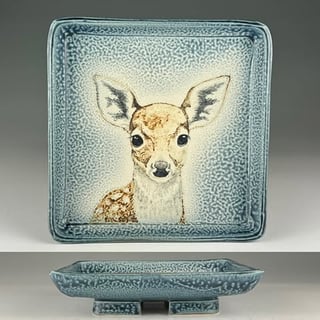
Speaker: OK, I wrote this down. It's a tricky one. So I make carved and imprinted porcelain art, homewares and tablewares that are inspired by Native Australian botanicals and flora and fauna. So tell me the story, how you started making this pipe part of the event today. Well, flashback, 17 years. It's a little bit of a journey, but I'll give you a little bit of a recap just so that you can understand part of what I'm doing now.
Speaker: I started back at university making completely non -functional work because back then we were really criticized for making functional pieces at a fine arts centre. So it was all sculptural, it had deep meaning. And often I looked at the internal vessel. I was making sculptural pieces, double walls. So, you know, with two parts, a vessel on the inside and on the outside. And there were often quite altered forms. And then I, at the community arts centre,
Speaker: I started dabbling with color as well. And that's, I faced a little bit of an issue because when I left there, I stopped having the shelves that I could access to fire all my work. So then I'd have to travel and put everything in the boot of my car, which was challenging because the pieces I was making was so fragile and quite big and just broke. So then I had to kind of reassess my ideas and become
Speaker: will make more enclosed forms again and more sort of functional pieces I suppose and at that time I was doing some woodwork with my father and he was telling me how important it is to follow the wood grain when you're sculpting and I thought oh wood grain oh I wonder if I can integrate some sort of a grain into the clay. So I started adding colorants to my clay and kind of layering that into the clay as I would throw them so that they would
Speaker: become my wood grain. So that was then carving those pieces again. That was, that was a whole another step of my work. And shortly after that time, then I had like two collections, my like bread and butter work, which sold and made me a little bit of pocket money. And then I had like more my artistic side. And at that time I was traveling in Switzerland and I was up the top of the mountains and
Speaker: looking down at this snow and I just remember seeing these amazing little bell flowers just popping out of the snow and I was like what like how is that even growing here and a short time later my grandfather came to Australia and we were up north and it's like desert for him and you know red dirt dust and he was looking at the flowers there and he was like oh my god how is that even possible how are those flowers growing there
Speaker: So, you know, again, I was like, wait a minute, we've got something pretty unique over here. Like this dirt is a pea that was growing in the in the dust with no water. We have something completely opposite to what, you know, my heritage, my background in Switzerland was. So I thought I'm going to focus on that now and really look at Australian flowers. So that's when the the vessel, I suppose, came my canvas.
Speaker: to tell my story about Australian flowers and some bird life as well, as well as endangered species that we have over here. I love that story. That was a really great story. As you mentioned earlier, you are greatly impacted by your upbringing. Can you tell me how your upbringing helped you with your pottery that you make today?
Speaker: Yeah. So as a family, we were always working together. We were together a lot. We didn't come from wealth and we'd go camping instead. We'd go bushwalking. So even now today, that's a big part of my life with my family as well. Being out there in nature, that's, you know, that's where my inspiration comes from now. But we also, we didn't have a lot. So it was making the most of what we had and looking on the bright side of things and finding the joy in the small things. So that's definitely part of who I am as a maker as well.
Speaker: Something I found interesting is your core mission is to make pieces that you love to share with others. Can you explain this to me further? Yeah, so that comes in two parts for me. So part of that that love and that passion is in teaching. I, you know, I'm
Speaker: very into sharing my techniques and my process. I love that other people come to my studio and they're able to pick up a piece of clay and find their own joy in that and make pieces, totally unique pieces for themselves. I mean, I give everyone basic instructions and give them all a piece of clay and I walk around, I'm like, whoa, everyone's created such different pieces. I mean, that's really exciting.
Speaker: And then on top of that, there is obviously, you know, finding homes, you know, when my pieces find homes and they go on their new journey, they find their forever homes. So I've had a lot of customers that come to me for the first time and they're like, oh my God, I've been following you along for so long. I've seen images of your work. I've seen you on social media and then they've come to my studio, they've come to my home and they're picking up the piece and they're like, whoa, this is so different than I imagined, you know, like,
Speaker: the texture, the softness, the weight. So actually feeling that piece for the first time, when my customers are able to kind of, you know, hold it, that's pretty cool. And seeing their faces light up and that joy. I mean, I've got a customer who has been following me and supporting me for many years now, and she's completely blind. I mean, completely blind. And I remember the day that she came into
Speaker: one of my market stalls and she took ages, you know, walking around and picking everything up and touching it and feeling it. I'm like, Oh, I wonder, you know, I wonder what she's thinking. She ended up buying quite a few pieces that day and has come back over many years and she's like, you know, I just, I can feel the textures on your pieces and they can tell me a story that I cannot see. You know, I can imagine the pictures in my,
Speaker: you know, in my imagination, I can see it all so clearly. And she actually comes and does throwing with me now as well. So she's making her own pieces and I'm like, yeah, go girl, it's great. So yeah, that's great. I love that. That's amazing. I love that so much. So over the years, you have changed different clay bodies a lot, but settled on Southern ice porcelain. Why did you settle on this clay body?
Speaker: Yeah. So as I said, as a teacher, so I'm actually a high school teacher as well. So I've definitely dabbled in so many different clays. And, you know, if you're sculpting or if you're hand building, if you slip casting, everyone will have their preference. It's really great to be able to trial all those different clay bodies out. For me, porcelain, one of my earlier teachers was working in porcelain and I was like, yeah, this is it.
Speaker: It's so challenging. It is hard to use in so many different ways. It warps, it cracks. You know, you have to dry it really slow. It's like throwing with icing sugar. Some people say, or like putty. It just, you have to use ribs or kidneys, I think you call them, and sponges to throw often. Don't use too much water. Tricks a lot. You know, there's so many things, but I'm like, oh my God, I'm in love with this medium because it's white. It is strong.
Speaker: has a lot of silica in it. So even though it shrinks a lot, it's like you don't have to glaze the outside surface. It's really soft and smooth and it just doesn't stain or anything like that. And it doesn't chip like a lot of Earthenware pottery unfortunately does. And it's translucent too. So I used to make a lot of translucent pieces. Now it's more to do with that soft whiteness as the background to my pieces. Yeah.
Speaker: I love that. Shaping Nation, an easy way to start finding something that you enjoy making is to just try different clay bodies. And the more you try different clay bodies out, you're gonna find one that really sticks to you. And that is a very easy and simple thing that you can literally do like today, tomorrow, whenever to start finding a unique thing for yourself. I love that. So can you give me a simplified explanation on how you create your body?
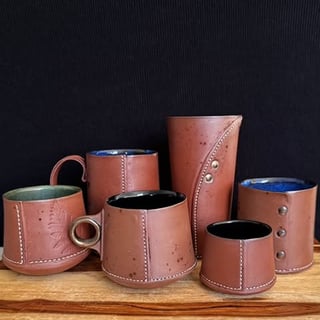
Speaker: Well, I do hand building partially and a lot of wheel throwing. So the hand building are the plates and the bolts and those ones I will roll the clay body out and then imprint nature itself. So things I've collected. Sometimes I have to draw some bits in or add some additional textures as well. Then I will pinch up all the sides or put them over molds and let them dry a little bit, carve them, clean them all up.
Speaker: Then they go into the kiln and they get bisque fired, come out wet and dry sanded. They get glazed. So all of the glaze gets kind of painted onto the textural surface and then wiped back. And then the whole piece is clear glazed back into the kiln to 1300 degrees. So I fire quite high. My porcelain clay is like usually between cone A and cone 10. And then, yeah, so that's the the tablewares and my vases, my vessel forms and my art
Speaker: artistic pieces. Those ones are all done on the pottery wheel so they are thrown, trimmed, carved at leather hard. So this is also when with my black pieces I will add a black slip or underglaze and then carve through that surface and that's all freehand. There's no images, you know, I might use some inspiration but I have to
Speaker: just go for it and carve straight onto the clay bodies. So there's no repetition there. There's no kind of production line when it comes to making those pieces. And they dry really slowly. So it takes a lot of time, especially for the big ones. They might take a month or longer just to dry.
Speaker: And then they go into the kiln and some of those even then will go on like a slow firing cycle so they don't crack. Cause these are over 70 centimetres. So they just, and they've taken me months to make. So just don't want them to break. And then they come out, get wet and dry sanded. I will glaze all of the parts, wipe everything back again. So again, the glaze is just in the textual parts. And then I will go through with a clear glaze and highlight all the sections again, back into the kiln.
Speaker: fired to close to 1300 degrees Celsius. So just, I've got three different porcelains that I now use, but just depending on which porcelain I'm using, they'll be between cone eight and cone 10. And then they come out, get wet and dry sanded again. And of course then everything else that comes with selling the work, the photographing and you know, all that jazz after that. But that's the making process. Summarised, believe it or not. So you mentioned that you hand build your bowls and your plates. Why you do that?
Speaker: Oh, okay. Yeah. So why do I hand build those ones? I used to wheel throw them, but I found with carving, it would just take such a long time. And that range is now my bread and butter money. So that sells really quick. I can make it a lot faster. It doesn't take so long.
Speaker: And those ones actually imprinted from nature so I can pick a flower that's not endangered. I can pick a flower and roll it into the clay and then I've got my immediate surface texture right there and then. So that's a lot faster than having to hand carve every single leaf, every single petal. So that's why I've decided to create those two different lines. So I've got my faster line that's, you know,
Speaker: sells nice and quickly, just turn around time, it dries fast, and then I've got the more artistic buzzes and art pieces that take a little longer.
Speaker: I love that. Shaping Nation, if you can have a technique or a pottery thing that you make that sells really well and is easy to make, and that's going to free up time for you to focus on the actual artistic part of the pottery process. I love that so much. So let's talk about discovering your voice. Can you tell me about the moment when you knew you were heading in the right direction with your pottery? Well, I can tell you the moment that I knew I wasn't heading in the right direction.
Speaker: I was, yeah, I just remember it was probably early on and I had a huge body of different paces. And I just remember this person coming up to me and going, hey, oh, this is cool. Is, is Alina McVeigh one of your teachers? I was like, yeah. She's like, yeah, that kind of looks like her work. And I was like, oh, how do I take that? You know, part of me was like flattered that I could make something.
Speaker: similar to her work. And I was like, wait, that wasn't my intention at all. And then the other part of me was like, yeah, no, I want to I want to find my style. I want to find something that totally resonates with me. I don't want to be known for making pieces that look like someone else's work. So, yeah, it took a little bit of time, but then I really had to think about what it was that made my work unique and what spoke to me, what my passion was. And over the years, I've just had so many people coming up to me and going, oh,
Speaker: I, you know, have I seen your work at this gallery? I'm like, yes, that's mine. Or, you know, have I seen your work in this restaurant? I'm like, yes, awesome. They can see my work. They can recognize that straight away. And even on social media, people tag me on stuff and I'm like, hey, that's my process. And they're like, yeah, that's done because like, why haven't they tagged your name? I'm like, oh, great. I'm glad that they can even see my process out there and recognize even that that's mine. So that's pretty cool.
Speaker: So what do you think makes your pottery unique to you? What makes it unique to me? Yeah, so it's definitely the Australian flora. It's finding the texture of the land. I use a lot of seed pods that I've gathered and found to add extra little textural elements. And it's not necessarily about reproducing the flower or the bird exactly how it is. It's still my own style in there.
Speaker: I've got a lot of different line work and themes, but yeah, it's kind of, I don't know, you got to see it. So bright pop colors, white contrast, black contrast in backgrounds, and just kind of telling a little story about nature here. So can you tell me what was your biggest obstacle when it came to discovering your own woods?
Speaker: So one of those obstacles is finding the balance and I'm still finding that challenging sometimes. So when we were talking about the bread and butter collection and the artistic range, that was important to me and not to necessarily only do the bread and butter collections. I don't do it for the money. I mean, you're never really going to make that much money out of ceramics unless you're
Speaker: You know, very well known, but yeah, do it because you enjoy it, because eventually I was finding that I was just making to fill orders, making to fill the wholesale. And then I wasn't finding that joy anymore within the pieces that I was making. So kind of taking a moment, learning how to say no.
Speaker: That's a big one to maybe taking on things that you don't have the time for and that, you know, aren't really that interesting to you and finding your direction and making sure you take time to keep exploring and being creative and finding that passion within your work. Yeah. Do you think you could give me an example of a time when you said no and it kind of paid off for you? Yeah, well, it's happened. Yeah, that's happened a few times in the sense that
Speaker: People have asked me to do certain things like make a lamp. And I was like, oh, you know, like there's so many amazing artists out there that can make a lampshade for you. I'm not that person that is not my strength. And then maybe a week later, I've got a call and people are like, yeah, I want a vase and I love your style and just put anything on there that you want.
Speaker: I'm like, great, I can work with that. You know, doing something that works for me that's within my style is, is much more, even though it's going to take me longer probably to make that one vase than it is potentially to make that lampshade. But in another sense, that wasn't my strength that, you know, I would have to do lots of tests and they probably were like wanting to, you know, to get that on a, on a cheap scale, I suppose. And I was like, I don't even have time for that. I don't, I don't want to focus my energy on that. So yeah.
Speaker: I love that. Shaper Nation, sometimes the best solution is to just simply say no. And that no will lead to new opportunities for you to focus on different things. I love that so much. What is something that you are doing to evolve your voice even further? Well, that was the big picture for this year, to be honest. I really wanted to refocus on making work for galleries, making larger scale work. And I went out and bought a new kiln. I was like, yes, we could do this.
Speaker: wasn't so easy because the new kiln i bought was fiber instead of brick so there's all these new variables all of a sudden my clay body changed as well one of my my clay bodies for my larger clay my lumina they changed the ingredients so it's been a challenge of six months of trialing and testing and learning all the basics again and i think that's a big part of it as a as a potter as a ceramicist you're never going to stop learning right i've been doing this for quite a while and
Speaker: I'm still learning so much I've had to go back to some basics and you know the heat works of firing kilns and firing temperatures and all of that and the technology within the clay body and the shrinkage and all of that so it's been a big learning curve but I'd say it's about again not giving up persevering and now I'm finally able to make these pieces these more artistic pieces
Speaker: Bigger scaled works and touch wood. Hopefully they all work out now. So as we're coming to a close here, what is one thing you want to hammer home with my audience today? Oh, one thing. I got a few little summaries here. I'd say don't give up. Ask for help if you need it. Stay true to you. So make sure you're doing it for the right reasons. So don't just go out there, follow the trend, but find the things that you're really passionate about and then find your audience. And just to find a little tip for you,
Speaker: is take your pottery that you make into your home, try it out. So use it every day. If you're making mugs, give it a go. Use it, work out if that rim on the top is facing outwards too much and you're dribbling when you're drinking from it. If that handle feels good in your hand, if you're making art pieces, put them out in your home. Look at how people will react when they walk into your home and see those pieces. And not so much so that you change it,
Speaker: but so that you can tweak it and keep doing the things that you love. Love those last piece of advice. Danica, it was really great chatting with you today. Where can my audience go and learn more about you? So I have a website, rediscoverceramics or rediscovering .com .au. Mainly on social media, on Instagram, you'll find me under rediscoverceramics and on Facebook, Danica victim and ceramic artist.