Transcript
Speaker: Welcome to Shaping Your Pottery with Nick Torres where we help you discover your own unique voice so you can stand out from the crowd and have more fun making pottery so you make pottery that is truly amazing.
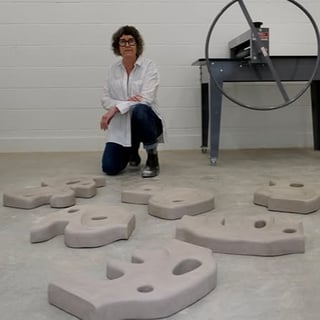
Speaker: What is up everybody and welcome to Shaping Your Pottery with Nick Torres. In this episode of Shaping Your Pottery, I got to interview Hannah Simpson. Hannah makes some really wonderful sculptures and you can really tell how much pride she puts into each piece. In this episode, you will learn how Hannah creates her sculptures, adding movement, and just having fun with your sculptures and pottery.
Speaker: Hannah, welcome to Shaping Your Pottery and share with me what is one thing you love besides making sculptures. So I would say because making sculptures and doing art is often like very solitary and I'm quite like
Speaker: I love being around people and being with other people, so I get a bit lonely. So what I love to do is just go out and have good food, go to restaurants with all my friends and family. That's what I love to do other than just making sculptures and just doing art. Yeah, mainly that.
Speaker: awesome love it so we're going to talk about your sculptures today we're also going to we're going to talk about your experiences with like design and discovering your voice so with that can you tell me the story how you started making sculptures
Speaker: So I started making sculptures quite a long time ago when I was at uni. So I've always had an interest in art. I started doing paintings and then everything that I painted ended up being on something that wasn't a canvas. And then I kind of realised that it was because I really created this sculptural experience. I like being able to walk around something
Speaker: and sort of see it from new perspectives. So I started like with, I used all sorts of materials. I started off using polystyrene and I used to make these massive monsters that you could like sit on and sit in and climb around because I had the studio space at university. And then I progressed to ceramic just sort of on a whim because in lockdown my mum used ceramics and
Speaker: So I kind of like learned a little bit from her and she had a kiln that she built bought off eBay. So we fixed up the kiln and that's kind of how I got into ceramics and carried on from there. What would you say was the biggest challenge you faced getting into ceramic sculpture?
Speaker: One of the biggest challenges I'd say was my own self -doubt probably because I kind of expected just to be really good straight away and I forgot that obviously things take time.
Speaker: doing something, everything. So because it was in lockdown that I started, I just did it every single day. And there was times when I just, honestly, I was comparing myself online to other people and I was like, why am I not good? Why can I not get to the place that I want to be? But it's just about taking your time and changing the mindset from being always self -critical to appreciating little bits in the sculptures that you're making that you love and then transferring them over to a new sculpture.
Speaker: And eventually you start to like what you're doing, just about. How did you change your mindset from, oh, I'm not as good as other people to I'm growing?
Speaker: I think that having my own social media page means that I could see my own development quite clearly. I would post the bits that I was more proud of, and then you could see quite clearly how they do progress. If you scroll down to the bottom of my Instagram, there's work that I'm like, whoa, that's crazy that I've come from there to where I am now.
Speaker: So trying not to compare yourself to other people is really big and it's just comparing it to something that you've done before rather than someone, because you don't know how long people have spent making this thing or you don't know what training they've had or anything like that. So trying really hard to not compare yourself to other people and just look at your own progress and then spotting those things. Every time you make something, something will be better than the last time.
Speaker: I absolutely love it. So you are not only interested in ceramics and sculpture, you're also interested in design. So can you tell me the story when you entered for nacho carbonyl? I hope I said that right.
Speaker: Yeah, that is right. Yeah, so I worked for Nacho as part of my degree. We did like a placement year. So after my second year of university, we went for a year to do placements and then you go back to university to finish. So for like seven months I worked with him and it was just, it was complete sort of luck. I just applied for the placement, had a 10 minute interview and then
Speaker: relocated to the Netherlands. And yeah, it was really great. It was like the first time I'd ever been in a big studio. And first time I ever really met a designer. And it really did inspire me to do what I'm doing now because before I was doing a fine art degree. And I kind of hadn't realised that fine art can sort of transfer into
Speaker: other disciplines. And I realised that I really liked design. And his work is kind of this combination of art and design. And that's kind of how I wanted to see what I'm doing. But yeah, it was just like, every day we would make something that he designed. So he'd come down with a design. And sometimes those projects would take, you know, four weeks, five weeks, but sometimes you do it in a day. And
Speaker: I just learned loads of different skills and to not be afraid to just get, get stuck in, because sometimes they just didn't work at all. And we just have to say, okay, like, call it quits and call time on it. And sometimes they worked really well better than before. And then that would become his new most like favorite piece. So there's a lot of like learning how to accept the successes and how to accept the failures. And that really helped me in the future as well.
Speaker: How did this experience help you with creating sculptures? It helped me because I think everyone there was in this same mindset of being really creative and just trying to be experimental. I think before I tried so hard to be perfect. Everything had to be perfect. And I was so self -critical.
Speaker: there they kind of had this more like loose way of looking at things and it was sort of like okay give that a go okay that doesn't work let's try making it out of wire instead or let's try making it out of concrete instead like there was so much trial and error to create something that was like
Speaker: really stunning in the end. But ultimately, you know, you're never going to get it right first time. Well, sometimes you do, but most of the time you won't. So it was accepting that things can take a lot a long time. And that's really quite helpful skill to have. But can you walk me through how you create one of your sculpture pieces?
Speaker: Yeah so everything that I start with starts with just a load of scribbling. My sketchbooks are an absolute chaotic mess like I've got drawings that cover drawings like basically I start with a
Speaker: like a line drawing, so I just kind of go mad with a pen. If you can see my hand on the camera, it's literally going all over the place. But yes, it starts with kind of this blobby shape. And then I kind of look more into it and see how I could change that into something that's more
Speaker: It's more something else, you know, so I can either put a light bulb on it or I can put a lampshade on it or maybe turn it into a monster. So you just use this blob and you put some teeth on it and some eyes. And I start, generally, the drawing process, I make like 20 to 50 drawings and I just choose one and go for it.
Speaker: Everything I make is hand built. So I use like the coil technique where you roll out sausages and then just sort of smooth them all together. And sometimes it looks like the drawing, sometimes it doesn't. But the drawing is just an idea. It's just like a place to start off with. And then the sculpture ends up sort of growing in its own like organic kind of way, which I honestly quite like. So everything changes so good.
Speaker: How does drawing it out beforehand help you get it into your mind and get better, I guess? It gives me an aim. So without the drawing, I wouldn't know what I'm doing. So the drawing is always 2D, whereas everything that I create is 3D.
Speaker: only helps to a certain extent and but it does give me something to aim towards and I think that that's I know some people do it without any drawings and they just sort of let the process take them but for me I think I'd end up making I don't I don't know where the stopping point would be if that was me so I like to have something that I can kind of refer to so that I don't go too out of hand and something that I know kind of looks
Speaker: nice -ish and then I can sort of play around a little bit. But I like to see where I'm going first. I guess that's why I do the drawings. What do you determine as a nice sculpture and what is a bad sculpture for you? This is really difficult because sometimes I'll have made something and I absolutely hate it, which happens quite often. I think every artist is the same. If you do a painting,
Speaker: often it's too subcritical. So it's difficult. So I make something like that I don't really like and then someone will come past my studio or my intern will be like, oh, that's really nice. And I'm like, what, how do you see that that's really nice? But so it is hard to know. But for me, a like a
Speaker: beautiful sculpture is something that has balance. I can always see when something is unbalanced, when one side is too busy or two looks too heavy. I like it when things sort of, I don't like things that slump as well. Often with clay, when you work too fast, it starts to slump and it looks kind of like it's
Speaker: falling in on itself, and even if it doesn't do it too much, I still really, really notice it. And it looks, to me, a little bit depressing when it starts doing that. So as soon as it starts doing that, I kind of don't like it, but I know that a lot of people quite like that look. But it is, honestly, from having a business and hearing feedback, you realise that people love all sorts of things. But yeah, for me,
Speaker: I like it. I like things to be quite neat and to be not slumpy. Yes. Lumpy but not slumpy. Lumpy but not slumpy. I love it. So you are inspired by movement and nature. Can you explain this further for me?
Speaker: Yeah, so when I was growing up, I used to always think that inanimate objects around the house had personalities. So I used to hate getting rid of my toothbrushes. And like, if I had to throw anything away, I'd get really sad by it. And I think that comes from like, being surrounded by nature, because when I grew up, and I thought that everything would be alive. And so I think that I liked this idea of bringing
Speaker: life back into the home. So everything that I make has kind of like legs, looks a little bit creature like, either like the lampshades have got made out of an alpaca silk or mohair. And I like having this idea that you've got this creature kind of crawling into your life. And, and the movement, I guess comes from, you know, everything, most of my work has sort of a direction. And
Speaker: And I think that design often looks so permanent and so like set and strong and heavy. And I quite like the idea that my work is more, you know, not temporary, but more, it does look like it is moving through your house because, you know, we move through our houses, everything kind of changes and moves. So yeah, I like having creatures around me, I guess.
Speaker: That was awesome. Love it. So what advice would you give to someone looking to start making sculptures, but more importantly, like adding movement to their sculptures? So I think a lot of it is to do with... This is, I think, where my drawings come into play because the movement is easier to create movement from a drawing because
Speaker: your hand is much freer. Whereas a sculpture is actually quite a, it's something that you have to work lots of hours on and concentrate really hard on. So sometimes you do lose that sort of ability to be free and like move freely because every single bit takes time. So you end up taking more consideration on it. So the drawing creates this sort of organic and flowing form, which then you can build on.
Speaker: in the sculpture. For me personally, I think that curved lines, blobs and lumps and all that sort of thing, they create this sort of organic and free flowing kind of sculpture. So yeah, I think starting with sort of a fluid drawing and then working from that, that kind of makes it easier to create
Speaker: more light kind of sculpture that you don't have to think as much about as you're making it. Really great advice. So what is something that you have said no to that has helped you with your process of making sculptures?
Speaker: Okay, so when I, when I first started making ceramics, I said yes to a lot of sort of commissions. So my friends and families, they wanted me to, they'd pay me like 10 pounds to make them plant pot or, you know, kind of online someone would see what I'm doing and then be like, oh, you can use ceramics, can you make me this or that? And to begin with, it was really good because it gives you the skills to,
Speaker: to kind of like progress in what you actually want to do. But then there comes a time where you have to just say no because these things they don't help you with what you actually want to be making. So you know I was getting overwhelmed with making my friends you know the plant pots or mugs and I wasn't having time to actually make
Speaker: what I wanted to be making. And I think there was this one day and I just kind of clicked in my head and some person on Instagram messaged me saying, can you make me a banana sculpture? And I was just like, no, I just really don't want to be making banana sculptures. So I just said, there was a point and I just said, okay, no, I'm not doing anything that's not, you know, one of my own designs anymore. I'm not copying anyone else. I'm not doing anything like that. I just want to make what I want to make. And
Speaker: So although, you know, commissions are really good at the beginning, just to get your skill level up, you do have to prioritise at some point and say no to anything that isn't, you know, making you happy with what you're making. So if something doesn't bring you joy when you're making it, stop making it. And yeah, just say no to stuff you don't want to do.
Speaker: For those that are listening, it's good to do commissions in the beginning, but if it's not bringing you joy or happiness, then say no to it. It's important to say no sometimes. So something that I found interesting from your website was that you said, my aim for this year is to try and get my workout into as many places as possible. Can you tell me more about this statement angle? I think I found it on your Instagram actually. Yeah. So, um,
Speaker: Basically I started this business obviously in lockdown and so I didn't see or meet anyone and everything was online. Every exhibition that I was part of was online and it just really felt like I kind of missed out on this, you know, the art world if you want to say it like that. So this year my, because everything's opened up again,
Speaker: My aim is just to try and experience getting into an actual gallery, going and being able to see my work in places, not just on a computer screen. Partly because it's nice to have my work out there, but also just because I really want to build a community where you get to know people and you can network a little bit, if you want to say, like that.
Speaker: Yeah, so by what I meant by that is I want to start getting into exhibitions. I want to sort of see my work in shops and sort of actually see physical products around rather than just in my little studio and then online. What have you been doing to reach out to people to get into galleries? So I've been really fortunate and a lot of people have actually messaged me first. And that's been my kind of lead.
Speaker: But the ones that I've contacted, what I've done is, you know, it's really important to keep your social media up to date because that's how people sort of see your work and your progression and that kind of thing. So it's kind of like a new portfolio now. Like you can just sort of drop people a message on Instagram and say, hey, I really like your gallery, can I,
Speaker: be part of it soon or have you got any shows where, you know, I might be able to take part. And they'll just quickly like click on your name and then they see all your work. Like it's so important to keep your Instagram up to date. And other than that, you know, having a portfolio, something that you can just sort of send across as soon as somebody messaged you. And I put so much pressure on myself having like a really, really amazing portfolio
Speaker: And it has to be like really creative and eye catching and all this. But actually all people want is to see, you know, clean photos of your work on a nice background and just really easy points. Like you don't need to put any words in really no faffing, except, you know, the size, price maybe if you want. But yeah, just keep it simple, keep it easy. And then you'll be able to keep up to date with it. Because otherwise if it's too complicated, you're never going to keep updating it.
Speaker: So that's my advice on portfolios and Instagram. So you said you were putting too much pressure on yourself. Why were you putting too much pressure on yourself? I guess I think it's quite easy. So when you're starting a business, it's easy to look too big. So look at the massive picture and be like, oh, I really want to be selling all over the world.
Speaker: be as big as this person or that person or whatever. And you forget that it takes so much work and it takes actually loads of little steps to get to that place. And I think that I tried too much too, I think everyone tries too much too soon and then gets confused why it doesn't work. And I think that that's where the pressure comes from.
Speaker: So as soon as you take a step back and you just sort of take these little, like make it into small steps. So it's like, okay, well today let's figure out how to post to America. Okay, today let's figure out how to do this and you know, take it in these tiny little steps and then you do eventually get to the places that you want to go to. But I think when I first started, I was, I was looking so big. I was like, 10, like 10 years I need to be here or here. And it's just, it's not the case. Like just go at your own pace and like try and
Speaker: trying to stay calm. For those that are listening, it's important to just start slow and just focus on your work and improving it and making it better. So what advice would you give to someone looking to discover their own unique voice and pottery? I would say
Speaker: As much as social media is really helpful to promote yourself, it's not, for me anyway, it's not helpful to sit and look at everybody else. Because as soon as you do that, you're stopping your own creative thoughts. So if you're sitting and scrolling through, yeah, it's fine to do it for a little bit of inspiration, but as soon as you're trying to recreate all the stuff you see online, it does start to impact
Speaker: how you are in style. Whereas if you just do your own drawings, you clear your own mind and just do whatever comes naturally, that's going to be your style. Like it might look really gross to begin with or like really ugly, but eventually you will keep, if you keep going,
Speaker: you'll find your style within that. And someone somewhere 100 % will like it. It's crazy. There's so many people in the world. People love all sorts of things. So your style will be liked. And it's just about keep going, keep going, keep going. And eventually, your own inner voice will come out because everyone's got one, everyone's unique. So yeah, just keep going and try not to try and be someone else because you don't need to be.
Speaker: Wonderful advice. So as we're coming to a close here, what is one thing you want to hammer home with my audience today? I think having fun is super important. I even forget to do it sometimes because you get so wrapped up in other things. But the reason I make monsters is because it's just so silly. And every time I make one,
Speaker: It makes me laugh and you just got to have fun with what you're doing. So like you have to, you know, every job, if you're making this into a business, like every job, you'll have like ups and downs days. And even if you're just sitting as a hobby, like the amount of times that I've got halfway through a sculpture and then just smashed it back down because I'm not happy with it. Like it's important to accept some days aren't going to be good.
Speaker: but just remind yourself that this is fun, like this is what you want to be doing and enjoy the process rather than getting bogged down on like the nitty details and that sort of thing. And just yeah, just play around and you'll enjoy yourself eventually. Absolutely wonderful. Hannah, I had a really great time chatting with you today. Where can my audience go and check out your work?
Speaker: So I've got a website which is hannonsonsonsstudio .com or my Instagram which is at hannonsonsonsstudio so just find me on there, drop me a message, whatever you want to do, I'll try my best to get back to you. But yeah, I just hope you really enjoy what I'm doing and hope to bring some happiness in the world.
Speaker: Thanks for listening to this episode of Shaping Your Pottery. If you have questions about developing your voice or just pottery questions in general, send them to me my way. Go to shapingyourpottery .com forward slash contact to send me your questions.