Transcript
Speaker: Hey, if you would like to discover what your unique pottery voice is, I put together a free quiz that you can take to help you discover what your pottery voice is. It's a quick four question quiz. All you have to do to take it is go to shapingyourpottery .com forward slash quiz, or you can just go simply go to shapingyourpottery .com. It'll be right there on the top.
Speaker: If you love pottery and want to take your skills to the next level, you're in the right place. Find your own pottery style right here on Shaping Your Pottery with Nick Torres. Let's get started. What is up, Shaping Nation? This is Nick Torres here. And on this episode of Shaping Your Pottery, I got to interview Ashley Bevington. Ashley makes some really incredible coping mechanism and ice cream themed pottery. In this episode, you will learn how Ashley makes her ice cream themed pottery
Speaker: You'll also learn about why it's important to have a schedule and to set a schedule for yourself to help you keep things on track. Finally, you'll also learn about sticking true to yourself in order to find your unique voice. I hope you guys enjoy this episode and I'll see you guys in there. Ashley, welcome to Shaping Your Pottery and share with me what is something people might not know about you.
Speaker: Well, thank you, Nick, for having me on your podcast. Something people might not know about me. This was a hard one because I'm pretty open with a lot of things, but when I was, well, actually turned 20, I was diagnosed with a super rare
Speaker: virus slash disease that you get from an infected mosquito bite and I was supposed to be starting undergrad and I missed the entire first week of undergrad when the hospital I could see like my undergrad had this huge sculpture in their campus and I could see that from my hospital window so it was like ah
Speaker: But, so that was a really weird moment in time. Cause I, like, I've never been to the hospital for anything and here I am like deathly ill and being teased with this. I was like envisioning everyone making friends and I'm like the weirdo that comes in a week later, but, but yeah, they diagnosed me and everything was fine, but I thought I was going to die while I was there. So that's kind of played a role in my work.
Speaker: Since then glad you here and I'm excited to hear. I'm excited to hear how that applies back into your work. So tell me the story, how you got started with ceramics. Well, I actually, I did get to go to undergrad. Thank God. And I was signed up for advertising and graphic design. Right. And it's the classic story, right? We had to take out fine arts class. So I picked ceramics and I was like, Oh, that'll, that'll be easy. Like I've seen people do that on wheel block.
Speaker: and took the class and my teacher was amazing and he kind of convinced me to switch to fine arts and all downhill from there. No, I'm just kidding. That was it. So tell me about the moment when you decided to become a full -time potter.
Speaker: That was actually about a month and a half ago, believe it or not. So it's pretty recent. The last couple of years, I mean, I've been selling my work for a while through my own website and galleries, but the last or two years ago, I guess now was like my best year yet. And I made more money than I've ever made in a year.
Speaker: Which wasn't like a lot. I'm like, whoo, like super rich. I mean, I went to undergrad and grad school. So clearly I didn't make a lot of money. So I did that. And I was like, wow, this is actually like, I didn't realize how much money I made until I did my taxes. And I was like, okay, this could be a thing, you know?
Speaker: But my husband and I, we wanted to buy a house, right? And the mortgage companies don't really like seeing that you're self -employed. So I was offered full, real part -time, full -time gig. And I took it just really so I could get the loan for the house. And I hope they don't want it. But I just found myself like at this desk in a basement, like
Speaker: thinking about everything I could make. And I would actually, you know, sketch during lunch and all that, but I would kill home and scarfed on some food and go to the studio downstairs anyway, and be working till midnight and wake up, go to work, you know.
Speaker: And I didn't really make too much work this past year because I was working my day job so much. And I was just miserable. I hated it. I want to make stuff all the time, all day, every day. People have hobbies. My hobby is what I can make decent money with. So I talk with my husband. Luckily, he was offered a full -time position at his work, and he loves his job.
Speaker: just worked out. So I quit my day job and now I'm full time in it. What would you say has been your biggest struggle since going full time? It's easy to get distracted, like especially if you have a home studio, right? Like, oh, I could throw in a load of laundry and then
Speaker: go trim these cups or whatever. That's kind of the biggest struggle is getting distracted, being in your house. But I think the main thing is you just need to have like a structure and some sort of schedule that you stick to every day. So what is your structure and schedule that you try to stick to?
Speaker: So I wake up, my husband, he goes to work at, he leaves at like seven 40. And so when he leaves, I'll go for like a morning walk for like an hour. And that kind of gets me thinking and in the mindset of a studio, like, cause I try to get, you know, new ideas. Like I don't want to get stuck making the same thing for the rest of my life. You know, like I want to keep pushing and pushing and pushing until I die. But so I go for a walk and then I come home and.
Speaker: Get the coffee going and then go down. We have a basement studio and just get to work down there until really until about dinnertime when I'll make dinner and we eat and then I go back downstairs. Dang, you are in there like all day. I love that. Yeah. Well, my husband, he does ceramics too. So it's not like we're not around each other because he'll come home from work and downstairs too.
Speaker: I love that. That's awesome. So let's talk about your pottery. In one sentence, can you tell me what you make? I hate this because I just ramble on about everything. So I make sculptures and sculptural pottery that deal with coping mechanisms in a humorous way. So can you tell me the story how you started making this type of pottery? Let's see.
Speaker: I mean, everything kind of meshes together. So it's weird to like, think of like a definitive moment in time where it was like Eureka, but thinking I went to watershed in Maine with a residency and we had to share like, it was like a goofy way where we did like a
Speaker: some sort of workshop for everyone. And I did like a kick wheel demonstration, but I've never used a kick wheel in my life. So really I just kicked a kick wheel. Like I physically kicked it and told a story about my childhood that was like dramatic.
Speaker: So the kicking was kind of like a way to deal with my angst about that story. In that while I was at the residency, I was kind of trying to make different work and branch out to other things. And after I told that story, one of the other people that were there, they were like, why don't you make work about that? And I was like, you know, it's not a good idea. So that was kind of like a snowball effect from there, thinking about
Speaker: or that stem from. So you mentioned that you went to Watershed. Can you tell me what is something that you learned from being at Watershed that really helped you with your own pottery? Something I learned at Watershed, honestly, was to take breaks and have fun. Everybody would get up super early and
Speaker: You know, we'd eat breakfast. They had amazing meals at Watershed, first of all. But we would get started in a studio. And we'd go take a break and jump in the light. And there was this super secret lake off on this long walk. And I'd jump off a rock into the lake with everyone. And the last thing I saw as I jumped in the water, they were all like, and they were like, you were so close to hitting the rock. You're not allowed to do that ever again. But yeah.
Speaker: Take breaks, but be safe. I love that. I also, I love going to the lake, like where I'm at, like 30 minute drive. I love going to the lake. See, that's nice. Yeah. So you are inspired by the everyday life. Can you tell me how does this impact your own pottery?
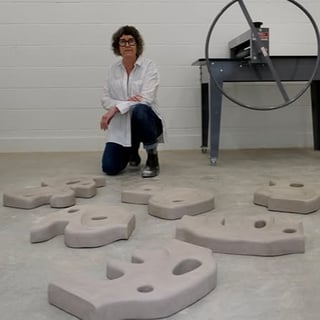
Speaker: So even going back to like the mosquito bite Disney story, like you can't see it now, but there's like this giant mosquito sculpture to the side here, like.
Speaker: I made work about that. So like I said earlier, I make stuff about coping mechanisms. I'm inspired by the everyday. So like my food work deals with like overindulgence and meals of celebration, like ice cream and pizza. That's kind of like something that you eat with other people or like my husband and I will eat ice cream at the end of a long day, just to kind of unwind and get ready for bed. You can see like,
Speaker: My super crazy feral pots. I mean, it looks wild, but it's really just, you know, two cardinals with a worm mouth. You know, it's really simple, like just about observing nature and gardening.
Speaker: Like I, I like to know from a garden from seeds and stuff like that. So just little things that add up to what I revolve my entire existence.
Speaker: I love that. So shaping nation, it's important to take moments from your life, whether it's like you enjoy eating pizza with somebody or just being around other people and try putting that into your own pottery because that's how your voice will truly start showing up by putting those experiences into your own pottery. I love that so much. Now, can you give me a simplified explanation on how you think about creating your pottery? Oh, simplified. Let's see.
Speaker: So I do keep sketchbook, right? It's super important for me just to have a sketchbook. Sometimes I'll think of an idea and I don't have time to like go make it right away. Right. Because I'm in the middle of a, you know, a series of work or I have 20 pots I'm working on in the moment. So.
Speaker: Very important to keep a sketchbook. And it depends on if I'm hand building or throwing, right? Because it's a very different mindset as far as the wet application with wheel throwing and then the dry aspect of hand building. Because it's way faster when you're hand building. The clay is already pretty dry. It's a lot of waiting around when you're throwing, waiting to trim the pots and to add the handles and all that.
Speaker: I tend to have everything going at once so it's kind of chaos so I try to keep lists and I have you know my deadlines in a in my little calendar just so I know how many pieces I need done by when when it needs shipped by I tend to push things to a limit though and I'll sometimes be unloading a kiln that needs like
Speaker: wrapped up and shipped like that day. I don't know. Like I'm never really satisfied with anything. Like I'm always thinking about the next thing. I'll pull something out and be like, okay, well, I wish I would have done this. It sounds sad. I'm not, I'm not like, yeah. So exciting every day.
Speaker: How do you manage that if you are trying to always, like, you're always trying to do new things? How do you manage that? Well, I definitely, I'll always, like sometimes, you know, I don't feel as inspired. So that'll be like the days where I'm making my.
Speaker: bread and butter work that the galleries want or I know that I could sell. And then I just try to have like some time to play, right? Especially if I see like a show deadline coming up that like a gallery that I really want to be in. Like I'll make work specifically for that call. Even if it, I mean, it'll tie into what I'm doing already, but I try to like push myself a little bit to fit the theme.
Speaker: Right. Shaping Nation, I love that. Actually, I love that. Shaping Nation, it's important to do things that you know are selling well, that you know that will sell and people like it. It's also important to have time to just play and do other things to help you expand your mind and to create new things. I love that so much. Now, what advice would you give to someone trying to add their own personality into their own pottery?
Speaker: So I, like I said earlier, keeping a sketchbook is super important and really think about the thoughts that you have every day or like what draws you in? Like, you know, what's your favorite color? What's something you enjoy doing? Your favorite animal? Like it could be that simple and really just working at it every day and keep pushing, add something new and that can lead to
Speaker: That can lead to a new body of work even, you know, just adding little embellishments here and there. Like I'm making the ice cream work, but I started adding like the whipped cream and little treats to it. And that got me into like a whole new body of work of making plates of sewed that look like faces.
Speaker: It's just keep pushing yourself. Also, it's important to have the bread and butter work, but you can keep tweaking that in some way to really push it and take it one step further and keep taking those steps. There's not really an end point. Definitely agree 100%. Before we go on to talking about discovering your own voice, do you think you could explain to me how you are creating your ice cream pottery right now?
Speaker: Yeah, so I have like this slab mold that I made of a waffle cone, which I'm not even sure what it was that I made a mold of, but it was like this plastic mesh. I think it's like the bottom of an aquarium or something, like plastic mesh. I saw that and I was like, ooh, that'd be perfect for like a waffle cone. So I press a piece of clay into it.
Speaker: and made a mold of that. So I'll start with a slab template that I made and push it into the waffle mold and then pinch the tops. I make a really thin slab and I have a handle template and I'll trace that out twice and then put those two pieces together and then shape it into you know the handle shape and put it on to the pinched upper body and then
Speaker: The little drips are just sculpted and slippin' scored on. And I try to do this pretty quick. That way the tops can be still kind of wet because then I can push out the nose from the inside and make whatever animal I'm creating add ears, the tail and the butthole. And then I paint under glazes, the top and the bottom.
Speaker: And then the sprinkles, I actually stain different colors of clay. And then I extrude with like a little hand extruder, all these little tiny coils, let them dry. And then I punch them up, which I need to make an oddly set. I made an oddly satisfying video, but I need to make a real now because that's like the viral thing. Yes.
Speaker: crunching sprinkle video but so I crunch up the sprinkles and then I bisque fire them so then I bisque everything and then it comes out and it gets colored blades on the inside and then clear coat on the outside and I use a fan brush and put the sprinkles in like a little bit of the clear and use that fan brush and kind of scoop out the sprinkles and paint them on.
Speaker: I love that. I think a lot of people will enjoy trying that out. I just wanted to, cause that, that's the, I, I do like your, your ice cream powder that you are making right now. I like it a lot. It takes some time and sometimes all you like individually place the sprinkles too. Like sometimes I get, somehow like it ends up, I get like five red sprinkles all next to each other in a clump. It's like, come on, we're really off of that. So pick them off and change it up a little bit.
Speaker: Yeah, I definitely I love that. I love that a lot. So let's talk about discovering your voice. Can you tell me about the moment when you found your voice or you knew you were heading in the right direction? When I first got invited to a show.
Speaker: Cause a lot of my peers, they were already like getting into shows and I was like, okay, this is how do I do this? But really I just kept working at it, you know, every single day and like all day. And I think it's important to look at your past and think about things that you enjoy, like I said earlier, and what, what excites you. And, but the moment.
Speaker: that watershed moment, which is kind of funny, because that's actually a thing. But then when I came back, I started, I feel like I was kind of trying to make work I thought was trendy. And then after I came back from watershed, I started kind of applying the things I was making in undergrad to what I was making in grads, because I was in grad school at that time.
Speaker: So I think that's kind of one thing quick. Like I felt like I was, I was trying to like refrain from putting faces on things, which sounds crazy to think about now because like everything you're making is a face. But for some reason I thought that made it like bulky or like out of style or something. And.
Speaker: After that, I was like, no, like that's what I want to do. Like I enjoy sculpting faces and making cute things. And so I'm going to keep doing that.
Speaker: I absolutely love that. Shaping Nation, it is so important for you to do the things that you enjoy making because that is where your voice is truly going to start showing up by doing the things that you enjoy. I don't know what you enjoy. Maybe like cars, maybe like ice cream, like Ashley here, but whatever you like, go do those things and apply those to your pottery. I love that so much. So what would you say was your biggest obstacle when it came to discovering your own voice?
Speaker: Like I just said, I was trying to make what I thought was cool at the time. I mean, it was fun. I enjoy making stuff no matter what it is. I enjoy making garden beds or a sidewalk. But it wasn't really who I am. And I couldn't really talk about the work. That was when I realized that things needed to switch around.
Speaker: what I couldn't defend what I was making, right? So getting over that and realizing that what I want to make is valid, I think that was the biggest obstacle. Definitely agree, 100%. I did the same exact thing. I thought for a long time, I thought I had to stick to wheel throwing and only do wheel throwing. And then I started branching out, and now I am making my own little superhero characters. And that is what I enjoy doing, because I'm a huge nerd, and I like doing those type of things.
Speaker: That is what's bringing me joy and I think it will help other people to do the same thing. Definitely. So what is something you are doing to evolve your voice even further? So I just try not to stick with one thing, right? So I do have kind of multiple bodies of work going at once and
Speaker: It can be overwhelming, but I embrace the overwhelming. So I try to take bits and pieces of different bodies of work and combine them to make something new. So really just keeping it exciting and every day pushing myself and trying new things. I love that. So as we are coming to a close here, what advice would you give to someone trying to discover their own unique voice with their pottery?
Speaker: Just stay true to yourself. I mean, definitely taking influence from others, but don't let that change who you are, right? Like, especially in school, I kind of struggle with that, but that's kind of the point of grad school was they try to get you to question what you're doing, because if you can't back it up and you change it, then that means it wasn't really authentic to you.
Speaker: So just stay true to yourself and keep working every day. Even if you get a rejection letter, it doesn't matter. That's just one juror's opinion of your work. So keep going. Definitely agree 100%. Ashley, it was so great sharing with you today. Where can my artists go and learn more about you?
Speaker: So my Instagram is just Ashley Bevington, A -S -H -L -E -Y -B -E -V -I -N -G -T -O -N, and then my website is AshleyBevington .com. Hey, thanks for listening to this episode of Shaping Your Pottery with Nick Torres. I am on the June 12th
Speaker: Through June 14th, I am holding an online workshop for wheel thrown potters who want to discover their own unique style with their pottery. There are limited seats available and the price is $50 per person. So if you are a wheel thrower and you would like to learn how to discover your own unique style, discover your own unique voice with your pottery,
Speaker: then go to shapingyourpottery .com forward slash three day workshop and to reserve your spot. There are limited seats available, so you have to act quick. Again, this starts on June 12th through June 14th and will be hosted over Zoom. So if you want to discover your own unique voice with the real -time pottery, go to shapingyourpottery .com forward slash three day workshop.