Transcript
Speaker: It's the narratives that they hold, right? You don't think about it much, but everybody's seen that box where they're like, oh, that tear, that rip, that dent, that piece of tape, you know, all kind of leading to this larger narrative.
Speaker: What is up Shaping Nation? This is Nick Torres here and on this episode of Shaping Your Pottery I gotta interview Tim Kowalczyk. Tim makes some really incredible box themed and trash themed pottery. In this episode you will learn how Tim makes his trash pottery. You'll also learn about how to use negative spaces into your own pottery
Speaker: And finally, learn about how when Tim hired an assistant and helped him expand his own pottery business. There's so much more in this episode and I hope you guys enjoy it. I'll see you guys in there. If you love pottery and want to take your skills to the next level, you're in the right place. Find your own pottery style right here on Shaping Your Pottery with Nick Torres. Let's get started. Tim, welcome to Shaping Your Pottery and share with me what is something people might not know about you.
Speaker: I have been a high school art teacher for the past four plus years. Love it. So tell me the story how you got started in ceramics.
Speaker: It was a series of events that started in junior college. I didn't much like the professor that was at my junior college. So I refused to take it. And then when I transferred to a university, I wanted to get my art ed degree and my BFA. And when I tried to do that, they said, you have to take a ceramics course. And at that point I was kind of over it and I was like, I don't really want to.
Speaker: And they're like, well, to get your teaching degree, you have to get, you have to take ceramics. And I said, well, what if I didn't? They said to get your BFA, you have to take ceramics. So I was kind of narrowed into that course. And then of course I had a lot of good mentors and GAs and things like that, that helped me through my journey. So tell me about your time when you got your MFA from Illinois State University.
Speaker: So I had just married my wife who is by far my biggest supporter and the reason that I have a home studio. And we decided to go well I decided to go back to graduate school. This was one of two places that accepted me.
Speaker: ISU was and then It kind of just spiraled from there. I met some really good people. The program was really good as far as like interdisciplinary programming and things like that So how did getting your MFA help you with growing as an artist? it gave me that time and anybody who's been in the MFA program or seen an MFA program they they start with the
Speaker: This is your time to be selfish talk. And it kind of was. I kind of hunkered down, did a lot of stupid things like trying like, what does this happen? And what happens when you do this? And playing with materials and different things and having a lot, a lot of critiques with people that were coming through the visiting artists program or people that were just coming through in general because of the professors.
Speaker: So what is something you learn while getting your MFA that you still use today?
Speaker: Oh, is there one thing? I don't know a multitude of things. I don't know. It's always kind of that work and play balance. I think is there's a, there's a lot of work to be done, but there's also, hold on one second. There's a lot of work and play to be done. So there's a lot of work balance, right? Like there's things that have to get done. And then there's also that time that you have to reserve for yourself to be able to play an experiment.
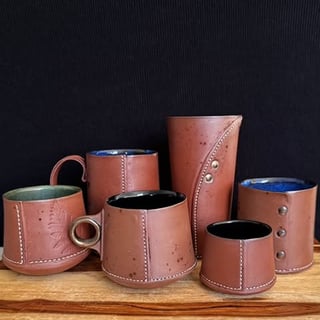
Speaker: So let's talk about your pottery. In one sentence, can you tell me what you make? I always call myself the world's largest photocopier. I make things that look like other things. I love that. That's a perfect one sentence. So tell me a story how you started making pottery that you make today.
Speaker: My grandfather and my father worked at a carton factory which is the reason I started going to higher education and I tried to get away from making boxes and things. I put myself through school by working at a warehouse moving boxes and when it came to thesis time for my BFA
Speaker: It seemed like a logical progression to start, you know, heading down the road of making boxes and technical aspects. And then David Furman came for a workshop and he unknowing to himself told me something was too difficult. So it was my, it's time to hold the beer moment. And I was like, I can do this. Like you thought it was too hard, but I can do this.
Speaker: I love that so much. So you are inspired by trash and garbage. What is it about trash and garbage that inspires you?
Speaker: It's the narratives that they hold, right? Like you don't think about it much, but everybody's seen that box where they're like, Oh, that tear, that rip, that dent, that piece of tape, you know, all kind of leading to this larger narrative, those little moments that talk about the journey of each individualized piece. Like when you see a piece of garbage or you see a broken down box, you can kind of start to put that narrative together and create that storytelling type event.
Speaker: how does that impact the way you create your own pottery? It's a lot of me walking around and my wife looking at me like I'm crazy. It's also a lot of like really studying things when I get a chance to like seeing that perfect piece of garbage or doing research for like spray cans and finding different avenues and understanding how material works so that I can copy it.
Speaker: I love that. Shaping Nation, if you are looking for inspiration for maybe your next piece of pottery, go out and go and explore things that you are interested in. And that's going to give you some inspiration. I love that so much. So can you explain to me how you get your cups and mugs to look like the boxes? Lots of practice. I think with trompe l 'oeil, a lot of the times it comes down to
Speaker: the fact that I'm replicating the process as well. So if you take the normal standard cardboard box, you break it down, it has three layers, a flat layer, a corrugated layer, and a flat layer. I do the same thing. I hand build and put them all together, slipping and scoring where needed. So it's kind of the same process that you'd go through to make a box. How do you get all the color to finish it off like that?
Speaker: The clear tape is just a glaze from Amico and then the masking tapes I've figured out about viscosity of underglazes and using them in non -traditional ways and like making negative spaces where the tape would be and then brushing them on so they have the correct textures. The big splatters of color are just easily that like you know
Speaker: You have the aspirator, the airbrush, the spray gun, the big brush, you know, sloppy brush that you kind of dip in and just slap the bisque where and it splatters everywhere. So just a multitude of different. So you mentioned negative spaces, would you mind explaining that to me further?
Speaker: Sure, like if you look at one of like the traditional fragile mug that I make, it has a piece of tape and instead of trying to make that and carve it out, what I do is I lay down masking tape to create the negative shape, right? Like the outline of the negative space so that when I brush on the underglaze or all I have to do is pull that masking tape back off and I'm left with that nice clean graphic edge.
Speaker: I love it. That's a great explanation of that. So let's talk about the business side of pottery. Can you tell me about the moment when you decided to go full time with your pottery?
Speaker: I mean, it was a multitude of things. Things were clicking on the internet. I was starting to talk with multiple other people that now become business partners of sorts, Mitchell, Spain, and Brett Kern. It was just kind of the collection of all these specific events and then coming together and just being like, well, if I don't, it seems like a waste of time to dedicate this much time and space in my home.
Speaker: You know, it's just like, OK, so let's make a go of it and let's try to make this thing work. So you are not only a full time Potter, but you're also a full time high school teacher. How do you balance between being a full time Potter and also a high school teacher?
Speaker: A lot of late nights and lots of work on the weekends. The trending audio, right, is like if you find something that you love, you'll work harder than anybody else. And that's kind of true. So I work during the day and sometimes I find time during the day to do some things when I'm not planning or prepping or cleaning up.
Speaker: And then I have a wonderful studio assistant and she's my second one. So I've had someone in the studio that works in my house and kind of, I'm going to air quote this and say, preps the canvases. So she makes the parts for me. So when I come home, I can put the labels on, dent them, add the tape and do those type of things. When did you know it was time to hire an assistant to help you out?
Speaker: I didn't know when it was time. I jokingly said something on Instagram and one of my former students from Illinois Central College had, I don't know, invited himself to be the assistant at that point. And then when he decided to go back to school and become
Speaker: something else, I kind of was left with a gap and I'm like, I can't keep up. And it's not that it's not that I wasn't being able to make product, it was just the fact that like, I needed to streamline the process so that I could get all the ideas out of my head. I love that shaping nation. Sometimes the easiest thing you can do is hire an assistant to help you with the work. And that's going to speed everything up. I love that so much.
Speaker: So you are able to sell your pottery for $100 plus. When was the moment you decided to start selling your pottery for this much?
Speaker: It was only a couple years ago I bumped up to $100. You know, you always have that conversation with people. I started out at $75, we made a bump to $80, and it was just kind of climate and culture of the market. Everybody else seemed to be selling at that rate, and I was hopeful that at $100 it might slow down the want for my products or my items, and it really didn't.
Speaker: That $100 mark, right, establishes me to be able to pay my studio assistant, people pay the utility bills and things like that that the studio is using of my house. And then also, you know, allows me a little bit of profit to be able to do some fun things by some new equipment and things like that. What would you say was your biggest obstacle when you went full time with your pottery?
Speaker: time management still is really trying to figure out that process of what I needed to make my bottom line I know I've had other conversations where it's like product but I don't I don't like that word product but just trying to figure out like okay like if I'm spending this much then I need to make this many pieces
Speaker: And that that balance between the two of like, well, I want to make them good, but I won't have to worry about just cranking out identical pieces or a line of products to satisfy that need. So what is something you're doing to help you manage your time better?
Speaker: lots and lots of lists and calendars. I currently have a calendar in my studio so that it sits in front of me the whole time. My studio assistant sees it, so she's able to kind of like, hey, you know, that's coming up, right? And then I have my task list of things I need to do every day when I come home. And then I make a task list for her when I'm not here. So lists and calendars kind of keep me, keep me motivated.
Speaker: I love that. So what are the steps people should take if they want to start being able to sell their own pottery successfully?
Speaker: Figure out social media. I don't know if I've figured it out. I've definitely been told recently that I have a better etiquette. And what I've done is I've set an alarm. So I have an alarm that goes off every day. Even my kids know what the alarm is. And that means I need to go post something, right? Getting your work out in front of people and getting that visualized.
Speaker: the visual aid to people so that they can see your work and your progressions. And not only that, but your failures as well as your successes. Sometimes it sucks, but right, we're not. Absolutely. I love that so much. So let's talk about discovering your voice. Can you tell me about the moment when you knew you were heading in the right direction with your pottery?
Speaker: Well, like I said, I started slip casting when I was an undergraduate and developing a kind of narrative. And then when it switched to the hand building and the things, there's always something not quite right about it. And what I, what I figured out through just some critiques with mentors and talks with people is that I really gravitated towards the really dirty kind of gross
Speaker: You know, quote unquote, gross looking things. Finding the, you know, finding the mark making in a different, in a different sense than traditional people think of mark making. I'm thinking of like rips, tears, bumps, tapes, labels, things like that as mark making. So you contribute your growth as an artist to three major life events. Can you tell me about these events?
Speaker: One was the death of my grandfather, which right now everybody's going to be super sad, but don't be sad. It was a really good moment in the fact that we were moving around things and I really realized the usage of cardboard within my life.
Speaker: So I realized the boxing of things and how that box can create a memory just by seeing who it's from, where it's from, kind of placing it there. I would say the other two more is the realization of garbage, like realizing that I didn't need things to be clean and nice or pretty.
Speaker: that was a that was a hard jump because you know we all we all want to make pretty things and then the ability to kind of push onto the internet because i was also reluctant to get on instagram and i didn't realize what a good tool that was to get my art out in front of people i absolutely love that shape nation your pottery doesn't have to be perfect it can be messy it can be silly it can be whatever just make whatever you want to make i love that so much
Speaker: So what does it mean to you to find your own unique voice with your pottery?
Speaker: You know, I don't, I always think that's a weird thing, like find your voice. And I think I can equate that to, right? We each find an element within ceramics or within our artworks to be able to find the thing that everyone else has lost control of. And you try to rein it in and find control. For me in particular, it's like trying to find
Speaker: the control of being able to make each item I do look like the thing that it started out as. So like, for instance, finding the right color for the clay body. I went through a whole bunch of phone calls. I went through months of trials and tests just to find that one thing. Right. That leads me to the next thing is like, okay, I have that under control. Now I need to go the next thing. And that kind of helped me create that voice of, you know, garbage and things like that.
Speaker: What advice would you give to someone trying to discover their own unique voice with their pottery?
Speaker: The people that could walk out of a critique or get ready for critique and could be joking and smiling and happy with what they were making were the most successful people. The people that were super stressed and they were like, well, this is not quite the thing, but I'm listening to my professors. I think you can take what your professors have to say to heart and also be able to reflect and make that thing work for your
Speaker: particular vision. Absolutely great shaping nation. Most important thing is for you to have fun, but also to be able to critique your own work to evolve it even further. I love that so much. So as we're coming to a close here today, what is one thing you want to hammer home with my audience today?
Speaker: I don't know. Have fun. Stop scrolling on Instagram a little bit less. Start focusing more on making more work. Making more work always leads to good things, right? The old saying of practice makes perfect doesn't necessarily hold true, but practice makes improvement does. Absolutely some excellent parting words advice. Thanks for listening to this episode of Shaping Your Pottery.
Speaker: If you are struggling with finding your own theme for your pottery so that you are known for something, I put together 53 themes that you can use and you can take
Speaker: All you have to do is go to shapingyourpottery .com forward slash 53 themes, that's five, three themes to get these 53 themes. It's really important for you to find a theme for your pottery so that you're not gonna get burnt out. You can have multiple styles with your pottery and you can be known for something. So again, go to shapingyourpottery .com forward slash 53 themes, that's five, three themes to get these 53 themes.
Speaker: Thanks guys, I'll see you guys next time.