Transcript
Speaker: If you love pottery and wanna take your skills to the next level, you're in the right place. Find your own pottery style right here on Shaping Your Pottery with Nick Torres. Let's get started. What is up everybody and welcome to Shaping Your Pottery with Nick Torres. In this episode, I got to interview Carolyn Tripp and she makes some really wonderful pottery that she takes from her everyday life and she applies it into her own work.
Speaker: In this episode, you will learn how Carolyn makes her pottery through newsprint transfers. You will also learn about the power of finding your own voice and how to actually intentionally go out and find it. Carolyn, welcome to Shaping Your Pottery and share with me what is one thing you believe pottery should be doing to have success in pottery.
Speaker: I think it's really important to be making things that you love, that you want to make, not trying to make things for success to sell, things that you think will be commercial. If you make the things you love and you make them well and you improve your craft, then you will be successful. I truly believe that based on my own experience in life. You know, for a long time, I was chasing sales with the products I was making.
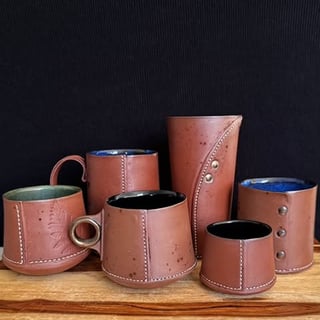
Speaker: And then it was only when I had a big sort of life changing event in that I lost my mother and everything sort of brought to a halt. And when I started again, I wanted to do something that I wanted to do. And the work that you see behind me came out of that and it's been very successful. And I love it because it is successful because I keep going and I keep loving it. So I haven't fallen out of love with it. It's not a chore. So I think making work that you make is key.
Speaker: I couldn't agree more. That is some like perfect advice. I love that so much. So can you tell me the story how you got started making ceramics? Yeah. So I, um, came to ceramics later in life. I was about 30 something and I'd had a career in advertising and, um, I sort of fell out of love with that. I went and did some traveling, traveled the world.
Speaker: And when I came back, I was able to work in a different way. So I actually had evenings to myself. And in those evenings, I did a few classes, and one of them was pottery. And I fell in love straight away. I still remember the very first thing I made. It was a bowl. I used a mold to mold it. And at the end of the class, it was sort of standing upright. And I remember saying, I made that. And that feeling of making something
Speaker: stayed with me and from that I went on to do an access course which is the equivalent to a qualification that you might get at school if you've done art. I wasn't able to do art at school, I was academic so I wasn't allowed to do art and I basically got some qualifications. At the end of that qualification I had a portfolio of work and I thought well I might as well apply to do what I really want to do and that was a degree in ceramics
Speaker: And I got onto the course at Camberwell College of Art, which was quite a famous course with some amazing studio potters as our tutors and led by Richard Sleigh, who's a very well -known English studio potter. And yeah, and it basically started, I graduated in 1998. I then promptly had a family and sort of kept my pottery up and then started teaching. So I've been teaching for the last 17 years.
Speaker: in a mental health setting and adults with special needs, but also doing my pottery as well. And it was this year that I was able to stop the teaching and concentrate solely on my own work because it's been going well. I love it. That was really, really, really amazing. So over the last 30 years, since you started making pottery, what would you say was your biggest struggle? Well, I think
Speaker: It's an eternal struggle. It's that imposter syndrome. It's that is what I'm making good enough. And then when it is good enough and people start buying it, why are they buying it? You know, I think that it's that self belief. And gradually, over time, that belief gets more and more. It's the most amazing feeling when you make something and someone loves it enough to want to pay money to buy it. And
Speaker: you know, it's sort of sometimes people might come up and say, I would like that piece. And it's one of your more expensive pieces. And you still say, Oh, gosh, are you sure? You know, but absolutely, they're sure, you know, I do it when I'm buying things myself, I want that I see that I want it. It's, you know, I've got to have that. So I think it's self belief. And there are down days, and there are up days, and it's sort of making sure there's down days, you still get some stuff in the bank from the good days that will see you through them.
Speaker: you know, when you don't get into a show or when, you know, a sale falls through or something like that where you're tired or a kiln fails and you've got, you know, work you've been working on for weeks is wasted. You know, gradually with time, those things get less and less. But I think that's really, yeah, that would be my answer to that one, I think.
Speaker: So you mentioned these bad days. How do you get over these bad days and how do you have more good days rather than bad days? I think it's about managing your own mental health a lot of the time. I appreciate, there are some days when I go to the potter's wheel and whatever I do, it doesn't work. You end up with a pile. When my pile of wasted pieces gets over a certain centimeter height,
Speaker: I know it's a day when I just need to pack up and go home. If my body's not rested, if I'm feeling tired, if I haven't slept well for a few nights, if I've got other things going on, you know, emotionally at home or whatever, if the dog wants to go for a walk and I want to be at the wheel, you know, actually everything has to be right for me to be able to create properly. And I know that, you know, you're not a machine. You can't keep at it every single day. You do need to build in rest days.
Speaker: I make sure that most weeks, this period of the year is a difficult one, it's a different one and we're busy a lot, but most weeks I will build in an artist's day where I will go to a museum, a gallery or just a walk or something, or go meet somebody and sit and chat. And those days fuel the good feelings that get you through difficult times. So yeah, I think that's how I see myself getting through.
Speaker: I definitely, I definitely agree 100 % with that. For those that are listening, it's important to take care of yourself, not just physically, but also mentally. This is a long journey that we're on and we need to take breaks. We need to take care of ourselves. Can you tell me the story, how you started making the pottery that you make today? Yeah. Um, so I don't think I have it. I'm just going to grab this because when, um, my mom was, um, well, she, my mom got cancer and,
Speaker: We spent a lot of time talking. And one of the things we discovered at home was this little pot here, which came from a great uncle of mine who traveled extensively in China in the 1940s. And I'd been making slip -caste work up until that point. And when I was at Canberra, I concentrated on slip -caste work. And I had a wheel, you know, you pick these things up, it was knocking around, but it wasn't really used apart from maybe helping me with some of my molds.
Speaker: And I just saw this and I thought to myself, I wonder if I can throw something with a long neck. And so that inspired me to try and have a go on the wheel. And I found the wheel during that period of my life to be incredibly therapeutic because when I was on the wheel,
Speaker: And, you know, you don't just, I've thrown at college and I haven't thrown since, and you don't just pick it up. You know, it's practice. It's about putting in that daily practice. And that focus of, can I do this? You know, I want to get better each time, again, again, again, reusing the clay. That really helped me during that difficult period of my life. And my mum collected blue and white ceramics. And I loved that collection.
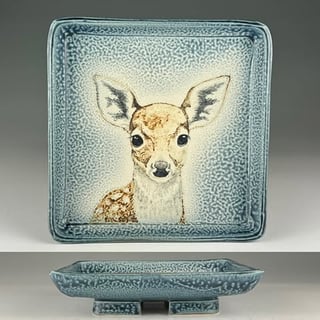
Speaker: And I basically started to sort of try and not recreate, but use some of that as my inspiration. And so also at that time, you know, that feeling of wanting to express how I was feeling was there. So my work, when you look at it in detail, is a lot of little messages and drawings and things I observe. It's basically, I sort of like to think of it as like memorialising what I see and what I feel and what I hear.
Speaker: And so it came from that really, that time of intense emotion where I wanted to record how I was feeling. I wanted to make tributes to my mum and various things that was helping me at the time. And so that's really where this work came from. It started about six years ago and it evolves and develops, you know, weekly. No two pieces I make are the same. And I love that. That keeps me engaged and interested.
Speaker: I love that. That is really, really beautiful. That was really amazing. So you are inspired by the opportunity to remember and record and celebrate life. How does this affect what you're going to put onto what you make? Well, my process is very much that every day I'm, you know, like we all are looking around us and I record things. So it might be that I take the dog for a walk and there's a particularly beautiful flower, bush or tree or something. And I might take a little detail from that,
Speaker: I might look across at the moment it's dark and I can see all the windows lit up. And so those patterns, there's patterns everywhere you look. There's things that I overhear. I might be on a bus journey and I overhear someone saying something. And there's poetry that I've written, that I read. There's lyrics to songs. There's all sorts of things in everyday life. And what I do is I record them down in little notebooks. And then when I've got enough, I put them together and I redraw them out onto a big sheet.
Speaker: And then I use that to make screen prints and I screen print my pattern or my surface design onto paper and then transfer it onto my pottery. So that's the process. So it's sort of almost every day collecting things. You know, sometimes I don't know whether you've ever done this, but when you're sorting through, trying to tidy up and you find an old drawer, stuff full of letters or cards or things and dig them out and there might be little gems in there.
Speaker: I'm always sort of finding things, always interested, always looking around. So I'm constantly making these patterns, you know, adding to my sheets and I've always got one on the go. I love that so much. I think that's very powerful to take things from your life and like what you observe and put it into your pottery. So over the last 30 years, what is something that has helped you with your pottery process? Well, I, um,
Speaker: Certainly in the last five or six years when I've been throwing, I make sure that every year I give myself some sort of training. And I think it's really important to do that. So you might get to a point where you're stuck or that you say with throwing, it's very simple to say you want to go bigger. Well, there are different techniques you need to do in order to do that. So I find somebody
Speaker: be a course, it might be an existing course, or it might be a particular potter who has a skill that I want to learn. And I contact them and I allow myself some training every year. So I think that's really important to keep an inquiring mind, to keep learning. It is a journey that we're on. We never know everything. I spent hours watching YouTube videos in lockdown. That was a great favorite of mine, watching people
Speaker: teaching on YouTube, you know, it's fantastic. But I'll always I'm always learning. So I and I formally make sure that I do that every year. And I think that's a key. It really is. I definitely agree. So I was gonna actually get into this right now. But how does learning actually help you like improve your pottery, your practice? Obviously, there's certain skills. And and the thing about throwing is that as an example is that, you know,
Speaker: There's not one way to do it. There's not one way at all. There's lots of different ways. And you can find your own way by getting information from other people. So I might take some people when they're centering, they go really fast. Some people go really slow. You find your own place within that spectrum of how to do things. And inevitably, when you learn from someone or observe someone, there'll be one little thing that might
Speaker: you might just resonate with you that you can pick up and put into your practice. So you're not ever sort of completely learning from one person. You're picking little bits. And what I'm teaching, you know, I'm very aware that if someone wants to hold their hands differently on the wheel, that's fine. That's what feels comfortable to them. And we all have our own way and that's how it should be. We all take, you know, a piece of clay
Speaker: And we all make completely different things from it. And that's so wonderful. And we do that because we bring ourselves to it. So yeah, I think you find little bits of information from people and and make your own sort of way of doing things from that. I definitely agree 100%. It's important to learn from other people and then try to incorporate it into your own work. Yeah.
Speaker: So something I found interesting was that you had the great opportunity to learn from Eric Landon. What was the best thing you learned from him? Gosh, what was the best thing I learned from him? I think what he has is an amazing ability with clay. He is at one with clay. Sounds really corny, but he
Speaker: Clay does what he wants it to because he respects Clay. And so I sort of learned from him, I think, the most important thing. There's lots of things you learn from him. It's a very enlightening course that he does. And everybody on the course that I did improved dramatically in the five days that we were there. But I think for me, it was to slow down. It was to sit back.
Speaker: and it was to break things down into stages and not rush it and to therefore enjoy it more. And it was very difficult at first because I had my way of centering and he has his way of centering and it took me a while to amalgamate the two, but I did and it was joyous and I was able to move much bigger pieces of clay
Speaker: by day two, you know, than I've ever been used to using before. So confidence comes from that, you know, a confidence in your ability to do more and to push yourself. I would say particularly. Yeah. Yeah. That is really great. I definitely feel like he is like at the cornerstone of like wheel throwing with ceramics. And I definitely one day I'll definitely want to take a class from him. Yeah.
Speaker: So let's talk about discovering your voice. Before you found your voice, what would you say was your biggest struggle? Well, I think, I think finding my voice, I mean, I think it's literally being true to yourself. It's a bit like, you know, what we talked about at first of, of, you know, chasing other things, thinking, if I make these bowls, I'll sell them. And this is, this is the colors of the season. This is what interior designers want now. They weren't really me.
Speaker: And when I would get orders in, you know, someone would order four or five and my heart would sink because I had to make four or five the same and realizing that, you know, that wasn't really me. So finding your voice is about being completely true to yourself. And I don't think that I was beforehand. Now that might be because I was splitting my life by being a parent, by being a teacher. And then my own practice came very low down on the threshold of things.
Speaker: you know, I am a parent, I continue to be a parent, I always will, although my children have grown up. And then also, but you know, then I'm, my practice is central to my, my voice, you know, so I think it is that very fact of struggling to find your voice. And I'm a child of the, you know, I was brought up in the 70s and the 80s, where, you know, children were very much more seen and not heard. And I wasn't encouraged. I worked in advertising the 80s, which was a
Speaker: a very different profession than it is now. And yeah, as a woman, I definitely was held back. At school, I was told that I wasn't creative, that I was academic, and the two could not sit side by side in the education system we had. And so, yeah, I think coming from a background of always wanting to be creative, and I would be at home being terribly creative,
Speaker: no one would recognize that. It took me a while to realize that my voice was important and what I had to say was interesting and that people would enjoy hearing about it. I definitely agree. For those that are listening, you have an important voice somewhere. It is out there somewhere and you just have to actually pursue it. So when you found your voice, what new opportunities started coming your way? Gosh, so much. Because I think
Speaker: It's when you're speaking your own truth, people see that sincerity. And yeah, I mean, lots of lucky things happened as well. My work was chosen to advertise a big show here in London. So suddenly my work was on posters and on buses and on the tube. And, you know, friends were really saying, I can't believe I saw your work drive past me on a bus.
Speaker: So it's almost like, you know, sometimes when you're happy, you give out happiness and good things come, who knows what it's all about. But I do think that being optimistic and having a positive outlook brings positivity back. It opens doors. You know, when somebody walks into my studio at an open studio and I smile and I engage with them and I chat to them whether they want to buy something or not, that's different than if I was to sit there feeling
Speaker: you know, oh gosh, this person might not buy anything from me, so I probably won't talk to them. You know, you give out, you get back a lot of what you give out, I think. And I think that finding my voice enabled me to be happy enough to give out and then get back. But yeah, all sorts of things, you know, you get picked for shows, you get to meet people. One of the things I say is I used to go around ceramic shows for years, and I'd always look at the people behind the tables, behind the stalls,
Speaker: and think, gosh, I'd love to be one of them. And now I am. And that's something to really be happy about. And you think, gosh, I'm one of those people, but I remember how it felt to be on the other side. So a potter comes up to me at a show and asks me a question. How do I do this? How do I do that? Of course, I'm going to talk to them and engage with them. And the connections, you make all these connections. And it's rather wonderful. We live in a very lovely community, the potter's community, certainly over here.
Speaker: When I did the course with Eric, you know, I met potters from around the world. And I feel like I have a bit of a worldwide little pottery community now, which is rather wonderful. I definitely agree. When you're able to find your voice, new opportunities come your way, not just like for your pottery, but you get to meet unique people. And I love that. Yeah. So what advice would you give to someone trying to find their own unique voice? Gosh, I would think
Speaker: It's sort of really be true to yourself. Do what you want to do. And if you can't do that all of the time because you have a job, because you have work that you're doing and selling and that's sustaining you, you know, set aside a bit of time each week. Diary that time. I think it's really important to use your time well and block off periods of time where you're just going to explore
Speaker: go to galleries, go to events, talk to people and write it down. Keep a book of things that interest you and then look at what you've written down after a period of time and you will start to see what directions you are naturally going in and you know it takes time as well, it takes time and I always say to people who say
Speaker: How do I learn to throw? And I always say, well, if you go to a class every week for two hours, that's great. But if you can take three days off work and you can go to an intensive throwing course for three days, you'll learn so much more because it's about practice. It's about repetition. And it's the same really for, you know, being disciplined, having a little book that you write things down in, that you would call the things you tear pages out of magazines.
Speaker: and you stick it in, things that interest you, and you'll find the direction I think you want to go in. I definitely agree 100 % with that. For those that are listening, it's important to be intentional with trying to find your voice, finding what you like to make with your pottery, and put in those reps so that you can actually find your voice. So as we're coming to a close here, what is one thing you want to hammer home with my audience today? Just do, you know,
Speaker: don't worry if it doesn't go right. Pottery is full of failures. I know you've got our pottery throwdown over there in the States now, haven't you? And that's a wonderful program to watch to see how things can go wrong, but there's still beauty in what you get out. So if a glaze has run everywhere, there might be a really beautiful part of it that you could take out. There's always good in everything. So I would say, yeah, just look at the good in everything that you do.
Speaker: Keep going, keep practicing, put in that regular practice. It's very, very important to do that. And just make sure that you're loving what you're doing. It should bring you joy. It should bring you joy. And if it's not, then you maybe need to look at another way, look at a different direction, but it should bring you joy and that's important. Some excellent parting advice. Carolyn, it was really great chatting with you today. Where can my audience go and check out your work?
Speaker: Um, well, I'm on Instagram and I do regularly post, um, uh, that's at Carolyn T ceramics. And I have a website, Carolyn T ceramics .com. So generally you can find me if you Google that. And if you look at it right now, I'm in the middle of moving studios. So I've been documenting that process and it's gosh, I didn't realize how much stuff I'd collected, but I'm moving to a bigger space because, um, yeah, things are going well and I need more space, which is great.
Speaker: Thanks for listening to this episode of Shaping Your Pottery. If you have questions about developing your voice or just pottery questions in general, send them to me my way. Go to shapingyourpottery .com forward slash contact to send me your questions.