Transcript
Speaker: That's when I started making more interesting forms. And that's when everything clicked. Everything sort of fell into place. And I got a plan and I knew what I was doing. And I, you know, executed that plan. What is up, Shape Nation? It's Victorce here. And on today's episode, I had the great pleasure of interviewing Jesse Shaw.
Speaker: Jessie makes some really incredible pottery and she has a very great fascination with glaze combinations. In this episode you will learn why Jessie has a fascination with glaze combinations. You'll also learn about why Jessie takes frequent breaks and how that actually helps her with discovering her own unique voice with her pottery. You'll also learn about how Jessie uses pottery to help her with her own mental health
Speaker: And finally, you'll learn about why Jessie only fires one time for her pottery. She skips the bisfire and only fires it once. And there's so much more in this episode. I hope you guys enjoy it. I'll see you guys in the next one.
Speaker: If you love pottery and want to take your skills to the next level, you're in the right place. Find your own pottery style right here on Shaping Your Pottery with Nick Torres. Let's get started.
Speaker: So first, having success in pottery, taking breaks from being creative and like doing pottery physically on the wheel or slab belt, taking breaks so that you can let your mind just flow and be creative and figure out where you want to go.
Speaker: with your pottery, you know, and not being so influenced with what others are wanting to see in your pottery. I mean, you can take part of that and bring it into your pottery, but focusing on what you want in your pottery and what's most important to you. Absolutely. I love that so much and that's it. Jesse, tell me the story how you got started in making pottery.
Speaker: Okay, so when I was 14, I was having some mental health issues and I was severely depressed and struggling. And my mom brought me to see an art therapist because all other forms of therapy were not really working for me.
Speaker: I had always been a creative child, always into arts and crafts and everything like that, but I had never done anything with clay. And this art therapist just happened to, you know, her medium was clay. Now we did all other types of things, painting and, you know, she had so many options that, you know, we could use.
Speaker: But she loved clay and I learned to love clay. She taught me hand building and that's where I started. I used to make these wavy sort of type of bowls. And back then I was really into like imprinting leaves on the clay and I loved that. So I got to learn quite a bit about pottery from her and then
Speaker: she got a little electric wheel at a certain point. So she taught me how to throw and our sessions were so organic and it was so different from what most other potters have probably, you know, their learning experience was, you know, they probably went to a class where they had a friend that did pottery and they were taught pottery.
Speaker: For me, we just sat down and there was a ball of clay in my hands and we chatted and I made something. And we didn't really talk about the technicalities of the clay or anything like that. And I just learned by doing it and by seeing her and then we got on the wheel. So we got on the wheel and she taught me how to do that. And I loved it from the beginning.
Speaker: And then I went into high school ceramics, and I started out much higher than a lot of the other students that were learning. So I quickly became the teacher's assistant, and I sort of took the back of the room, which was the wheels, and she took the front of the room, which was hand -building, and I helped the other students. So teaching the other students helped me learn quite a bit too. It's different from when you're throwing and you're paying attention to what you're doing, and then
Speaker: telling someone how to do it and showing them the handshapes that they should be using or where they should be putting the pressure on their hands. It helps you when you're having to really think about, what do I do when I'm doing that with the clay? How do I raise the walls? High school ceramics honed in all my ceramic knowledge and then I had my own studio at my house at that time and then
Speaker: I sort of dropped off the face of the world with ceramics and I gave it all up because I thought I was supposed to grow up and be an adult. I didn't think that I could make.
Speaker: pottery living and I didn't really want to, I was selling some of my pottery just on a custom order basis and I, and I loved it and I didn't want my hobby to be my job. So, you know, I went into the really logical job field of accounting. 80 right there. That was an absent story. Now, can you tell me how did pottery help you with your own mental health? Oh, so there's something about.
Speaker: feeling the clay in your hands and creating something with it that can be really healing. And also there are studies done that showing when you're working with your hands and talking about issues or anything like that, it helps to just sort of make the conversations less awkward and it helped me heal. It helped me heal and
Speaker: Yeah, the claim will always have a special place with my heart. And I think it always needs to be a part of my life. And I know that now. Yeah. And I will never give it up again. Now, earlier you mentioned that you thought you had to quit or start being an adult and quit ceramics. Can you tell me about the moment when you decided to leave your accounting job and go back into ceramics?
Speaker: Yeah, that was, so it wasn't just one moment, but it, it was great. It was great realizing that that's what I had to do. So it started with, I had quite a bit of health issues. So I, wait, let me back up. So I, I worked for an accounting firm and it was crazy. Overworked and extensive hours, especially during tax season and you know, so many responsibilities and having so many clients.
Speaker: you know, being responsible for them and them looking up to me. And it was so much of a weight on my shoulders. And it became too much. It was too much. And my health took a turn because of that stress that I was under. And I kept trying to keep with the job. But at a certain point, it became apparent that I couldn't stay at that job. It wasn't going to be sustainable for me or my life or my health.
Speaker: And I remember a conversation with a friend who came over here at my house and we had a bonfire and we were sort of just, I had just gotten off of work and I came home. We were trying to have a fire and a relax. And I was just dressed and explaining how, you know, I was working 60 hour weeks and, you know, exhausted and I didn't know what to do. And he said,
Speaker: This sounds terrible. Why are you doing that? And I was like, I don't know. And it started the thinking process. Well, what else could I do? This is what I went to college for. This is the path that I thought I was supposed to go down. Am I just going to give all this up because it's hard and I'm miserable?
Speaker: And so that's when the thoughts started about, well, what else could I do? Where's my side hustle? What should I be doing? And there were so many conversations after that with my husband and just dumping all my thoughts on him.
Speaker: you know, what should I be doing? Where should I be going? What else could I be doing? You know, I need to make money. And it just got to the point where my health was so bad that, you know, I had to stop that job no matter what, even if I didn't have a plan. And I did stop that job. I quit. And I went to the private sector of bookkeeping and it was much less stress. And I guess right before I left my job at the accounting firm,
Speaker: I decided, I can't really remember the exact moment that I said I need to get back into pottery, but I didn't have any hobbies. I thought I had to grow up and I couldn't do the fun stunts anymore and I didn't have time for it when I was at the accounting job.
Speaker: I decided I was seeing doctors at that point that said, you know, what are you doing for yourself? What do you do when you're stressed? You know, what do you do for fun? And I'm like, nothing. I go home and I sleep. I'm exhausted. And I kept thinking, well, I loved pottery. I used to love pottery so much and I still love pottery and I still have an appreciation of pottery. And I was like to my husband, I'm like, I have to get back into pottery.
Speaker: And he's like, what do we have to do? How do we do it? But I'm like, okay, we have to get a kill and a wheel and we have to set up the office so that I can do pottery. And he was like, yes, let's do it. And it was during COVID and
Speaker: There was my kiln was so backwards. It took like nine months and multiple headaches to get it here to my house and get it all hooked up. And we had an amazing electrician and I had my wheel and I could finally get started. And I had, after I left the firm, I had a little part -time job as a bookkeeper. So I had that.
Speaker: so that I didn't have to focus on making a profit from the pottery. And I could just kind of play and enjoy and, you know, play with the clay like I'm used to. And, you know, I had lots of friends and family that were supporting me. And, you know, it evolved and I left that job, but I have other work from home type of job, but it's the highlight of my work life. It's mostly pottery now. So.
Speaker: That's it. I love that. So now you mentioned that your husband had a pretty big impact on you being able to actually do pottery. Can you tell me the impact your husband has had through your pottery journey?
Speaker: Oh my God, the endless amounts of things I could give my husband. Oh my God. He has supported me in everything. And like I said, when I said, you know, I think I need to get back into pottery. And he was just like, yes, let's do it. You know, what do we have to do? You know, do you, do you have the money? Let me buy it. You know, he was.
Speaker: He was supportive every single aspect and I've gotten him on the wheel and so he has a bit about understanding about, you know, it's not super easy. And, you know, he sees me making and I can see that it makes him happy to see me happy. And, you know, I'm not so burnt out like I was at the accounting job anymore. You know, I'm doing my passion and
Speaker: he comes home from his job and I'm here in my studio with a smile on my face and I want to show him everything I made that day or a different handle I put on a mug or something I'm working on that's different or whatever and he's just so excited to hear about it.
Speaker: He supports me in every aspect too. He helps me with packages and when the orders come in. And when I started making it on social media, he always finds me the trending audios and always wants to, oh, did you see this? I saw this. What about this idea? What if you do this? And he's so invested in it and my future with pottery. And oh my God.
Speaker: I couldn't thank him enough and I couldn't imagine it any other way. He's just amazing. I absolutely love that. That's so amazing. So let's talk about your pottery. Can you tell me about the story, how you started making the pottery that you make today? Okay, so my pottery is ever evolving. You know, I haven't figured out
Speaker: This is the thing I make and it's very unique and it's this one thing. It has evolved and I remember the first release I did, now this was only back in April of 2023, I did a mug release and it was a bunch of different mugs. There was a single one that was similar to another one, they were all vastly different. Part of it was I was figuring out
Speaker: you know, what my style was and what I liked and figuring out the glazes again because I, you know, it had been so long. So, you know, it took a while, you know, there were people that bought those mugs and they loved them and I loved them, but it took a while for me to figure out, you know,
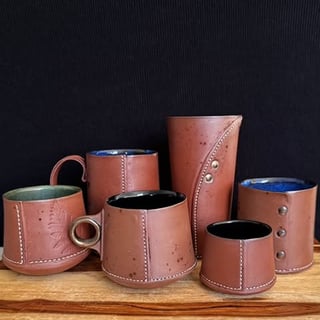
Speaker: I don't really like making mugs. I make some mugs and I drink my coffee from my mugs every day. But what's really fun to make is the things that not all potters are doing and there's so many potters making mugs.
Speaker: I did a release of olive oil bottles, and it was so fun for me. That shape is a little, you know, it's not as easy as a mug. And it was so fun. And I loved it. And I saw that other people loved it too, and they flew off the shelves.
Speaker: And I made these yarn bowls and they flew off the shelves too and they were so fun. They were so different from, you know, the boring, in my opinion, boring mugs that I was doing, you know, making those shapes that not all the other potters are doing and, you know, figuring it out and then adding, you know, my fun glaze combinations to them, which is really where my passion's at, you know, and making them mine. That was,
Speaker: I love that shaping nation. You don't have to stick doing the same thing as everybody else. If you want to make something completely wild, you can go do that because what matters most is if you were having fun. I love that. So you are inspired by seeing the possibilities in the medium and the medium being clay. Can you tell me more about this?
Speaker: Yeah, so I think all putters can agree, like, you can make anything in clay. And, you know, it might not work on the first try, it might craft, it might warp, whatever. You try again, and you try again, and you tweak it, and you can make it in clay. There's so many things you can make in clay, and that is...
Speaker: overwhelming and that makes it so that I never get bored with the medium. You know, there are endless possibilities with clay. You know, I didn't have to stick with mugs. If I didn't want to make mugs, you know, I can make olive oil bottles. I can make yarn bowls. I can make, I don't know, just about anything I want to make. You know, I made a couple of things for myself this month. I sort of took it off and regrouped and I made myself a
Speaker: an organizer for all my tools on the wheels. And I can make that in clay, and we'll see if it survives the kiln without cracking. But if it doesn't, I'll try again. And if that doesn't work, I'll keep trying. But you can always make it in clay, almost anything. And that's overwhelmingly exciting. And the possibilities are endless. You can't say that about other mediums, about all other mediums. You can do that.
Speaker: Definitely. That's one of the best reasons I, I enjoy Potter by myself and you can try so many different things. And if it doesn't work, you can try it again. I love that. So something interesting for me, Instagram that I've found is you don't fist buy your pots. Can you tell me more about this?
Speaker: Yeah, I didn't know so many other potters didn't know about this. So back to the art therapist I saw when I was younger. So she didn't bisque fire, she single fired. And I got taught single firing my pottery. And you know, we glazed the pottery, we glazed it when it was bone dry.
Speaker: And, you know, I didn't think anything of it. That's how I learned. I didn't really have any outside learning besides her at that point. So when I went to high school and we bisque fired, I was like, what the heck is this? What are we doing? Like, can I just glaze my piece and be done with it? Like, why are we wasting all this time? And
Speaker: And I quickly realized why, because I was the one that loaded the kiln, and oh my god, everybody's pieces exploded like all the time. You know, they were super thick pieces and, you know, had air bubbles trapping the moisture in them. And I still snuck some pieces and they thought that would have been single fired because I was the one loading the kiln, not that I did it all the time. So,
Speaker: I'm sure there are some people listening that are like, what the heck is single firing? So it's when you skip the bisque firing, you take your piece, you throw it, you make it bite slab or whatever. I wait until my pieces are bone dry.
Speaker: But some people do it in the leather hard stage because it's not as fragile. But I've always done it bone dry and I've never had an issue. And you put glaze on it when it's bone dry in that fragile state, you have to be careful with it. It works better with commercial glazes. And then you fire it. And as long as you don't normally have issues with your pieces exploding.
Speaker: It works, it works pretty seamlessly and you get to skip that step of bisque firing. And for me, like my studio is upstairs and my kiln is downstairs. So all that time and energy bringing pottery up and down the stairs, you know, it saves me that and the electricity. You know, I haven't had many issues with it at all.
Speaker: I love that so much. So can you tell me what is your firing schedule look like? Like, for example, most people will raise the temperature like every hour or so. So what is your firing schedule look like?
Speaker: Yeah, so this answer isn't that interesting. So I have a Bailey kill with a Bartlett controller, and all I do is do the slow, it's pre -programmed on there for slow glaze firing. And they don't tell me exactly how they programmed the slow glaze firing. It takes about eight hours to complete the firing.
Speaker: For me, like from closing the kiln to opening it, it's about 24 hours. I let it cool off pretty slowly. I don't know what else I could say about that. I'm not sure what the pre -programming is. I love that. Simple. I love it. So let's talk about discovering your voice. Can you tell me about the moment when you knew you were heading in the right direction with your voice?
Speaker: So I was in October of 2023 for the whole entire month and before that I had done, you know, I did the mug release in April and I did some other little releases that didn't do that well, but I wasn't going to give up. I wasn't going to, you know, no matter what, I wasn't going to give up, but I was sick and that gave me space.
Speaker: I wasn't throwing on the wheel. I was too sick for that, but I could lay in bed and I could still think and I could do research and I could, you know, jot in my notebook ideas and glaze combinations and, you know, decide where I really wanted to take my pottery and my business and the pieces that I wanted to make.
Speaker: And instead of those mugs and everything like that. And that's when I started making more interesting forms. And that's when everything clicked. Everything sort of fell into place. And I got a plan and I knew what I was doing. And I executed that plan. And because of the time that I spent figuring out all the kinks during that month and thinking and researching,
Speaker: You know, it paid off in those, you know, busy November and December months. And yeah, that was October was when I knew I was on the right track and November and December was when I knew I really was on the right track. So now at the beginning of this podcast episode, I asked the question, what does it take for parties to be successful in pottery? And he said taking break. Would you say this experience helped you in realizing that?
Speaker: Yeah, yeah, completely. You know, I thought I had to keep making pottery and I made it. I put myself on this schedule that I, you know, had a release like every single month. And they were small releases, but I was like, I got to keep up and I have to have the consistency.
Speaker: And then, you know, October happened and it was like, you know, I can't make anything this month. And it was that break that let my, instead of like just doing the work and being so in the work that I couldn't think outside of the box, it was sitting on my bed, you know, thinking and, you know, not having much to do, that let my mind sort of wander and think about the possibilities and
Speaker: just look at it as a whole and really get on the right track with what I wanted to do instead of sort of just winging it, which is what I was doing before. And to this day, because I said I was taking this month, it was like the later half of December and now into January, that I was taking off.
Speaker: And that's because of October, because after those busy months, I think the best things potters can do with artists in general is take a break until you feel the creative energy flowing again and until you feel inspired to make your craft again. Because if you're making pieces that you're just making them to make them,
Speaker: People are going to sense that. People are not going to want your pieces that you don't have your heart and soul in. People are going to want the pieces that you're ecstatic about and you made from a point of high energy. And, you know, it will show through your craft how you're feeling about, you know, the pottery. Yeah. Take breaks. 100%.
Speaker: I love that shaping nation. Sometimes the best solution is to simply take a break, take a step back from your work and look at it from a different perspective. So you get new ideas and start creating new things. I love that. So you contributed to an artist to understanding why he makes for me. Can you tell me more about this?
Speaker: So this goes back to the mental health aspect and why I started making pottery. It started as something that I was doing over therapy and I came to love it.
Speaker: It helped me express feelings that I was having a hard time expressing. And that feeling with the clay and my art therapist had a very organic approach to all forms of art. And it was a very relaxed setting. And so when I stopped doing pottery and I went into accounting and I didn't do pottery anymore,
Speaker: And my mental health paid. I was, you know, depressed. I was burnt out. It made me realize how important having the pottery and, you know, art in general in my life and, you know, that I could express myself through the clay. And I will never not be doing pottery. I learned that the hard way.
Speaker: I love that. Now, what is something you are doing to evolve your voice even further? Just... So, number one, glaze combinations. I love playing with glaze, figuring out all the possibilities the glazes have. You know, it can take a boring piece and make it extraordinary.
Speaker: And take a piece that, so people might want yarn bowls and I'm not into knitting or anything, but people seem to like the yarn bowls. But how I make the piece mine is those glazes I put on it. That's what I'm excited about. And other people are excited, the people that actually want the yarn bowls are going to see those glazes and be excited about them too. Taking breaks.
Speaker: making different forms that isn't what all the potters are doing, like mugs. I keep beating on mugs, but they're just so overdone. Not that I don't make mugs, there's multiple mugs on the shelf behind me that I made for myself. And I love mugs, but I don't want to be making mugs all the time.
Speaker: I love that. Now, what advice would you give to someone that's looking to discover their own unique voice with their pottery? Oh, figure out why you're doing pottery. You know, for me, that's for my mental health. And also take, take breaks and rest. Let yourself be creative and have the space to be creative. Yeah, I think that's it.
Speaker: some excellent advice, but there just has been really great time today. And as we're coming to a close here, what is one thing you really want him to know with my audience today?
Speaker: Oh, don't be scared to pursue your passion. Even if it feels like, you know, it's not mainstream or, you know, your parents are going to be mad that you're, you know, trying to do or, you know, don't be scared to just jump out there and do it. Do it scared. You know, it could be even better than what you were imagining it was going to be. It could turn out amazing. And you're just not going to know until you do it. So just do it.
Speaker: Some excellent parting words of advice. Jesse, we're so great chatters today and where can my audience go and learn more about you? So I'm on Instagram at Modern Fire Pottery. I'm on Facebook, Modern Fire Pottery and Etsy, Modern Fire Pottery.
Speaker: Hey, thanks for listening to this episode of Shaping Your Pottery with Nick Torres. If you want to discover how close you are to actually discovering your own unique voice with your pottery, I put together a free four question quiz. It's very short. It takes 30 seconds for you to take. If you want to know how close you are to finding your own unique voice, go to shapingyourpottery .com forward slash quiz, or you could simply go to shapingyourpottery .com and it'll be right there at the top.
Speaker: I hope you guys enjoyed this episode and I'll see you guys next time.