Transcript
Speaker: I think being a ceramic artist, I think it teaches you to be humble. I think it teaches you to be resilient. And I think it teaches you to get up, you know, when you open up the kill and then all your stuff blew up, right?
Speaker: What is up Shaper Nation this is Nick Torres here and on this episode of Shaping Your Pottery I got to interview Alina Hayes. Alina makes some really incredible sculptures and they're just really awesome. In this episode Alina dives really deep on how she creates her unique and awesome sculptures. You'll also learn about why you shouldn't be taking yourself too seriously with your own pottery.
Speaker: You'll also learn about Alina's best advice to help you start selling your own pottery. And finally, she gives some really amazing tips on how you can find your own unique voice and how you can start making that voice come to life. And there's so much more in this episode. I hope you guys enjoy it. I'll see you guys in there. Alina, welcome to Shaping Your Pottery and share with me what is something you believe potters should be doing to have success in pottery.
Speaker: Well, thank you for having me. It's important for potters to keep making. I think that if you're busy and you're constantly exploring, I think that's really helpful. I think that also surrounding yourself with other potters, it's a very communal art. I think being in a group together, you could do shows together, things like that. So I think that's very important. And also just get out of your own way because you're probably your own worst critic.
Speaker: It's difficult to really just focus on making the work if you're constantly criticizing and standing in your way. Also, don't expect the shows, the notoriety, the things, don't expect them to come your way.
Speaker: all the time and really go after it and hustle and don't just expect for things to come on their own. It happens very rarely and I think that the harder you hustle and the harder you go after what you want, I think it'll end up in the long run. I think it's going to be more successful for you.
Speaker: I absolutely love that. Shape Nation, keep making pottery, surround yourself with other creatives and get out of your own way. Keep making. I love that so much. So tell me the story, how you got started making pottery. So I was working an office job, a very boring office job. And I had dropped out of art school and I was just working a job and I was really kind of bored out of my mind.
Speaker: And this woman told me to take a wheel throwing class at a creative art center in Bourbon, California. And so it was like, yeah, I'll try it out. And I fell in love with it. I fell in love with it. It was something that came very naturally to me. I loved the symmetry. I loved that there was a beginning, middle, and an end, that you could throw a pot and then trim it, glaze it, and it's done.
Speaker: And so I started doing that. And then I read an article in ceramics monthly about this woman who was the head of ceramics at CSUN, California State University, Northridge. And her name was Patsy Cox. And I loved all the things that she stood for and all the wonderful things that the article said about her. And I said, you know what? I'm going to go back to school and I'm going to take ceramics as my major. And I did. And been making ceramics for 15 years now.
Speaker: Love that. So as you mentioned you went back into art school Can you tell me about why you decided to get your masters in finals? so That would honestly have to be Etsy because she was a mentor of mine and I had just wanted you know I had a tip on my shoulder that I dropped out of school and I knew I wanted to get my bachelor's degree and at that it was
Speaker: You know, she decided, she'd mentioned that maybe I should go back and get my master's as well. And I really wasn't sure. I wasn't sure if I wanted to teach. And she said, just do it. And I think that having that push, I went ahead and I completed the program. And I honestly think it was, it was incredible because I learned that I really did love teaching afterwards. So how did this time getting your master's degree help you with your growth as an artist?
Speaker: I think going to art school, and I know there are some people that, you know, can argue back and forth, but I think going to art school was helpful because, predominantly because of critiques, also because it opened me up to other disciplines.
Speaker: you know, painting, sculpture, drawing, and the program at CSUN, it's an interdisciplinary program. So you get to sit in critiques with all the other majors, whether they be sculptors or painters. And I think getting perspectives from those students and those artists was really important because they view the work completely differently.
Speaker: I think with ceramics, we could really get trapped in this idea of glazing, temperature, kilns, and we could really focus on technique more than the thought behind the work, which is a bowl is a bowl, a cup is a cup. But I think there could be so much more to that type of work if you just
Speaker: kind of start thinking about it and think about why you're making this type of shape, why you're making this specific object. So I think it was important for me to really done my work. And I think people brought up some wonderful ideas about where my work can go. And so I think that was predominantly the most helpful thing about. I love that. Shape Nation, if you can learn to reflect your own pot or your own work, then your pottery is going to grow and you're going to have so much more success in that. I love that.
Speaker: So what is something you learn from your time getting your master's that you still use today?
Speaker: is this little tool that I was introduced to and I meant to bring it here, but I'm sure you know what it is. It's the serrated rib. You know, it's the little metal rib that has the little teeth on it. You use to smooth out your pottery. It is instrumental to my everyday making because if I didn't use that tool, I would not have the smooth objects that I make by hand building.
Speaker: So a lot of the time people wonder how did I make this piece? Did I throw it because it looks so smooth? It's because I use that red and it's it's huge. It's my it's my all -time favorite tool I love that. So we're gonna talk more about that in a little bit but earlier you mentioned that
Speaker: Your growth as an artist came from critiques from other artists and new perspectives came from that. What perspectives would you say did you learn from other artists? What other perspectives did I learn from other artists? That's a tough one.
Speaker: Well, I think it would have to be just, you know, not to take yourself too seriously. And again, just kind of allow the work to speak for itself, tend to be somebody who
Speaker: over thinks about the work. I sort of, I criticize myself in a lot of ways. And I think, you know, that fear is just, it can stay in the way of being creative. And also, I think, you know, at the same time, while taking critiques to, you know, kind of taking them in and exploring them is important. I think taking them with a grain of salt is also
Speaker: as important. I think sometimes when people talk about your work, they're really talking about themselves. And I do this too. I catch myself because you talk to people about what relates to you. And so I think that would probably have to be the thing that I would say. I love that. So let's talk about your pottery. In one sentence, can you tell me what you make?
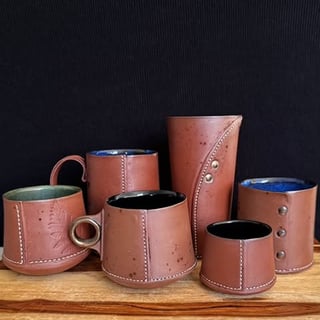
Speaker: I make happy, joyful, weird, biomorphic objects, as well as functional, spottery pieces that question the idea of function. So while it may be a cup, it sort of, you know, challenges, how do you use the cup? How do you hold the cup? Is this handle comfortable? So yes.
Speaker: So tell me the story how you started making the pottery that you make today.
Speaker: Well, I had put in a, I had submitted a proposal for a show. It was for my first solo show at Amloka American Museum of Ceramic Art. And I was really nervous. I wasn't sure, you know, what I was doing or if they'd like when I was proposing, but I wrote it, sent it in, they got back to me and was like, okay, yeah, sure. Well, you know, you can have a show in a year or so because they have backlogged.
Speaker: So anyway, and so I was supposed to start making this work that I proposed for the show. And I just couldn't get myself to do it. I couldn't bring myself to do it. I was like, you know, I just, I was so nervous about starting this work, this big, right, this proposed work, you know, for my first solo shows, just daunting, the idea of having to do it.
Speaker: that I started procrastinating. I decided, oh, I'm going to do everything but. And so I started making sort of these kind of comfortable to hold funky little objects. I really wasn't thinking about, you know, I was just like, let's see where this goes. And I really, really loved them. I loved how intimate they were becoming, how quirky and weird.
Speaker: And so I just started making them and I'd make them in different sizes. I'd make them small, like handheld, and then I'd make them a little larger.
Speaker: And then there were these naked little creatures. And I was like, well, glazing you doesn't seem to make sense. So what am I going to do with you? What am I going to cover you in? And I started looking at what a lot of potters call warm room temperature glazes, which is not fired on glazes. And I did that. And I discovered this rubber material. Essentially, it's like a rubber paint.
Speaker: And it came in these vibrant colors, and so I decided to try it and use it. And it really brought the work to life. But what I love about it the most was that, yes, you would cover it in rubber, but the cool thing about it was that you can also peel the rubber off.
Speaker: And so it was this really interesting idea of like, oh, this is like a facade. This is like an outfit that you're wearing. You know, you're like this naked little creature underneath, but you're covered in this colorful coating. Like, look at me, I'm happy and everything's great. And I was like, this is really great because you could just like peel it off like clothes.
Speaker: And so then it really all came together because that was really how I was feeling at the time. It was like I was presented to be this like happy person when on the inside I was insecure and unsure of myself. I love that story. That was so great.
Speaker: So you were born into a family with various traits, and you view working with your hand as part of your heritage. How have these impacted you and your own part? You know, I think so, especially in today's day and age with technology, so few people can actually or work with their hands, right? They use their thumbs. They, you know, they look at the screen. Everything is two dimensional.
Speaker: And when something, you know, you upgrade your iPhone and you, you know, something breaks, you throw it away, buy a new one, right? Nobody really, not as many people make or repair or create something, you know, with their own two hands. And I think for me, being a maker, I think that's an important daily part of my practice. And so coming from a family, my dad's a jeweler.
Speaker: And my great grandfather was a surgeon. You know, it's such an important ability that people have by making something with their hands. And I think for me, especially given the state of the world right now, love that I can create an object that can somehow brighten someone's day. And I love seeing people, especially children, react to my work because it's playful, it's colorful, it's, you know, it's
Speaker: joyful. And so to me, the fact that I was able to, in some small way, contribute by making, it's a huge plus for my soul, for my wellbeing.
Speaker: I love that so much. So something I found interesting from your website is you said in my studio practice the work moves between form and function as I think about the fluidity of materials. Materials, process, and time. Drawing on parallels between the unpredictability of the ceramic process and the shortcomings. Can you explain this to me further?
Speaker: Yes. So, you know, a lot of potters know this. We rely on the kiln, right? And we rely, we don't really know what the final product will be. We try, you know, we test, right? But in the end, you
Speaker: make two months worth of work, and then you put it in this giant oven, and then you cross your fingers, and you hope for the best, right? And I think a lot of that is like that in life. And I think being a ceramic artist, I think it teaches you to be humble. I think it teaches you to be resilient. And I think it teaches you to get up when you open up the kill, and then all your stuff blew up, right?
Speaker: So painters, they work on their paintings for months on end and they know that they will have an end product. That's not always the case with ceramics. I think for me, I always felt that if I was seeding, so I was making work, I was also teaching and I'm also a mom. So I have a family life and people that I'm responsible for.
Speaker: And I think for me, I always felt like if I was doing really well at teaching, then my personal work would suffer. If I was being a great mom and really dedicating my time to my family, then maybe I wouldn't have the same time or wouldn't put in the same type of effort into my teaching. There just wasn't enough time for everything. And so when you're constantly
Speaker: feeling down about yourself, like I'm never measuring up to this full persona that I have to have, it's hard. And I think with pottery, there's like a kind of a metaphorical connection between that, your life and pottery.
Speaker: I love that shape nation. There are going to be times when, you know, life's maybe going to be hard or life's going to be exciting, but you could take that and use it as motivation and continue to make great work, continue to build yourself as a person and in your own life. I love that so much. So you make some really awesome and unique sculptures. Can you walk me through the process of how you create your sculptures?
Speaker: Yes. So part of why is look for, and sometimes I look for it and sometimes it inadvertently makes.
Speaker: its way into my work. So I think about pop culture. I think about different toys. I think about animation, like, for instance, the candy nerds. I think about different sort of... And so that kind of starts to inspire some of the forms. Then I also think about
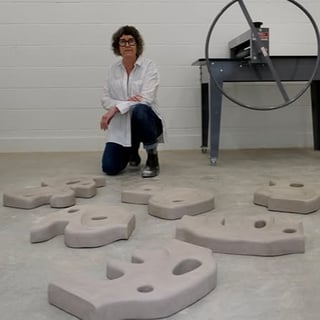
Speaker: you know, us biomorphic objects. And so it depends on the piece. So sometimes I'll sketch it out. Sometimes I'll just start throwing on the wheel and exploring. So depending on the size of the pieces is what the method with which I make them. So if they're small, I will most likely wheel throw all the parts and then assemble them together. If they're larger, then I would probably coil build them
Speaker: and then maybe add some wheel thrown parts that are smaller. So it really depends on what I'm making. Sometimes if I really like the small version of the piece, then I can scale it up and make a bigger version of it. Like the piece that you see behind me, that's that kind of white beigey piece right there, that is made with both coil built parts and wheel thrown parts. So being a mom and just being busy,
Speaker: I've developed sort of a method of figuring out how I can build this piece the fastest. So depending on, you know, how can I make this object appear as quickly as possible? So that's what I end up doing. Sometimes wheel throwing portions of the piece is really helpful in making it move along faster.
Speaker: I love that. ShapeNation, if you are looking to kind of speed up things, maybe try combining different techniques together. That way you can speed up the process and your idea can truly come to life. So now, earlier you mentioned that the one all be all tool that you use is the metal rib with the rigid. Can you explain to me how you used your metal rib?
Speaker: Yes. So what, now you know that the molecules, clay molecules are flat, right? And they're slippery. So we use this process called score and slip, score and slip, right? Which is, you know, talk to it from the very beginning, right?
Speaker: So what I like to do is I like to scratch the surface, right, which would be scoring before I touch another coil. And then, but if you've tried hand building, you know that with hand building, it can kind of go in and out, in and out, and it can kind of be lumpy and bumpy.
Speaker: That is something that I really disliked about hand -built pottery because I loved the wheel. The wheel was my first love. I threw everything on the wheel. I loved symmetry. I loved how all the pieces came together. So for me, having this lumpy bumpy business was like, oh, this is an amateurish type of thing.
Speaker: So, um, the rib allows you to move the clay from the high points to the low points to fill in like that irregularity. And it's beautiful because after you're done, it like, it really moves the clay. And so then it prevents cracking. And, and, and once you smooth it out, which is, I suppose my other favorite tool is the red mud tool. Not sponsored. They still haven't sent me a free rib.
Speaker: It really is amazing because the silicone rib really then allows you to smooth out that, that object. And then you get like this perfect, it almost looks wheel thrown, right? Because I don't know it's, what can I say? It's a flaw. So, but yes, but I love smooth and I love smoothing things out. And so, yes, so that tool hands down allows me to equal, you know, really, really equalize the wall.
Speaker: I absolutely love that. So let's talk about the business side of making pottery. Can you tell me about the moment when you decided to go full time with your pottery?
Speaker: I started selling my pottery on Etsy. I did a few shows, meaning little community shows like sales, holidays, type of sales. And Etsy was really becoming popular at the time. And Etsy was really this, well, at the beginning of Etsy, it was very different than what it is today. It was where you could view all the ceramics more or less on one to two pages.
Speaker: It was, there was absolutely no vintage, no commercial, you know, none of that stuff there at all. It was just completely, purely handmade. And I started selling my work on there and the work sold. And so I really saw the potential in starting to, you know, really put
Speaker: put my work out there and sell it. And that's what I did. And as Etsy grew and as my work grew, I began to realize that I was no longer selling mugs for $20 a mug. And so I realized that that was no longer a platform for me.
Speaker: And then another thing else to take into account is that Etsy's priorities changed. Etsy was interested in making more money. Etsy was interested in introducing vintage antique mall shops that were made in foreign countries that were claiming themselves as quote unquote handmade. Meanwhile, they're a factory in China selling the stuff for $10. And so it was becoming
Speaker: wasn't a place for me anymore. And I think this has to do a lot with social media in general. When you're using somebody else's platform, like Instagram or Facebook, you're at their discretion. You're at the discretion of their algorithms. If you want people
Speaker: If they want people to see your work, those people will see your work. If they want to bury you somewhere and they don't want your, you know, then that's, you know, that's on you, right? So actually part of, it was funny, some time ago I had to email Instagram because they kept flagging my work as sex toys.
Speaker: And I was like, these are not sex toys, you know, I assure you, this is like, this is just ceramics, just weird stuff that I make. But they're like, well, this is, you know, so this gives you, you have to have your own platform. And so I think that's why building your own website.
Speaker: that you control and send traffic to on your own, whether it's advertising through Google, then you control who sees your work and then you control it. So they can't tell you what you can and cannot do. And so I think having your own place that you're in charge of, I think is very important.
Speaker: I love that and I definitely agree with having your own place to charge it because the algorithm can definitely change and everything else can just definitely go out the wall. Having your own place to sell it is definitely the go -to move. I love that. Just really quick, I've known artists with thousands of people who follow them, 20 ,000, 10 ,000, and their accounts have been hacked. Their Instagram account has been hacked and they couldn't get it back for months. In some cases, they couldn't get it back at all.
Speaker: That's huge, right? Like if you have a big sale coming up and all of a sudden somebody takes over your account, what do you do then? Yeah, definitely agree 100%. So outside of having your own platform to drive traffic to, what else helped you the most was selling your pottery.
Speaker: to shows. I don't know if it's because my work is always changing, or if what I found happened was when I was making all functional work, and this would have been around 2017. I was making cups and bowls and teapots and things.
Speaker: I was applying for the functional shows, you know, you would go at the back of the ceramics monthly and you would apply to your never write shows. And so that was, you know, it was great and I was doing well and everything was, you know, I would get accepted into the show and the work would sell.
Speaker: But then the moment I started making sculptural work, it's almost like all those other people that knew me for making cups and things, they were like, oh, but she's not making that work anymore. You know, that's not necessarily true, right? I'm still capable of making the cups and bowls and whatnot, but people don't see me in that way.
Speaker: So then I was almost starting to, I had to kind of start all over, right? I had to introduce myself as a sculptor, you know, and all of a sudden the work, the price was different, the size was different. And so people were
Speaker: you know, like who was she? So anyway, so I think applying to shows on your own is incredibly important. And I think part of why people don't do it is because they are, you know, they're afraid of failure. They think that they will fail or, oh, I'm not going to get in.
Speaker: Or, oh, this work is not right for the show. Or, oh, I'm too afraid. Stop. Just apply. It's not up for you to decide. They decide. You don't know what they want. You don't know what they're looking for. Just apply. And so I think over time, the more you apply, the more your work gets out there.
Speaker: I don't really know, you know, there is no one avenue. Like people are always like, help me, help me figure out how to get this work sold or how to get a show. There is no one way. You know, let's say you sent in your work to some show and it costs you a little bit of money and none of the work sold. And then it got sent back to you, right? So now you're in, you know, you're in the hole maybe for a couple of hundred bucks.
Speaker: But then somebody who came to see the show, right, ends up remembering you for another show or they have, it's an interior decorator who has a client who will be looking for this type of work, right? So it's just important to get your work into every little niche you can and then you never know what will come to fruition.
Speaker: definitely reshaping Nation. It's all about a numbers game. The more you can send out your work and get your work out there, whether it's on Instagram or the shows, the more chances you are going to be able to sell your pottery. I love that. So what advice would you give to help someone start selling their own pottery and their own sculptures?
Speaker: Well, I would say open, get a website. That would be number one. Start applying all the call for art. There's ton of them out there. Also start checking out and this, because you know, you actually have to go in person and sell yourself.
Speaker: Don't be afraid to go in and go to a shop, go to a local shop that sells handmade pottery, and just introduce yourself and say, Hi, my name is so and so, you know, this is this, I just I'm a local show you my work.
Speaker: It's funny because I'm married to a guy who's in sales and he's always on me about, you know, going out there. And one of the things he says is that it's harder to say no in person. It's also harder to say no on the phone. It's easier to say no to someone in a text. It's easier to say no to someone in an email. And I know a lot of us these days, like I don't even want to get on the phone anymore. It's weird, right? Like who, who, you know, who do I talk to on the phone? My mom, maybe.
Speaker: that it's always right through email and text. But I really do think that if you get out there and you, you know, show up in person, you are more likely to succeed. I love that so much. So let's talk about discovering your voice. Can you tell me about the moment when you knew you were heading the right direction with your pottery? I still don't know what the right direction for my pottery is. I think
Speaker: Couple of things. I will tell you the advice that's been given to me. And I think it's true for most people. Try to see. So we made things. And then they go out into the world. And where they live, they're in their own homes. We don't know. But try to picture what the room or the house that you want your work to live in
Speaker: Right? So let's say I love, you know, mid -century modern. I love the architecture. I love the colors. I love the look.
Speaker: My work lives really well there. So when I take my photos, I take them in that setting. Is your work inspired by Art Nouveau? And it has a lot of flowers and a lot of sort of delicate and intricate design. Think of what house that pot will likely live in, right?
Speaker: So that helps you, right? That helps you determine what type of pots you should be making, what interior these objects will live in. Also, I just completely lost my train of thought.
Speaker: So, so yes, so that's, that's, that's one advice is figuring out where you want your work to live. Second advice that I, that was given to me when I would be, or when students would be extra critical of their work, like, Oh, I hate this. I don't like the way this looks. I don't like the way this, this object is or the handle is or whatever.
Speaker: It was actually another student that said this and I always think about it. She said, maybe if your work didn't look like you made it, you would start to love it more. And I think that is so interesting because we're critical of the work because it looks like we made it.
Speaker: But once the work takes on a persona of their own, you know, and it no longer looks like you made it, you start to appreciate it more. And I think about that at least, I don't know, at least a couple of times a week, it's like, yes, why do I love this object so much? Because it doesn't look like you made it. So you can't be critical of yourself anymore. And just play, you know, the importance of playing and exploring is you can't,
Speaker: You know, you can't stand in your own way. You know, who cares? Just make something. You don't like it. You know, it didn't turn out. You know, and then maybe, but maybe you'll learn something from it and then you'll use it towards your other adventure. I love that so much. That is some excellent advice right there for anyone that is looking to try to discover their own voice. So what does it mean to you to find your own voice? You think?
Speaker: Well, how do you really know? You know, it's like we don't live in a vacuum.
Speaker: We don't, we're, I think we already have a unique voice, right? I mean, I think experience will be totally different from your life experience. Where I come from, how I grew up, you know, the things that I see every day, the city that we live in, do we live in a suburb? Do we live in a big city? Do we live, you know, it's all those experiences and perspectives, they're unique to,
Speaker: you and you only. And I think that's why when you show your work and somebody comes and sees it and then they're drawn to your work for some reason, they don't even know. They're like, oh wow, that's so cool. Why did they think that was cool? And then what one person thinks is great and cool, the other person might be like, oh my God,
Speaker: You know, like for the longest time I hated, I hated this, you know, and I already mentioned this, I hated like the very Pinti, you know, sort of thrown together kind of work where I was like, oh, you know, like this is like so amateurish and I love that type of work now.
Speaker: Because I really, I've learned to appreciate sort of the spontaneity and, you know, the lack of, of, of concentration and how people can just put it together and make an object. And I'm like, wow, this is a lot harder than it looks.
Speaker: You know, and so I think we have a voice and I think that if you maybe fall into your own interests and your own likes and embrace those, that will allow that voice to come through. Absolutely. Re -shape your nation, follow your interests and keep pursuing those things so that's where your voice is truly going to start shining.
Speaker: Alina, it was so great chatting with you today. As we're coming to a close here, what is one thing you want to hammer home with my audience today? Okay. So I've thought about this question. There is a little book and it's called Art and Fear. It's only about 20 pages. It's, I think it's like $10 on Amazon and it's called Art and Fear. And I think you should read it.
Speaker: I think everyone should read it because it's an easy read, but what it does is it helps you get out of your own skin. And a lot of what it talks about is just make art.
Speaker: It doesn't have to be monumental. It doesn't have to, you know, save the world. Just make your art. Don't take it too seriously. And yeah, it's a really good read that kind of reinforces you and it makes you feel good after you leave it. You're like, yes, I'm going to go out. I'm going to do this. So. Absolutely love it. Some great parting words of advice. Where can my artist go and learn more about you?
Speaker: Okay, they can go on alinahays .com. That is where I sell most of my work is through my website. Also, if you want to check in with me on the work that I'm making most current work, I am most active on Instagram at Alina Hayes. So yeah, check me out.
Speaker: Hey, thanks for listening to this episode of Shaping Your Pottery with Nick Torres. If you want to discover how close you are to actually discovering your own unique voice with your pottery, I put together a free four question quiz. It's very short. It takes 30 seconds for you to take. If you want to know how close you are to finding your own unique voice, go to shapingyourpottery .com forward slash quiz, or you could simply go to shapingyourpottery .com and it'll be right there at the top.
Speaker: Hope you guys enjoyed this episode. I'll see you guys next time