Transcript
Speaker: Real quick before we get started, if you have a full time job and you would still like to try to find your own unique voice but you just don't have the time, I put together a free guide to help you manage your time so that you can experiment with your pottery and make pottery so that you can find your voice. If you would like this free guide, go to shapingyourpottery .com forward slash time to get your free guide.
Speaker: If you love pottery and want to take your skills to the next level, you're in the right place. Find your own pottery style right here on Shaping Your Pottery with Nick Torres. Let's get started. What is up, Shaping Nation? This is Nick Torres here with Shaping Your Pottery. In this episode, I got to interview Lindsay Langsdale.
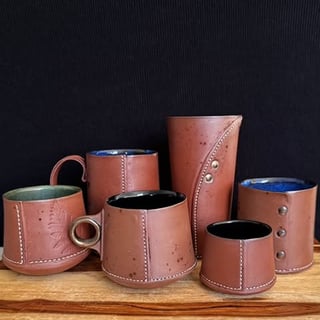
Speaker: Lindsay makes some really incredible knitted pottery and it is really really incredible looking. In this episode you will learn how Lindsay makes her knitted pottery. You will also learn how the story about how Lindsay created her pottery studio and why
Speaker: The struggles that she learned can help you really with developing your voice and getting out of your comfort zone. Lindsay, welcome to Shaping Your Pottery. And share with me, what is something you love besides pottery? Oh, geez. I love a lot of things besides pottery. But in general, art in general, period, whether I'm making it in another medium or if I'm looking at it, I'm fascinated with creative expression.
Speaker: through art of any medium. And I think it's interesting to see how a medium can inform how the way that I make as well as the way that other people can make too. So can you tell me the story on why you decided to open up a pottery studio? Yeah, survival in San Francisco, basically. Basically,
Speaker: beginning of the pandemic, I was laid off and furloughed from my operations, studio operations and management position at another studio. And my partner had been out of work for a while and I was the sole income maker and I was just not, I didn't know what I was going to do. I promised myself when I left my office job in 2017 that I'd never go back to another office job. And I
Speaker: promised myself that so I kept that promise. So I started figuring out how to turn $2 ,000 in my bank account into 20K so I could start a studio. And I sold, I did Indiegogo and I sold like 100 sculptural ceramic hams and raised 20K through community. And that's the story. We've been here for about a year and a half now.
Speaker: What would you say was your biggest struggle when you were starting it? Um, other than the finances, I think the biggest struggle was probably, um, getting out of my own head and believing in myself as well as the community too, because if I'm honest, um, I'm a little bit of a pessimist. So when I put my Indiegogo up there, I was like, this isn't going to happen. I'm going to make like a hundred bucks. And then, you know, within,
Speaker: two hours, I had 13K and I was like, what the heck? So I kind of kicked myself in the pants for not believing in the community, but at first, but they really came through for me. But getting out of my own head and just committing to doing the damn thing is really the hardest struggle. That I feel that when I was first starting this podcast, I was kept on procrastinating and procrastinating and I was in my damn head. Like you said, it's that yeah, you just got to get out of there, you know, so
Speaker: And sometimes that's the hardest. We're our own worst enemies. That is so true. So super true. So what is something that you have learned since starting your studio that has kind of just helped you out in general? That's a really good question. I have learned so many things, but if I had to.
Speaker: boil it down to probably two. It would be that the relationships you build within the community matter, and it's really, really important to spend time getting to know people, make friends, and support those people because you genuinely want to see them succeed. And the second one would be flexible. When I started this whole venture, I had a whole
Speaker: other idea of how this place is going to operate and how it was going to be. And it continues to change and adapt. I've had to adapt and change to the needs of the community what's inside the studio, where my beliefs and needs fall, as well as thinking about the studio as a business too, and what the business end of everything needs as well.
Speaker: specifically finances and how to keep the place going. So we all have a place to make work at. What was your vision when you were first starting the studio? What did you want for the studio? I wanted it to be me and like two other people. And now I'm at 30 members
Speaker: 24 students and we just added more shelves in our garage area. So we're at capacity. We'll have 50 members and 36 students. So it's a big difference. But the essence of what I wanted, I wanted to make a community space where people can come in as well as myself, come and work and collaborate. And that still is the core of what's going on here at brick and mortar.
Speaker: Love it. Love it so much. So can you tell me the story how you started making your knitted pottery? Yeah, sure. So I'm actually a knittering crocheter. I learned how to crochet for my grandmother. We used to do like little projects in the summers and she would we would crochet little beads around the ankles of like little ankle socks for girls, little girls and things like that. And
Speaker: I just, it's also helped me through a lot of hard times, knitting and crocheting. I have, I deal with anxiety and if I don't keep my hands moving all the time, I tend to, this is kind of weird, but pick and peel at the skin around my fingers and on my feet. So having that kind of outlet has always helped me. And I was looking, when I started working in pottery, I was looking at
Speaker: how I can incorporate the different, because I've worked in many different mediums, and how I can incorporate those different mediums into clay, which clay is so malleable that you can like print make on it and you can carve and paint and draw. So I tried to figure out how to
Speaker: incorporate my knit textures. And what happened is I was doing some research on some like texture molds. And I came across this company called Marvelous Molds. I think I have one here. They have these great molds like this that are fantastic. And they do them in knit textures. So I started, and I'm still currently using these, but I started using those. And then I'm working on, here's a test tile. Is it okay to use?
Speaker: Visually? Yeah. So I'm starting to do knit textures where I take actual pieces of my knit and make my own molds. And the reason being is because working from a four by six mold is really difficult when you want to scale up your work. And that's my goal for the knit series of work is to scale it up a little bit in the future.
Speaker: And it's just been continually growing from there. Love it. That's so awesome. I love how you took something from your own life and you put it into pottery. You made it into pottery, like knitting. That's so cool. Yeah. Yeah. I think it's really important to really explore those things, to make put meaning into the work that you're making. So can you walk me through how you create your your knitted pottery from like start to finish?
Speaker: Yeah, so there's, I work in slabs and I use a lot of templates that most of them I design myself and there's two ways that I, three ways that I design them. Sometimes I base them off of research that I've done on sewing patterns and I use those as a way to give myself a foundation to work off of in clay. And then I also have used templates from other people
Speaker: I'm I don't know if this is how you pronounce his name Mike serve. He's on Instagram. He does beautiful templates. And he has a great butter dish template that I've used and adapted and changed into my own as well. He's fantastic. And then the other way is I
Speaker: sit in front of the television in my underwear and watch really bad television, like Real Housewives of Orange County, and I cut things out of paper and tape them together and see how they work. I also do that with clay too, if I'm in the studio, but not in my underwear, obviously not in my underwear. But yeah. I love it.
Speaker: And then there's the slab building. And right now it's the four by sixes. Those get rolled out and textured. And then I bevel cut all of those and stick them back together to create larger sheets of textured slab. And then I take and use my template. So I'll make templates. This is a shark one. I'll take a
Speaker: the hammerhead shark and I'll make sure the slab can fit this template. And then I'll build, flip and score, put it together, pray for the best when it goes into the kiln. And usually it does okay. Those dang kiln gods never know what they're gonna do. Geez, sometimes they do. They're not very favorable. No other times they make you feel really good. I think that's one another thing that I really love about pottery is
Speaker: You can you can get this like adrenaline high from it because you get this thing out of the can. It's so amazing. And then it really humbles you the next time around. Yep. So true. So he keeps you in check. So you are inspired by cozy sweaters, comics and puppetry. How did these come back into your work?
Speaker: So I guess it's pretty literal. The knit texture, when I'm making something, it's the knit texture, it mimics a sweater, but I'm also, every time I do a run of work, I'm also trying to make that clay feel and look and react more like a fabric, a knitted fabric, which is a continual process.
Speaker: but it's getting better every time. There's things that I like each time I make and things that I don't like that I keep and I don't keep.
Speaker: And then the comics. So for a long time, I was doing these dark washes. And the reason why is I wanted to capture kind of like that graphic black and white line work you get from comics. One of my favorite ones is a great use of black and white is the black hole. What's his name by? I forget his name, but black hole is really great one. You should look at it. And that kind of brings the comics in and then
Speaker: puppetry. So I was my mom was very into going to church. And so I had to have an outlet outside of school and the home that was church related. So I did puppet ministry for a while. But they also it's also very literal. We've got a puppet. He's literally a sock puppet. That's what I call them. He hangs on the wall. And then so, you know, there's
Speaker: It's pretty I think my my inspirations are pretty obvious, maybe not with the comics so much unless you really are into comics, too. I like comics. I'm a huge nerd. Yeah, I've never really gotten into the superhero comics, but I really like things like The Dark Hole and, you know, more
Speaker: Uh, Joan and Vasquez is also a good one, like filler bunny and all those silly ones. Love it. That's so cool. So how has a failure or a parent failure led you to future success? Oh, geez. Um, I've had, I had a lot of failures when I got back into pottery in my mid to late twenties. Um,
Speaker: I made a lot of very large abstract sculptures that I would, you know, get through the process and then come to the glaze and I'd dump a whole bunch of glaze on it. And it always come out as a disappointment, basically. And so it really pushed me to start testing so that I could try to control the outcomes. And I think
Speaker: those failures, if I hadn't had those failures, I wouldn't value testing as much as I do now. And as far as failures for the business end of things, like opening up a studio, I think if I hadn't failed as an office manager and executive assistant in my survival job, I probably would still be there because it was comfortable financially.
Speaker: I love it. I love the part about how you test things and like you make it a norm now instead of just kind of going and making whatever. Yeah, so the surface is a way for me to keep things interesting, so I change it up all the time. So before I do a run of work, I decide am I going to experiment a little bit? And if the answer is yes, it's always like, OK, well, how many hundreds of test tiles do I need to do to make sure I get this color palette right doing this new technique that I want to try?
Speaker: before I actually apply it to the work. Love it. Shaping Nation, if you're listening right now, you have to make sure that you're setting time to test things out before you start trying to apply it into your own work so that that way you are more prepared and you are, when you're able to get it right, your pottery just looks that much better. Yeah, it's well worth it. So let's talk about finding your voice. What is something you did to help you discover your voice?
Speaker: Oh, what I did. I definitely took the time to get out of my comfort zone. I failed a lot. I also took a lot of workshops. That's another thing that I kind of wanted to touch on is my education. I didn't go to school for ceramic. I went to school for design and illustration. And I was a painter out of college.
Speaker: So workshops is where I got most of my ceramic education. And not only do you get to learn from other artists, you also get to learn about them and get eventually sometimes become friends with them. And like I said earlier, community is huge. Making sure that you're connecting with people within the community is what really makes I think ceramic really special.
Speaker: I forgot where I was going now. Can you repeat the question again? What is something you did to help you discover your own voice? The other thing that I did too is I took some time and what really pushed me out of my comfort zone was I didn't have the critiques that people get out of school for their ceramic work, like people that go to school for that. And I ended up
Speaker: reaching out to artists that I've followed on Instagram and Colt basically emailed them a bunch of images and said, if you have time, can you please tell me what you think of my work? And then opened up dialogue and I got great criticism as well as good positive feedback. And I've continued to touch base with different artists going forward. It's really helped.
Speaker: I think that is really, really important. Shaping Nation, if you're listening right now, how can you go out and get opinions from other people? Maybe it could be negative opinions, it could be positive opinions, whatever. Just try to get opinions from other artists or other potters so that you can start developing your work even further. These opinions are gonna really make really huge difference.
Speaker: I mean, for me, it was mostly about the functionality of things. I primarily started ceramic as a sculptor. And when I started to try to do more functional work, it was really important for me to get that feedback. I love that so much. So part of finding your voice is building confidence in your own work. What is something you have done or still do to help you build your confidence with your work? That is a hard one. Confidence is really difficult.
Speaker: And it still becomes a difficult, it still is a difficult hurdle that I have to deal with. And I found that putting myself out there, submitting to shows, showing my work.
Speaker: and asking for my work to be critiqued helps me keep motivated and also helps me build that confidence. Whether it's negative feedback or not, I know that I'm getting something that I can proactively do to help my work grow and be better. And I think the hardest part of finding and holding onto that confidence really is my own internal
Speaker: yapper that wants to tell me that I can't and I won't and I'm not good enough and just kind of working through that and that I think making it becomes easier the more that you make and do and put yourself out there to to work your way past that inner dialogue that you might have. I love that shaping nation. Right now, if you are having troubles with your inner thoughts
Speaker: The best thing that you could do is just kind of keep on making more work and making more work and build your skills. This is going to allow you to kind of free up your mind a little bit because your skills are going to get better and your work is going to get better as well. So what advice would you give to someone trying to find their own unique voice with their pottery? Experiment, take workshops, have fun, and don't be afraid to try and fail. That's how you're going to learn.
Speaker: and reach out to the community, ask them their opinions, ask them how you can learn from them. Excellent piece of advice. So as we're coming to a close here, what is one thing you want to hammer home with Shaping Nation today? Build community, keep making, and ignore the inner voice that tells you you can't do it and that you're not capable because you are.
Speaker: Lindsay, it was really great chatting with you today. Where can my audience go and check out your work? My Instagram is the best way to get a hold of me. It's L -I -N dot L -A -N -G, so Lynn dot Lang. And I don't currently have a website right now. It's under construction, but it was wonderful talking to you. Thanks for having me.
Speaker: Thanks for listening to this episode of Shaping Your Pottery. If you have questions about developing your voice or just pottery questions in general, send them to me my way. Go to shapingyourpottery .com forward slash contact to send me your questions.