Transcript
Speaker: I'm attracted to things that have a sense of history to it, a sense of use.
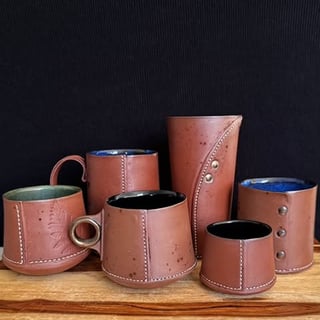
Speaker: nostalgia and I think it's all of those things that and you may not you may not know exactly what the story is but through it's it's it's I guess wear and tear. What is up Shaping Nation it's Nick Torres here and on this episode of Shaping Your Pottery I got the great pleasure of interviewing Brian Wilkerson. Brian makes some really incredible what he calls goon pottery. In this episode you will learn how Brian makes his goon mugs his goon pottery.
Speaker: You also learn about the power of taking time to make a pot look great and adding in all those tiny little details. And finally, you also learn about if you do things long enough, you're bound to get good at it. And there's so much more this episode. Hope you guys enjoy it. See you guys in there. If you love pottery and want to take your skills to the next level, you're in the right place. Find your own pottery style right here on Shaping Your Pottery with Nick Torres. Let's get started.
Speaker: Brian, welcome to Shape of Your Pottery and share with me what is something you believe Potter should be doing to have success in Potter? I think early on and one thing that I learned is just developing some fundamental skills.
Speaker: Got those working as an assistant more so than I got in college. College at the University of Tennessee was a super great way for me to explore kind of the conceptual side. But I feel like I really honed in the craft of making work.
Speaker: as an apprentice, where it was just really focusing on the technical side of being able to manipulate clay. And I think that's important, just diving in and immersing yourself in the material and spending time with it. I think that's most important. And then I think just a commitment to it. Absolutely agree. I love that advice. So we're going to talk more about your apprenticeship in just a little bit. But for now, tell me a story of how you got started making pottery.
Speaker: You know, I, somewhere along the line, I always knew that I probably would go into art or a creative field. And when I started college, my mom encouraged me to go into marketing and she was, I guess my mom would have been my first college advisor and she thought marketing would be a good, just a good starting point. And as I got more into the curriculum, I realized it was more business.
Speaker: courses, then creative classes. So I talked to someone in the school of business and they said, you need to go into graphic design. And so I went over to the art department at the University of Tennessee. And prior to that, I had done art my entire life. So when I was in college, I don't know that
Speaker: You know, seeking out a major or the pressure of being like, okay, this is what you're going to do forever was a little daunting, but it kind of all clicked around my sophomore year. And so I really started out, I think as a 2D artist only because I had not really had a lot of clay experience. My high school art teacher was fantastic, but she was a painter.
Speaker: And we had like one clay project and I loved it, but my my piece blew up in the kiln and it it was her fault. She admitted it. I had built this structure over a glass to like a drinking glass. And I gave her instructions. I said, hey, that's in there. You need to pull it out. She didn't pull it out. She put in the kiln and it caused the thing to
Speaker: So that was like my one ceramic experience prior to going into, prior to art school. And so as I went from the art department or the school of business marketing at UT to the art department, the moment I went into the art and architecture building, I was like, this is where I just, it felt right. I knew I was in the right place to kind of pursue just my creativity and then
Speaker: So, you know, I kind of navigate that and declared my major's graphic design. And then at the same semester, I took 2 art electives. I took painting and I took ceramics. And that was kind of it right there. You know, once I took that clay class, it was.
Speaker: I fell in love with it I think it was the ability to give form and again I didn't you know I still I then and still even now don't 100 % consider myself a potter I mean I love making pots but I kind of come at it I think from a maybe a little bit different angle than
Speaker: than typical but yeah it was that moment where I was able to take this material and kind of give a physicality to things that I had been drawing and sketching. There's something about making it tangible that gives it a life that a drawing is just kind of a to me like an illusion to something else whereas once you have it tangible it takes on a new reality and so
Speaker: I just fell in love with clay my faculty members there had a lot to do with that too You know, I love painting but the the painting department I don't know the vibe of the ceramic department just clicked with me and i've never looked back Absolutely. Love that. So now tell me the story about when you were an apprentice for another potter Okay, so, you know I and
Speaker: It was, I just wanted, I sought out this opportunity and I found a wonderful guy in Murfreesboro, Tennessee named Louis Snyder, who had a pottery called Studio S Pottery. And I approached him and said, just, you know, out of wanting to kind of learn, just really just to get better at it. And to be honest, I had probably had maybe two or three semesters of wheel throwing at the, at the college level. And.
Speaker: At the time, I thought I probably was really good. And I was probably one of those people that it took a little bit longer to...
Speaker: to get a feel for throwing. The finessed, I was a little heavy -handed, I think, with the material at the beginning. He just worked with me. He was a department head at MTSU, Middle Tennessee State University for many years, and his son still works there.
Speaker: I approached him and he very graciously took me in and really for the most part, all I did was throw and trim. And it was his forms that he would bring in every morning. He'd bring in a bisque form and tell me, I want you to work on this. And he would break it down, show me the mechanics of the anatomy. One thing that was really helpful, he would have me draw a technical drawing of scale of the pot before I ever started throwing it.
Speaker: So I kind of understood the inside, the thickness, everything that it should be. He was very methodical about his process where the weight, the size of the pieces, for each piece he had kind of like a little, I don't use this method very often, but he would have a stick
Speaker: That he would bring out and it would be marked on certain measurements where you could say the height of the piece needs to be this. And there were markings along it the inside height. The, the width of it and so very production very much trying to create the same form. Over and over and over with exact this was what he taught me.
Speaker: And it was, it was tricky at first. I realized at the beginning that he, I quickly learned. I really didn't know as much as I thought I did when I came to that. And it kind of was eye opening for me, but it was through that experience. I think that just the repetition and that I was just throwing for like.
Speaker: at least eight hours a day, but often at that time I would work into the evening and take a break and just kind of, because I was getting paid by the, by the piece, not by the hour. And so, and to be honest, I don't think I got paid for the first six weeks at all, just because my work wasn't just wasn't up to standard yet. You know, and I was kind of at the point, I think where, you know, I took a little, I took a loan from my, my mom kind of gave me some money to get started there. And.
Speaker: He, you know, right around the point where I was about to call her and be like, hey, could you float me a little bit more money? It started to click in and I started to make work that was, so that was like two years, maybe a year and a half or two of college throwing. And then probably a couple months working, I mean, very hard every day. And then it finally started to kind of come together for me as far as just being able to take something that he gave me and make it up to his specifications.
Speaker: I absolutely love that. Love hearing that. So let's talk about your pottery. Can you tell me the story how you started making the monster face pottery that you make today? Hmm. Yeah. You know, I think, you know, so I've loved making pottery. I always have loved that process. There's something very, you know, just.
Speaker: like meditation I feel like when you get into that rhythm and when you get into that place where it's just you're in that zone and everything else is kind of like all the extraneous stuff you're just you and that material I'll be honest with you it was during that apprenticeship when I realized
Speaker: I don't know that I love production. You know what I mean? I'm so grateful and the skills I gained from that have been immensely valuable. But if you looked at my sketchbook, I draw a lot of things that probably have
Speaker: work their way into my pottery sense, you know, character -based. I've been a lifelong fan. I guess my first love of art honestly came from Bugs Bunny cartoons growing up. I was obsessed with animation. And honestly, I probably would have gone into animation had University of Tennessee offered that, possibly. I've just always loved the ability of taking a line and creating, making us, telling a story with it.
Speaker: So I think those two along somewhere along the line converged so making pottery and then my sketches and then they slowly just started to come together where
Speaker: into some sort of marriage where I'm taking the kooky crazy things that I draw and then the pottery that I make. And it's been an evolution. I think when I first started making them, the pots were, I kinda got away from the real technical side of it and there was probably some aspects of my pots that weren't as functional as they could be.
Speaker: And as important to me, but my friend, good friend and gallery owner, Eric bot bill, who owns companion gallery kind of had, gave me a talk one day about some tough, gave me some tough love and was like, Hey, you know, we love your work, but there's some parts of it that need to be kind of like a little more. Just, I don't know. So.
Speaker: more functional you know i was kind of cutting corners on some aspects maybe and i took that to heart and now i love i honestly love that aspect that challenge of can i make something with a monster face but i still want it to be super functional super you know not heavy not clunky i don't want the i want the bottom to be smooth i want the handle to feel really right and some of those aspects
Speaker: I was so interested I think when I discovered that kind of that putting those characters into the pottery that I just got so obsessed with that part that some of the the pottery side of it I kind of got scampy on but now I get really obsessive with all of it you know I know they they kind of look loose and stuff but
Speaker: I really want to maintain an integrity that it's also really nice to use and it's fun and it feels good in your hand. The weight of it feels right. And so that's, that's an important part of the work to me. Did I answer that? Wait, what was the question? I'm going to cut you off right there. Okay. So, so we can move on a little bit. So.
Speaker: Sure. So you, as you mentioned a little bit, you are inspired by cartoons and old toys. Can you tell me more about this? Yeah, I think it's, I'm attracted to things that have a sense of history to it, a sense of use.
Speaker: nostalgia and I think it's all of those things that and you may not you may not know exactly what the story is but through it's it's it's I guess wear and tear and somebody's loved on it you know that there's there's there's some past story to these things and so
Speaker: Yeah, I love going through, you know, junk stores or thrift stores and finding these quirky objects that have a sense of just some sort of history to it. Like I said, I like monsters, but I'm probably not on the scary side of monsters. I'm more on the like Tim Burton, Nightmare Before Christmas, where it's a little scary, but more kind of magic and mystery and enchantment. Absolutely love that. Now,
Speaker: You have been making pottery for around 30 years. What has been the best advice you have received and helped you with your pottery? Oh, you know that that story I told you about probably that you know two of the biggest helps were of you know that that conversation I had with Eric and that was not that long ago probably within the past seven or eight years where he just kind of like
Speaker: We just went through some of my work and pointed out, and it wasn't that I didn't have the ability. I just wasn't taking the time. You know, I was kind of just sidestepping. I mean, I certainly knew how to do those things, but I was kind of being so kind of, you know.
Speaker: And so I think that was very helpful in me kind of refining and getting to the point is kind of revisiting. Because I think the needle flipped the whole other way because when I worked with Lewis, the work was so tight and so particular and had to be done a certain way that kind of when I got back into really exploring making vessels again.
Speaker: I kind of threw all that out the window. And it wasn't that I couldn't. It was just real gesturals and loose. But those aspects of kind of fine tuning and refinement, you know, I feel like that was one of the best things that has been told to me was that conversation with Eric. And to be honest, it hurt a little. I'm not going to lie when he said, hey, we love your work, but these things can't.
Speaker: These won't fly. You know, this is a little rough on the bottom or, you know, cause collectors now are, they're sophisticated. They know what's up in a pottery collectors. Really. They're not naive and they have expectations and, you know, ultimately.
Speaker: I want, if I can make the user's experience, whoever has my work, and that's one aspect I kind of lose sight of that people actually use these. I kind of always envisioned like maybe somebody just puts it on a shelf or whatever, but a lot of people use my work. And so I always take that to heart. Like if there's one more thing that I can do to make that person's experience better, then I want to do that. And I'm constantly on that search of how can I make their experience
Speaker: the most, even down to like things like packaging, shipping, from the moment they receive it, open it, I want it to just be kind of special. Absolutely agree. I love that. Shaping Nation, the tiny details matter and the more tiny details you put and the more effort you put into each piece, the better it will turn out and the more other people actually receive it and like it. I love that. I agree. I agree. Yeah.
Speaker: Now, can you brief me, walk me through how you create one of your monster theme looks? Yeah, I mean, they mostly start out with, I mean, you know, I, I am actually in just in love with a very simple cylindrical form. And I start out with that or, or pretty simple shapes, spherical cylindrical. Um, sometimes I venture out of that, but.
Speaker: I usually take that cylindrical form when it's still right in the middle of leather hard, not the soft side of leather hard, not the end of it, but right in that middle part where it's still, you can push it around and get some good movement. And there's some steps involved. I feel like to pull it off and execute it the way that I'm happy with it. And so I kind of throw, and let's say I have a leather hard cylinder,
Speaker: one of the the things that I do is I manipulate it and then I go back and trim it after I've put like indentations and sockets and I start to push eye sockets from the outside I go from the inside and start to push back out to give it like cheekbones and kind of a structure almost like a like a skull or
Speaker: armature underneath, and then I go back and trim it after that, and sometimes during that process of manipulating the clay, it can kind of, you know, you gotta be, or I try to be careful not to get it so out of whack that it becomes incredibly tricky to trim. You know, when you get a shape that's irregular, sometimes trimming it can be a little bit tricky, and so it's kind of finding a balance between those two. So I throw it, I manipulate it, then I go back and trim it, and then after it's trimmed,
Speaker: That's my favorite part. That's when I kind of bring out the expressiveness of the characters, which I've kind of adopted the umbrella term of goons because they're kind of goony, they're kind of goofy. But most of my work, they're just called goons for obvious reasons.
Speaker: Again, I want them to be fun, just fun to use. That's my main thing is if it, you know, just to smile to somebody, look at it and it kind of be quirky and funny and expressive and functional. If I, if I can capture all of those things, then I feel like I'm hitting the mark. I absolutely love that. Now let's talk about the business side of pottery. Can you tell me about the moment when you decided to become a full -time potter?
Speaker: I don't know that I've made it there yet, per se, because I do a lot of other things. I'm a full -time college professor. I do murals, but I, you know, I think it just things.
Speaker: I think if you pursue something long enough and you keep after it, you'll eventually over time start to get rid of the things that aren't important. You know, if you, if you make stuff, you know, to back up to an earlier question, I think it's important to just immerse yourself. And I think over time.
Speaker: If you give something enough time, you're going to get good at it. There's no way around it, or you're going to improve. You're going to get pretty good at it after five years, after 10 years. I think eventually you're going to find that place where you're going to eliminate the things that don't interest you, and you'll focus on the things that
Speaker: And that's the other thing too, I want to be happy in the studio. I want the person who's receiving it, but I like to laugh and giggle and when I'm making stuff, if I'm not smiling and smirking a little bit, that's where I like to be in the studio where I'm making and in the moment with the clay, but then I hit this moment where I snicker at something that I've done because it's funny.
Speaker: I think that's where I got. I feel like there was probably a lot of, you know, my work is kind of lowbrow, I guess you would say. And I think it took me a while to get enough courage to be like, and social media certainly helped, but I felt like there was probably a pressure that I put on myself to make work that was very maybe academic or, you know, where my work, I want to be taken seriously as an artist,
Speaker: But, but honestly, not that, I mean, but as a person, I, I have a pretty, you know, good sense of humor. And so I think giving myself permission to feel that way in the studio took a while and, and. You know, just, just realizing this is what makes me happy and to pursue it and not feel this pressure of like, well, you know, the world wants, you got to make a special kind of pot or a certain kind of pot or a very.
Speaker: formal type of work and then kind of letting loose of some of those preconceived notions I think really helped me to free up and land on the stuff that you know. So yeah, I think finding that place where you're just happy in the studio doing what you're doing I think is important and I think that shows no matter what and you know finding that place where you get up in the morning and like I can't wait to get back to doing what I'm working on.
Speaker: Absolutely agree. I love that. Shaping Nation, the most important thing is to be making work that you are proud of and that you are happy to make because that makes all the difference. I love that. Now, what would you say helped you the most with being able to sell your own pottery? Well, you know, when I first started, I started making this work and when I was like, OK, I think I'm on to something and I feel good about this, apply to every single show you can, you know,
Speaker: group shows there's so many shows out there that are that are available now to get out there and so that's what I first started was just any group show I could I was applying to and you know and again just as I look at the progression of my work I think it's just applying to these shows and
Speaker: evaluating and looking at what's working. And, uh, so I think that's a good starting point to help you get your name out there. I think social media is a great tool to network to, to, to market yourself to.
Speaker: to let people know kind of, hey, here's what I'm making and here's what I'm about and help you connect. I think every artist has an audience out there waiting for them. You just got to find it and you got to work towards it. And I think at a certain point too, and I've never, I love animation, but I also,
Speaker: try to eliminate things that are, that are time sucks and dangers that we all fall into. Like I tried to stay away from too much Netflix, too much, you know, I used to play a lot of video games, especially, you know, but when I was a kid and then when I had my kid, my, my son and I got back, I got back into it because I got him, you know, I got him, what was the first
Speaker: Nintendo that I grew up on the Nintendo and then I got him. I can't remember which one it was, but we started. I started playing those again. Like I specifically remember Donkey Kong country.
Speaker: And I get, I'm, you know, just like my pottery, I treat those video games the same way where it's like, I want to get to the end. I want to beat it. I want to get everything I wanted. And, but I realized too, I was like, I don't think this is a good waste of my time. I realized I will never be on my death bed and look back and be like, I wish I'd played Donkey Kong country one more day, but I'll always take another day to make artwork. And so I think focusing on, you know,
Speaker: It's like working out, you know, if you want to be physically fit, you want to build muscle, you've got to, you've got to be committed to it. It's not something I do kind of part time or on the side. It's a, I'm committed to being in the studio and I don't always feel like it, but I love it to where I'm on those days that I, you know, don't necessarily, I don't know. I just keep pushing.
Speaker: journey and I want to get better. I'm still improving. Absolutely love that. So let's talk about discovering your voice. You contribute growth as an artist to starting a business. Can you tell me more about this? Yeah, and that was another thing too. It was very helpful. I started a
Speaker: holiday seasonal business with a business partner and he and I had some great success with that and I learned so much about things that really aren't taught in art school. I feel like there's a separation between, especially anything that is like commercial art or product based or sales
Speaker: I think there's a gray area or a void in art where it's about making the best art you can. But at least when I was in school, there wasn't a lot of class or focus on, okay, once you're thrown out of there, what do you do with this? You know, how do you do this? And I feel like that's a place where a lot of schools could
Speaker: And maybe there are now, you know, I know we do, I do a little bit in my classes, but again, it's still focused on kind of the, the craft of making, getting your skills down and getting your concept down. But there's so many opportunities I learned during that, that places where you can use those skills that you might not even think of until you're introduced to them. So.
Speaker: And that part of it, you know, and I was going to markets and I was going to the different trade shows and setting up and that was kind of pre -social media too. And so I think social media has now made it where there's really no excuse for anyone to not be able to get their work out there and display.
Speaker: Yeah, you know, so here's another part of my practice that I've always been a big kind of techie person. And so I, you know, I teach more, I've taught more computer art classes than I have ceramic classes.
Speaker: So I teach a lot of Adobe creative suite. I teach cinema 4d. I've done layout and web design and all of those things. And those have been tremendously helpful skills to, to help promote my work. And not only that, but build my work. I use it oftentimes as a way to visualize projects or art projects or, or even vessels that I'm making, you know,
Speaker: I like to start on pencil and paper, then sometimes I'll take it to the computer and look at a number of digital tools to help visualize it. Just creating kind of like I call a blueprint. I always use the analogy to my students, it's good to have a plan before you go into something. And not that the plan can change, but so many of my students early on, I feel like want to jump in and start doing things on their projects where
Speaker: Let's say you're building a house and I'll watch what they're working on. And it's like they're finishing off the, let's say the bathroom. You know what I mean? And I'm like, whoa, whoa, whoa. You got to frame it all out. You got to do it in steps. And not that there's per se a specific set of rules to art making, but I like to think that like having some sort of plan of action where you're going to frame it up in stages seems to work best.
Speaker: Definitely agree with that. I love that. Yeah. Yeah. Yeah. And yeah. And creating a business can just, I mean, I think, especially if someone just wants to go out there and start. The other thing I would, I would say is like, like I did learn, find a mentor, find somebody that's doing what you want to be doing down the road. Like this is my goal. I want to, whatever it is.
Speaker: and find somebody that you think is being already out there successful and reach out to them and learn from them and get their advice. I think that's tremendously helpful. Absolutely agree. I love that advice. Brian, it has been so great time today. And as we're coming to a close here, what is one thing you want to hammer home with my audience today?
Speaker: I mean, I'm going to plug one thing because I just had it in a group chat and in SICA, we're going to have a group called, this is not the only thing, but I am going to plug this. We have a pot stars pop up in Richmond. I hope, are you going to be at in SICA? You get to go in SICA this year in Richmond. Maybe this year, not too sure. Maybe.
Speaker: Well, that's the one thing, I'm just gonna stick that in there. But the other thing is, I would encourage your listeners just to stay after it. Just stay after it, you know, and don't be discouraged. There's all these things that are gonna pop up along the way that are gonna challenge you, your skills and things like that. But just continue to stay on track and I think it will just come together for you.
Speaker: Absolutely greasy. Some excellent party words of advice. Brian, it was so great to have you today. Where can my audience go and learn more about you? I would start just on my Instagram account. That's the best place. That's where I'm most active. And it is just my name. If you can find me on Instagram at Brian with a Y Wilkerson, Brian Wilkerson. And you can message me. I'm pretty good about getting back with DMs and I'd love to talk to your listeners in more detail. Thanks for listening to this episode of Shaping Your Pottery.
Speaker: If you are struggling with finding your own theme for your pottery so that you know you are known for something, I put together 53 themes that you can use and you can take. All you have to do is go to shapingyourpottery .com
Speaker: or slash 53 themes, that's five, three themes to get these 53 themes. It's really important for you to find a theme for your pottery so that you're not gonna get burnt out. You can have multiple styles with your pottery and you can be known for something. So again, go to shapingyourpottery .com or slash 53 themes, that's five, three themes to get these 53 themes. Thanks guys, I'll see you guys next time.