Transcript
Speaker: Real quick before we get started, did you know that the questions that we asked are going to determine what our pottery is going to look like and it's going to determine what our voice is going to look like? That's why I created 15 questions that you can use right now to start discovering your own unique voice. Go to shapingyourpottery .com forward slash questions to get this free booklet.
Speaker: If you love pottery and want to take your skills to the next level, you're in the right place. Find your own pottery style right here on Shaping Your Pottery with Nick Torres. Let's get started.
Speaker: What is up, Shaping Nation? This is Nick Torres here, and in this episode of Shaping Your Pottery, I got to interview Sarah Connor. Sarah is a once former graphic designer turned potter. In this episode, you will learn about asking other potters for help and just DMing people on Instagram. And I promise you, they will answer.
Speaker: You will also learn about how to create Sarah's illustrative pottery. Finally, you will also learn about not limiting yourself with your pottery style so that you're not going to get burnt out and you're not going to get feel overwhelmed just by making one thing over and over again. So let's get to this episode. I hope you really enjoy it because I know I enjoyed this interview. Sarah, welcome to Shaping Your Pottery.
Speaker: Um, I've talked publicly about weight loss surgery. I've talked publicly about, um, my ADD diagnosis. I've talked publicly about my pregnancies and everything. So I am kind of like an open book and I'm passionate about things all the time. And I love to talk. So I really like there, I don't hold back from anything. I don't have any, like, I'm not mysterious at all.
Speaker: and share with me, what is something people might not know about you?
Speaker: just not cool enough to be mysterious. I like to knit now, but everybody knows because I talk about it. So I just don't have anything that's like fun that I can be like, actually, I was once the president of Australia. Not many people know this. I just don't have that. Awesome. Would you say that helps you with really making like something, some unique pottery? I think that it helps make honest pottery.
Speaker: I think that, um, I think that not having anything in your brain that goes like, actually maybe don't talk about that. Or do people really care? Like in my brain, I have overconfidence instead of underconfidence or lack of confidence. That's the right word. So yeah, I think that it just helps you be genuine. That's how I like to see it. Um, and.
Speaker: Yeah, I think that people on the internet, we've been advertised to so much, thank you Facebook and Instagram, that like human beings using our social media now, we're really good at spotting fake stuff. So when people see someone who is genuine and honest and just real, it's endearing and it's lovely. And that's what I hope people see when they
Speaker: When I overshare, they just think, oh, she's nice instead of like, shut the fuck up. I absolutely love it. That's that's amazing. I love how honest you are. So can you tell me the story how you got started with ceramics?
Speaker: Okay, so I was on maternity leave from being a full -time graphic designer and freelance web designer, and I was on maternity leave with my son, my second child, and I worked through my first maternity leave, and for my second, my husband was like, nope,
Speaker: you're not working, you're just going to focus on being a mom and enjoying everything about it. And I did that for like three months and then
Speaker: I got really like itchy to be creative and like I just felt like kind of stifled and instead my brain was telling me go back to work and my husband said nope and he bought me a thing like a big block of clay and this big wooden board and he said make something and
Speaker: At night when my children were asleep, me and my husband would sit out the back and play with clay and something just snapped inside my brain and I just loved it. And we were making like hand built slab things.
Speaker: And then we were making pinch pot things, and he's really good at sculpture and stuff like that. I'm not. But there was just something about it. I just fell in love with it. And I just became obsessed with it. I was watching YouTube videos. I followed all of these potters. I was reaching out to them, asking them questions all the time. And I just never stopped.
Speaker: Absolutely love it shaping nation if you're listening right now If you are like just starting out with pottery go out and ask other potters I promise you most of them will actually like respond back go ask other potters and tips and they'll help you so much like for something that I did which I I just think was one of the best things I ever did because my is I did have an Instagram account at the moment because I was a designer and an illustrator so I had like a
Speaker: 500 followers, let's just say. And so I went and started following all pottery hashtags and then I found potters with around about the same sort of follower count as what I had and I reached out to them and I made some wonderful friends and those accounts now have got like
Speaker: thousands. They like surpassed me. They're so talented because they were like way ahead of me. People like Shelby Sherritt, people like Taylor from the Pottery Witch. Some of these accounts just like blew up Callahan ceramics and I made friends with them when they were just like little dinguses and we were just like so excited to talk about pottery and because I think
Speaker: accounts with like those huge followers while they 100 % will reply to you and be lovely. They also have so many people messaging them. It's kind of hard to strike up a friendship.
Speaker: Um, whereas I think it's so important to find pottery friends. And yeah, so if you find someone with like, kind of that's like kind of on the same level as you, it's just easier to like make a real connection with someone and talk all the time. Again, all I do is talk, just talk, talk, talk. Absolutely agree. That is some really powerful advice right there to help everyone out.
Speaker: So can you describe to me the moment when you decided to go full time with your pottery? Yeah. So, um, it wasn't really like a moment. It was kind of like slipping into a bath. At the time I was, Oh, are you there? Yep. Sorry. Um,
Speaker: So this kind of sad slash good thing happened. I didn't have a kiln for a very long time and I wasn't really planning on getting one. I wasn't taking pottery seriously or anything. And one of my aunties in Wales died and she left me some money. And my other auntie who gave it to me passed on the message that
Speaker: She would want you to spend this money on something that you love. Don't spend it on a holiday. Don't spend it on a car. Spend it on something really silly and something that just makes you happy, but something that you'll keep. And that's how I bought my Kiln. And yeah, once I had my Kiln man, I was just firing it so much. I had so much crap pottery.
Speaker: Filling my walls and one of the friends that I made online, she is a ceramic artist. Her name is Danielle from Small Wild Shop. She's wonderful. She's the one who said start having some Instagram sales. Like just get rid of it, sell it cheap. Even if you just get people to pay for the postage, it's not in your house anymore. And so I started doing that and then slowly I started charging like a little bit
Speaker: Just so I could like keep firing my kiln and because I wasn't just accumulating Ceramics all the time and it was actually going out This what I was selling started being able to pay for the clay and then it started being able to play for the glaze and then it I just didn't stop like That and I just never went back. I'm technically still in maternity leave You never left That's awesome
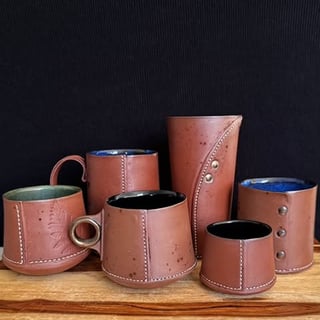
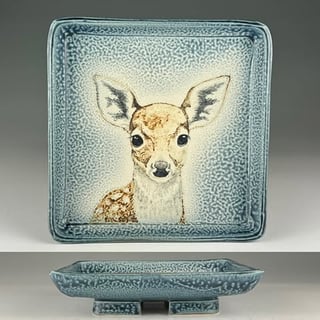
Speaker: I love that so much. So let's talk about your pottery. Can you tell me in one sentence what you make? One sentence, huh? Okay, I wrote this down because I knew I wouldn't be able to do it in one sentence. I make slip classed monks that are covered in dorky little illustrations that I hope make people happy.
Speaker: Love it. Awesome. So tell the story of how you started creating your illustration pottery. OK, so I started because technically I was a really bad potter, but I'm a good drawer because I was a commercial illustrator for years. So I when I first started pottery, I really didn't want to do illustration. I just wanted to make things.
Speaker: But my pottery was so poor because I'm like self -taught that I thought, oh, I better, I've got to make this look good. And because I was bad at glazing, but I knew I'd be good at illustrating, that's why I started drawing on things. I started drawing moons because they were circular and it was really easy to do. And I could just like do it really quick. And then,
Speaker: I did have one of my original ones, but I've cleaned my studio. Anyways, yeah, so then I just started drawing moons and then moons just, I don't know, it brought just these wonderful people who really loved what I was doing and from there I started putting faces on things and then I just started putting faces on whatever I felt like drawing. So it went from that to
Speaker: Bigfoot and cryptids and monsters and strawberries and lemons and Literally anything I can draw eyes on That's what I do now That is really cool. So when did your what when did you say your vision started really kind of coming to life? um, I think that that started once I stopped sort of fighting against myself because
Speaker: When I, all the potters that I were like looking at, at their work, I was so obsessed with like, you know those beautiful like glaze combinations and like the drippy glazes on things and just like technically beautiful pottery. I wasn't looking at illustrated pottery. And I was finding it really frustrating because that's the work I wanted to do, but my skill level just wasn't there yet. And then, I don't know, like just
Speaker: illustrating on pottery and learning underglazes. And I just sort of really fell in love with learning underglaze ceramics over like traditional glaze ceramics. And once I sort of stopped fighting against myself and just like started enjoying under glazing, that's when I really started going like, right, if I'm going to do this, it's going to be bright. It's going to be
Speaker: I'm going to find a way to be really, really good at under glazing over glazing. And then once I started doing that and like testing things and trying things that I wasn't seeing other people doing, that's when I think my pottery came to life. And that's when I was like, whoa, this is really cool. Like I could do this for a living, like for real. And then, yeah.
Speaker: That is really cool. Shaping Nation, you don't always have to go and do what other people are doing. If you have your own strengths, your own strengths outside of pottery, try applying that to pottery, and that is how your vision is gonna start coming to life. 100%. I think that if you, and that's what's so cool about pottery is if you are good at, God, anything, if you're good with your hands, you can bring it to pottery.
Speaker: Like I've seen some incredible stuff. Have you seen that guy who's like, he's like a machine fitter. And then he makes this pottery with like all these cogs and stuff in it. And it, I don't know. Is it? I think that's Ann Clark, Andrew Clark. Yeah, it's super cool. I like that one a lot. Yeah. Definitely like that one. I'm like, I've never seen anybody do anything like him. And I just think it's so cool. And there's so many people like that.
Speaker: Yep, definitely agree, super amazing. So you mentioned you were a graphic designer. How does this experience help you when you were starting making your illustrations?
Speaker: Um, I think that it just made it easy for me because, um, I've always, I've always been that kid that, you know, that trope, like I've been drawing since I could hold a pen. Like that is true for me. So it just made it, I could find a comfortable space working with clay. Whereas if I wasn't good at drawing, I think that it would have been a lot harder for me to find that comfort.
Speaker: that to fall back on when, as you know with pottery, there's a lot of failure. You really have to be good at failing. And I think being a commercial designer as well,
Speaker: you get a lot of knock backs whether or not you're like trying to win work or trying to like push a design to a client that you know it's a good idea but they don't really see your vision. And so like being good at taking failure, I'm really good at that. So that kind of helped me with pottery as well. And also it's really helped me with like creating a brand around what I'm doing.
Speaker: Um, so like, obviously I could make myself a logo. I could package my stuff and make it look really pretty. Um, I know cheap ways of doing that, expensive ways of doing that. I could put all of my print design to work for myself instead of for someone else, which was, and is really, really fun.
Speaker: definitely agree 100 % about that failure. So I used to play baseball a lot and baseball taught me how to fail because when you are playing baseball, you fail seven times out of 10 times. And that's how I loved that correlation between baseball and pottery and failing it. Absolutely amazing. Totally, totally relate to that. Yes. I think that if you are someone who takes failure hard,
Speaker: Pottery is gonna make you cry like opening Have you ever had that moment where you open your kiln and you can see? Like shit in there doesn't look right and you're like, oh that is a month's work of worth of work And you've just got to throw it all in the bin. It's like absolutely Yeah, absolutely the Kim gold killing gods weren't with us that day So, can you give me a simplified version of how you create your pottery?
Speaker: Okay, so I now make slip -cast pottery. So I worked with this wonderful guy who helped me make my moulds. He made my moulds from a 3D printed design that I made. And so, yeah, now I can make my own plaster moulds. I pour my cups and then I design on them. I found that
Speaker: While I thought I would love wheelwork, what I actually love is decorating cups. So I went into slip casting because I am very, very impatient and foot casting just meant like, boom, I can just be doing the thing that I love doing and stop struggling against the thing that I kind of enjoy doing, but it just takes too long. So yeah, I got into slip casting and I absolutely love it. It's so much fun.
Speaker: I love it. I'm also like I also started out with wheel throwing, but now I'm like branching out into like sculpture, but I'm also going to be adding that into my wheel throwing. So it's like, but I'm enjoying sculpting more right now.
Speaker: watching your sculpting stuff. And I think the stuff that you're making is so freaking cool. And I can't wait to see how you integrate it with like wheel stuff. I could totally see you making like little battle scenes around a vase or something. I'm really excited to see where you go with it. That is exactly what I plan to do. I plan to do a battle seed. Definitely try to do that.
Speaker: What advice would you give to someone trying to get into slip casting? Okay. I wrote myself notes on this. Um, I don't think, I don't think this was, I don't think this was a question that I, uh, put down on it that I sent you. This was just, uh, one that I came up with right now is, um, slip casting is so different to working with clay, normal clay. It, it's an,
Speaker: Finding ways to work with slip is like learning, it's like learning pottery all over again. So I would say get yourself a big slab of plaster.
Speaker: by yourself some stain and start having fun with staining slip, pouring it, feel what it feels like when, cause you can take it from being liquid to being like workable clay wet that you can like sculpt with. And it just feels like silky and it's so much stickier. And yeah, I would say just get your hands in the slip, get messy, experiment,
Speaker: make like sprig molds with plaster and yeah like I'm looking at learning how to be better at mold making and everything I pick up like I'll look at a pen and I'll be like how did they make the mold from that and where is the undercuts and like yeah I just I think that as with anything when you're learning
Speaker: Don't look at what you want to make as the finished product. Look at all the chaos you can make in the in -between because that's where you're going to learn if you actually like it or not. And yeah, just get really messy and gross. I absolutely agree about the messy chaos in between. I think that's the process that leads you to the end goal. That is really some great advice right there.
Speaker: So something I found interesting from your website is you said, I shoot from the hip and run towards stuff I find interesting. How does this impact how you make your pottery? Okay, so I have ADHD, which means that if I don't feel like doing something, it's really, really difficult to push myself to do it. And when you are working for yourself, there's a lot about what you do that you're not going to love.
Speaker: What I've learned is how to use my neurodivergency to my benefit. And so I only do things that I'm really interested in. And so when I say I shoot from the hip and I make things that I like doing, I don't take commissions anymore because what somebody else finds interesting, I just might not. And it makes making that thing
Speaker: fucking impossibly hard for me. So I just listened to myself and said, you know what, I'm not taking commissions anymore. And that was just like a massively positive thing that, yeah, it felt like I was moving backwards in a way, but it was actually me moving a lot more forward. And I also find that
Speaker: it's really important to give yourself a break from one creative process. So me and my best friend and business partner Bryn Corey from Gummy Pony, we do a lot of things like this week let's learn how to do lino printing.
Speaker: And I won't touch pottery for a week and I will just learn a new skill. And it's so fun. And then when I come back to pottery, I've missed it. And I'm so much more likely to do those things that I find a little bit boring because now they're not boring anymore.
Speaker: So I found that like diversifying my time, I make like stickers, I do prints, I am learning how to like manufacture things and then I'll do like, I don't know, I learned how to make rugs not that long ago. I'm learning how to knit now.
Speaker: I don't know I might make a comic book at some point it has nothing to do with pottery but all it does is when I come back to pottery I'm just like oh man I really missed you and then I'm just so happy to do pottery for a month and just really dive into it so I think
Speaker: Like it's important to make time to be creative in another way, because you can burn yourself out so easily doing the same thing, especially with pottery, because it's the same process every time. You do this, and then you do this, and then you fire it, and then you sell it, and then you go back to the start. And if you just keep on in that loop, you're gonna fall out of love with it. So it's like any relationship. You gotta keep it spicy. You gotta...
Speaker: You gotta find something to be frightened and come back to it. Absence makes the heart grow fonder. Absolutely. Shaping Nation, how can you take intentional breaks where you're trying to learn new skills, new, just creative things, and when you come back, you will be really refreshed when you do it that way. Excellent advice right there. So you have a family. How do you balance time between pottery and family time?
Speaker: I don't do a great job of it. My kids are obsessed with being in my studio. They think it's so fun in here and I am constantly like, get out because it's a pottery studio and I don't want them to touch anything in here.
Speaker: Me and my family do a lot of physical activity. We, you know, once I pick them up from school, it's let's go skating. Let's, we go on play dates. We, my kids have a bunch of like after school activities and I'm really lucky. Both my kids are in full time school now. So while they're at school, I'm at work.
Speaker: And then from the hours of like three to like seven 30, I am full -time mum. My husband also, he works from home. So when the kids are finished school, he also knocks off. And we all spend that time together doing something together. There's very little TV time. It is, we are all up each other's butts. And then once the kids go to sleep, me and my husband,
Speaker: most of the time we'll say like bye I love you and then I'll come in my studio he'll go in his studio and then we work till late it's not a great system it's just I don't know if that's uh shaping your pottery advice that's maybe good I don't know I think that was really I think that was some great advice just just in general
Speaker: So being very kind. Let's talk about discovering your voice. What would you say was your biggest struggle when it came to discovering your voice?
Speaker: Okay so I thought about this question a lot and I'm really interested when I listen to your podcast. This is where I really start paying attention because I love how other potters answer this. Recently I have really been struggling with finding my voice and understanding like what is my voice and
Speaker: Um, I think because I was a brand designer for so long, I am really good at putting myself in a box. It's like, this is how I draw eyes. So I can never not draw eyes like that because if I do, that's not part of my brand. And I didn't realize that I was like really crushing my own creative energy.
Speaker: And at mid last year, I had to do a lot of really hard thinking. And me and my best mate got sketchbooks. And I just started, that was like my new obsession, was like drawing in this sketchbook. And everything I was drawing did not look like my pottery. And I was like, there's something like wrong here. Like why does this look like this? And I love this look. But then when I draw my pottery, it has to look like this.
Speaker: Why, who made these rules? Why do I have to stay in this box? So yeah, it was probably about mid to the end of last year. I even made like Instagram posts about it because I was so nervous about like changing my style or my voice, whatever you want to call it. And I told people who follow me like, look, I need to change things up because
Speaker: When I look at what I'm doing, it's just not bringing me the joy that it should. And what I thought would happen, like what that like little goblin in your brain, I thought everyone was going to be like, well, this isn't what Saraconda ceramics pottery is supposed to look like. I don't want to follow this anymore. I don't like this. But what actually happened was overwhelming support from my friends and followers saying like, oh my God, we just want you to make things that like make you happy because
Speaker: when you make stuff that you're passionate about the people who follow you are gonna fucking love it because all you're doing is going like look at this cool thing that i'm making and then people go whoa that is really cool so um yeah i just completely shifted and just started drawing things differently and i don't know if i've found my voice but i definitely feel like i'm being more authentic and
Speaker: Something else that I noticed was I would go back and look through people's Instagram, like, um, Anna Lisa from, um, uh, what is her account name? Dirtworks. You had her on your show not long ago. She's perfect example. If you look through Anna Lisa's Instagram account, her work shifts and changes.
Speaker: her styles change. She has not put herself in any boxes. And I was like, God damn, I love that. And then you look through like, another great example is Katie Marks from, she was not another Seattle artist, but now she is silver lining ceramics. Scroll through her work.
Speaker: A year ago, her work looked different. A year before that, it looked different. I think that finding your voice is whatever is making you passionate right now. And if that changes, then your voice is just, you're just singing a different song, but it's still your voice. And that was something that was like a light bulb moment for me. And yeah, I think that
Speaker: I think the idea of finding your voice and your style, it's really, I think it comes from being obsessed with Disney as a kid. Because you know all Disney movies, the drawings are the same. So you look at that and you go, that's a Disney movie because you recognize it. And then you think, my work, I want it to be recognizable and therefore it has to look concise. But I don't know, you look at Katie's work from two years ago,
Speaker: It still looks like Katie's work, but it doesn't look like what her work looks like now. And you look through Annalisa's Instagram posts and her website and every release it's different. And yet it still looks like Annalisa's work. So your voice is your hands. Whatever you're making with your hands, that's it. You don't have to do any more deep thinking than that, I think.
Speaker: absolutely 100 % agree. Shaping Nation, you do not have to limit yourself with your work. You can go so broad and have so many different styles. It's more important to have just a theme for your pottery and have many different styles within that theme. That was some excellent advice right there. Oh, thank you. I was quite proud of that when I came up with it. That was really great advice. I love that.
Speaker: So what advice would you give to someone trying to discover their own? Actually, let's scratch that for a second. So you mentioned being authentic. What advice would you give to someone trying to be more authentic, to be more authentic with their pottery? I think that
Speaker: It's different for everyone because there's a lot of people out there that don't want to share themselves on the internet And that's okay. There's a lot of potters out there that don't want to show their face Because it makes them feel uncomfortable so I think like I really feel like The most important thing is to do whatever is making you feel comfortable Because when you feel uncomfortable and awkward
Speaker: it's so easy to see that you feel uncomfortable and awkward. So if showing your face makes you feel weird but then you're seeing all these other potters do it so you're like I'm required to do this, don't do that. Like maybe just be known by your work or show your hands or I don't know find something that just makes you feel comfortable and confident because all people want to do is support
Speaker: Artists like there are so many people out there that they just want to see you thrive They don't want to see you feeling uncomfortable on the internet. So I would say just find How think about what you don't want to do write it down? Just don't do that. And then for everything you write down that you don't want to do write down an alternative option
Speaker: I also think that every person out there, whether you are a creative writer or a potter or anything, everybody needs a sketchbook. Dumping your brain out onto paper, whether it's like
Speaker: crazy notes or like silly little doodles or whatever sketching and drawing every day and keeping a visual journal it has helped me so much to be more authentic because sometimes I don't really know what I want to say or I don't know how like like what am I going to talk about today and
Speaker: It feels really inauthentic to think, God, I have to post something on Instagram today, but I don't feel like it. And that's when people come up with those like kind of passive aggressive posts. That's like, I've got to feed the internet algorithm. Here's your content. Like nobody likes seeing that. So when you have a sketchbook or a visual journal in front of you,
Speaker: you can look through it and go like, man, that's like, I really like what I did here. And then you can maybe share that idea or talk about how you're feeling or take a photo of your sketchbook and show that. And it's more authentic because you actually care about what you're sharing and you're not just like feeding this internet demon. Absolutely agree. Especially that part when like you're just posting the post instead of just being like real about it. I love that so much.
Speaker: So as we're coming to a close here, what is something that you would really want to hammer home with my audience today? Um, if you are making work, then you are an artist. If you are, if you are creating anything, if you are a hairdresser, if you are like a machine fitter, if you are, everything is art, everything. So,
Speaker: I think that when we're little and we're in school and we're told that there's no money in art and being an artist isn't a career, being an artist is the only career. Everything is creation. So I think that, God, I don't know where I'm going with this. I think that, yeah, the work you make is your voice because you're making it. I don't know. I don't know.
Speaker: Shaping Nation, you already have a voice out there.
Speaker: It's your voice because you are making it. And you should be proud of that. Exactly, exactly. Like, God, anyone can draw moons. I feel like, like, moons is like my go to thing. But goddamn, moons have been drawn for a million years. There is nothing like nothing unique about me as a potter drawing moons. And yet, no one draws with moons like me because only these hands be drawn those moons.
Speaker: So like, don't feel like, oh well, so -and -so's doing that, or I can't do the, I really wanna draw moons, but Sarah's moon for moons. Fucking draw moons, man! Cause you're not gonna draw in the way that I do, and there's plenty of space out there for everybody. Absolutely agree. Sarah, it was really wonderful chatting with you today. I learned so much, and I know my audience learned a lot. Where can my audience go and check you out and learn more about you?
Speaker: Thank you so much for having me Nick. I enjoyed this so much. And I just want to say I'm such a fan of yours. I've listened to like, I think almost every episode of your podcast right now. I just think you're very endearing and honest and genuine. I love your work. And thank you for having me. And if people want to find me, my Instagram is Sarah Connor ceramics. Um, and my website is Sarah Connor ceramics .com. And that's it.
Speaker: Thanks for listening to this episode of Shaping Your Pottery with Nick Torres. If you want to start discovering your own unique voice, you must first start with the right questions. That's why I put together a free 15 question booklet for you to start discovering your own unique pottery voice. All you have to do is go to shapingyourpottery .com forward slash questions to get this free booklet.