Transcript
Speaker: Welcome to Shaping Your Pottery with Nick Torres, where we help you discover your own unique voice so you can stand out from the crowd and have more fun making pottery. So you make pottery that is truly amazing. What is up, everybody? This is Nick Torres here with Shaping Your Pottery. On this episode of Shaping Pottery, I'm going to be interviewing Leslie Bevin. Leslie makes some amazing slip trailing pottery that she uses soda firing to complete.
Speaker: Leslie, welcome to Shaping Your Pottery and share with me one thing people might not know about you. Thanks. Oh, I'm excited to be here. Thanks for asking me. So my, I'm not going to call it my day job, but my other job in real life among civilians is I'm a voiceover artist. So one of the
Speaker: weirdest and yet most ongoing jobs that I have is I am the voice in what shall be an unnamed big box store, where when you call this big box store to talk about your problems with your electronics, I'm the voice that says, sorry, you're having trouble. For customer service, press one. For geek squad, press two, etc. So that's how I make my living when I'm not making my living on pots.
Speaker: That's awesome. That is actually incredible. I love that. You can call any state in the union, including Puerto Rico, and I think you might hear me. I get around. That is so cool. Can you tell me the story, how you got started in pottery?
Speaker: Yeah, I had a list of all of the art forms that I wanted to learn how to do and photography was first, tried it, didn't like it, it was too chemically
Speaker: ironically, because now I do pottery. And pottery was the second one and I got there and that was, you know, 20 odd years ago and I haven't moved beyond it. So there's a whole list of things I want to learn how to do. And frankly, when I'm dragging my stuff to and from pottery shows, I'm like, gosh, I wish I had picked up the paper arts or, you know, weaving something slightly, a jeweler, something slightly less heavy to lug around, but here I am.
Speaker: So I am simultaneously an actor, at least I was when this all started, and I was performing for a season at the Cincinnati Shakespeare Festival, and there was a place there called Annie's Mud Pie Shop.
Speaker: And I'd always wanted to learn how to be a potter. And so I took classes and would, like every potter you've ever met became obsessed and couldn't get enough. And I would spend my days at the studio throwing terrible pots. And my nights I would race to rehearsal and covered in mud and rehearse Shakespeare. And that's how it started.
Speaker: So can you describe the moment when you decided to just solely focus on ceramics instead of being an actor as well? Sure. So I was an actor for 20, probably 25 years in Chicago, mostly staged some film, lots of commercials. Simultaneously, I was a potter. So it's not like I dropped one and decided, I think I'm going to pick up pottery. I was doing both at the same time.
Speaker: but one was my career and one was my, um, avocation, my, my hobby. And, um, uh, without getting too dark somewhere along the way about what 10, five, six years ago, I got cancer. Um, and I had to, you know, life stopped. I had to go through chemotherapy. I went bald as a, as a naked mole rat and was uncastable and had to take a big, big step back from, from theater.
Speaker: And, um, but I did not stop doing pottery and it was really, um, therapeutic as I think anyone who touches clay can tell you, it was a place where I felt normal again, even though I was going through chemo and I was sick, sick, sick. And, um, so, uh,
Speaker: I had that opportunity to really focus on ceramics with nothing else, but focusing on going to doctor's visits and doing ceramics. And it really kicked my practice into high gear and really crystallized some things. And so by the time a year had passed and I was hairy again and able to go out and be cast and things, my agent called and said, hey, welcome back. We're so glad you're okay. You're ready to start auditioning again.
Speaker: I said, no, I don't want to. I didn't miss it. I think I'm done. And I really credit having Pottery there to give me the license to step away from an entire career because I don't think I would have had the courage to do it otherwise. It's very hard to leave your career. It's scary to make a new
Speaker: to start out on a new path at that point in my life. But I knew I loved it. I knew I was good at it. And there was plenty about theater that I didn't miss. And so I stepped away. And that's how it happened. How did making pottery, when you had cancer, how did that keep your mind off to the cancer itself? Well, you know, pottery is meditative. And what I like about ceramics, which I never got in theater,
Speaker: is that theater is an exchange between a whole group of people. And basically you don't get to act until someone invites you to. So the director says, hey, I want you in this play. And then suddenly you have license to practice your craft. Whereas what I loved about ceramics is no one has to give me permission. I get to sit down and make whatever I want to make, whatever moves me.
Speaker: What I also love about it is that it is, theater is ephemeral. It's gone the minute it's out of your mouth. The minute the night is over, that particular moment of storytelling is gone and no one will ever see it again. And I really cherished having a cup to show for myself. A mug that I could line up next to another mug and next to another mug and see how I am improving. Where theater, you just never get that. And I really appreciated the agency
Speaker: that ceramics gave me. And that holds during cancer or not. Like that is really what, it made me feel normal. It made me feel like myself again. And I was able to do it without anyone else's permission. That is absolutely incredible. So how did being in theater help you with developing your voice in your pottery? Yeah. Well, in,
Speaker: What I love about theater is, especially about being an actor, is it is a gateway to every culture you could imagine, every time period you could imagine, every socioeconomic status you could imagine. And you get to travel to all of these places that you may never see in your real life. And so I was exposed to cultures that I was not necessarily a part of. I was exposed to religions
Speaker: to time periods that I could never hope to see. And I love all that comes with that, the props that come with being in an Edwardian play, specifically costumes. I mean, I love being an actor, but in my heart of hearts, I kind of wish that I'd been a costumer. I just love costume and fabric and textiles and the structure of clothing and
Speaker: Actors will always tell you that they don't really get their character until the day they put their shoes on, the shoes that they've been giving, because it makes you walk in a certain way. And suddenly you're like, oh, that's what this character feels like. And so all that stuff builds to build a character. And I found that to be transportive to things that I was drawn to, like
Speaker: I don't know, Asian cultures and I don't know, but being in the costume shop in particular and seeing how people thought to put fabrics together and the way that they were constructed, I still, I think, call on that in my ceramics. As I go on, I realize that a lot of my ceramics, I'm drawn to fabrics and the way that they butt up next to each other and the way that a pattern may stop
Speaker: And if you don't line up your fabric properly, the pattern starts again in another place. And I do try to actually incorporate that into my work. So that, for sure, is how theater has colored my ceramics. But actually, I have to thank you because I have been walking my dog today and thinking about the questions that you're going to ask me.
Speaker: More importantly, I think I came by today is that what I miss about theater is that conversation that you have with an audience through telling a story. And I think that I try to imbue a little bit of that into my pots somehow. It's a lot to ask of a mug to be like, here, this mug is going to communicate with you. But I do. I try to
Speaker: give it a sense of something, which is also what an actor does. An actor will decide how to use their hands or their mouth or their eyebrows to sort of give a feeling of what's going on. And I like my mugs to do that too. When I feel like I've made a successful mug, it is a mug that I pick up and there's a feeling there. I had a director friend, a director that I loved and she was always very supportive of me. We did a bunch of shows together and she would buy my ceramics at Christmas time.
Speaker: She bought one year and the next year she came back and bought something else. And she said, Leslie, I like where your work is going. It's much more emotional. And that kind of blew my mind that a mug or a pot could be emotional. So I think that's what I'm going for now, that somehow my mug has a sense of an emotion or instills an emotion in somebody.
Speaker: I can't promise that I'm always successful at that, but when I do it, I can see it, and when other potters do it, it makes me feel something here, and that's what I'm going for. So that's how theater, that's how, you can't take the actor out of me, and I think that's how it still informs my work, for sure. I love that so much. I love how it's really inspired you to really make unique pottery that is meaningful. I try, I try.
Speaker: We're going to talk about discovering your voice a little bit later on. But can you tell me the story how you started slip trailing your pottery? I don't remember how I started slip trailing pottery. I do remember when I found slip trailing, I slip trailed everything, which actually hasn't changed much. I still do. But I did lots and I remember giving my first slip trailed mug that I was really proud of to my mom.
Speaker: She lives in Arizona and lives in the desert. And I gave her this mug and it was so spiky from all of this, the killed dots and each one had a little spike on the end. And I was very proud of it and gave it to her. She said, Oh, thank you. And then she went and put it in her garden because it matched all the cactuses. Um, so yeah, I honestly, I can't remember when I started. All I know is it was my thing and I had found my thing and then I applied my thing to everything.
Speaker: So can you give me a simplified version of how you slip trail your pots? Sure. Well, OK. So technically speaking, the slip needs to be in a very specific amount of fluidity. So I say it's like wet sour cream or somewhere in the creme fraiche sour cream.
Speaker: We're always using dairy as our touch points for ceramics. Anyway, when it comes out of the slip trailer, if it leaves a design and then spreads that is too wet, if it hangs and can dangle from the slip trailer like a paste, it is too dry.
Speaker: And so I would say if you're ever having trouble slip trailing and it's one of those two things, you just need to stop and address it because you will be very frustrated if you continue on using that slip without addressing its liquidity. So you can add water and mix it up and let it sit for a bit. That's usually pretty fast. You can apply some that's too wet to a plaster bat and leave it for like
Speaker: five seconds, 10 seconds, scrape it up, put it back through your sieve again. And so I think I see why people give up on slip trailing because it's really not a lot of fun if things aren't going well. But I will say it is so forgiving. What I love about it is that if I am trailing on a mug and I've made a line or a design or an image that is not working for me, you wipe it off and you start again. And no one's judging it. It's not like etching.
Speaker: or carving, where once you make a line, it's pretty much there. So I just take a red rib, the red squishy soft ribs, and wipe off what I've done, and start again. I learned not to sponge it off, because then that kicks up the grog eventually, if you're doing a lot of erasing and starting again, it kind of marrs your surface. But just a red rib, scrape that off, and start again, and you're good.
Speaker: Other than that, I don't design beforehand. I don't know what I'm going to do before I start. But again, I lean pretty heavily on wiping off and starting again if I don't like it. In the beginning, I think a lot of people do slip trailing. I was drawn to Mendy and those, like the Henna designs that is popular in lots of East Asian countries.
Speaker: to get a bad feeling about that at one point when I realized that's not my culture. It felt like a little appropriaty to me, which was a great thing for me, because as soon as I recognized that and that that made me uncomfortable, it made me expand into images that felt more like mine. When people say, oh, that looks like Mendy, that looks like Henna, I have to agree with them. It's kind of hard. They both are a paste that you draw out in a line.
Speaker: in a continuous manner, they're often botanicals. So I understand that it's hard to get away from the similarity, but I try very hard to come up with a library of designs that are more my own. And I still do that every day. I'm not happy entirely. I think I'm always trying to find something that's new and that is mine, and which I would also encourage other people to do as well.
Speaker: What would you say is the difference between yours and then the other one that you said? Well, I mean, if you have ever gotten your, you know, Mendy Dunn or, you know, seen Henna designs, there's, there are people who excel and I'm sure, you know, again, it's, it's not my expertise. So I can't talk about it like an expert, but you see many of the same themes over and over again. You see many of the same designs over, over and again.
Speaker: put in different arrangements and with different levels of artistry. But so I moved away from a lot of those. Or if I wanted to do, like, for instance, the flower is so standard. And a flower certainly isn't, every culture has flowers. So I certainly feel like I have the right to draw flowers. But I've been trying to draw them in a more fluid way, in a less repetitive way, to give it a little more emotion, like I said earlier.
Speaker: I am a perfectionist, which is not a great thing because I tend to sort of like perfect the life out of things. Sometimes I'll finish a mug and I'm like, oh, that's perfect. And there's got no life whatsoever. So it brings me back to what my director friend Jessica said. It's like if it has emotion,
Speaker: It's because it has movement. There's flaws. It hasn't been squeezed to perfection. So I think I try to do that in my designs as well. Just give it a little more breath, a little less repetition, because repetition can be not boring, but predictable. And I think in order to have emotion or a little bit of life there, there has to be something that the eye isn't expecting.
Speaker: I love it. For those that are listening, it's okay to kind of go out from the norm and make something different. That's where your emotion is going to start coming from.
Speaker: If you had, if you could make pottery with anyone in the world, who would it be? For example, I've given, I've said Clay Thompson, but I also think Hugh Jackman would also be fun to make pottery with. I would, I would do anything with Hugh Jackman. It doesn't have to be pottery. You cook dinner. I mean, no, okay. So it doesn't have to be pottery. But when you ask that question,
Speaker: I thought about potters first and foremost that I would want to pot with. And you know, I've got plenty of people that I admire, but what I was reminded of, and I have show and tell, I'm going to show you and tell you, before I was a potter, before I even knew I wanted to be a potter, which is weird because as I was growing up, I had no idea I wanted to be a potter, but there were little things in my life that kept alluding to it.
Speaker: or that I would even allude to it, even though I had no notion that I wanted to become a potter, I would mention it. But anyway, this was back in college when I was studying to be an actor. I was visiting my mom in Arizona, and we were on a golf course. And it was a golf course that was in construction. And I stumbled upon this shard. It's a pottery shard. And what is extraordinary about it is it has
Speaker: painting on it. You can see the stain or pigment or whatever. And this thing is easily 3 ,000 years old. I suspect I probably shouldn't own it. I'm going to chop it up to my naivete at the time. It is so precious to me, this thing. I have kept this in a little leather purse.
Speaker: since then. And I don't look at it often, but I love the idea of being able to touch this pot and somehow touch the person who made it so long ago. Like, I don't know who this person is or what their story was. Also, look how thin it is. I mean, somebody has this. Yeah, that's incredible. But I would love to make pottery with this person, whoever this person is.
Speaker: I think it would be really freeing to watch someone make a pot purely for utilitarian purposes, and then also took the time to beautify it. That would be the trip of a lifetime. So that's who, that person, whoever that was back in Arizona. That one random person from 3 ,000 years ago. That one Native American from, I suspect, the Hohokam tribe of people.
Speaker: around Carefree, Arizona. I did actually, there was a museum in the town and I took this shard there and they had a whole set of shards set up and I was able by, you know, by my armchair archaeologist leanings to go and like try to find exactly what it was similar to and that thing is old. It's old and that's just, that's fascinating to me.
Speaker: That is awesome. So can you tell me the story how you started codifying your pottery? Yeah. So I've been at Little Street Art Center for 20 years, 18 years. And they have so much available there. But like most community art centers, you basically make your pot, you put it on a shelf, someone fires it for you.
Speaker: You get it back. You glaze it. You put it on a shelf. Someone fires it for you. And that was great for a long time. But eventually I started itching. I had started selling work and really felt like I was somehow being dishonest that I was selling this pottery and hadn't really been in charge of all
Speaker: stages of its execution. And so I really wanted to go to grad school for ceramics, but I already had one fairly useless degree and a kid at this point, and it just wasn't an option. So I made it my point at Little Street to just squeeze as much information out of that place as I could. And I was in the soda department, I think, again, to try to give my work a little more emotion. And that's what I love about
Speaker: soda fired work. There's just so much happening in there that is uncontrollable and it just feels kind of wild and wooly. So I was in the soda department and the position, I had worked at Little Street in several other iterations. I had briefly been a glaze maker. I had worked in the kids department glazing their work.
Speaker: a position in the soda department came up and it was to fire the soda kiln and I had never fired a kiln in my life. Um, like I said, I had no degree in ceramics and, uh, it was terrifying to consider. I didn't think that I had the knowledge or the know how to do it. And, um, they believed in me and they gave me the keys and, um, I learned how to do it. And it's been about a, what a year and a half now. And, um,
Speaker: I can't say that I know entirely what I'm doing. There's so much that is out of my control in that kiln, which is part of what's great about it and part of what's terrifying about it. But I have learned, I've learned and it has built my confidence and it has built my confidence as a seller of work that I feel like I have had my hand in more of what makes my work mine than just putting on a shelf.
Speaker: having it return finished magic. What are the materials they use to actually make a soda firing a soda firing? Sure.
Speaker: So I think most people would know what a gas kiln is. That's how a lot of high fired work is fired. So the difference with the soda kiln is that a certain point near the end of the firing, when we get to just before cone 10, you insert these soda burritos. Some people spray, but at our institution, we make burritos, which sounds tasty.
Speaker: newspaper with some soda ash and some soda bicarbonate which is basically baking soda and some whiting which I think is a dispersant and then use some wood chips and you mix it all up until it looks like
Speaker: Some people say, you know, chicken salad. It looks pretty kooky, frankly, between you and me. Cookie dough, it could look like oatmeal cookies. That's nicer. And then you wrap it up in a newspaper. And when the time comes, just before cone 10, you stick it on a huge rod and you open the peeps and you shove the rod in and dump the burritos into the firebox. The burritos combust and
Speaker: The flame carries that soda ash and soda bicarbonate and waiting throughout the kiln and anywhere that it touches or makes contact with your clay it extracts the other chemicals that it needs in order to make a glaze and glazes your pot.
Speaker: So basically, if the flame has gone that way and the soda has gone that way, there will be glaze there. And it's kind of awesome and magical because you can put, you know, I say for people who are afraid of glazing and glazing is they're white whale, you know, try soda firing if it's available to you because you can put pots in there unglazed and it will come back with all the thought done for you and with some wonderful, you know, fiery marks and whatnot. I don't know. I'm going to have a pot here. So with my work,
Speaker: Um, I do not blaze anything.
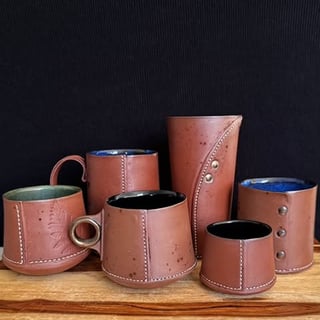
Speaker: except inside these petals. So there's a blue glaze in there. Everything else, all the shiny awesomeness. This is a slip that reacts with the soda, so it gets kind of modeled here. But basically, this is where a soda has hit, rather dark heavily. So I think it's just astounding that you can do very little to a pot, and it comes back
Speaker: utterly transformed because of that burrito you put in there. So that's how soda firing works and I love it. It is
Speaker: fantastically tiring and hot and long and Frankly, I wish I had been given the opportunity ten years earlier because it's really hard on the body But I love it I have also upped my prices since since I will say like since The days when I put my stuff on the shelf and some nice person went and fired it for me and brought it back to the days where I am firing other students work and firing my own work and that
Speaker: Nothing gets done unless I've done it myself and on top of it all it's soda which is so time -consuming and hard on the body and I've upped my prices and I feel like I've earned it because I know exactly what has gone into making that piece So it's just been I mean it has it has changed my perspective entirely and I I don't know how long I'll do it because again hard, but um, but I really I really love it and it's it's it's pushed me into
Speaker: areas that I would never have gone before, which is great. I love it. Love it. That whole process. That was really great. So over the last 22 years, you have grappled with imposter syndrome. So can you tell me how do you get over that imposter syndrome so it doesn't affect your work? Oh, I mean, it still affects my work.
Speaker: Okay, so the imposter syndrome I think is hand in hand with being a perfectionist. So I went to school for theater. I don't think anyone needs to go to school for theater. I think you either have it or you don't. But what theater did for me was give me confidence because I am, for better or for worse, a rule follower, and I sort of feel like you got to do this, this, and this before you can call yourself that.
Speaker: And so I spent four years learning how to be an actor and came out with gobs of confidence. And that is great. What I did not get was a degree in ceramics. And there's that little part of me that still is like, OK, you got to do this, this and this. And then you can call yourself a potter. And I I always felt weird calling myself a potter, an artist. I didn't sell my first piece until I think 12 years in.
Speaker: 12 years.
Speaker: And these days, people are like, oh my God, I wanted to find this cartoon to show to you, and maybe you've seen it. I just put a post out on the different Facebook groups. Does someone please share this cartoon? It's from the New Yorker or something. No one came up with it. I couldn't find it. But it basically was like a guy huddled around a wheel with kids behind him, learning how to make pots. And he says, OK, now we stick this in the oven. And while it's baking, we can open our Etsy store.
Speaker: And I just thought that was so funny because everybody has an Etsy store now and everybody is selling. And I am not judging. More power to you. That was not me. I felt that everything needed to be perfect before anyone would be willing to buy my work. And what I will say is 12 years in, by the time I did do a show, my work was damn good and I would sell out.
Speaker: So the flip side of my route being super perfectionist and fearful that I couldn't call myself a potter is that I didn't have to go through those years of like, I'm at this, you know, farmer's market and no one is buying my eight pound mug.
Speaker: because I had already sort of worked out a lot of the kinks, and I'm not saying one route is better than the other, but the way that I was built having imposter syndrome, it allowed me to really formulate my voice and really be sure of what I was selling before I was selling it.
Speaker: Yeah. How do I get over it now? I did a lot of stuff that scares me. I applied to things that I didn't feel like I had a right to apply to. I got into a lot of them, and then I got declined from a couple of them, and that felt very much like being an actor where you're just constantly auditioning for things and
Speaker: not getting them and you just pick yourself up and do it again. The real watershed moment for me was applying to galleries and having galleries be interested in me.
Speaker: So basically it was a lot of like faking it till you make it, but I will say what I am committed to doing is never making myself out to be what I am not. So I don't claim to have a degree in ceramics. I claim to have come by my knowledge through 22 years of
Speaker: messing around and messing up and figuring it out i don't claim with galleries to be what i'm not i mean i don't go in there advertising like hey you know,
Speaker: I am a layman. But if they ask me things, I'm not going to lie. This is who I am, and the pots are an expression of how I got here. And that released me when I decided to stop
Speaker: When you're an impostor, there is a tacit belief that you don't belong there or that you are pretending to be something that you're not. And so I decided to stop pretending to be something that I was not and to just claim who I was and these are my wares and things went really smoothly after that.
Speaker: So I can't say I don't still feel it, but just being true to who you are and to not pretend to be the expert that you would like to be has a lot of, it's very helpful. So that's what I would recommend. I absolutely love it. For those that are listening, one of the things that I took away from this is that you have to be patient sometimes in order to develop your voice. And when you develop your voice, finally, that's when things are going to start going a lot better.
Speaker: As we're coming up on our last question here, what is one thing you want to hammer home with my audience today? Oh my gosh, that sounds like such a violent question. What do I want to hammer people with?
Speaker: Gosh, I could go through the usual stuff. I am a huge believer in safety and health. Try standing up. If it's not too late to start standing up, wheel throwing. That's what I do. It helped enormously when I did it. All those things. Watch your lungs. Really, I think
Speaker: Getting back to finding your voice, what really, really, really helped me solidify what I was trying to say was to write an artist statement. And I had to do that when I started selling my work in galleries and whatnot. And an artist statement
Speaker: is again, something that you learn how to do in grad school. I never learned how to do that. So here I was, butting up against my own fears of like, Oh God, I don't know how to do this, but I guess this is what I have to do. And I came up with an artist statement that is really not what you would find from someone who came out of grad school.
Speaker: I don't use the buzz words. There's an academic quality to artist statements that I just don't have. Mine came out sounding more like a blog post about me. But again, that is who I am. I'm not going to claim to be a grad student or an art student that I am not. But once I had to put my thoughts on paper about what I was trying to express through my work,
Speaker: It held me accountable to expressing that. It helped me clarify. And I still use my artist statement. I go back to it from time to time and reread it and then look at my work and decide, is this still what I'm trying to express? Or did I express this in this pot?
Speaker: And sometimes the answer is, no, you didn't express it in that pot. That pot is probably not worthy of your body of work. Or it might mean your statement has changed, and it's time to go back and tinker with that. But I found it a really great exercise in how to clearly express yourself on the page.
Speaker: and then to translate that to your work. And really, when I did that, it solidified things for me. It gave me a path.
Speaker: And that's still the path I'm on. So I would recommend, even if you're not applying to things that require an artist statement, even if you're just brand new, you've been doing this for three months, write down what it is you want your pots to express. Write down what you want people to feel when they hold your work, whether it's an emotion or
Speaker: a sense of something. Is it a narrative? What do you want them to feel? Get that all down on paper and then hold yourself to it or change with it. And that is what I recommend. That was absolutely amazing, Leslie. So where can my artists go and connect with you and where can they just go check out your work?
Speaker: Oh, well, I'm on Instagram, which I have, you know, I could talk about that for a while. I have feelings about Instagram. But it is the vehicle for getting your work out these days. I'm on Facebook. They are both Leslie Bevan ceramics.
Speaker: I'm in Chicago and I love doing in -person sales. I don't do them very often, but man, it triggers that thing I feel when I'm on stage with other people and with an audience, that communication. I love watching people feel pots and touch pots and talk about pots. So anytime I can see you in person, I have a teeny weeny, teeny weeny, weeny, weeny studio. So I'm not great on giving studio tours, but
Speaker: Yeah, so you find me in Chicago, find me online, and that's it so far. Yeah. Thanks for listening to this episode of Shaping Your Pottery. If you would like to learn more about how Leslie makes her slip trailing and her slip trailing design, then go to shapingyourpottery .com forward slash blog.