Transcript
Speaker: I'm very proud of my work. I think it's unique and I think it's...
Speaker: That's Lee Weinberg, a potter who is greatly inspired by children's books. In this episode, you will learn how Lee has evolved her pottery over time into what she makes today. I got more professional and I really honed in on my skills and so I think I'm curious to see what my mugs and everything will look like in a year from now. You will also learn how being authentic will actually help you with selling your pottery and building an audience online. I'm not, you know,
Speaker: I'm not trying to be anything other than who I am and I think maybe that is refreshing for people. Finally, one of the last things you will learn about is Lee's unconventional ways of how she sells her own potters. Most potters prefer making to
Speaker: the, you know, spending hours editing pictures on the couch or doing anything like that. I also, I like to update my store with a big amount of stock. And there's so much more in this episode. I hope you guys enjoy it and we'll see you guys in there. Lee, welcome to Shape Your Pottery and share with me what is something that's helped you the most on your pottery journey so far? I'd say what's helped me the most with my pottery journey is the fact that throughout my whole time of making, I've been given
Speaker: the opportunity and the freedom to fail. And I think just being allowed to mess up everything you make without judgment in the process of learning was what helped me kind of get to where I'm at now. And there's a lot of zero judgment from myself and from everybody else when I make what I make. I love that. How would you say this has helped you with developing your own style? Yeah, I think
Speaker: I mean, when you're not worried about what everybody else is thinking or what your work means or anything like that, and you can just kind of fiddle around, draw what you want, do whatever. It's very freeing, especially coming out of, you know, art school and there are critiques and there are things like that. I'm at a point now where I can kind of put that aside and say, okay, I've learned all of the foundations of that. I was given the time to make really good work, make really bad work. And I know.
Speaker: what's good and what's bad for myself now, if that makes sense. I love that. Shaping Nation, the most important thing is to actually be able to fail and learn from those failures so you can start finding your own unique style with your voice. I love that. So now, tell me the story about when you took your first part of your classes in college. Yeah. So when I was in college, I didn't go to a full art school. We just had a really good art program there.
Speaker: And I was originally just kind of in the major of studio art, and we had to take a class in every single medium that they had offering just to get our credits to, you know, get our degree and everything. And I had already done ceramics, very loose term of ceramics when I was in high school, just building pinch pots and things like that. And I hated doing it in high school. I didn't like how.
Speaker: you know, clay dried on my hands. I didn't like all of the mess or anything like that. So when I went into my first class, I was a little bit anxious just because I was like, oh, this is going to be, you know, a couple months of just travesties for me. And then everybody there, my professors and my TAs were some of the most supportive and kind people that I'd ever met in really any art school kind of setting. There was just a lot of freedom and openness and
Speaker: Yeah, we sat kind of around my professor while he threw just a very simple cylinder for the first time. And I was sitting there thinking like, oh yeah, this will be easy. And as we all know, doing pottery, it's not at all. And yeah, then I ended up struggling for a couple months. It was one of those things that I was really determined I wanted to be good at it. And all of my free time was spent in that studio, like outside of class, just like trying to make something that wasn't an ashtray, you know? Yeah, I think that's
Speaker: kind of really the whole story of it. It just ended up being something where I kind of got into the struggle of it. There wasn't any other art form that wasn't hard like that for me. And that sounds conceited, but it was true, you know? I definitely agree with what I felt like when I was first started pottery, it was that challenge that made me want to keep doing it. I love that. So during the first year of the pandemic,
Speaker: Like a lot of us, you felt a little lost and unsure where to go next. Can you tell me more about this? Yeah. When I graduated from college, the pandemic hit just like a few months after that. And I graduated with a degree in ceramics, which isn't really, if you're wanting to get a job right now in college, that's not really the thing you go for. And so.
Speaker: trying to find studio space and trying to get into shows and do things like that right when the pandemic was hitting was just not really working out for me. And I had to end up spending a couple months just not really even doing anything in clay, just there wasn't the inability to do it at that point without putting myself and my family at risk. And so I just kind of focused on drawing and seeing like, oh, maybe I'll go back into painting for a little bit. Maybe I'll do this. I don't really know what to do.
Speaker: You know, and being in Texas, nobody really took the pandemic super seriously, which I lived with my parents and my grandma and everything. I was like, I can't go outside, you know, do anything. And so I guess it was about a year after COVID hit was when, you know, my parents let me build a little studio in their shed. And I just started kind of working from there. And, you know, it just took a lot of waiting.
Speaker: I guess that's where I was pretty lost on things. I think we all had to sit and wait and think and plan for a good long time, you know. How did this impact you on your pottery journey itself? I think for a long time, especially when I was first getting started, I had all this time to think about what I wanted to do.
Speaker: when even though I went and I got a degree in ceramics, I was really focusing on sculpture. And so I didn't have as much of a foundation in throwing on the wheel or making vessels or anything like that. And so a good three months was just spent making those over and over and over again until I felt comfortable enough to start selling them. But I already came into making again, knowing that I wanted to make
Speaker: work to sell and that I wanted to make smaller scale things that people can have in their homes. And I think the being lost in the pandemic just gave me the time to realize that that's what I wanted to do, if that makes sense. I love that. Shaping Nation, sometimes the best solution is to simply give yourself time to think so you can think about where you want the direction of your pottery to go. I love that. So we're going to talk a little bit more about selling your pottery
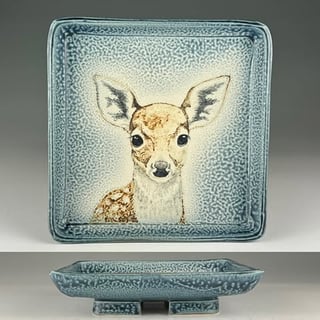
Speaker: in a little bit. But for now, let's talk about your pottery. Tell me the story how you started making your illustrative animal pottery that you make today. Yeah, I think it's something that kind of just slowly developed. When I was in college, I was really, I don't mean to talk about college so much, but it was a big formative time. I really was focusing on animals to, you know, kind of anthropomorphize them and put human emotions into them. And I was doing some really serious
Speaker: topics about identity and things like that, using animals. And I always like to draw and paint animals. And I think over time, it just, my style started developing into something else. And then when I started doing my, my vessels, I already started trying to put animals on them. There wasn't even really a question of what am I going to put on these things? It was just how am I going to put it on them? Or what are they going to look like? I think it's just what my brain is wired for and what I'm interested in.
Speaker: I've never really been all that interested in drawing people. I'd rather, you know, draw a raccoon that resembles a person instead, you know? What is it about animals that excites you? I think they're, I mean, this sounds kind of lame to say it this way, but animals are very pure in their own way. I mean, you don't have to really question in animals
Speaker: like animals aren't going to judge you. They're not going to, you know, be thinking about anything other than what their little animal brains want to think about. And I find that nice. I find that refreshing. And I think, you know, growing up, I was surrounded by animals. We had all sorts of creatures and critters in the house. I grew up horseback riding. My mom had an iguana for like 10 years. And I think that that
Speaker: Definitely added to this interest. It was you know, a lot of my time was spent in the company of animals rather than people and so I think it was easier for me to kind of put Personalities on to them rather than kind of suss out other actual people's personalities. I Love that. I will say that I do feel like my dogs will judge me sometimes like especially from around other dogs But that might just be me and maybe it's a judgment of love, you know, you never know and
Speaker: Yeah, maybe. So you are inspired by children's books. Can you tell me more about this?
Speaker: Yeah, so when I was growing up, I mean, I guess this goes back into more animals anyways, but I had this huge collection of children's books, specifically the Serendipity series by Stephen Cosgrove. And all of those books were very, you know, they all had a little moral story of like, listen to your mom and, you know, don't steal and all of those things. And the way those books were illustrated, every single page had these beautiful, beautiful paintings. And I believe
Speaker: I don't remember her last name. I believe the artist's name was Robin. I should know her full name, but the way she painted it was like these watercolor -y illustrations of just some of the most beautiful animals you've ever seen that like there was a story called Morgan Morning that was about a little horse who didn't want to listen to his mom and he ran off and fell down a waterfall. And I don't know in the story if he like died or what happened, but basically he
Speaker: came back like weeks later as like a unicorn and like the story itself when you were an adult you read back all night that's pretty sad but as a kid I was so focused just on the way that those paintings were showing the story and I think that's what really stuck with me you know all of us grew up with kids are visual we have to have
Speaker: all sorts of things, but it was the ones specifically about like horses and dragons and rabbits doing, you know, almost nefarious things to the parents were the ones that stuck with me.
Speaker: I love that. So I was scrolling through your Instagram when I was coming up with some questions and I noticed your pottery. So it started like very simple with the children's author books and inspiration at first. But as you, as I started going through it more, I noticed that it evolved into a little bit more complicated artwork. Can you tell me more about that? Yeah, I think that when I was first starting it, a lot of my
Speaker: Pottery was very much limited by my skill set and what I figured out how to do. I started out with porcelain and I was, I didn't know how to layer thick underglades on top of anything. I didn't know how to do it in a way that supported what my ideas were. And so it was a lot of lighter watercolor finishes on top of, you know, porcelain bisque ware. And even that took forever to try to figure out how to test and get it in a way I liked it. And I think just over time,
Speaker: you know, you start with an inspiration and kind of you're limited by what you can do. And there's a really cool term for that, but it escapes me now. But just over time, as I got better with my pottery, I could start testing out different techniques in applying them. And it became more about if I was telling a story on a blog, what would I be trying to say rather than me emulating somebody else? Yeah, I think it's just, I got
Speaker: more professional. And I really honed in on my skills. And so I think I'm curious to see what my mugs and everything will look like in a year from now. I don't know if they'll even look like this anymore. I've kind of been always trying new things and seeing where where everything I love that shape nation, your pottery may not look the way you want it right now. But the more you develop your skills, the better your pottery will turn out and the better your visions will be as well. I love that.
Speaker: So can you give me a brief explanation of how you create your designs onto your pottery? Yeah, as brief as I can be, I kind of I have learned how to make silk screens with my kind of Cricut cutting machine. And I basically I draw my designs and what I wanted to make silk screens through my Cricut and use those to lay down a foundation of color.
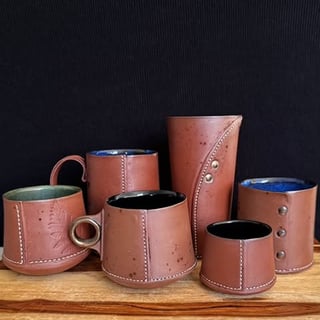
Speaker: if there's anything I hate and I'm not patient about, it's layering three layers of underglaze and waiting for it to dry. So I just don't do that. I kind of slap it all on, paint everything as much as I can. And then once things are pretty leather hard, I go through and carve with my carving tools. And that's pretty much, you know, then I bisk and I glaze and there's other little things like sanding and lustering and everything that go on later in the process. But the biggest part is the,
Speaker: I guess the silk screen, the painting and the carving. So tell me more about this silk screen. Yeah, all it is is I take some heat transfer vinyl and I cut it out on a Cricut. So I think you can do it by hand too. And then I iron it on top of some silk screen mesh. It's just like very, very fine mesh. And you basically end up with something that is really easy to wash, very easy to clean. It's pretty,
Speaker: Pretty much once it's done, you're not really wasting anything after that. I've been using the same silk screen for like six months now and there's no sign of wear and tear. Mako, I believe, makes a silk screen medium that is like this little, it's like a grainy little bit of sand that you can put on your underglaze and it turns it into a thick paste that's meant to go through silk screens. And so it's a whole thing.
Speaker: You know, I don't even know, there's a couple of potters who were doing something kind of similar that I saw on Instagram. And I was like, Oh, I bet I bet I could do that. If I just, you know, think hard enough. And eventually it worked out. It took a lot of refining though, to get it to a point where it's actually usable. I love that. So let's talk about the business side of pottery. Can you tell me about the moment when you decided to go full time with your pottery? Yeah, I think that I was pretty much always set on
Speaker: doing art full time. I think going to college and being in a studio art major, I was, I already knew I was going to be an artist. I just didn't know how or what kind. And I think it was after that time, you know, during COVID and just working every single day and chucking pots into the trash bin and saying like, this isn't good enough. This isn't good enough. I was just figuring out a way that I could sustain myself off of
Speaker: art, especially pottery, in a way that didn't force me to go through a gallery route, which is all great. And if that's something you want to do, you should do it. I just don't know if it was really for me for a good long time. So yeah, I think it was, we live in an age now where we can make money off of our art easier than ever. And I definitely wanted to give it a go. And now I'm here. What were you feeling when you became a full -time potter?
Speaker: I was fucking terrified. I had this big support system behind me with my family and friends who everyone just believed in me so much that I was going to be able to do this. And so I had to very much keep it to myself where I was like, I don't know how, like, what if this doesn't work? You know, those were thoughts I had to really keep down because everybody else was rooting for me so hard, which was great. Fantastic. I'm not complaining about that at all, but it was still very much a concern.
Speaker: Well, I just went to school for art. I just spent all this time perfecting what I do. And there's still a huge possibility that nobody wants to look at it or nobody wants to buy it. And then what do I do? And I never took a business class, which if you want to do pottery full time and sell it, take a business class. You know, I hadn't done that. So I was just learning everything kind of on the fly. And so it was scary, but it was also, you know, the first time I started making sales and, you know, getting more noticed, I guess.
Speaker: It was like, oh, this is actually a possibility for me. This could happen. And then I felt relieved, but I'm still scared all the time. I mean, running a business in this, this economy is scary, you know? So dang it. I had it. I lost it. I'm sorry. I had a good question for you. I lost it. No, you're fine. I ramble. So don't I take it. Okay. So there it is. What do you think helped you the most with being able to sell your own pottery?
Speaker: I think it was that support system that I had.
Speaker: That combined with, I'm an incredibly stubborn person and I don't like to, I don't give up if I'm set on something. I think that kind of just made for a perfect storm of everybody around me screaming like, you can do this and you're crazy to think that you couldn't. And me being like, well, everybody else thinks I can and I don't want to let anybody else down and I don't want to let myself down. So I'm just going to, you know, work my ass off until something happens. And it did, you know, I think sometimes I can have an idea of like, oh my gosh, all this stuff is happening, but it's not that it's happening. I mean, I did it and it was on purpose.
Speaker: So yeah, I think, I think definitely having really great people around you just knowing that you can do it and telling you that all the time really helps. So now you have almost 75 ,000 followers on Instagram. Can you tell me about the moment when you decided to put more attention towards Instagram? Yeah, I think when I first made a pot that I thought actually looked nice and wasn't just, you know, but ugly, I was like, Oh, maybe I should actually start, you know,
Speaker: selling these things and getting them online. And I started with TikTok, which, you know, that's where I kind of was trying to figure out how to use social media for my art. I'm not a big social media person, which sounds crazy with all the stuff I'm doing on my Instagram, but, you know, I don't have a personal Instagram. I don't use anything for myself because I just, I don't love how social media works. But when it comes to my art,
Speaker: You know, I loved making videos of the process. I like, one of my favorite things is like, when people ask like, oh, how do you do this? Like, and I get to kind of teach without having to go through a schooling session for it. I think eventually once I kind of started getting bigger on TikTok, I kind of made this connection of like, maybe I should try this on both platforms that are meant for sharing your content and everything. You know, better the chances that people see it, better the chances that people will maybe make a purchase. And I think.
Speaker: it just kind of naturally started happening. And then people are also a lot nicer on Instagram. So I was like, I think I'll, I think I'll stick here for a while. And it's been, you know, I think a lot of artists are also on Instagram. I've been talking with, I get to talk with everybody all the time and that's really cool. There's a, there's a bigger community of clay people who are just kind of doing the same thing and it's a lot more friendly than I like. So what do you think helped you the best
Speaker: for what do you think works the best for you on Instagram? I think it's, I don't want to sound conceited when I say it. It sounds like I'm tooting my own horn and I'm not trying to. When I started making videos where I just started talking about what I was doing or what I was thinking, that seemed to be where things started doing a lot better. I think, you know, I'm very proud of my work. I think it's unique and I think it's, you know, it's intricate. People like looking at it, but I think having my work combined with
Speaker: me talking about it or people being able to see who I am as a person, I think nowadays, I mean, you get flooded with art everywhere. And I think people more than ever want to connect with other people. And so I think just talking, I guess, and being myself and cursing all the time seems to be working. Why do you think that works so well for you? I don't know. I think I don't fake anything.
Speaker: I think that that helps. I think, I mean, we all know social media is fake as hell and everybody's trying their best and putting out their best foot forward. And I'd still do that too. But I think people who are out there and just actually being people and I'm not, you know, I'm not trying to be anything other than who I am. And I think maybe that is refreshing for people. I don't know. It's, I try not to get myself too deep into a thought hole about it because
Speaker: I'm just going to ride the wave while it goes. So now how, when you were trying to sell your own pottery, how do you use Instagram to help you with this? Yeah, I think because I share a lot of the process of me making my pottery, I try to let people see as much of that process as possible. I get a lot of people who are like, Oh, I really want to see the end result. And as soon as it's time to start selling my pots, which you know, I do every couple of months, I'll start
Speaker: just announcing like every three, two to three days, like, oh, I'm selling this on this date, you know, check out my store, you know, and having amassed a good amount of, you know, people following me on Instagram, you know, if even 3000 people see six months that I've made, there's bound to be a couple that are like, oh, you know, I kind of want that in my house. So yeah, I think it's just almost annoying everybody with it by talking about it too much, you know, post all the time.
Speaker: So you mentioned that you will do a shop update every couple months. Why do you do it every couple months instead of every month? I, this sounds bad, but I hate the, it's not bureaucracy. That's not the right word, but there's parts of the process that I really like to get lost in, especially, I mean, the making part. I think most potters prefer making to the, you know, spending hours editing pictures on the couch or doing anything like that.
Speaker: I also, I like to update my store with a big amount of stock, a large amount of stock. Like right now I have, I think 36 or 40 mugs that are just waiting to be glazed and I'm going to take my time with it because I used to rush and I would just make mistakes and I'd get anxious and be like, Oh, well, what if this patch isn't as good as the last one? And I think just doing it every couple of months gives me the space to try new things. I think.
Speaker: I never like painting the same design the same way twice and that takes time. I thought I've tried doing it once a month before like two years ago and I was just like every three weeks crying, you know, just trying to get everything done and it just wasn't working for the way my brain works. I think the really great thing about doing work like this and owning a small business and making pottery and being a full -time artist
Speaker: is that we get to set the way our business works. And if it doesn't work for me in some ways, I'm not going to try to force it. I love that. Shaping Nation, if you are looking to try to sell your pottery, you don't need to be selling your pottery every single month. Give yourself a buffer so you can make great quality work. I love that. So let's talk about discovering your voice. Can you tell me about the moment when you knew you were heading in the right direction with your pottery?
Speaker: I think there are a couple of moments and I think the first moment was when I sold my first pot was I really didn't even know anybody was looking at them. I was using Etsy at the time and I was painting a bunch of little unicorn teacups, I think is what I was doing. And I put one up and I was like, okay, it'll probably be like three weeks before I hear anything, if anything. And that evening I sold like three cups, one right after another and
Speaker: I was like, oh, oh, okay. Very exciting time. Pop champagne did everything. I think that was really important. Just, you know, I make my art for myself, but it's also for other people. And to know that somebody, a total stranger that wasn't my mom, you know, was into my art enough to spend their own hard earned money to keep it in their house was really, really cool. And I think the second time was I took a workshop from an artist that
Speaker: I've always been super inspired by Renee Labresti. You know, her work is incredibly detailed and just perfect in my mind. And I got to talk with her about my work and she knew my work and just gave, you know, really just talked to me like I was a peer, which like, I guess we are, but she's still this incredible artist. So in my mind, I was like, oh my God, like you are the, I'm your humble servant, you know? And I think having some just people you look up to start
Speaker: Complimenting your work and coming to you and talking to you and you're like, oh, oh I am somewhere that I didn't realize I was I guess How did that make you feel when she was talking to you like a peer? I Think in my mind, I was kind of like oh, I'm just I think I had this imposter syndrome about it. I was like, hmm Maybe she's just being nice. I don't know but you know she was talking to me about like being comfortable about pricing my work and really just
Speaker: like hammering it in on like, you can do this, like you're good, you know? And I think it was just hearing it from somebody else who did ceramics full -time and worked on the scale that she works on. I was like, oh, okay. Like it isn't just my parents and my friends, it's other people too. And I think that, and then slowly working on, you know, just getting comfortable talking on social media and talking about my work and things I was interested in, it all just started to
Speaker: make me realize that, like, people do give a shit about what I have to say, I guess. Not all the time. I still talk a lot of shit all the time. But yeah, I guess very externally motivated, it seems. But it worked for me. So you mentioned pricing your work. How do you price your own potters? So with my mugs, I recently just increased my prices. So my mugs, I kind of set them a standard and then any flaw they have, I start taking things off.
Speaker: So my mugs are basically set at $200, which is a lot. And when I first did that, I was like, I don't know if anybody's like, I'm going to get roasted on every platform ever. And, but it really didn't. I had a lot of really good feedback and there was, wasn't any, nobody was crying about it. And the way that I priced it was I had originally been, it was about 50 to $70 cheaper for a couple of years. I hadn't increased anything and it was like my prices.
Speaker: needed to increase as things got more detailed. When I went from my watercolor paintings and, you know, little dots of luster here and there to doing full scale, like everything's covered. Every piece of the mug is carved by hand. It was like, okay, this needs to go in a direction where I'm actually making money off of my time. And so I was combining a, you know, I wanted
Speaker: Having had a college degree in this and being, at this point, a professional, I'm paying myself above minimum wage. I'm, you know, applying for the costs it made to make the thing, including like shipping and, you know, cost of clay. I ship my clay and my clay is very expensive to ship in. So just doing all of that and combining it together, I kind of came to a price line that was in line also with artists doing similar work to me.
Speaker: So I guess it's a very roundabout way. I was just kind of checking all my bases to see what seemed the most fair for both me and the people who like my work. I love that. That was a great detail on that. Thank you. So what would you say was your biggest obstacle when it came to finding your own voice? I think myself really, I've always been very much in my head about everything and I think
Speaker: You know, I, I am my biggest critic. I'm my biggest obstacle to everything, which is why I think it's been so nice to have so many people behind me, you know, giving me the validation that I will hopefully one day give myself. But I think it took me so long to think that my work was worth it. You know, this is the first year since I started making full time that I've even tried to apply to a gallery or anything. Cause I was just like, I don't think it's going to get in.
Speaker: You know just things that holding myself back out of I guess fear or Fear of rejection a lack of confidence. I'm not really sure But I think I just did not give myself the benefit of the doubt enough, but luckily I'm getting over that I feel a lot better about my pottery. So things are definitely changing But yeah, I'm my own my own obstacle all the time What has helped you with getting out of your own head? I think just
Speaker: my kind of nose to the grindstone attitude about everything. This isn't like a, you know, there may be other people who would say, say much better than me, but it's like how, I guess my mindset was, how can I feel bad about my work if I've done everything in my possible ability to make it the best I can make it? And so even though that leads to some pretty harsh criticisms of myself and my work, it does lead to some also really great work, I think. So I think just,
Speaker: Working the confidence into things is kind of what I've been doing. I love that. That was some excellent advice right there. Now, what would you say are some new opportunities that started coming your way once you found your own voice? I think new opportunities. I think I've had my voice for a little bit of time. I think it was once I started getting traction on social media was when those opportunities started kind of coming in a little bit more.
Speaker: And it's not even that there's more, I mean, I'm, you know, doing this interview with you and I have a couple other things. I'm teaching a class in May and lots of things that, you know, people have reached out to me to do things, which is amazing. But I still have to go out and apply for things and look for things. And I think there is some level of that that I'm still getting comfortable doing. Yeah. I think.
Speaker: The biggest opportunity has just been being able to talk with more people. I think, you know, I'm very open when I talk online about my thought process and like my insecurities and mental health and everything like that. And I think maybe that leads to some pretty cool avenues for people to think like, oh, like I can talk to this person. And I'm really open for that. I've had a lot of people message me and, you know, lots of up and coming artists in their first pottery classes messaging me like for tips and advice, which
Speaker: I do love, so if you guys are listening, you can message me, it's all good. But yeah, I like all of the people I've been able to talk to, or people that relate to anything I'm saying, and then we get to have fun little chats, and I can maybe do art trades with people and do things like that. Lots of very fun, communal things, I guess. I love that. What advice would you give to someone looking to discover their own unique voice with their pottery?
Speaker: out of your own way, I guess is what I would say. You're not going to get anywhere if you don't make stuff. You know, if you don't fail, if you don't screw things up, you know, definitely read what temperature your clay is supposed to go to. Like don't melt or kill or anything. But if you're curious about things, there are people you can ask. There's the internet is super accessible to find things out and you're not going to know what you want to do or how you want to do it until you try it.
Speaker: And I think as far as voice goes and finding it, if it's through your artwork, a lot of that, I think if you have something to say or your ideals or your ideas, once you learn how to make the work you want to make, I think your voice will kind of implement itself anyways. So I'd say focus on technique, but also be free.
Speaker: Absolutely. Some excellent advice right there. Lee, it has been great chatting today. And as we're coming to close here, what is one thing you want to hammer home with my listeners today? Ooh, one thing to hammer home. I feel like I've said it. Be nice to yourself. Get out of your head. Bail a little bit. Break some stuff. Have fun. Excellent. Last party words of advice. Lee, it has been great chatting today. Where can my audience go and learn more about you?
Speaker: So I'm on both Instagram and TikTok under lawful underscore nature. It's all non -capitalized letters. And my website is lawfulstudios .com. Any of those ways you can find me, pretty easy. Hey, thanks for listening to this episode of Shaping Your Pottery with Nick Torres. If you want to discover how close you are to actually discovering your own unique voice with your pottery, I put together a free
Speaker: I hope you guys enjoyed this episode and I'll see you guys next time.