Transcript
Speaker: Hey, real quick before we get started. Before you can actually find your voice with your pottery, you have to find out what you actually like to make with your pottery. That's why I created a free quick start guide to help you do just that. Go to shapingyourpottery .com to get your free quick start guide. I'll see you in there.
Speaker: If you love pottery and want to take your skills to the next level, you're in the right place. Find your own pottery style right here on Shaping Your Pottery with Nick Torres. Let's get started. What is up, everybody? It's Nick Torres here. And in this episode of Shaping Your Pottery, I got to interview Julia Claire Weber. Julia is an author of the book A Beginner's Guide to Wheel Throwing.
Speaker: In this episode you will learn how Julia creates her geometrical mountain themed pottery. You will also learn about how pottery can be used to heal and how it's a really good thing for healing. And finally you will also learn about how you have to suck first before you can actually find your voice. Julia
Speaker: Welcome to Shaping Your Pottery and share with me what is one thing you believe potters should be doing to have success in pottery? One thing potters should be doing is practicing, making pots, making as many pots as you possibly can. I think that's the best way to be successful is just by tightening up your own craft little by little. Yeah, I definitely agree. Got to put in the reps for the to get better. Exactly.
Speaker: Tell me the story how you transitioned from pursuing a degree in health and nutrition into ceramics. Oh, well, it's kind of a funny story. I was always into art in high school. And so I was in this art competition my senior year and I said, OK, well, if I place in this art competition, then it means I'm meant to go to school for art. And if not, then maybe it means I should pursue nutrition.
Speaker: and I didn't place in this art competition. Back then I was a drawer and a painter, it was a painting. And yeah, I was so sad. I should have known right then, like how devastated I was that I made this wager with myself, but I didn't. And I went to school at Kent State for nutrition, thinking, you know, art must not be for me. And then my roommate was a fashion designer and I was watching her draw and I'm like,
Speaker: Well, I can draw. And so that's when I was like, you know what? I need to transfer. I need to pursue art. And so that's kind of what got me motivated. So I transferred to Edinburgh University to major in art education. Now, when you were learning ceramics, what would you say was your biggest struggle?
Speaker: Centering. Isn't it, everybody? Yeah, centering. I could not get it. I was so, so frustrated. I just thought this is nuts to be getting a grade in clay. But then I got it, you know, that moment when you have your hands on a pot and on the clay and it centers perfectly. And that was all that it took.
Speaker: Can you describe the moment when you were finally able to center a piece of clay on the wheel? Oh, it was an amazing feeling. Because I think everybody knows when they try pottery, it's not as easy as it looks. You watch your professor do it, you watch your instructor, and it looks so flawless. And you think, oh, gosh, this is going to be easy. And then you sit down and the centrifugal force of the wheel, all of it is harder than you imagined.
Speaker: Yeah, that was an amazing feeling. And directly after I centered, then I was able to throw a pot, and I still have that first bowl that I ever threw, and it's just like, it's amazing. It wasn't wonky, like it was centered, the walls were even, it was just a good feeling. Yeah, I remember my first time, I was super excited. I was like, yes, let's continue doing this. Yeah, right? I think that's what gets people hooked on clay, just the moment that you get it, you get it.
Speaker: Yeah, I definitely agree. So your parents are a big impact on you pursuing pottery further. How did having them in your corner just help you out in general? It helped immensely. I, I felt very fortunate.
Speaker: I know not everybody has that support system or the financial backing because you're broke for a really long time until you make it. So having my parents in my corner was amazing. I'm also an only child so that helped a little bit. They were able to stick with it and at times if I was struggling, they'd buy pottery or sell it at their store.
Speaker: Mom was a hairstylist, so she actually sold all of my beginning pottery, which is so fun. I can't believe people bought that stuff, because it's so one side's thicker than the other, one side's taller than the other. Very wonky, but yeah, they've been amazing, and they're still amazing. I have an empty house right now, because they're watching my daughter. That is absolutely awesome. I love it, because I think my parents are very supportive of me, too. That's great.
Speaker: So can you tell me the story how you started making your vibrant, geometric, mountain -themed pottery? Yes. It was really the move to North Carolina that did it for me. I've never lived in the mountains before. And before I started making mountain -themed pottery, I was doing a lot of florals, more inspired by vintage. But I wasn't really nailing it. It just wasn't right. Something wasn't right.
Speaker: And so when we moved to Asheville for the artists in residence at Odyssey Clay Works, I started hiking and being in the mountains a lot. And just that the, I remember going to one craft show and seeing this beautiful painting of the Blue Ridge Mountains, you know, with the cascading colors. And that's really all that it took. And then I just made one basic design from there and
Speaker: it was really well received. So I just kept going and going and going. So I'm still wondering like if it will come to an end. How did you know that this was like something that you wanted to pursue further with your style? It just clicked because I think for the longest time, and this is true for most people in clay, for the longest time, you're just trying to nail your craftsmanship. So you know, you want your
Speaker: lays to stay where it's supposed to stay. You want your bottoms to be nice and smooth and clean. And once I started nailing all of that, then the color schemes that I wanted to work with, it just all clicked. And I think at the time, certain electronic music was becoming really popular. And so the triangles, and I just got really into that path of geometric
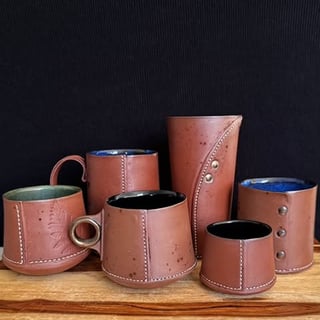
Speaker: geometric everything pretty much. So can you walk me through how you make your your geometric pottery? Yeah, so some of my work is pretty straightforward, like cylinders, because it's a lot easier to put a decal on a cylinder. So my process is pretty long. So I generally will throw everything. Because I enjoy the process, I could
Speaker: work with slip casting. I think, you know, I have a lot of friends that do it. I could do it, but I don't enjoy it. I slip cast my handles, but I hand throw everything and trim everything. And from that process, then I'll add stencil, do some stencil work or underglaze work, just to add some dimension. And then from there, I'll do Mishima.
Speaker: So the carving into the carving lines into the clay, the debate like inlay. And then from there, I'll, you know, bisque fire it and apply the glaze. The glaze, I hate the most. I don't love glazing. If there's any part of the process that I could ever pay somebody to do, I feel like it would be glazing.
Speaker: So I've tried to streamline that with just like a few glazes, because then once it's glaze fire, then I get involved in the decals. And that's where I really, really start to shine personally. I love that process of designing images and then putting those images on my clay. And then once I do that, I still have to fire it a third time. So it's a lengthy process, definitely. So how do you create your own, your decals?
Speaker: Um, so I have a special decal printer and I purchased it about 10 years now. So glad that technology is not, uh, outdated. So I purchased it through a company called Enduring Images and they're out of Colorado and they're assist like
Speaker: I guess they're like a distributor for MZ toner technologies, which is a company in Germany. And so they've created this technology where it's a graphic design printer, a Ricoh graphic design printer that's been gutted. So essentially the inks have been taken out and replaced with China paint toner. So, um,
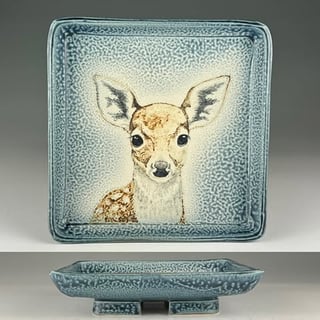
Speaker: for people listening, if you imagine, like Kurt Weiser is an amazing China painter. So instead of me hand painting everything, I'm using a printer that has CMYK, cyan, magenta, yellow and black, and then that creates my decals. And with technology now, you can just print it out right on decal paper and apply it. I used to have to screen print cover coat or laminate it, but I've totally crossed that out of the process, which is
Speaker: Amazing because that was a whole nother whole nother step. Love it. Technology helps so much with keeping things a lot smoother. Yes. Yeah. In some ways it has. In some ways it's complicated things like I really complicated my process with this, but but I like it. So it works for you. Yeah. So let's talk about your book, The Beginner's Guide to Wheel Throwing. Can you tell me the story on why you decided to make this book?
Speaker: So I never imagined that I would write a book, but one of my students was an editor for this book company. Oh my gosh, I lost my earring. I haven't attached them yet, of course.
Speaker: They're not finished. I was like, I should wear my own earrings. Anyways, so the editor for this book company, which has produced several important clay books, took one of my clay classes and said, you know, I have a passion for teaching. I've always loved teaching. And Beginner Wheel really speaks to me because like I said, that moment when I could center, it just felt so good. And so I wanted to create
Speaker: book to help people like just like me because I started out making wonky pots just like everybody else and so I wanted to make a guide to help others kind of find their voice faster basically and I'm I'm so thrilled because I was never great at handouts. So now this is the I never have to write them again. This is the best handout I've ever made and
Speaker: Hey, if you're enjoying this episode, I would really appreciate it if you could share it with one of your friends. I'm sure somebody out there could get some value from this episode. I would really appreciate it if you could share it. Now let's get back to the episode. What advice would you give to wheel throwers just to help them with wheel throwing in general? So if you're struggling, my best tip is it's all about the left hand as far as centering. So you'd be like,
Speaker: Like when I, when I show my beginner students how to center on the wheel, I actually put my hands over their hands and show them what kind of pressure you need. They're like, Oh, that much pressure. So it's really about keeping your left hand steady. And when I was, you know, younger, it was, I didn't have the upper body strength and it doesn't require a lot, but it does require some.
Speaker: You know, like after your first few times throwing, you actually feel your sore. So I've used like my left leg to help with stability, like getting your elbow in the crook of your thigh, basically, so when you're centering, you're really coming in with your left hand. So that's one of my biggest tips. And I feel like when people take my class, I just come and I just bring their left hand in and they're like, whoa,
Speaker: That was it, like that's it. So, and that's like one thing that, I'm sure my professor said something, but when you're struggling, you get so frustrated. That's another thing, you can't get frustrated. Because once you get it in your head that you can't do it, you're not gonna do it. So you just have to stay positive and keep trying. Even if you just, you know, get rid of the clay, start with a new ball, get rid of the clay, start with a new ball, you'll get it. I definitely agree. For those who are listening,
Speaker: If you are just starting out with wheel throw, you have to stay positive. And if you mess up, just get a new ball and start over. It's okay to start over. You'll get it eventually, I promise. It all takes us a while, but you'll get it. Yes, you got it. Yeah, if you give up, then obviously you're not going to make it. So now you mentioned teaching that you love teaching. What is it about teaching that you love?
Speaker: I think making other people feel good. I think that's what it is, seeing their excitement because I took a break from teaching for a while because I had some success early on with Instagram and selling my pottery. I was like, oh, this is so great. I could just make pots and sell them all day. But then something felt like it was missing. I was making pots to sell them and that was beautifying the world in a different way.
Speaker: I didn't feel like I was giving back to my community in any way. And so I feel like teaching is very thrilling because it makes other people feel good. And if I can help somebody struggle just like a tiny bit less than I did, then it's totally it's all worth it.
Speaker: I definitely agree so much that part of the reason why I started this podcast was to help other potters out. That's like my biggest thing because it's it's it's a long road with us and it's it's hard and we have a lot. It's amazing. Yeah.
Speaker: We have a lot of experience that we can give out to others. And that's why I like that a lot. So something that I found interesting on your website is you said, I used clay as a tool for healing and learning. Can you explain this to me some more? Yes. So when I was in Pennsylvania, I managed a clay studio there called Clay Space run by the Erie Art Museum. And at the time I was like just
Speaker: having a hard time figuring out how to create income from this. And so I started applying for grants with the help of the Art Museum. I didn't actually write the grants. I can't take credit for that, but they wrote the grants to bring in refugees, Bhutanese refugees, because there is a large population of them in Pennsylvania.
Speaker: They were having a really basically the elders they were having a really hard time assimilating to our culture Like they didn't even know what a green light meant. So crossing the street was dangerous for them so we used clay as a tool to help get them to speak English and Obviously, I don't speak Bhutanese, but it was so rewarding even just like reading a clock like they have to go to appointments but they've never read a clock before so clay
Speaker: was just so good for them to make them feel good about themselves, to feel like they belong to part of a community. And it was so cute because the language barrier, they did some funky stuff with underglazes, putting them overglazes, because I'm like, how can I communicate this to them without a translator? And so surprisingly though, they made some really amazing work.
Speaker: that they were able to take home and give us gifts, which was something, you know, they didn't have any money. So it was an amazing tool. And I also, um, now we do programs for veterans, which is amazing because it helps them with the healing process of PTSD and also, um, kids that are in recovery from drug, drug use. And that's been very valuable too. So clay is amazing.
Speaker: So how does this help with BTSD and just healing in general? I think clay is just amazing. It just has this tactile, beautiful quality to it. We're just even touching it feels good. And especially for the veterans, I think being a part of a community, it's all about the community because they come to a place where they feel safe.
Speaker: and where they feel welcome, where they won't be triggered by things, because we're all very aware of what they've gone through. So Clay just brings the community together. And we've had people stay for, oh gosh, so many. They just become part of our studio. We know them by name, by the end. So. I love it. That's really amazing.
Speaker: So over the last 15 years, you've had the opportunity to teach and attend residency. What is something you have learned that you still use today? Oh, so much. I'm still processing all of the things that I've learned from residencies. I feel like I it will take years to process some things like the first see the first workshop that I assisted was Kristen Kiefer's at Pennland and
Speaker: It was basically about how she makes her pottery in a week, like a quick rundown of everything. But she also included darting, which is something she used in her earlier work and is using again. And just that one little thing took me into an abyss of a different direction. So the way that she taught us
Speaker: I kind of absorbed it and then used it in my own way. So that's how I started making the geometric shapes. So that was one amazing thing. And then I took Jason Burnett's workshop.
Speaker: Also, I assisted one of his, well, I assisted a couple because he's so much fun. And whew, they were a lot of work though. So, but using underglaze and using slips and just to create more dimension with my work, that was super valuable because for a while I was just using glaze and there wasn't a whole lot of depth going on. So,
Speaker: I think the more workshops you can take, that's truly where I found my voice is by taking workshops and absorbing all that information. And then I have amazing things to show my students later. So yeah. So you mentioned depth. What do you mean by adding more depth to your pottery?
Speaker: Well, you know what they say, the longer it takes to finish it, the better it is. It's not necessarily true, but I think I've thought a lot more about the surface and, you know, like a painting, if it looks flat, it's flat. And so adding more to the surface does create depth, like using the stencils.
Speaker: I use Tyvek instead of paper sometimes because you can reuse it over and over again. So when I'm doing production pottery, I have these cutouts and I put it on my leather hard and then I paint over it with underglaze. And so there's a layer. And then I let that dry and then I carved through it. So there's another layer. So just like when you look at it, there's just more to look at than the decal because for a while I was just putting decals on white clay. So I've evolved since then.
Speaker: love it. So let's talk about finding your voice. How long did it take you to actually find your voice? I think quite a while probably till up until I moved to North Carolina. And it's a journey because it feel like it's hard to find your voice without starting to master the craft in a way. Because you get to a point in your making where
Speaker: When you can make whatever you see in your mind, that's a very sweet spot to be. And so I think my getting your skill level up is the best way to find your own voice, like to just keep making pots, keep making pots, keep trying things, trying different techniques. Because for me, it was more of happenstance. It just happened where, you know,
Speaker: through all the information I learned in undergrad and through all the workshops that I had taken, I finally started making work and it just clicked. So I think drawing on your inspiration is a really good idea. Having an inspiration board, seeing what kind of pottery would you want? What are you drawn to buying? What do you like? All those factors are good at finding your own voice.
Speaker: I love it. So when you found your voice, what were some of the opportunities that started to come your way? Invites to shows, which was really some of the proudest moments in my career was when I was invited to shows with some of my idols, people that I had idolized while I was in undergrad or had them come do workshops at college. So that was
Speaker: I think that that was the biggest thrill to be invited to shows with people that I had never ever thought I would be on the same level as. And I still don't feel like I'm on the same level, but it's an honor. It was such an honor. Yeah. And let's see here. I got some books. I'm using books to hold my laptop up.
Speaker: Uh, this was one of the, excuse me while I move all these books. This is one of the biggest thrills of my life, uh, meeting Deb and assisting one of her workshops and then being asked to be in her book. I think that was, I'm still kind of starstruck by that. That is really, really, really awesome. So as we're coming to a close here, what is one thing you want to hammer home with my audience today?
Speaker: Oh, keep, keep going. Don't give up. Keep going. I know it's really hard, especially when you're when you're trying to find your own voice, that means you're experimenting. And when you're experimenting, things are not always things might not go for well for a long time. So keep trying. If you're the type of person that gets very attached to your work or attached to a special piece, then don't
Speaker: don't just finish it, maybe make some test tiles or some test pieces, experiment on those first. Cause I have a lot of students that are, they make this bowl and they're, it's the best bowl they've ever made. And then they just dive right in. And then they're upset that it doesn't come out the way that they wanted it to. And it still might not, even if they do testing. So I think just knowing that we, we give a lot up to the kiln gods and
Speaker: Just hope for the best and just keep trying because we've all we've all been there and like right now I'm experimenting so I'm I'm making some horrible work and That's fine. Because that's the only way that I'll get to the place that I'm going. So Yeah, that's my my advice. Keep at it. I Definitely agree with that. You got to suck before you can get good and be able to actually find your voice You're gonna make some crappy pots. It's okay
Speaker: Julia, it was really great chatting with you today. Where can my audience go and check out your work? Instagram is probably the best place. Julia Claire Clay is my handle and I've been fixing my website for years.
Speaker: I would definitely go to Instagram first. That's kind of my jam right now. Thanks for listening to this episode of Shaping Your Pottery. If you have questions about developing your voice or just pottery questions in general, send them to me my way. Go to shapingyourpottery .com forward slash contact to send me your questions.