Transcript
Speaker: Honestly, it was all by accident. Like I, I was just trying out whatever I wanted to try when I was starting. I would see things and I was like, Oh, I want to figure out how to make that. What is up Shape Nation? It's Nick Torres here. And on today's episode, I had the great pleasure of interviewing Ellie Gao. Ellie makes some really incredible, bright colored pottery and also wobbly coat pottery.
Speaker: And in this episode, you'll learn how Ellie started making these completely by accident. You also learn about why you need to start being a little bit more intentional about how you make things. You also learn about the benefits of a shared studio. And there's so much more in this episode. I hope you guys enjoy it. I'll see you guys in there.
Speaker: If you love pottery and want to take your skills to the next level, you're in the right place. Find your own pottery style right here on Shaping Your Pottery with Nick Torres. Let's get started. Ellie, welcome to Shaping Your Pottery and share with me what is something you love besides making pottery.
Speaker: I mean, at the moment I've been loving cooking. I've been really like getting very experimental and in the cooking world, I could say. But I have a lot of hobbies. I love watching movies. I'm in the film industry as well. So I've been watching a lot of the awards season films that are coming out at the moment. Yeah. Just doing all the things. Absolutely love it. So tell me a story how you started making Potter.
Speaker: I started making pottery consistently in 2020, but I had kind of dabbled since, I guess, 2017. I took my first one -off pottery class, and then took a four -week wheel throwing class in 2019, and then bought a wheel in 2020. So I kind of had learned like a few of the basic fundamental throwing things, and I kind of knew how to hand build.
Speaker: mostly taught myself after those kind of beginning classes until yeah 2021 when I really took like a pretty intensive eight -week course and refined some things and was on my way. So you mentioned that you started pottery in 2017 and then you picked it back up again in 2020. What made you pick it back up again?
Speaker: So I picked it back up in 2019. I just really had wanted to do it for so long. Like I just, it was always like on my wish list. I had just done the artist way program or like I started it and I've finished it. But one of the questions they always ask you.
Speaker: is like, what would you do if money wasn't an issue? Like, what would you like to, how would you like to spend your time? And I was always like, I'd love to have a pottery studio or I'd love to do pottery, but I live, I was living in Los Angeles at the time and I'm also an actor and being an actor is very expensive. So my acting classes were like,
Speaker: three hundred dollars a month. All my acting subscriptions were expensive and I was kind of living like paycheck to paycheck so I just didn't think that I could afford to to do pottery and then I took some time off an acting class and instead of spending it on that I spent it on a pottery class. So that's kind of how I started to feel like oh maybe I could do this
Speaker: not as well as acting but like instead of acting just for a little bit to you know try something new because i think that's really important i love that so on your instagram you have talked about how ceramics can teach many life lessons what has been something that you have learned that is from party that's impacted your own life i think just patience like you know you really you think you can control things you can't but yeah you just gotta
Speaker: You gotta go with it. I think everything that I've kind of, like my style now is very indicative of me just trying things and going with whatever happens rather than trying to control an outcome. So yeah, I think just releasing control. I love that. So you mentioned that you were an actor. Are you still currently an actor? And if you are, how are you, how are you balancing being an actor and also being able to make pottery as well?
Speaker: I mean acting is kind of one of those long term I think careers unless you get lucky in the beginning or it's very up and down. So for me last year all I did was I shot a movie in Australia and that was it. So I made a movie and that was like a month of the year and then the rest of the year I'm
Speaker: auditioning for things so they're very up and down you know some ways you have really crazy auditions you might have a few a week or you might have like one a month or you might have nothing for a few months and we actually had I'm not sure if your listeners will be familiar with like what's going on in the entertainment industry but last year was
Speaker: one of the craziest years that we've ever had because we had a writer's strike starting in May, which is the WGA, the Writers Guild of America and the Actors Guild of America, which I'm also in. So we were on strike, I think we were on strike for four months and the writers were on strike for four or five months. So there was like not a lot of work happening in the US and there also wasn't a lot of work
Speaker: in Australia, cause a lot of Australian productions are also American productions. So kind of like trickled down into Australia. So there really wasn't much work last year. So I could really focus on mainly just creating content and getting settled back in LA. Cause I haven't lived here for, I hadn't lived here for two and a half years. So I just really wanted to become part of the community here in LA and build a community online. And yeah, I did that.
Speaker: I love that. So we're going to talk about more about building a community online a little bit later. But for now, let's talk about your pottery. Can you tell me the story how you started making a pottery that you make today? Honestly, it was all by accident. Like I...
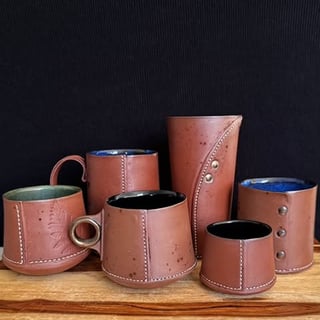
Speaker: I was just trying out whatever I wanted to try when I was starting. I would see things and I was like, oh, I want to figure out how to make that. So I would just try to make it. And the wobbly kind of ergonomic look that I do now.
Speaker: came about because the old wheel that I used to have was didn't have a bat on there and so I would take my pieces off and because I wasn't very good my pieces didn't have a lot of structure to them so I'd pull them off the wheel and then they would collapse because they were so wet and I'd try to like fix them
Speaker: when they were collapsing, so they weren't collapsed. And they, a lot of them ended up having this like, they were all tiny. They were like these, if you really scroll down my page, you can see they ended up being like espresso cup sized. And I put like checkers on them. And I think I did like a
Speaker: a gingham pattern and they were like squeezed in they looked like I kind of squished them and then someone reached out to me to ask I did a collaboration with a candle maker in Sydney and I was like okay what kind of vessels are you thinking about like what shape do you want and she pulled up that photo and was like oh I like I like these ones can you make these and I was like oh I don't know that was that was an accident I don't know if I can replicate that
Speaker: Anyway, so I tried and I ended up having so much fun with it. And I think we made like 30 something pieces for that. But yeah, I ended up really enjoying the process of that and was like, okay, I feel like this is the style of my cups that I wanna make. And yeah, from there, I've just kind of been refining that as I go.
Speaker: I love that. I love that so much. Shapingation, sometimes the accidents are what is going to lead you to actually finding your own unique pottery voice. I love that. Exactly. So you mentioned that you were refining those pieces. Would you mind telling me more about that? As in like refining them how they look now? Is that what you mean?
Speaker: So I think my most recent wobble cups, they have a lot more structure to them. I used to kind of like squeeze, just squeeze them with my hands and then create like a single thumb dent. And I like that way of making them, but I realized that over time,
Speaker: I personally, I don't like making mugs anymore. I know people love mugs, but I'm a bit of a, yeah, I'm not a fan of mugs. So I was trying to figure out a way to make a cup that
Speaker: you could hold with like hot, just like a tea or hot water in it that wasn't gonna burn your hands. So I made it with a foot ring so that you can hold it kind of from the top and the bottom at the beginning. And I drink black coffee, so I want it to be like hot when I have it and then be able to hold it in my hands. But I think now my pieces are more refined and consistent.
Speaker: I would say I can kind of create a more consistent shape. And I think they've got more, they're more structured, like the dents are more intentional in each, like there's more consistency. Before I was just kind of squeezing and everyone be slightly different, but now it's more of a variation in like shape rather than where the mark, the markings are.
Speaker: I love that. Shaping Nation, sometimes you have to be a little bit more intentional about what you're trying to make in order to make something a little bit more different and a little bit more unique. I love that. So you are inspired by color and creative freedom. Can you tell me, how does this impact the way you make your own pottery? I think I'm just always trying to, like, I think I'm always looking for colors that work well together. So,
Speaker: I'm not, I've always been very drawn to pink, which has been very hit or miss at my studio lately, to be honest. I used to have my own glaze, but now I use the studio's glaze. I don't really know how to answer this question. Cause I think sometimes I am really inspired by color and sometimes I don't want to make colorful things. I've been recently leaning towards making more like muted colors. I'm not sure if it's a season. I know that it does say on my website that color is
Speaker: is a big inspiration for me, but I'm always trying to create like contrast and interesting colors. Like I'm very specific about that. If I'm doing something that's very colorful, I want to make sure that the colors really work well together. And I'm not just putting any colors on there. Like it's very thought out about the combination of the colors. I usually will go like either within a certain part of the color wheel or I'll do like, what do you call it? Like contrasting colors, like on the opposite side to create
Speaker: What do you call it? Contrast? To create contrast, yeah. I love that. That's a very great and easy way to actually do that. I love that. Yeah. So something I found interesting from your website is you use both stoneware and porcelain clay. Can you tell me more about this? I mean, I personally love using porcelain because I think
Speaker: It's a higher quality of clay. It's finer. I love to throw with it. The only thing is it's a higher price point. So it means that my work has to be more expensive and it's also a more difficult clay to work with. So I do have a lot more problems with stoneware and the glazing and the firing. It's a lot more unpredictable. I also work in a shared studio so I don't have full control over everything. So I like to use stoneware just to
Speaker: I don't know, lower the stakes a little bit. I also find that I get bored of making one thing with using one type of clay, like I'm definitely not the type of potter that will just, I do one thing, I work with one clay, I work with one color, or like I'm, I'm always kind of trying new things and
Speaker: experimenting still. I'm still, I think I'm still pretty early days of pottery. So yeah, I'm not married to one thing, but definitely cups I like to make in porcelain. I think that they're an item that you tend to use more often. So I like that they're a higher quality. I also like the porcelain for my like wobbly pieces can warp in the kiln a bit. So it still will change shape
Speaker: depending on, you know, how I've thrown it. So yeah, I like the unpredictability of porcelain. I love that shape nation. Always be trying to experiment with new things, even if it means changing different clays, because that's how you're going to continue growing as a potter. I love that. Now, can you walk me through how you create one of your bright and wobbly pieces?
Speaker: So the wobbles I will just create with my hands on the wheel so that's all in the I guess the initial design stage and the the colorful pieces I use a compression a compressor and like a airbrush spray gun so my studio has has one of them and that's how I've been able to create that pattern like I never
Speaker: never was able to do that before in Sydney because I don't want to invest in a compressor because they're pretty expensive and huge and bulky and I just yeah I wasn't ready to do that so yeah I'm spraying them on. I use glazes in my on my pieces so I'm not actually spraying underglaze so the glazing of the the pieces with the airbrush fan is actually quite specific because
Speaker: I mean, I'm sure your listeners will know that glaze is very unpredictable. When you start to mix certain glazes, they can react with each other. So I have to be really specific about the layers of the glazes that I'm doing. So I don't start with a gloss glaze. I'll always start with a matte glaze and then finish on a gloss. I always glaze the inside first and then clean up the outside. Like if I get any dribbles and then I leave it to dry for
Speaker: completely dry, so it needs to dry for like, depends on the temperature and the humidity in the day, but it will usually be like.
Speaker: I started leaving it overnight if I can, and then I'll come back to it and spray that outside. And I have to do that outside because our spray booth that they've been telling me at my studio is gonna be ready like for almost five months is not ready. So yeah, I'm spraying them outside. So the weather plays a big part of it. Like it was so hot when I started to spray glaze and I was getting like crazy, you know,
Speaker: tans, shirt tans and like the back of my neck was getting I was only using like a just a N95 face mask and then I started like feeling like my lungs were starting to get damaged so I was like I need a respirator and that's changed the game but usually when I I like to batch blaze them so I'll wait until I have
Speaker: a good chunk of them because I go like one color at a time and then I clean it and then I go another color and then I clean it. And the whole process can take me anywhere from like three to five hours. And by the time I'm finished, I'm so dirty. Like I'm just, I covered in glaze. I love that. I always heard that glazing is the longest process in everything that we, in pottery pretty much. Yeah, it's, I have, I don't love glazing and
Speaker: I don't love spray glazing, but I love how it looks. So I kind of have to, I'm really keeping that in mind. And, you know, I, I'm very nervous when I spray glaze. If it doesn't work out, I've only had a few times where it hasn't worked out and I'm not happy with it, but most of the time I've, fingers crossed I've been very successful so far. And yeah. Absolutely love that. So you mentioned that you are in a shared studio space. So outside of having all the tools and glazes,
Speaker: What other benefits are there to being in a shared studio space? There are so many benefits to being in a shared studio space. One benefit is I don't have to load my own kilns and do my own firings, which is also a con definitely at some points, but loading a kiln takes a long time. You have to wait until you have like a full kiln to fire things usually, or like you probably, I don't know, depends certain potters don't always fill a kiln, but you,
Speaker: It just means that I can turn around work slightly faster, which is good. It also means that if I like split things up in different firings and say like a certain firing doesn't really work out, then I haven't lost a whole batch of something. So that's nice.
Speaker: My studio also offers free recycled clay. It's got a slab roller. It's got a bunch of all these really expensive tools. It obviously has a wheel. I don't have to buy a wheel. I don't have to buy a kiln. I don't have to worry about kiln maintenance. This studio in particular has amazing glaze.
Speaker: actually they used to have amazing glaze now they have changed a few recipes and I'm not stoked with them so I've lost access to my pink glaze and my crackled green glaze which I'm a bit disappointed about but other than that great community the teachers there are really great so if you have any questions you can ask them you can also meet other potters you can get inspired by other potters
Speaker: they have discounts on tools, clay. I get to try like a bunch of, I guess, different clays that I might not have access to. Like, you know, someone's like, if they're a free bag, sometimes they give away like free bags of other members that, you know, leave the studio. So it's been able to give me access to a lot of, a lot of tools, people, community, they have sales that I can be a part of. So it's just a really great way
Speaker: I think to make pottery less confusing because
Speaker: year -round people. Whereas when I was at home, I was constantly like searching YouTube and just trying to figure things out on my own. And I was making a huge mess in my house, which was honestly very dangerous because you don't want to be breathing in clay dust. So a studio just gives you access to like clean, dedicated space. And I really liked that aspect of the shared studio, but I wish it was bigger. I don't have the storage space at my studio, like the private workspace that
Speaker: I would like to have in the future. I love that. Shaping Nation, if you're thinking about wanting to get more into pottery, but you don't have the space or the resources, try joining a shared studio so that we already have all the resources there and community there with you.
Speaker: Yeah, I think if you, a lot of people ask me this, they're like, what do I need to start pottery? You need, if you want to just hand build, you don't need that much, but it's so expensive to buy all the things and then the transporting them, which I don't have to transport my pieces to the studio. And I definitely like damaged pieces in the past transporting them. So yeah, it's good in that aspect for sure.
Speaker: Transporting pottery is the most stressful thing I've ever experienced. It's so stressful. So let's talk a little bit about the business side of pottery. And we're going to come back to what you said earlier about building community. Can you tell me more about that? My goal for last year was to just, I've been creating video content, honestly, since I started. Yeah. And I really put my head down when Reels first started in 2020, I think maybe was when they got
Speaker: kind of popular and I saw a lot of growth then, but I also had a lot of free time to make the content. And then after that, I was like, oh, I don't want to spend a day a week filming and like edit every day. I want to hang out with my friends because COVID's over and what was, it was kind of over in Australia.
Speaker: But creating a community, I honestly, I really wanted to, and I still want to stop. This is definitely, I'm not here yet, but living in LA, it's really competitive here for pottery, more so than Australia, I think. And I had a community in Australia of people I could sell to
Speaker: in person I have my friends I have my family and my extended family I had friends of friends I had just like way more people that wanted to buy my work and here I don't have that so I wanted to stop relying on going to markets because people don't spend
Speaker: much at markets here in the US compared to Australia. It's definitely people in Australia go to the markets more frequently. I don't know exactly what it is if it's like there's too many markets here in the US or like LA specifically to buy things out or if people just want to buy things online more. So I just wanted to create
Speaker: I guess more of a following online so that I could move on to online sales more and I follow a lot of potters that do that so it's like how how what are they doing how can I do that and what can I offer people that's more than just like buy my work you know like I want to
Speaker: share my things I've learned along the way. And I learned so much from watching other people's videos when I was just starting out. So it's almost like I'm giving, it feels like I'm giving back to the community in a way, because yeah, that's how I learned a lot of the things when I was just at home with my little wheel, like trying to figure things out. So yeah, that's, that's why I make them. I love that. So something interesting I found
Speaker: from your Instagram is that in five months, you grew your Instagram from about a thousand followers to over 10 ,000 followers. Can you tell me more about this? Yeah. So I was sitting at like, I think 1600 when my first video and really buyer on the like slowly went viral, but I've been making content for three years at that point before I got there. So to be honest, I think I just got good at
Speaker: making content after all that time of trial and error and seeing what people wanted and just honestly putting my face in my videos more i'd always been a bit like i don't i don't want to do that i don't want people to see me making things and i was always really shy in the studio like with my camera and kind of like putting it at a bad angle and you know making making things and not really showing the whole process and
Speaker: If I'm making these videos and the videos that I like to watch are such high quality, there's so many angles, there's a lot of things going on. So just kind of worked on getting over the anxiety of I guess the self -consciousness that I had in my studio to film myself. I just got over that literally.
Speaker: just took, got, I have my tripod, you're on it now, it's my clay tripod, it's filthy, but I will take it into the studio and just set it up. I stopped being embarrassed about it. I was like, I don't care anymore. There's nothing, it's not embarrassing. What's more embarrassing is sitting in a market all day and losing money. Like that's more embarrassing to me now. Like I just need to put content out there. So yeah, I just started filming myself and I set myself a goal when the strike happened. I was like, I wanna,
Speaker: I want to put content out at least five times a week. So I want to be making content almost every day. So I did that for a few months. And then I finally had one video that went really viral, which was me making my martini glasses. And I thought that I kind of knew what I was doing then. And I still had a few videos that didn't really hit. And then from there, I've just kind of focused on more storytelling in my reels. So I'm less.
Speaker: I'm less of just like, here's the thing I'm making. I'm trying to engage people by telling stories. So I've definitely found that since I started doing that, the growth has been very fast, but it was like three years of work. So it seems like, oh, all of a sudden she's got all these followers, but I was practicing making content for years. I love that. Now what benefits did you see once you got past that 10 ,000 subscriber, follower mark?
Speaker: I mean, honestly, I still haven't seen a lot of benefits yet. I guess recently I've had a random commission from a new person, which hasn't happened in a while. It was happening a lot in Australia, but not since I've been here. It's been a lot of like friends or a friend of a friend. I've had a few brands reach out to me, sending me a few things. So I guess like kind of hitting the,
Speaker: micro -influencer level. I mean, I don't know, but I'm still in the very much in the early stages. I have a lot more people kind of DMing me, asking me like pottery related questions now and I do my best to answer them. But sometimes I think people honestly just don't want to watch my videos because a lot of the answers to what they're asking me in like in my videos. So
Speaker: Yeah, I think that you used to be able to have, I remember when I started pottery and someone started working in my studio, they had 10 ,000 followers and they were like, once you get to 10 ,000 followers, you know, the work just sells itself. And she would do online drops of like 50 pieces and she would sell it instantly. But now I think that
Speaker: you kind of need at least like 50 to 100 ,000 followers or just like have a really engaged audience to sell out immediately because I'm still not selling out immediately. So yeah, I'm not sure if it's me or if it's like, that's kind of where the world's at right now. I love that. That was awesome. So let's talk about discovering your voice. You contribute growth as an artist to the COVID lockdown. Can you tell me more about this?
Speaker: I honestly think it was just like having time, like just having time to do it. It's such a luxury to not have a job. I was in Australia so I actually, I was getting like government support, which was like the first time that I had ever
Speaker: had disposable income as an adult, you know, like living at home, you're paying rent, you're doing classes, you have a little, I would have like a little bit of money for like hanging out with my friends and food. And then that was, I was like, oh, okay, well, my money is gone. I'll book an acting job and I'd have to like ration that out so that I could like survive auditioning for a few months. So I think having, yeah, like time
Speaker: financial freedom for a few months. I accidentally like got stuck in Australia for three and a half months. I thought I was gonna be there for three and a half months and then my flight got cancelled back to the US and I was like living in my parents house so I was like oh my god I'm not going back to the US anytime soon like you guys America was having like crazy
Speaker: crazy like it seemed crazy from where I was in Australia my friends were like don't come back here it's terrible so yeah I stayed in Australia and had time and money and the community there was great and then I people in Australia were like reaching out to buy my work so it wasn't I wasn't like trying to sell my work it was just like friends being like oh can I get this and then yeah I was able to
Speaker: I guess sell it. I don't know. That wasn't your question, but yeah. I love that. Shaping Nation, sometimes the best way to find your unique voice is just to have a little bit of time working on the actual pottery. I love that. Now, what would you say was your biggest obstacle when it came to trying to find your own voice? It is obstacle. I guess just not being like good. Just being like bad for a while and just trying to figure out like how I did
Speaker: something. I think my biggest obstacle initially was trying to replicate a piece so I would like make something by accident and then I would try to replicate it. I think my first year of making pottery and I had really only been doing it for about six months, I opened up a wholesale, not wholesale, commissions for Christmas and I had my friends put in like so many orders and I was like oh my god I don't actually don't think I have
Speaker: the skill set to make that. But I ended up doing it. So now that I think about it, I think that the only obstacle was myself. It was just me thinking, oh, I can't do this. And then I always would do it. And it would work out. And it would be good. And they'd be happy and I'd be happy. So yeah. I love that. So now, what advice would you give to someone that is looking to discover their own unique voice with their pottery? Just make stuff.
Speaker: Just do it and see what feels good for you and what you like to make. And yeah, you just kind of have to keep making things to feel like you know what you're doing. The confidence comes with time. You kind of have to earn it. It doesn't just, yeah, it doesn't just show up overnight, I would say. Some excellent pieces of advice. Ellie, it has been so great chatting with you today. And as we're coming to a close here, what is one thing you want to hammer home with my audience today?
Speaker: Just do it, you know, just do it. And if you can't afford to make pottery, just buy some. I know it seems really expensive, but I guess all of your audience already make pottery. Just keep making stuff and you'll figure it out. Some excellent words of advice right there. Ellie, where can my arts go and learn more about you?
Speaker: They can go to my Instagram, which is Elga, E -L -G -A, which is my first and last name put together. A lot of people think my name is Elga, it is not Elga, it's Elga .ceramics on Instagram. They can go to Elga Ceramics on TikTok.
Speaker: They can go to elgoceramics .com and you can buy things from me online or you can inquire for what do you call it? Customs commissions. And I also do Instagram audits. So if you're interested in me auditing your Instagram, I offer consultations and I'm also on YouTube and Ellie makes stuff. Yeah. I haven't posted many long form videos, but I posted two. Maybe we'll do more in the future. I don't know.
Speaker: Hey, thanks for listening to this episode of Shaping Your Pottery with Nick Torres. If you want to discover how close you are to actually discovering your own unique voice with your pottery, I put together a free four question quiz. It's very short. It takes 30 seconds for you to take. If you want to know how close you are to finding your own unique voice, go to shapingyourpottery .com forward slash quiz, or you could simply go to shapingyourpottery .com and it'll be right there at the top.
Speaker: I hope you guys enjoyed this episode and I'll see you guys next time.