Transcript
Speaker: Hey, real quick before we get started, if you would like to find your own theme for your pottery so your voice really stands out and you're not getting bored with making the same thing over and over again, I put together 53 themes for you guys and it's completely free. All you have to do to get it is just go to shapingyourpottery .com forward slash 53 themes. That's shapingyourpottery .com forward slash 53 themes. I'll see you guys in there.
Speaker: What is up, Shaping Nation? This is Nick Torres here, and on this episode of Shaping Your Pottery, I gotta interview Jordan Coons. Jordan makes some really incredible double -walled pottery. In this episode, you're gonna learn how Jordan makes her double -walled pottery. You're also gonna learn about leaning into your inner voice. If it's telling you something, lean into it. Finally, you're also gonna learn about getting into a childlike state to help you really enjoy the pottery process.
Speaker: I hope you guys enjoy this episode and I'll see you guys in there. If you love pottery and want to take your skills to the next level, you're in the right place. Find your own pottery style right here on Shaping Your Pottery with Nick Torres. Let's get started. Jordan, welcome to Shaping Your Pottery and share with me what do you think potters should be doing to have success in pottery?
Speaker: So it almost feels weird for me to tell other potters what to do. So I'm actually going to frame it more on some of my successes and what has worked for me. And I'm going to encourage others to learn from other potters and take what works for them and then leave the rest, I guess.
Speaker: I will say though, I really like the mission of your podcast that you focus so much on finding someone's voice. For me, I think a lot of my success really has been in finding my voice as a pattern, as an artist. And once I found that really going in that direction, that has been where a lot of my success has laid.
Speaker: late. Awesome. I love it. So we're going to talk more about finding your force later on. But for now, tell me a story of how you got started in ceramics.
Speaker: So I was totally that kid who looked forward to art class, like on the rotation schedule in elementary school. And all throughout middle school, I especially loved when we did clay units. And I don't know, I had seen someone doing pottery on the wheel. And by the time I got to high school, I was like chomping at the bit to take a ceramics class. But unfortunately,
Speaker: In my high school, and in most schools in New York State, there's kind of like a setup where you have to take like a rudimentary studio and art class. So I remember being in that class, but I was in the ceramics room. So here I had to sit there for an entire year, my freshman year, taking just like, you know, drawing and painting and like learning all the different like,
Speaker: facets of art and there would be upperclassmen students in ceramics like on the wheel in front of me and I'd be like, when can I do this? So I finally got on the wheel my sophomore year of high school and literally haven't looked back. Like it's just from the moment when I was 15, I've been on a wheel and throwing. I love it. So tell me about the moment when you decided to go full time with your pottery.
Speaker: feel like that one it's been kind of a series of moments it's it's really been like little little dips of the toe and I'll talk about this a little bit later on about I'm right now transitioning into leaving my full -time teaching position for part -time so that I can make room for ceramics but I've
Speaker: probably been a full -time teacher and a full -time artist. I consider it full -time for the last five or so years. Yeah. So tell me about the moment about you deciding to make the transition from full -time teaching to part -time teaching. Okay. So that
Speaker: That really happened in the last two years. This last year, I was teaching full -time ceramics in a junior and senior high school. And the year before that, I was the only art teacher in a high school. And I just was finding that the demand for my art is high.
Speaker: And I constantly have people asking like, when are you making the next batch? What about this? Are you doing online orders? Are you, you know, do you have your work in shops? I'm like, I don't, I don't have time. I don't have time to do all of that because I still teach all day long. And so that change happened this spring. I was really starting to question it the last two years and just had this quiet voice of like, maybe I should
Speaker: maybe I should step back in the classroom and really open up room for my business. And that voice was really scary, but now it's like, it's not a whisper anymore. It's been like an all out battle cry. I'm like, Jordan, you need to focus on this more.
Speaker: I love that shaping nation. There might become a time when you are either working and making pottery, but that time might come where you might start focusing more on making pottery. And if you start hearing that voice, start leaning into that voice so that you can start making that vision come to life. I love that so much. Yeah, absolutely. So as you mentioned, you were a teacher doing full time. How did you manage teaching, but also still being able to make time to at least make some pottery?
Speaker: So like the question is, how did I balance that? Yes.
Speaker: I don't. I haven't. My personal life really struggles, I guess. I'm 35 and I've made the conscious choice. I do not want to have kids or have children. I see my creations as creating little lives and putting it out into the world. That's one area of my life where balance really struggles. This last year, like I said, I was full -time teaching and then
Speaker: I would spend anywhere from two to four hours after school, every day working and then going in on the weekends.
Speaker: And then on top of that, I'm doing all sorts of art festivals. It's been a very hectic year. It's been a very crazy year that my balance has been off. And I've even found that when my balance is off, then I'm not a good educator for my students either. So that also has contributed to my reason for going part -time with education and focusing on pottery more. I love that. So let's talk about your pottery. In one sentence, can you tell me what you make?
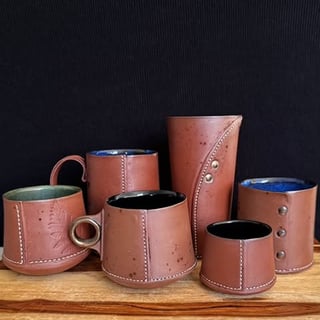
Speaker: I wrote this down. So I specialize in double -walled, reticulated or carved pottery that intersects function with aesthetically pleasing sculptural elements. That was a great one sentence. I love that. So tell me a story how you started making this double -walled pottery that you are making. So in 2015, I was renting studio space in a local pottery studio.
Speaker: in Rochester, New York. And I was getting, I had gone a few years without being on the wheel like a lot. And so I had dipped my toes back in and was like, okay, I remember all of this stuff from college days, right? And so I started looking up YouTube videos of more challenging
Speaker: techniques to try and this was again 2015 and Instagram hadn't like quite blown up. So I was looking up YouTube videos and let's see, I have his name written down. It's oh, here we go. Chin Lin. Yes. I know. I know who you're talking about. Yeah. Yeah. Yeah. Okay. I had to, I had to double check because anyway, so Shin Chin Lin, he does so many videos and I came across a double walled teapot.
Speaker: And he threw that in one go. So we're talking like he centered the clay and he threw it so he's got the inner chamber and the outer chamber all in one go. And I was transfixed and watched the video at least 17 times and then decided to go into the studio and give it a try.
Speaker: And my first piece is actually, it's within reaching distance. I could bring it up for the video. But that was my first piece and I was immediately hooked. I was just like, I think something about the negative space, it was so exciting to me. So that really started my trajectory for once I made that piece, then I applied for grad school and my entire grad school thesis was on making double -walled vessels as well. And it just kind of
Speaker: kept getting bigger and bigger and going in different directions. I love this. So it's funny you said that because I also watched him a lot when I was first learning how to get better at throwing a wheel. And it really helped a lot. Definitely, definitely like that. So you are inspired by challenging yourself. How does this impact the way you make your pottery?
Speaker: Yeah, I, I just, I, it's something about challenging. I don't know. Maybe it's because I'm a hardcore Aries. I don't know if you're an astrology nerd, but like, I think there's something about like, I'm going to do it. I'm going to be the best. I'm going to try and I'm going to keep doing this until
Speaker: I get it right. So if I see a new technique that looks challenging, I want to figure out how to do it. So I also like going to art festivals and seeing other potters who do things and just trying to guess how they did this technique. So I don't know. It's all part of the creative process for me. I'm really, really inspired by others and then like taking that inspiration and just applying it to my own style.
Speaker: Which I think is like, that's how we all should be as creators, I think. Definitely agree. Shaping Nation is so important to kind of model other parts. You can take inspiration from them. You can take things that you like and apply it to your own work. And that's how you're going to find your own unique style. I love that so much. So now earlier you did mention that you liked the negative spaces of
Speaker: I already don't want to say his name because I want to butch it. Sin Chin Lin. Yes. And so you're inspired by the negative spaces. Can you tell me more about the negative spaces?
Speaker: I'm not sure if this is gonna go into one of your other questions. So maybe I'll just, I'll go for it. So the negative spaces for me, if you think about it, like this is one of my pieces that I have up. I don't know if you'll do a screen grab, but I really, really like how it looks like a window, right? And so the more I've thought about how this vessel kind of like is a reflection of us, right? Like we decorate ourselves or we'll,
Speaker: you know, dress ourselves in ways that either allow people to get a better story of us.
Speaker: like the way we put our makeup on or the way we tattoo our skin or if we wear clothes that cover us or reveal ourselves. I really like this concept of having this outer vessel that has windows that's like revealing to the viewer so you can see more of the vessel inside. Does that make sense? Yes, I love that because I love that shaping nation
Speaker: Your pottery is a reflection of yourself. Whatever you're doing, it's a reflection of yourself. And it's so important to put your personality into that. And I love that you are doing that as well with your pottery. That is so amazing. Thanks. So can you explain to me the technique on how you create your double walled pottery?
Speaker: Yeah, so I started out with doing the style like Shin Chin Lin, and I don't think he was the very first person who started double walled pottery. Like I've traveled around Europe and I've actually seen double walled bathroom chambers that people would use to pee in, but they're double walled, like fantastic, that were made in like 1200.
Speaker: So he's certainly not the first person, but the style of making double -walled pottery where you are throwing it all in one go, I find that really limiting. So I've started, not started, but I've really just developed this own technique where I throw two separate vessels right like in succession. Actually, now I'm at the point where I'll throw in small batches. So maybe I'll decide, okay, I'm going to sit down today and make
Speaker: batch of four to nine mugs. So I'll sit down and I'll wedge out my clay and I'll weigh it all out and I'll throw all of the inner vessels first and I'm throwing them on bats. Then I let them sit out.
Speaker: And then I'll throw the outer vessels and the outer vessels usually require just a smidge more clay. So the inner vessels have less clay. The outer vessels have a little bit more. And while I'm throwing the outer vessels, you know, the inner vessels are.
Speaker: drawing and so then I will cut the inner vessels off the bat, trim all of those and then drop them into the outer vessel. I'm saying a lot of inner and outer and inner and outer and it's a little confusing. With this question I was like oh gosh I'm gonna lose the viewers because
Speaker: just like rolling through the process. But anyway, the inner vessels, I'll make it so that there's like a natural curve where it like flanges out. Does that make sense? So then when I set that inner vessel in, this is where it actually connects. And so this part here, the outer vessel, this is still on the back and I'll turn the wheel to connect it.
Speaker: So the process of throwing two separate vessels allows for me to really have more control on how much negative space is in between the two chambers. Does that make sense? Yes, I love that. So is the outside vessel smaller or taller than the inside vessel? The inside vessel is usually narrower and taller, and then the outer vessel is shorter and wider.
Speaker: that I love that so much because I always wanted to try doing double walled stuff but I can never figure it out when I was doing it and it always like frustrated me like this is not coming out how I wanted it
Speaker: That's a great explanation. Yeah, thanks. I don't think I really explained it that well. It's one of those things that you have to visualize it and see it. I'm like, Oh, these poor podcast listeners. But the other trick that I'll share as well is when I go to carve, after I've like, cut the the double walled piece off and I've trimmed the bottom and it and it's set up and kind of gotten to a leather hard stage and I'm ready to carve.
Speaker: I actually have to flip the vessel upside down and carve the entire piece upside down. Why is that? So the reason is once you start cutting into the outer vessel, you have to think
Speaker: that outer piece is going to dry faster, it's going to shrink faster, and it's going to get brittle. And so while you're trying to control the dampness and moisture consistency of the clay, you're also working with the weight of the inner vessel, working against with gravity. So if I have this upside down, then there's less weight that the piece is trying to hold up when it's structurally compromised.
Speaker: That is very, very, very interesting. So earlier you mentioned that you traveled around Europe and you saw like double walled stuff just around Europe. Can you tell me about your experience in Europe and how this kind of impacted your pottery?
Speaker: Well, my experience in Europe also impacted a lot of the imagery that I'll use for the carvings that I do. I spent a lot of time going into churches, spending time going and looking at just Gothic architecture.
Speaker: and being really impressed. The gothic architecture also boasts a lot of like negative space that I'm obviously drawn to. Stained glass windows, rose windows, the whole thing. The reason why I use a lot of gothic architectural elements in my designs is actually, so this is going to get a little political here, hope this doesn't like, but I've
Speaker: been really interested in how whenever you go into a huge cathedral or basilica in Europe, the first thing that happens is you walk in and you're overtaken by the huge arches and all of the architecture. And what happens is your eye gets drawn upward, right? And so I started researching a lot of like, why is that? And
Speaker: Back then, the architects would say, we're designing these churches to draw people's attention upward to the heavens, draw people's attention up to God. But something that I also started to think about is, well, if people's attention is focused upwards, then they're missing out on looking at one another in the eye. And they're missing that human connection.
Speaker: Right? So that's actually a big reason why I do a bit of appropriation. I'm appropriating typical Christian iconography almost as a sense. It's almost like I'm trying to do this as an act of defiance of like, let's be thinking about why are we drawing our attention at different things? And if we come back to how I see the body as a metaphor and I see
Speaker: these vessels as a metaphor for human connection. I'm trying to draw the connection back to thinking about our connections with one another.
Speaker: I love that. Shaping Nation, pottery is all about connection. Whoever's seeing your pottery, it's a connection. Your hands to clay, that's a connection. Pottery is all about connection. And I love the way that you just explained that. Thanks. So let's talk about discovering your voice. Can you tell me about the moment when you knew you were heading in the right direction with your pottery?
Speaker: Well, I've talked about how I really liked challenging myself. I really liked carving into work. And when I really started going in the direction of my vessels that have a sculpted feminine figure inside of it. So I have like this example here that I showed earlier. This one is like, it's a little hard to see because it's darker glaze
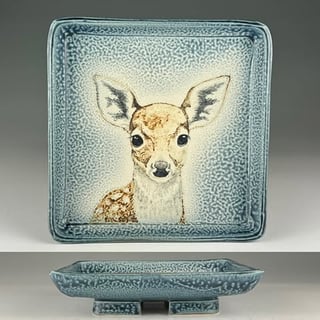
Speaker: I have a few pieces that are currently, well, I have one piece that's in a regional show right now. The vessels that I make with the feminine forms, there's so much that I'm trying to talk about with those pieces. And I feel like I've finally gotten to this sweet spot of like, yes, I make pieces that are functional, that people can have in their homes, but I'm also making pieces that are winding up in,
Speaker: museums and regional exhibitions. And so I'm really walking this line of being an artist and a potter and a business maker and an activist. And, you know, I'm walking this whole line and trying to balance. But as I talked about earlier, balance is hard. I feel like I'm running all over the place with this answer. But I feel like my voice is finally starting to get out there and people are starting to notice. Yeah.
Speaker: I love that. So earlier you mentioned that finding your voice was really big for your success. Can you tell me more about that? Yeah, I think the other thing that I want to encourage listeners to notice and look for is
Speaker: When you start leaning into your voice, what I've found at least is more doors will open for you, or at least for me. I've, I've started to notice that I have opportunities that keep opening.
Speaker: And at the same time, there are other opportunities that are like a very hard closed door where it's like the universe is saying, absolutely not. That is not the direction you should be going in. So there's something about leaning into my voice and it seems like the path is almost being guided for me. And I'm just kind of following along where I should go.
Speaker: I love that. Shaping Nation, when you're able to find your voice, the path opens up for you to have more opportunities and have more success with your pottery. I love that so much. So you contribute your growth as an artist to learning to embrace imperfections and leading with compassion. Can you tell me more about this? Yeah. The body as a metaphor began really taking shape when I was reflecting on just
Speaker: When I'm making these pieces that are so challenging, I am inviting so many opportunities for failure to occur, right?
Speaker: I mean, you already have from wedging or reclaiming your clay to the final glaze firing. There's so many opportunities for things to go wrong, right? But then when you add in structurally compromising your pieces and making it so that the exterior is so fragile and delicate, my pieces break often, like all the time.
Speaker: I have this one piece that I make that's really popular that I will make like four or five of them and only two will get through the firing.
Speaker: And so as I've been thinking about this process, it really makes me reflect on just what it's like to be a teacher and working with high school students. And they start out as ninth graders and try to get through high school. And so many things can happen in those four years, just like so many things can happen to your clay along the way. And then when I make that even broader and I go out of the school setting and I think about just human life, there's so many opportunities for
Speaker: mistakes to happen or things to go wrong or accidents or just being an idiot someday, right? And in embracing the imperfections in my clay and not going like, I can't keep this because it's not perfect, but instead going like, Oh, but look,
Speaker: this imperfect spot or this crack or this break actually tells a story. In spending time really thinking about those concepts, it's helped me be a better educator to my students and offer them more compassion when they're just being idiot kids.
Speaker: Like, I love them, but come on. But it also helps me be more compassionate to myself when I'm holding myself to ridiculously high standards. And it helps put things into perspective of, like, we are so, so, so imperfect. And we really deserve a lot of grace in just being humans on this messy planet right now.
Speaker: I love that shaping nation, invite imperfections into your life, into your pottery, because we're not perfect. And those imperfections are what's going to help you evolve your pottery even further. I love that so much. So what advice would you give to someone trying to discover their own unique voice with their pottery? I think try everything, first of all. But if you start to notice that you're leaning in a direction that excites and scares you a little,
Speaker: Go that way.
Speaker: I think we learn so much from being a little scared. I'll say to my students all the time, like if they're trying something new and they say, I'm nervous, they go, nerves are a really good sign. Actually, I said this to you before we started the podcast. I'm nervous and nerves are assigned to us that we care, that we give a shit, right? So lean into those nerves, lean into that like little bit of fear because that's probably your intuition telling you,
Speaker: This is a magical direction. Go. I definitely agree with that. I would experience that all the time when I would play sports, especially baseball. That's like the first game I would like other people would say they're nervous, but most time I would flip it around and say, I'm excited and flipping it around was like that was the best thing possibly I could do and maybe play better. I love that so much. That's great. So what is a pottery technique that every potter should learn if they are just starting out?
Speaker: Okay, so this one is not so much a technique, but really just a mindset. So the thing that's so frustrating to me when I teach teenagers and adults is they go into pottery with this mindset of like, I have got to be good the first go. I've got to get in here and I've got to touch this clay and it's got to be perfect the first start. And that is so unrealistic.
Speaker: That's why I love teaching little kids too because they still have that wonder and just the curiosity, right? But something happens along the way into adulthood where we just like get that whole perfectionism thing. So then I wrote some things down.
Speaker: So it feels like people go into it like they have to be the master and the clay is this subservient thing or subservient thing that like just molds to your hand, right? And that will for sure set anyone up for failure because we have to go into it. If you've never touched clay before, you have to go into it and understand that clay knows what it needs. It's our job to listen to the clay.
Speaker: Right? Like if it's like, if it's drying or cracking or breaking, then you either need to apply pressure and like secure that or add moisture. Or if the clay is too wet, when you're trying to carve it, you have to let it sit out a little bit and kind of like get to a leather hard stage. It's really important to
Speaker: get into a mindfulness practice with clay, at least for me, and learn to listen to it. And the clay will tell you if you're doing something wrong, or the clay will tell you if you're not centering it that day, it's telling you like, change your body position.
Speaker: whatever you're doing, it's not right. So stop doing the same thing and expecting a different result. You have to change what you're doing. So yeah, to answer your question, really humble yourself with clay and learn that if you treat clay like it is your teacher and you are the student, you can get to a symbiotic relationship with clay where it really works.
Speaker: And then also remember never to get cocky with clay because it will serve you such a huge slice of humble pie. It'll slap you right in the face. I love that so much. Shapingdation, listen to the clay and enjoy the journey of messing up. Improve something each time you're making because that's how you're going to get better. I love that so much. So as we're coming to a close here, what is one thing you want to hammer home with my audience today?
Speaker: I think the thing that people find so intoxicating about clay is that it gets you into this child -like headspace, like what I was just talking about. If you allow yourself to get there and it really feels like play, first of all, it's so good for your health.
Speaker: Right our cortisol levels drop we all of a sudden like feel like in this meditative flow state like I can't even tell you how I feel so guilty about going into pottery full -time because I'm like I Get to just play and make a living like this feels like illegal but I think
Speaker: Allowing yourself to get into a childlike place with clay is so important in the process. Definitely agree. Jordan, it was so great sharing with you today. Where can my arms go and learn more about you?
Speaker: I'm still getting on the TikTok thing, so I do have a TikTok platform, but my biggest platform is my Instagram. My handle is just Jordan Coons Ceramics. It's Coons with a C. If you also Google me, you can find my website. It's just JordanCoonsCeramics .com. And yeah, those are the best places to find me.
Speaker: We hope you enjoyed this episode of Shaping Your Pottery with Nick Torres. Do you have questions about pottery that you'd like Nick to answer? Send them to us on Instagram at Nick Torres underscore pottery. We'll see you next time.